Management Information Systems
Control in Systems
Feedback (Positive & Negative)
Input, Process and Output Control
Prepared By:
Mohammed Jasir PV
Asst. Professor
NBS, Koratty
Contact: 9605 69 32 66
Control in Systems
Feedback (Positive & Negative)
Input, Process and Output Control
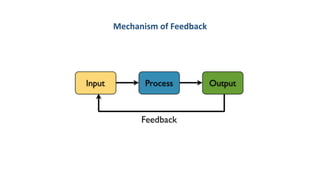
Feedback
• The mechanism of feedback has a very simple definition: "the return
to the input of a part of the output"
• It is data about the performance of a system
• The information measuring the goals and providing control to the
system
• It provides a perfect regulatory mechanism
Definition
• Feedback generally as "information about the gap between the
actual level and the reference level of a system parameter which
is used to alter the gap in some way",
Mechanism of Feedback
Types of feedback
• Positive feedback
• Negative feedback
Positive Feedback
• Positive feedback is defined as a positive loop gain around a feedback loop
• Positive feedback is in phase with the input, in the sense that it adds to
make the input larger
• Positive feedback tends to cause system instability
• Positive feedback is also known as regenerative feedback
• Negative feedback is also known as degenerative feedback
• Feedback that reduces the output of a system
• Negative feedback tends to make a system self-regulating
• It can produce stability and reduce the effect of fluctuations
Negative Feedback
Negative Feedback Control
Negative feedback control is system means keeping the
system operating within certain limit of performance
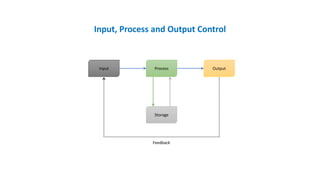
Input, Process and Output Control
Input Process Output
Storage
Feedback
Input
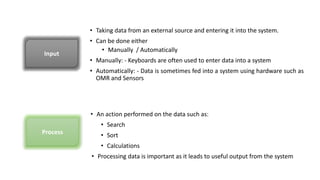
• Taking data from an external source and entering it into the system.
• Can be done either
• Manually / Automatically
• Manually: - Keyboards are often used to enter data into a system
• Automatically: - Data is sometimes fed into a system using hardware such as
OMR and Sensors
Process
• An action performed on the data such as:
• Search
• Sort
• Calculations
• Processing data is important as it leads to useful output from the system
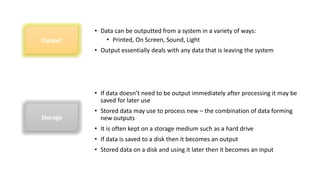
• Data can be outputted from a system in a variety of ways:
• Printed, On Screen, Sound, Light
• Output essentially deals with any data that is leaving the system
Output
• If data doesn’t need to be output immediately after processing it may be
saved for later use
• Stored data may use to process new – the combination of data forming
new outputs
• It is often kept on a storage medium such as a hard drive
• If data is saved to a disk then it becomes an output
• Stored data on a disk and using it later then it becomes an input
Storage
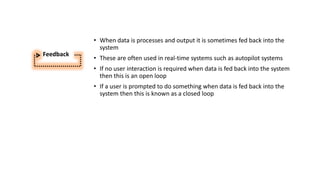
• When data is processes and output it is sometimes fed back into the
system
• These are often used in real-time systems such as autopilot systems
• If no user interaction is required when data is fed back into the system
then this is an open loop
• If a user is prompted to do something when data is fed back into the
system then this is known as a closed loop
Feedback
THANK YOU

Control in Systems - Feedback and Input, Process & Output Control

  • 1.
    Management Information Systems Controlin Systems Feedback (Positive & Negative) Input, Process and Output Control Prepared By: Mohammed Jasir PV Asst. Professor NBS, Koratty Contact: 9605 69 32 66
  • 2.
    Control in Systems Feedback(Positive & Negative) Input, Process and Output Control
  • 3.
    Feedback • The mechanismof feedback has a very simple definition: "the return to the input of a part of the output" • It is data about the performance of a system • The information measuring the goals and providing control to the system • It provides a perfect regulatory mechanism
  • 4.
    Definition • Feedback generallyas "information about the gap between the actual level and the reference level of a system parameter which is used to alter the gap in some way",
  • 5.
  • 6.
    Types of feedback •Positive feedback • Negative feedback
  • 7.
    Positive Feedback • Positivefeedback is defined as a positive loop gain around a feedback loop • Positive feedback is in phase with the input, in the sense that it adds to make the input larger • Positive feedback tends to cause system instability • Positive feedback is also known as regenerative feedback
  • 8.
    • Negative feedbackis also known as degenerative feedback • Feedback that reduces the output of a system • Negative feedback tends to make a system self-regulating • It can produce stability and reduce the effect of fluctuations Negative Feedback
  • 9.
    Negative Feedback Control Negativefeedback control is system means keeping the system operating within certain limit of performance
  • 10.
    Input, Process andOutput Control
  • 11.
    Input, Process andOutput Control Input Process Output Storage Feedback
  • 12.
    Input • Taking datafrom an external source and entering it into the system. • Can be done either • Manually / Automatically • Manually: - Keyboards are often used to enter data into a system • Automatically: - Data is sometimes fed into a system using hardware such as OMR and Sensors Process • An action performed on the data such as: • Search • Sort • Calculations • Processing data is important as it leads to useful output from the system
  • 13.
    • Data canbe outputted from a system in a variety of ways: • Printed, On Screen, Sound, Light • Output essentially deals with any data that is leaving the system Output • If data doesn’t need to be output immediately after processing it may be saved for later use • Stored data may use to process new – the combination of data forming new outputs • It is often kept on a storage medium such as a hard drive • If data is saved to a disk then it becomes an output • Stored data on a disk and using it later then it becomes an input Storage
  • 14.
    • When datais processes and output it is sometimes fed back into the system • These are often used in real-time systems such as autopilot systems • If no user interaction is required when data is fed back into the system then this is an open loop • If a user is prompted to do something when data is fed back into the system then this is known as a closed loop Feedback
  • 15.