Introduction to Binocular
Vision and Ocular Motility
Mohammad Arman Bin Aziz
B. Optom
ICO, CU
April 01, 2014
Vision
• Anatomic, physiologic, biophysical, & biochemical
arrangements & mechanisms within the retina give rise to
excitations that ultimately result in vision.
• Eye is a biological camera
•We see from the brain ,not from the retina.
Types of Vision
1. Monocular
Single eye vision
1. Biocular
no co-ordination between two eyes
1. Binocular
Co-ordinated vision from two eyes
Pre-requisites for BSV
•Separate fields of vision must overlap in all
directions of gazes.
•Separate fields of fixation must overlap with
coordinated movements of the two eyes.
•Neural transmission from the two eyes must reach
the same area of the brain.
•Perceptual co-ordination must take place.
Theories of binocular single vision
• Alternation theory of binocular vision.
• Projection theory of binocular vision.
• Theory of isomorphism.
• Correspondence and Disparity.
• Neurophysiologic Theory of Binocular Vision and Stereopsis.
Alternation theory of Binocular Vision
• Alternation of preference between two eyes
• A function of visual cortex
• One retinal image always suppressed
• Also known as suppression theory of BSV
• Claims that there is no sensory fusion
• Brain always selects one out of the two retinal images and
one is always suppressed
• This selection alternates between the two retinal images
• Stereopsis?
• This theory argues that stereopsis is retained by extracting
disparity from the remembered image of the suppressed eye
and the visible image of the non-suppressed eye.
Projection theory of binocular vision.
• largely abandoned theory
• According to this theory, visual stimuli are
exteriorized/projected along the lines of direction.
• If a person fixates binocularly, a ‘‘bicentric’’ projection is
supposed to occur that places the impression of each eye at
the point of intersection of the lines of projection.
Theory of isomorphism
• Developed by Linksz
• a theory of binocular vision based on a rigid retinocortical
relationship.
• Images from corresponding retinal points are fused
together in the line called line of Gennari or Gennari’s
stripe
• Gennari’s stripe is considered to be anatomical
counterpart of the horopter plane in objective space and
of the nuclear plane in subjective space.
• Objects nearer to or farther from the fixation point
stimulate disparate retinal elements.
• The resultant excitations converge in front of or behind
Gennari’s stripe in strict conformity with the distribution of
objects in space.
• In this way the sensation of stereopsis is created.
• The point-to-point relationship between retina and cortex
and strict conformity or isomorphism between the
distribution of objects in space and cortical events form the
basis of spatial orientation.
Correspondence and Disparity
• Based upon the concepts of corresponding retinal
points/elements/areas and retinal disparity
• Stimulation of corresponding retinal elements required for
sensory fusion and BSV
• Retinal disparity required simultaneously for stereopsis
• Also explains retinal rivalry and diplopia
Neurophysiologic Theory of Binocular Vision and
Stereopsis
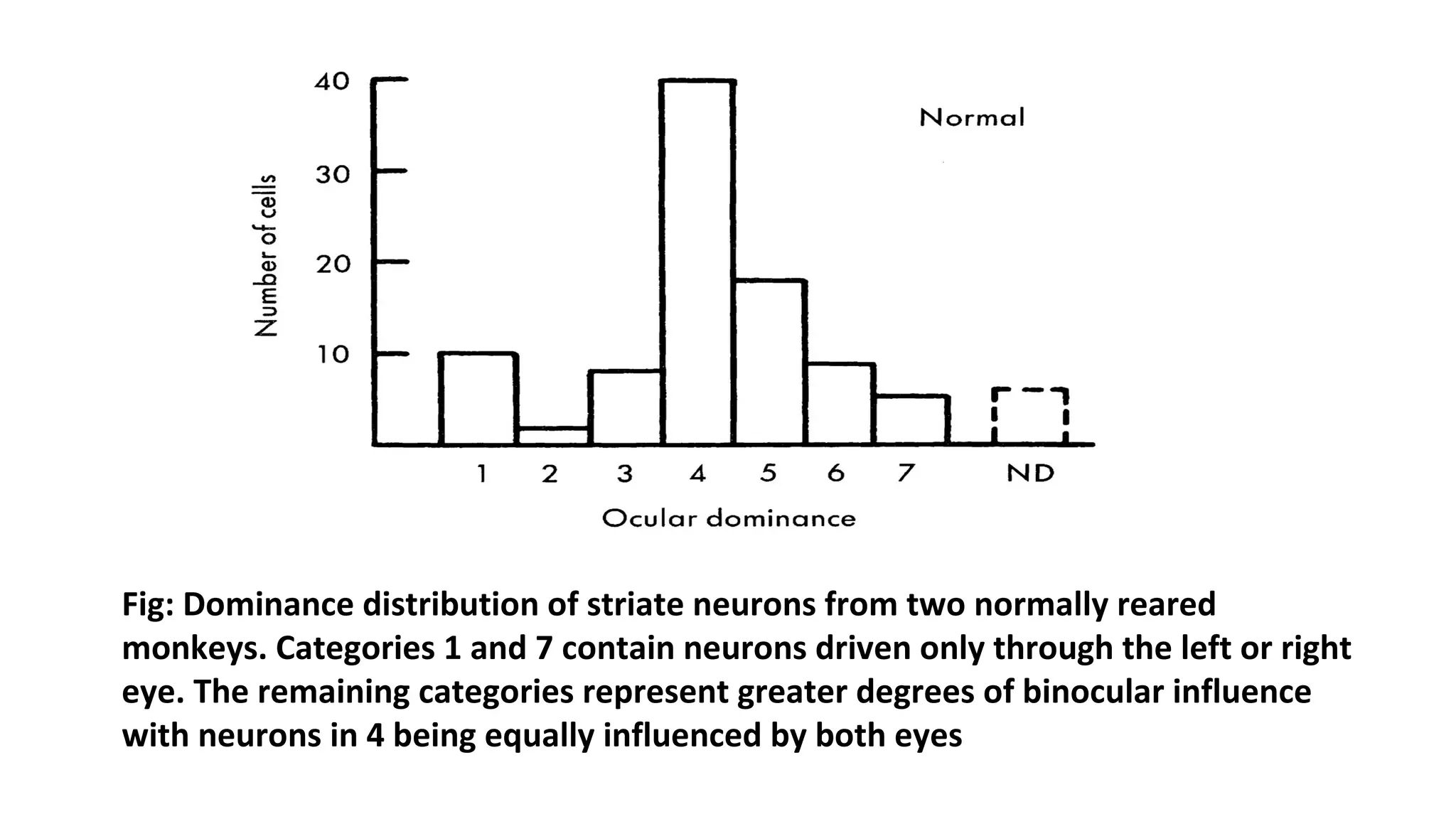
• Microelectrode studies of single-cell responses in the striate cortex of
the cat have shown that roughly 80% of the neurons could be driven
from either eye.
• However, only 25% of these binocularly driven cells are stimulated
equally well from each eye; the remaining 75% represent graded
degrees of influence from the right or left eye.
• Ten percent of the cells are driven exclusively from the right or left eye.
• Cells that can be driven by stimulation of either eye have receptive
fields of nearly equal size and in approximately corresponding positions
in the visual field.
• Stimulation of the binocular neurons give rise to binocular single vision.
Fig: Dominance distribution of striate neurons from two normally reared
monkeys. Categories 1 and 7 contain neurons driven only through the left or right
eye. The remaining categories represent greater degrees of binocular influence
with neurons in 4 being equally influenced by both eyes
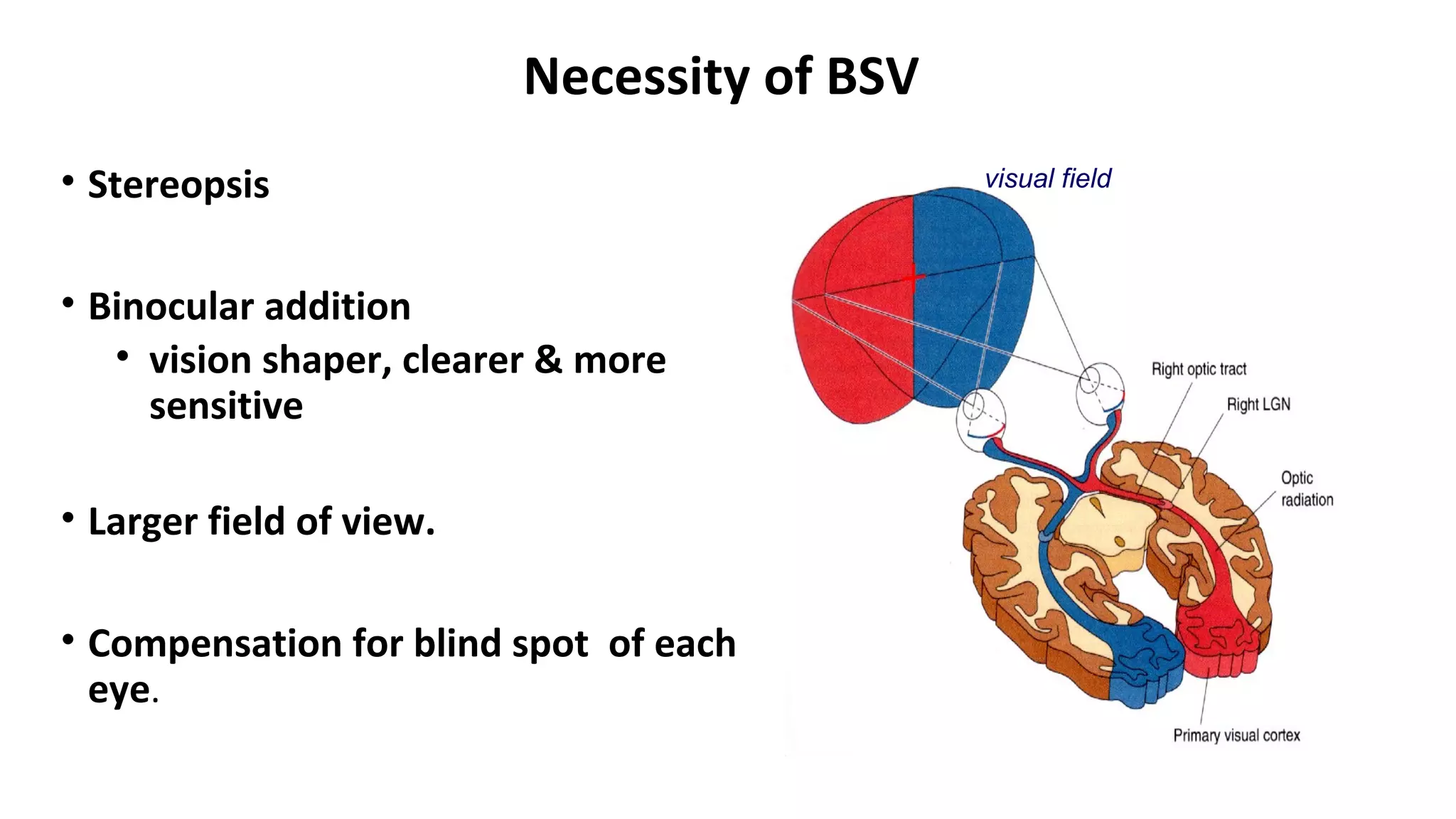
Necessity of BSV
• Stereopsis
• Binocular addition
• vision shaper, clearer & more
sensitive
• Larger field of view.
• Compensation for blind spot of each
eye.
visual field
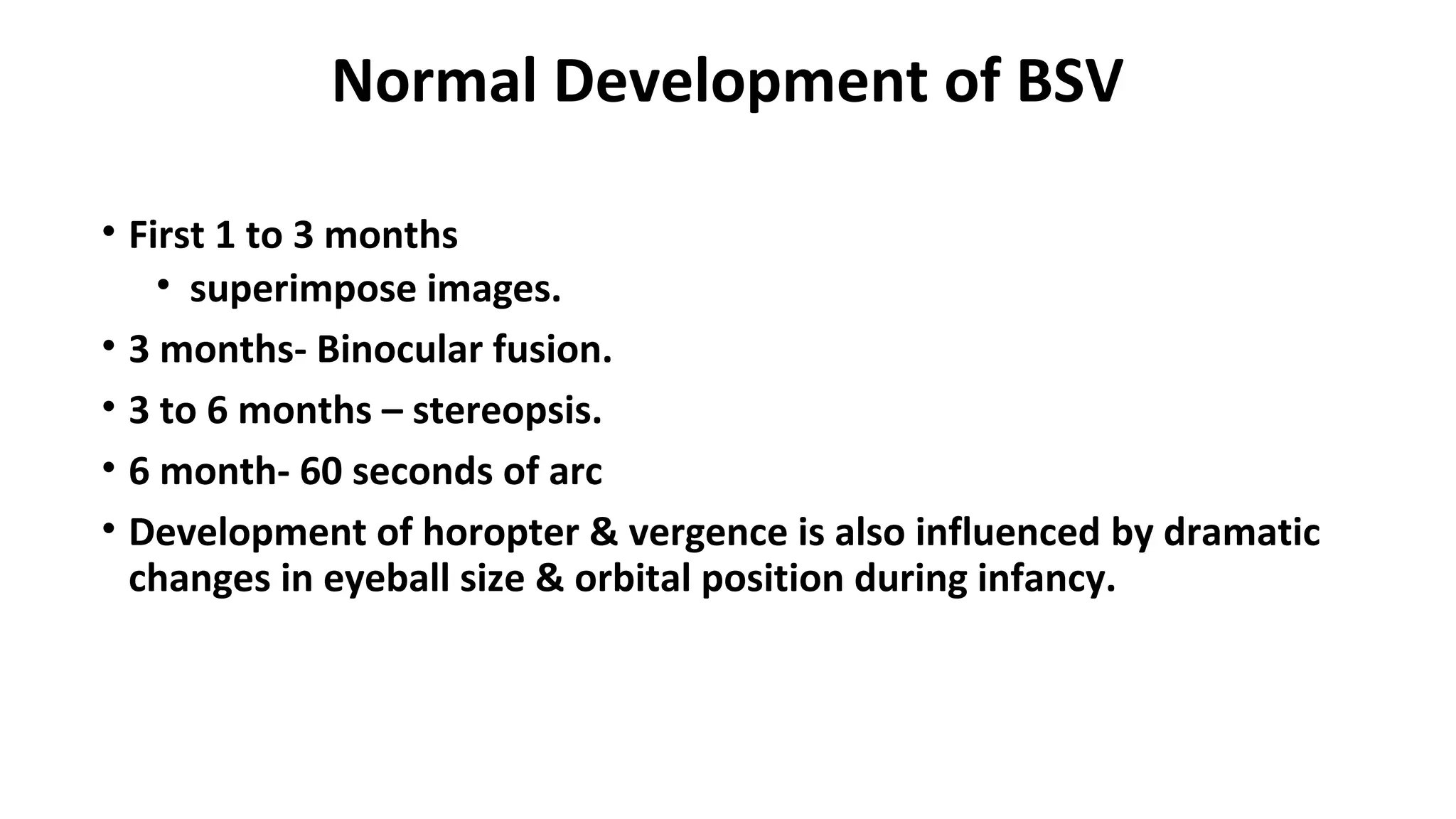
Normal Development of BSV
• First 1 to 3 months
• superimpose images.
• 3 months- Binocular fusion.
• 3 to 6 months – stereopsis.
• 6 month- 60 seconds of arc
• Development of horopter & vergence is also influenced by dramatic
changes in eyeball size & orbital position during infancy.
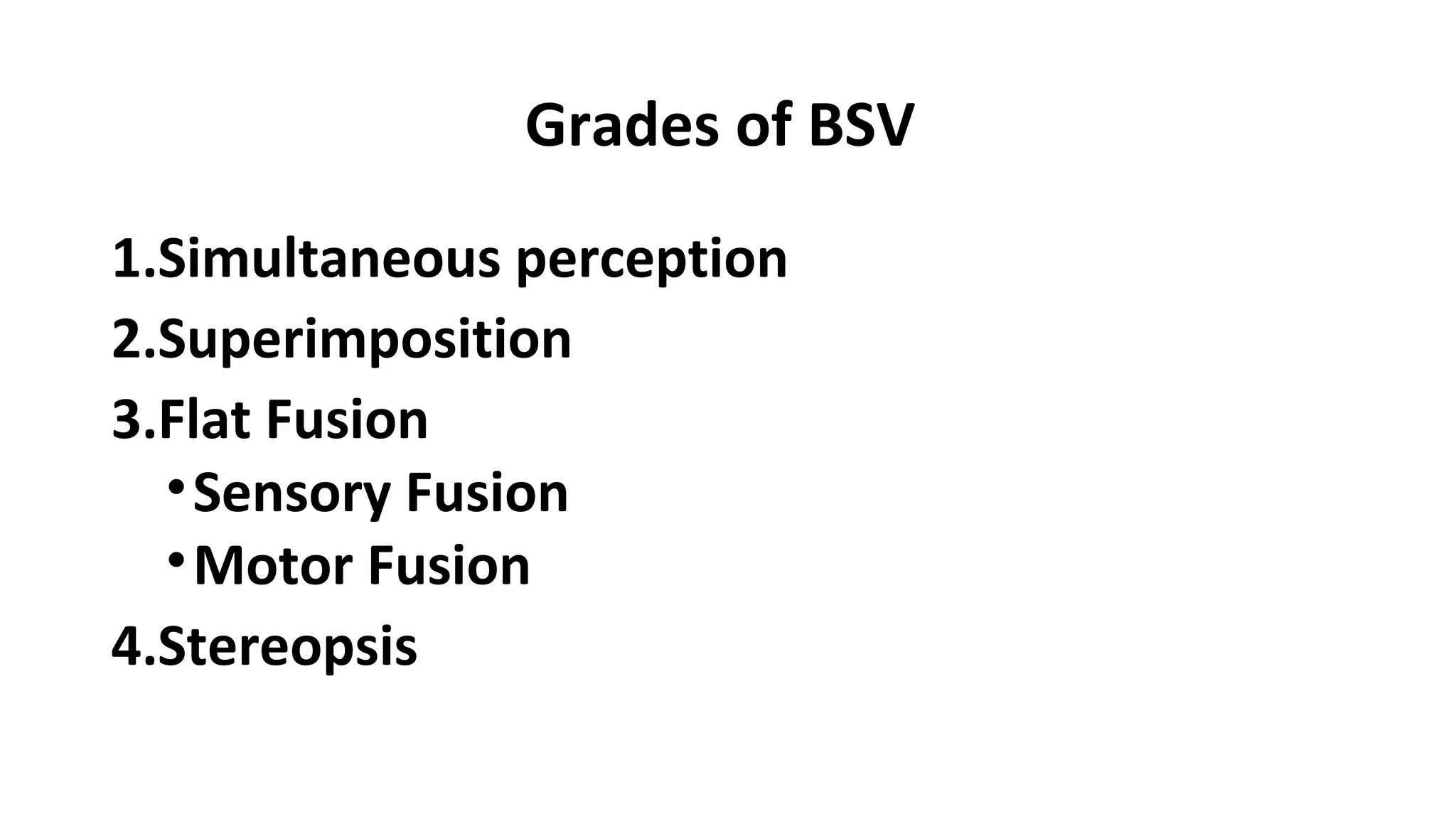
Grades of BSV
1.Simultaneous perception
2.Superimposition
3.Flat Fusion
•Sensory Fusion
•Motor Fusion
4.Stereopsis
Abnormal Binocular Vision
• Sensory adaptation
• Confusion
• Diplopia
• Suppression
• eccentric fixation
• anomalous retinal correspondence (ARC)
• Amblyopia
• Motor adaptation
• Head tilt
• Chin up
• Face turn
Terminology of Ocular Motility
• Agonist
• Any particular EOM producing a specific ocular movement
• Synergist
• Two muscles moving an eye in the same direction
• Example – SR / IO - Synergist for elevation movement
• Antagonist
• The muscles having opposite action in the same eye
• Example – medial and lateral rectus
•Yoke muscle (Contralateral synergists)
a pair of muscle one in each eye which contract simultaneously
during version movement
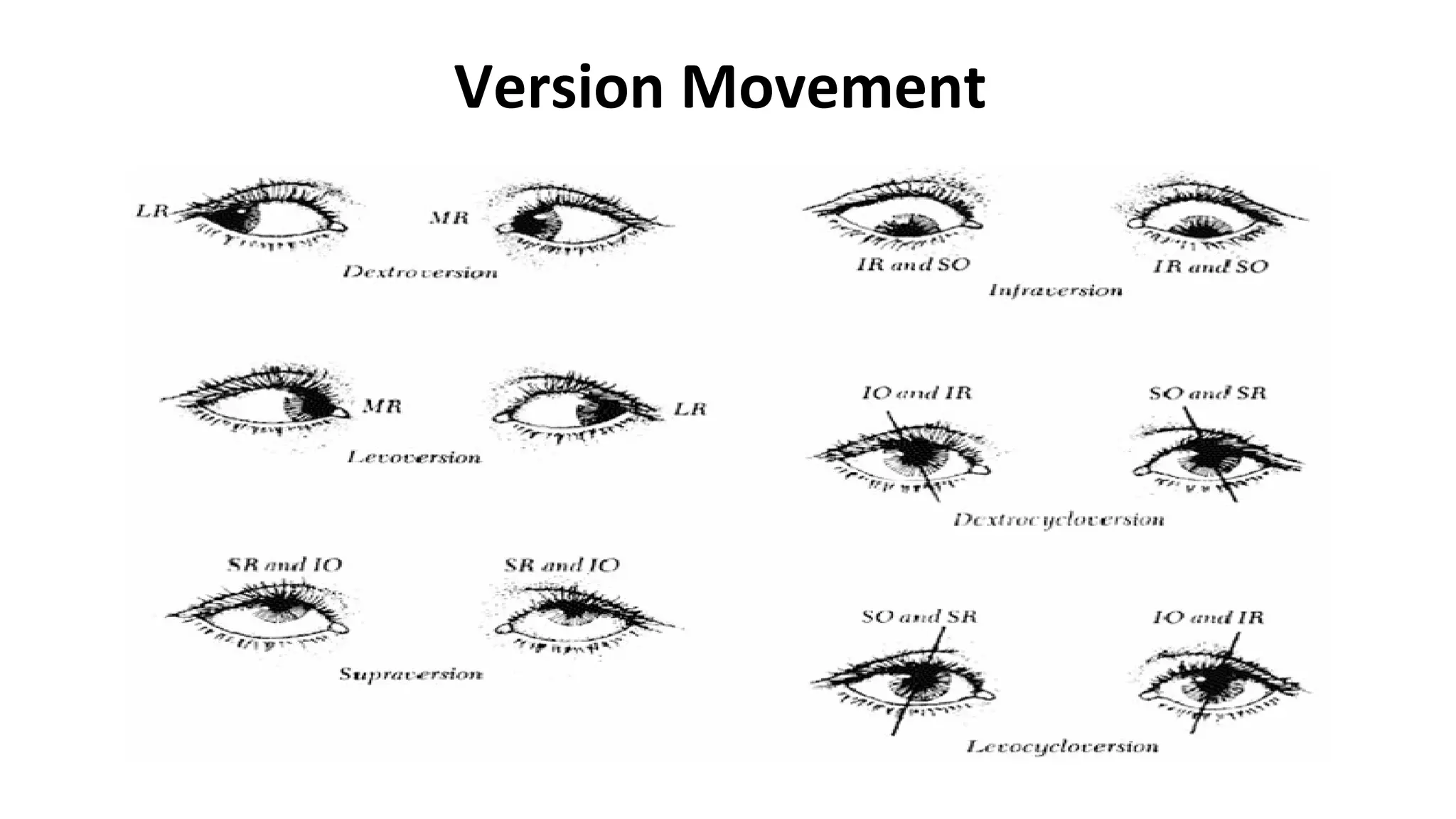
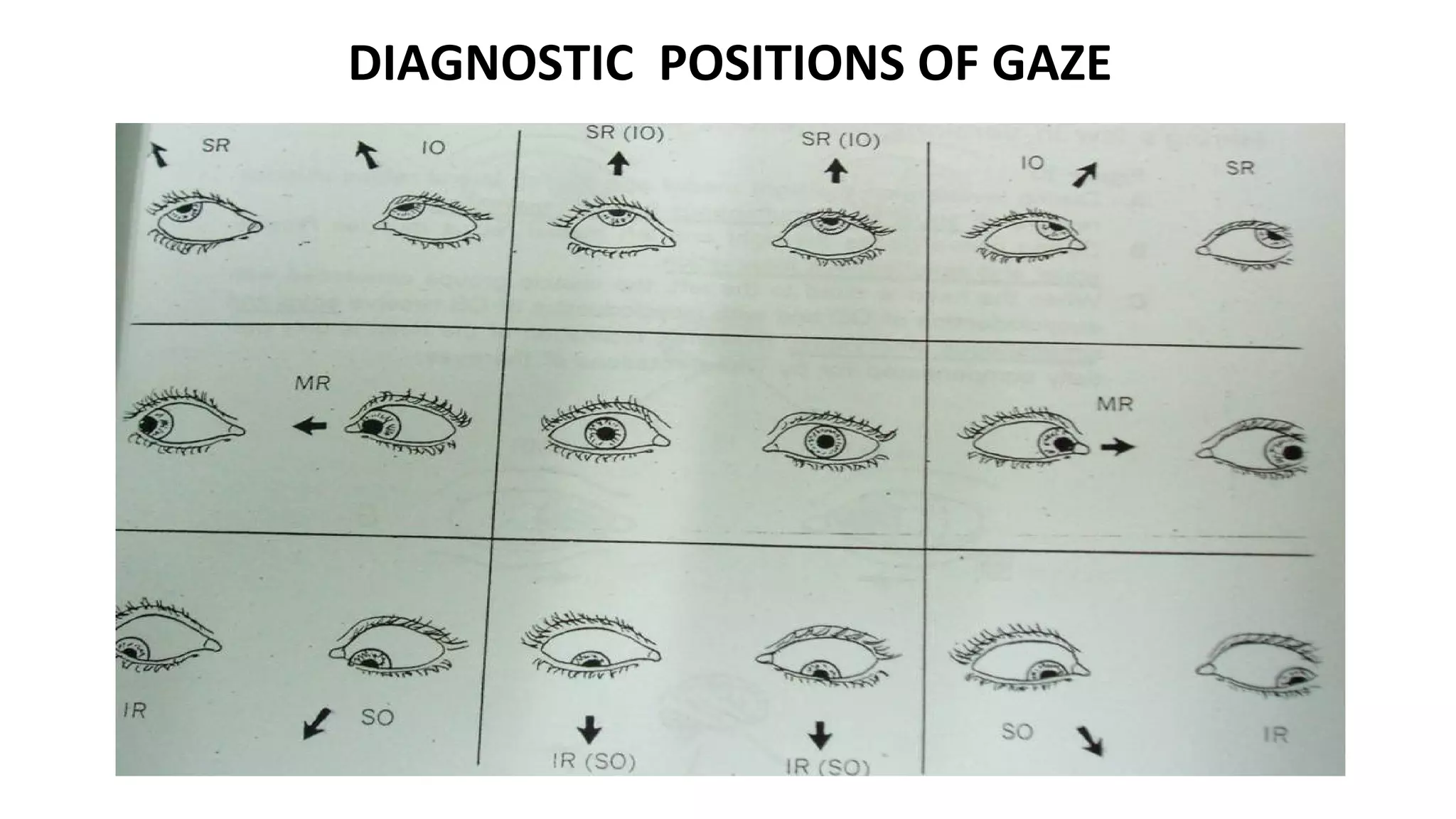
• Pairs for six cardinal positions of gaze
• Dextroversion – RLR- LMR
• Levoversion – LLR- RMR
• Dextroelevation – RSR-LIO
• Levoelevation – LSR- RIO
• Dextrodepression – RIR-LSO
• Levodepression –LIR-RSO
• Contralateral Antagonist
a pair of muscles, one in each eye having opposite action
eg. RLR & LLR.
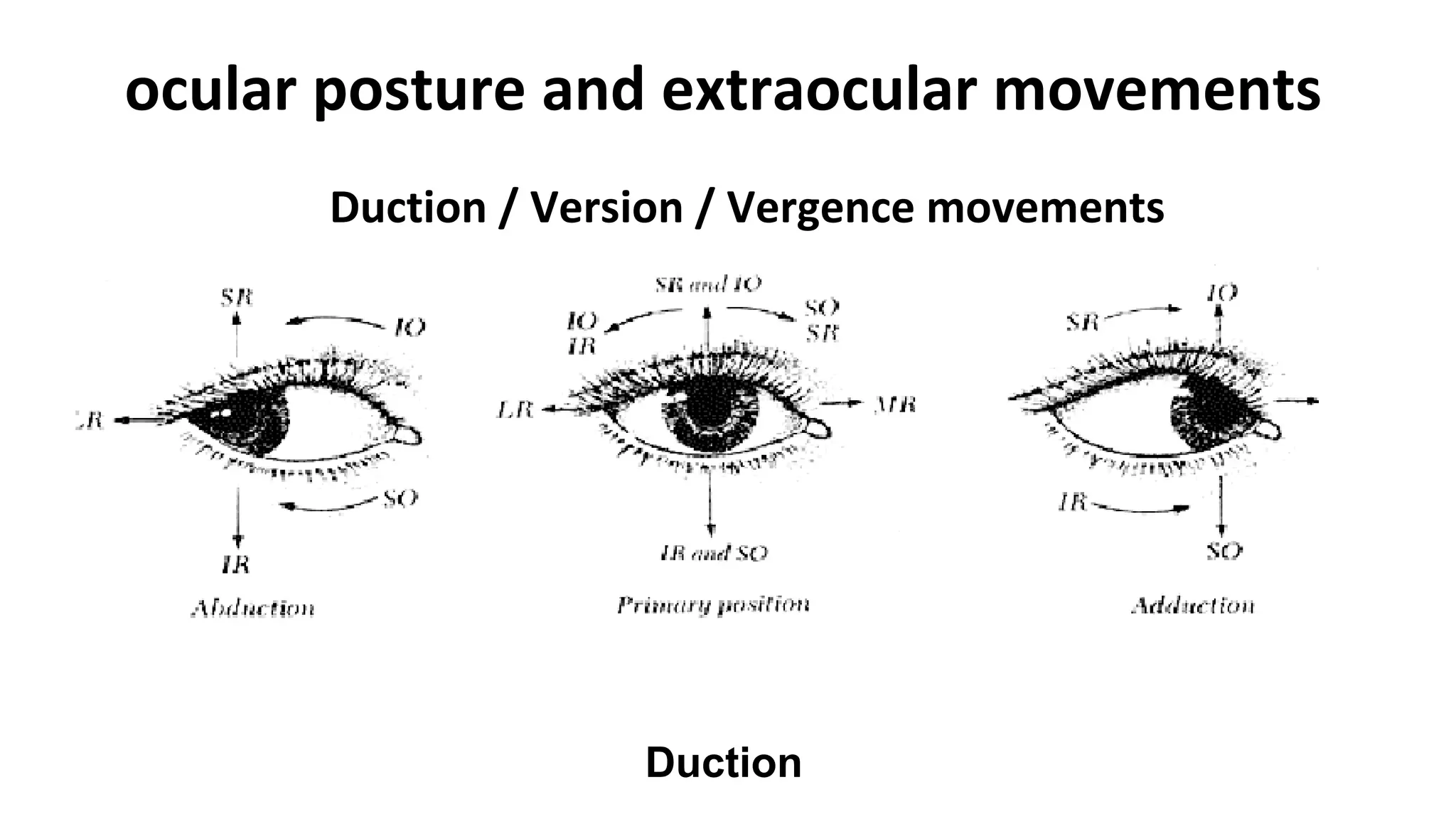
ocular posture and extraocular movements
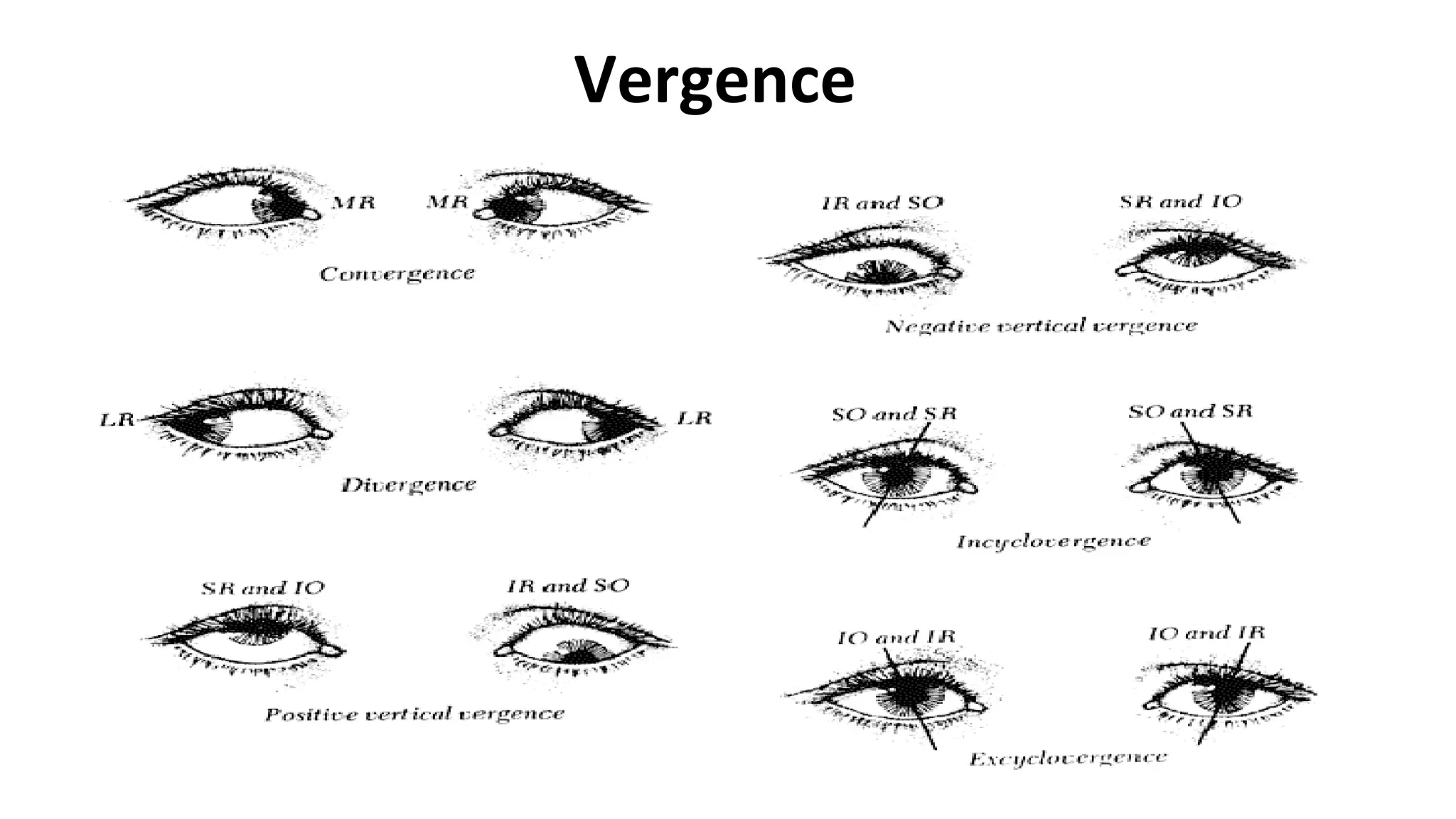
Duction / Version / Vergence movements
Duction
Version Movement
DIAGNOSTIC POSITIONS OF GAZE
Vergence
References
• Lecture notes on Mr. Ashutosh Jnawali, Former Optometry Faculty,
ICO, CU
• Pickwell’s Binocular vision
• Binocular vision by Gunter K Von Noordon

Introduction to binocular vision and ocular motility

  • 1.
    Introduction to Binocular Visionand Ocular Motility Mohammad Arman Bin Aziz B. Optom ICO, CU April 01, 2014
  • 2.
    Vision • Anatomic, physiologic,biophysical, & biochemical arrangements & mechanisms within the retina give rise to excitations that ultimately result in vision. • Eye is a biological camera •We see from the brain ,not from the retina.
  • 3.
    Types of Vision 1.Monocular Single eye vision 1. Biocular no co-ordination between two eyes 1. Binocular Co-ordinated vision from two eyes
  • 4.
    Pre-requisites for BSV •Separatefields of vision must overlap in all directions of gazes. •Separate fields of fixation must overlap with coordinated movements of the two eyes. •Neural transmission from the two eyes must reach the same area of the brain. •Perceptual co-ordination must take place.
  • 5.
    Theories of binocularsingle vision • Alternation theory of binocular vision. • Projection theory of binocular vision. • Theory of isomorphism. • Correspondence and Disparity. • Neurophysiologic Theory of Binocular Vision and Stereopsis.
  • 6.
    Alternation theory ofBinocular Vision • Alternation of preference between two eyes • A function of visual cortex • One retinal image always suppressed • Also known as suppression theory of BSV • Claims that there is no sensory fusion • Brain always selects one out of the two retinal images and one is always suppressed • This selection alternates between the two retinal images • Stereopsis?
  • 7.
    • This theoryargues that stereopsis is retained by extracting disparity from the remembered image of the suppressed eye and the visible image of the non-suppressed eye.
  • 8.
    Projection theory ofbinocular vision. • largely abandoned theory • According to this theory, visual stimuli are exteriorized/projected along the lines of direction. • If a person fixates binocularly, a ‘‘bicentric’’ projection is supposed to occur that places the impression of each eye at the point of intersection of the lines of projection.
  • 9.
    Theory of isomorphism •Developed by Linksz • a theory of binocular vision based on a rigid retinocortical relationship. • Images from corresponding retinal points are fused together in the line called line of Gennari or Gennari’s stripe • Gennari’s stripe is considered to be anatomical counterpart of the horopter plane in objective space and of the nuclear plane in subjective space.
  • 10.
    • Objects nearerto or farther from the fixation point stimulate disparate retinal elements. • The resultant excitations converge in front of or behind Gennari’s stripe in strict conformity with the distribution of objects in space. • In this way the sensation of stereopsis is created. • The point-to-point relationship between retina and cortex and strict conformity or isomorphism between the distribution of objects in space and cortical events form the basis of spatial orientation.
  • 11.
    Correspondence and Disparity •Based upon the concepts of corresponding retinal points/elements/areas and retinal disparity • Stimulation of corresponding retinal elements required for sensory fusion and BSV • Retinal disparity required simultaneously for stereopsis • Also explains retinal rivalry and diplopia
  • 12.
    Neurophysiologic Theory ofBinocular Vision and Stereopsis • Microelectrode studies of single-cell responses in the striate cortex of the cat have shown that roughly 80% of the neurons could be driven from either eye. • However, only 25% of these binocularly driven cells are stimulated equally well from each eye; the remaining 75% represent graded degrees of influence from the right or left eye. • Ten percent of the cells are driven exclusively from the right or left eye. • Cells that can be driven by stimulation of either eye have receptive fields of nearly equal size and in approximately corresponding positions in the visual field. • Stimulation of the binocular neurons give rise to binocular single vision.
  • 13.
    Fig: Dominance distributionof striate neurons from two normally reared monkeys. Categories 1 and 7 contain neurons driven only through the left or right eye. The remaining categories represent greater degrees of binocular influence with neurons in 4 being equally influenced by both eyes
  • 14.
    Necessity of BSV •Stereopsis • Binocular addition • vision shaper, clearer & more sensitive • Larger field of view. • Compensation for blind spot of each eye. visual field
  • 15.
    Normal Development ofBSV • First 1 to 3 months • superimpose images. • 3 months- Binocular fusion. • 3 to 6 months – stereopsis. • 6 month- 60 seconds of arc • Development of horopter & vergence is also influenced by dramatic changes in eyeball size & orbital position during infancy.
  • 16.
    Grades of BSV 1.Simultaneousperception 2.Superimposition 3.Flat Fusion •Sensory Fusion •Motor Fusion 4.Stereopsis
  • 17.
    Abnormal Binocular Vision •Sensory adaptation • Confusion • Diplopia • Suppression • eccentric fixation • anomalous retinal correspondence (ARC) • Amblyopia • Motor adaptation • Head tilt • Chin up • Face turn
  • 18.
    Terminology of OcularMotility • Agonist • Any particular EOM producing a specific ocular movement • Synergist • Two muscles moving an eye in the same direction • Example – SR / IO - Synergist for elevation movement • Antagonist • The muscles having opposite action in the same eye • Example – medial and lateral rectus
  • 19.
    •Yoke muscle (Contralateralsynergists) a pair of muscle one in each eye which contract simultaneously during version movement • Pairs for six cardinal positions of gaze • Dextroversion – RLR- LMR • Levoversion – LLR- RMR • Dextroelevation – RSR-LIO • Levoelevation – LSR- RIO • Dextrodepression – RIR-LSO • Levodepression –LIR-RSO • Contralateral Antagonist a pair of muscles, one in each eye having opposite action eg. RLR & LLR.
  • 20.
    ocular posture andextraocular movements Duction / Version / Vergence movements Duction
  • 21.
  • 22.
  • 23.
  • 24.
    References • Lecture noteson Mr. Ashutosh Jnawali, Former Optometry Faculty, ICO, CU • Pickwell’s Binocular vision • Binocular vision by Gunter K Von Noordon