BY:
NOORMUNIRAHBINTI AWANG ABU BAKAR
OPTOMETRIST
MOC: O-0869
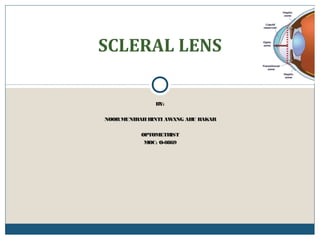
SCLERAL LENS
OUTLINES
Scleral Lens
Terminology
Anatomy
History
Indications
Design
Lens fitting
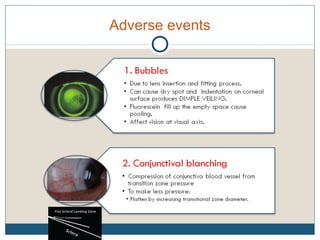
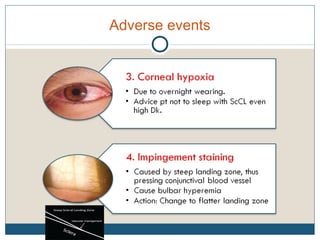
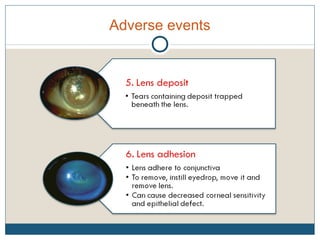
Adverse events
Patient compliance
Future hope
Scleral Lens
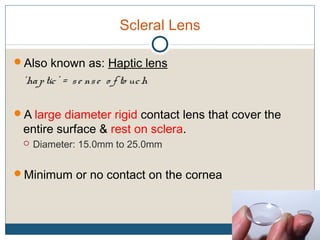
Also known as: Haptic lens
‘haptic’ = se nse o f to uch
A large diameter rigid contact lens that cover the
entire surface & rest on sclera.
 Diameter: 15.0mm to 25.0mm
Minimum or no contact on the cornea
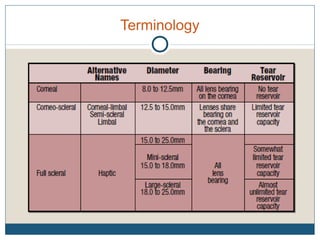
Terminology
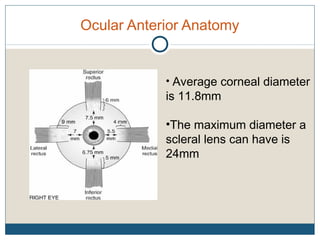
Ocular Anterior Anatomy
• Average corneal diameter
is 11.8mm
•The maximum diameter a
scleral lens can have is
24mm
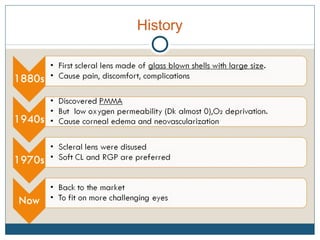
History
When it starts?
Scleral lens is used to fit on corneal diseases
(irregular corneas)
Two forms of manufacturing lens
(a) Spin cast - mold
(b) Lathe cut – custom made
Scleral lenses are lathe cut
 High cost making it unpopular
Why is Scleral Lens not popular?
 Expensive
 Large lens diameter
 Difficult to fit
 Fragile
 Lack of expertise to fit
 Complications when patient wear it overnight
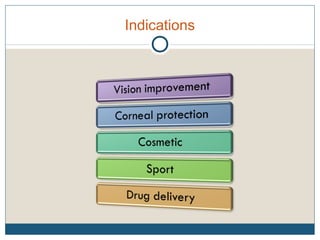
Indications
Indications
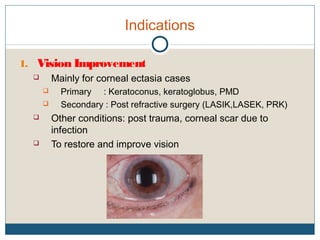
1. Vision Improvement
 Mainly for corneal ectasia cases
 Primary : Keratoconus, keratoglobus, PMD
 Secondary : Post refractive surgery (LASIK,LASEK, PRK)
 Other conditions: post trauma, corneal scar due to
infection
 To restore and improve vision
Indications
2. Corneal protection
 In 2 conditions:
 Severe ocular disease (Sjogren, Steven Johnson, Graft versus
host dx)
 Incomplete lid closure (eyelid coloboma, ectropion,
exophthalmos, nerve palsies)
 Help by reducing corneal exposure to air (not to close the
eye)
 Benefits:
 To relieve symptoms of pain & discomfort
 Keep ocular surface moist in severe dry eyes by fluid reservoir
retention
 Slow the progression of corneal disease and delay the need for
surgery
 Decrease risk of scarring
Indications
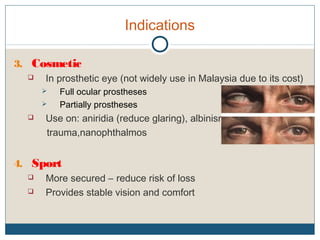
3. Cosmetic
 In prosthetic eye (not widely use in Malaysia due to its cost)
 Full ocular prostheses
 Partially prostheses
 Use on: aniridia (reduce glaring), albinism,
trauma,nanophthalmos
4. Sport
 More secured – reduce risk of loss
 Provides stable vision and comfort
Indications
5. Drug delivery
 Scleral lens has tear reservoir
 Instill drug onto bowl of scleral lens
 RGP is not suitable for drug delivery, due to lens movement
5. Normal eyes
 Very common in other country
 Corneal lens cannot fit well
 It gives less complication
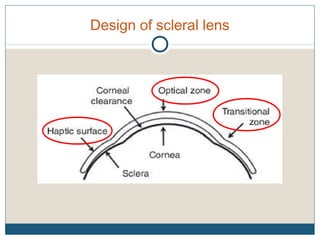
Design of scleral lens
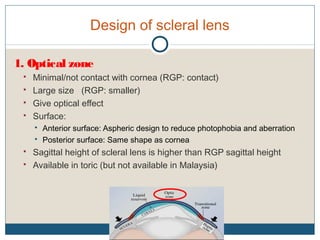
1. Optical zone
 Minimal/not contact with cornea (RGP: contact)
 Large size (RGP: smaller)
 Give optical effect
 Surface:
 Anterior surface: Aspheric design to reduce photophobia and aberration
 Posterior surface: Same shape as cornea
 Sagittal height of scleral lens is higher than RGP sagittal height
 Available in toric (but not available in Malaysia)
Design of scleral lens
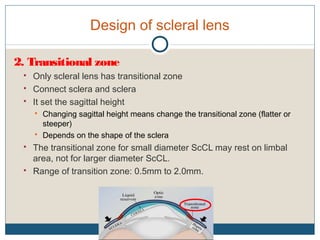
2. Transitional zone
 Only scleral lens has transitional zone
 Connect sclera and sclera
 It set the sagittal height
 Changing sagittal height means change the transitional zone (flatter or
steeper)
 Depends on the shape of the sclera
 The transitional zone for small diameter ScCL may rest on limbal
area, not for larger diameter ScCL.
 Range of transition zone: 0.5mm to 2.0mm.
Design of scleral lens
2. Transitional zone
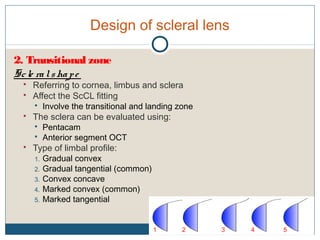
Scle ralshape
 Referring to cornea, limbus and sclera
 Affect the ScCL fitting
 Involve the transitional and landing zone
 The sclera can be evaluated using:
 Pentacam
 Anterior segment OCT
 Type of limbal profile:
1. Gradual convex
2. Gradual tangential (common)
3. Convex concave
4. Marked convex (common)
5. Marked tangential
1 2 3 4 5
Design of scleral lens
2. Transitional zone
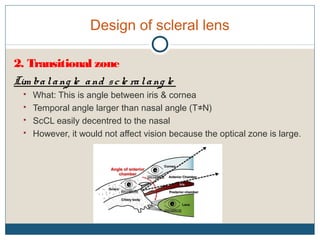
Lim balang le and scle ralang le
 What: This is angle between iris & cornea
 Temporal angle larger than nasal angle (T≠N)
 ScCL easily decentred to the nasal
 However, it would not affect vision because the optical zone is large.
Design of scleral lens
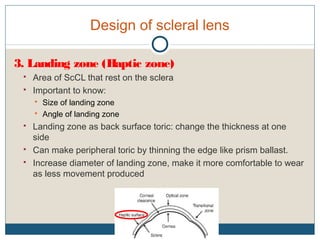
3. Landing zone (Haptic zone)
 Area of ScCL that rest on the sclera
 Important to know:
 Size of landing zone
 Angle of landing zone
 Landing zone as back surface toric: change the thickness at one
side
 Can make peripheral toric by thinning the edge like prism ballast.
 Increase diameter of landing zone, make it more comfortable to wear
as less movement produced
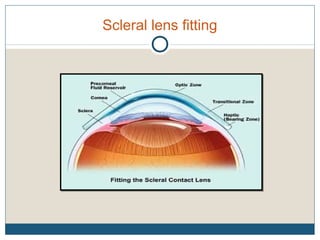
Scleral lens fitting
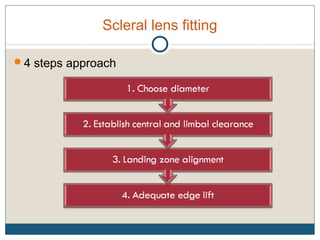
4 steps approach
Scleral lens fitting
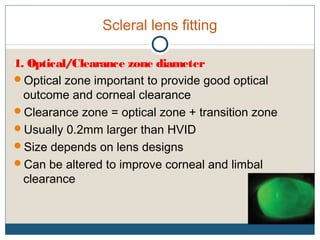
1. Optical/Clearance zone diameter
Optical zone important to provide good optical
outcome and corneal clearance
Clearance zone = optical zone + transition zone
Usually 0.2mm larger than HVID
Size depends on lens designs
Can be altered to improve corneal and limbal
clearance
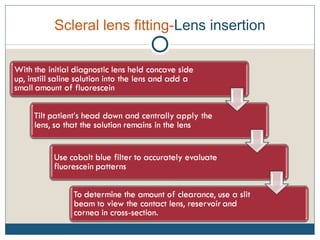
Scleral lens fitting-Lens insertion
Scleral lens fitting
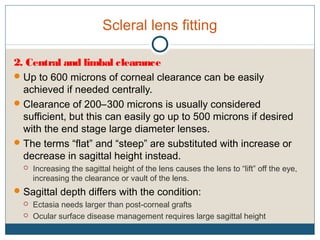
2. Central and limbal clearance
Up to 600 microns of corneal clearance can be easily
achieved if needed centrally.
Clearance of 200–300 microns is usually considered
sufficient, but this can easily go up to 500 microns if desired
with the end stage large diameter lenses.
The terms “flat” and “steep” are substituted with increase or
decrease in sagittal height instead.
 Increasing the sagittal height of the lens causes the lens to “lift” off the eye,
increasing the clearance or vault of the lens.
Sagittal depth differs with the condition:
 Ectasia needs larger than post-corneal grafts
 Ocular surface disease management requires large sagittal height
Scleral lens fitting
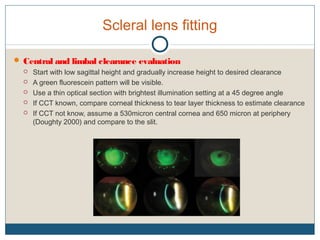
 Central and limbal clearance evaluation
 Start with low sagittal height and gradually increase height to desired clearance
 A green fluorescein pattern will be visible.
 Use a thin optical section with brightest illumination setting at a 45 degree angle
 If CCT known, compare corneal thickness to tear layer thickness to estimate clearance
 If CCT not know, assume a 530micron central cornea and 650 micron at periphery
(Doughty 2000) and compare to the slit.
Scleral lens fitting
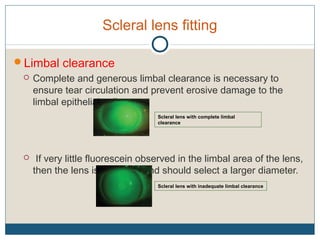
Limbal clearance
 Complete and generous limbal clearance is necessary to
ensure tear circulation and prevent erosive damage to the
limbal epithelial cells.
 If very little fluorescein observed in the limbal area of the lens,
then the lens is too small and should select a larger diameter.
Scleral lens with inadequate limbal clearance
Scleral lens with complete limbal
clearance
Scleral lens fitting
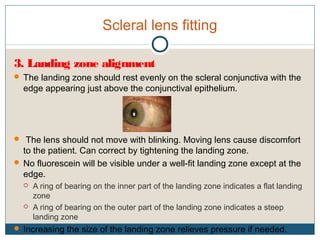
3. Landing zone alignment
 The landing zone should rest evenly on the scleral conjunctiva with the
edge appearing just above the conjunctival epithelium.
  The lens should not move with blinking. Moving lens cause discomfort
to the patient. Can correct by tightening the landing zone.
 No fluorescein will be visible under a well-fit landing zone except at the
edge.
 A ring of bearing on the inner part of the landing zone indicates a flat landing
zone
 A ring of bearing on the outer part of the landing zone indicates a steep
landing zone
 Increasing the size of the landing zone relieves pressure if needed.
Scleral lens fitting
4. Lens edge lift
 Assess lens edge lift after 30 minutes of lens installation during fitting
process.
 Also assess lens edge after 3-4 hours of lens wear.
 Too much edge lift :
 Cause lens awareness and discomfort
 Action: Decrease the edge lift by changing the landing zone angle or by choosing
a smaller landing zone radius of curvature.
 Low edge lifts:
 Leave a full or partial impingement ring on the conjunctiva after lens removal
 Two easy methods
 Observe the edge lift with white light & how much it “sinks” into the
conjunctiva
 Push-in method -preferred if the lens showed some mobility
 Remove lens and evaluate surface with fluorescein staining
Adverse events
Adverse events
Adverse events
Patient compliance
Patient compliance:
1. Hygiene
 Cleaning kit same as RGP, must using protein cleaner.
 If deposit on lens present, first see Giant papillary
Conjunctivitis.
1. Sleeping with Scleral CL
 Pt love to wear lens overnight.
 Advice patient not to wear scleral lens extendedly to avoid
complications.
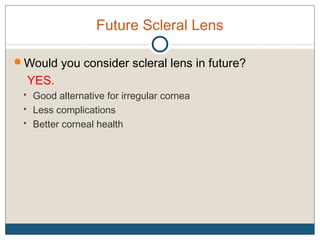
Future Scleral Lens
Would you consider scleral lens in future?
YES.
 Good alternative for irregular cornea
 Less complications
 Better corneal health
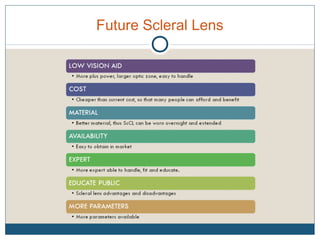
Future Scleral Lens
Thank You

Scleral lenses

  • 1.
    BY: NOORMUNIRAHBINTI AWANG ABUBAKAR OPTOMETRIST MOC: O-0869 SCLERAL LENS
  • 2.
  • 3.
    Scleral Lens Also knownas: Haptic lens ‘haptic’ = se nse o f to uch A large diameter rigid contact lens that cover the entire surface & rest on sclera.  Diameter: 15.0mm to 25.0mm Minimum or no contact on the cornea
  • 4.
  • 5.
    Ocular Anterior Anatomy •Average corneal diameter is 11.8mm •The maximum diameter a scleral lens can have is 24mm
  • 6.
  • 7.
    When it starts? Sclerallens is used to fit on corneal diseases (irregular corneas) Two forms of manufacturing lens (a) Spin cast - mold (b) Lathe cut – custom made Scleral lenses are lathe cut  High cost making it unpopular
  • 8.
    Why is ScleralLens not popular?  Expensive  Large lens diameter  Difficult to fit  Fragile  Lack of expertise to fit  Complications when patient wear it overnight
  • 9.
  • 10.
    Indications 1. Vision Improvement Mainly for corneal ectasia cases  Primary : Keratoconus, keratoglobus, PMD  Secondary : Post refractive surgery (LASIK,LASEK, PRK)  Other conditions: post trauma, corneal scar due to infection  To restore and improve vision
  • 11.
    Indications 2. Corneal protection In 2 conditions:  Severe ocular disease (Sjogren, Steven Johnson, Graft versus host dx)  Incomplete lid closure (eyelid coloboma, ectropion, exophthalmos, nerve palsies)  Help by reducing corneal exposure to air (not to close the eye)  Benefits:  To relieve symptoms of pain & discomfort  Keep ocular surface moist in severe dry eyes by fluid reservoir retention  Slow the progression of corneal disease and delay the need for surgery  Decrease risk of scarring
  • 12.
    Indications 3. Cosmetic  Inprosthetic eye (not widely use in Malaysia due to its cost)  Full ocular prostheses  Partially prostheses  Use on: aniridia (reduce glaring), albinism, trauma,nanophthalmos 4. Sport  More secured – reduce risk of loss  Provides stable vision and comfort
  • 13.
    Indications 5. Drug delivery Scleral lens has tear reservoir  Instill drug onto bowl of scleral lens  RGP is not suitable for drug delivery, due to lens movement 5. Normal eyes  Very common in other country  Corneal lens cannot fit well  It gives less complication
  • 14.
  • 15.
    Design of sclerallens 1. Optical zone  Minimal/not contact with cornea (RGP: contact)  Large size (RGP: smaller)  Give optical effect  Surface:  Anterior surface: Aspheric design to reduce photophobia and aberration  Posterior surface: Same shape as cornea  Sagittal height of scleral lens is higher than RGP sagittal height  Available in toric (but not available in Malaysia)
  • 16.
    Design of sclerallens 2. Transitional zone  Only scleral lens has transitional zone  Connect sclera and sclera  It set the sagittal height  Changing sagittal height means change the transitional zone (flatter or steeper)  Depends on the shape of the sclera  The transitional zone for small diameter ScCL may rest on limbal area, not for larger diameter ScCL.  Range of transition zone: 0.5mm to 2.0mm.
  • 17.
    Design of sclerallens 2. Transitional zone Scle ralshape  Referring to cornea, limbus and sclera  Affect the ScCL fitting  Involve the transitional and landing zone  The sclera can be evaluated using:  Pentacam  Anterior segment OCT  Type of limbal profile: 1. Gradual convex 2. Gradual tangential (common) 3. Convex concave 4. Marked convex (common) 5. Marked tangential 1 2 3 4 5
  • 18.
    Design of sclerallens 2. Transitional zone Lim balang le and scle ralang le  What: This is angle between iris & cornea  Temporal angle larger than nasal angle (T≠N)  ScCL easily decentred to the nasal  However, it would not affect vision because the optical zone is large.
  • 19.
    Design of sclerallens 3. Landing zone (Haptic zone)  Area of ScCL that rest on the sclera  Important to know:  Size of landing zone  Angle of landing zone  Landing zone as back surface toric: change the thickness at one side  Can make peripheral toric by thinning the edge like prism ballast.  Increase diameter of landing zone, make it more comfortable to wear as less movement produced
  • 20.
  • 21.
  • 22.
    Scleral lens fitting 1.Optical/Clearance zone diameter Optical zone important to provide good optical outcome and corneal clearance Clearance zone = optical zone + transition zone Usually 0.2mm larger than HVID Size depends on lens designs Can be altered to improve corneal and limbal clearance
  • 23.
  • 24.
    Scleral lens fitting 2.Central and limbal clearance Up to 600 microns of corneal clearance can be easily achieved if needed centrally. Clearance of 200–300 microns is usually considered sufficient, but this can easily go up to 500 microns if desired with the end stage large diameter lenses. The terms “flat” and “steep” are substituted with increase or decrease in sagittal height instead.  Increasing the sagittal height of the lens causes the lens to “lift” off the eye, increasing the clearance or vault of the lens. Sagittal depth differs with the condition:  Ectasia needs larger than post-corneal grafts  Ocular surface disease management requires large sagittal height
  • 25.
    Scleral lens fitting Central and limbal clearance evaluation  Start with low sagittal height and gradually increase height to desired clearance  A green fluorescein pattern will be visible.  Use a thin optical section with brightest illumination setting at a 45 degree angle  If CCT known, compare corneal thickness to tear layer thickness to estimate clearance  If CCT not know, assume a 530micron central cornea and 650 micron at periphery (Doughty 2000) and compare to the slit.
  • 26.
    Scleral lens fitting Limbalclearance  Complete and generous limbal clearance is necessary to ensure tear circulation and prevent erosive damage to the limbal epithelial cells.  If very little fluorescein observed in the limbal area of the lens, then the lens is too small and should select a larger diameter. Scleral lens with inadequate limbal clearance Scleral lens with complete limbal clearance
  • 27.
    Scleral lens fitting 3.Landing zone alignment  The landing zone should rest evenly on the scleral conjunctiva with the edge appearing just above the conjunctival epithelium.   The lens should not move with blinking. Moving lens cause discomfort to the patient. Can correct by tightening the landing zone.  No fluorescein will be visible under a well-fit landing zone except at the edge.  A ring of bearing on the inner part of the landing zone indicates a flat landing zone  A ring of bearing on the outer part of the landing zone indicates a steep landing zone  Increasing the size of the landing zone relieves pressure if needed.
  • 28.
    Scleral lens fitting 4.Lens edge lift  Assess lens edge lift after 30 minutes of lens installation during fitting process.  Also assess lens edge after 3-4 hours of lens wear.  Too much edge lift :  Cause lens awareness and discomfort  Action: Decrease the edge lift by changing the landing zone angle or by choosing a smaller landing zone radius of curvature.  Low edge lifts:  Leave a full or partial impingement ring on the conjunctiva after lens removal  Two easy methods  Observe the edge lift with white light & how much it “sinks” into the conjunctiva  Push-in method -preferred if the lens showed some mobility  Remove lens and evaluate surface with fluorescein staining
  • 29.
  • 30.
  • 31.
  • 32.
    Patient compliance Patient compliance: 1.Hygiene  Cleaning kit same as RGP, must using protein cleaner.  If deposit on lens present, first see Giant papillary Conjunctivitis. 1. Sleeping with Scleral CL  Pt love to wear lens overnight.  Advice patient not to wear scleral lens extendedly to avoid complications.
  • 33.
    Future Scleral Lens Wouldyou consider scleral lens in future? YES.  Good alternative for irregular cornea  Less complications  Better corneal health
  • 34.
  • 35.