ACCOMMODATIVE ANOMALIES
L - 1 & 2
Mohammad Arman Bin Aziz
Instructor Optometrist cum Faculty
Institute of Community Ophthalmology
ACCOMMODATION
 The process by
which the dioptric
power of eye
changes so that an
infocus retinal
image of an object
of regard is obtained
and maintained at
high resolution at
fovea.
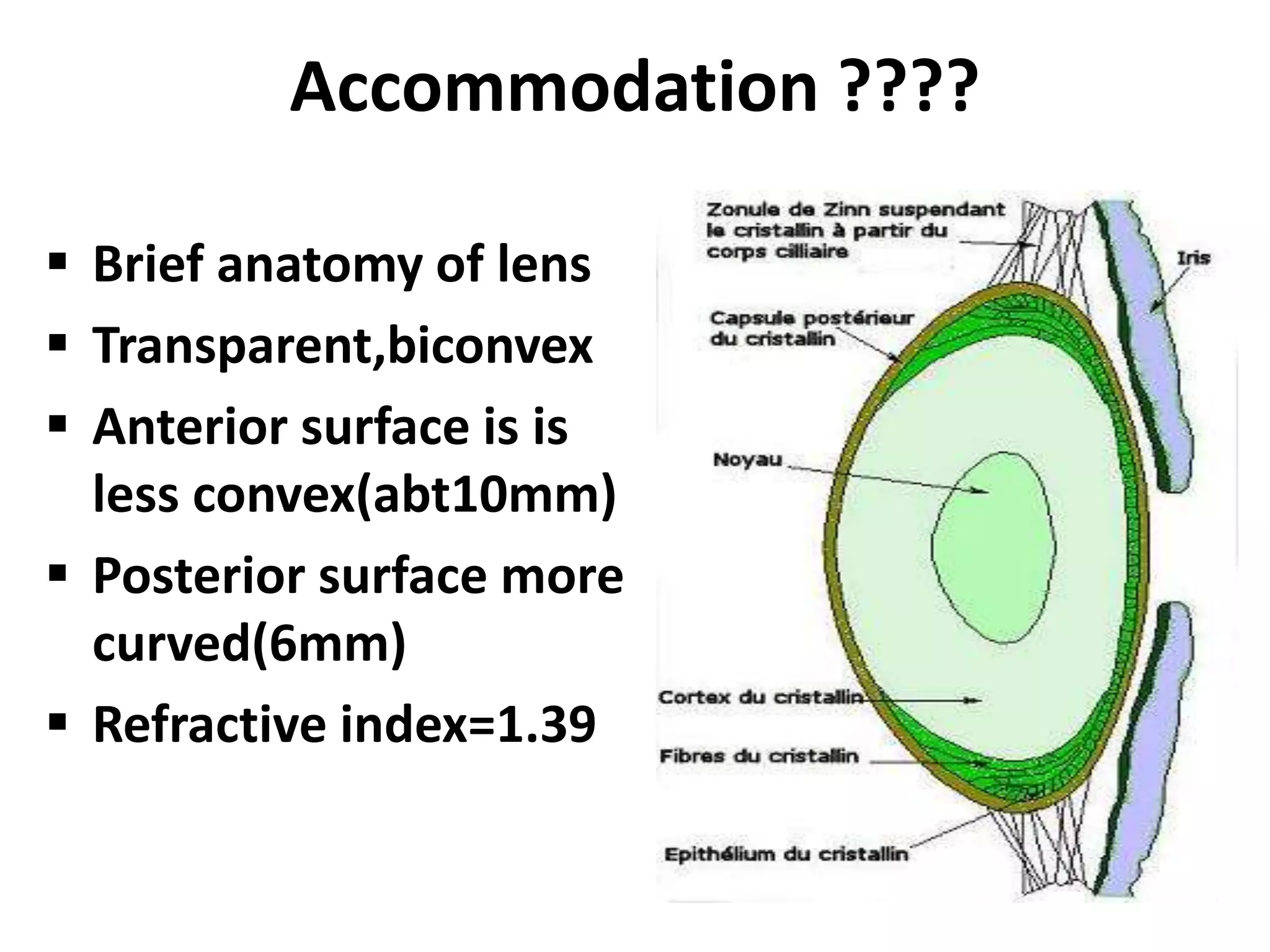
Accommodation ????
 Brief anatomy of lens
 Transparent,biconvex
 Anterior surface is is
less convex(abt10mm)
 Posterior surface more
curved(6mm)
 Refractive index=1.39
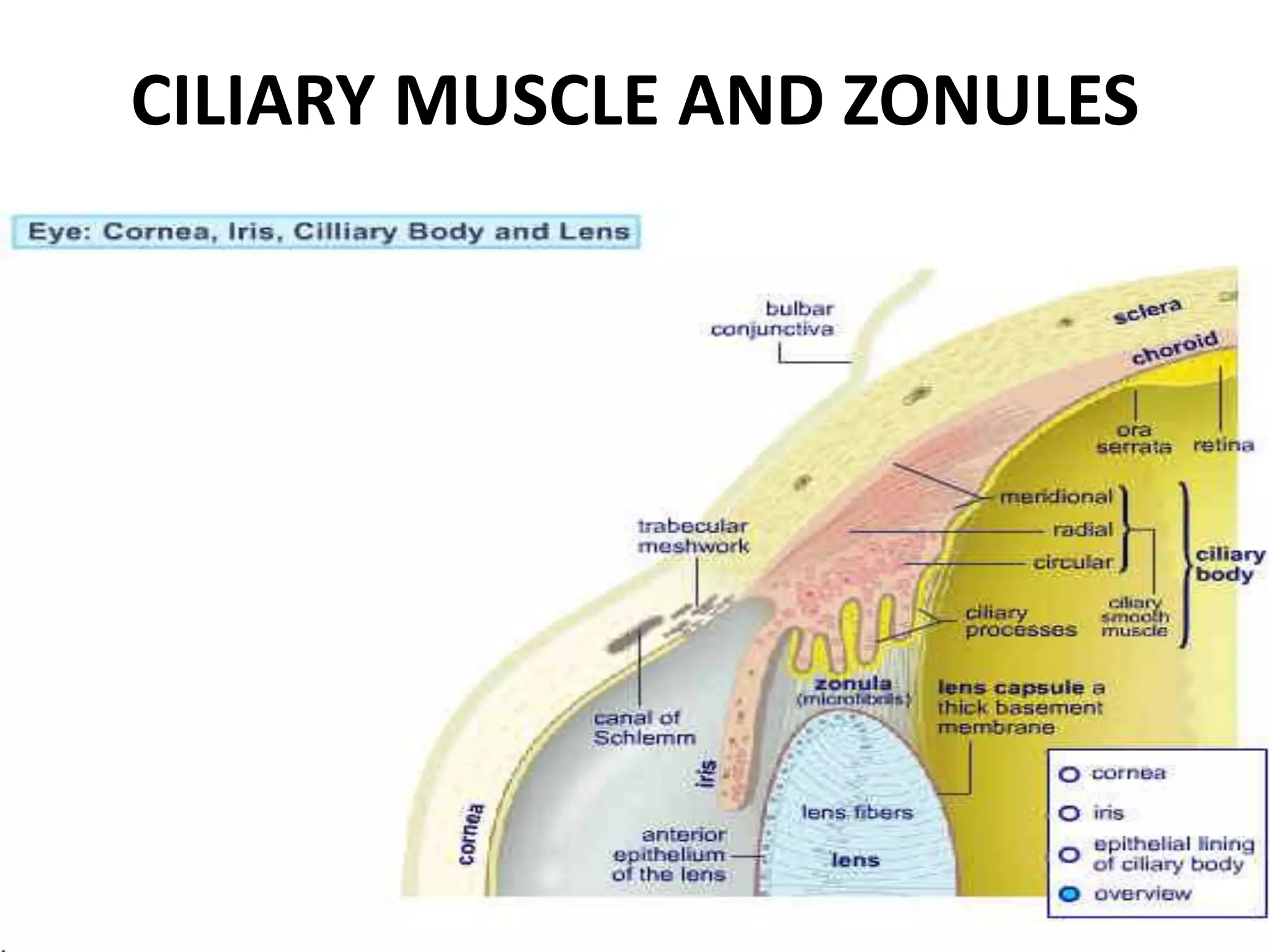
CILIARY MUSCLE AND ZONULES
Changes in accommodation
Ranges and amplitude of accommodation
 Punctum proximum-
 Punctum remotum-
 Ranges of accommodation-
 Amplitude of accommodation-
 Variation with refractive error???
Variation of amplitude of accommodation with age
DONDER’S TABLE
AGE (yrs) AMP (Ds) AGE (yrs) AMP (Ds)
10 14 40 5.50
20 10 50 3.5
30 7 60 1
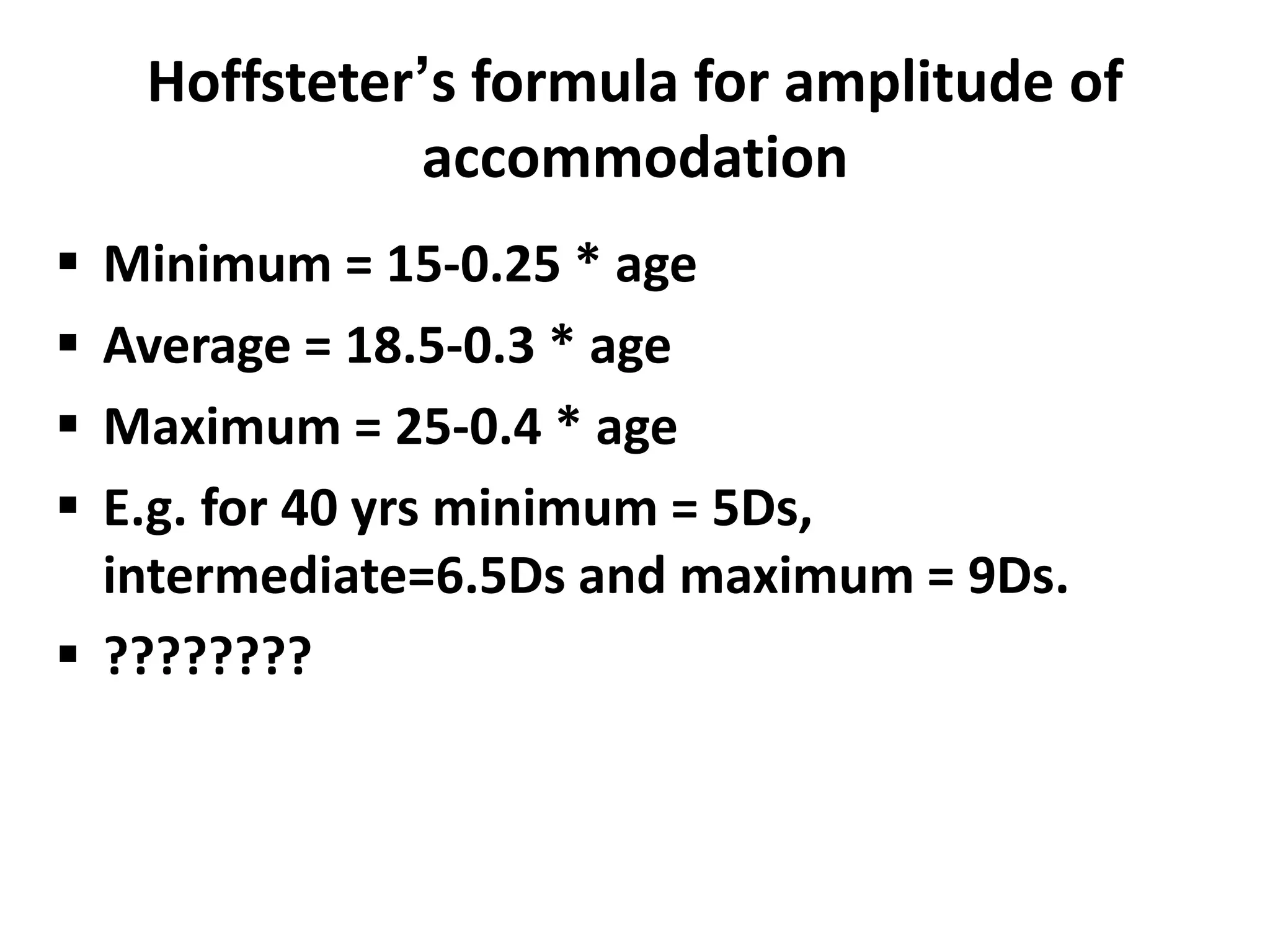
Hoffsteter’s formula for amplitude of
accommodation
 Minimum = 15-0.25 * age
 Average = 18.5-0.3 * age
 Maximum = 25-0.4 * age
 E.g. for 40 yrs minimum = 5Ds,
intermediate=6.5Ds and maximum = 9Ds.
 ????????
Anomalies of accommodation
 Insufficiency of accommodation
 Excess or spasm of accommodation
Insuffeciency of accommodation
 Physiological anomaly
 Pharmacological anomaly
 Pathological anomaly
Physiological anomaly
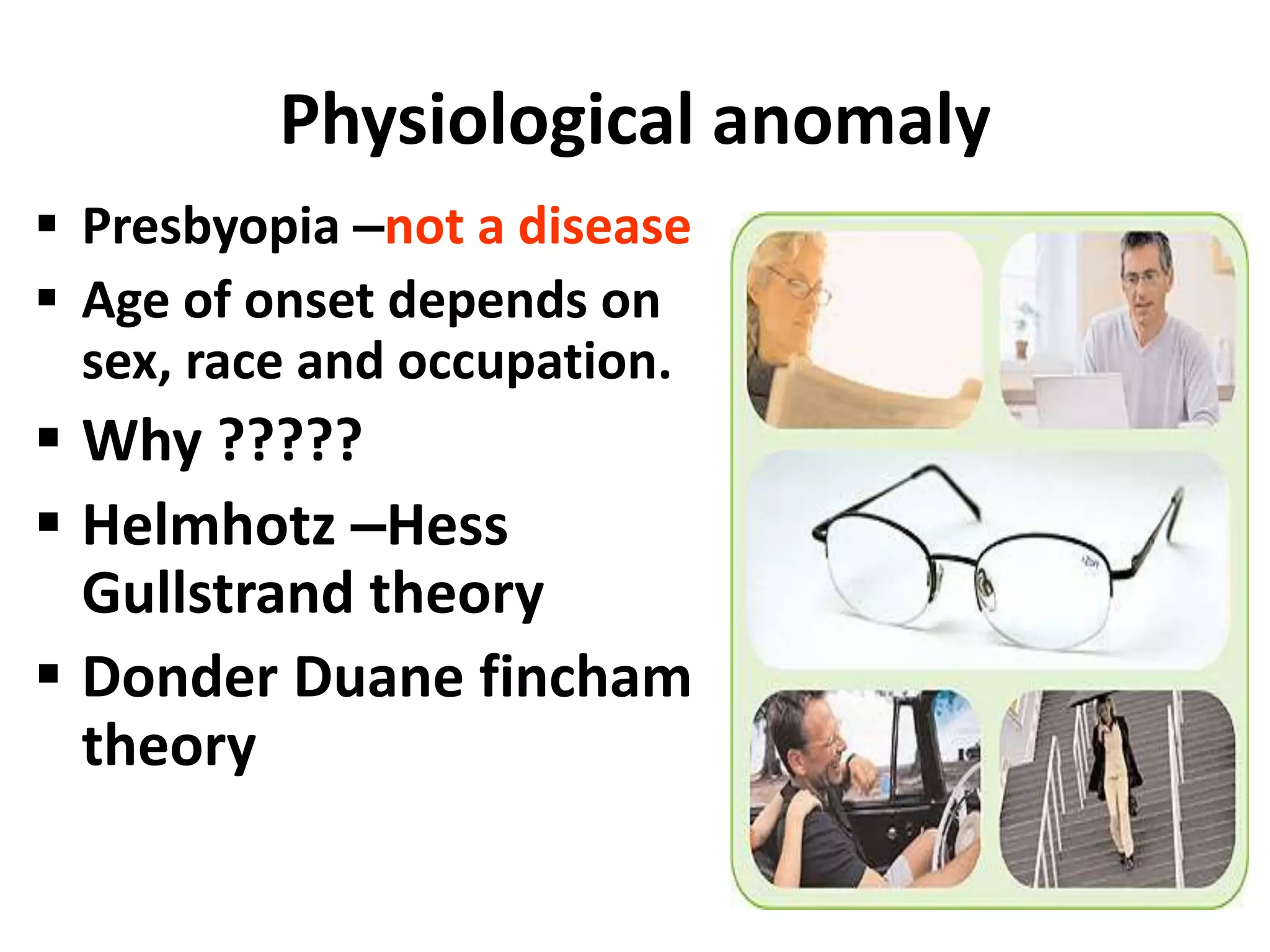
 Presbyopia –not a disease
 Age of onset depends on
sex, race and occupation.
 Why ?????
 Helmhotz –Hess
Gullstrand theory
 Donder Duane fincham
theory
Types of presbyopia
 Incipient presbyopia
 Functional presbyopia
 Absolute presbyopia
 Premature presbyopia
 Nocturnal presbyopia
 Symptoms –
 Small print become indistinct in dim
illumination.
 Hand short for reading
Optical correction
 Glass..near glass, bifocal glass, progressive addition
lens, monovision glasses
 Contact lens option
 Distance single vision CL and near glasses
 Monovision CL
 Bifocal /multifocal CL
 Non refractive bifocal
 Weakest glass which are compatible with good
vision????
Methods determining addition
• A general rule an individual require 1D at 40 and in
every 5 yrs ,increases by 1D until 55 then stabilizes.
• Considering amplitude of accommodation
 RAF ruler
 Donder's table
 hoffsteter’s formula
 Dynamic retinoscopy
• Binocular cross cylinder test-
 Negative relative accommodation
(NRA)and positive relative
accommodation (PRA)-
 Addition-NRA+1/2 relative amplitude of
accommodation
 E.g. if PRA is – 0.50 Ds and NRA is +2.00
 Amplitude of accommodation= +2.50
 Addition==2.00-1/2 * 2.50= +0.75Ds
Treatment ???
 Surgical procedure
 Made artificially anisometropic
 New advancement in surgical process
Pharmacological anomaly
 Ciliary body is supplied by both sympathetic
and parasympathetic supply.
 Sympathetic receptor include alpha and beta
 Parasympathetic include muscarinic receptor
M1, M2, M3
Group of drugs affecting accommodation
 Parasympatho mimetic
 Parasympatholytics
 Sympathomimetics
 sympatholytics
Some other causing accommodation
insuffeciency
 Alcohol
 Phenothiazine
 Antihistamine
 Marijuana
 Digitalis
Pathological anomaly
 Insuffeciency of accommodation-
 Accommodative power is consistently poor than
what may be considered as normal at that age.
Etiology
 General debility
 Malnutrition
 Anaemia
 Glaucoma (?)
Treatment
 Cause is treated
 If not treatable,symptom relieving majors…
 Optical treatment-1st choice
 Accommodation therapy…
Lag of accommodation
 Accommodative response
is smaller than
accommodative demand.
 Causes asthenopic
symptoms.
 Can be found by dynamic
retinoscopy, jackson cross
cyl method.
 Corrected by giving
addition for near.
Research report
 Normal accommodative lag in Nepalese
population-Dhungana Purushottam
 151 patient were examined out of which
88(58%) were female,63(42%)male.
 He found normal accommodative lag increase
with age and ranges from 1.004-1.33(16-
35yrs)in monocular fixation and 0.915-
1.116(16-35yrs)in binocular condition.
Conclusions of the study
 Accommodation lag in entire Nepalese
population found to be increase with age
 Myope showed lag towards higher side,
hyperope towards lower side.
 Normal lag 1.174(+/-0.17) monocular
fixation, 0.998(+/-0.003)binocular condition.
Ill sustained accommodation/fatigue of
accommodation
 Accommodation is normal initially but can not be
maintained over length of time.
 Initial stage of true insufficiency
 Convalescent period from debilitating illness
 Tiredness
 refractive status
 relationship with convergence
Treatment
 Correct significant ametropia
 High astigmatism ? - check near cyl
axes
 Advise on lighting and length of time
accommodation
Inertia of accommodation
accommodation facility
 Difficulty is experienced in altering the range
of accommodation .
 Measurement of quality of the eye ability to
smoothly and efficiently change the amount
of accommodation
 Cycles per minute by flipper
Facility testing
Normal value
 Monocular distribution of monocular
accommodative measurement using +/-2 Ds for
100 eyes,12-14 cycles constitute about 50
percent eyes. (asymptomatic)
 Binocular accommodative facility measurement
using +/-2Ds, 8-14 constitute about 50 percent
total screened(asymptomatic)
Paralysis of accommodation
 Disease affecting cranium and oculomotor
nerve.
 Paralytical mydriasis.
 If accommodation paralysis is isolated cause, it
is cortical in origin.
 Other cause include encephalitis, anterior
poliomyelitis, TB, syphilis etc
 May be partial or total, unilateral or
bilateral
 Signs and symptoms
 Blurred vision
 Micropsia
Aetiology
 Congenital defects e.g., no ciliary
muscle
 Cycloplegic drugs
 topical eye drops intentional or
unintentional
 Systemic drugs
 Degenerative conditions e.g. Parkinson’s
 Exogenous poisons e.g., snake bites, bee
stings
 III N lesion (tumour, aneurysm, haemorrhage)
 Ocular disease (anterior uveitis, glaucoma)
 Trauma to head or eye (temporary or
permanent paralysis)
Management
 If recent onset and not previously
investigated then refer and, if of
sudden onset, urgently
 Subsequent intervention will include
spectacles and management of any
diplopia
Excessive accommodation
 Tone of ciliary muscle is increased,inducing
pseudomyopia.
Symptoms
 Blurred vision depending on patient’s
refractive status
 Macropsia
 Asthenopia during close work
 Pain (brows/headache)
 Poor concentration
 Miosis
 Convergence anomalies (excess or
insufficiency)
Investigation
 Cycloplegic refraction used to
determine true refraction
aetiologies
 Functional cause
 Organic cause
Functional cause
• Functional spasm
 A response to over fatigue and "eye strain".
Precipitated by 3 factors:
 Bad visual hygiene e.g., poor lighting, glare
unaccustomed work
 Optical or ocular motor difficulties e.g.,
anisometropia, early presbyopia, convergence
anomalies
 psychological factors
Organic cause
• Irritation of parasympathetic system
Aetiology
• Ciliary spasm
• - drug induced e.g., physostigmine,
pilocarpine, morphine, digitalis
• - lesions of brain stem
• Inflammation e.g., anterior uveitis
• Trigeminal neuralgia
Treatment
 Reversible or irreversible….
 Reversible then + lens
 Irreversible than – lenses
Unequal accommodation
 Can be due to ciliary muscle weakness or
decrease in elasticity of lens capsule..
 Other causes include amblyopia,unilateral
sclerosis..
Accommodative esotropia
 Accommodative esotropia……
 Refractive accommodative esotropia..(AC/A
normal)
 Non refractive accommodative esotropia
(high AC/A ratio)
 Mixed
 AC/A= ipd + N. phoria - D.phoria/D
Accommodative therapy
 To improve accommodative amplitude,
facility
 Principle is to alter the stimulus for
accommodation by glasses or changing
distance
 Initially therapy is performed monocularly so
that vergence system does not influence.
 Hart chat push up(push up paddle)
 Hart chat distance near facility
 Lens flippers
 Loose minus lens rock
 Split pupil rock
conclusion
 Accommodative anomaly is one of the most
common cause of asthenopic symptom
presenting to optometrist.
 So all patient should undergo tests for
refractive error, muscle imbalance and
convergence and accommodation anomaly
should not be forgotten.
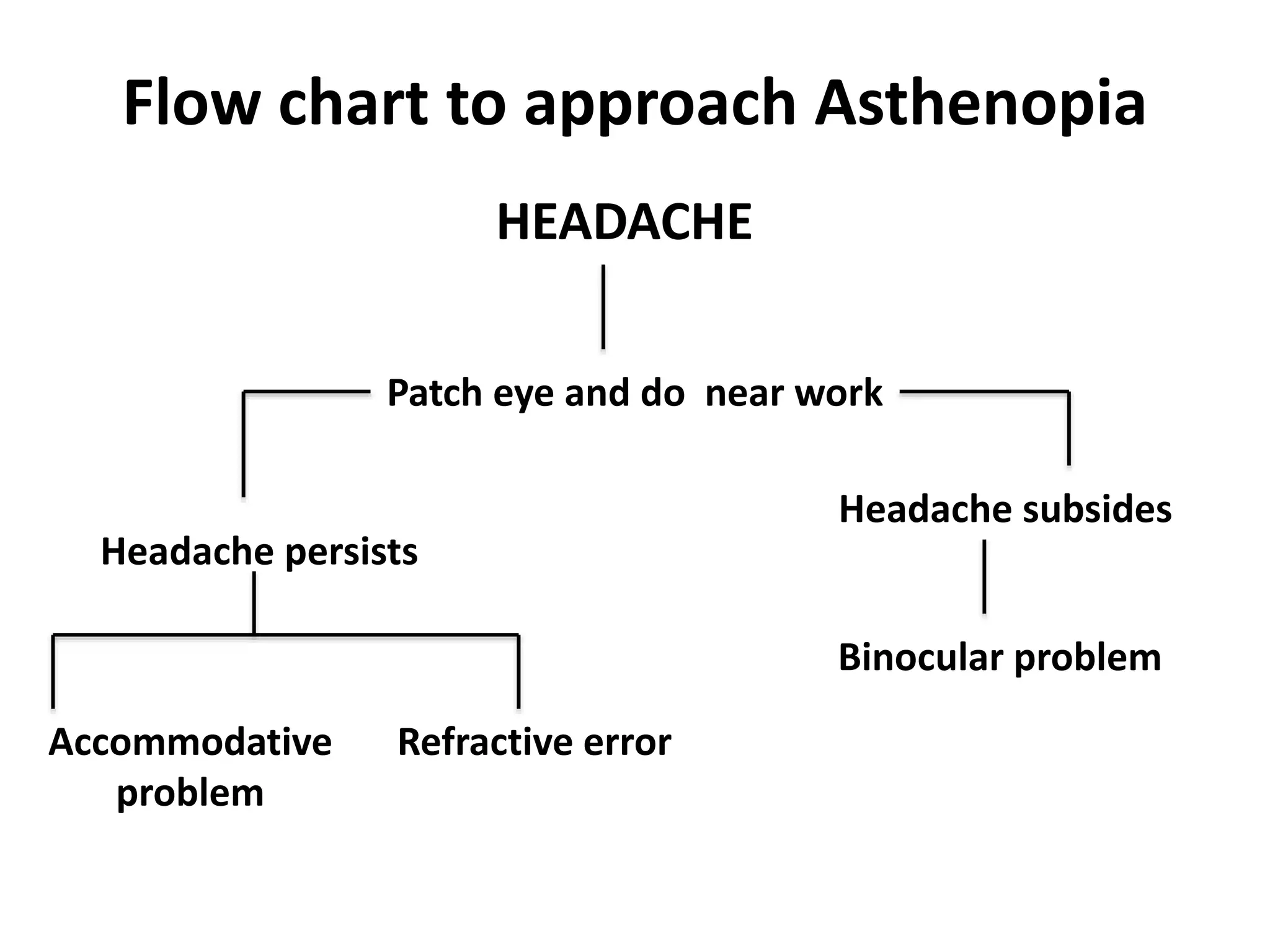
Flow chart to approach Asthenopia
HEADACHE
Patch eye and do near work
Headache persists
Headache subsides
Binocular problem
Accommodative
problem
Refractive error
REFERENCES
• Borish’s clinical refraction
• Duke-Elder’s practice of refraction
• Principal of optics and refraction by Lalit P.
Agrawal
• Binocular vision and ocular motility-Gunter K
Von noorden
• Clinical management of strabismus-Elizabeth

Accommodative anomalies (Full)

  • 1.
    ACCOMMODATIVE ANOMALIES L -1 & 2 Mohammad Arman Bin Aziz Instructor Optometrist cum Faculty Institute of Community Ophthalmology
  • 2.
    ACCOMMODATION  The processby which the dioptric power of eye changes so that an infocus retinal image of an object of regard is obtained and maintained at high resolution at fovea.
  • 3.
    Accommodation ????  Briefanatomy of lens  Transparent,biconvex  Anterior surface is is less convex(abt10mm)  Posterior surface more curved(6mm)  Refractive index=1.39
  • 4.
  • 5.
  • 6.
    Ranges and amplitudeof accommodation  Punctum proximum-  Punctum remotum-  Ranges of accommodation-  Amplitude of accommodation-  Variation with refractive error???
  • 7.
    Variation of amplitudeof accommodation with age DONDER’S TABLE AGE (yrs) AMP (Ds) AGE (yrs) AMP (Ds) 10 14 40 5.50 20 10 50 3.5 30 7 60 1
  • 8.
    Hoffsteter’s formula foramplitude of accommodation  Minimum = 15-0.25 * age  Average = 18.5-0.3 * age  Maximum = 25-0.4 * age  E.g. for 40 yrs minimum = 5Ds, intermediate=6.5Ds and maximum = 9Ds.  ????????
  • 9.
    Anomalies of accommodation Insufficiency of accommodation  Excess or spasm of accommodation
  • 10.
    Insuffeciency of accommodation Physiological anomaly  Pharmacological anomaly  Pathological anomaly
  • 11.
    Physiological anomaly  Presbyopia–not a disease  Age of onset depends on sex, race and occupation.  Why ?????  Helmhotz –Hess Gullstrand theory  Donder Duane fincham theory
  • 12.
    Types of presbyopia Incipient presbyopia  Functional presbyopia  Absolute presbyopia  Premature presbyopia  Nocturnal presbyopia
  • 13.
     Symptoms – Small print become indistinct in dim illumination.  Hand short for reading
  • 14.
    Optical correction  Glass..nearglass, bifocal glass, progressive addition lens, monovision glasses  Contact lens option  Distance single vision CL and near glasses  Monovision CL  Bifocal /multifocal CL  Non refractive bifocal  Weakest glass which are compatible with good vision????
  • 15.
    Methods determining addition •A general rule an individual require 1D at 40 and in every 5 yrs ,increases by 1D until 55 then stabilizes. • Considering amplitude of accommodation  RAF ruler  Donder's table  hoffsteter’s formula  Dynamic retinoscopy • Binocular cross cylinder test-
  • 16.
     Negative relativeaccommodation (NRA)and positive relative accommodation (PRA)-  Addition-NRA+1/2 relative amplitude of accommodation  E.g. if PRA is – 0.50 Ds and NRA is +2.00  Amplitude of accommodation= +2.50  Addition==2.00-1/2 * 2.50= +0.75Ds
  • 17.
    Treatment ???  Surgicalprocedure  Made artificially anisometropic  New advancement in surgical process
  • 18.
    Pharmacological anomaly  Ciliarybody is supplied by both sympathetic and parasympathetic supply.  Sympathetic receptor include alpha and beta  Parasympathetic include muscarinic receptor M1, M2, M3
  • 19.
    Group of drugsaffecting accommodation  Parasympatho mimetic  Parasympatholytics  Sympathomimetics  sympatholytics
  • 20.
    Some other causingaccommodation insuffeciency  Alcohol  Phenothiazine  Antihistamine  Marijuana  Digitalis
  • 21.
    Pathological anomaly  Insuffeciencyof accommodation-  Accommodative power is consistently poor than what may be considered as normal at that age. Etiology  General debility  Malnutrition  Anaemia  Glaucoma (?)
  • 22.
    Treatment  Cause istreated  If not treatable,symptom relieving majors…  Optical treatment-1st choice  Accommodation therapy…
  • 23.
    Lag of accommodation Accommodative response is smaller than accommodative demand.  Causes asthenopic symptoms.  Can be found by dynamic retinoscopy, jackson cross cyl method.  Corrected by giving addition for near.
  • 24.
    Research report  Normalaccommodative lag in Nepalese population-Dhungana Purushottam  151 patient were examined out of which 88(58%) were female,63(42%)male.  He found normal accommodative lag increase with age and ranges from 1.004-1.33(16- 35yrs)in monocular fixation and 0.915- 1.116(16-35yrs)in binocular condition.
  • 25.
    Conclusions of thestudy  Accommodation lag in entire Nepalese population found to be increase with age  Myope showed lag towards higher side, hyperope towards lower side.  Normal lag 1.174(+/-0.17) monocular fixation, 0.998(+/-0.003)binocular condition.
  • 26.
    Ill sustained accommodation/fatigueof accommodation  Accommodation is normal initially but can not be maintained over length of time.  Initial stage of true insufficiency  Convalescent period from debilitating illness  Tiredness  refractive status  relationship with convergence
  • 27.
    Treatment  Correct significantametropia  High astigmatism ? - check near cyl axes  Advise on lighting and length of time accommodation
  • 28.
    Inertia of accommodation accommodationfacility  Difficulty is experienced in altering the range of accommodation .  Measurement of quality of the eye ability to smoothly and efficiently change the amount of accommodation  Cycles per minute by flipper
  • 29.
  • 30.
    Normal value  Monoculardistribution of monocular accommodative measurement using +/-2 Ds for 100 eyes,12-14 cycles constitute about 50 percent eyes. (asymptomatic)  Binocular accommodative facility measurement using +/-2Ds, 8-14 constitute about 50 percent total screened(asymptomatic)
  • 31.
    Paralysis of accommodation Disease affecting cranium and oculomotor nerve.  Paralytical mydriasis.  If accommodation paralysis is isolated cause, it is cortical in origin.  Other cause include encephalitis, anterior poliomyelitis, TB, syphilis etc
  • 32.
     May bepartial or total, unilateral or bilateral  Signs and symptoms  Blurred vision  Micropsia
  • 33.
    Aetiology  Congenital defectse.g., no ciliary muscle  Cycloplegic drugs  topical eye drops intentional or unintentional  Systemic drugs
  • 34.
     Degenerative conditionse.g. Parkinson’s  Exogenous poisons e.g., snake bites, bee stings  III N lesion (tumour, aneurysm, haemorrhage)  Ocular disease (anterior uveitis, glaucoma)  Trauma to head or eye (temporary or permanent paralysis)
  • 35.
    Management  If recentonset and not previously investigated then refer and, if of sudden onset, urgently  Subsequent intervention will include spectacles and management of any diplopia
  • 36.
    Excessive accommodation  Toneof ciliary muscle is increased,inducing pseudomyopia. Symptoms  Blurred vision depending on patient’s refractive status  Macropsia  Asthenopia during close work  Pain (brows/headache)  Poor concentration  Miosis  Convergence anomalies (excess or insufficiency)
  • 37.
    Investigation  Cycloplegic refractionused to determine true refraction
  • 38.
  • 39.
    Functional cause • Functionalspasm  A response to over fatigue and "eye strain". Precipitated by 3 factors:  Bad visual hygiene e.g., poor lighting, glare unaccustomed work  Optical or ocular motor difficulties e.g., anisometropia, early presbyopia, convergence anomalies  psychological factors
  • 40.
    Organic cause • Irritationof parasympathetic system Aetiology • Ciliary spasm • - drug induced e.g., physostigmine, pilocarpine, morphine, digitalis • - lesions of brain stem • Inflammation e.g., anterior uveitis • Trigeminal neuralgia
  • 41.
    Treatment  Reversible orirreversible….  Reversible then + lens  Irreversible than – lenses
  • 42.
    Unequal accommodation  Canbe due to ciliary muscle weakness or decrease in elasticity of lens capsule..  Other causes include amblyopia,unilateral sclerosis..
  • 43.
    Accommodative esotropia  Accommodativeesotropia……  Refractive accommodative esotropia..(AC/A normal)  Non refractive accommodative esotropia (high AC/A ratio)  Mixed  AC/A= ipd + N. phoria - D.phoria/D
  • 44.
    Accommodative therapy  Toimprove accommodative amplitude, facility  Principle is to alter the stimulus for accommodation by glasses or changing distance  Initially therapy is performed monocularly so that vergence system does not influence.
  • 45.
     Hart chatpush up(push up paddle)  Hart chat distance near facility  Lens flippers  Loose minus lens rock  Split pupil rock
  • 47.
    conclusion  Accommodative anomalyis one of the most common cause of asthenopic symptom presenting to optometrist.  So all patient should undergo tests for refractive error, muscle imbalance and convergence and accommodation anomaly should not be forgotten.
  • 48.
    Flow chart toapproach Asthenopia HEADACHE Patch eye and do near work Headache persists Headache subsides Binocular problem Accommodative problem Refractive error
  • 49.
    REFERENCES • Borish’s clinicalrefraction • Duke-Elder’s practice of refraction • Principal of optics and refraction by Lalit P. Agrawal • Binocular vision and ocular motility-Gunter K Von noorden • Clinical management of strabismus-Elizabeth