VISUAL FIELD
ASSESSMENT IN
LOW VISION
PATIENTS…
PRESENTED BY:
MISS.REEMA DANDAVATE
T.Y.B.OPTOMETRY
Roll : RAI2014BOPT2F024
SUB: LOW VISION
WHAT IS LOW VISION ?
•Low vision is the term used to refer to a visual
impairment that is not correctable through
surgery, pharmaceuticals, glasses or contact
lenses.
WHO Definition…
•A person with low vision is one who has
impairment of visual functioning even after
treatment and has a visual acuity of less than
6/18 to perception of light (PL +ve) or a visual
field of less than 10 degree from the point of
fixation but who uses or is potentially able to
use vision for the planning and/or execution of
task.
WHAT IS VISUAL FIELD ?
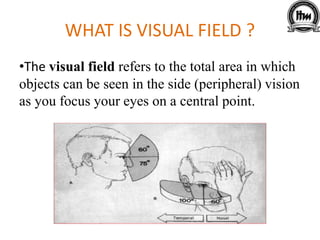
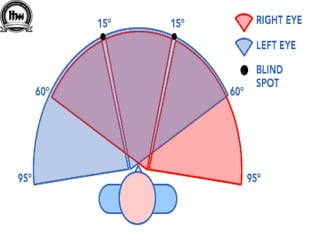
•The visual field refers to the total area in which
objects can be seen in the side (peripheral) vision
as you focus your eyes on a central point.
WHY IS VISUAL FIELD ASSESSMENT
REQUIRED ?
•Visual Fields are frequently evaluated during
the diagnosis and management of ocular disease .
•They have a role in LOW VISION rehabilitation
of patients with vision impairment.
•It is important to know the extent of the visual
field as well as presence of any scotomas when
prescribing optical devices and making
rehabilitation plans
VISUAL FIELD STATUS..
•An important diagnostic and screening tool for
patients with glaucoma, retinitis pigmentosa
and neurological disease.
•To check eccentric fixation due to scotoma or
deviation. Find about Eccentric viewing and
fixation skills.
• Record any apparent eccentric viewing angle.
•Eccentric viewing angles are typically recorded
using a clock -dial designation.
•Patient can use different eccentric viewing and
fixation for distance and near task.
•Do not assume that the patient uses the
eccentric fixation and viewing strategies for
distance as well as near visual tasks.
•GLAUCOMA : early glaucomatous visual field defects
include paracentral scotomas, arcuate scotomas, nasal
steps, and temporal wedges. Progressive visual field loss
from these areas occurs as the disease worsens.
•ARMD : a central or paracentral scotoma with normal
peripheral findings.
•RETINITI PIGMENTOSA : visual field loss begins in
the midperiphery, extending inward and outward,
creating a “donut-shaped” field defect.
VARIOUS DISEASES RELATED TO VISUAL FIELD
DEFECT…
•DIABETIC RETINOPATHY : in proliferative disease,
retinal ischemia, laser scars, and retinal detachment can
cause corresponding field loss.
•RETINAL DETACHMENT :visual fields defects
develop corresponding to the site of retinal detachment.
•R.O.P :visual field defects are variable, most common
nasally, correlating with the area of neovascularized
temporal periphery.
•MACULAR HOLE : full thickness holes result in dense
central scotomas.
•OPTIC ATROPHY : central vision affected. Paracentral,
cecocentral, or central scotomas may be present.
•CATARACT : central and peripheral field testing -
depression without focal defects.
•MULTIPLE SCLEROSIS: several patterns of visual
field loss occur in patients with optic neuritis secondary
to MS. Central and cecocentral scotomas may be present,
although altitudinal defects occur most commonly.
•MYOPIC DEGENERATION: high degrees of myopia
can result in a variety of visual field defects. Central ring-
shaped scotoma, as well as hemianopic and quadrantic
defects, can arise in the presence of posterior staphyloma
VISUAL FIELDS AND VARIOUS
OCCUPATIONS
Most of the occupations affected by loss of visual field
like :
•Patients report running into objects
•Tripping, falling
•Being startled by objects or people that suddenly appear
in front of them
•Difficult to detect objects, movements, orientation
•Patients often loose their place while reading
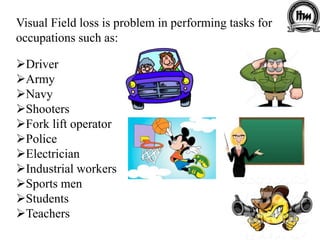
Visual Field loss is problem in performing tasks for
occupations such as:
Driver
Army
Navy
Shooters
Fork lift operator
Police
Electrician
Industrial workers
Sports men
Students
Teachers
FORK LIFT OPERATOR : min 70 degrees of horizontal
visual field on each side of fixation is often set as the
standard.
DRIVER : visual field loss may lead to some difficulties
like: sign detection, recognition task, merging on & off
the free way, straight and curved sections of the road
way, frequent mirror glance, eye scanning pattern.
120 degree visual field required.
SPORTS: goal keepers and other players need visual field
> 20 degrees. Difficulty in catching, kicking, tracking the
ball
USES OF VISUAL FIELD IN LOW
VISION
•To document visual field parameter for “LEGAL
BLINDNESS”
•To fulfill the eligibility criteria for those states
which require a minimum visual field
•To provide objective information about
scotoma in visual field which may explain
unexpectedly poor performance.
•Orientation & Mobility : learn skills and
influence plan for rehabilitation.
•To follow disease progression.
VISUAL ACUITY EXAMINATION
CLUES
•Turning or tilting head –adapt more favorable
EV.
•Leaving out one side of chart –field defect
present
•Skipping of individual letter on line –central
scotoma
•Shielding eyes from light –glare sensitivity
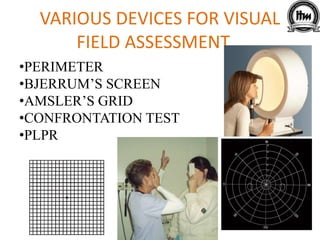
VARIOUS DEVICES FOR VISUAL
FIELD ASSESSMENT…
•PERIMETER
•BJERRUM’S SCREEN
•AMSLER’S GRID
•CONFRONTATION TEST
•PLPR
PERIMETER
•Humphrey’s Perimeter
•Arc Perimeter
•Bowl Perimeter
•Goldman Perimeter
•Burnel’s Perimeter
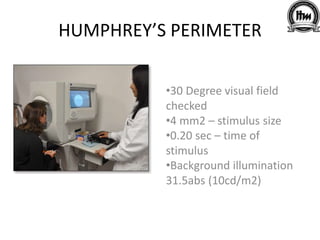
HUMPHREY’S PERIMETER
•30 Degree visual field
checked
•4 mm2 – stimulus size
•0.20 sec – time of
stimulus
•Background illumination
31.5abs (10cd/m2)
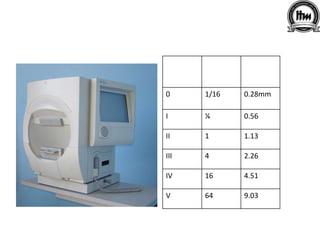
Size Area
mm2
Diameter
(mm2)
0 1/16 0.28mm
I ¼ 0.56
II 1 1.13
III 4 2.26
IV 16 4.51
V 64 9.03
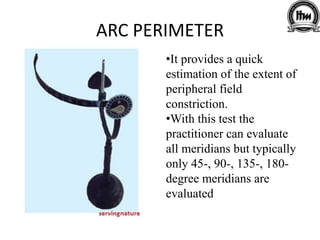
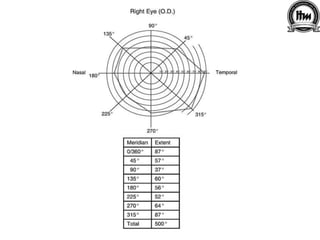
ARC PERIMETER
•It provides a quick
estimation of the extent of
peripheral field
constriction.
•With this test the
practitioner can evaluate
all meridians but typically
only 45-, 90-, 135-, 180-
degree meridians are
evaluated
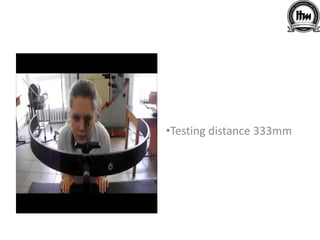
•Testing distance 333mm
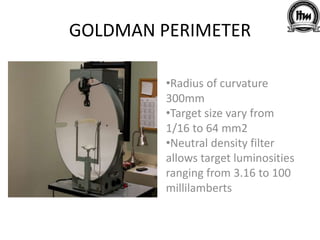
GOLDMAN PERIMETER
•Radius of curvature
300mm
•Target size vary from
1/16 to 64 mm2
•Neutral density filter
allows target luminosities
ranging from 3.16 to 100
millilamberts
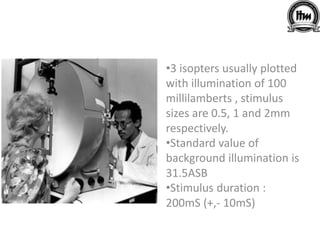
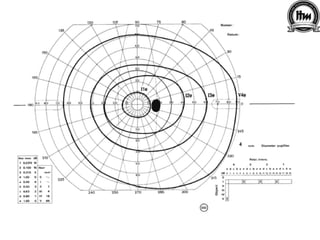
•3 isopters usually plotted
with illumination of 100
millilamberts , stimulus
sizes are 0.5, 1 and 2mm
respectively.
•Standard value of
background illumination is
31.5ASB
•Stimulus duration :
200mS (+,- 10mS)
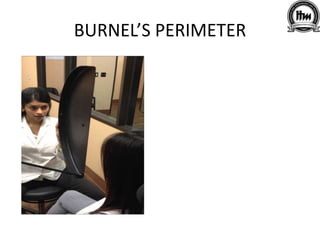
BURNEL’S PERIMETER
BJERRUM’S SCREEN
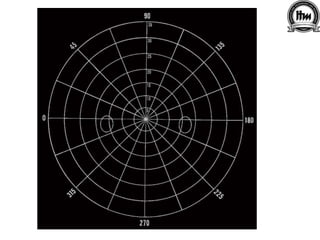
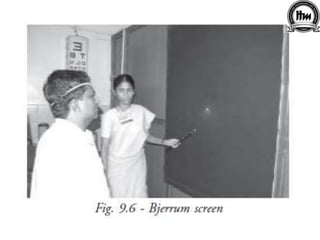
The Bjerrum Tangent Screen is a flat, usually
black surface, used to measure the central 30
degrees of the visual field. The Bjerrum screen is
made of black matte material and stitched with
radial lines at 15 degree intervals and circles at 5
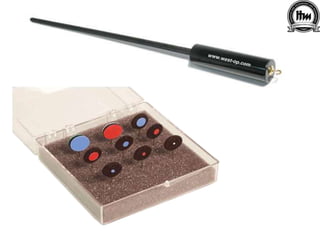
degree intervals. For use at 1 meter with Traquair
or similar stimuli.
• Check 30 degree central visual field
Bjerrum Screen Method
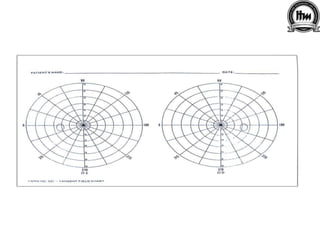
•In normal subjects the blind spot is the same angular distance
from fixation in both eyes.
•Plot the blind spot carefully in both eyes and compare positions.
•Degree of eccentricity can be measured by the difference in
angular distance of blind spot from fixation in each eye.
•Requires good co-operation
AMSLER’S GRID
•Designed by Marc Amsler.
•These charts consists of a series seven gridlike
charts designed for evaluating the central visual
field, mounted on stiff cardboard in a ring binder.
•20 degree visual field (10 degree)
•Performed at 13 inch/ 30cm
•First uniocular then binocular
INDICATIONS…
•The Amsler Chart test should be performed
whenever macular disease is suspected as a
result of
An unexplained visual acuity loss
A report of a visual disturbance in or near the
fixation area (metamorphopsia)
A questionable appearance of macular area in
ophthalmoscopy
7 AMSLER charts…
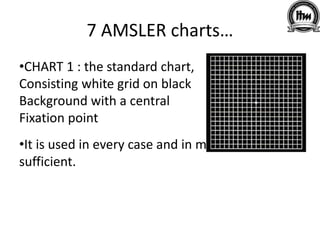
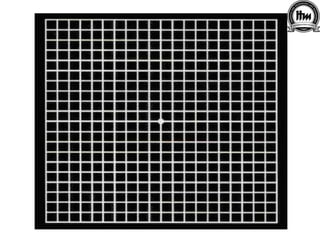
•CHART 1 : the standard chart,
Consisting white grid on black
Background with a central
Fixation point
•It is used in every case and in many cases is
sufficient.
CHART 2
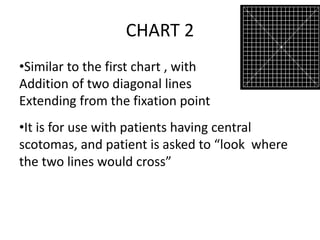
•Similar to the first chart , with
Addition of two diagonal lines
Extending from the fixation point
•It is for use with patients having central
scotomas, and patient is asked to “look where
the two lines would cross”
CHART 3
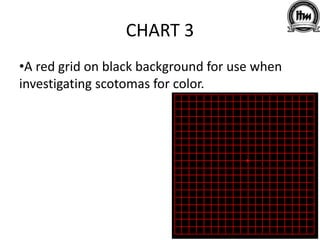
•A red grid on black background for use when
investigating scotomas for color.
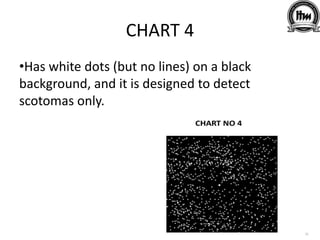
CHART 4
•Has white dots (but no lines) on a black
background, and it is designed to detect
scotomas only.
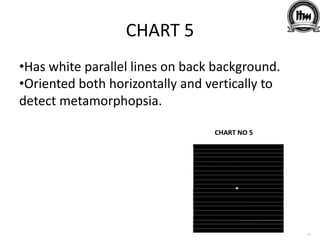
CHART 5
•Has white parallel lines on back background.
•Oriented both horizontally and vertically to
detect metamorphopsia.
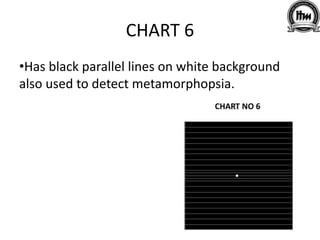
CHART 6
•Has black parallel lines on white background
also used to detect metamorphopsia.
CHART 7
•Similar to chart 1 but consists of small squares
in central 8 degrees
SOME QUESTIONS TO BE ASKED
???
•Keep your eye focused on the dot in the center
of the grid and answer these questions:
–Do any of the lines in the grid appear wavy, blurred
or distorted?
–Do all the boxes in the grid look square and the
same size?
–Are there any "holes" (missing areas) or dark areas
in the grid?
–Can you see all corners and sides of the grid (while
keeping your eye on the central dot)?
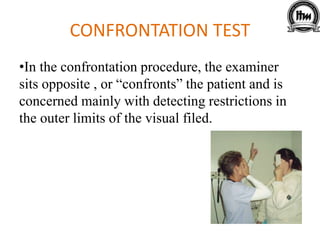
CONFRONTATION TEST
•In the confrontation procedure, the examiner
sits opposite , or “confronts” the patient and is
concerned mainly with detecting restrictions in
the outer limits of the visual filed.
PLPR
When none of the test show result and the visual field is
very low, we can do PLPR test just to get a gross idea of
whether light perception is present in any of the four
quadrants.
REFERENCE…
BOOKS...…
•PRIMARY CARE OPTOMETRY
•BORISH
•ESSENTIALS OF LOW VISION PRACTICE
•A.K.KHURANA OPTICS AND REFRACTION
•A.K.KHURANA OPHTHALMOLOGY
•ICEE CLINICAL ASSESSMENT OF LOW VISION
WEBSITES…
•SLIDESHARE
•WIKIPEDIA
•MEDSCAPE
•ALLABOUTVISION
•PPT – MR.GAURAV BHARADWAJ
•IMAGES…
•GOOGLE
THANKYOU… 

visual field assessment in low vision

  • 1.
    VISUAL FIELD ASSESSMENT IN LOWVISION PATIENTS… PRESENTED BY: MISS.REEMA DANDAVATE T.Y.B.OPTOMETRY Roll : RAI2014BOPT2F024 SUB: LOW VISION
  • 2.
    WHAT IS LOWVISION ? •Low vision is the term used to refer to a visual impairment that is not correctable through surgery, pharmaceuticals, glasses or contact lenses.
  • 3.
    WHO Definition… •A personwith low vision is one who has impairment of visual functioning even after treatment and has a visual acuity of less than 6/18 to perception of light (PL +ve) or a visual field of less than 10 degree from the point of fixation but who uses or is potentially able to use vision for the planning and/or execution of task.
  • 4.
    WHAT IS VISUALFIELD ? •The visual field refers to the total area in which objects can be seen in the side (peripheral) vision as you focus your eyes on a central point.
  • 6.
    WHY IS VISUALFIELD ASSESSMENT REQUIRED ? •Visual Fields are frequently evaluated during the diagnosis and management of ocular disease . •They have a role in LOW VISION rehabilitation of patients with vision impairment. •It is important to know the extent of the visual field as well as presence of any scotomas when prescribing optical devices and making rehabilitation plans
  • 7.
    VISUAL FIELD STATUS.. •Animportant diagnostic and screening tool for patients with glaucoma, retinitis pigmentosa and neurological disease. •To check eccentric fixation due to scotoma or deviation. Find about Eccentric viewing and fixation skills. • Record any apparent eccentric viewing angle.
  • 8.
    •Eccentric viewing anglesare typically recorded using a clock -dial designation. •Patient can use different eccentric viewing and fixation for distance and near task. •Do not assume that the patient uses the eccentric fixation and viewing strategies for distance as well as near visual tasks.
  • 9.
    •GLAUCOMA : earlyglaucomatous visual field defects include paracentral scotomas, arcuate scotomas, nasal steps, and temporal wedges. Progressive visual field loss from these areas occurs as the disease worsens. •ARMD : a central or paracentral scotoma with normal peripheral findings. •RETINITI PIGMENTOSA : visual field loss begins in the midperiphery, extending inward and outward, creating a “donut-shaped” field defect. VARIOUS DISEASES RELATED TO VISUAL FIELD DEFECT…
  • 10.
    •DIABETIC RETINOPATHY :in proliferative disease, retinal ischemia, laser scars, and retinal detachment can cause corresponding field loss. •RETINAL DETACHMENT :visual fields defects develop corresponding to the site of retinal detachment. •R.O.P :visual field defects are variable, most common nasally, correlating with the area of neovascularized temporal periphery. •MACULAR HOLE : full thickness holes result in dense central scotomas. •OPTIC ATROPHY : central vision affected. Paracentral, cecocentral, or central scotomas may be present.
  • 11.
    •CATARACT : centraland peripheral field testing - depression without focal defects. •MULTIPLE SCLEROSIS: several patterns of visual field loss occur in patients with optic neuritis secondary to MS. Central and cecocentral scotomas may be present, although altitudinal defects occur most commonly. •MYOPIC DEGENERATION: high degrees of myopia can result in a variety of visual field defects. Central ring- shaped scotoma, as well as hemianopic and quadrantic defects, can arise in the presence of posterior staphyloma
  • 12.
    VISUAL FIELDS ANDVARIOUS OCCUPATIONS Most of the occupations affected by loss of visual field like : •Patients report running into objects •Tripping, falling •Being startled by objects or people that suddenly appear in front of them •Difficult to detect objects, movements, orientation •Patients often loose their place while reading
  • 13.
    Visual Field lossis problem in performing tasks for occupations such as: Driver Army Navy Shooters Fork lift operator Police Electrician Industrial workers Sports men Students Teachers
  • 14.
    FORK LIFT OPERATOR: min 70 degrees of horizontal visual field on each side of fixation is often set as the standard. DRIVER : visual field loss may lead to some difficulties like: sign detection, recognition task, merging on & off the free way, straight and curved sections of the road way, frequent mirror glance, eye scanning pattern. 120 degree visual field required. SPORTS: goal keepers and other players need visual field > 20 degrees. Difficulty in catching, kicking, tracking the ball
  • 15.
    USES OF VISUALFIELD IN LOW VISION •To document visual field parameter for “LEGAL BLINDNESS” •To fulfill the eligibility criteria for those states which require a minimum visual field •To provide objective information about scotoma in visual field which may explain unexpectedly poor performance.
  • 16.
    •Orientation & Mobility: learn skills and influence plan for rehabilitation. •To follow disease progression.
  • 17.
    VISUAL ACUITY EXAMINATION CLUES •Turningor tilting head –adapt more favorable EV. •Leaving out one side of chart –field defect present •Skipping of individual letter on line –central scotoma •Shielding eyes from light –glare sensitivity
  • 18.
    VARIOUS DEVICES FORVISUAL FIELD ASSESSMENT… •PERIMETER •BJERRUM’S SCREEN •AMSLER’S GRID •CONFRONTATION TEST •PLPR
  • 19.
    PERIMETER •Humphrey’s Perimeter •Arc Perimeter •BowlPerimeter •Goldman Perimeter •Burnel’s Perimeter
  • 21.
    HUMPHREY’S PERIMETER •30 Degreevisual field checked •4 mm2 – stimulus size •0.20 sec – time of stimulus •Background illumination 31.5abs (10cd/m2)
  • 22.
    Size Area mm2 Diameter (mm2) 0 1/160.28mm I ¼ 0.56 II 1 1.13 III 4 2.26 IV 16 4.51 V 64 9.03
  • 24.
    ARC PERIMETER •It providesa quick estimation of the extent of peripheral field constriction. •With this test the practitioner can evaluate all meridians but typically only 45-, 90-, 135-, 180- degree meridians are evaluated
  • 25.
  • 27.
    GOLDMAN PERIMETER •Radius ofcurvature 300mm •Target size vary from 1/16 to 64 mm2 •Neutral density filter allows target luminosities ranging from 3.16 to 100 millilamberts
  • 28.
    •3 isopters usuallyplotted with illumination of 100 millilamberts , stimulus sizes are 0.5, 1 and 2mm respectively. •Standard value of background illumination is 31.5ASB •Stimulus duration : 200mS (+,- 10mS)
  • 30.
  • 31.
    BJERRUM’S SCREEN The BjerrumTangent Screen is a flat, usually black surface, used to measure the central 30 degrees of the visual field. The Bjerrum screen is made of black matte material and stitched with radial lines at 15 degree intervals and circles at 5 degree intervals. For use at 1 meter with Traquair or similar stimuli. • Check 30 degree central visual field
  • 36.
    Bjerrum Screen Method •Innormal subjects the blind spot is the same angular distance from fixation in both eyes. •Plot the blind spot carefully in both eyes and compare positions. •Degree of eccentricity can be measured by the difference in angular distance of blind spot from fixation in each eye. •Requires good co-operation
  • 37.
    AMSLER’S GRID •Designed byMarc Amsler. •These charts consists of a series seven gridlike charts designed for evaluating the central visual field, mounted on stiff cardboard in a ring binder. •20 degree visual field (10 degree) •Performed at 13 inch/ 30cm •First uniocular then binocular
  • 39.
    INDICATIONS… •The Amsler Charttest should be performed whenever macular disease is suspected as a result of An unexplained visual acuity loss A report of a visual disturbance in or near the fixation area (metamorphopsia) A questionable appearance of macular area in ophthalmoscopy
  • 40.
    7 AMSLER charts… •CHART1 : the standard chart, Consisting white grid on black Background with a central Fixation point •It is used in every case and in many cases is sufficient.
  • 41.
    CHART 2 •Similar tothe first chart , with Addition of two diagonal lines Extending from the fixation point •It is for use with patients having central scotomas, and patient is asked to “look where the two lines would cross”
  • 42.
    CHART 3 •A redgrid on black background for use when investigating scotomas for color.
  • 43.
    CHART 4 •Has whitedots (but no lines) on a black background, and it is designed to detect scotomas only.
  • 44.
    CHART 5 •Has whiteparallel lines on back background. •Oriented both horizontally and vertically to detect metamorphopsia.
  • 45.
    CHART 6 •Has blackparallel lines on white background also used to detect metamorphopsia.
  • 46.
    CHART 7 •Similar tochart 1 but consists of small squares in central 8 degrees
  • 47.
    SOME QUESTIONS TOBE ASKED ??? •Keep your eye focused on the dot in the center of the grid and answer these questions: –Do any of the lines in the grid appear wavy, blurred or distorted? –Do all the boxes in the grid look square and the same size? –Are there any "holes" (missing areas) or dark areas in the grid? –Can you see all corners and sides of the grid (while keeping your eye on the central dot)?
  • 48.
    CONFRONTATION TEST •In theconfrontation procedure, the examiner sits opposite , or “confronts” the patient and is concerned mainly with detecting restrictions in the outer limits of the visual filed.
  • 49.
    PLPR When none ofthe test show result and the visual field is very low, we can do PLPR test just to get a gross idea of whether light perception is present in any of the four quadrants.
  • 50.
    REFERENCE… BOOKS...… •PRIMARY CARE OPTOMETRY •BORISH •ESSENTIALSOF LOW VISION PRACTICE •A.K.KHURANA OPTICS AND REFRACTION •A.K.KHURANA OPHTHALMOLOGY •ICEE CLINICAL ASSESSMENT OF LOW VISION WEBSITES… •SLIDESHARE •WIKIPEDIA •MEDSCAPE •ALLABOUTVISION •PPT – MR.GAURAV BHARADWAJ •IMAGES… •GOOGLE
  • 51.