Vertical strabismus and
Cyclo – deviations
KAPIL GAUTAM
Institute Of Medicine, MMC, KTM, Nepal
Mero Eye's Academy by Kapil Gautam
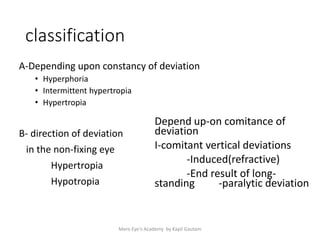
classification
Depend up-on comitance of
deviation
I-comitant vertical deviations
-Induced(refractive)
-End result of long-
standing -paralytic deviation
A-Depending upon constancy of deviation
• Hyperphoria
• Intermittent hypertropia
• Hypertropia
B- direction of deviation
in the non-fixing eye
Hypertropia
Hypotropia
Mero Eye's Academy by Kapil Gautam
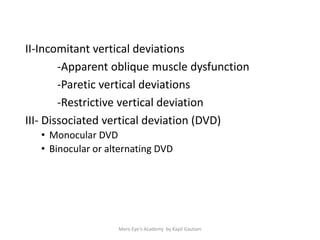
II-Incomitant vertical deviations
-Apparent oblique muscle dysfunction
-Paretic vertical deviations
-Restrictive vertical deviation
III- Dissociated vertical deviation (DVD)
• Monocular DVD
• Binocular or alternating DVD
Mero Eye's Academy by Kapil Gautam
Comitant vertical deviation
• Occur associated with horizontal deviation
• Types are
• Hypertropia- non-fixating eye is higher than the fixating
eye
• Hypotropia- vise-versa
• Etiology
• Correction of unequal refractive error
• Anomalous position of rest-anatomical
• Convertion of incomitant paralytic hyperdeviation
Mero Eye's Academy by Kapil Gautam
treatment
1-Orthoptics- to eliminate suppression may be
indicated prior to surgery
It is impossible to improve vertical fusional
vergence through orthoptic training
2-prismotherapy- smaller than 10D can correct prism
hypertropia= 5pd BD
Hypotropia= 5pdBU
3-Surgical correction
Mero Eye's Academy by Kapil Gautam
Incomitant vertical deviation
1- apparent oblique muscle dysfunction-
i-inferior oblique overaction now term as over-
elevation in adduction (OEA)
ii-inferior oblique underaction- now term as
under-elevation in adduction (UEA)
iii- superior oblique overaction now term as
over-depression in adduction (ODA)
Iv- superior oblique underaction-term as under-
depression in adduction (UDA)
Mero Eye's Academy by Kapil Gautam
2-paretic vertical deviations
• Congenital unilateral superior oblique paresis
• Non-congenital superior oblique paresis
• Bilateral superior oblique paresis
• Monocular elevation deficiency (MED) old name Double
elevator palsy
• Monocular depression deficiency (MDD)
• Superior rectus paresis
• Inferior rectus paresis
• Skew deviation
3- restrictive vertical deviationsMero Eye's Academy by Kapil Gautam
Inferior oblique overaction
1- primary overaction of the inferior oblique muscle
(PIOO)
• Referred to as over-elevation in adduction
• Due to mechanical or innervation causes or a
combination of the two
2- secondary overaction of the inferior oblique muscle
(SIOO)
-Caused by paralysis or paresis of either its
antagonist muscle (ipsilateral superior oblique
muscle) or its yoke muscle
Mero Eye's Academy by Kapil Gautam
Clinical feature
1-Age of oneset - PIOO occurs by the age 2-3yrs
-SIOO can occur at any age
2-Bilaterality – PIOO B/L
while SIOO is occasionally bilateral
3- Upshoot or over-elevation of the eye in adduction-
primary as well as secondary inferior oblique
overaction
- With the eyes in lateral gaze and the abducting
eye fixing
Mero Eye's Academy by Kapil Gautam
4- Associated horizontal deviation in primary position
PIOO – comitant esotripai (more) or exotropia (less)
SIOO – not associated with any form of concnmitant deviation
5- Associated vertical deviation in primary position
PIOO- Absence or less than 5D
SIOO – 22D
6- head tilt – SIOO – only present
7- Associated excyclodeviation
SIOO – hess screen test, Maddox rod test, major amblyope or
the Lancaster red-green
PSOO – Absence
Mero Eye's Academy by Kapil Gautam
Differential diagnosis
•Dissociated vertical deviation
•PIOO can be differentiated from the
secondary inferior oblique overaction
Mero Eye's Academy by Kapil Gautam
treatment
• Inferior oblique weakening procedures
• Disinsertion
• Myectomy extirpation
• Recession
• Recession with anterior transposition
Mero Eye's Academy by Kapil Gautam
Superior oblique overaction
• Referred as strabismus deorsoadduction
• Now term as over-depression in adduction (ODA)
• Characterized by a downshoot of the eye in
adduction
Mero Eye's Academy by Kapil Gautam
Etiology
1- primary overaction of the superior oblique muscle
(PSOO)
-may be due to mechanical or innervational causes or
a combination of the two
2- Secondary overaction of the superior oblique muscle-
cause by –paresis or paralysis of either its antagonist
muscle or its yolk muscle
Mero Eye's Academy by Kapil Gautam
Clinical features
-Unlike superior oblique muscle, isolated palsy in inferior
oblique is not much known and so is the secondary
overaction of the superior oblique muscle
-So, much so that all bilateral superior oblique muscle
overaction can be considered “primary”
- Primary superior oblique overaction (PSOO)
- Secondary superior oblique overaction (PSOO)
Mero Eye's Academy by Kapil Gautam
1- Age of oneset- PSOO- 2-3 yrs
SSOO = either spontaneously or few
weeks to months following paresis of ipsilateral inferior
oblique muscle or contralateral inferior rectus muscle
2- PSOO – bilateral
SSOO- unilateral or some time b/l
3- Downshoot of the eye in adduction
4- Associated horizontal deviation in primary position
5-Associated vertical deviation in primary position
6- Head tilt -SSOO
7-Associated incyclodeviation
Mero Eye's Academy by Kapil Gautam
Treatment
1- superior oblique tenotomy
2-superior oblique lengthening by insertion
Mero Eye's Academy by Kapil Gautam
Dissociated Vertical Deviations
•k/n as Alternating sursumduction
• Alternating hyperphoria
• Alternating hypertropia
• Alternating sursumvergence
• Occlusion hyperphoria
• Occlusion hypertropia
• Dissociated veritical divergence
• Dissociated hyperdeviation
Mero Eye's Academy by Kapil Gautam
• Don’t follow the Hering’s law of ocular motility
• Since the upward drifting of the non-fixing eye os often
associated with lateral deviation and excyclotorsion the
term Dissociated strabismus complex (DSC)
• Suggested to denote all the component
• Dissociated vertical deviation (DVD)
• Dissociated horizontal deviation (DHD)
• Dissociated torsional deviation (DTD)
Mero Eye's Academy by Kapil Gautam
Etiology
• Bielschoswsky’s theory of position and negative
subcortical vertical divergence centres – due to
alternating and intermittent excitation of both
subcortical vertical divergence centers
• Therory of imbalance binocular stimulation- DVD cause
by imbalance of binocular stimulation
• Brodsky theory- DVD is vetstigial remnant of the dorsal
light reflex of lower animals
• Other theory
• Theory of bilateral paralysis of the depressor muscles
• Theory of defective mid-brain stimuli
• Guyton’s theory
Mero Eye's Academy by Kapil Gautam
Clinical features
1-Deviation – spontaneous occurrence pf vertical deviation
in either eye
A day dreaming = manifest DVD
Fusion is interrupted by artificial means = latent DVD
2- association
-75% cases of essential infantile esotropia
-Usually diagnosed betw 2 to 5 yrs
-In infantile exotropia
-Excycloduction and latent nystagmus
Mero Eye's Academy by Kapil Gautam
4-laterality-frequently bilateral but rarely may be
monocular
monocular dissociated hyperdeviation – presence of an
intermittent exotropia
Frequently found that when fusion is broken and
the eye is deviated, the deviated eye develops a
small hyperdeviation
5- Binocular vision and sensory adaptation
suppression usually develops in pts with
spontaneous DVD
- Absolute facultative central scotoma
Mero Eye's Academy by Kapil Gautam
Diagnosis
1-cover-uncover test
• Pt with unilateral manifest DVD
• In pt with alternate DVD
• In pts with latent DVD- present only when the eyes have been
dissociated
2-Head tilt test- contralateral head tilt
(right eye increases with left head tilt)
3- Red glass test-
diplopia can be elicited in most pts with dark-red
glass
4-Demonstration of bielshowsky phenomenon
Mero Eye's Academy by Kapil Gautam
5-mesurment of DVD
I- prism base-down under the occlude test
II- modified form of Krimsky test- used to measure
DVD in pt who cant fix with deviating eye
III- An approximate grading pf DVD
1+ deviation = a slight deviation
2+ deviation = a small deviation
3+ Deviation = moderate deviation
4+ deviation = a large deviation
Mero Eye's Academy by Kapil Gautam
•Differential diagnosis-
DVD must be differential from
inferior oblique overaction
Mero Eye's Academy by Kapil Gautam
Treatment
A-Non-surgical treatment
conservative therapy in the form of changing
the fixation pattern by patching or optical means
may be useful
B- surgical treatment
Mero Eye's Academy by Kapil Gautam

Vertical Strabismus and Cyclo-deviations

  • 1.
    Vertical strabismus and Cyclo– deviations KAPIL GAUTAM Institute Of Medicine, MMC, KTM, Nepal Mero Eye's Academy by Kapil Gautam
  • 2.
    classification Depend up-on comitanceof deviation I-comitant vertical deviations -Induced(refractive) -End result of long- standing -paralytic deviation A-Depending upon constancy of deviation • Hyperphoria • Intermittent hypertropia • Hypertropia B- direction of deviation in the non-fixing eye Hypertropia Hypotropia Mero Eye's Academy by Kapil Gautam
  • 3.
    II-Incomitant vertical deviations -Apparentoblique muscle dysfunction -Paretic vertical deviations -Restrictive vertical deviation III- Dissociated vertical deviation (DVD) • Monocular DVD • Binocular or alternating DVD Mero Eye's Academy by Kapil Gautam
  • 4.
    Comitant vertical deviation •Occur associated with horizontal deviation • Types are • Hypertropia- non-fixating eye is higher than the fixating eye • Hypotropia- vise-versa • Etiology • Correction of unequal refractive error • Anomalous position of rest-anatomical • Convertion of incomitant paralytic hyperdeviation Mero Eye's Academy by Kapil Gautam
  • 5.
    treatment 1-Orthoptics- to eliminatesuppression may be indicated prior to surgery It is impossible to improve vertical fusional vergence through orthoptic training 2-prismotherapy- smaller than 10D can correct prism hypertropia= 5pd BD Hypotropia= 5pdBU 3-Surgical correction Mero Eye's Academy by Kapil Gautam
  • 6.
    Incomitant vertical deviation 1-apparent oblique muscle dysfunction- i-inferior oblique overaction now term as over- elevation in adduction (OEA) ii-inferior oblique underaction- now term as under-elevation in adduction (UEA) iii- superior oblique overaction now term as over-depression in adduction (ODA) Iv- superior oblique underaction-term as under- depression in adduction (UDA) Mero Eye's Academy by Kapil Gautam
  • 7.
    2-paretic vertical deviations •Congenital unilateral superior oblique paresis • Non-congenital superior oblique paresis • Bilateral superior oblique paresis • Monocular elevation deficiency (MED) old name Double elevator palsy • Monocular depression deficiency (MDD) • Superior rectus paresis • Inferior rectus paresis • Skew deviation 3- restrictive vertical deviationsMero Eye's Academy by Kapil Gautam
  • 8.
    Inferior oblique overaction 1-primary overaction of the inferior oblique muscle (PIOO) • Referred to as over-elevation in adduction • Due to mechanical or innervation causes or a combination of the two 2- secondary overaction of the inferior oblique muscle (SIOO) -Caused by paralysis or paresis of either its antagonist muscle (ipsilateral superior oblique muscle) or its yoke muscle Mero Eye's Academy by Kapil Gautam
  • 9.
    Clinical feature 1-Age ofoneset - PIOO occurs by the age 2-3yrs -SIOO can occur at any age 2-Bilaterality – PIOO B/L while SIOO is occasionally bilateral 3- Upshoot or over-elevation of the eye in adduction- primary as well as secondary inferior oblique overaction - With the eyes in lateral gaze and the abducting eye fixing Mero Eye's Academy by Kapil Gautam
  • 10.
    4- Associated horizontaldeviation in primary position PIOO – comitant esotripai (more) or exotropia (less) SIOO – not associated with any form of concnmitant deviation 5- Associated vertical deviation in primary position PIOO- Absence or less than 5D SIOO – 22D 6- head tilt – SIOO – only present 7- Associated excyclodeviation SIOO – hess screen test, Maddox rod test, major amblyope or the Lancaster red-green PSOO – Absence Mero Eye's Academy by Kapil Gautam
  • 11.
    Differential diagnosis •Dissociated verticaldeviation •PIOO can be differentiated from the secondary inferior oblique overaction Mero Eye's Academy by Kapil Gautam
  • 12.
    treatment • Inferior obliqueweakening procedures • Disinsertion • Myectomy extirpation • Recession • Recession with anterior transposition Mero Eye's Academy by Kapil Gautam
  • 13.
    Superior oblique overaction •Referred as strabismus deorsoadduction • Now term as over-depression in adduction (ODA) • Characterized by a downshoot of the eye in adduction Mero Eye's Academy by Kapil Gautam
  • 14.
    Etiology 1- primary overactionof the superior oblique muscle (PSOO) -may be due to mechanical or innervational causes or a combination of the two 2- Secondary overaction of the superior oblique muscle- cause by –paresis or paralysis of either its antagonist muscle or its yolk muscle Mero Eye's Academy by Kapil Gautam
  • 15.
    Clinical features -Unlike superioroblique muscle, isolated palsy in inferior oblique is not much known and so is the secondary overaction of the superior oblique muscle -So, much so that all bilateral superior oblique muscle overaction can be considered “primary” - Primary superior oblique overaction (PSOO) - Secondary superior oblique overaction (PSOO) Mero Eye's Academy by Kapil Gautam
  • 16.
    1- Age ofoneset- PSOO- 2-3 yrs SSOO = either spontaneously or few weeks to months following paresis of ipsilateral inferior oblique muscle or contralateral inferior rectus muscle 2- PSOO – bilateral SSOO- unilateral or some time b/l 3- Downshoot of the eye in adduction 4- Associated horizontal deviation in primary position 5-Associated vertical deviation in primary position 6- Head tilt -SSOO 7-Associated incyclodeviation Mero Eye's Academy by Kapil Gautam
  • 17.
    Treatment 1- superior obliquetenotomy 2-superior oblique lengthening by insertion Mero Eye's Academy by Kapil Gautam
  • 18.
    Dissociated Vertical Deviations •k/nas Alternating sursumduction • Alternating hyperphoria • Alternating hypertropia • Alternating sursumvergence • Occlusion hyperphoria • Occlusion hyperphoria • Occlusion hypertropia • Dissociated veritical divergence • Dissociated hyperdeviation Mero Eye's Academy by Kapil Gautam
  • 19.
    • Don’t followthe Hering’s law of ocular motility • Since the upward drifting of the non-fixing eye os often associated with lateral deviation and excyclotorsion the term Dissociated strabismus complex (DSC) • Suggested to denote all the component • Dissociated vertical deviation (DVD) • Dissociated horizontal deviation (DHD) • Dissociated torsional deviation (DTD) Mero Eye's Academy by Kapil Gautam
  • 20.
    Etiology • Bielschoswsky’s theoryof position and negative subcortical vertical divergence centres – due to alternating and intermittent excitation of both subcortical vertical divergence centers • Therory of imbalance binocular stimulation- DVD cause by imbalance of binocular stimulation • Brodsky theory- DVD is vetstigial remnant of the dorsal light reflex of lower animals • Other theory • Theory of bilateral paralysis of the depressor muscles • Theory of defective mid-brain stimuli • Guyton’s theory Mero Eye's Academy by Kapil Gautam
  • 21.
    Clinical features 1-Deviation –spontaneous occurrence pf vertical deviation in either eye A day dreaming = manifest DVD Fusion is interrupted by artificial means = latent DVD 2- association -75% cases of essential infantile esotropia -Usually diagnosed betw 2 to 5 yrs -In infantile exotropia -Excycloduction and latent nystagmus Mero Eye's Academy by Kapil Gautam
  • 22.
    4-laterality-frequently bilateral butrarely may be monocular monocular dissociated hyperdeviation – presence of an intermittent exotropia Frequently found that when fusion is broken and the eye is deviated, the deviated eye develops a small hyperdeviation 5- Binocular vision and sensory adaptation suppression usually develops in pts with spontaneous DVD - Absolute facultative central scotoma Mero Eye's Academy by Kapil Gautam
  • 23.
    Diagnosis 1-cover-uncover test • Ptwith unilateral manifest DVD • In pt with alternate DVD • In pts with latent DVD- present only when the eyes have been dissociated 2-Head tilt test- contralateral head tilt (right eye increases with left head tilt) 3- Red glass test- diplopia can be elicited in most pts with dark-red glass 4-Demonstration of bielshowsky phenomenon Mero Eye's Academy by Kapil Gautam
  • 24.
    5-mesurment of DVD I-prism base-down under the occlude test II- modified form of Krimsky test- used to measure DVD in pt who cant fix with deviating eye III- An approximate grading pf DVD 1+ deviation = a slight deviation 2+ deviation = a small deviation 3+ Deviation = moderate deviation 4+ deviation = a large deviation Mero Eye's Academy by Kapil Gautam
  • 25.
    •Differential diagnosis- DVD mustbe differential from inferior oblique overaction Mero Eye's Academy by Kapil Gautam
  • 26.
    Treatment A-Non-surgical treatment conservative therapyin the form of changing the fixation pattern by patching or optical means may be useful B- surgical treatment Mero Eye's Academy by Kapil Gautam