Contact Lens Fitting
1. Introduction to Contact Lens Fitting
CONTACT LENS FITTING –
PROTOCOL
Patient screening
Preliminary examination &
measurements
Trial lens fitting
Lens dispensing
After-care
PATIENT SCREENING
Establish why the patient wants CLs
Is the patient suitable for CLs ?
Obtain baseline information
Advise patient of their options
PRELIMINARY EXAMINATION
AND MEASUREMENTS
 A slit-lamp examination of the anterior
segment.
 Keratometry.
 Corneal and pupil size measurements.
 Assessment of lid characteristics.
 A tear assessment.
 A spectacle refraction and calculation of
the ocular Rx (corneal-plane refraction).
KERATOMETRY
 Corneal curvature is the most important
measurement needed before starting CL
fitting.
 Measures only 3 mm of the corneal curvature
 Corneal topography gives the complete
mapping of the cornea.
 KR measurement is sufficient in most of the
fittings.
Corneal irregularity also noted.
The reading also tell us about the
degree of corneal astigmatism.
The BC of the CL is determined by
the corneal curvature
measurements.
CORNEAL DIAMETER
 HVID – Horizontal Visible Iris Diameter
 VVID – Vertical Visible Iris Diameter
 With a simple millimeter scale ,measuring
the limbus to limbus size both across the
horizontal and vertical lengths.
 The corneal diameter aids in
determination of the total diameter of the
CL.
PUPIL SIZE
 The diameter of the pupil is measured by
a simple millimeter scale both in standard
room illumination and low illumination .
 This aids in determining the optic zone
size of the CL.
TRIAL FITTING: ROUTINE
 Diagnostic fitting
A diagnostic or trial fitting uses a series of
lenses, chosen on the basis of the findings of
the preliminary examination.
Lenses are assessed sequentially until a
desirable fit is obtained.
The aim of the trial fit is ensure a good lens-
cornea relationship with the design chosen
and to confirm the final Rx required.
 Final lens order
TRIAL FITTING: LENS SELECTION
Back optic zone radius (BOZR).
Total diameter (TD).
Water content (for soft contact lenses).
Lens design (lenticular, multicurve,
surface shape, etc.).
Lens type (spherical, toric, bifocal, etc.).
Lens material.
BVP
TRIAL FITTING: PROCEDURE
 Initial lens selection.
 Trial lens fitting and vision assessment.
 Subsequent trial lens selection.
If Trial lens required is not available:
Empirical Prescribing
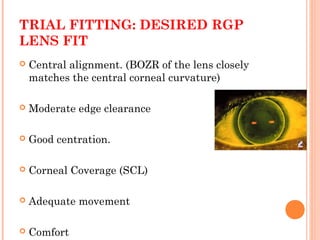
TRIAL FITTING: DESIRED RGP
LENS FIT
 Central alignment. (BOZR of the lens closely
matches the central corneal curvature)
 Moderate edge clearance
 Good centration.
 Corneal Coverage (SCL)
 Adequate movement
 Comfort
TRIAL FITTING: FINAL LENS
ORDER
 Lens parameters
 Lens material and type
 Special requirements
 Delivery date required
LENS DISPENSING
 •Provide information on the lens care regimen
 • Practise insertion and removal techniques
 • Provide information on adaptation
 • Provide information on signs of complications
 • After-care visit schedule
AFTER-CARE
 Investigate complaints
 Perform general ocular examination:
 - Over-refraction
 - Slit-lamp microscopy
 - Other tests particular to the patient
 Assess lens fit
 Review lens care regimen
 Schedule next after-care visit
THANK U

Introduction to cl fitting

  • 1.
    Contact Lens Fitting 1.Introduction to Contact Lens Fitting
  • 2.
    CONTACT LENS FITTING– PROTOCOL Patient screening Preliminary examination & measurements Trial lens fitting Lens dispensing After-care
  • 3.
    PATIENT SCREENING Establish whythe patient wants CLs Is the patient suitable for CLs ? Obtain baseline information Advise patient of their options
  • 4.
    PRELIMINARY EXAMINATION AND MEASUREMENTS A slit-lamp examination of the anterior segment.  Keratometry.  Corneal and pupil size measurements.  Assessment of lid characteristics.  A tear assessment.  A spectacle refraction and calculation of the ocular Rx (corneal-plane refraction).
  • 5.
    KERATOMETRY  Corneal curvatureis the most important measurement needed before starting CL fitting.  Measures only 3 mm of the corneal curvature  Corneal topography gives the complete mapping of the cornea.  KR measurement is sufficient in most of the fittings.
  • 6.
    Corneal irregularity alsonoted. The reading also tell us about the degree of corneal astigmatism. The BC of the CL is determined by the corneal curvature measurements.
  • 7.
    CORNEAL DIAMETER  HVID– Horizontal Visible Iris Diameter  VVID – Vertical Visible Iris Diameter  With a simple millimeter scale ,measuring the limbus to limbus size both across the horizontal and vertical lengths.  The corneal diameter aids in determination of the total diameter of the CL.
  • 8.
    PUPIL SIZE  Thediameter of the pupil is measured by a simple millimeter scale both in standard room illumination and low illumination .  This aids in determining the optic zone size of the CL.
  • 9.
    TRIAL FITTING: ROUTINE Diagnostic fitting A diagnostic or trial fitting uses a series of lenses, chosen on the basis of the findings of the preliminary examination. Lenses are assessed sequentially until a desirable fit is obtained. The aim of the trial fit is ensure a good lens- cornea relationship with the design chosen and to confirm the final Rx required.  Final lens order
  • 10.
    TRIAL FITTING: LENSSELECTION Back optic zone radius (BOZR). Total diameter (TD). Water content (for soft contact lenses). Lens design (lenticular, multicurve, surface shape, etc.). Lens type (spherical, toric, bifocal, etc.). Lens material. BVP
  • 11.
    TRIAL FITTING: PROCEDURE Initial lens selection.  Trial lens fitting and vision assessment.  Subsequent trial lens selection. If Trial lens required is not available: Empirical Prescribing
  • 12.
    TRIAL FITTING: DESIREDRGP LENS FIT  Central alignment. (BOZR of the lens closely matches the central corneal curvature)  Moderate edge clearance  Good centration.  Corneal Coverage (SCL)  Adequate movement  Comfort
  • 13.
    TRIAL FITTING: FINALLENS ORDER  Lens parameters  Lens material and type  Special requirements  Delivery date required
  • 14.
    LENS DISPENSING  •Provideinformation on the lens care regimen  • Practise insertion and removal techniques  • Provide information on adaptation  • Provide information on signs of complications  • After-care visit schedule
  • 15.
    AFTER-CARE  Investigate complaints Perform general ocular examination:  - Over-refraction  - Slit-lamp microscopy  - Other tests particular to the patient  Assess lens fit  Review lens care regimen  Schedule next after-care visit
  • 16.