Aberrations in Optical Aids
Mohammad Arman Bin Aziz
Instructor Optometrist
Institute of Community Ophthalmology
Contents of presentation
Definition of aberration
Types of aberration
Reduction of monochromatic aberration.
A discussion of 5 types of monochromatic
aberration.
•Monochromatic aberrations:
image is blurred or deformed due to the
approximation error in the paraxial
approximation to the exact solution.
• Chromatic aberrations:
rays corresponding to different wavelengths
travel different paths
Aberrations:
chromatic and monochromatic
Monochromatic Aberration
• Monochromatic aberration is due to the
paraxial rays are just an approximation to the
real case.
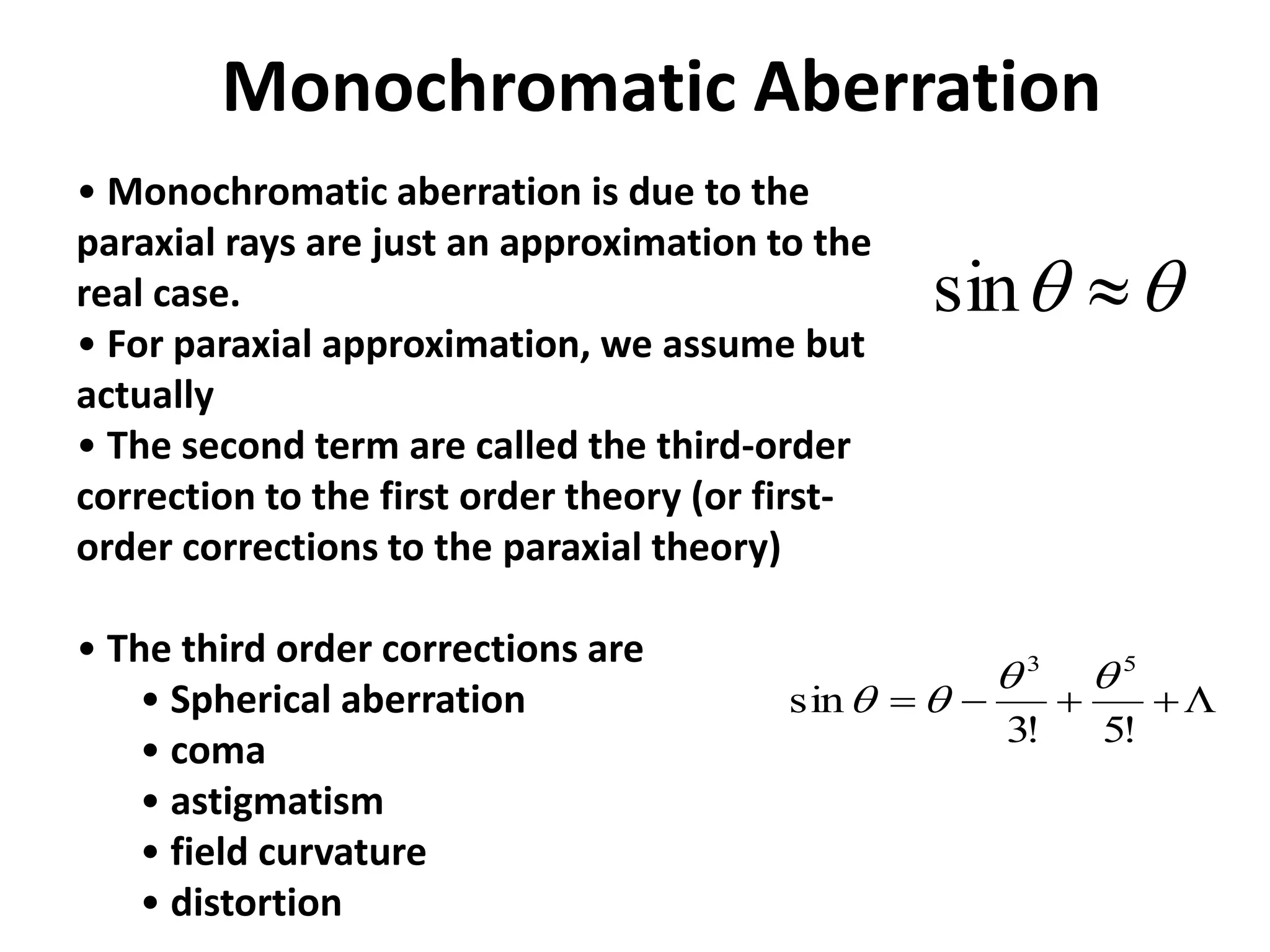
• For paraxial approximation, we assume but
actually
• The second term are called the third-order
correction to the first order theory (or first-
order corrections to the paraxial theory)
• The third order corrections are
• Spherical aberration
• coma
• astigmatism
• field curvature
• distortion
 sin

!5!3
sin
53


Monochromatic aberration
• Are image imperfection occurring due to a
form of lens and from monochromatic light.
• In 1850 Seidel described 5 monochromatic
aberration.
• also called as seidel aberration.
Seidel aberrations
• Depends on lens diameter, object size and
lens position.
• Independent of wavelength.
• Full correction of one aberration requires
correction of all previous aberrations
• Expressed as 5 terms on coefficients-
• denoted by s1, s2, s3, s4, s5
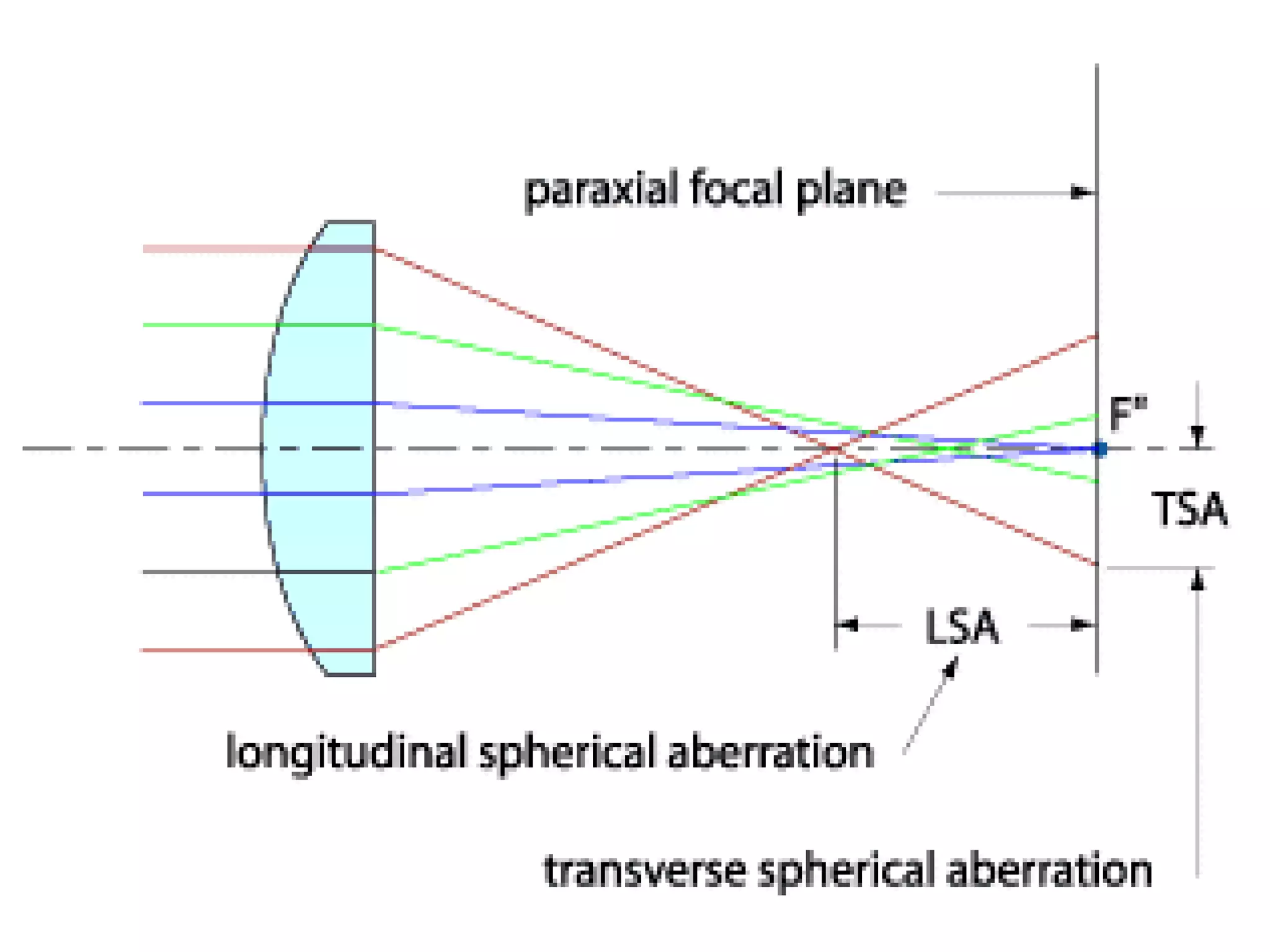
Spherical aberration
• Occurs when a pencil of
light is refracted by a large
aperture system.
• Affects sharpness of
image.
• Occurs because different
zone of aperture lens have
different focal length.
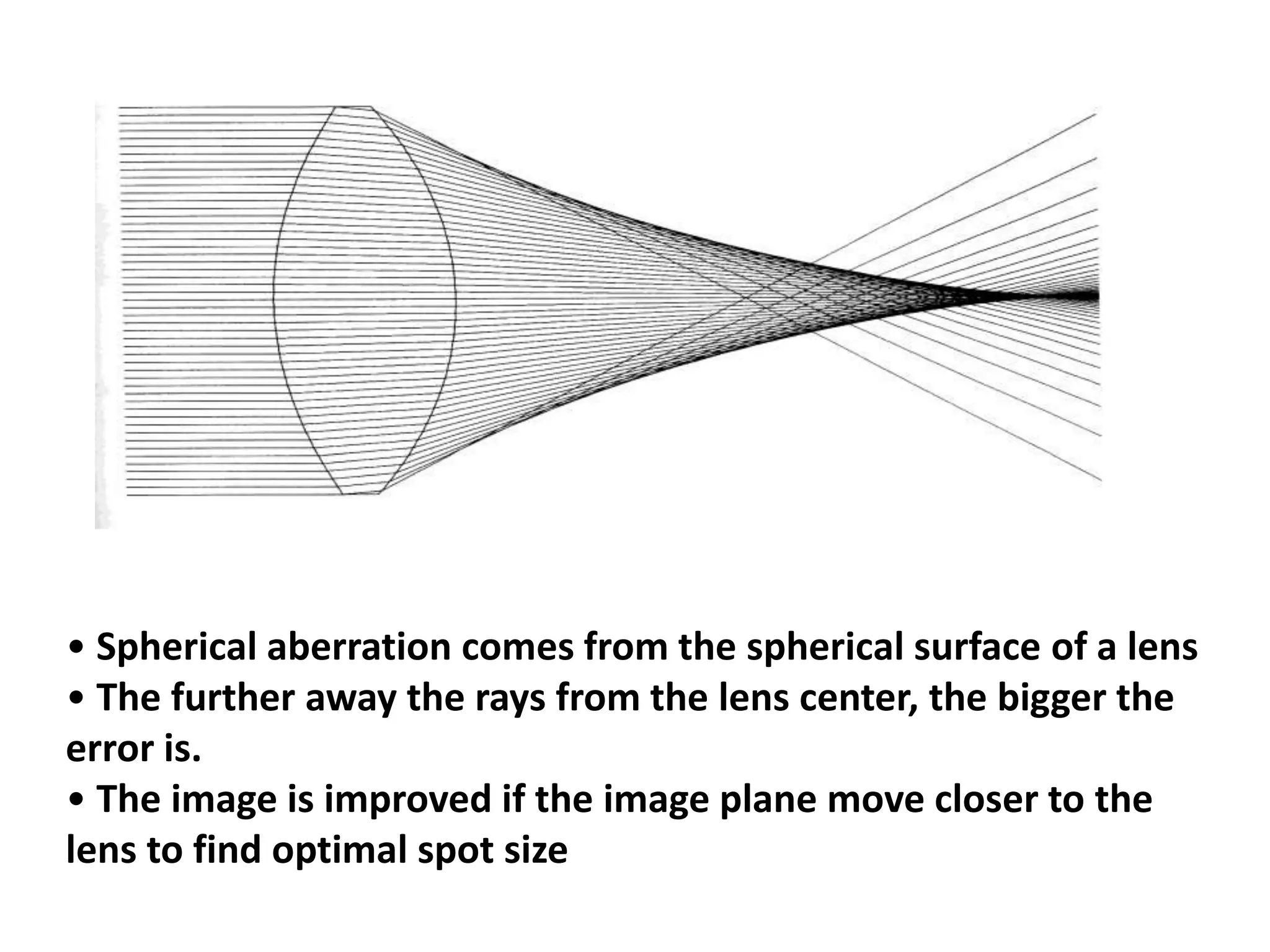
• Spherical aberration comes from the spherical surface of a lens
• The further away the rays from the lens center, the bigger the
error is.
• The image is improved if the image plane move closer to the
lens to find optimal spot size
Types
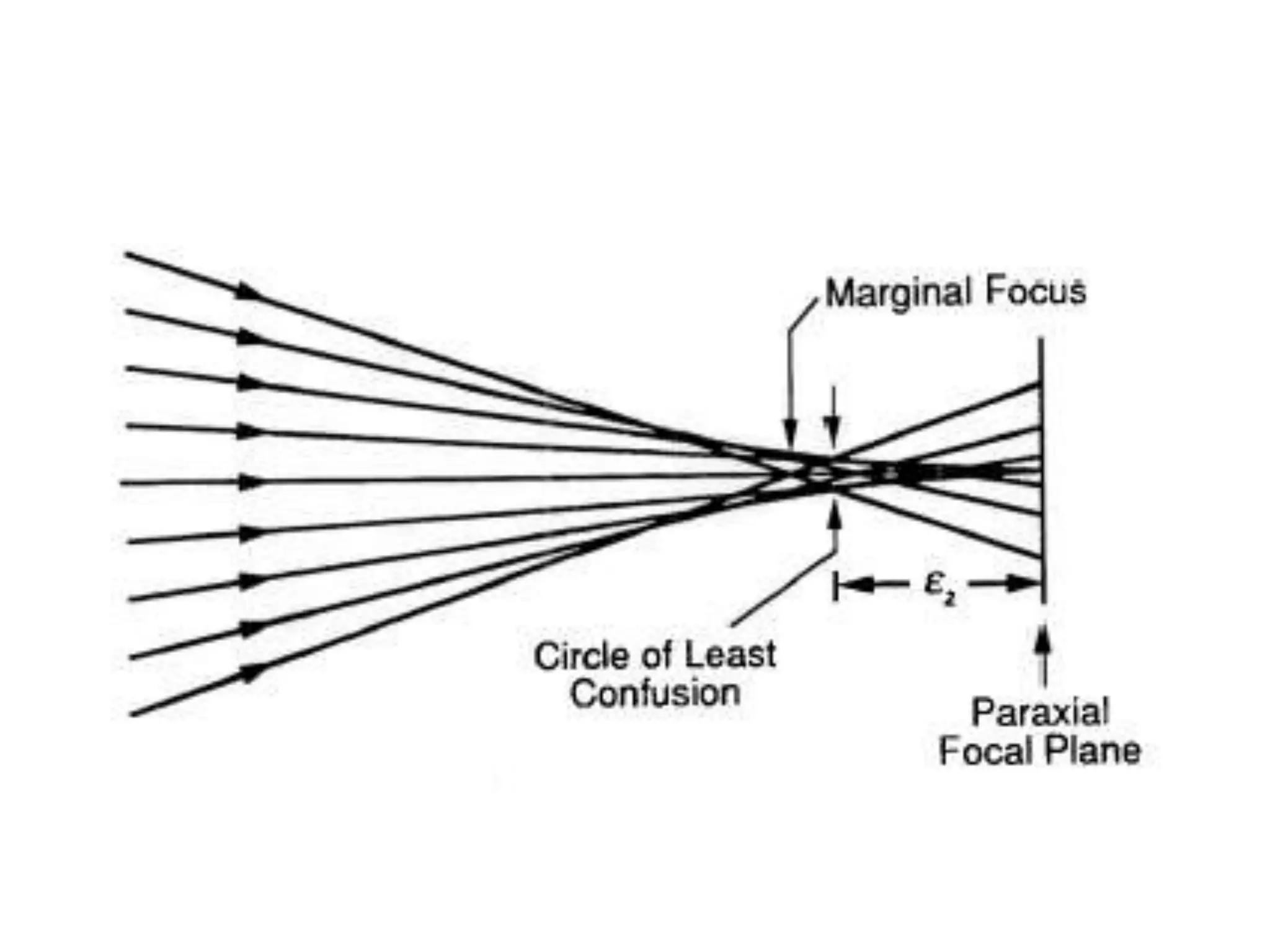
• Longitudinal spherical aberration-refers to
separation of paraxial and marginal focus in
diopter along optical axis
• Increases with square of aperture.
• Transverse spherical aberration-measured in
terms of image height differences by two
focuses .
• Increases with cube of aperture
Reduction of spherical aberration
stop transmit all rays (only paraxial rays)
Aplantic surface
High powered lenses
Aspheric surfaces
Coma
• Occurs when oblique rays are refracted by a
large aperture optical system.
• Affects sharpness of image points.
• Also called as off axial spherical aberration.
• Rarely a problem with spectacle lenses;
limiting effect of pupil .
Coma
• Arises from off-axis object points.
• The transverse magnification is a function of ray height
• The resulting pattern is like a comet.
• Image resembles a comet or a tear drop.
• Comet shaped patch is formed by a series of
comatic circles .
Reduction of coma-
• controlling aperture size
• Lens form
• Angle of obliquity
• Using aplantic surfaces
Oblique astigmatism
• Also called as radial or marginal astigmatism
• Occurs when oblique rays are refracted by a
narrow-aperture system
• Affects both sharpness of image points and
image position.
• Affects the off axial objects point only.
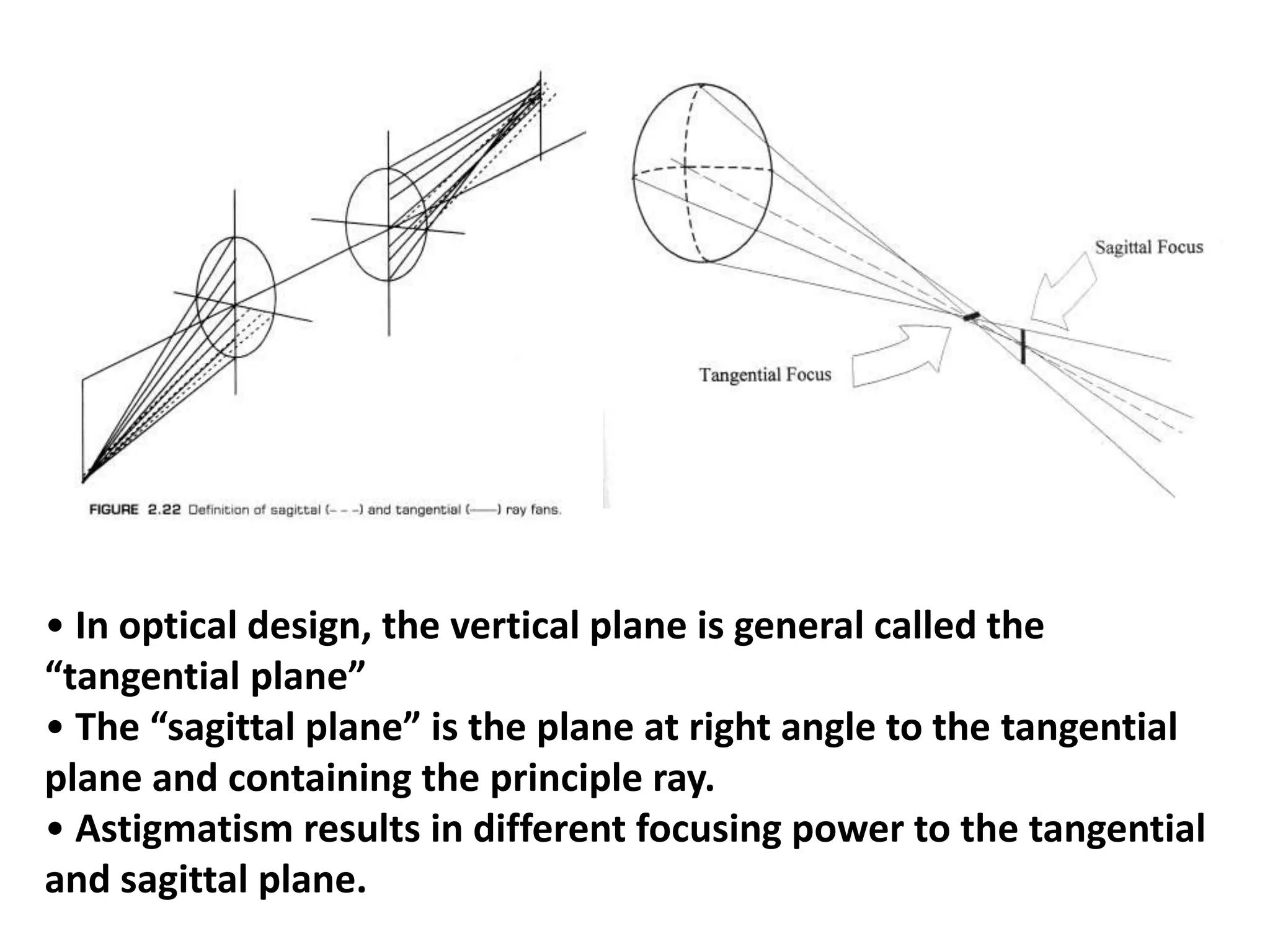
• In optical design, the vertical plane is general called the
“tangential plane”
• The “sagittal plane” is the plane at right angle to the tangential
plane and containing the principle ray.
• Astigmatism results in different focusing power to the tangential
and sagittal plane.
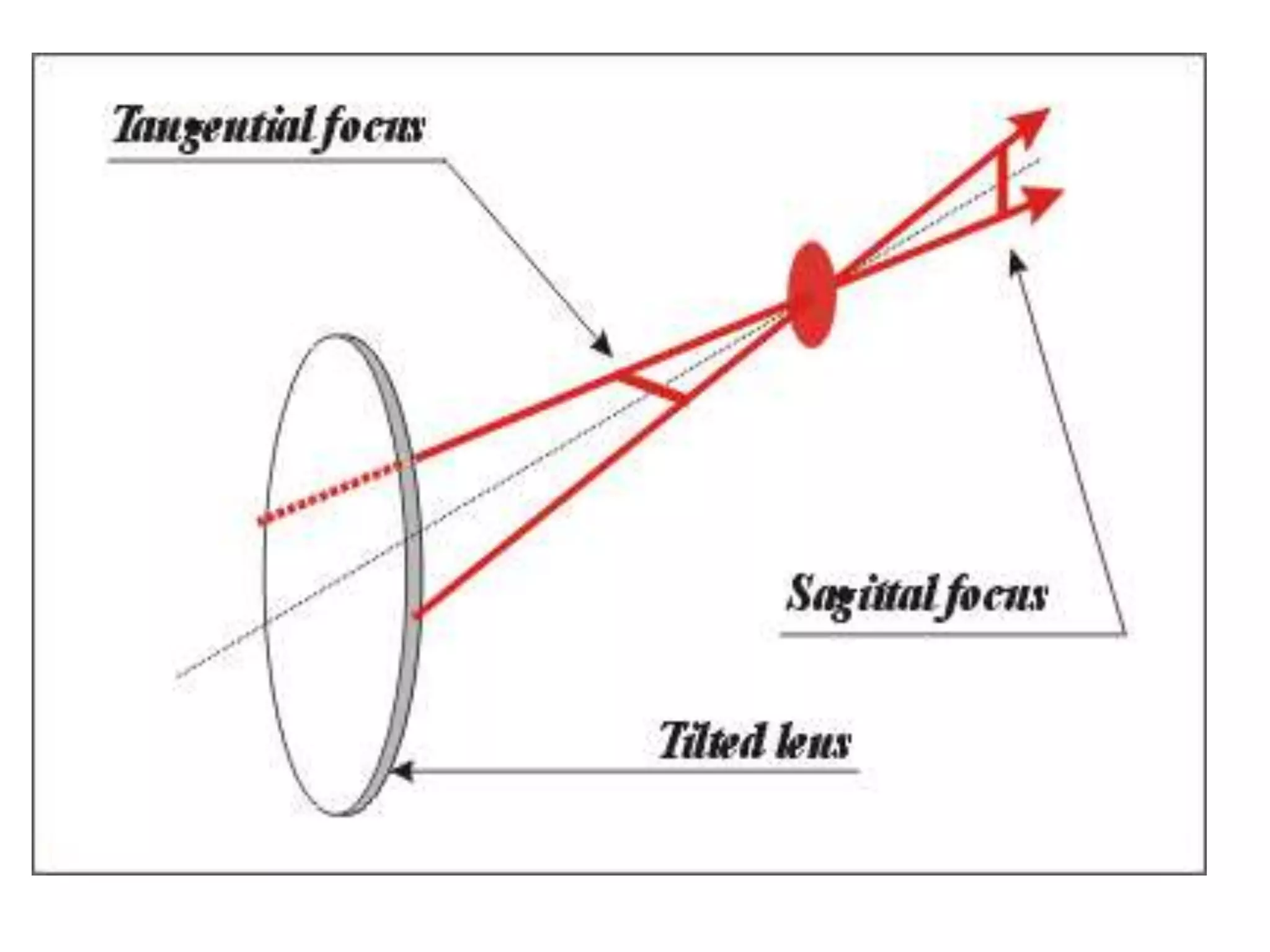
tangential
sagittal
Astigmatism often arises when focusing with a mirror with an angle
• Inability of a lens to form a point image of
an oblique point object.
• Interval of sturms –2 line foci and circle of
least confusion.
• Plane and foci-
• Tangential plane-contains chief ray from
object and optic axis .
• Saggital plane –contain chief ray and
perpendicular to tangential plane
• Tangential foci –primary or meridional
foci
• Saggital focus –secondary or
equatorial focus
• Petzvals surface-curved surface along
which image of a planed object lies.
• Oblique astigmatism occurs when oblique
power of lens is always weaker than axial
power
• Reduction –use of steeper curvature lens
eg-meniscus lens
Curvature of image
• Inability of a lens to form a plane image
of a plane object.
• Image surface is known as petzval
surface.
• Manifest itself as a curved image
surfaces for a flat object surface
• Affects image position.
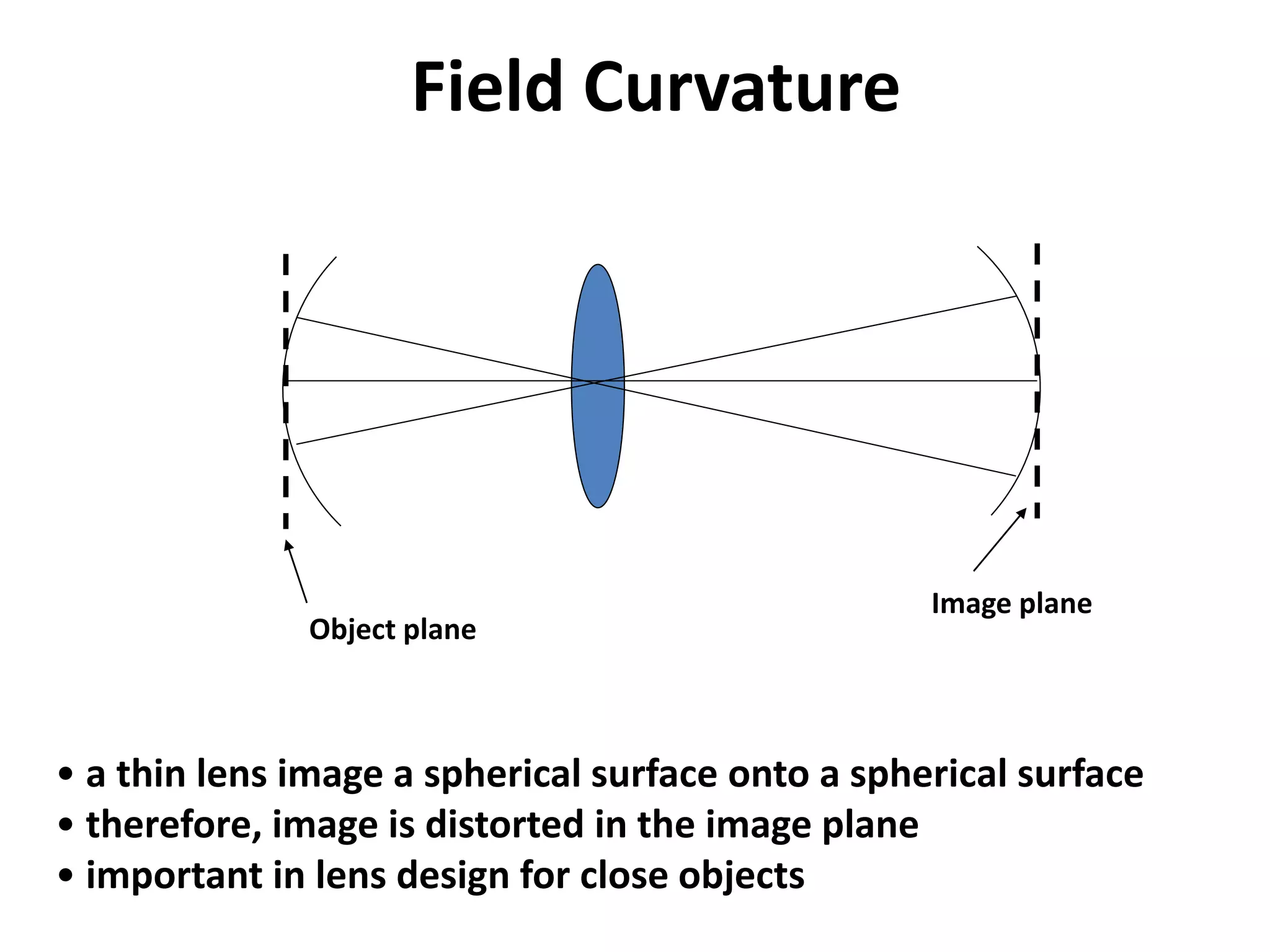
Field Curvature
• a thin lens image a spherical surface onto a spherical surface
• therefore, image is distorted in the image plane
• important in lens design for close objects
Object plane
Image plane
Far point sphere
• It is a locus of points conjugate to fovea
as eye rotates .
• Centre is absent only when image
corresponds to far point sphere.
Reduction
• Using lens having lower refractive index.
• Slightly overcorrecting myopic eye when
oblique astigmatism is absent .
• Far point of eye –property of eye
• Petzval surfaces –property of correcting lens
• If A is permitted, p can be controlled
• By combining 2 lenses one plus and one
minus.
• Cannot be controlled by altering lens form.
Distortion
• Inability of lens to form an image of same
shape as object.
• Occurs when magnification of extended
image varies with distance of corresponding
object from optical axis .
• Affects image shape and lateral position but
not image clarity.
• When ratio of image size to object size
has constant value for all object size, no
distortion occurs called as condition of
orthoscopy.
• Pupil of a eye acts as a stop behind a
spectacle lens .
• Mainly a problem for lenses of high
power.
• For plus lens ,virtual image suffers a
pinchusion distortion.
• For a minus lens virtual image suffers
barrel distortion.
• Can be reduced by aspheric lenses and
using steeper back surfaces.
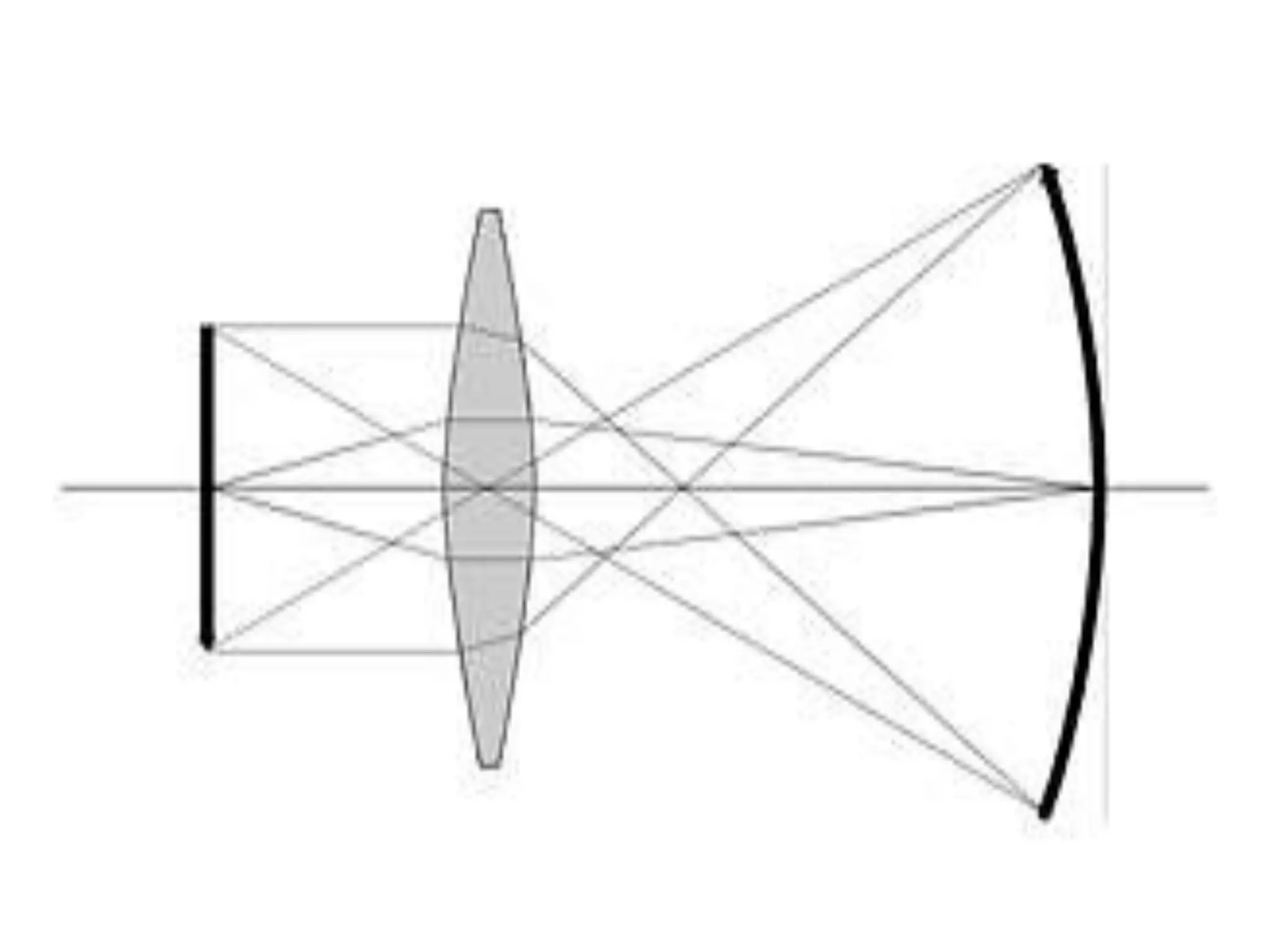
Distortion
With distortion Corrected
• all points in the object plane are imaged to points in image
plane
• Distortion arises when he magnification of off-axis image is a
function of the distance to the lens center
Summary of presentation
Spherical
aberration
coma Oblique
astigmatism
Curvature of
image
distortio
n
Affects
sharpness of
image
Affects
sharpness of
image
Affects both
shapness and
position of
image
Affects
position of
image
Affects
laterality
of image
and
position
B. Chromatic Aberration
• When white light is refracted at an optical
interface, dispersed into its component
wavelength or colors
• Shorter the wavelength, more it is deviated
on refraction with series of color images
formed
• Total dispersion from the red to the blue
image being approx 1.5 to 2 D
• Emmetropic eye focuses for the yellow
green portion of spectrum, lies approx.
in the middle of the range of retinal
sensitivity
• Thus approx 0.75 to 1.00D of CA lie on
either side of the maximally sharp focus
• For average eye difference between red
and blue foci is 0.5 D
• Caused by material from which lens is
made
Types of Chromatic aberration
 Lateral(Transverse CA)
• Defect of an optical system in which size of
image of a point object is extended by a
colored fringe, due to unequal refraction of
different wavelength(dispersion)
• Known as chromatic difference of
magnification
• Transverse (lateral) - lens
y
TCAlens = y’C - y’F
TCAlens =
yF
V
Chromatic Aberration
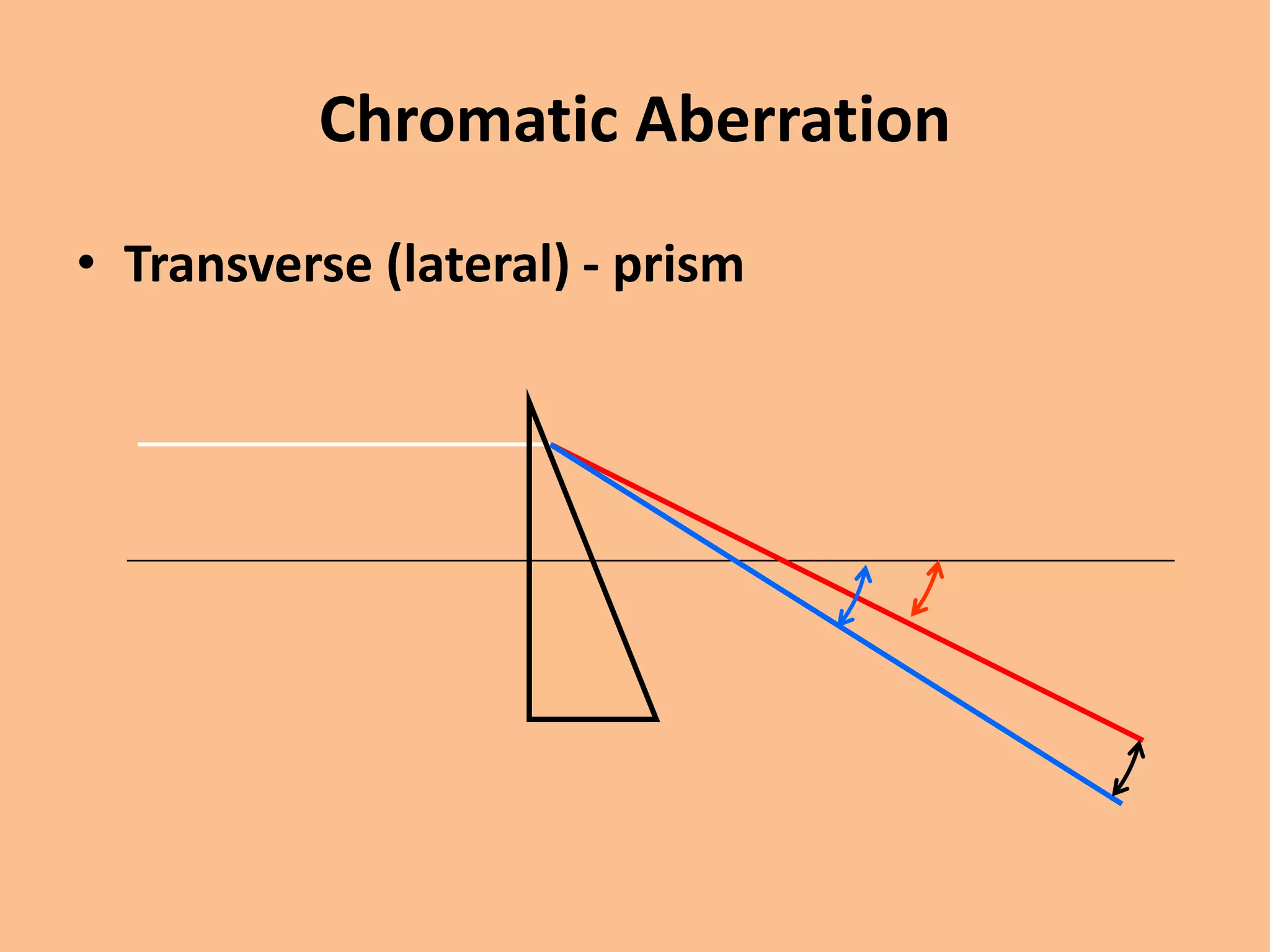
• Transverse (lateral) - prism
Longitudinal chromatic aberration
• Due to unequal refraction of different
wavelengths(dispersion) which results in an
extended image along the optical axis
• Blue focuses in front of red
• Dispersion (dispersive power)
– longitudinal (axial) chromatic aberration of an
optical material:
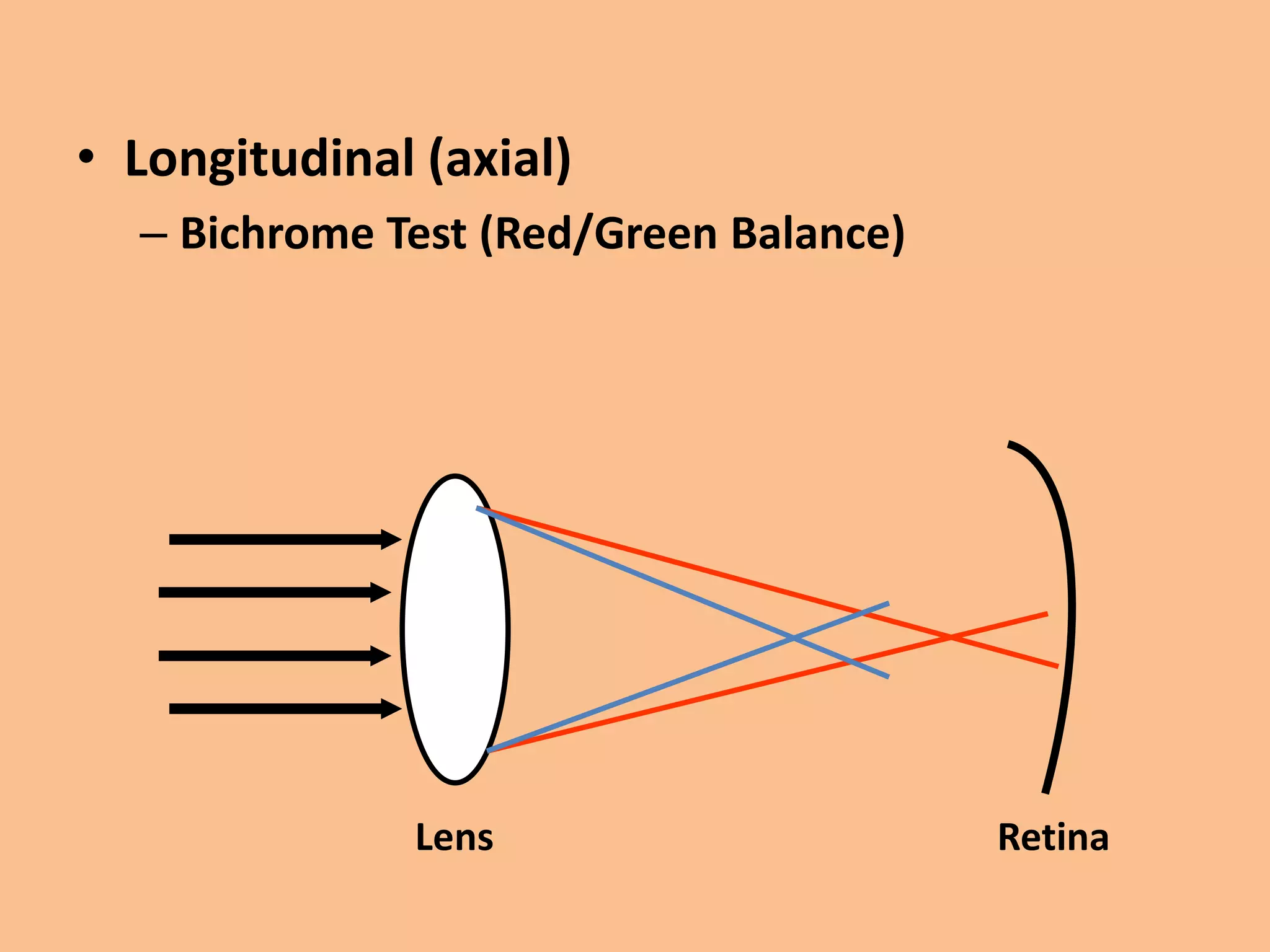
• Longitudinal (axial)
– Bichrome Test (Red/Green Balance)
Lens Retina
• Longitudinal (axial)
Treatment of chromatic aberration
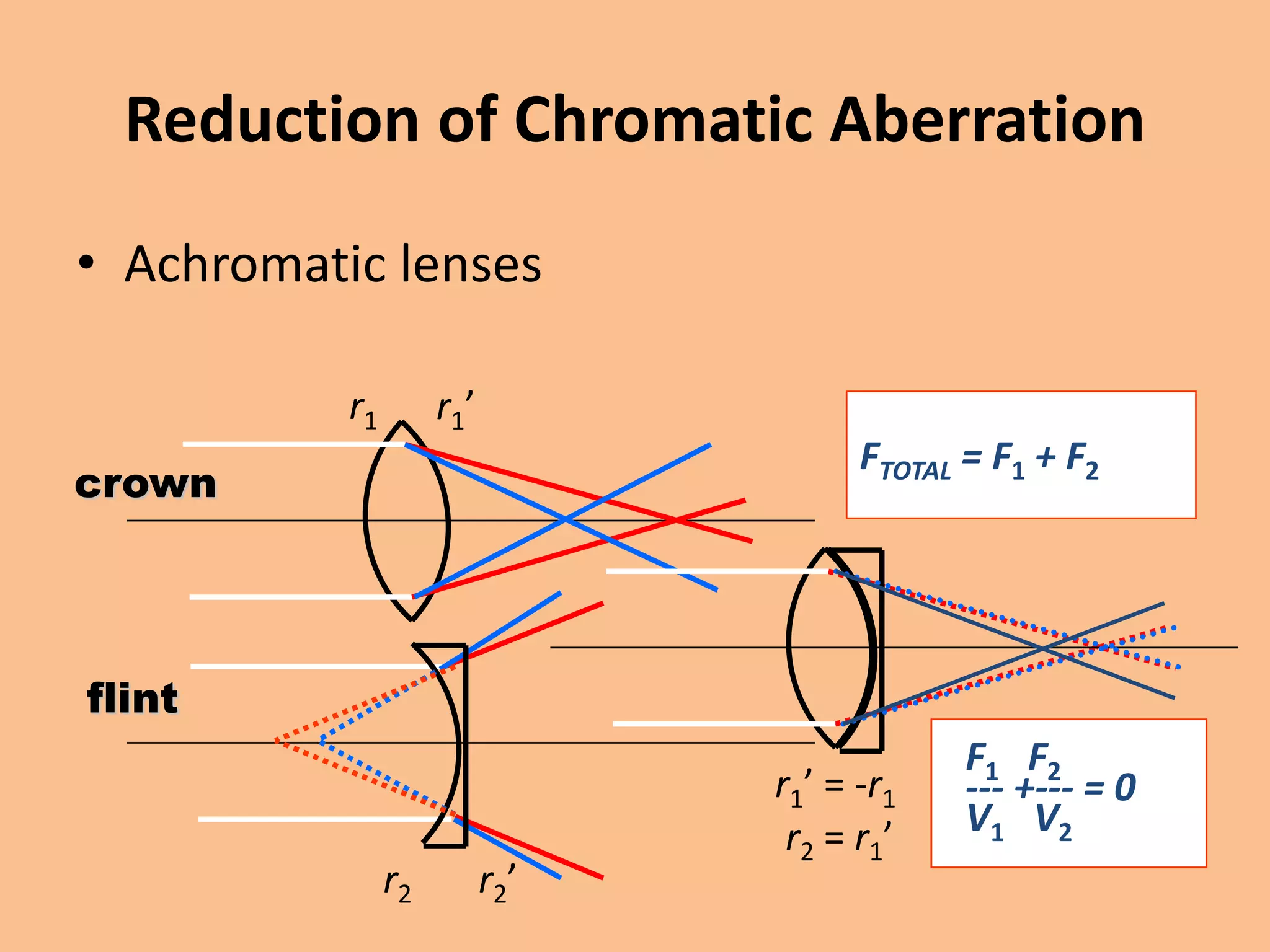
• Cant be eliminated in an optical element made of
single material
• Use of achromatic lens system, composed of
elements of (lenses)of varying material combined so
that dispersion is neutralized while the overall
refractive power is preserved
• Eg by combining a convex lens of high refractive
power and low dispersive power with a concave lens
of low refractive power but high dispersive power,
aberration can be neutralized
Reduction of Chromatic Aberration
• Achromatic lenses
crown
flint
r1 r1’
r2 r2’
r2 = r1’
r1’ = -r1
FTOTAL = F1 + F2
F1 F2
--- +--- = 0
V1 V2
n1
n2
R1
R2
R3
• Achromatic doublet (achormat) is often used to compensate
for the chromatic aberration
• the focuses for red and blue is the same if …
Achromatic doublet
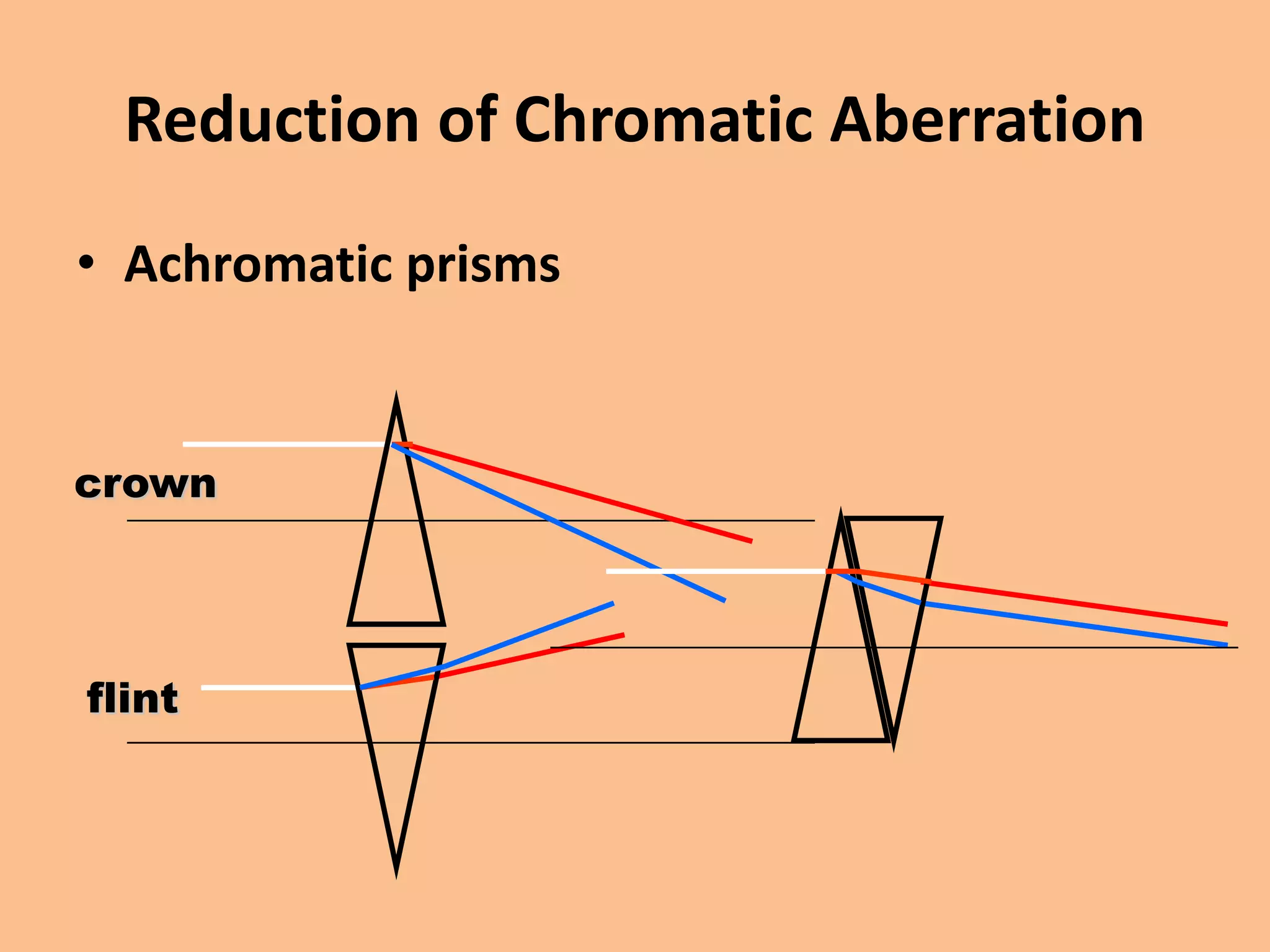
Reduction of Chromatic Aberration
• Achromatic prisms
crown
flint
References
• Optics by Tunnacliffe.
• The Principle of Optics by Hardy and Perrind
• Optics by Fincham Freeman.
• The Art and Science of Optical Design,
R. R. Shannon, Cambridge 1997.

Aberrations in optical aids

  • 1.
    Aberrations in OpticalAids Mohammad Arman Bin Aziz Instructor Optometrist Institute of Community Ophthalmology
  • 2.
    Contents of presentation Definitionof aberration Types of aberration Reduction of monochromatic aberration. A discussion of 5 types of monochromatic aberration.
  • 3.
    •Monochromatic aberrations: image isblurred or deformed due to the approximation error in the paraxial approximation to the exact solution. • Chromatic aberrations: rays corresponding to different wavelengths travel different paths Aberrations: chromatic and monochromatic
  • 4.
    Monochromatic Aberration • Monochromaticaberration is due to the paraxial rays are just an approximation to the real case. • For paraxial approximation, we assume but actually • The second term are called the third-order correction to the first order theory (or first- order corrections to the paraxial theory) • The third order corrections are • Spherical aberration • coma • astigmatism • field curvature • distortion  sin  !5!3 sin 53  
  • 5.
    Monochromatic aberration • Areimage imperfection occurring due to a form of lens and from monochromatic light. • In 1850 Seidel described 5 monochromatic aberration. • also called as seidel aberration.
  • 7.
    Seidel aberrations • Dependson lens diameter, object size and lens position. • Independent of wavelength. • Full correction of one aberration requires correction of all previous aberrations • Expressed as 5 terms on coefficients- • denoted by s1, s2, s3, s4, s5
  • 8.
    Spherical aberration • Occurswhen a pencil of light is refracted by a large aperture system. • Affects sharpness of image. • Occurs because different zone of aperture lens have different focal length.
  • 9.
    • Spherical aberrationcomes from the spherical surface of a lens • The further away the rays from the lens center, the bigger the error is. • The image is improved if the image plane move closer to the lens to find optimal spot size
  • 10.
    Types • Longitudinal sphericalaberration-refers to separation of paraxial and marginal focus in diopter along optical axis • Increases with square of aperture. • Transverse spherical aberration-measured in terms of image height differences by two focuses . • Increases with cube of aperture
  • 12.
    Reduction of sphericalaberration stop transmit all rays (only paraxial rays) Aplantic surface High powered lenses Aspheric surfaces
  • 13.
    Coma • Occurs whenoblique rays are refracted by a large aperture optical system. • Affects sharpness of image points. • Also called as off axial spherical aberration. • Rarely a problem with spectacle lenses; limiting effect of pupil .
  • 16.
    Coma • Arises fromoff-axis object points. • The transverse magnification is a function of ray height • The resulting pattern is like a comet.
  • 17.
    • Image resemblesa comet or a tear drop. • Comet shaped patch is formed by a series of comatic circles . Reduction of coma- • controlling aperture size • Lens form • Angle of obliquity • Using aplantic surfaces
  • 18.
    Oblique astigmatism • Alsocalled as radial or marginal astigmatism • Occurs when oblique rays are refracted by a narrow-aperture system • Affects both sharpness of image points and image position. • Affects the off axial objects point only.
  • 20.
    • In opticaldesign, the vertical plane is general called the “tangential plane” • The “sagittal plane” is the plane at right angle to the tangential plane and containing the principle ray. • Astigmatism results in different focusing power to the tangential and sagittal plane.
  • 21.
    tangential sagittal Astigmatism often ariseswhen focusing with a mirror with an angle
  • 22.
    • Inability ofa lens to form a point image of an oblique point object. • Interval of sturms –2 line foci and circle of least confusion. • Plane and foci- • Tangential plane-contains chief ray from object and optic axis .
  • 24.
    • Saggital plane–contain chief ray and perpendicular to tangential plane • Tangential foci –primary or meridional foci • Saggital focus –secondary or equatorial focus • Petzvals surface-curved surface along which image of a planed object lies.
  • 25.
    • Oblique astigmatismoccurs when oblique power of lens is always weaker than axial power • Reduction –use of steeper curvature lens eg-meniscus lens
  • 26.
    Curvature of image •Inability of a lens to form a plane image of a plane object. • Image surface is known as petzval surface. • Manifest itself as a curved image surfaces for a flat object surface • Affects image position.
  • 27.
    Field Curvature • athin lens image a spherical surface onto a spherical surface • therefore, image is distorted in the image plane • important in lens design for close objects Object plane Image plane
  • 29.
    Far point sphere •It is a locus of points conjugate to fovea as eye rotates . • Centre is absent only when image corresponds to far point sphere.
  • 31.
    Reduction • Using lenshaving lower refractive index. • Slightly overcorrecting myopic eye when oblique astigmatism is absent . • Far point of eye –property of eye • Petzval surfaces –property of correcting lens • If A is permitted, p can be controlled • By combining 2 lenses one plus and one minus. • Cannot be controlled by altering lens form.
  • 32.
    Distortion • Inability oflens to form an image of same shape as object. • Occurs when magnification of extended image varies with distance of corresponding object from optical axis . • Affects image shape and lateral position but not image clarity.
  • 33.
    • When ratioof image size to object size has constant value for all object size, no distortion occurs called as condition of orthoscopy. • Pupil of a eye acts as a stop behind a spectacle lens .
  • 34.
    • Mainly aproblem for lenses of high power. • For plus lens ,virtual image suffers a pinchusion distortion. • For a minus lens virtual image suffers barrel distortion. • Can be reduced by aspheric lenses and using steeper back surfaces.
  • 35.
    Distortion With distortion Corrected •all points in the object plane are imaged to points in image plane • Distortion arises when he magnification of off-axis image is a function of the distance to the lens center
  • 36.
    Summary of presentation Spherical aberration comaOblique astigmatism Curvature of image distortio n Affects sharpness of image Affects sharpness of image Affects both shapness and position of image Affects position of image Affects laterality of image and position
  • 37.
    B. Chromatic Aberration •When white light is refracted at an optical interface, dispersed into its component wavelength or colors • Shorter the wavelength, more it is deviated on refraction with series of color images formed • Total dispersion from the red to the blue image being approx 1.5 to 2 D
  • 38.
    • Emmetropic eyefocuses for the yellow green portion of spectrum, lies approx. in the middle of the range of retinal sensitivity • Thus approx 0.75 to 1.00D of CA lie on either side of the maximally sharp focus • For average eye difference between red and blue foci is 0.5 D • Caused by material from which lens is made
  • 39.
    Types of Chromaticaberration  Lateral(Transverse CA) • Defect of an optical system in which size of image of a point object is extended by a colored fringe, due to unequal refraction of different wavelength(dispersion) • Known as chromatic difference of magnification
  • 40.
    • Transverse (lateral)- lens y TCAlens = y’C - y’F TCAlens = yF V
  • 41.
  • 42.
    Longitudinal chromatic aberration •Due to unequal refraction of different wavelengths(dispersion) which results in an extended image along the optical axis • Blue focuses in front of red
  • 43.
    • Dispersion (dispersivepower) – longitudinal (axial) chromatic aberration of an optical material:
  • 44.
    • Longitudinal (axial) –Bichrome Test (Red/Green Balance) Lens Retina
  • 45.
  • 46.
    Treatment of chromaticaberration • Cant be eliminated in an optical element made of single material • Use of achromatic lens system, composed of elements of (lenses)of varying material combined so that dispersion is neutralized while the overall refractive power is preserved • Eg by combining a convex lens of high refractive power and low dispersive power with a concave lens of low refractive power but high dispersive power, aberration can be neutralized
  • 47.
    Reduction of ChromaticAberration • Achromatic lenses crown flint r1 r1’ r2 r2’ r2 = r1’ r1’ = -r1 FTOTAL = F1 + F2 F1 F2 --- +--- = 0 V1 V2
  • 48.
    n1 n2 R1 R2 R3 • Achromatic doublet(achormat) is often used to compensate for the chromatic aberration • the focuses for red and blue is the same if … Achromatic doublet
  • 49.
    Reduction of ChromaticAberration • Achromatic prisms crown flint
  • 50.
    References • Optics byTunnacliffe. • The Principle of Optics by Hardy and Perrind • Optics by Fincham Freeman. • The Art and Science of Optical Design, R. R. Shannon, Cambridge 1997.