Binocular single vision, it's grades and abnormalities.ppt
2.
Visual developmentis a highly complex
maturation process. Structural changes
occur in both the eye and the central
nervous system.
Normal vision develops as a result of
genetic coding and experience in a
normal visual environment.
Binocular cells arepresent from birth on,
but they need the input from both eyes in
order to become binocularly driven.
Refinement of neuroanatomic connections
and the development of normal binocular
vision are dependent on appropriate
binocular visual stimulation.
5.
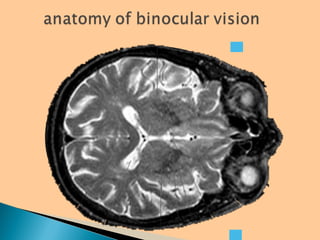
Binocular Visionis the coordinated use of both
eyes to create one three-dimensional single
visual sensation.
It is being made possible through the
senso-motoric union of the eye.
6.
Full visualacuity on both eyes with normal
central fixation
Optical system of the two eyes have to be the
same
Normal retinal correspondence
Visual fields have to overlap each other
Normal functioning of the nerve centres and
the visual pathway
Binocularly driven cells in the visual cortex
Normal visual development
7.
Orthophoria orheterophoria
Full extraocular movements of both eyeballs
Proper coordination of accommodation and
convergence
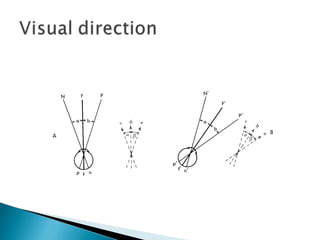
Visual direction
Projection is the term for object location in space
and it depends on the point on the retina
being stimulated
Each part of the retina has a given angle from
fixation
This is termed the visual sign or visual
direction
The fovea is the reference point
The fovea has the principal visual direction
All other points have secondary visual
direction
19.
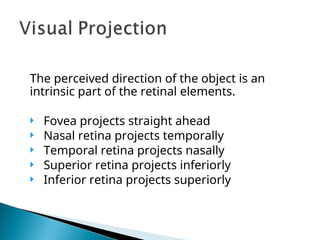
The perceived directionof the object is an
intrinsic part of the retinal elements.
Fovea projects straight ahead
Nasal retina projects temporally
Temporal retina projects nasally
Superior retina projects inferiorly
Inferior retina projects superiorly
20.
Retinal corrospondence:
Ifretinal areas in the two eyes share a common
subjective visual direction they are said to be
corresponding.
Normal Retinal corrospondence:
If corresponding retinal areas in both eyes bear
identical relationships to the fovea in each eye, then
normal retinal correspondence exists.
21.
Images fallingon corresponding points are
seen singly
Nasal retinal points in one eye correspond
to temporal points in the other eye
Sight originates from a point central to both
eyes representing the cerebral
interpretation of the direction of an object
22.
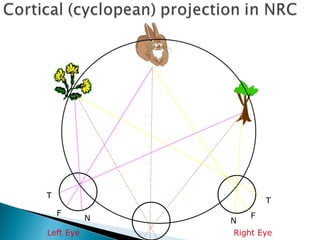
Normal retinalcorrespondence is necessary
for BSV
An object fixated by the two fovea appears
to be located centrally by a cyclopean eye
Binocular projection can be considered as if
from this imaginary cyclopean single eye
Cyclopean projection diagrams are always
used to describe BSV
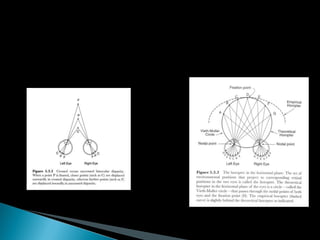
Horopter:
Allpoints which are stimulating
corresponding retinal elements are lying on
an imaginary circle in space called horopter.
25.
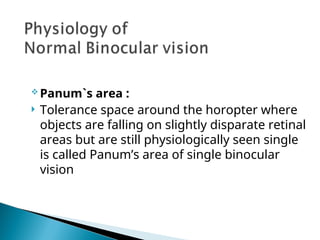
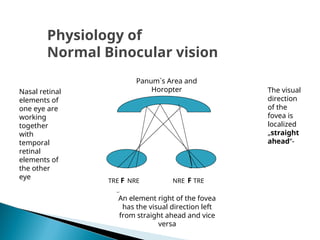
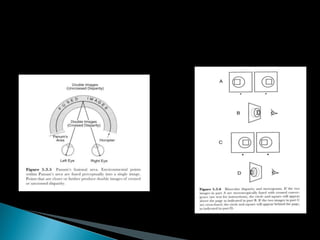
Panum`s area:
Tolerance space around the horopter where
objects are falling on slightly disparate retinal
areas but are still physiologically seen single
is called Panum’s area of single binocular
vision
26.
Physiology of
Normal Binocularvision
Panum`s Area and
Horopter
TRE F NRE NRE F TRE
Nasal retinal
elements of
one eye are
working
together
with
temporal
retinal
elements of
the other
eye
The visual
direction
of the
fovea is
localized
„straight
ahead“-
An element right of the fovea
has the visual direction left
from straight ahead and vice
versa
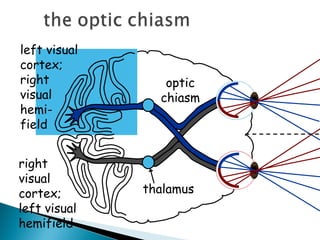
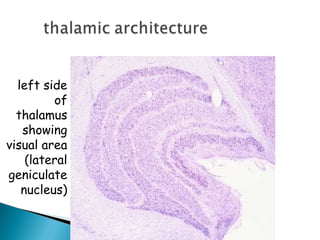
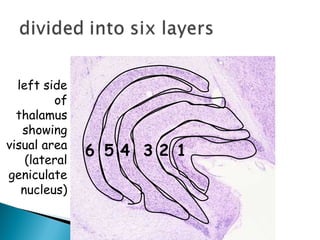
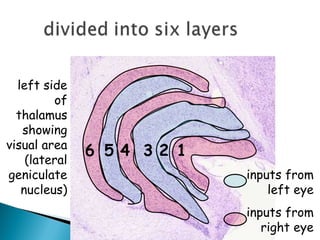
29.
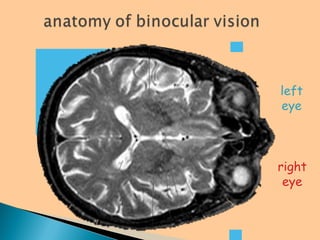
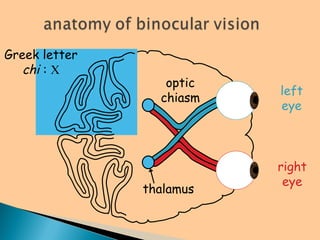
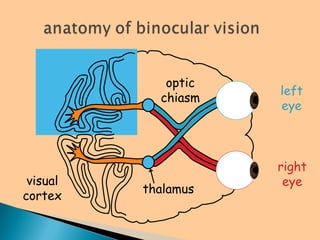
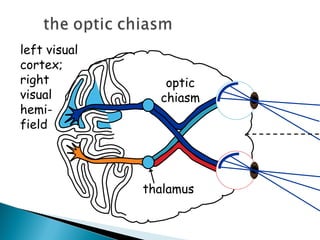
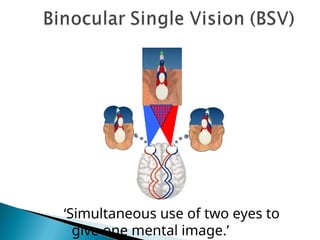
Visual informationfrom the right half of both
retinas is transferred to the right half of the
brain and vice versa.
Thus, visual information from both eyes is
available to the cortical cells which combine the
double information
into one image
Simultan perception
Theability to perceive two pictures at the same
time in each retina.
Dissimilarly contoured images are only perceived
simultaneously by the extramacular portions of
the retina.
33.
Fusion
Cortical unification ofvisual objects into one single
percept made possible by the stimulation of
corresponding retinal areas.
34.
Sensory fusionbased on the relationship
between retina and visual cortex
Motor fusion is the ability to maintain sensory
fusion through a range of fusional vergence
movements – „diplopia-avoidance mechanism“
35.
Stereopsis
Response to disparateretinal stimulation
Ability to perceive objects three-dimensionally
Binocular sensation of relative depth caused by
horizontal retinal disparity which is not great
enough to provoke diplopia








![CASE_PRESENTATION_ON_subdural_hematoma(SDH)[1 FINAL PPT]-1.pptx](https://cdn.slidesharecdn.com/ss_thumbnails/casepresentationonsubduralhematomasdh1finalppt-1-260129172522-d405d375-thumbnail.jpg?width=640&height=640&fit=bounds)


