Accommodation and its
anomalies
Mohammad Arman Bin Aziz
Optometry Officer
ICO, CU
March 02, 2014
Accommodation
The facility enabling the change in dioptric
power of the crystalline lens thereby altering the
focus of the eye.
Assessment of accommodation
1. Dynamic retinoscopy
2. Subjective measurement of accommodation
amplitudes with e.g., RAF rule
3. Facility of accommodation with "lens flippers"
Accommodative fatigue
Apart from overuse, factors that influence onset of fatigue
include
1.refractive status
2.relationship with convergence
•Symptoms
Asthenopia
Treatment
• Correct significant ametropia
• Correct significant OMB anomaly
• High astigmatism ? - check near cylinder axes
• Discuss "Visual Hygiene"
• Advise on lighting and length of time accommodation
• Consider "orthoscopic" spectacles
Failure of accommodation-Presbyopia
"Old sight"
Not a "disease" - explain to patients
Distance vision ?
• Age of onset
Depends on individuals, ace, occupation, and habits
Symptoms of presbyopia
• "I have to hold my book further away"
• "my arms are not long enough"
• "newspaper print is not what it used to be"
Patients complain of reading difficulty in poor light, tired eyes
after reading and BLURRED VISION for reading
Management
Prescribe correction so that near point of focus is brought within normal
working distance
Determination of reading addition
•Objective - dynamic retinoscopy
•Subjective –
 complete distance refraction
 measure amplitudes of accommodation
 use amplitudes as a STARTING point to calculate an approximate reading
addition
•Rule of thumb - leave 1/3rd accommodation in reserve
•Check clarity and range. Double check with (+) and (-) additions
Pre-senile cataract
• Cataract is likely to reduce accommodation
• May be unilateral
• Unequal reading adds ?
• May have reduced VA
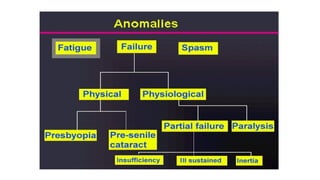
Insufficiency of accommodation
•Amplitude consistently lower than normal for age
•Fairly common
•"premature presbyopia"
Aetiology of insufficiency
• General debility
• Malnutrition
• Anaemia
• Glaucoma (?)
Symptoms of insufficiency
• Asthenopia
• Blurred vision for near work (? distance)
• Over or under convergence
Investigation of insufficiency
• Exclude...
Local cause
• the glaucoma's (IOP, fields, AC, funduscopy)
• anterior uveitis (slit lamp)
Central cause
• e.g., neurological lesion (fields, motility, pupils)
General cause
• e.g. illness
Treatment management of insufficiency
• Eliminate cause
• Occasional prescribing of temporary appliance e.g., in case
of debilitating illness
Ill sustained accommodation
• Amplitudes are normal but rapidly diminish with use. Is this the
start of a true insufficiency ?
…or… rapid onset fatigue ?
Aetiology
Commonest cause - debilitating illness
Investigation & Treatment
...in the same way as insufficiency
Inertia of accommodation
•Difficulty in changing focus from distance to near
and vice versa
•Diagnosis often based on symptomatology
Aetiology/associations
•Prolonged close work
•Ocular motor imbalance
Treatment
•Discuss visual hygiene
•Correct any ocular motor anomaly
Paralysis of accommodation
• May be partial or total, unilateral or bilateral
Signs and symptoms
• Blurred vision
• Micropsia
• More accommodative effort required to see near object which is then
perceived to be nearer than it actually is and therefore smaller
• Markedly reduced amplitude(s) of accommodation
• If lesion is localised to the lens or ciliary body then these will be the only
signs and symptoms
• If IIIrd
Oculomotor nerve is affected then there will be other signs
What does N IIIrd
innervate ? ….
Aetiology
•Congenital defects e.g., no ciliary muscle
•Cycloplegic drugs
•topical eye drops Þ intentional or unintentional
•Systemic drugs
•Degenerative conditions e.g. Parkinson’s
•Exogenous poisons e.g., snake bites, bee stings
•III N lesion (tumour, aneurysm, haemorrhage)
•Ocular disease (anterior uveitis, glaucoma)
•Trauma to head or eye (temporary or permanent paralysis)
•Visual Conversion Reaction
Management
• If recent onset and not previously investigated then refer
and, if of sudden onset, urgently
• Subsequent intervention will include spectacles and
management of any diplopia
Spasm of accommodation
Tone of ciliary muscle is increased and a constant
accommodative effort is expended by the parasympathetic
nervous system. Pseudo myopia produced.
Symptoms
• Blurred vision depending on patient’s refractive status
• Macropsia
• Asthenopia during close work
• Pain (brows/headache)
• Poor concentration
• Miosis
• Convergence anomalies (excess or insufficiency)
Investigation
Cycloplegic refraction used to determine true refraction
Aetiology
•Spasm can be further categorised into:
•(a) Functional spasm
•(b) Organic spasm
Functional spasm
•A response to over fatigue and "eye strain". Precipitated by 3
factors:
•Bad visual hygiene e.g., poor lighting, glare unaccustomed work
•Optical or ocular motor difficulties e.g., anisometropia, early
presbyopia, convergence anomalies
•psychological factors e.g., VCR (see Barnard & Edgar)
Treatment
• Eliminate exciting cause
• Consider occupation, general health, mental state
• Correct refractive error and/or ocular motor anomaly
Aetiology
• Ciliary spasm
- drug induced e.g., physostigmine, pilocarpine, morphine, digitalis
- lesions of brain stem and OM trunk
• Inflammation
• e.g., anterior uveitis
• Trigeminal neuralgia
• Others
• e.g., diphtheria, tooth extraction
Treatment of organic spasm
•Manage the cause
Summary
•Anomalies of accommodation are very common
•Management of these anomalies is an integral part
of optometric practice
References
• Primary Care Optometry by Theodore Grosvenor
• Clinical Procedure of Primary Eye Care
• Barnard S & Edgar (1996) Pediatric Eye Care, Blackwell Science,
Oxford
• Duke-Elder S (1973), System of Ophthalmology, Kimpton, London
• Evans BJW (1997) Pickwell’s Binocular Vision Anomalies,
Butterworth-Heinemann, Oxford
• Simon Barnard November 1999
• Internet

Accommodation and its anomalies

  • 1.
    Accommodation and its anomalies MohammadArman Bin Aziz Optometry Officer ICO, CU March 02, 2014
  • 2.
    Accommodation The facility enablingthe change in dioptric power of the crystalline lens thereby altering the focus of the eye.
  • 3.
    Assessment of accommodation 1.Dynamic retinoscopy 2. Subjective measurement of accommodation amplitudes with e.g., RAF rule 3. Facility of accommodation with "lens flippers"
  • 5.
    Accommodative fatigue Apart fromoveruse, factors that influence onset of fatigue include 1.refractive status 2.relationship with convergence •Symptoms Asthenopia
  • 6.
    Treatment • Correct significantametropia • Correct significant OMB anomaly • High astigmatism ? - check near cylinder axes • Discuss "Visual Hygiene" • Advise on lighting and length of time accommodation • Consider "orthoscopic" spectacles
  • 7.
    Failure of accommodation-Presbyopia "Oldsight" Not a "disease" - explain to patients Distance vision ? • Age of onset Depends on individuals, ace, occupation, and habits
  • 8.
    Symptoms of presbyopia •"I have to hold my book further away" • "my arms are not long enough" • "newspaper print is not what it used to be" Patients complain of reading difficulty in poor light, tired eyes after reading and BLURRED VISION for reading
  • 9.
    Management Prescribe correction sothat near point of focus is brought within normal working distance Determination of reading addition •Objective - dynamic retinoscopy •Subjective –  complete distance refraction  measure amplitudes of accommodation  use amplitudes as a STARTING point to calculate an approximate reading addition •Rule of thumb - leave 1/3rd accommodation in reserve •Check clarity and range. Double check with (+) and (-) additions
  • 10.
    Pre-senile cataract • Cataractis likely to reduce accommodation • May be unilateral • Unequal reading adds ? • May have reduced VA
  • 11.
    Insufficiency of accommodation •Amplitudeconsistently lower than normal for age •Fairly common •"premature presbyopia"
  • 12.
    Aetiology of insufficiency •General debility • Malnutrition • Anaemia • Glaucoma (?) Symptoms of insufficiency • Asthenopia • Blurred vision for near work (? distance) • Over or under convergence
  • 13.
    Investigation of insufficiency •Exclude... Local cause • the glaucoma's (IOP, fields, AC, funduscopy) • anterior uveitis (slit lamp) Central cause • e.g., neurological lesion (fields, motility, pupils) General cause • e.g. illness
  • 14.
    Treatment management ofinsufficiency • Eliminate cause • Occasional prescribing of temporary appliance e.g., in case of debilitating illness
  • 15.
    Ill sustained accommodation •Amplitudes are normal but rapidly diminish with use. Is this the start of a true insufficiency ? …or… rapid onset fatigue ? Aetiology Commonest cause - debilitating illness Investigation & Treatment ...in the same way as insufficiency
  • 16.
    Inertia of accommodation •Difficultyin changing focus from distance to near and vice versa •Diagnosis often based on symptomatology Aetiology/associations •Prolonged close work •Ocular motor imbalance
  • 17.
  • 18.
    Paralysis of accommodation •May be partial or total, unilateral or bilateral Signs and symptoms • Blurred vision • Micropsia • More accommodative effort required to see near object which is then perceived to be nearer than it actually is and therefore smaller • Markedly reduced amplitude(s) of accommodation • If lesion is localised to the lens or ciliary body then these will be the only signs and symptoms • If IIIrd Oculomotor nerve is affected then there will be other signs
  • 19.
    What does NIIIrd innervate ? …. Aetiology •Congenital defects e.g., no ciliary muscle •Cycloplegic drugs •topical eye drops Þ intentional or unintentional •Systemic drugs •Degenerative conditions e.g. Parkinson’s •Exogenous poisons e.g., snake bites, bee stings •III N lesion (tumour, aneurysm, haemorrhage) •Ocular disease (anterior uveitis, glaucoma) •Trauma to head or eye (temporary or permanent paralysis) •Visual Conversion Reaction
  • 20.
    Management • If recentonset and not previously investigated then refer and, if of sudden onset, urgently • Subsequent intervention will include spectacles and management of any diplopia
  • 21.
    Spasm of accommodation Toneof ciliary muscle is increased and a constant accommodative effort is expended by the parasympathetic nervous system. Pseudo myopia produced.
  • 22.
    Symptoms • Blurred visiondepending on patient’s refractive status • Macropsia • Asthenopia during close work • Pain (brows/headache) • Poor concentration • Miosis • Convergence anomalies (excess or insufficiency) Investigation Cycloplegic refraction used to determine true refraction
  • 23.
    Aetiology •Spasm can befurther categorised into: •(a) Functional spasm •(b) Organic spasm Functional spasm •A response to over fatigue and "eye strain". Precipitated by 3 factors: •Bad visual hygiene e.g., poor lighting, glare unaccustomed work •Optical or ocular motor difficulties e.g., anisometropia, early presbyopia, convergence anomalies •psychological factors e.g., VCR (see Barnard & Edgar)
  • 24.
    Treatment • Eliminate excitingcause • Consider occupation, general health, mental state • Correct refractive error and/or ocular motor anomaly
  • 25.
    Aetiology • Ciliary spasm -drug induced e.g., physostigmine, pilocarpine, morphine, digitalis - lesions of brain stem and OM trunk • Inflammation • e.g., anterior uveitis • Trigeminal neuralgia • Others • e.g., diphtheria, tooth extraction
  • 26.
    Treatment of organicspasm •Manage the cause Summary •Anomalies of accommodation are very common •Management of these anomalies is an integral part of optometric practice
  • 27.
    References • Primary CareOptometry by Theodore Grosvenor • Clinical Procedure of Primary Eye Care • Barnard S & Edgar (1996) Pediatric Eye Care, Blackwell Science, Oxford • Duke-Elder S (1973), System of Ophthalmology, Kimpton, London • Evans BJW (1997) Pickwell’s Binocular Vision Anomalies, Butterworth-Heinemann, Oxford • Simon Barnard November 1999 • Internet