Dr.k.vanya
Bony orbit 
 Angle of the medial and lateral walls of the orbit is 45° 
so the optical axis forms approimately 23 °with both 
medial &lateral walls. 
 The medial walls of the 2 orbits are parallel to each 
other.
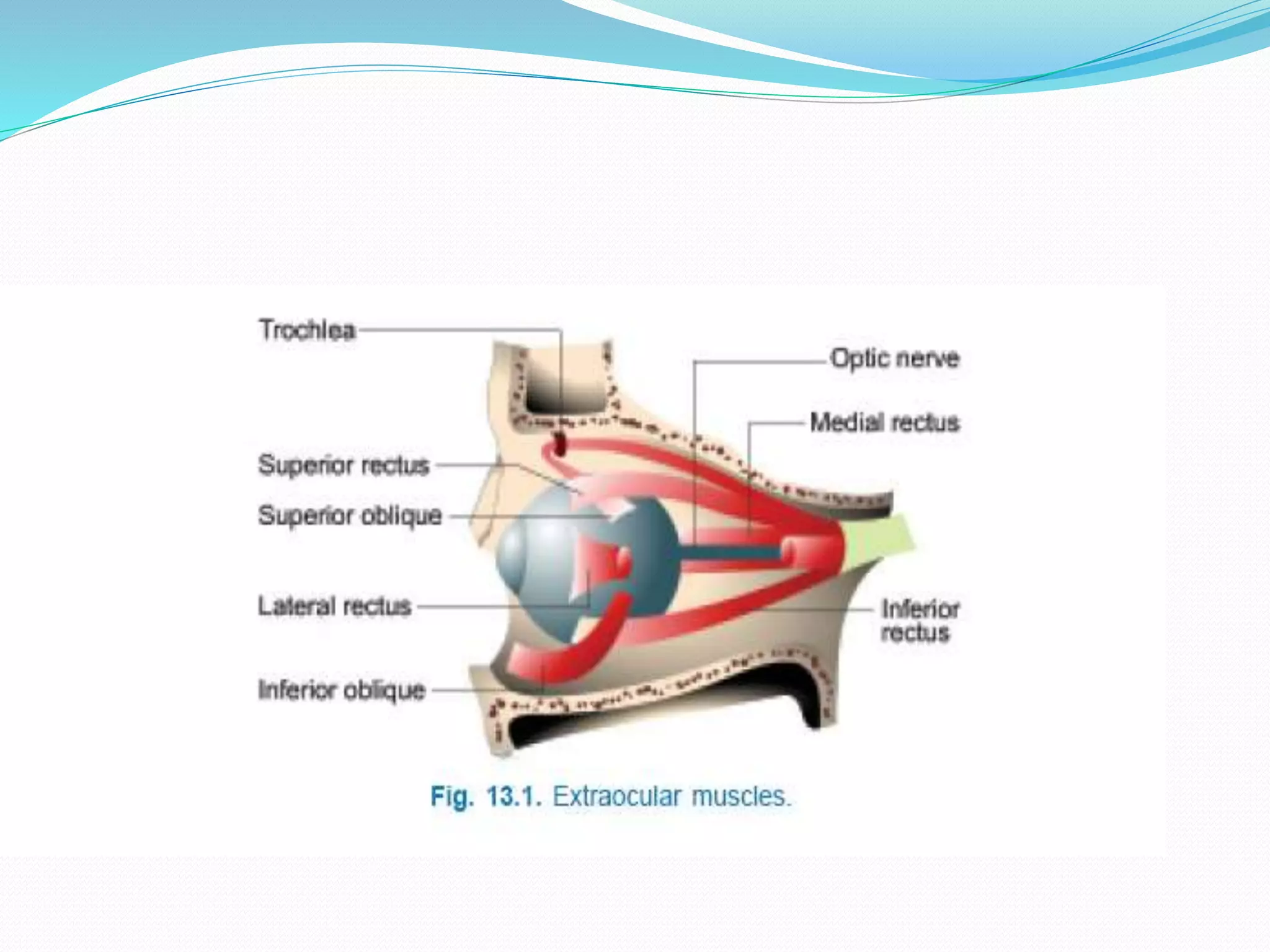
Extraocularmusles(EOM):-6 
 Four recti:- 
 Superior rectus 
 Inferior rectus 
 Medial rectus 
 Lateral rectus
 Two oblique muscles:- 
 Superior oblique 
 Inferior oblique 
 In addition levator palpebrae superioris also present 
&it inserts into upper eye lid for elevating palpebral 
fissure. 
 The 4 rectii arises from fibrous ring (annulus of 
zinn)around optic foramen.
 Vertical recti(sup.&inf. Rectus ) run in line with orbital 
axis & are inserted infront of equator. 
 They form an angle of 23° with visual axis.
Superior rectus 
 Arises from upper part of annulus o zinn. 
 Below the attachment of levator M. 
 Continuous with attachment of med.,&lat. Recti 
 Pierces tenon’s capsule &it is inserted into sclera 7.7 
mm from superior limbus. 
 Length 48 mm;width 9mm. 
 N.supply:-sup.divison of oculomotor N. 
 B.supply:-lat. Muscular branch of ophthalmic A.
Inferior rectus 
 Shortest of all recti 
 Arises from lower part of optic foramen. 
 Attached to sclera at 6.5 mm from inferior limbus 
 Lies b/w globe and inf.oblique. 
 Also attached to fascial sheath of lower lid. 
 Length 40mm;width 9mm 
 N.supply:-branch of inf divison of oculomotor N. 
 B.supply:-medial muscular branch of ophthalmic A.
Medial rectus 
 Largest ocular M& stronger than lateral rectus. 
 Arise from medial & inferior sides of optic foramen 
 Passing along medial wall of orbit ;inserts 5.5mm from 
nasal limbus. 
 Length 40mm;thicker than other EOM. 
 N.supply:-inf.divison of oculomotor N. 
 B.supply:-medial muscular branch of ophthalmic A. 

Lateral rectus 
 Arises from annular tendon. 
 Pierces tenon’s capsule &inserts in sclera at 6.9 mm 
from temporal limbus. 
 Length 48mm;2/3 of cross sectional area of MR. 
 N.supply:-Abducent N enters lR on its ocular 
aspect,just post.to its mid point.
Spiral of tillaux 
 Imaginary line joining the insertions of the 4 recti and 
is an important anatomical landmark when 
performing surgery. 
 The insertions are located progressively further away 
from the limbus in a spiral pattern. 
 the medial rectus insertion is closest . 
 Superior rectus is farthest.
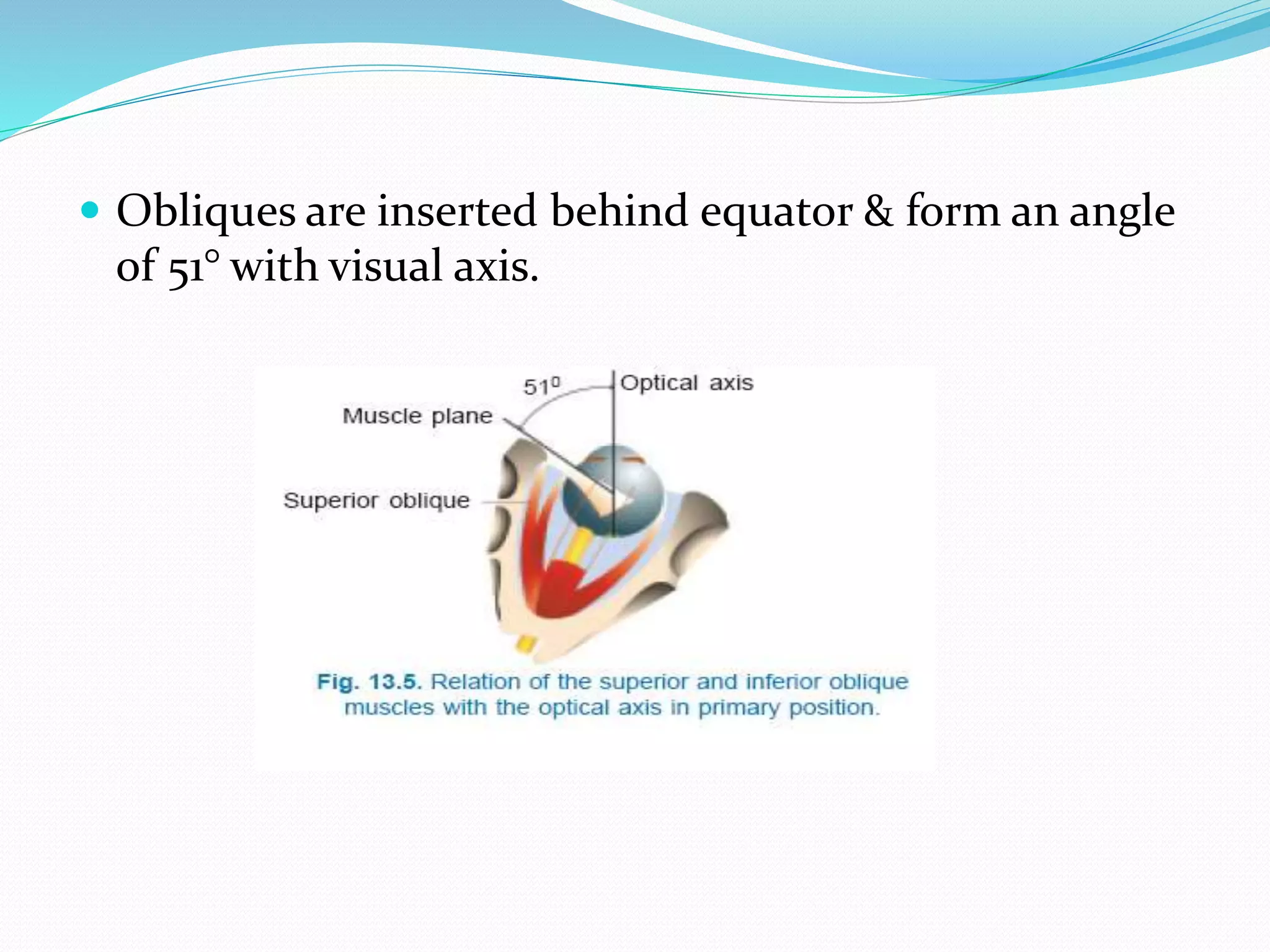
 Obliques are inserted behind equator & form an angle 
of 51° with visual axis.
Superior oblique 
 Longest& thinnest EOM. 
 Arises from common origin at the apex of orbit; 
superomedial to optic foramen. 
 Runs forward to trochlea(cartilaginous ring at 
upper&inner angles of orbit) 
 After threading through this it becomes tendinous 
 It changes its direction completely and runs over the 
globe under SR to attach above & lat, to posterior pole.
 Ant.fibres of S.O tendon-intorsion 
 Post.fibres of S.O tendon-extorsion 
 N.supply:-Trochlear N(4) after dividing into 2-3 
branches enters muscle superiorly. 
 B.supply:-superior muscular branch of ophthalmic A.
Inferior oblique 
 Only EOM not arising from apex of orbit 
 It arises anteriorly from lower & inner orbital walls 
near lacrimal fossa. 
 Running below inf.rectus& attaches below&lat. to 
post.pole of globe. 
 N.supply:-Inf.divison of oculomotor N. 
 B.supply:-Infraorbital &medial muscular branches of 
ophtalmic A.
Action of extraocular muscles 
 Rotation around centre of rotation 
 Centre of rotation lies 12/13 mm behind cornea. 
 3 types of rotation: 
1. Rotation around fick vertical axis Z—side to side 
2. “ “ fick horizontal axis X– up&down 
3. “ “ fick antero posterior axis– torsion
Uniocular movements 
 Ductions – only one eye is open,the other covered/closed 
tested by asking the pt. to follow a target in each direction 
of gaze. 
 Types of ductions:- 
1. Adduction 
2. Abduction 
3. Supraduction 
4. Infraduction 
5. Incycloduction 
6. excycloduction
Binocular movements 
 Versions:-both eyes open,attempting to fixate a target 
&moving in same direction. 
 Binocular ,simultaneous,conjugate movements in 
same direction. 
 Abduction of one eye accompanied by adduction of 
other eye is called conjugate movements.
Types of versions:- 
 Dextroversion&laevo version 
 Elevation&depression 
 Dextro elevation&dextro depression 
 Laevo elevation& laevo depression
 Torsional movements/righting reflexes:- 
 When you tilt head to maintain upright image. 
 Vergences:- 
binocular,simultaneous,disjugate/disjunctive 
movements (opp.direction) 
 Convergence– simultaneous adduction 
 Divergence– outward movement from convergent 
position
Types of convergence 
 Reflex ----tonic 
 ----proximal 
 ----fusional 
 ----accommodative 
 voluntary
Actions of EOM 
ACTION PRIMARY SECONDARY TERTIARY 
MR ADDUCTION ------ --------- 
LR ABDUCTION ------ --------- 
SR ELEVATION INTORSION ADDUCTION 
IR DEPRESSION EXTORSION ADDUCTION 
SO INTORSION DEPRESSION ABDUCTION 
IO EXTORSION ELEVATION ABDUCTION
 Both obliques have same tertiary action because 
inserted behind the center of rotation, 
 pull post. pole of globe medially 
 when they contract ant.portion of eye so it causes 
abduction
 Both recti have same tertiary action bcz they inserted 
anterior to centre of rotation 
 pull ant.portion of globe medially so it causes 
adduction
 Synergists:-ref.to muscles having same primary action 
in same eye. 
 Ex:-sup.rectus & inf.oblique----elevators 
 inf.rectus&sup.oblique-----depressors 
 Antagonists:-having opp.action in same eye 
 Ex:-sup.&inf. Recti 
 sup.&inf.oblique
 Yoke muscle(contralateral synergists):- 
 Ref. to pair of muscles (one from each eye) which 
contract simultaneously during version movements. 
 Ex :-in dextroversion RLR &LMR 
 Contralateral antagonist:-pair of muscle (one from 
each eye)having an opposite action. 
 Ex:-in dextroversion RLR & LLR
Diagnostic positions of gaze:-9 
1 Primary position of gaze:-assumed by eyes when 
fixating a distant object with head erect. 
6 cardinal positions :- to test 12 EOM in their main 
field of action
1. Dextroversion 
2. Laevo version 
3. Dextro elevation 
4. Leavo elevation 
5. Dextro depression 
6. Laevo depression 
 +2 Elevation 
 Depression
Laws of ocular motility 
1. Hering’s law of equal innervation:- during any 
conjugate movement equal & simultaneous 
innervation flows to yoke muscles
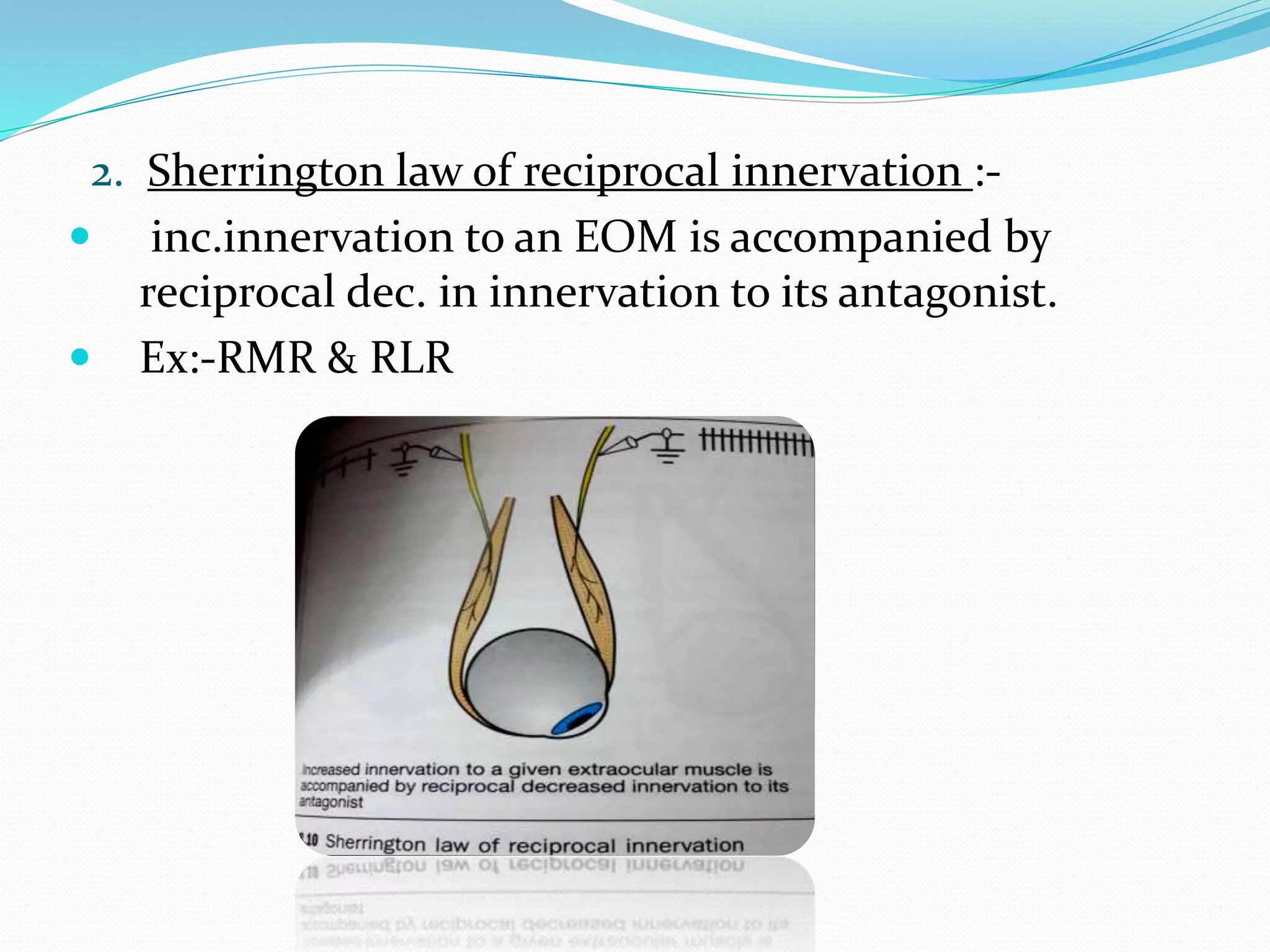
2. Sherrington law of reciprocal innervation :- 
 inc.innervation to an EOM is accompanied by 
reciprocal dec. in innervation to its antagonist. 
 Ex:-RMR & RLR
Supranuclear control of ocular 
movements:- 
1. Saccadic system 
2. Smooth pursuit system 
3. Vergence system 
4. Vestibular system 
5. Optokinetic system 
6. Position maintenance system
 Saccadic system:- 
saccades are sudden,jerky,conjugate,movements 
as the gaze shifts from one object to other. 
 voluntary(normal) 
 invoiuntary(peripheral,auditory,visual 
stimuli)
 Smooth pursuit eye movements:- 
 Tracking movements of eye as they follow moving 
object 
 Voluntary movements 
 When the velocity of moving object inc. replaced by 
small saccades(“catchup saccades”)
 Vergence movement: 
 Allow focussing an object which moves away 
from/towards observer. 
 Very slow disjugate movements
 Vestibular eye movement:- 
 Effective in compensating for effects of head 
movements in disturbing visual fixation 
 Through vestibular system
 Optokinetic system:- 
 a movement following the moving scene , succeeded 
by rapid saccade in opp.direction 
 Position maintenance system:- 
 Helps to maintain specific gaze by rapid micro 
movements called “flicks” & slow micro movements 
called “drifts”.
Bibilography 
 Adler’s physiology of eye -11th edition 
 Wolff’s anatomy of eye -8th edition 
 Parson’s disease of eye-21st edition 
 Jack.j.kanski brad bowlingclinical ophthalmology - 
7th edition 
 A.k.Khurana comprehensive ophthalmology - 
5th edition
Anatomy of extraocular muscles and ocular motility

Anatomy of extraocular muscles and ocular motility

  • 1.
  • 2.
    Bony orbit Angle of the medial and lateral walls of the orbit is 45° so the optical axis forms approimately 23 °with both medial &lateral walls.  The medial walls of the 2 orbits are parallel to each other.
  • 4.
    Extraocularmusles(EOM):-6  Fourrecti:-  Superior rectus  Inferior rectus  Medial rectus  Lateral rectus
  • 5.
     Two obliquemuscles:-  Superior oblique  Inferior oblique  In addition levator palpebrae superioris also present &it inserts into upper eye lid for elevating palpebral fissure.  The 4 rectii arises from fibrous ring (annulus of zinn)around optic foramen.
  • 6.
     Vertical recti(sup.&inf.Rectus ) run in line with orbital axis & are inserted infront of equator.  They form an angle of 23° with visual axis.
  • 7.
    Superior rectus Arises from upper part of annulus o zinn.  Below the attachment of levator M.  Continuous with attachment of med.,&lat. Recti  Pierces tenon’s capsule &it is inserted into sclera 7.7 mm from superior limbus.  Length 48 mm;width 9mm.  N.supply:-sup.divison of oculomotor N.  B.supply:-lat. Muscular branch of ophthalmic A.
  • 8.
    Inferior rectus Shortest of all recti  Arises from lower part of optic foramen.  Attached to sclera at 6.5 mm from inferior limbus  Lies b/w globe and inf.oblique.  Also attached to fascial sheath of lower lid.  Length 40mm;width 9mm  N.supply:-branch of inf divison of oculomotor N.  B.supply:-medial muscular branch of ophthalmic A.
  • 9.
    Medial rectus Largest ocular M& stronger than lateral rectus.  Arise from medial & inferior sides of optic foramen  Passing along medial wall of orbit ;inserts 5.5mm from nasal limbus.  Length 40mm;thicker than other EOM.  N.supply:-inf.divison of oculomotor N.  B.supply:-medial muscular branch of ophthalmic A. 
  • 10.
    Lateral rectus Arises from annular tendon.  Pierces tenon’s capsule &inserts in sclera at 6.9 mm from temporal limbus.  Length 48mm;2/3 of cross sectional area of MR.  N.supply:-Abducent N enters lR on its ocular aspect,just post.to its mid point.
  • 11.
    Spiral of tillaux  Imaginary line joining the insertions of the 4 recti and is an important anatomical landmark when performing surgery.  The insertions are located progressively further away from the limbus in a spiral pattern.  the medial rectus insertion is closest .  Superior rectus is farthest.
  • 13.
     Obliques areinserted behind equator & form an angle of 51° with visual axis.
  • 14.
    Superior oblique Longest& thinnest EOM.  Arises from common origin at the apex of orbit; superomedial to optic foramen.  Runs forward to trochlea(cartilaginous ring at upper&inner angles of orbit)  After threading through this it becomes tendinous  It changes its direction completely and runs over the globe under SR to attach above & lat, to posterior pole.
  • 15.
     Ant.fibres ofS.O tendon-intorsion  Post.fibres of S.O tendon-extorsion  N.supply:-Trochlear N(4) after dividing into 2-3 branches enters muscle superiorly.  B.supply:-superior muscular branch of ophthalmic A.
  • 16.
    Inferior oblique Only EOM not arising from apex of orbit  It arises anteriorly from lower & inner orbital walls near lacrimal fossa.  Running below inf.rectus& attaches below&lat. to post.pole of globe.  N.supply:-Inf.divison of oculomotor N.  B.supply:-Infraorbital &medial muscular branches of ophtalmic A.
  • 17.
    Action of extraocularmuscles  Rotation around centre of rotation  Centre of rotation lies 12/13 mm behind cornea.  3 types of rotation: 1. Rotation around fick vertical axis Z—side to side 2. “ “ fick horizontal axis X– up&down 3. “ “ fick antero posterior axis– torsion
  • 19.
    Uniocular movements Ductions – only one eye is open,the other covered/closed tested by asking the pt. to follow a target in each direction of gaze.  Types of ductions:- 1. Adduction 2. Abduction 3. Supraduction 4. Infraduction 5. Incycloduction 6. excycloduction
  • 21.
    Binocular movements Versions:-both eyes open,attempting to fixate a target &moving in same direction.  Binocular ,simultaneous,conjugate movements in same direction.  Abduction of one eye accompanied by adduction of other eye is called conjugate movements.
  • 22.
    Types of versions:-  Dextroversion&laevo version  Elevation&depression  Dextro elevation&dextro depression  Laevo elevation& laevo depression
  • 23.
     Torsional movements/rightingreflexes:-  When you tilt head to maintain upright image.  Vergences:- binocular,simultaneous,disjugate/disjunctive movements (opp.direction)  Convergence– simultaneous adduction  Divergence– outward movement from convergent position
  • 24.
    Types of convergence  Reflex ----tonic  ----proximal  ----fusional  ----accommodative  voluntary
  • 25.
    Actions of EOM ACTION PRIMARY SECONDARY TERTIARY MR ADDUCTION ------ --------- LR ABDUCTION ------ --------- SR ELEVATION INTORSION ADDUCTION IR DEPRESSION EXTORSION ADDUCTION SO INTORSION DEPRESSION ABDUCTION IO EXTORSION ELEVATION ABDUCTION
  • 26.
     Both obliqueshave same tertiary action because inserted behind the center of rotation,  pull post. pole of globe medially  when they contract ant.portion of eye so it causes abduction
  • 27.
     Both rectihave same tertiary action bcz they inserted anterior to centre of rotation  pull ant.portion of globe medially so it causes adduction
  • 28.
     Synergists:-ref.to muscleshaving same primary action in same eye.  Ex:-sup.rectus & inf.oblique----elevators  inf.rectus&sup.oblique-----depressors  Antagonists:-having opp.action in same eye  Ex:-sup.&inf. Recti  sup.&inf.oblique
  • 29.
     Yoke muscle(contralateralsynergists):-  Ref. to pair of muscles (one from each eye) which contract simultaneously during version movements.  Ex :-in dextroversion RLR &LMR  Contralateral antagonist:-pair of muscle (one from each eye)having an opposite action.  Ex:-in dextroversion RLR & LLR
  • 30.
    Diagnostic positions ofgaze:-9 1 Primary position of gaze:-assumed by eyes when fixating a distant object with head erect. 6 cardinal positions :- to test 12 EOM in their main field of action
  • 31.
    1. Dextroversion 2.Laevo version 3. Dextro elevation 4. Leavo elevation 5. Dextro depression 6. Laevo depression  +2 Elevation  Depression
  • 33.
    Laws of ocularmotility 1. Hering’s law of equal innervation:- during any conjugate movement equal & simultaneous innervation flows to yoke muscles
  • 34.
    2. Sherrington lawof reciprocal innervation :-  inc.innervation to an EOM is accompanied by reciprocal dec. in innervation to its antagonist.  Ex:-RMR & RLR
  • 35.
    Supranuclear control ofocular movements:- 1. Saccadic system 2. Smooth pursuit system 3. Vergence system 4. Vestibular system 5. Optokinetic system 6. Position maintenance system
  • 36.
     Saccadic system:- saccades are sudden,jerky,conjugate,movements as the gaze shifts from one object to other.  voluntary(normal)  invoiuntary(peripheral,auditory,visual stimuli)
  • 37.
     Smooth pursuiteye movements:-  Tracking movements of eye as they follow moving object  Voluntary movements  When the velocity of moving object inc. replaced by small saccades(“catchup saccades”)
  • 38.
     Vergence movement:  Allow focussing an object which moves away from/towards observer.  Very slow disjugate movements
  • 39.
     Vestibular eyemovement:-  Effective in compensating for effects of head movements in disturbing visual fixation  Through vestibular system
  • 40.
     Optokinetic system:-  a movement following the moving scene , succeeded by rapid saccade in opp.direction  Position maintenance system:-  Helps to maintain specific gaze by rapid micro movements called “flicks” & slow micro movements called “drifts”.
  • 41.
    Bibilography  Adler’sphysiology of eye -11th edition  Wolff’s anatomy of eye -8th edition  Parson’s disease of eye-21st edition  Jack.j.kanski brad bowlingclinical ophthalmology - 7th edition  A.k.Khurana comprehensive ophthalmology - 5th edition