Inferential Statistics

             Objective:
An introduction to what you need to
        know about statistics
Key Terms
Test statistic
Critical value
Degrees of freedom
P value/level
Significance
Chance
Type 1 error
Type 2 error
Interval
Ordinal
Nominal
Inferential Statistics Tests


    Make inferences about the
populations from which the samples
             are drawn
Descriptive Statistics vs. Inferential Statistics


    Allows us to draw
                          Allow us to say whether
       conclusions
                          difference is significant
  Through use of graphs


                                   This difference
                                    Is significant
Probability
Inferential tests use probability to ascertain the
likelihood that a pattern of results could have
arisen by chance.

If the probability of the results occurring by
chance is below a certain level we assume these
results to be significant
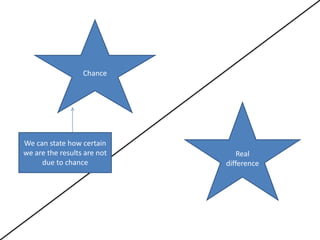
Chance


We can state how certain
we are the results are not      Real
     due to chance           difference
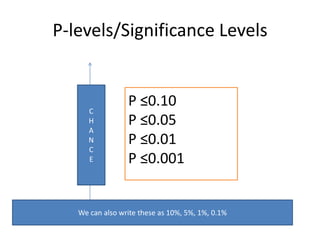
P-levels/Significance Levels


                 P ≤0.10
      C
      H          P ≤0.05
      A
      N          P ≤0.01
      C
      E          P ≤0.001


   We can also write these as 10%, 5%, 1%, 0.1%
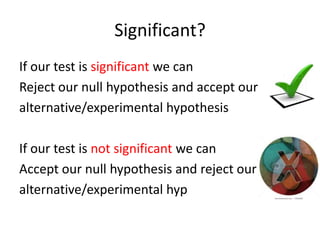
Significant?
If our test is significant we can
Reject our null hypothesis and accept our
alternative/experimental hypothesis

If our test is not significant we can
Accept our null hypothesis and reject our
alternative/experimental hyp
Levels of measurement
       Nominal

        Ordinal

       Interval
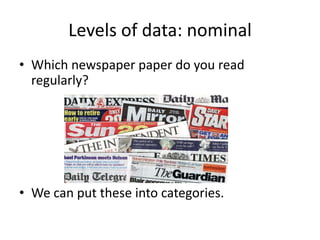
Levels of data: nominal
• Which newspaper paper do you read
  regularly?


• We can put these into categories.
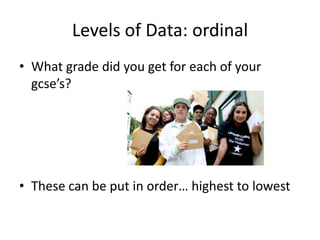
Levels of Data: ordinal
• What grade did you get for each of your
  gcse’s?


• These can be put in order… highest to lowest
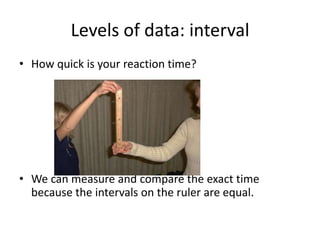
Levels of data: interval
• How quick is your reaction time?


• We can measure and compare the exact time
  because the intervals on the ruler are equal.
Inferential Tests
Which test to use depends upon a number of
factors:
• The type of data
• Type of research design (RM vs. IG)
• One tailed or two tailed test
Tests to Know
Mann Whitney U
 Chi Squared
  Wilcoxon T
Spearmans rho
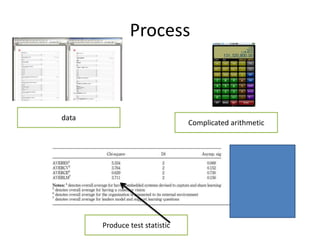
Process


data
                                Complicated arithmetic


       Produce test statistic
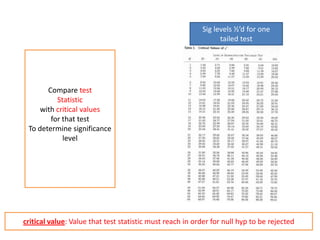
Sig levels ½’d for one
                                                                tailed test


       Compare test
          Statistic
     with critical values
        for that test
 To determine significance
            level


critical value: Value that test statistic must reach in order for null hyp to be rejected
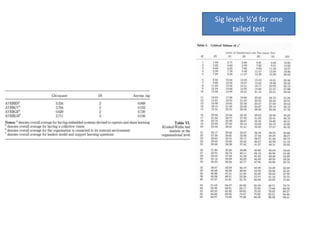
Sig levels ½’d for one
      tailed test
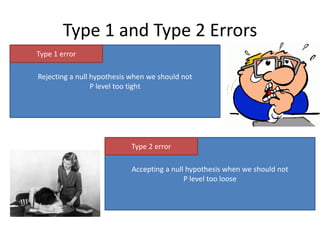
Type 1 and Type 2 Errors
Type 1 error

Rejecting a null hypothesis when we should not
                 P level too tight


                           Type 2 error

                           Accepting a null hypothesis when we should not
                                           P level too loose