Determining whether to use
Inferential and Descriptive Statistics
Learning Module: Explanation
Welcome to this learning
module!
In this module you will learn
the difference between
Inferential and Descriptive
statistics!
In later modules you will then
determine when a question
should be answered with one
or the other.
First, Descriptive statistics!
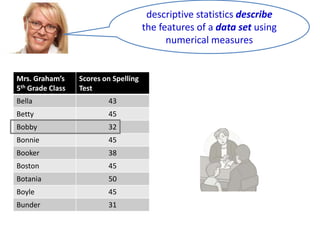
Simply put, descriptive statistics describe the
features of a data set using numerical measures.
Simply put, descriptive statistics describe the
features of a data set using numerical measures.
And that’s it!
Simply put, descriptive statistics describe the
features of a data set using numerical measures.
And that’s it!
Here’s an example
Meet Mrs. Graham,
a fifth Grade teacher
having a parent teacher
conference.
The parent has some
questions about her son
Bobby.
She will base her
answers off of a class
data set.
She will base her
answers off of a class
data set.

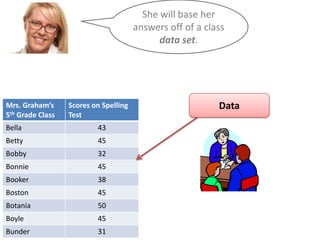
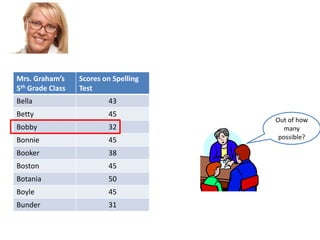
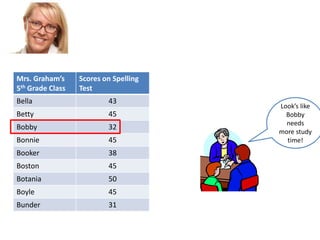
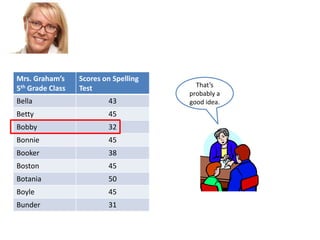
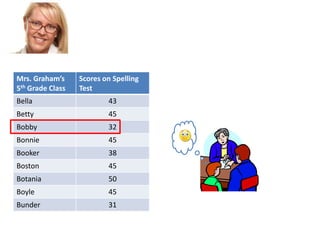
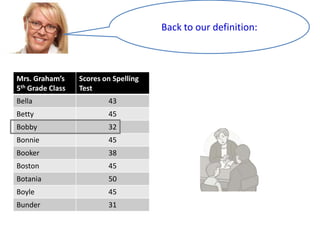
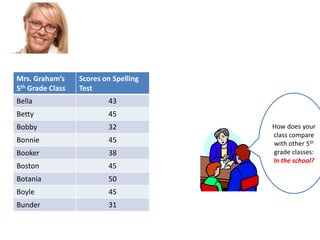
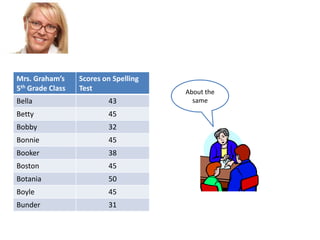
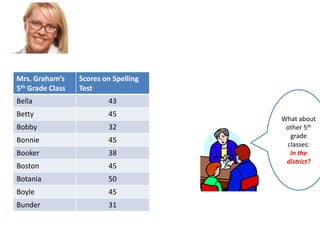
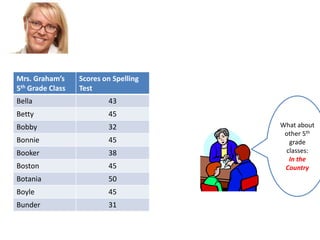
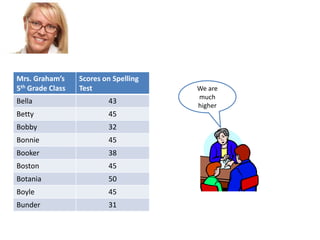
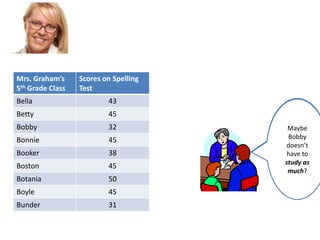
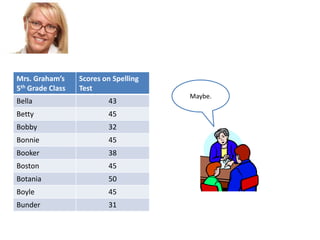
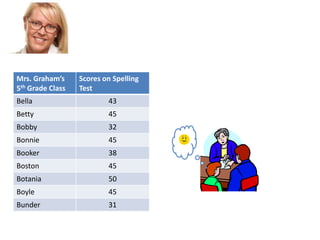
Mrs. Graham’s
5th Grade Class

Scores on Spelling
Test

Bella

43

Betty

45

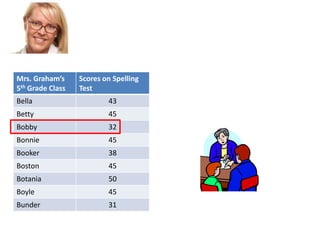
Bobby

32

Bonnie

45

Booker

38
Boston

45

Botania

50

Boyle

45

Bunder

31
She will base her
answers off of a class
data set.

Mrs. Graham’s
5th Grade Class

Scores on Spelling
Test

Bella

43

Betty

45

Bobby

32

Bonnie

45

Booker

38

Boston

45

Botania

50

Boyle

45

Bunder

31

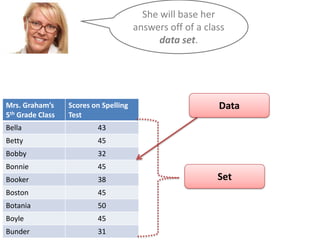
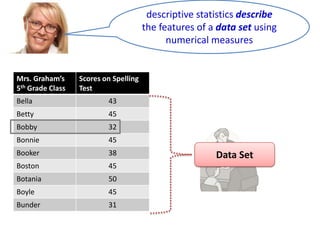
Data
She will base her
answers off of a class
data set.

Mrs. Graham’s
5th Grade Class

Scores on Spelling
Test

Bella

43

Betty

45

Bobby

32

Bonnie

45

Booker

38

Boston

45

Botania

50

Boyle

45

Bunder

31

Data

Set
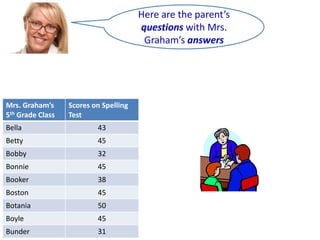
Here are the parent’s
questions with Mrs.
Graham’s answers

Mrs. Graham’s
5th Grade Class

Scores on Spelling
Test

Bella

43

Betty

45

Bobby

32

Bonnie

45

Booker

38

Boston

45

Botania

50

Boyle

45

Bunder

31
Mrs. Graham’s
5th Grade Class

Scores on Spelling
Test

Bella

43

Betty

45

Bobby

32

Bonnie

45

Booker

38

Boston

45

Botania

50

Boyle

45

Bunder

31

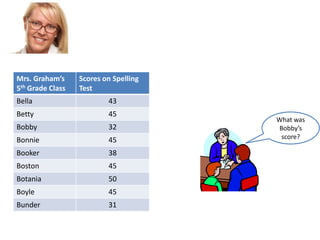
What was
Bobby’s
score?
Mrs. Graham’s
5th Grade Class

Scores on Spelling
Test

Bella

43

Betty

45

Bobby

32

Bonnie

45

Booker

38

Boston

45

Botania

50

Boyle

45

Bunder

31
Mrs. Graham’s
5th Grade Class

Scores on Spelling
Test

Bella

43

Betty

45

Bobby

32

Bonnie

45

Booker

38

Boston

45

Botania

50

Boyle

45

Bunder

31

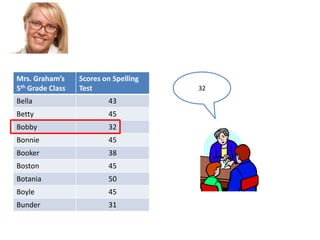
32
Mrs. Graham’s
5th Grade Class

Scores on Spelling
Test

Bella

43

Betty

45

Bobby

32

Bonnie

45

Booker

38

Boston

45

Botania

50

Boyle

45

Bunder

31

Out of how
many
possible?
Mrs. Graham’s
5th Grade Class

Scores on Spelling
Test

Bella

43

Betty

45

Bobby

32

Bonnie

45

Booker

38

Boston

45

Botania

50

Boyle

45

Bunder

31

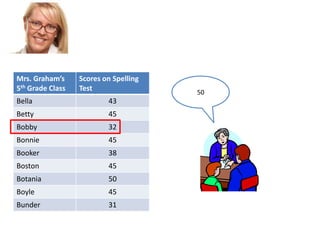
50
Mrs. Graham’s
5th Grade Class

Scores on Spelling
Test

Bella

43

Betty

45

Bobby

32

Bonnie

45

Booker

38

Boston

45

Botania

50

Boyle

45

Bunder

31

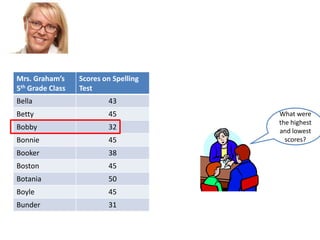
What were
the highest
and lowest
scores?
Mrs. Graham’s
5th Grade Class

Scores on Spelling
Test

Bella

43

Betty

45

Bobby

32

Bonnie

45

Booker

38

Boston

45

Botania

50

Boyle

45

Bunder

31

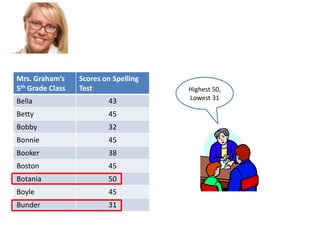
Highest 50,
Lowest 31
Mrs. Graham’s
5th Grade Class

Scores on Spelling
Test

Bella

43

Betty

45

Bobby

32

Bonnie

45

Booker

38

Boston

45

Botania

50

Boyle

45

Bunder

31

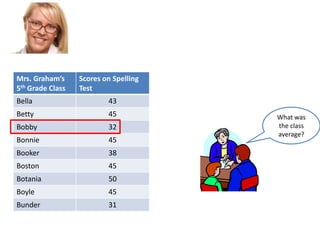
What was
the class
average?
Mrs. Graham’s
5th Grade Class

Scores on Spelling
Test

Bella

43

Betty

45

Bobby

32

Bonnie

45

Booker

38

Boston

45

Botania

50

Boyle

45

Bunder

31

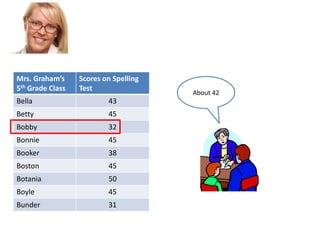
About 42
Mrs. Graham’s
5th Grade Class

Scores on Spelling
Test

Bella

43

Betty

45

Bobby

32

Bonnie

45

Booker

38

Boston

45

Botania

50

Boyle

45

Bunder

31

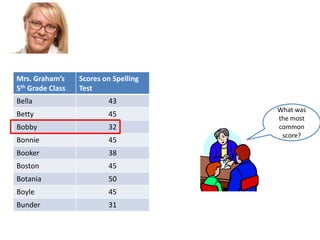
What was
the most
common
score?
Mrs. Graham’s
5th Grade Class

Scores on Spelling
Test

Bella

43

Betty

45

Bobby

32

Bonnie

45

Booker

38

Boston

45

Botania

50

Boyle

45

Bunder

31

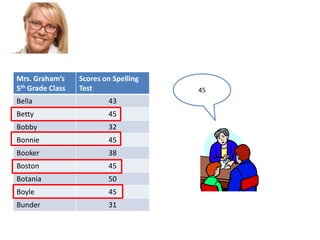
45
Mrs. Graham’s
5th Grade Class

Scores on Spelling
Test

Bella

43

Betty

45

Bobby

32

Bonnie

45

Booker

38

Boston

45

Botania

50

Boyle

45

Bunder

31

Look’s like
Bobby
needs
more study
time!
Mrs. Graham’s
5th Grade Class

Scores on Spelling
Test

Bella

43

Betty

45

Bobby

32

Bonnie

45

Booker

38

Boston

45

Botania

50

Boyle

45

Bunder

31

That’s
probably a
good idea.
Mrs. Graham’s
5th Grade Class

Scores on Spelling
Test

Bella

43

Betty

45

Bobby

32

Bonnie

45

Booker

38

Boston

45

Botania

50

Boyle

45

Bunder

31
Back to our definition:

Mrs. Graham’s
5th Grade Class

Scores on Spelling
Test

Bella

43

Betty

45

Bobby

32

Bonnie

45

Booker

38

Boston

45

Botania

50

Boyle

45

Bunder

31
descriptive statistics describe
the features of a data set using
numerical measures

Mrs. Graham’s
5th Grade Class

Scores on Spelling
Test

Bella

43

Betty

45

Bobby

32

Bonnie

45

Booker

38

Boston

45

Botania

50

Boyle

45

Bunder

31
descriptive statistics describe
the features of a data set using
numerical measures

Mrs. Graham’s
5th Grade Class

Scores on Spelling
Test

Bella

43

Betty

45

Bobby

32

Bonnie

45

Booker

38

Boston

45

Botania

50

Boyle

45

Bunder

31

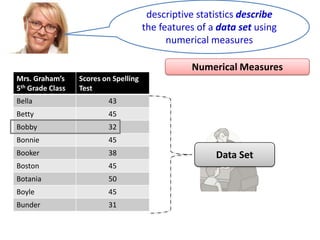
Data Set
descriptive statistics describe
the features of a data set using
numerical measures
Numerical Measures
Mrs. Graham’s
5th Grade Class

Scores on Spelling
Test

Bella

43

Betty

45

Bobby

32

Bonnie

45

Booker

38

Boston

45

Botania

50

Boyle

45

Bunder

31

Data Set
descriptive statistics describe
the features of a data set using
numerical measures
Numerical Measures
Mrs. Graham’s
5th Grade Class

Scores on Spelling
Test

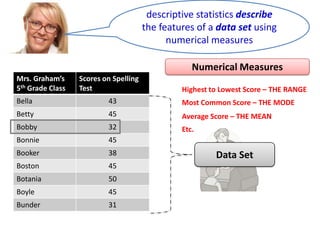
Highest to Lowest Score – THE RANGE

Bella

43

Most Common Score – THE MODE

Betty

45

Average Score – THE MEAN

Bobby

32

Etc.

Bonnie

45

Booker

38

Boston

45

Botania

50

Boyle

45

Bunder

31

Data Set
Now for Inferential statistics!

• While descriptive statistics focus on describing a
data set,
• Inferential statistics aims to draw conclusions
about a larger group (called a population),
• based on what is happening with a smaller group
(called a sample).
• Inferential statistics studies a statistical sample,
and from this analysis is able to say something
about the population from which the sample
came.
• While descriptive statistics focus on describing a
data set,
• Inferential statistics aims to draw conclusions or
INFER about a larger group (called a population),
• based on what is happening with a smaller group
(called a sample).
• INFERential statistics studies a statistical sample,
and from this analysis is able to say something
about the population from which the sample
came.
Same example, but here come a
series of inferential questions
from the parent.
Mrs. Graham’s
5th Grade Class

Scores on Spelling
Test

Bella

43

Betty

45

Bobby

32

Bonnie

45

Booker

38

Boston

45

Botania

50

Boyle

45

Bunder

31

How does your
class compare
with other 5th
grade classes:
In the school?
Mrs. Graham’s
5th Grade Class

Scores on Spelling
Test

Bella

43

Betty

45

Bobby

32

Bonnie

45

Booker

38

Boston

45

Botania

50

Boyle

45

Bunder

31

About the
same
Mrs. Graham’s
5th Grade Class

Scores on Spelling
Test

Bella

43

Betty

45

Bobby

32

Bonnie

45

Booker

38

Boston

45

Botania

50

Boyle

45

Bunder

31

What about
other 5th
grade
classes:
In the
district?
Mrs. Graham’s
5th Grade Class

Scores on Spelling
Test

Bella

43

Betty

45

Bobby

32

Bonnie

45

Booker

38

Boston

45

Botania

50

Boyle

45

Bunder

31

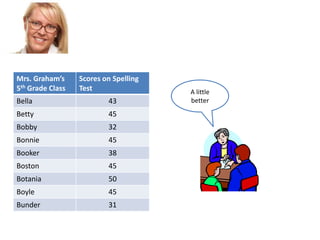
A little
better
Mrs. Graham’s
5th Grade Class

Scores on Spelling
Test

Bella

43

Betty

45

Bobby

32

Bonnie

45

Booker

38

Boston

45

Botania

50

Boyle

45

Bunder

31

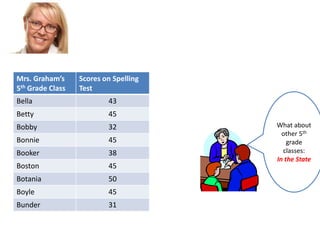
What about
other 5th
grade
classes:
In the State
Mrs. Graham’s
5th Grade Class

Scores on Spelling
Test

Bella

43

Betty

45

Bobby

32

Bonnie

45

Booker

38

Boston

45

Botania

50

Boyle

45

Bunder

31

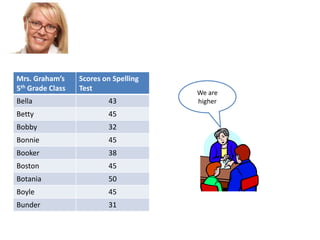
We are
higher
Mrs. Graham’s
5th Grade Class

Scores on Spelling
Test

Bella

43

Betty

45

Bobby

32

Bonnie

45

Booker

38

Boston

45

Botania

50

Boyle

45

Bunder

31

What about
other 5th
grade
classes:
In the
Country
Mrs. Graham’s
5th Grade Class

Scores on Spelling
Test

Bella

43

Betty

45

Bobby

32

Bonnie

45

Booker

38

Boston

45

Botania

50

Boyle

45

Bunder

31

We are
much
higher
Mrs. Graham’s
5th Grade Class

Scores on Spelling
Test

Bella

43

Betty

45

Bobby

32

Bonnie

45

Booker

38

Boston

45

Botania

50

Boyle

45

Bunder

31

Looks like
your class
Maybe
does not
Bobby
represent
doesn’t
the national
have to
population
study as
and is
much?
probably
doing better.
Mrs. Graham’s
5th Grade Class

Scores on Spelling
Test

Bella

43

Betty

45

Bobby

32

Bonnie

45

Booker

38

Boston

45

Botania

50

Boyle

45

Bunder

31

Maybe.
Mrs. Graham’s
5th Grade Class

Scores on Spelling
Test

Bella

43

Betty

45

Bobby

32

Bonnie

45

Booker

38

Boston

45

Botania

50

Boyle

45

Bunder

31
In summary -

A descriptive study examines the data from
everyone in a group or population.
A descriptive study cannot generalize to other
like groups or populations.
An inferential study examines the data from a
sample and then generalizes the conclusions
about that group to a larger population.
A descriptive study examines the data from
everyone in a group or population.
A descriptive study cannot generalize to other
like groups or populations.
An inferential study examines the data from a
sample and then generalizes the conclusions
about that group to a larger population.
A descriptive study examines the data from
everyone in a group or population.
A descriptive study cannot generalize to other
like groups or populations.
An inferential study examines the data from a
sample and then generalizes the conclusions
about that group to a larger population.
A descriptive study examines the data from
everyone in a group or population.
A descriptive study cannot generalize to other
like groups or populations.
An inferential study examines the data from a
sample and then generalizes the conclusions
about that group to a larger population.
A descriptive study examines the data from
everyone in a group or population.
A descriptive study cannot generalize to other
like groups or populations.
An inferential study examines the data from a
sample and then generalizes the conclusions
about that group to a larger population.
Note – inferential and descriptive studies use the
SAME statistics (e.g., mean, range, mode, etc.),
but as you can see – for DIFFERENT reasons!