Inferential Statistics
Dr.Thet Aung Moe( Roll NO- 29 )
Dr. Win Thandar Phyu ( Roll No-27)
(1/2015) Diploma In Hospital Administration
Statistics
A field of study concerned with (1) the
collection, organization, summarization &
analysis of data ; & (2) drawing of inferences
about a body of data when only a part of the
data is observed .
The science of collecting , organizing,
presenting , analyzing & interpreting data to
assist in making more effective decisions.
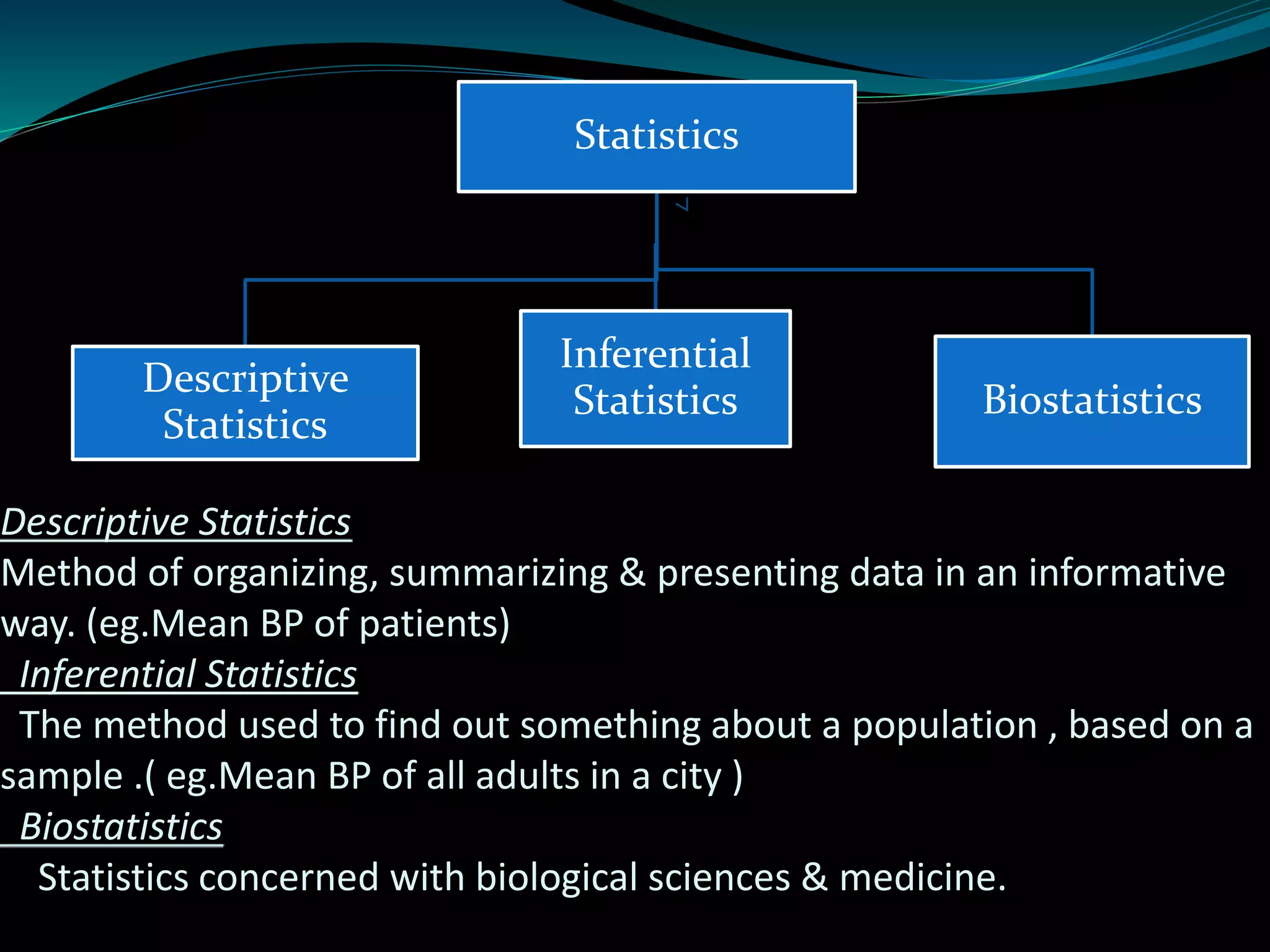
Descriptive Statistics
Method of organizing, summarizing & presenting data in an informative
way. (eg.Mean BP of patients)
Inferential Statistics
The method used to find out something about a population , based on a
sample .( eg.Mean BP of all adults in a city )
Biostatistics
Statistics concerned with biological sciences & medicine.
Statistics
Descriptive
Statistics
Inferential
Statistics Biostatistics
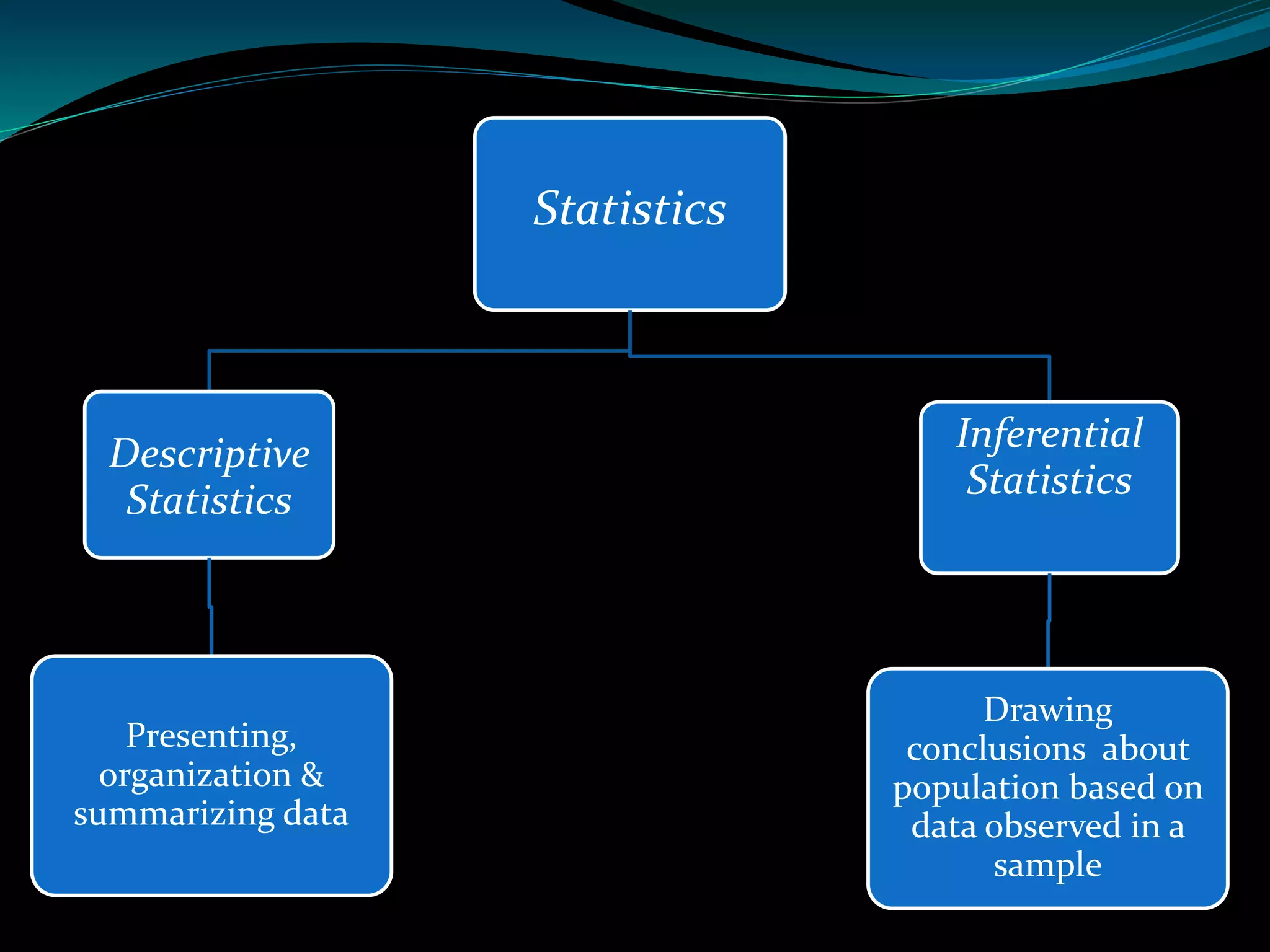
Statistics
Descriptive
Statistics
Presenting,
organization &
summarizing data
Inferential
Statistics
Drawing
conclusions about
population based on
data observed in a
sample
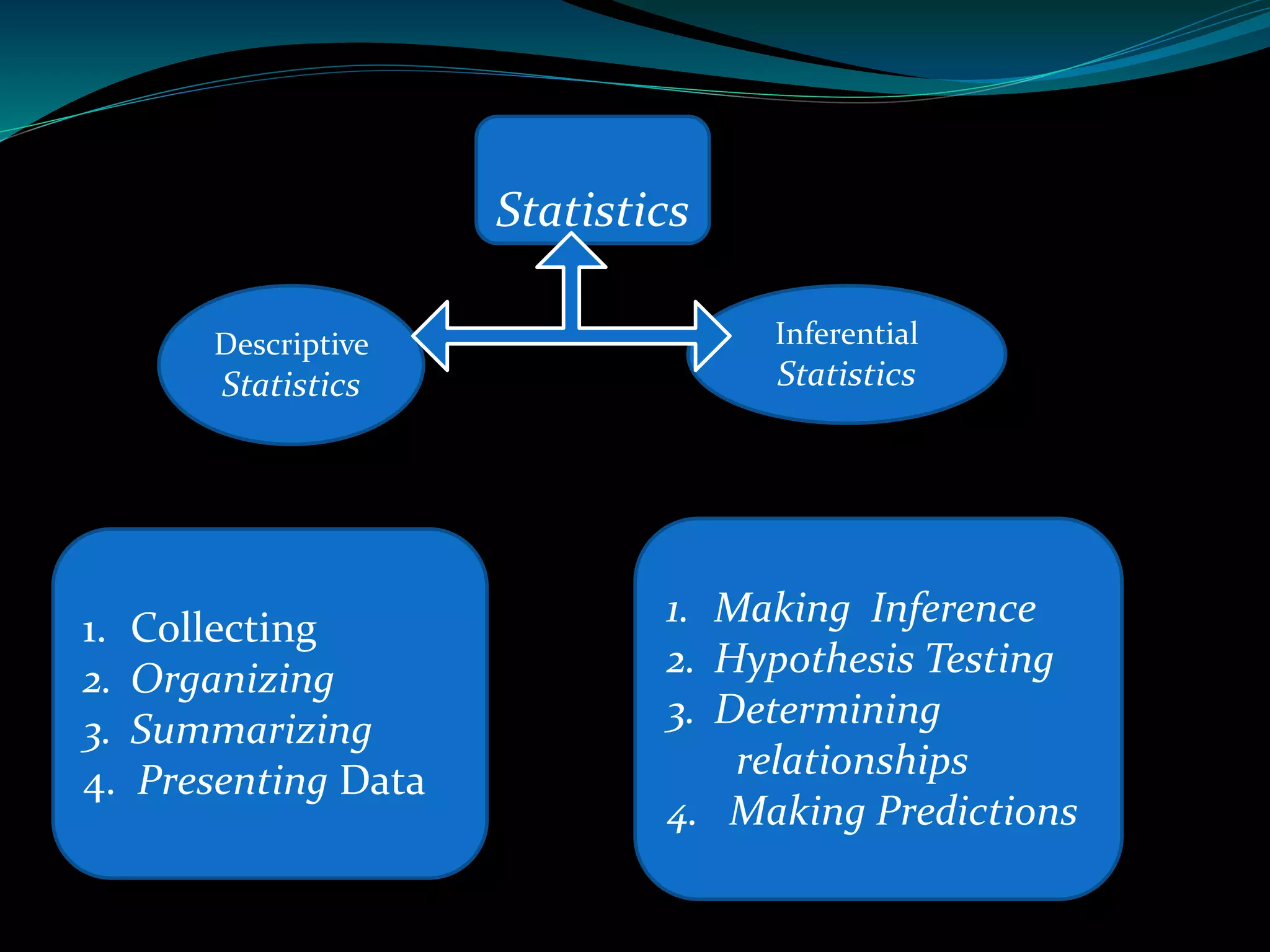
Statistics
Inferential
Statistics
Descriptive
Statistics
1. Collecting
2. Organizing
3. Summarizing
4. Presenting Data
1. Making Inference
2. Hypothesis Testing
3. Determining
relationships
4. Making Predictions
Statistical Inference
Definition
Statistical inference is the procedure by which
we reach a conclusion about a population on the
basic of the information contained in a sample that
has been drawn from that population.
Inferential Statistics
Definition
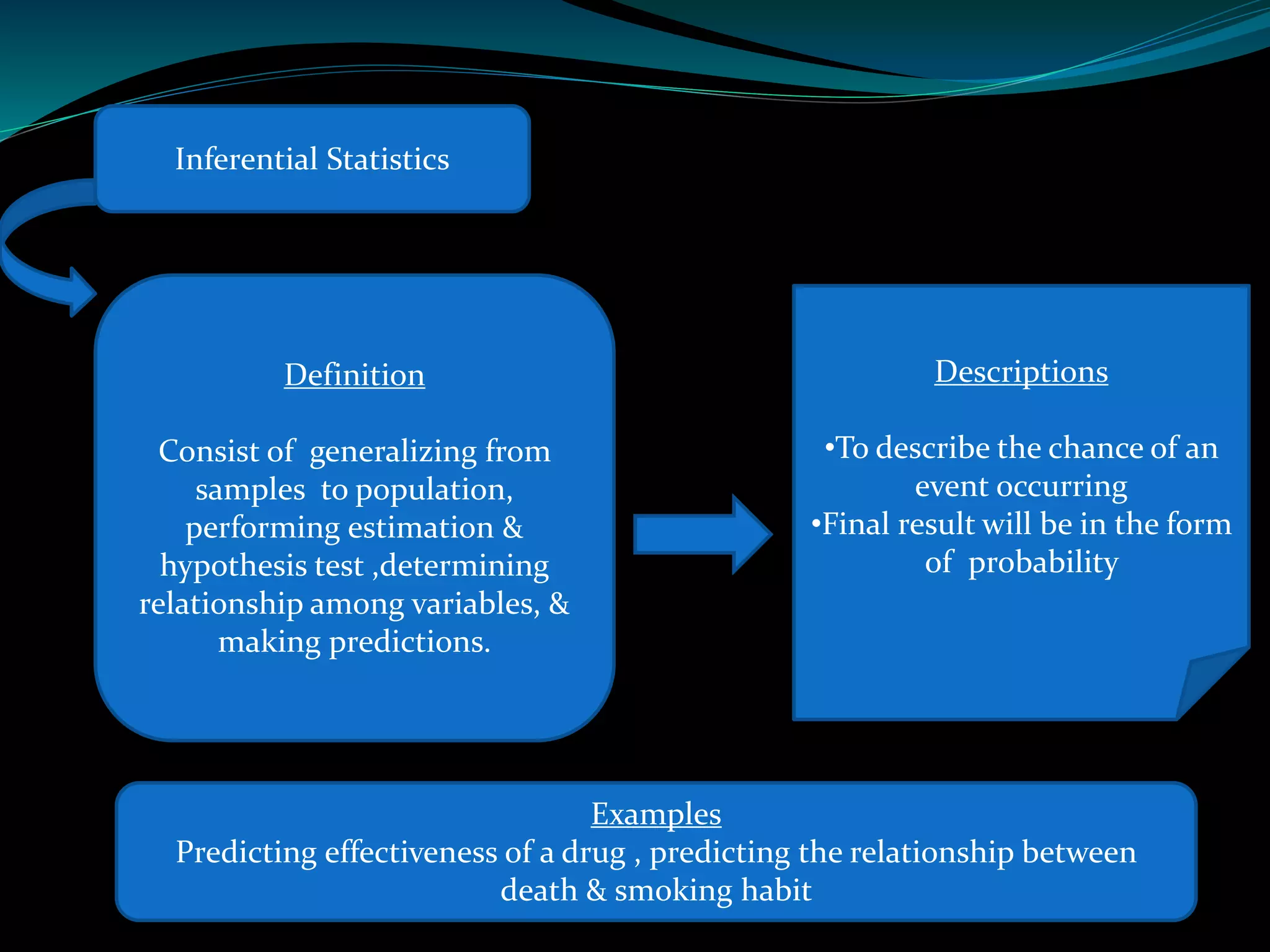
Consist of generalizing from
samples to population,
performing estimation &
hypothesis test ,determining
relationship among variables, &
making predictions.
Descriptions
•To describe the chance of an
event occurring
•Final result will be in the form
of probability
Examples
Predicting effectiveness of a drug , predicting the relationship between
death & smoking habit
Inferential Statistics
Inferential Statistics :
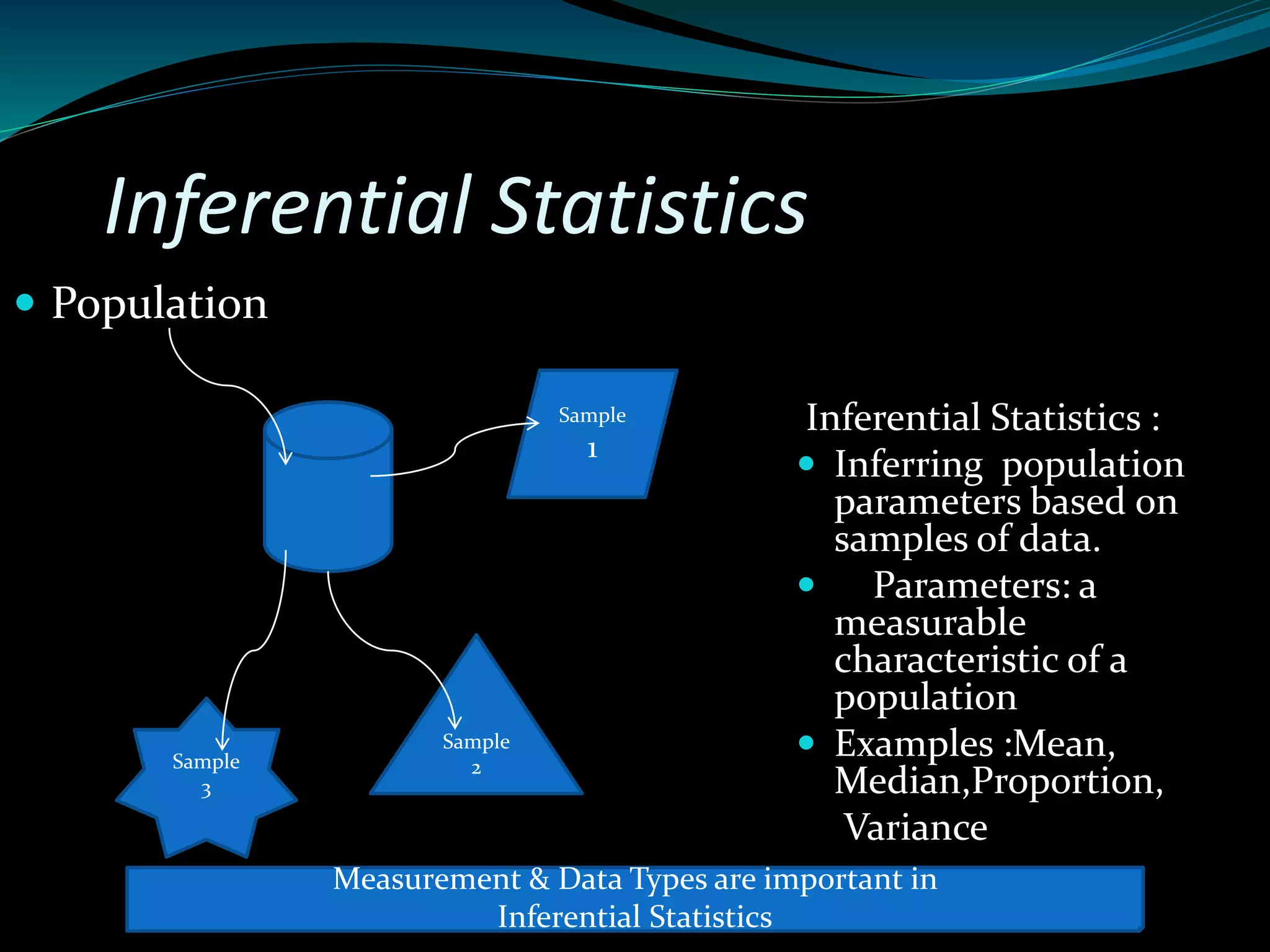
 Inferring population
parameters based on
samples of data.
 Parameters: a
measurable
characteristic of a
population
 Examples :Mean,
Median,Proportion,
Variance
 Population
Sample
3
Sample
2
Sample
1
Measurement & Data Types are important in
Inferential Statistics
Population
Largest collection of entities or values of a random variable
for which we have an interest at a particular time.
( eg. weights of infants , weights of adults )
Finite population – fixed numbers of values
(eg. Adult population in a village)
Infinite population – endless succession of values
(eg.OPD patients in a hospital)
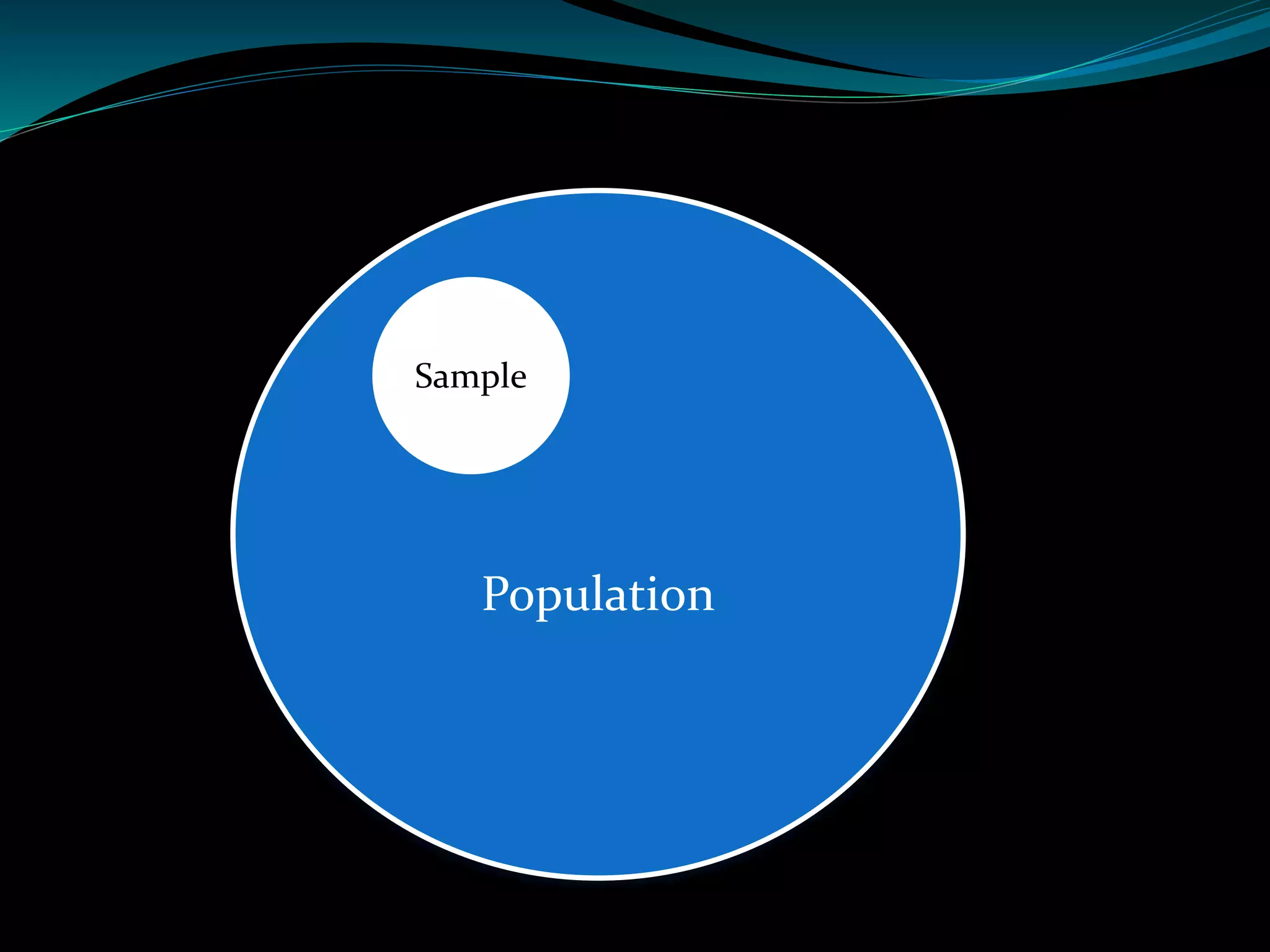
Sample : A part of population
Population
Sample
There are many kinds of samples that may be drawn
from a population.
Not every kind of sample can be used as a basis for
making valid inferences about a population.
To make a valid inference about a population , we need a
scientific sample from the population.
The simplest of these scientific samples is the Simple
Random Sample.
Ifwe use the letter N – size of a finite population
The letter n - size of a sample , we defined a simple random sample.
Definition
If a sample of size “n” is drawn from a population of size
“N” in such a way that every possible sample of size “n” has
the same chance of being selected , the sample is called a
simple random sample.
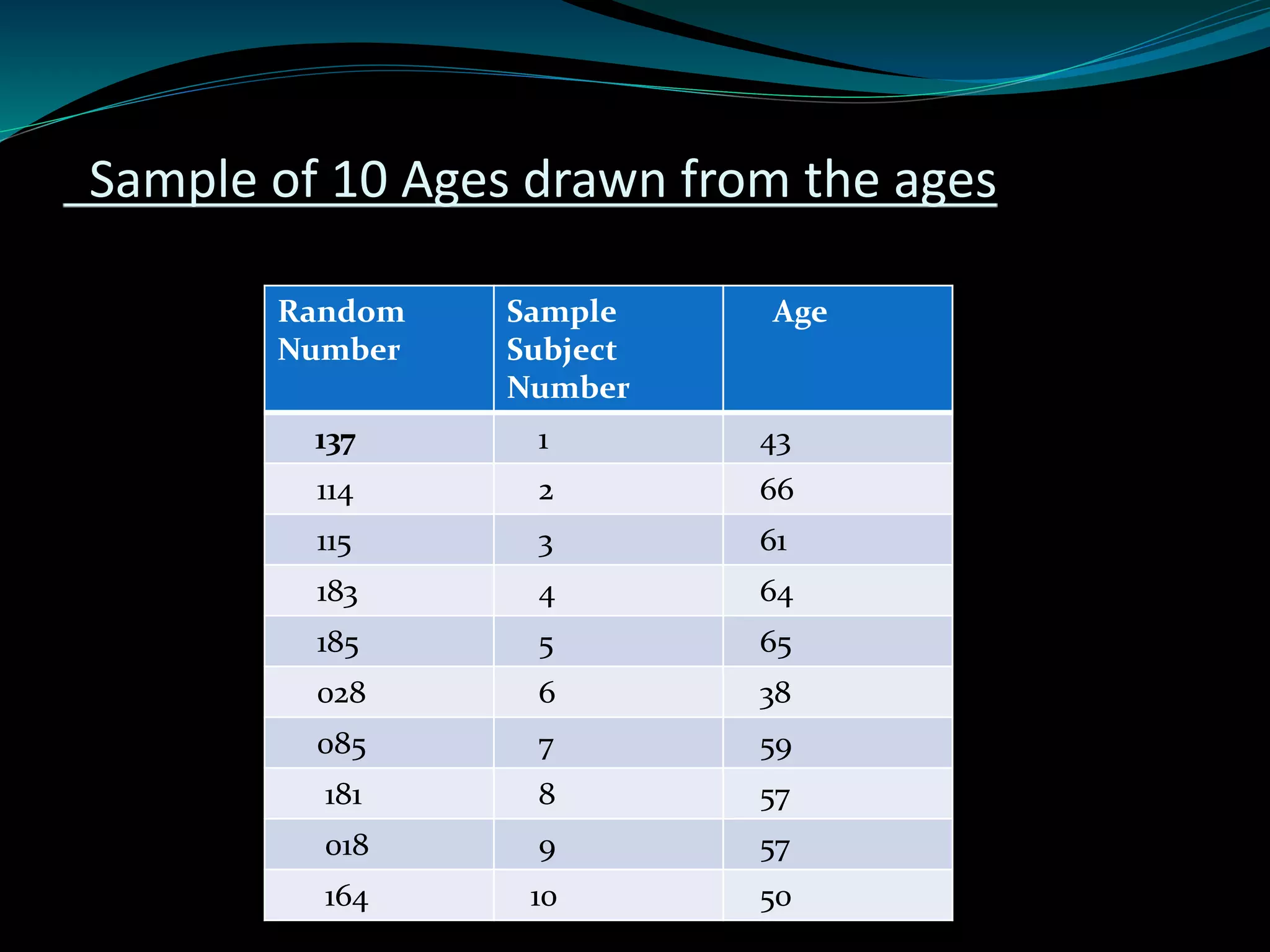
Random
Number
Sample
Subject
Number
Age
137 1 43
114 2 66
115 3 61
183 4 64
185 5 65
028 6 38
085 7 59
181 8 57
018 9 57
164 10 50
Sample of 10 Ages drawn from the ages
The mechanics of drawing a simple random
sample is called simple random sampling.
May be with replacement or without
replacement .
As a rule in practice sampling is always done
without replacement .
Eg. A simple random of size n=10 from a
population of size N = 189*
Random sampling is important role in designing research studies &
experiments.
Definition
A research study is a scientific study of phenomenon of interest .
Research studies involve sampling protocols , collecting & analyzing
data, & providing valid conclusions based on the results of the
analyses.
Definition
Experiments are a special type of research study in which
observations are made after specific manipulations of conditions
have been carried out ; they provide the foundation for scientific
research.
Systematic Sampling
Definition
A sampling method that is widely used in
healthcare research is the systemic sample .
Medical records which contain raw data used
in healthcare research are stored in a file
system or a computer.
Are easy to select in a systematic way.
Stratified Random Sampling
Definition
A method of sampling that involves the divisions of
a population into smaller groups known as strata . In
stratified random sampling, the strata are formed
based on member’s shared attributes or
characteristics.
A random sample from each stratum is taken in a
number proportion to the stratum ‘s size when
compared to the population.
These subsets of the strata are pooled to form a
random sample.
Two Main Methods Used In Inferential Statistics
1. Estimation: A sample is used to estimate a
parameter & confidence interval about the estimate
is constructed .
2. Hypothesis : When doing an experiment we
assume an hypothesis is called Null Hypothesis. Data
are collected & the null hypothesis is compared with
them .
If the data are very different from the null hypothesis
it is rejected.
If not, it is accepted.
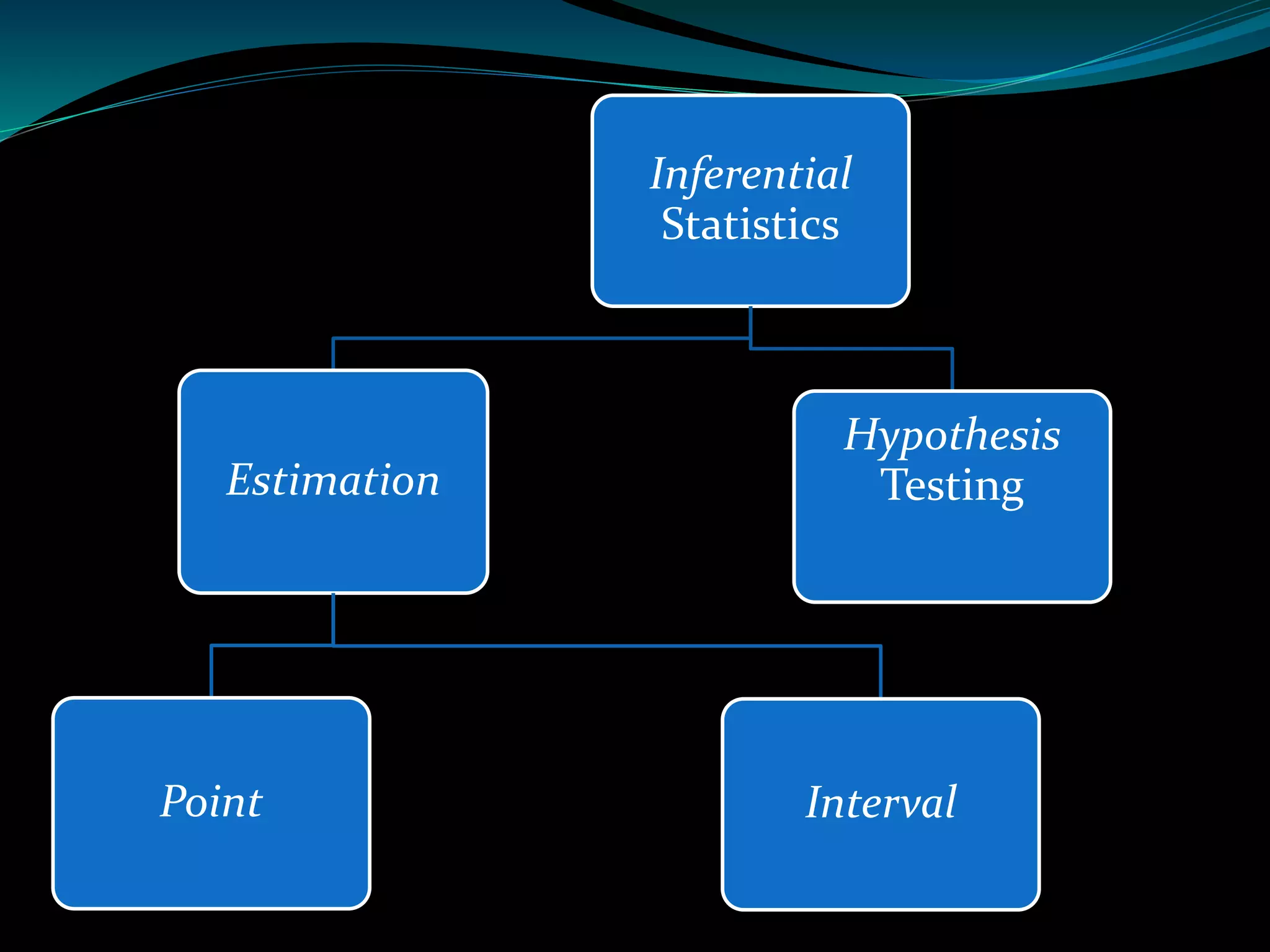
Inferential
Statistics
Estimation
Point Interval
Hypothesis
Testing
Thank U !

Inferential statictis ready go

  • 1.
    Inferential Statistics Dr.Thet AungMoe( Roll NO- 29 ) Dr. Win Thandar Phyu ( Roll No-27) (1/2015) Diploma In Hospital Administration
  • 2.
    Statistics A field ofstudy concerned with (1) the collection, organization, summarization & analysis of data ; & (2) drawing of inferences about a body of data when only a part of the data is observed . The science of collecting , organizing, presenting , analyzing & interpreting data to assist in making more effective decisions.
  • 3.
    Descriptive Statistics Method oforganizing, summarizing & presenting data in an informative way. (eg.Mean BP of patients) Inferential Statistics The method used to find out something about a population , based on a sample .( eg.Mean BP of all adults in a city ) Biostatistics Statistics concerned with biological sciences & medicine. Statistics Descriptive Statistics Inferential Statistics Biostatistics
  • 4.
  • 5.
    Statistics Inferential Statistics Descriptive Statistics 1. Collecting 2. Organizing 3.Summarizing 4. Presenting Data 1. Making Inference 2. Hypothesis Testing 3. Determining relationships 4. Making Predictions
  • 6.
    Statistical Inference Definition Statistical inferenceis the procedure by which we reach a conclusion about a population on the basic of the information contained in a sample that has been drawn from that population.
  • 7.
    Inferential Statistics Definition Consist ofgeneralizing from samples to population, performing estimation & hypothesis test ,determining relationship among variables, & making predictions. Descriptions •To describe the chance of an event occurring •Final result will be in the form of probability Examples Predicting effectiveness of a drug , predicting the relationship between death & smoking habit
  • 8.
    Inferential Statistics Inferential Statistics:  Inferring population parameters based on samples of data.  Parameters: a measurable characteristic of a population  Examples :Mean, Median,Proportion, Variance  Population Sample 3 Sample 2 Sample 1 Measurement & Data Types are important in Inferential Statistics
  • 9.
    Population Largest collection ofentities or values of a random variable for which we have an interest at a particular time. ( eg. weights of infants , weights of adults ) Finite population – fixed numbers of values (eg. Adult population in a village) Infinite population – endless succession of values (eg.OPD patients in a hospital) Sample : A part of population
  • 10.
  • 11.
    There are manykinds of samples that may be drawn from a population. Not every kind of sample can be used as a basis for making valid inferences about a population. To make a valid inference about a population , we need a scientific sample from the population. The simplest of these scientific samples is the Simple Random Sample.
  • 12.
    Ifwe use theletter N – size of a finite population The letter n - size of a sample , we defined a simple random sample. Definition If a sample of size “n” is drawn from a population of size “N” in such a way that every possible sample of size “n” has the same chance of being selected , the sample is called a simple random sample.
  • 13.
    Random Number Sample Subject Number Age 137 1 43 1142 66 115 3 61 183 4 64 185 5 65 028 6 38 085 7 59 181 8 57 018 9 57 164 10 50 Sample of 10 Ages drawn from the ages
  • 14.
    The mechanics ofdrawing a simple random sample is called simple random sampling. May be with replacement or without replacement . As a rule in practice sampling is always done without replacement . Eg. A simple random of size n=10 from a population of size N = 189*
  • 15.
    Random sampling isimportant role in designing research studies & experiments. Definition A research study is a scientific study of phenomenon of interest . Research studies involve sampling protocols , collecting & analyzing data, & providing valid conclusions based on the results of the analyses. Definition Experiments are a special type of research study in which observations are made after specific manipulations of conditions have been carried out ; they provide the foundation for scientific research.
  • 16.
    Systematic Sampling Definition A samplingmethod that is widely used in healthcare research is the systemic sample . Medical records which contain raw data used in healthcare research are stored in a file system or a computer. Are easy to select in a systematic way.
  • 17.
    Stratified Random Sampling Definition Amethod of sampling that involves the divisions of a population into smaller groups known as strata . In stratified random sampling, the strata are formed based on member’s shared attributes or characteristics. A random sample from each stratum is taken in a number proportion to the stratum ‘s size when compared to the population. These subsets of the strata are pooled to form a random sample.
  • 18.
    Two Main MethodsUsed In Inferential Statistics 1. Estimation: A sample is used to estimate a parameter & confidence interval about the estimate is constructed . 2. Hypothesis : When doing an experiment we assume an hypothesis is called Null Hypothesis. Data are collected & the null hypothesis is compared with them . If the data are very different from the null hypothesis it is rejected. If not, it is accepted.
  • 19.
  • 20.