Inferential Statistics
Dr. A.P. Kulkarni
Outline
Null hypothesis
Common situations
What is inferential statistics?
Concept of probability
Choice of statistical test
What is inferential statistics?
 Process of drawing conclusions from
descriptive statistics
Scientific process & not half-hazard
Use of concepts like
 Confidence limits
 Null hypothesis
 Probability
Common situations
Association in two/ more variables
Difference in two samples
Population parameter from sample
Correlation in two / more variables
Choice of statistical test
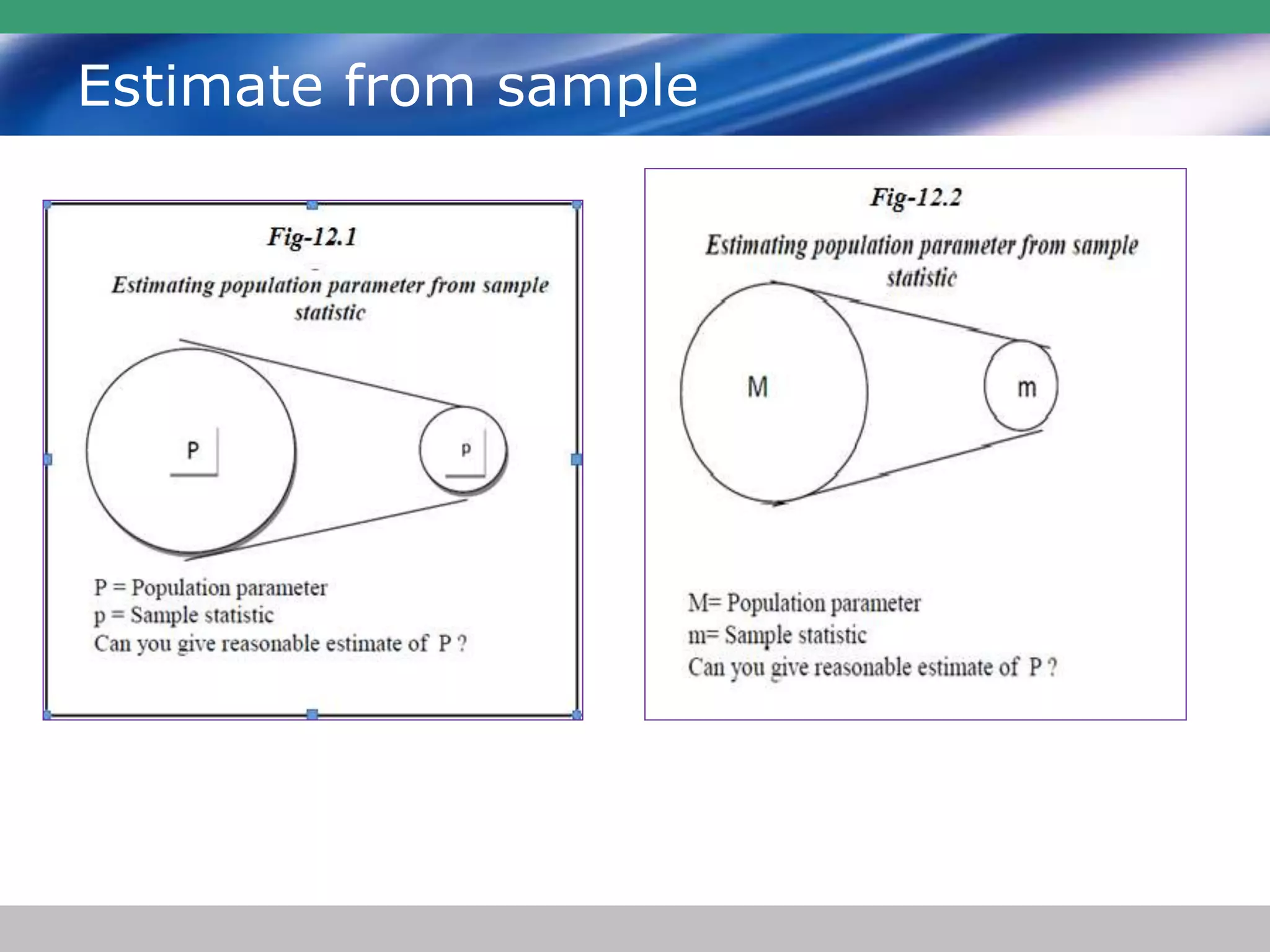
Estimate about population from sample
 Population constant = Parameter
 Estimate from sample = Sample statistics
(Point estimate)
Variable could be:
QUANTITATIVE
QUALITATIVE
 Test statistics calculated is Standard Error
Presumption: Sample is representing
population
Estimate from sample
Example-1
 Example: Mean Hb% of medical
students (allopathic) of
Maharashtra is unknown. In a
representative sample of 500
medicos it was found to be 11.2
gm% with SD of 2.0 gm%
 What is your estimate of Hb% of
medicos?
 SE m = SD / ⱱ(n) = 3.5 / ⱱ(500) = 0.1565
 M est = m ± 2SEm
 = 11.2 ± (2* 0.1565)
 = 10.88, 11.51
Example-2
 Example: Prevalence of diabetes
in gazetted employees in
Mubmbai in 400 randomly
selected officers was 5%. What
is your estimate about
prevalence of diabetes in these
officers?
p i.e. proportion of affected is 5 % = 0.05
1-p i.e. proportion of unaffected = (1-0.05) = 0.95
SEp = √ { (p x (1-p)/ n) = √ [(0.05 x 0.95)/400] = 0.011
P est = 0.05 +/- 2(0.011) = 0.0228; 0.072
Hypothesis test about difference
 If there is difference in two or more samples then
two questions
1. Has the difference occurred due to sampling
variation ? (NULL Hypothesis accepted)
2. Is the difference because samples belong to
populations with different parameters? (Research
hypothesis accepted)
 The variable being examined could be:
 QUALITATIVE
 QUANTITATIVE
3. Here we use various tests of significance
Tests of Significance
Basic steps in any test of significance are
 Identify the variables & choose appropriate test of
significance
 Calculate the test statistics like Z, t, Chi-Sq &
other required things like degrees of freedom)
 Find probability
 Interpret: A) Accept NH & Reject RH
B) Reject NH, Accept RH
 Decision level of Probability = 0.05
If P => 0.05: Accept NH
P < 0.05: Reject NH
Common Tests of Significance
Type of
variable
Sample
size
Groups
compared
Test of choice Test
statistic
Qualitative
Large
2 Z-test
(Difference in 2
proportions)
Z
> 2 Chi-square Chi-square,
DF
Small 2 or more Chi-square Chi-square,
DF
Small 2 Fischer Exact
test
P
Quantitative
Large 2 Z-Test
(Difference in 2
means)
Z
Small 2 t-test t, df
>2 ANOVA F, DF
Example-1
Example: In clinical trial of two drugs (A,B -
new) in a disease 100 patients were
treated with drug A, 80 were cured. In
200 comparable patients treated with
drug-B, 190 were cured.
Cure rate with drug A = 80%
Cure rate with drug B = 95%
What is NH?
What is AH?
What is type of variable?
Which test? Why?
Example-2
Example: In 100 pregnant mothers mean
Hb% was 9.0 gm% with SD 2 gm%. In
comparable 200 non-pregnant women
Hb% was 11 gm % with SD 2.5 gms%
What is NH?
What is AH?
What is type of variable?
Which test? Why?
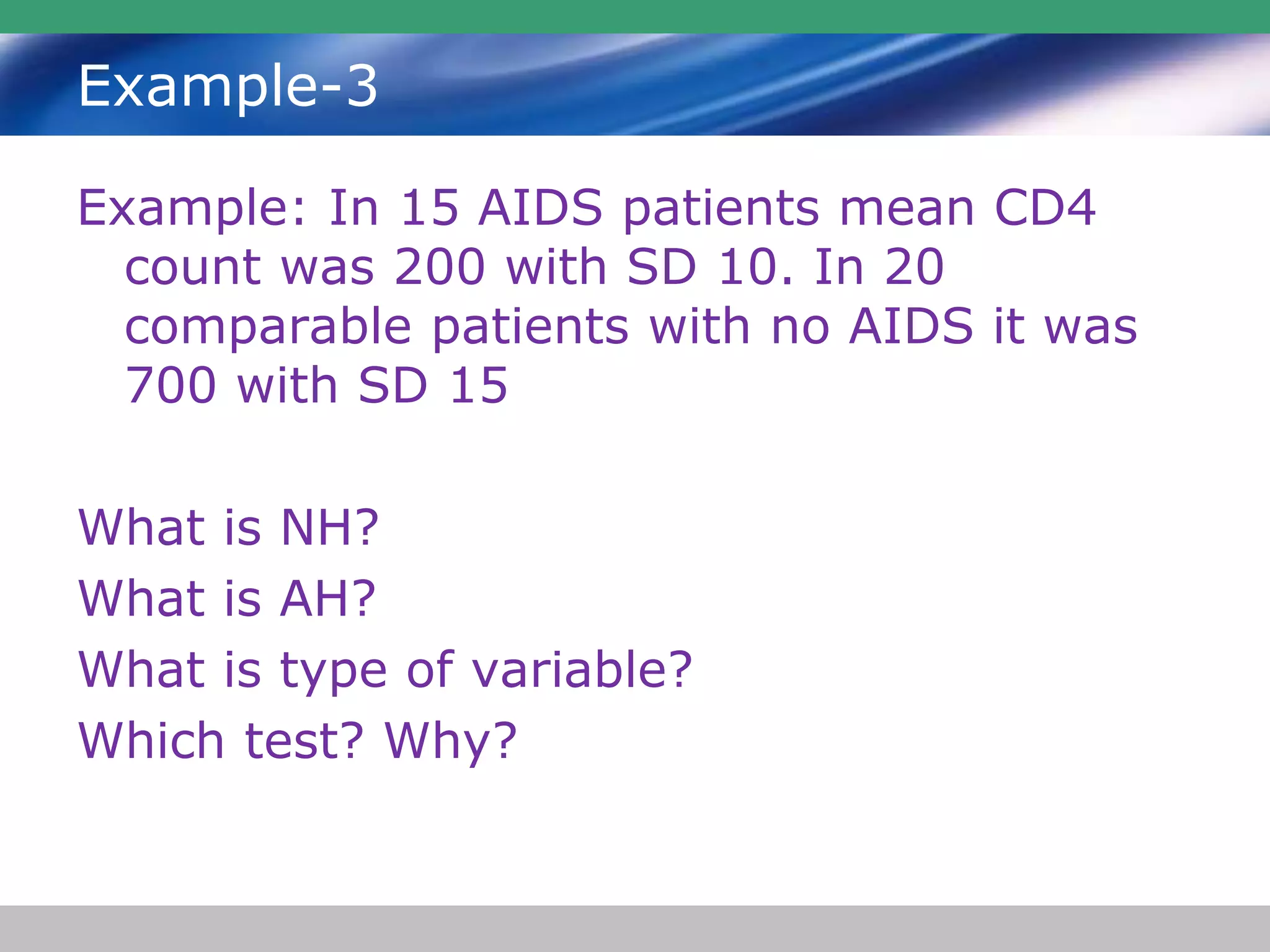
Example-3
Example: In 15 AIDS patients mean CD4
count was 200 with SD 10. In 20
comparable patients with no AIDS it was
700 with SD 15
What is NH?
What is AH?
What is type of variable?
Which test? Why?
Example-4
Example: In a trial two anti-anemic
drugs, these were compared with
standard treatment of Ferrous sulphate.
The patients were randomized in 3 groups
of 50 each. Mean Hb% with SD after 3
months are compared.
What is NH?
What is AH?
What is type of variable?
Which test? Why?
Example-5
Example: Following data shows weight gain
in mice after giving two drugs
What is NH?
What is AH?
What is type of variable?
Which test? Why?
Drug Weight
gain YES
Weight
gain NO
Total
A 4 2 6
B 1 5 6
Total 5 7 12
Errors in test of significance
 Alpha (Type-1)
 Probability of
rejecting a true NH
 Possibility of bringing
a useless drug in
market
 It is the P level of test
 Usually kept at 0.05
(5%)
 Confidence Level
= 1-alpha
 Beta (Type-2)
 Probability of
accepting a false NH
 Possibility of
prohibiting a good
drug from entering
market
 Usually kept at 0.20
(20%)
 Power of test
= 1-beta
Association between two variables
 This situation is seen in ANALYTICAL
studies
 The test statistics is Odds Ratio or
Relative Risk
 This being estimate from sample,
requires 95% CI
 Software can find 95% CI
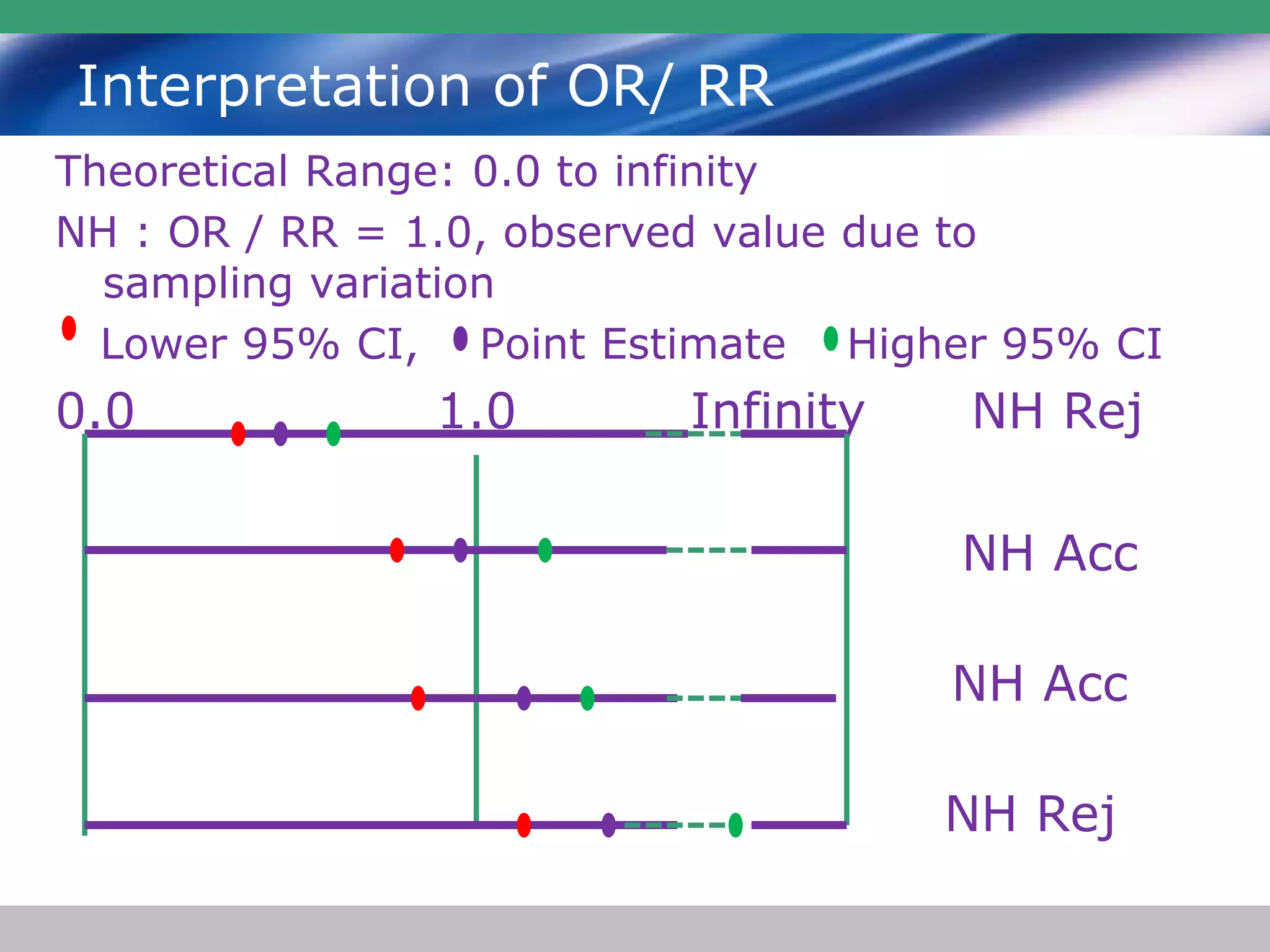
Interpretation of OR/ RR
Theoretical Range: 0.0 to infinity
NH : OR / RR = 1.0, observed value due to
sampling variation
Lower 95% CI, Point Estimate Higher 95% CI
0.0 1.0 Infinity NH Rej
NH Acc
NH Acc
NH Rej
Interpretation of Correlation
 Relationship between two QUANTITATIVE
variables (say like Ht & Wt)
 Test statistics: (r) Correlation coefficient
 Theoretical range: -1.0 to +1.0
 If (-) ve: Negative correlation
 If (+) ve: Positive correlation
 If above 0.6, strong correlation
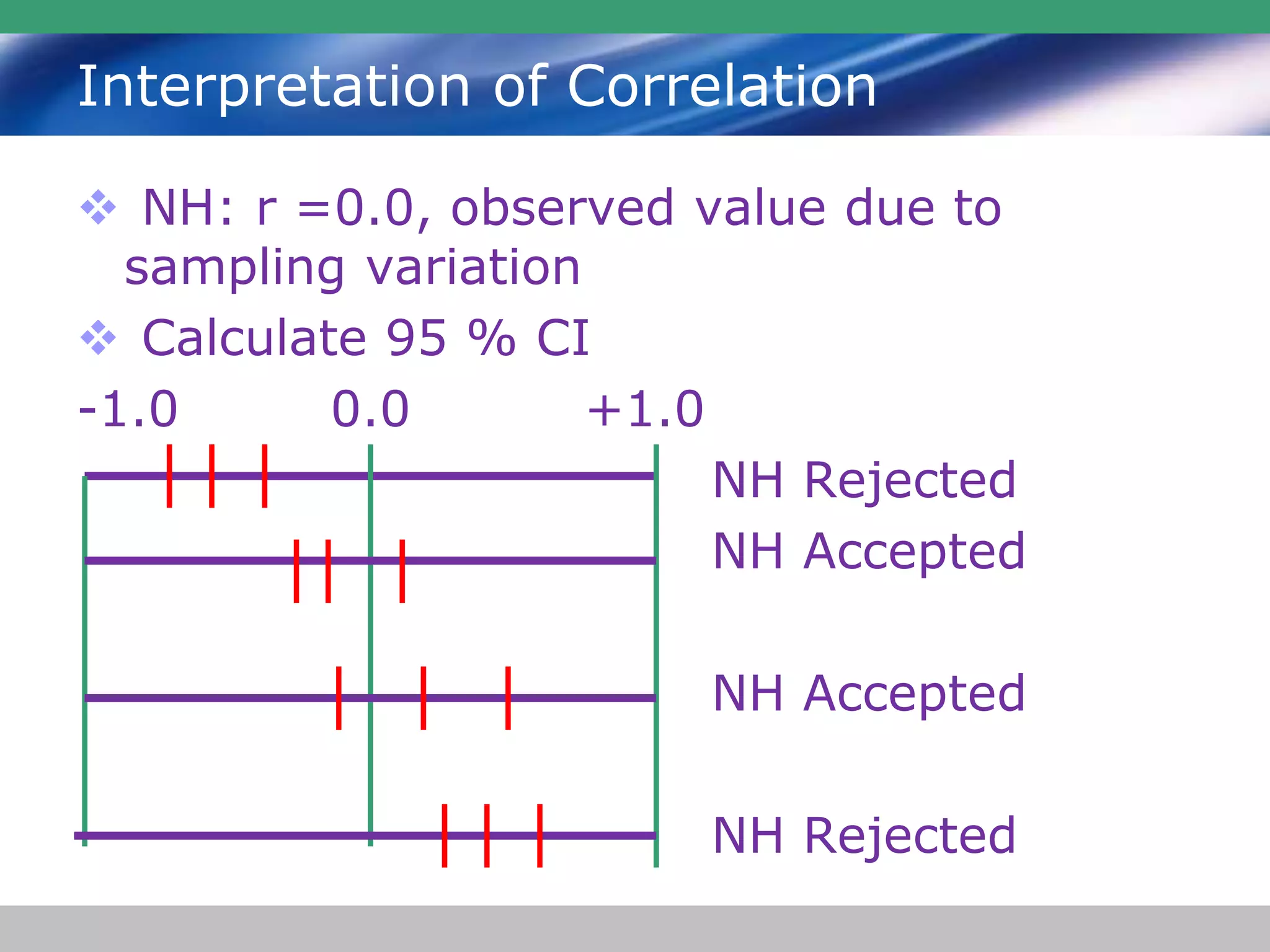
Interpretation of Correlation
 NH: r =0.0, observed value due to
sampling variation
 Calculate 95 % CI
-1.0 0.0 +1.0
NH Rejected
NH Accepted
NH Accepted
NH Rejected
Inferential statistics

Inferential statistics

  • 1.
  • 2.
    Outline Null hypothesis Common situations Whatis inferential statistics? Concept of probability Choice of statistical test
  • 3.
    What is inferentialstatistics?  Process of drawing conclusions from descriptive statistics Scientific process & not half-hazard Use of concepts like  Confidence limits  Null hypothesis  Probability
  • 4.
    Common situations Association intwo/ more variables Difference in two samples Population parameter from sample Correlation in two / more variables Choice of statistical test
  • 5.
    Estimate about populationfrom sample  Population constant = Parameter  Estimate from sample = Sample statistics (Point estimate) Variable could be: QUANTITATIVE QUALITATIVE  Test statistics calculated is Standard Error Presumption: Sample is representing population
  • 6.
  • 7.
    Example-1  Example: MeanHb% of medical students (allopathic) of Maharashtra is unknown. In a representative sample of 500 medicos it was found to be 11.2 gm% with SD of 2.0 gm%  What is your estimate of Hb% of medicos?  SE m = SD / ⱱ(n) = 3.5 / ⱱ(500) = 0.1565  M est = m ± 2SEm  = 11.2 ± (2* 0.1565)  = 10.88, 11.51
  • 8.
    Example-2  Example: Prevalenceof diabetes in gazetted employees in Mubmbai in 400 randomly selected officers was 5%. What is your estimate about prevalence of diabetes in these officers? p i.e. proportion of affected is 5 % = 0.05 1-p i.e. proportion of unaffected = (1-0.05) = 0.95 SEp = √ { (p x (1-p)/ n) = √ [(0.05 x 0.95)/400] = 0.011 P est = 0.05 +/- 2(0.011) = 0.0228; 0.072
  • 9.
    Hypothesis test aboutdifference  If there is difference in two or more samples then two questions 1. Has the difference occurred due to sampling variation ? (NULL Hypothesis accepted) 2. Is the difference because samples belong to populations with different parameters? (Research hypothesis accepted)  The variable being examined could be:  QUALITATIVE  QUANTITATIVE 3. Here we use various tests of significance
  • 10.
    Tests of Significance Basicsteps in any test of significance are  Identify the variables & choose appropriate test of significance  Calculate the test statistics like Z, t, Chi-Sq & other required things like degrees of freedom)  Find probability  Interpret: A) Accept NH & Reject RH B) Reject NH, Accept RH  Decision level of Probability = 0.05 If P => 0.05: Accept NH P < 0.05: Reject NH
  • 11.
    Common Tests ofSignificance Type of variable Sample size Groups compared Test of choice Test statistic Qualitative Large 2 Z-test (Difference in 2 proportions) Z > 2 Chi-square Chi-square, DF Small 2 or more Chi-square Chi-square, DF Small 2 Fischer Exact test P Quantitative Large 2 Z-Test (Difference in 2 means) Z Small 2 t-test t, df >2 ANOVA F, DF
  • 12.
    Example-1 Example: In clinicaltrial of two drugs (A,B - new) in a disease 100 patients were treated with drug A, 80 were cured. In 200 comparable patients treated with drug-B, 190 were cured. Cure rate with drug A = 80% Cure rate with drug B = 95% What is NH? What is AH? What is type of variable? Which test? Why?
  • 13.
    Example-2 Example: In 100pregnant mothers mean Hb% was 9.0 gm% with SD 2 gm%. In comparable 200 non-pregnant women Hb% was 11 gm % with SD 2.5 gms% What is NH? What is AH? What is type of variable? Which test? Why?
  • 14.
    Example-3 Example: In 15AIDS patients mean CD4 count was 200 with SD 10. In 20 comparable patients with no AIDS it was 700 with SD 15 What is NH? What is AH? What is type of variable? Which test? Why?
  • 15.
    Example-4 Example: In atrial two anti-anemic drugs, these were compared with standard treatment of Ferrous sulphate. The patients were randomized in 3 groups of 50 each. Mean Hb% with SD after 3 months are compared. What is NH? What is AH? What is type of variable? Which test? Why?
  • 16.
    Example-5 Example: Following datashows weight gain in mice after giving two drugs What is NH? What is AH? What is type of variable? Which test? Why? Drug Weight gain YES Weight gain NO Total A 4 2 6 B 1 5 6 Total 5 7 12
  • 17.
    Errors in testof significance  Alpha (Type-1)  Probability of rejecting a true NH  Possibility of bringing a useless drug in market  It is the P level of test  Usually kept at 0.05 (5%)  Confidence Level = 1-alpha  Beta (Type-2)  Probability of accepting a false NH  Possibility of prohibiting a good drug from entering market  Usually kept at 0.20 (20%)  Power of test = 1-beta
  • 18.
    Association between twovariables  This situation is seen in ANALYTICAL studies  The test statistics is Odds Ratio or Relative Risk  This being estimate from sample, requires 95% CI  Software can find 95% CI
  • 19.
    Interpretation of OR/RR Theoretical Range: 0.0 to infinity NH : OR / RR = 1.0, observed value due to sampling variation Lower 95% CI, Point Estimate Higher 95% CI 0.0 1.0 Infinity NH Rej NH Acc NH Acc NH Rej
  • 20.
    Interpretation of Correlation Relationship between two QUANTITATIVE variables (say like Ht & Wt)  Test statistics: (r) Correlation coefficient  Theoretical range: -1.0 to +1.0  If (-) ve: Negative correlation  If (+) ve: Positive correlation  If above 0.6, strong correlation
  • 21.
    Interpretation of Correlation NH: r =0.0, observed value due to sampling variation  Calculate 95 % CI -1.0 0.0 +1.0 NH Rejected NH Accepted NH Accepted NH Rejected