Fundamentals of Data
     Analysis
      Lecture 8
Chapter 12
Univariate statistical analysis: A
recap of inferential statistics


                                     2
Review sampling
• You want to see a new movie this weekend.
  So you get onto a website and checkout
  previews of what’s on.
• Is this sampling?
• How good a sample would this be>


                                              3
Census vs Sampling


                     4
Learning Objectives
• Understand and explain the need for data
  preparation techniques such as editing,
  coding, cleaning and statistically adjusting the
  data where required
• Develop a data analysis strategy based on
  specific research objectives
• Identify the factors influencing the selection of
  an appropriate data analysis strategy
• Outline various analysis techniques
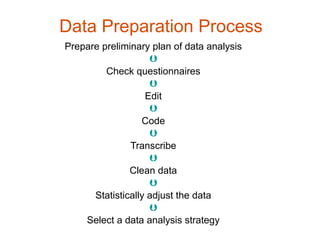
Data Preparation Process
Prepare preliminary plan of data analysis
                    
         Check questionnaires
                    
                   Edit
                    
                  Code
                    
               Transcribe
                    
               Clean data
                    
      Statistically adjust the data
                    
    Select a data analysis strategy
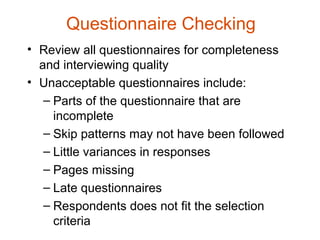
Questionnaire Checking
• Review all questionnaires for completeness
  and interviewing quality
• Unacceptable questionnaires include:
   – Parts of the questionnaire that are
     incomplete
   – Skip patterns may not have been followed
   – Little variances in responses
   – Pages missing
   – Late questionnaires
   – Respondents does not fit the selection
     criteria
Data Editing
• A review of the questionnaires with the
  objective of increasing accuracy and
  precision.

• Identify responses that are:
   – Illegible

  – Incomplete

  – Inconsistent

  – Ambiguous responses
Data Editing cont.
• Treatment of unsatisfactory responses
  – Return to the field
     • Recontact the respondent
  – Assign missing values
     • If the number of unsatisfactory responses is
       small
     • Key variables are not missing
  – Discard unsatisfactory respondents (cases)
     • Proportion of unsatisfactory responses is small
     • Sample size is large
     • Unsatisfactory respondents do not differ from
       satisfactory respondents
     • Responses to key variables are missing
Data Coding
• Assigning a code [number] to each possible
  response to each question [variable]
   – Structured questionnaires [pre-coded]
   – Unstructured questions [post-coding]
• Category codes should be mutually exclusive
  and collectively exhaustive.
• Category codes should be assigned for critical
  issues even if no one mentions them.
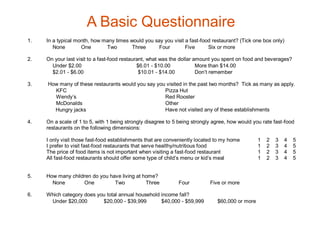
A Basic Questionnaire
1.   In a typical month, how many times would you say you visit a fast-food restaurant? (Tick one box only)
        None        One       Two        Three      Four        Five      Six or more

2.   On your last visit to a fast-food restaurant, what was the dollar amount you spent on food and beverages?
       Under $2.00                            $6.01 - $10.00            More than $14.00
       $2.01 - $6.00                           $10.01 - $14.00          Don’t remember

3.   How many of these restaurants would you say you visited in the past two months? Tick as many as apply.
       KFC                                          Pizza Hut
       Wendy’s                                      Red Rooster
       McDonalds                                    Other
       Hungry jacks                                 Have not visited any of these establishments

4.   On a scale of 1 to 5, with 1 being strongly disagree to 5 being strongly agree, how would you rate fast-food
     restaurants on the following dimensions:

     I only visit those fast-food establishments that are conveniently located to my home        1   2   3   4   5
     I prefer to visit fast-food restaurants that serve healthy/nutritious food                  1   2   3   4   5
     The price of food items is not important when visiting a fast-food restaurant               1   2   3   4   5
     All fast-food restaurants should offer some type of child’s menu or kid’s meal              1   2   3   4   5


5.   How many children do you have living at home?
       None        One          Two           Three           Four          Five or more

6.   Which category does you total annual household income fall?
      Under $20,000        $20,000 - $39,999        $40,000 - $59,999          $60,000 or more
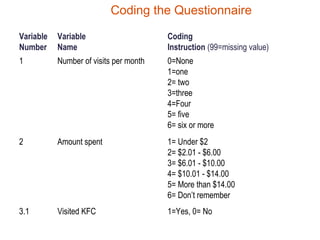
Coding the Questionnaire

Variable   Variable                     Coding
Number     Name                         Instruction (99=missing value)
1          Number of visits per month   0=None
                                        1=one
                                        2= two
                                        3=three
                                        4=Four
                                        5= five
                                        6= six or more
2          Amount spent                 1= Under $2
                                        2= $2.01 - $6.00
                                        3= $6.01 - $10.00
                                        4= $10.01 - $14.00
                                        5= More than $14.00
                                        6= Don’t remember
3.1        Visited KFC                  1=Yes, 0= No
Coding the Questionnaire cont.
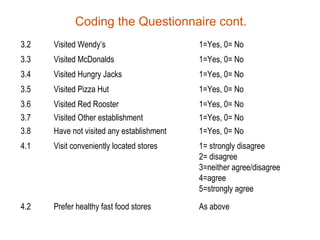
3.2   Visited Wendy’s                      1=Yes, 0= No
3.3   Visited McDonalds                    1=Yes, 0= No
3.4   Visited Hungry Jacks                 1=Yes, 0= No
3.5   Visited Pizza Hut                    1=Yes, 0= No
3.6   Visited Red Rooster                  1=Yes, 0= No
3.7   Visited Other establishment          1=Yes, 0= No
3.8   Have not visited any establishment   1=Yes, 0= No
4.1   Visit conveniently located stores    1= strongly disagree
                                           2= disagree
                                           3=neither agree/disagree
                                           4=agree
                                           5=strongly agree

4.2   Prefer healthy fast food stores      As above
Coding the Questionnaire cont.
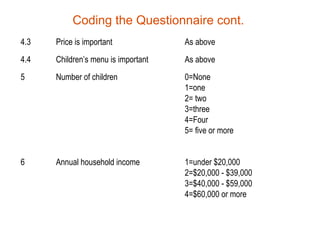
4.3   Price is important             As above
4.4   Children’s menu is important   As above
5     Number of children             0=None
                                     1=one
                                     2= two
                                     3=three
                                     4=Four
                                     5= five or more


6     Annual household income        1=under $20,000
                                     2=$20,000 - $39,000
                                     3=$40,000 - $59,000
                                     4=$60,000 or more
Transcribing
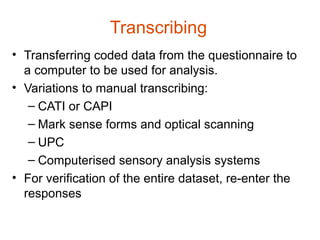
• Transferring coded data from the questionnaire to
  a computer to be used for analysis.
• Variations to manual transcribing:
   – CATI or CAPI
   – Mark sense forms and optical scanning
   – UPC
   – Computerised sensory analysis systems
• For verification of the entire dataset, re-enter the
  responses
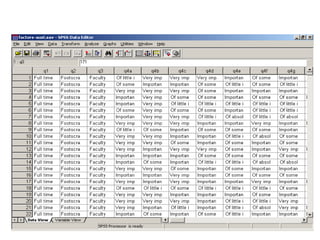
Transcribing cont.
Data Cleaning
• Consistency check
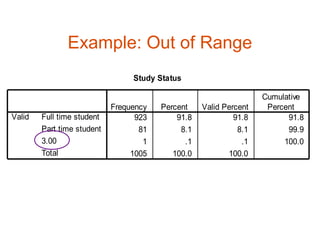
  – Out of range [see study status]
  – Logically inconsistent
    [e.g., does not own the product but is a heavy user]
  – Extreme values
    [indiscriminatingly responding the same way on all attributes]
Example: Out of Range
                                 Study Status

                                                                   Cumulative
                            Frequency   Percent    Valid Percent    Percent
Valid   Full time student         923       91.8            91.8         91.8
        Part time student          81        8.1             8.1         99.9
        3.00                        1         .1              .1        100.0
        Total                    1005      100.0          100.0
Data Cleaning cont.
• Treatment of missing responses
   – Substitute a neutral value [substitute the ‘mean’
     response of the variable]
   – Substitute an imputed response [use the
     respondent’s pattern of responses to other
     questions]
   – Casewise deletion [respondents with any missing
     values are discarded from the analysis]
   – Pairwise deletion [use only cases or respondents
     with complete responses for each calculation]
Statistically Adjusting the Data
• Weighting
   – Each case is assigned a weight to reflect its
     importance relative to other cases, often used to
     make the sample more representative of a target
     population
• Variable re-specification
   – Transformation of data to create new variables or
     modify existing variables to better suit the
     research objectives by summing several variables,
     log transformations, dummy variables [see next
     slide]
• Scale transformation
   – Manipulation of scale values to ensure
     comparability with other scales or otherwise make
     the data suitable for analysis [when data is not
     normally distributed].
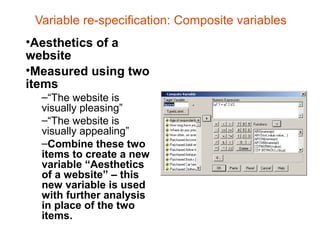
Variable re-specification: Composite variables
•Aesthetics of a
website
•Measured using two
items
  –“The website is
  visually pleasing”
  –“The website is
  visually appealing”
  –Combine these two
  items to create a new
  variable “Aesthetics
  of a website” – this
  new variable is used
  with further analysis
  in place of the two
  items.
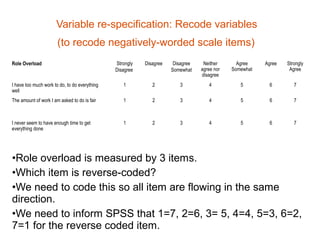
Variable re-specification: Recode variables
                       (to recode negatively-worded scale items)
Role Overload                                  Strongly   Disagree    Disagree    Neither      Agree    Agree   Strongly
                                               Disagree              Somewhat    agree nor   Somewhat            Agree
                                                                                 disagree
I have too much work to do, to do everything      1          2          3           4           5        6         7
well
The amount of work I am asked to do is fair       1          2          3           4           5        6         7


I never seem to have enough time to get           1          2          3           4           5        6         7
everything done


•Role overload is measured by 3 items.
•Which item is reverse-coded?
•We need to code this so all item are flowing in the same
direction.
•We need to inform SPSS that 1=7, 2=6, 3= 5, 4=4, 5=3, 6=2,
7=1 for the reverse coded item.
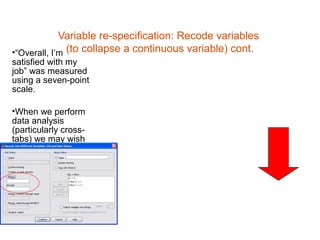
Variable re-specification: Recode variables
•“Overall, I’m (to collapse a continuous variable) cont.
satisfied with my
job” was measured
using a seven-point
scale.

•When we perform
data analysis
(particularly cross-
tabs) we may wish
to have fewer
categories for
brevity.
Strategy for Data Analysis
• Determine the type of data which is available
  [nominal, ordinal, interval, ratio]
• Decide what needs to be discussed in order to tell
  ‘the story’
• Choose techniques to best get information on
  specific parts of what has to be discussed
• Run the results
• Determine what the results mean, what patterns
  can be seen, what kind of statistical decisions
  should be made
• Write about the results to explain what is going on
  to someone who does not like numbers and has
  never heard of statistics
Overview of Techniques
• Descriptive Statistics
   – Frequency distribution and cross
     tabulations
   – Measures of central tendency [mean,
     median, mode]
   – Measures of dispersion [range,
     interquartile range, standard deviation]
   – Shape [skewness, kurtosis]
• Inferential Statistics
   – Parametric tests [Z or t test, paired t
     test]
   – Non-parametric tests [Chi-square]
Descriptive and inferential statistics

• Descriptive statistics are used to describe
  characteristics of a population.
• Inferential statistics are used to make
  inferences about a population from a
  sample of that population.


                                                26
Sample statistics and population
            parameters
• Sample statistics are variables in a sample or
  measures computed from sample data.
• Population parameters are variables in a
  population or measured characteristics of the
  population.
• But, generally we do not know what these
  population parameters are and that is why we
  use samples.

                                               27
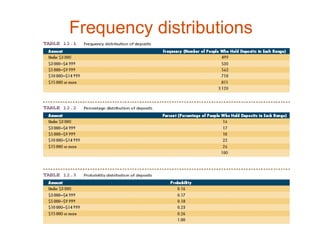
Frequency distributions
• Frequency distribution involves a process of
  recording the number of times a particular
  value of a variable occurs.
• Percentage distribution is a distribution of
  relative frequency.
• Probability is the long–run relative frequency
  with which an event will occur.


                                                   28
Frequency distributions


                          29
Measures of central tendency

• Mean: arithmetic average
• Median: the midpoint
  – The value below which half the values
    in a distribution fall.
• Mode: the value that occurs most often.


                                            30
Measures of dispersion
• The tendency of observations to depart from
  the central tendency.
• Range: distance between the smallest and
  largest values.
• Deviation scores: how far any observation is
  from the mean.
   – Average deviation
• Variance: measure of variability or dispersion
   – Its square root is the standard deviation.
                                               31
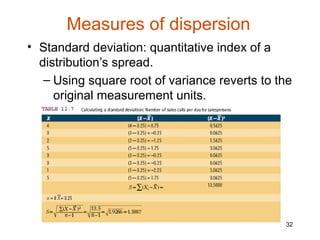
Measures of dispersion
• Standard deviation: quantitative index of a
  distribution’s spread.
   – Using square root of variance reverts to the
     original measurement units.


                                               32
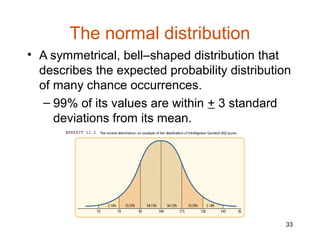
The normal distribution
• A symmetrical, bell–shaped distribution that
  describes the expected probability distribution
  of many chance occurrences.
   – 99% of its values are within + 3 standard
     deviations from its mean.


                                                33
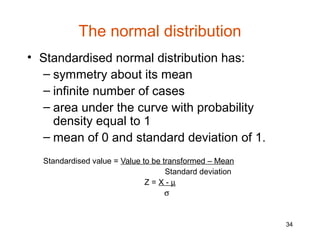
The normal distribution
• Standardised normal distribution has:
  – symmetry about its mean
  – infinite number of cases
  – area under the curve with probability
    density equal to 1
  – mean of 0 and standard deviation of 1.
  Standardised value = Value to be transformed – Mean
                                    Standard deviation
                              Z=X-µ
                                    σ


                                                         34
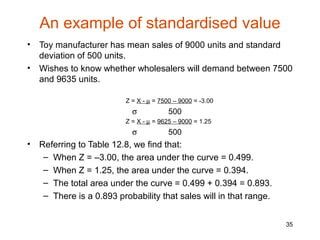
An example of standardised value
•   Toy manufacturer has mean sales of 9000 units and standard
    deviation of 500 units.
•   Wishes to know whether wholesalers will demand between 7500
    and 9635 units.

                           Z = X - µ = 7500 – 9000 = -3.00
                             σ            500
                           Z = X - µ = 9625 – 9000 = 1.25
                             σ            500
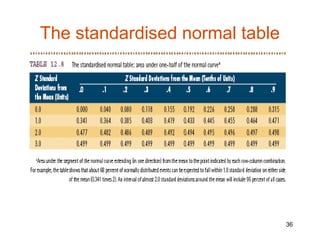
•   Referring to Table 12.8, we find that:
     – When Z = –3.00, the area under the curve = 0.499.
     – When Z = 1.25, the area under the curve = 0.394.
     – The total area under the curve = 0.499 + 0.394 = 0.893.
     – There is a 0.893 probability that sales will in that range.


                                                                     35
The standardised normal table


                                36
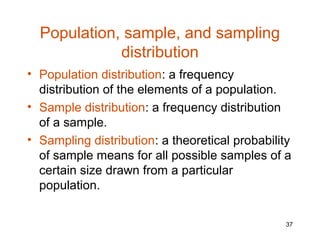
Population, sample, and sampling
             distribution
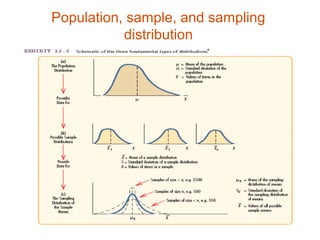
• Population distribution: a frequency
  distribution of the elements of a population.
• Sample distribution: a frequency distribution
  of a sample.
• Sampling distribution: a theoretical probability
  of sample means for all possible samples of a
  certain size drawn from a particular
  population.

                                                37
Population, sample, and sampling
             distribution
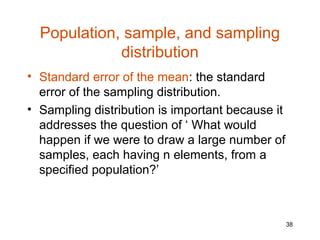
• Standard error of the mean: the standard
  error of the sampling distribution.
• Sampling distribution is important because it
  addresses the question of ‘ What would
  happen if we were to draw a large number of
  samples, each having n elements, from a
  specified population?’


                                                  38
Population, sample, and sampling
           distribution


                                   39
Central–limit theorem
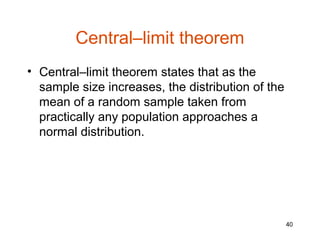
• Central–limit theorem states that as the
  sample size increases, the distribution of the
  mean of a random sample taken from
  practically any population approaches a
  normal distribution.


                                                   40
Confidence intervals
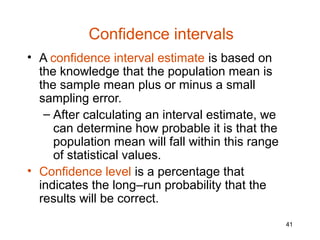
• A confidence interval estimate is based on
  the knowledge that the population mean is
  the sample mean plus or minus a small
  sampling error.
   – After calculating an interval estimate, we
     can determine how probable it is that the
     population mean will fall within this range
     of statistical values.
• Confidence level is a percentage that
  indicates the long–run probability that the
  results will be correct.
                                                   41
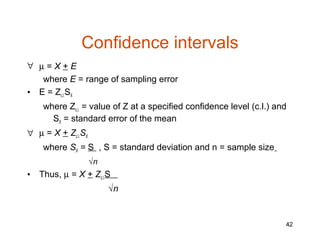
Confidence intervals
∀ µ=X+E
   where E = range of sampling error
• E = Zc.l.SX
     where Zc.l. = value of Z at a specified confidence level (c.l.) and
       SX = standard error of the mean
∀ µ = X + Zc.l.SX
     where SX = S , S = standard deviation and n = sample size
                    √n
•   Thus, µ = X + Zc.l.S
                         √n


                                                                       42
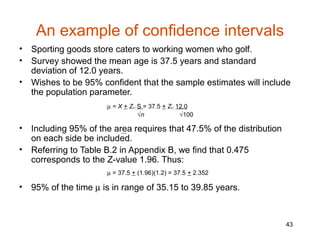
An example of confidence intervals
•   Sporting goods store caters to working women who golf.
•   Survey showed the mean age is 37.5 years and standard
    deviation of 12.0 years.
•   Wishes to be 95% confident that the sample estimates will include
    the population parameter.
                       µ = X + Zc.l. S = 37.5 + Zc.l. 12.0
                                     √n                √100

•   Including 95% of the area requires that 47.5% of the distribution
    on each side be included.
•   Referring to Table B.2 in Appendix B, we find that 0.475
    corresponds to the Z-value 1.96. Thus:
                       µ = 37.5 + (1.96)(1.2) = 37.5 + 2.352

•   95% of the time µ is in range of 35.15 to 39.85 years.


                                                                        43
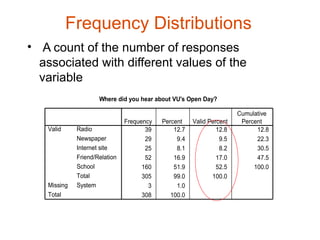
Frequency Distributions
• A count of the number of responses
  associated with different values of the
  variable
                     Where did you hear about VU's Open Day?

                                                                      Cumulative
                               Frequency   Percent    Valid Percent    Percent
   Valid     Radio                    39       12.7            12.8         12.8
             Newspaper                29        9.4             9.5         22.3
             Internet site            25        8.1             8.2         30.5
             Friend/Relation          52       16.9            17.0         47.5
             School                  160       51.9            52.5        100.0
             Total                   305       99.0          100.0
   Missing   System                    3        1.0
   Total                             308      100.0
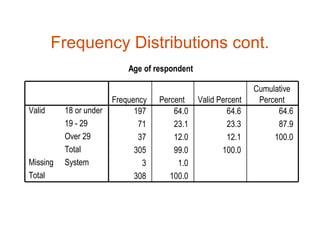
Frequency Distributions cont.
                            Age of respondent

                                                                Cumulative
                        Frequency   Percent     Valid Percent    Percent
Valid     18 or under         197       64.0             64.6         64.6
          19 - 29              71       23.1             23.3         87.9
          Over 29              37       12.0             12.1        100.0
          Total               305       99.0           100.0
Missing   System                3        1.0
Total                         308      100.0
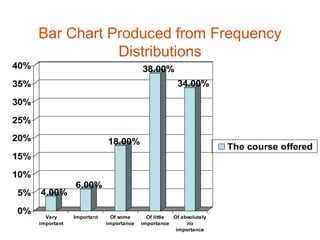
Bar Chart Produced from Frequency
                 Distributions
40%                                        38.00%
35%                                                     34.00%

30%

25%
20%                           18.00%
                                                                       The course offered
15%

10%
                  6.00%
5%    4.00%

0%
        Very      Important    Of some       Of little Of absolutely
      important               importance   importance       no
                                                        importance
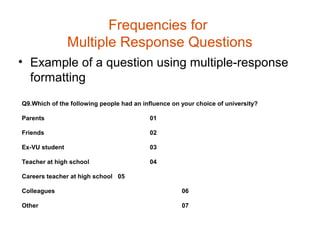
Frequencies for
                Multiple Response Questions
• Example of a question using multiple-response
  formatting
Q9.Which of the following people had an influence on your choice of university?

Parents                                   01

Friends                                   02

Ex-VU student                             03

Teacher at high school                    04

Careers teacher at high school 05

Colleagues                                           06

Other                                                07
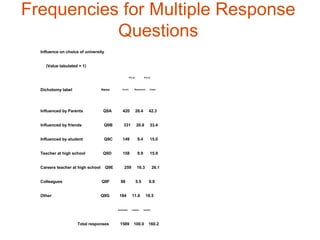
Frequencies for Multiple Response
           Questions
  Influence on choice of university


    (Value tabulated = 1)

                                                       Pct of          Pct of


  Dichotomy label                  Name        Count        Responses       Cases


  Influenced by Parents            Q9A         420              26.4       42.3


  Influenced by friends             Q9B         331             20.8        33.4


  Influenced by student             Q9C        149               9.4        15.0


  Teacher at high school           Q9D         158               9.9        15.9


  Careers teacher at high school      Q9E       259             16.3            26.1


  Colleagues                       Q9F        88                5.5         8.9


  Other                            Q9G       184          11.6          18.5


                                            -------       -----        -----


                     Total responses         1589           100.0          160.2
Statistics Associated with Frequency
     Distributions: Measures of Location
• Mean
  – ‘average’

• Mode
  – The value that occurs most frequently.
  – Most appropriate for categorical data.

• Median
  – Middle value in the data set when the data are
    arranged in ascending or descending order.
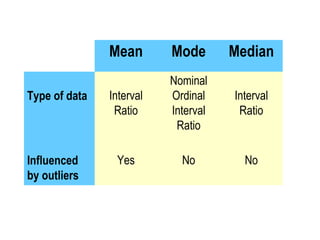
Mean       Mode       Median
                          Nominal
Type of data   Interval   Ordinal    Interval
                Ratio     Interval    Ratio
                           Ratio

Influenced      Yes         No         No
by outliers
Statistics Associated with Frequency
  Distributions: Measures of Variability
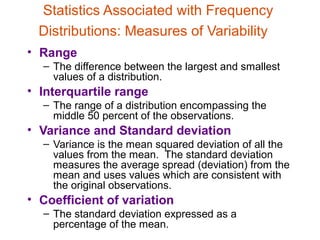
• Range
  – The difference between the largest and smallest
    values of a distribution.
• Interquartile range
  – The range of a distribution encompassing the
    middle 50 percent of the observations.
• Variance and Standard deviation
  – Variance is the mean squared deviation of all the
    values from the mean. The standard deviation
    measures the average spread (deviation) from the
    mean and uses values which are consistent with
    the original observations.
• Coefficient of variation
  – The standard deviation expressed as a
    percentage of the mean.
Table 1: Factors students consider when selecting University
Statistics Associated with Frequency Distributions


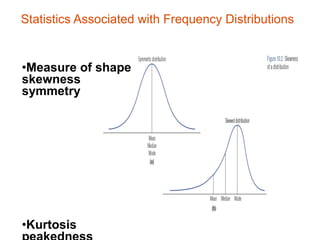
•Measure of shape
skewness
symmetry


•Kurtosis
Cross-Tabulations
• Describes two or more variables
  simultaneously
Expressing the data as percentages
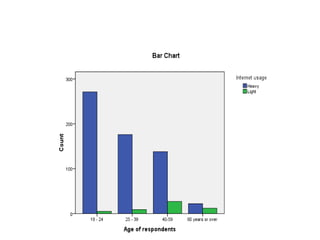
Can also be presented graphically.
Notes on writing up results
• Do not simply repeat the numbers in the table as
  part of the discussion
• The discussion should focus on the patterns in the
  data
• Percentages (rather than numbers) are more
  generalisable to the population,
• However, keep in mind that because of sampling
  error the percentage in the population will not
  exactly match that of the sample
• We rarely care about the sample itself, except
  what it tells us about the population, it is supposed
  to represent

Fundamentals of data analysis

  • 1.
    Fundamentals of Data Analysis Lecture 8
  • 2.
    Chapter 12 Univariate statisticalanalysis: A recap of inferential statistics 2
  • 3.
    Review sampling • Youwant to see a new movie this weekend. So you get onto a website and checkout previews of what’s on. • Is this sampling? • How good a sample would this be> 3
  • 4.
  • 5.
    Learning Objectives • Understandand explain the need for data preparation techniques such as editing, coding, cleaning and statistically adjusting the data where required • Develop a data analysis strategy based on specific research objectives • Identify the factors influencing the selection of an appropriate data analysis strategy • Outline various analysis techniques
  • 6.
    Data Preparation Process Preparepreliminary plan of data analysis  Check questionnaires  Edit  Code  Transcribe  Clean data  Statistically adjust the data  Select a data analysis strategy
  • 7.
    Questionnaire Checking • Reviewall questionnaires for completeness and interviewing quality • Unacceptable questionnaires include: – Parts of the questionnaire that are incomplete – Skip patterns may not have been followed – Little variances in responses – Pages missing – Late questionnaires – Respondents does not fit the selection criteria
  • 8.
    Data Editing • Areview of the questionnaires with the objective of increasing accuracy and precision. • Identify responses that are: – Illegible – Incomplete – Inconsistent – Ambiguous responses
  • 9.
    Data Editing cont. •Treatment of unsatisfactory responses – Return to the field • Recontact the respondent – Assign missing values • If the number of unsatisfactory responses is small • Key variables are not missing – Discard unsatisfactory respondents (cases) • Proportion of unsatisfactory responses is small • Sample size is large • Unsatisfactory respondents do not differ from satisfactory respondents • Responses to key variables are missing
  • 10.
    Data Coding • Assigninga code [number] to each possible response to each question [variable] – Structured questionnaires [pre-coded] – Unstructured questions [post-coding] • Category codes should be mutually exclusive and collectively exhaustive. • Category codes should be assigned for critical issues even if no one mentions them.
  • 11.
    A Basic Questionnaire 1. In a typical month, how many times would you say you visit a fast-food restaurant? (Tick one box only) None One Two Three Four Five Six or more 2. On your last visit to a fast-food restaurant, what was the dollar amount you spent on food and beverages? Under $2.00 $6.01 - $10.00 More than $14.00 $2.01 - $6.00 $10.01 - $14.00 Don’t remember 3. How many of these restaurants would you say you visited in the past two months? Tick as many as apply. KFC Pizza Hut Wendy’s Red Rooster McDonalds Other Hungry jacks Have not visited any of these establishments 4. On a scale of 1 to 5, with 1 being strongly disagree to 5 being strongly agree, how would you rate fast-food restaurants on the following dimensions: I only visit those fast-food establishments that are conveniently located to my home 1 2 3 4 5 I prefer to visit fast-food restaurants that serve healthy/nutritious food 1 2 3 4 5 The price of food items is not important when visiting a fast-food restaurant 1 2 3 4 5 All fast-food restaurants should offer some type of child’s menu or kid’s meal 1 2 3 4 5 5. How many children do you have living at home? None One Two Three Four Five or more 6. Which category does you total annual household income fall? Under $20,000 $20,000 - $39,999 $40,000 - $59,999 $60,000 or more
  • 12.
    Coding the Questionnaire Variable Variable Coding Number Name Instruction (99=missing value) 1 Number of visits per month 0=None 1=one 2= two 3=three 4=Four 5= five 6= six or more 2 Amount spent 1= Under $2 2= $2.01 - $6.00 3= $6.01 - $10.00 4= $10.01 - $14.00 5= More than $14.00 6= Don’t remember 3.1 Visited KFC 1=Yes, 0= No
  • 13.
    Coding the Questionnairecont. 3.2 Visited Wendy’s 1=Yes, 0= No 3.3 Visited McDonalds 1=Yes, 0= No 3.4 Visited Hungry Jacks 1=Yes, 0= No 3.5 Visited Pizza Hut 1=Yes, 0= No 3.6 Visited Red Rooster 1=Yes, 0= No 3.7 Visited Other establishment 1=Yes, 0= No 3.8 Have not visited any establishment 1=Yes, 0= No 4.1 Visit conveniently located stores 1= strongly disagree 2= disagree 3=neither agree/disagree 4=agree 5=strongly agree 4.2 Prefer healthy fast food stores As above
  • 14.
    Coding the Questionnairecont. 4.3 Price is important As above 4.4 Children’s menu is important As above 5 Number of children 0=None 1=one 2= two 3=three 4=Four 5= five or more 6 Annual household income 1=under $20,000 2=$20,000 - $39,000 3=$40,000 - $59,000 4=$60,000 or more
  • 15.
    Transcribing • Transferring codeddata from the questionnaire to a computer to be used for analysis. • Variations to manual transcribing: – CATI or CAPI – Mark sense forms and optical scanning – UPC – Computerised sensory analysis systems • For verification of the entire dataset, re-enter the responses
  • 16.
  • 17.
    Data Cleaning • Consistencycheck – Out of range [see study status] – Logically inconsistent [e.g., does not own the product but is a heavy user] – Extreme values [indiscriminatingly responding the same way on all attributes]
  • 18.
    Example: Out ofRange Study Status Cumulative Frequency Percent Valid Percent Percent Valid Full time student 923 91.8 91.8 91.8 Part time student 81 8.1 8.1 99.9 3.00 1 .1 .1 100.0 Total 1005 100.0 100.0
  • 19.
    Data Cleaning cont. •Treatment of missing responses – Substitute a neutral value [substitute the ‘mean’ response of the variable] – Substitute an imputed response [use the respondent’s pattern of responses to other questions] – Casewise deletion [respondents with any missing values are discarded from the analysis] – Pairwise deletion [use only cases or respondents with complete responses for each calculation]
  • 20.
    Statistically Adjusting theData • Weighting – Each case is assigned a weight to reflect its importance relative to other cases, often used to make the sample more representative of a target population • Variable re-specification – Transformation of data to create new variables or modify existing variables to better suit the research objectives by summing several variables, log transformations, dummy variables [see next slide] • Scale transformation – Manipulation of scale values to ensure comparability with other scales or otherwise make the data suitable for analysis [when data is not normally distributed].
  • 21.
    Variable re-specification: Compositevariables •Aesthetics of a website •Measured using two items –“The website is visually pleasing” –“The website is visually appealing” –Combine these two items to create a new variable “Aesthetics of a website” – this new variable is used with further analysis in place of the two items.
  • 22.
    Variable re-specification: Recodevariables (to recode negatively-worded scale items) Role Overload Strongly Disagree Disagree Neither Agree Agree Strongly Disagree Somewhat agree nor Somewhat Agree disagree I have too much work to do, to do everything 1 2 3 4 5 6 7 well The amount of work I am asked to do is fair 1 2 3 4 5 6 7 I never seem to have enough time to get 1 2 3 4 5 6 7 everything done •Role overload is measured by 3 items. •Which item is reverse-coded? •We need to code this so all item are flowing in the same direction. •We need to inform SPSS that 1=7, 2=6, 3= 5, 4=4, 5=3, 6=2, 7=1 for the reverse coded item.
  • 23.
    Variable re-specification: Recodevariables •“Overall, I’m (to collapse a continuous variable) cont. satisfied with my job” was measured using a seven-point scale. •When we perform data analysis (particularly cross- tabs) we may wish to have fewer categories for brevity.
  • 24.
    Strategy for DataAnalysis • Determine the type of data which is available [nominal, ordinal, interval, ratio] • Decide what needs to be discussed in order to tell ‘the story’ • Choose techniques to best get information on specific parts of what has to be discussed • Run the results • Determine what the results mean, what patterns can be seen, what kind of statistical decisions should be made • Write about the results to explain what is going on to someone who does not like numbers and has never heard of statistics
  • 25.
    Overview of Techniques •Descriptive Statistics – Frequency distribution and cross tabulations – Measures of central tendency [mean, median, mode] – Measures of dispersion [range, interquartile range, standard deviation] – Shape [skewness, kurtosis] • Inferential Statistics – Parametric tests [Z or t test, paired t test] – Non-parametric tests [Chi-square]
  • 26.
    Descriptive and inferentialstatistics • Descriptive statistics are used to describe characteristics of a population. • Inferential statistics are used to make inferences about a population from a sample of that population. 26
  • 27.
    Sample statistics andpopulation parameters • Sample statistics are variables in a sample or measures computed from sample data. • Population parameters are variables in a population or measured characteristics of the population. • But, generally we do not know what these population parameters are and that is why we use samples. 27
  • 28.
    Frequency distributions • Frequencydistribution involves a process of recording the number of times a particular value of a variable occurs. • Percentage distribution is a distribution of relative frequency. • Probability is the long–run relative frequency with which an event will occur. 28
  • 29.
  • 30.
    Measures of centraltendency • Mean: arithmetic average • Median: the midpoint – The value below which half the values in a distribution fall. • Mode: the value that occurs most often. 30
  • 31.
    Measures of dispersion •The tendency of observations to depart from the central tendency. • Range: distance between the smallest and largest values. • Deviation scores: how far any observation is from the mean. – Average deviation • Variance: measure of variability or dispersion – Its square root is the standard deviation. 31
  • 32.
    Measures of dispersion •Standard deviation: quantitative index of a distribution’s spread. – Using square root of variance reverts to the original measurement units. 32
  • 33.
    The normal distribution •A symmetrical, bell–shaped distribution that describes the expected probability distribution of many chance occurrences. – 99% of its values are within + 3 standard deviations from its mean. 33
  • 34.
    The normal distribution •Standardised normal distribution has: – symmetry about its mean – infinite number of cases – area under the curve with probability density equal to 1 – mean of 0 and standard deviation of 1. Standardised value = Value to be transformed – Mean Standard deviation Z=X-µ σ 34
  • 35.
    An example ofstandardised value • Toy manufacturer has mean sales of 9000 units and standard deviation of 500 units. • Wishes to know whether wholesalers will demand between 7500 and 9635 units. Z = X - µ = 7500 – 9000 = -3.00 σ 500 Z = X - µ = 9625 – 9000 = 1.25 σ 500 • Referring to Table 12.8, we find that: – When Z = –3.00, the area under the curve = 0.499. – When Z = 1.25, the area under the curve = 0.394. – The total area under the curve = 0.499 + 0.394 = 0.893. – There is a 0.893 probability that sales will in that range. 35
  • 36.
  • 37.
    Population, sample, andsampling distribution • Population distribution: a frequency distribution of the elements of a population. • Sample distribution: a frequency distribution of a sample. • Sampling distribution: a theoretical probability of sample means for all possible samples of a certain size drawn from a particular population. 37
  • 38.
    Population, sample, andsampling distribution • Standard error of the mean: the standard error of the sampling distribution. • Sampling distribution is important because it addresses the question of ‘ What would happen if we were to draw a large number of samples, each having n elements, from a specified population?’ 38
  • 39.
    Population, sample, andsampling distribution 39
  • 40.
    Central–limit theorem • Central–limittheorem states that as the sample size increases, the distribution of the mean of a random sample taken from practically any population approaches a normal distribution. 40
  • 41.
    Confidence intervals • Aconfidence interval estimate is based on the knowledge that the population mean is the sample mean plus or minus a small sampling error. – After calculating an interval estimate, we can determine how probable it is that the population mean will fall within this range of statistical values. • Confidence level is a percentage that indicates the long–run probability that the results will be correct. 41
  • 42.
    Confidence intervals ∀ µ=X+E where E = range of sampling error • E = Zc.l.SX where Zc.l. = value of Z at a specified confidence level (c.l.) and SX = standard error of the mean ∀ µ = X + Zc.l.SX where SX = S , S = standard deviation and n = sample size √n • Thus, µ = X + Zc.l.S √n 42
  • 43.
    An example ofconfidence intervals • Sporting goods store caters to working women who golf. • Survey showed the mean age is 37.5 years and standard deviation of 12.0 years. • Wishes to be 95% confident that the sample estimates will include the population parameter. µ = X + Zc.l. S = 37.5 + Zc.l. 12.0 √n √100 • Including 95% of the area requires that 47.5% of the distribution on each side be included. • Referring to Table B.2 in Appendix B, we find that 0.475 corresponds to the Z-value 1.96. Thus: µ = 37.5 + (1.96)(1.2) = 37.5 + 2.352 • 95% of the time µ is in range of 35.15 to 39.85 years. 43
  • 44.
    Frequency Distributions • Acount of the number of responses associated with different values of the variable Where did you hear about VU's Open Day? Cumulative Frequency Percent Valid Percent Percent Valid Radio 39 12.7 12.8 12.8 Newspaper 29 9.4 9.5 22.3 Internet site 25 8.1 8.2 30.5 Friend/Relation 52 16.9 17.0 47.5 School 160 51.9 52.5 100.0 Total 305 99.0 100.0 Missing System 3 1.0 Total 308 100.0
  • 45.
    Frequency Distributions cont. Age of respondent Cumulative Frequency Percent Valid Percent Percent Valid 18 or under 197 64.0 64.6 64.6 19 - 29 71 23.1 23.3 87.9 Over 29 37 12.0 12.1 100.0 Total 305 99.0 100.0 Missing System 3 1.0 Total 308 100.0
  • 46.
    Bar Chart Producedfrom Frequency Distributions 40% 38.00% 35% 34.00% 30% 25% 20% 18.00% The course offered 15% 10% 6.00% 5% 4.00% 0% Very Important Of some Of little Of absolutely important importance importance no importance
  • 47.
    Frequencies for Multiple Response Questions • Example of a question using multiple-response formatting Q9.Which of the following people had an influence on your choice of university? Parents 01 Friends 02 Ex-VU student 03 Teacher at high school 04 Careers teacher at high school 05 Colleagues 06 Other 07
  • 48.
    Frequencies for MultipleResponse Questions Influence on choice of university (Value tabulated = 1) Pct of Pct of Dichotomy label Name Count Responses Cases Influenced by Parents Q9A 420 26.4 42.3 Influenced by friends Q9B 331 20.8 33.4 Influenced by student Q9C 149 9.4 15.0 Teacher at high school Q9D 158 9.9 15.9 Careers teacher at high school Q9E 259 16.3 26.1 Colleagues Q9F 88 5.5 8.9 Other Q9G 184 11.6 18.5 ------- ----- ----- Total responses 1589 100.0 160.2
  • 49.
    Statistics Associated withFrequency Distributions: Measures of Location • Mean – ‘average’ • Mode – The value that occurs most frequently. – Most appropriate for categorical data. • Median – Middle value in the data set when the data are arranged in ascending or descending order.
  • 50.
    Mean Mode Median Nominal Type of data Interval Ordinal Interval Ratio Interval Ratio Ratio Influenced Yes No No by outliers
  • 51.
    Statistics Associated withFrequency Distributions: Measures of Variability • Range – The difference between the largest and smallest values of a distribution. • Interquartile range – The range of a distribution encompassing the middle 50 percent of the observations. • Variance and Standard deviation – Variance is the mean squared deviation of all the values from the mean. The standard deviation measures the average spread (deviation) from the mean and uses values which are consistent with the original observations. • Coefficient of variation – The standard deviation expressed as a percentage of the mean.
  • 52.
    Table 1: Factorsstudents consider when selecting University
  • 53.
    Statistics Associated withFrequency Distributions •Measure of shape skewness symmetry •Kurtosis
  • 54.
    Cross-Tabulations • Describes twoor more variables simultaneously
  • 55.
    Expressing the dataas percentages
  • 56.
    Can also bepresented graphically.
  • 57.
    Notes on writingup results • Do not simply repeat the numbers in the table as part of the discussion • The discussion should focus on the patterns in the data • Percentages (rather than numbers) are more generalisable to the population, • However, keep in mind that because of sampling error the percentage in the population will not exactly match that of the sample • We rarely care about the sample itself, except what it tells us about the population, it is supposed to represent