Week 7:
Hypothesis Testing:
               z-test


                        1
Review
   We have seen descriptive statistics, statistical
    procedures to summarize data and describe
    distributions and individual scores.
   We also need inferential statistics, techniques
    that can help us to test hypotheses, to
    generalize results to a given population, and
    to estimate the parameters of a population.


                                                   2
Statistics and Parameters
   Statistics are the facts on which we draw
    conclusions about parameters.
   Sample statistics are only estimates of the
    population parameters.
   We need to know how the sample we have
    taken compares with other samples that
    might be taken from the population.


                                                  3
Sampling distribution of the mean

   Sampling distribution of the mean is the
    distribution of sample means for all samples
    of a given size randomly selected from the
    population.
   If we had generated all possible samples, the
    mean of the possible values of sample mean
    would agree exactly with μ.


                                                    4
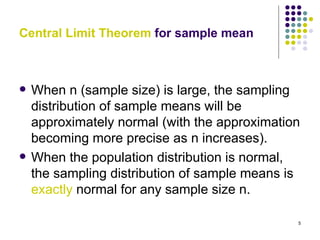
Central Limit Theorem for sample mean


   When n (sample size) is large, the sampling
    distribution of sample means will be
    approximately normal (with the approximation
    becoming more precise as n increases).
   When the population distribution is normal,
    the sampling distribution of sample means is
    exactly normal for any sample size n.

                                               5
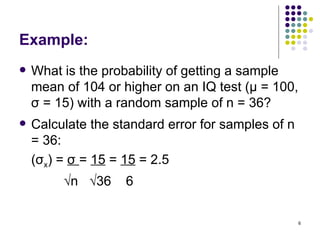
Example:
   What is the probability of getting a sample
    mean of 104 or higher on an IQ test (μ = 100,
    σ = 15) with a random sample of n = 36?
   Calculate the standard error for samples of n
    = 36:
    (σx) = σ = 15 = 15 = 2.5
         √n √36     6

                                                    6
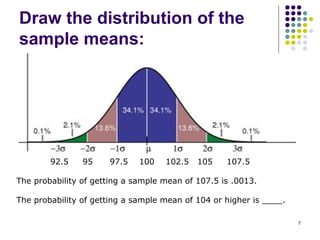
Draw the distribution of the
sample means:


        92.5    95    97.5    100   102.5   105    107.5

The probability of getting a sample mean of 107.5 is .0013.

The probability of getting a sample mean of 104 or higher is ____.

                                                                     7
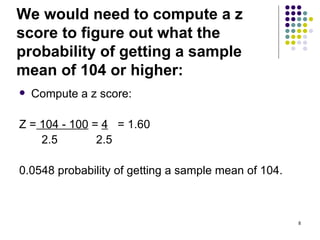
We would need to compute a z
score to figure out what the
probability of getting a sample
mean of 104 or higher:
   Compute a z score:

Z = 104 - 100 = 4 = 1.60
    2.5        2.5

0.0548 probability of getting a sample mean of 104.


                                                      8
Steps of Hypothesis Testing

1. State the hypotheses.
2. Set the criterion for rejecting Ho (null hypothesis).
3. Compute the test statistic.
4. Compare test statistic to criterion set.
   * Create a confidence interval and interpret.
5. Decide about null Ho.


                                                           9
1. Stating the Hypotheses
   Null hypothesis (Ho): The hypothesis to be
    tested. Usual states “no difference between
    groups” or “no relationship between
    variables.” Any difference or relationship you
    observe is most likely due to chance.
   Research/Alternative hypothesis (H1):
    Conjecture about one or more population
    parameters.
       Can be non-directional or directional.
                                                     10
Directionality of the test

   A directional alternative hypothesis states
    that the parameter is statistically
    significantly greater than or less than the
    hypothesized value.
   A non-directional alternative hypothesis
    merely states that the parameter is
    statistically significantly different from (not
    equal to) the hypothesized value.
                                                      11
Examples:
   Non-directional hypothesis:
       There is a statistically significant difference in
        males and females on math achievement test
        scores.

       How can we rephrase this to be a directional
        hypothesis?


                                                             12
Errors in Inferential Statistics

   Type I error: Reject Ho when it’s true.
   Type II error: Fail to reject Ho when it’s false.
   We’ll discuss Type I error and Type II error when
    we look at statistical power next week.


                                                        13
2. Setting the Criterion for
Rejecting Ho
   Level of significance (α level): the probability of
    making a Type I error when testing a null
    hypothesis.
   Establish α level before collecting data. Alpha levels:
    .10,.05,.01,.001….
   In deciding to reject the hypothesis at one of these
    levels, the researcher knows that the decision to
    reject the hypothesis may be incorrect 1%, 5%, or
    10% of the time, respectively.


                                                          14
Rejection Region
   The level of significance represents a proportion of area
    in a sampling distribution that equals the probability of
    rejecting the Ho if it is true.
   Rejection region refers to the area of the sampling
    distribution that represents values for the sample means
    that are improbable (possible but highly unlikely) if the
    Ho is true.
   The critical values of the test statistic are those values in
    the sampling distribution that represent the beginning of
    the region of rejection.
   The directionality of the test (one-tailed or two tailed)
    affects the critical values.
                                                                15
   See pages 181 – 188 in text for examples
    depicting the relationship between the critical
    value and rejection region.


                                                  16
3. Computing test statistic to
compute P-value
   P value: The probability of obtaining a value of the
    test statistic that is as likely or more likely to reject
    Ho as the actual observed value of the test
    statistic.
   P value Ranges from 0 to 1.
   Answers: If the populations really have the same
    mean overall, what is the probability that random
    sampling would lead to a difference between
    sample means as large (or larger) than you
    observed?
   Do we want a large or small p value?
                                                                17
Interpreting P-value
   “The probability is greater than .05 that the
    observed sample mean would have occurred
    by chance if the null hypothesis were true” (p.
    195).
       The difference between the sample mean and the
        hypothesized value of the population is sufficient
        (or not sufficient) enough to attribute it to anything
        other than sampling error.


                                                             18
4. Compare P value to preset threshold value:
Create confidence interval “Interval Estimate”
     Confidence Interval: Provides an indication of how
      accurately the sample mean estimates population
      mean.
     An interval of possible values for population mean in
      place of using just a single value of sample mean.
     Confidence Coefficient = 1-α
     When α=.05, a 95% confidence interval indicates
      that 95% of the time in repeated sampling, intervals
      calculated will contain the population mean (true
      parameter).

                                                          19
5. Make Decision about Ho
 1.   If P value is less than the threshold, state that
      you “reject the null hypothesis” and conclude
      that the difference is “statistically significant.”

 2. If P value is greater than the threshold, state that
       you “fail to reject the null hypothesis” and
       conclude that the difference is “not statistically
       significant.” The difference is within distribution
       of sampling fluctuation.


                                                             20
Revisiting Hypothesis Testing
Steps:
o   State hypotheses.
o   Set criterion.
o   Compute appropriate test statistic to compute the
    P value.
o   Compare the P value to the preset threshold
    value.
o   Make decision.


                                                        21
Z-test
   Determine the magnitude of the difference
    between sample mean and population
    mean.

   The population mean μ and its standard
    deviation σ are known.


                                                22
Z-test Example 1: non-
directional


                         23
1. State hypotheses:

Ho: Children who learn whole language approach do not
    statistically significantly differ from the average child in word
    recognition (µ = 75%, σ = 5%).

    In symbols: Ho: µ = 75%.

H1: Children who learn whole language approach statistically
     significantly differ from the average child with respect to
     word recognition (µ = 75%, σ = 5%).

    In symbols: H1: µ ≠ 75%.

                                                                    24
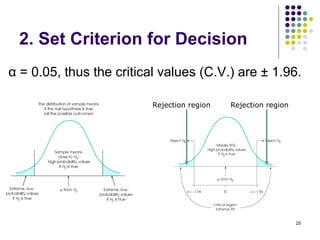
2. Set Criterion for Decision
α = 0.05, thus the critical values (C.V.) are ± 1.96.

                          Rejection region   Rejection region


                                                                25
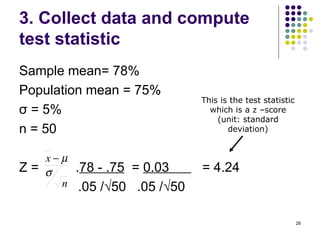
3. Collect data and compute
test statistic
Sample mean= 78%
Population mean = 75%
                                This is the test statistic
σ = 5%                            which is a z –score
                                    (unit: standard
n = 50                                 deviation)


     x−µ
Z=   σ     .78 - .75 = 0.03     = 4.24
       n    .05 /√50 .05 /√50

                                                             26
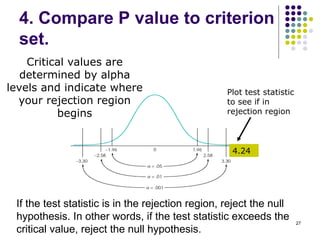
4. Compare P value to criterion
  set.
    Critical values are
   determined by alpha
levels and indicate where                          Plot test statistic
  your rejection region                            to see if in
          begins                                   rejection region


                                                    4.24


 If the test statistic is in the rejection region, reject the null
 hypothesis. In other words, if the test statistic exceeds the           27
 critical value, reject the null hypothesis.
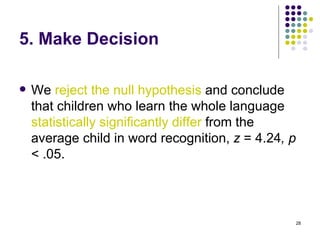
5. Make Decision

   We reject the null hypothesis and conclude
    that children who learn the whole language
    statistically significantly differ from the
    average child in word recognition, z = 4.24, p
    < .05.


                                                     28
Compute confidence interval
  Alpha set a 0.05. Thus, we build a 95% confidence interval and
   the critical values are ± 1.96.
CI95 = μ ± Critical value (σ )          Standard error
                           √n
CI95% = .75 ± 1.96 (.05 / √50 ) = .75 ± .01 =

[.74, .76]

   95% of all possible means for samples of size 50 in the population
    will fall between 74% and 76%.

   Our sample mean of 78% falls outside of the interval we built.


                                                                         29
Z-test Example 2: Directional


                                30
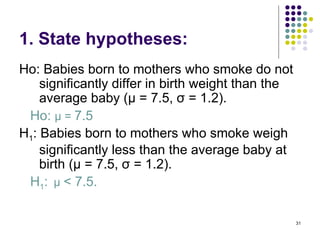
1. State hypotheses:
Ho: Babies born to mothers who smoke do not
    significantly differ in birth weight than the
    average baby (µ = 7.5, σ = 1.2).
 Ho: µ = 7.5
H1: Babies born to mothers who smoke weigh
    significantly less than the average baby at
    birth (µ = 7.5, σ = 1.2).
 H1: µ < 7.5.

                                                    31
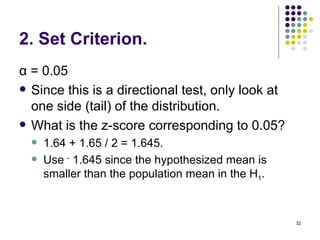
2. Set Criterion.
α = 0.05
 Since this is a directional test, only look at
  one side (tail) of the distribution.
 What is the z-score corresponding to 0.05?
     1.64 + 1.65 / 2 = 1.645.
     Use - 1.645 since the hypothesized mean is
      smaller than the population mean in the H1.


                                                    32
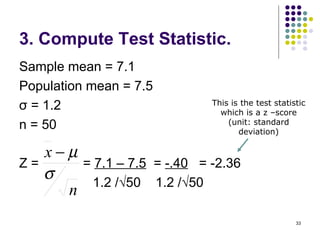
3. Compute Test Statistic.
Sample mean = 7.1
Population mean = 7.5
σ = 1.2                     This is the test statistic
                              which is a z –score
                                (unit: standard
n = 50                             deviation)

   x−µ
Z=     = 7.1 – 7.5 = -.40 = -2.36
   σ     1.2 /√50 1.2 /√50
     n
                                                   33
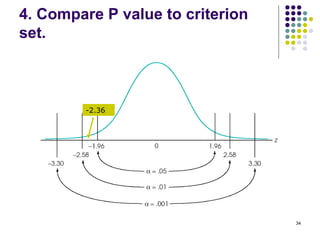
4. Compare P value to criterion
set.


         -2.36


                                  34
5. Make Decision.
We reject the null hypothesis and conclude
 that babies born to mothers who smoke
 weigh statistically significantly less than the
 average baby at birth, z = -2.36, p < .05.


                                                   35
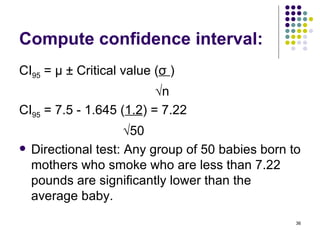
Compute confidence interval:
CI95 = μ ± Critical value (σ )
                          √n
CI95 = 7.5 - 1.645 (1.2) = 7.22
                      √50
   Directional test: Any group of 50 babies born to
    mothers who smoke who are less than 7.22
    pounds are significantly lower than the
    average baby.
                                                   36
Recommended note cards:
   Steps in hypothesis testing
   Critical values associated with alpha levels of .05
    and .01 (most commonly used) for a one and two-
    tailed test. Use page 189 in your text as a guide.
   Z-test
       When to use a Z-test
       Formula for computing a Z-test
   Confidence interval
       Formula
       Interpretation
                                                          37

Review Z Test Ci 1

  • 1.
  • 2.
    Review  We have seen descriptive statistics, statistical procedures to summarize data and describe distributions and individual scores.  We also need inferential statistics, techniques that can help us to test hypotheses, to generalize results to a given population, and to estimate the parameters of a population. 2
  • 3.
    Statistics and Parameters  Statistics are the facts on which we draw conclusions about parameters.  Sample statistics are only estimates of the population parameters.  We need to know how the sample we have taken compares with other samples that might be taken from the population. 3
  • 4.
    Sampling distribution ofthe mean  Sampling distribution of the mean is the distribution of sample means for all samples of a given size randomly selected from the population.  If we had generated all possible samples, the mean of the possible values of sample mean would agree exactly with μ. 4
  • 5.
    Central Limit Theoremfor sample mean  When n (sample size) is large, the sampling distribution of sample means will be approximately normal (with the approximation becoming more precise as n increases).  When the population distribution is normal, the sampling distribution of sample means is exactly normal for any sample size n. 5
  • 6.
    Example:  What is the probability of getting a sample mean of 104 or higher on an IQ test (μ = 100, σ = 15) with a random sample of n = 36?  Calculate the standard error for samples of n = 36: (σx) = σ = 15 = 15 = 2.5 √n √36 6 6
  • 7.
    Draw the distributionof the sample means: 92.5 95 97.5 100 102.5 105 107.5 The probability of getting a sample mean of 107.5 is .0013. The probability of getting a sample mean of 104 or higher is ____. 7
  • 8.
    We would needto compute a z score to figure out what the probability of getting a sample mean of 104 or higher:  Compute a z score: Z = 104 - 100 = 4 = 1.60 2.5 2.5 0.0548 probability of getting a sample mean of 104. 8
  • 9.
    Steps of HypothesisTesting 1. State the hypotheses. 2. Set the criterion for rejecting Ho (null hypothesis). 3. Compute the test statistic. 4. Compare test statistic to criterion set. * Create a confidence interval and interpret. 5. Decide about null Ho. 9
  • 10.
    1. Stating theHypotheses  Null hypothesis (Ho): The hypothesis to be tested. Usual states “no difference between groups” or “no relationship between variables.” Any difference or relationship you observe is most likely due to chance.  Research/Alternative hypothesis (H1): Conjecture about one or more population parameters.  Can be non-directional or directional. 10
  • 11.
    Directionality of thetest  A directional alternative hypothesis states that the parameter is statistically significantly greater than or less than the hypothesized value.  A non-directional alternative hypothesis merely states that the parameter is statistically significantly different from (not equal to) the hypothesized value. 11
  • 12.
    Examples:  Non-directional hypothesis:  There is a statistically significant difference in males and females on math achievement test scores.  How can we rephrase this to be a directional hypothesis? 12
  • 13.
    Errors in InferentialStatistics  Type I error: Reject Ho when it’s true.  Type II error: Fail to reject Ho when it’s false.  We’ll discuss Type I error and Type II error when we look at statistical power next week. 13
  • 14.
    2. Setting theCriterion for Rejecting Ho  Level of significance (α level): the probability of making a Type I error when testing a null hypothesis.  Establish α level before collecting data. Alpha levels: .10,.05,.01,.001….  In deciding to reject the hypothesis at one of these levels, the researcher knows that the decision to reject the hypothesis may be incorrect 1%, 5%, or 10% of the time, respectively. 14
  • 15.
    Rejection Region  The level of significance represents a proportion of area in a sampling distribution that equals the probability of rejecting the Ho if it is true.  Rejection region refers to the area of the sampling distribution that represents values for the sample means that are improbable (possible but highly unlikely) if the Ho is true.  The critical values of the test statistic are those values in the sampling distribution that represent the beginning of the region of rejection.  The directionality of the test (one-tailed or two tailed) affects the critical values. 15
  • 16.
    See pages 181 – 188 in text for examples depicting the relationship between the critical value and rejection region. 16
  • 17.
    3. Computing teststatistic to compute P-value  P value: The probability of obtaining a value of the test statistic that is as likely or more likely to reject Ho as the actual observed value of the test statistic.  P value Ranges from 0 to 1.  Answers: If the populations really have the same mean overall, what is the probability that random sampling would lead to a difference between sample means as large (or larger) than you observed?  Do we want a large or small p value? 17
  • 18.
    Interpreting P-value  “The probability is greater than .05 that the observed sample mean would have occurred by chance if the null hypothesis were true” (p. 195).  The difference between the sample mean and the hypothesized value of the population is sufficient (or not sufficient) enough to attribute it to anything other than sampling error. 18
  • 19.
    4. Compare Pvalue to preset threshold value: Create confidence interval “Interval Estimate”  Confidence Interval: Provides an indication of how accurately the sample mean estimates population mean.  An interval of possible values for population mean in place of using just a single value of sample mean.  Confidence Coefficient = 1-α  When α=.05, a 95% confidence interval indicates that 95% of the time in repeated sampling, intervals calculated will contain the population mean (true parameter). 19
  • 20.
    5. Make Decisionabout Ho 1. If P value is less than the threshold, state that you “reject the null hypothesis” and conclude that the difference is “statistically significant.” 2. If P value is greater than the threshold, state that you “fail to reject the null hypothesis” and conclude that the difference is “not statistically significant.” The difference is within distribution of sampling fluctuation. 20
  • 21.
    Revisiting Hypothesis Testing Steps: o State hypotheses. o Set criterion. o Compute appropriate test statistic to compute the P value. o Compare the P value to the preset threshold value. o Make decision. 21
  • 22.
    Z-test  Determine the magnitude of the difference between sample mean and population mean.  The population mean μ and its standard deviation σ are known. 22
  • 23.
    Z-test Example 1:non- directional 23
  • 24.
    1. State hypotheses: Ho:Children who learn whole language approach do not statistically significantly differ from the average child in word recognition (µ = 75%, σ = 5%). In symbols: Ho: µ = 75%. H1: Children who learn whole language approach statistically significantly differ from the average child with respect to word recognition (µ = 75%, σ = 5%). In symbols: H1: µ ≠ 75%. 24
  • 25.
    2. Set Criterionfor Decision α = 0.05, thus the critical values (C.V.) are ± 1.96. Rejection region Rejection region 25
  • 26.
    3. Collect dataand compute test statistic Sample mean= 78% Population mean = 75% This is the test statistic σ = 5% which is a z –score (unit: standard n = 50 deviation) x−µ Z= σ .78 - .75 = 0.03 = 4.24 n .05 /√50 .05 /√50 26
  • 27.
    4. Compare Pvalue to criterion set. Critical values are determined by alpha levels and indicate where Plot test statistic your rejection region to see if in begins rejection region 4.24 If the test statistic is in the rejection region, reject the null hypothesis. In other words, if the test statistic exceeds the 27 critical value, reject the null hypothesis.
  • 28.
    5. Make Decision  We reject the null hypothesis and conclude that children who learn the whole language statistically significantly differ from the average child in word recognition, z = 4.24, p < .05. 28
  • 29.
    Compute confidence interval  Alpha set a 0.05. Thus, we build a 95% confidence interval and the critical values are ± 1.96. CI95 = μ ± Critical value (σ ) Standard error √n CI95% = .75 ± 1.96 (.05 / √50 ) = .75 ± .01 = [.74, .76]  95% of all possible means for samples of size 50 in the population will fall between 74% and 76%.  Our sample mean of 78% falls outside of the interval we built. 29
  • 30.
    Z-test Example 2:Directional 30
  • 31.
    1. State hypotheses: Ho:Babies born to mothers who smoke do not significantly differ in birth weight than the average baby (µ = 7.5, σ = 1.2). Ho: µ = 7.5 H1: Babies born to mothers who smoke weigh significantly less than the average baby at birth (µ = 7.5, σ = 1.2). H1: µ < 7.5. 31
  • 32.
    2. Set Criterion. α= 0.05  Since this is a directional test, only look at one side (tail) of the distribution.  What is the z-score corresponding to 0.05?  1.64 + 1.65 / 2 = 1.645.  Use - 1.645 since the hypothesized mean is smaller than the population mean in the H1. 32
  • 33.
    3. Compute TestStatistic. Sample mean = 7.1 Population mean = 7.5 σ = 1.2 This is the test statistic which is a z –score (unit: standard n = 50 deviation) x−µ Z= = 7.1 – 7.5 = -.40 = -2.36 σ 1.2 /√50 1.2 /√50 n 33
  • 34.
    4. Compare Pvalue to criterion set. -2.36 34
  • 35.
    5. Make Decision. Wereject the null hypothesis and conclude that babies born to mothers who smoke weigh statistically significantly less than the average baby at birth, z = -2.36, p < .05. 35
  • 36.
    Compute confidence interval: CI95= μ ± Critical value (σ ) √n CI95 = 7.5 - 1.645 (1.2) = 7.22 √50  Directional test: Any group of 50 babies born to mothers who smoke who are less than 7.22 pounds are significantly lower than the average baby. 36
  • 37.
    Recommended note cards:  Steps in hypothesis testing  Critical values associated with alpha levels of .05 and .01 (most commonly used) for a one and two- tailed test. Use page 189 in your text as a guide.  Z-test  When to use a Z-test  Formula for computing a Z-test  Confidence interval  Formula  Interpretation 37