IMPRESSIONISM
IMPRESSIONISM
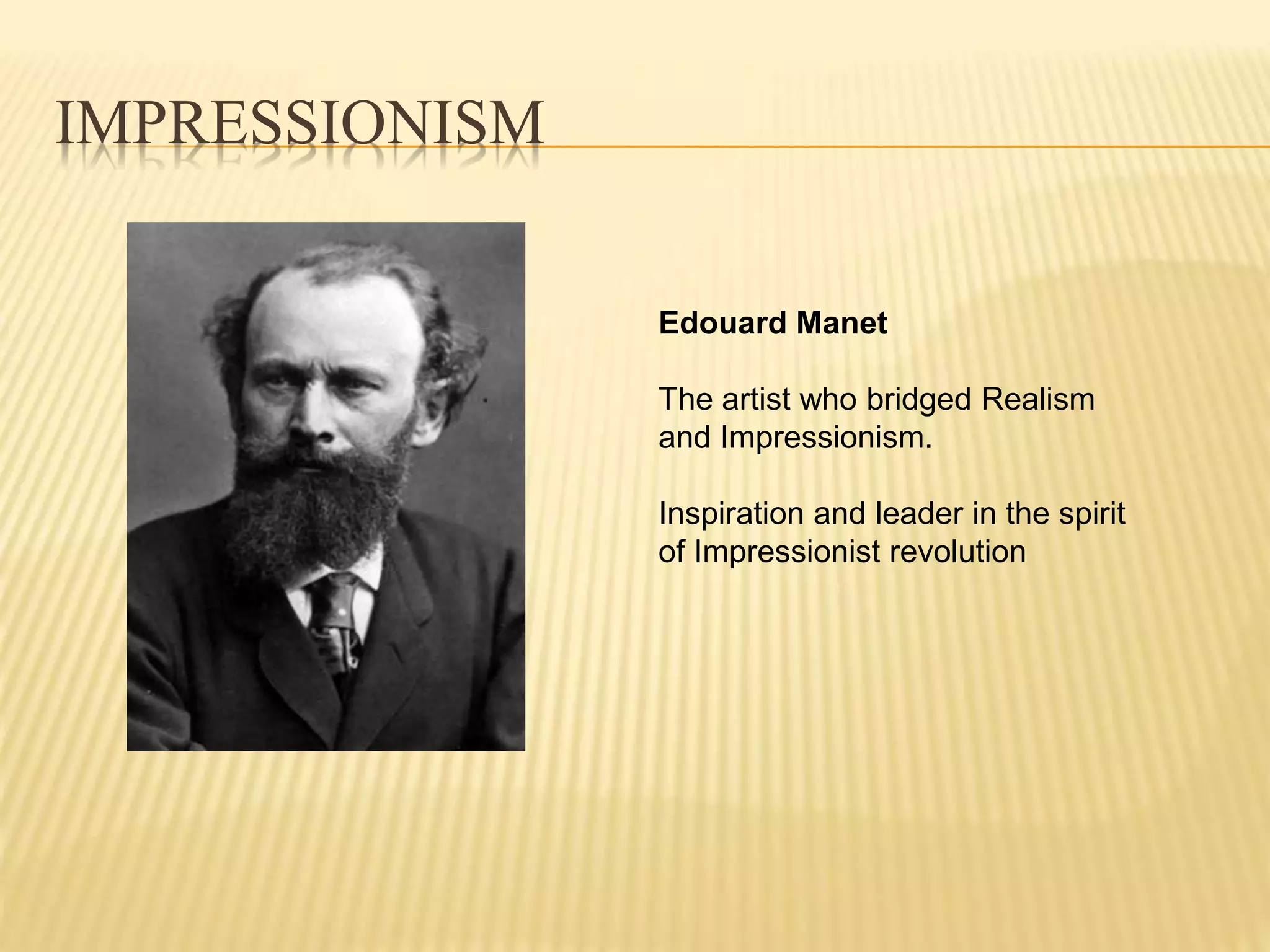
Edouard Manet
The artist who bridged Realism
and Impressionism.
Inspiration and leader in the spirit
of Impressionist revolution
IMPRESSIONISM
Manet
The Luncheon on the Grass
oil on canvas
1863
IMPRESSIONISM
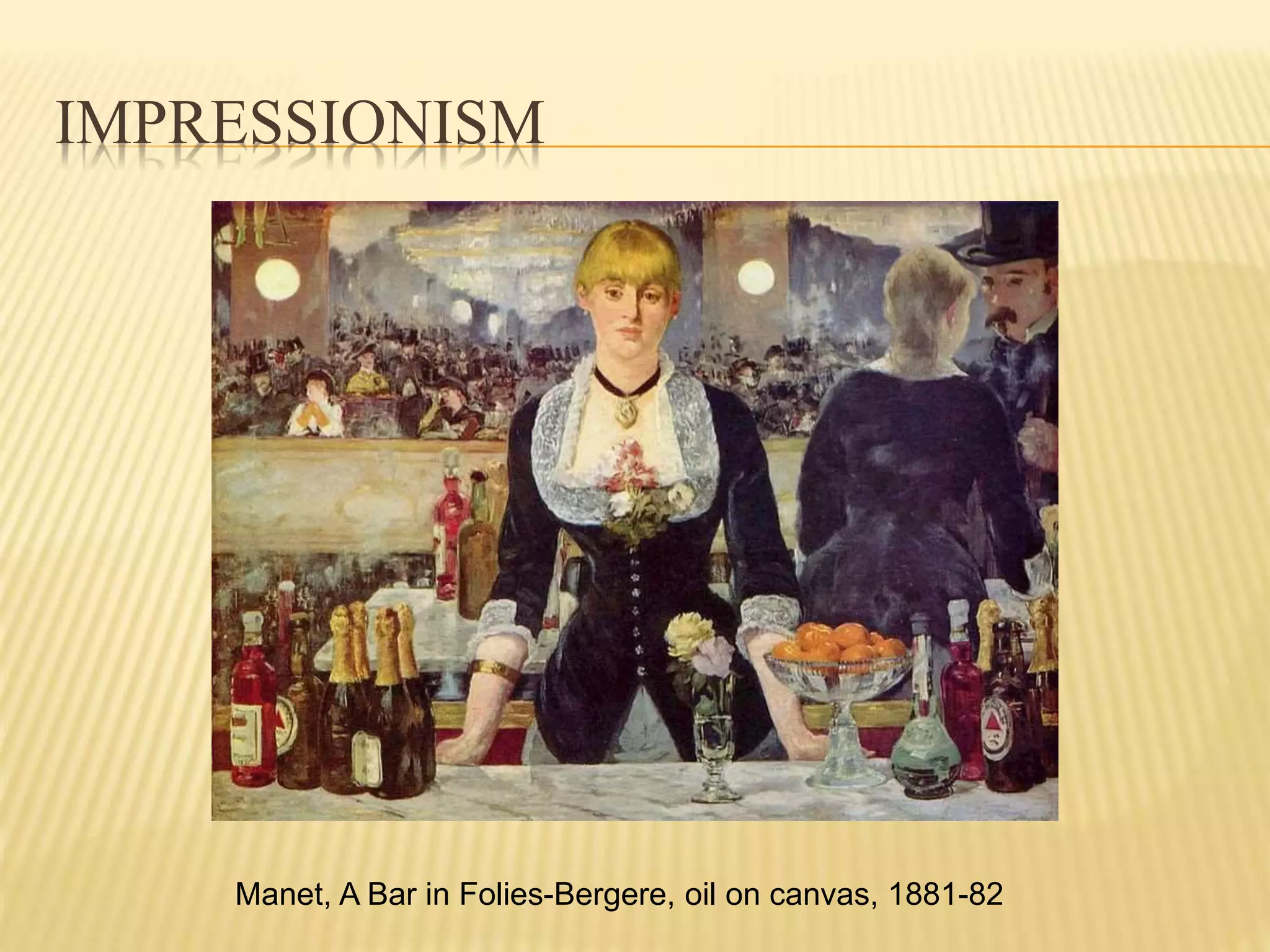
Manet, A Bar in Folies-Bergere, oil on canvas, 1881-82
IMPRESSIONISM
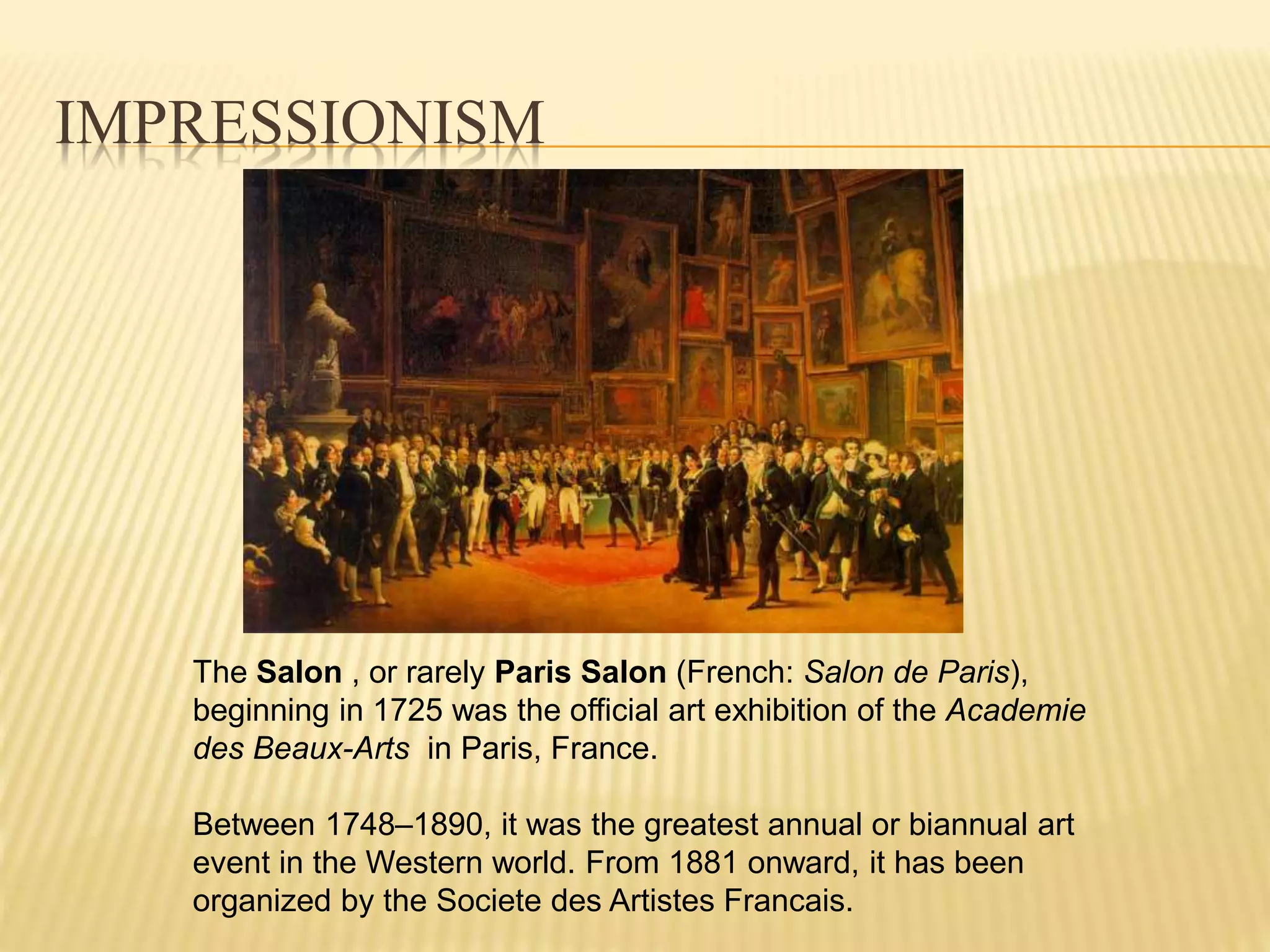
The Salon , or rarely Paris Salon (French: Salon de Paris),
beginning in 1725 was the official art exhibition of the Academie
des Beaux-Arts in Paris, France.
Between 1748–1890, it was the greatest annual or biannual art
event in the Western world. From 1881 onward, it has been
organized by the Societe des Artistes Francais.
IMPRESSIONISM
Claude Monet
Frederic Bazille
Pierre-Auguste Renoir
Edgar Degas
They called themselves the Anonymous Society of
Painters, Sculptors, and Printmakers.
The show opened at about the same time as the
annual Salon, May 1874.
The Impressionists held eight exhibitions from 1874
through 1886.
IMPRESSIONISM
Claude Monet's Impression, Sunrise (Musée Marmottan
Monet, Paris) exhibited in 1874, gave the Impressionist
movement its name when the critic Louis Leroy accused it of
being a sketch or "impression," not a finished painting.
IMPRESSIONISM
It demonstrates the techniques many of the independent artists
adopted:
--short, broken brushstrokes that barely convey forms
-- pure and bright unblended colors
--mostly opaque, no glazes
--emphasis on the effects or play of natural light
--shadows and highlights rendered in color rather than neutrals, no
black pigment
-- loose brushwork gives an effect of spontaneity and effortlessness
that masks their often carefully constructed compositions
--casual style
IMPRESSIONISM
Claude Monet
The Father of Impressionism
IMPRESSIONISM
Claude Monet, Impression Sunrise, 1872
(exhibited at the first Impressionist
exhibition in 1874)
IMPRESSIONISM
Monet
Haystacks at the End of Summer, Morning Effect
oil on canvas
1891.
IMPRESSIONISM
Monet
Haystack, Morning Snow
Effect
oil on canvas
1891
IMPRESSIONISM
Monet
Haystack
End of the Summer. Morning
oil on canvas
1891
IMPRESSIONISM
Rouen Cathedral
Full Sunlight
1894
Rouen Cathedral
West Façade, Sunlight
1892
IMPRESSIONISM
Rouen Cathedral: the portal 1800s
The critics didn't understand that this painting wasn't
about the cathedral, it was about the sunlight and
time of day the painting was made in.
Monet focused on the lighting of the object to create a
better understanding of the form.
It was more like a study of light and color. Critics
said he was destroying the form of art.
IMPRESSIONISM
Edgar Degas
1834-1917
IMPRESSIONISM
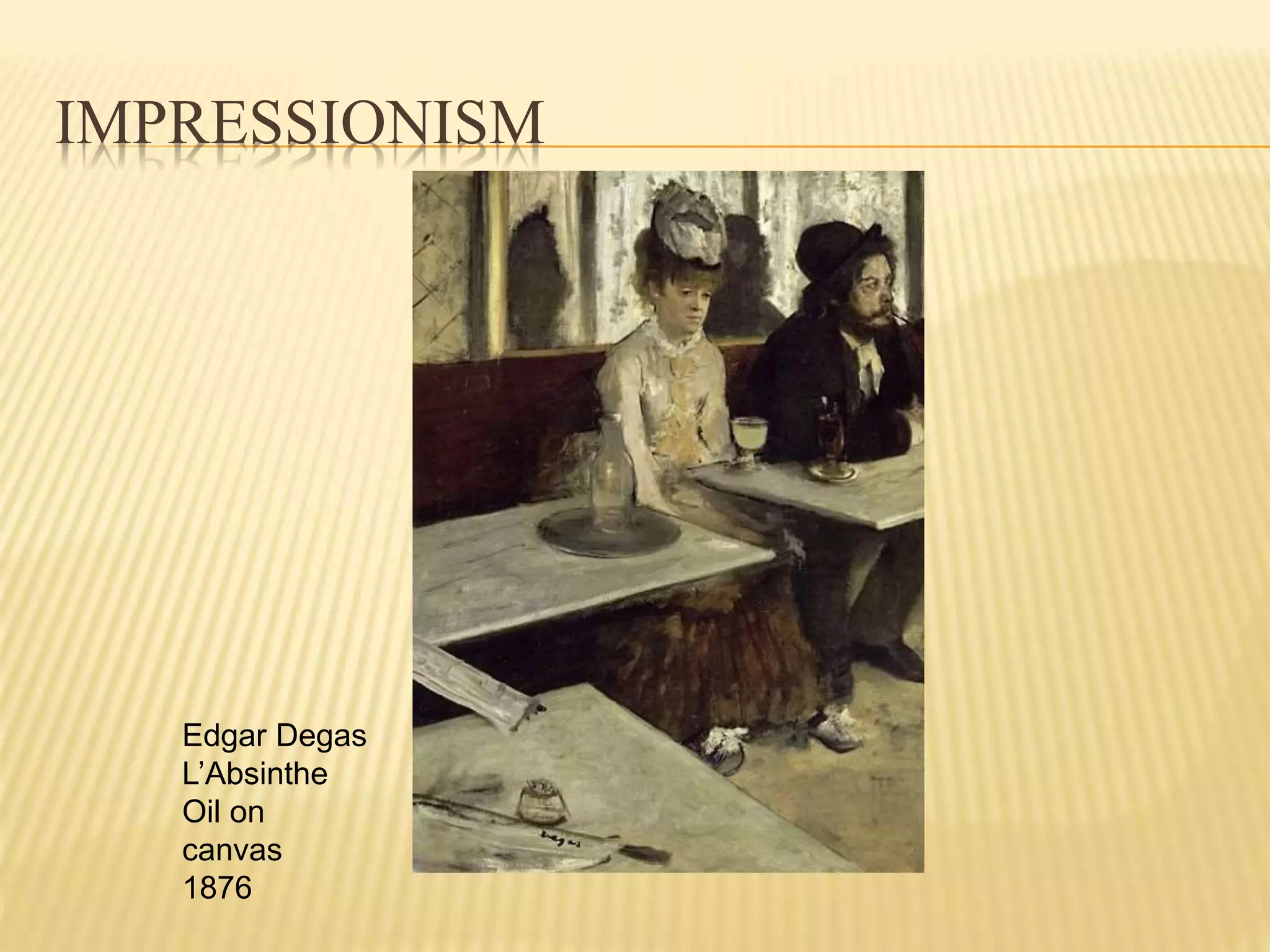
Edgar Degas
L’Absinthe
Oil on
canvas
1876
IMPRESSIONISM
Edgar Degas
Ballet
Rehearsal
1873
IMPRESSIONISM
Edgar Degas
The Tub
Late 1800s
IMPRESSIONISM
Edgar Degas
The Little Fourteen Year Old Dancer
bronze, wood, satin, cotton skirt
1922, 1879-80
IMPRESSIONISM
Pierre-Auguste Renoir
1841-1910
IMPRESSIONISM
Pierre-August Renoir
Luncheon of the Boating Party
1881
IMPRESSIONISM
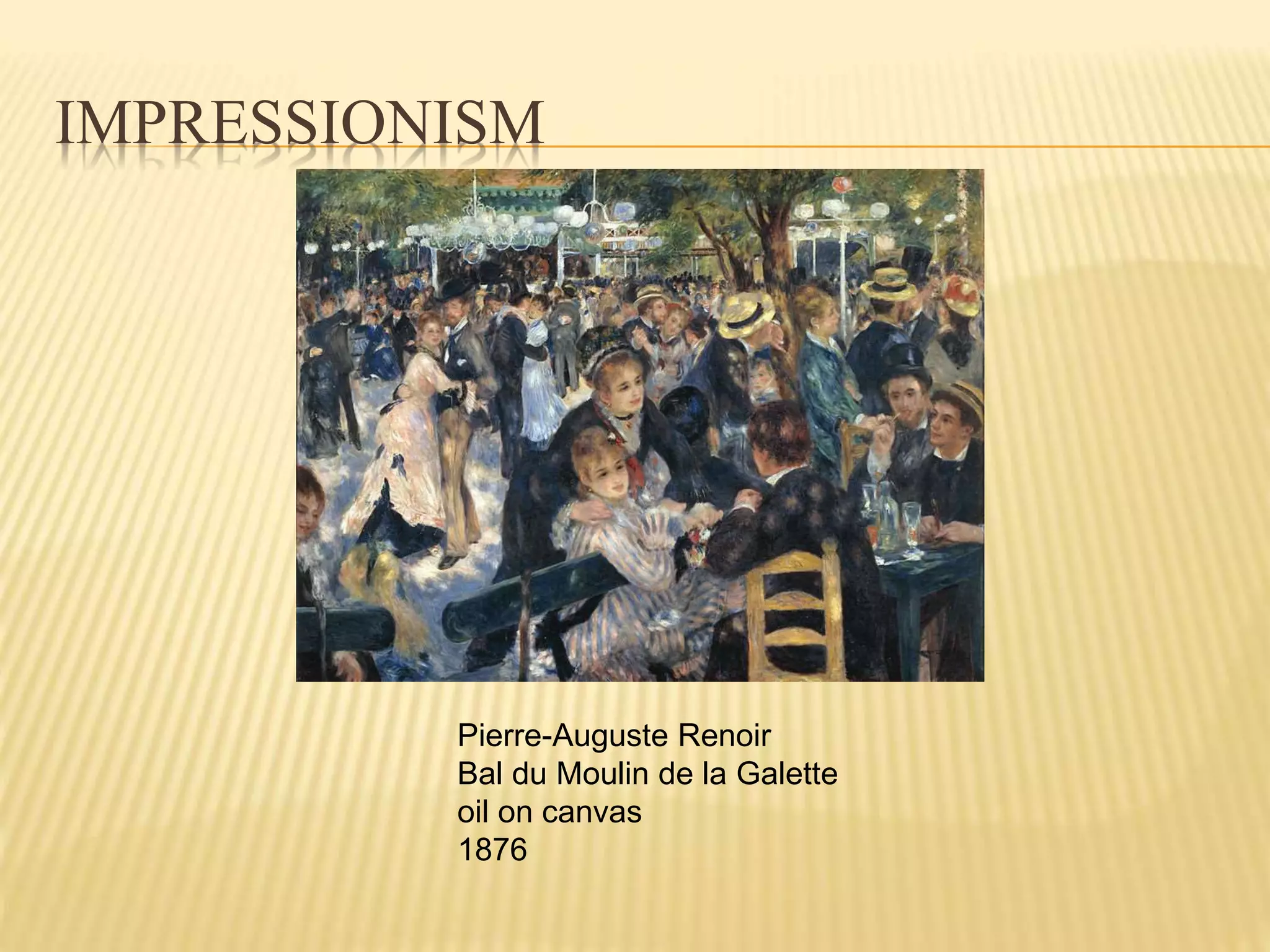
Pierre-Auguste Renoir
Bal du Moulin de la Galette
oil on canvas
1876
IMPRESSIONISM
Renoir
Girl with a
Hoop
1885
Renoir
Portrait of Berthe Morisot and
Daughter Julie Manet
1894
IMPRESSIONISM
Gustave Caillebot
Paris Street in Rainy Weather
Oil on canvas
1877
Gustave Caillebot
1848-1894
IMPRESSIONISM
Bethe Morisot
1841-1895 Berthe Morisot
Cornfield
oil on canvas
ca 1875
IMPRESSIONISM
Mary Cassatt
The Bath
oil on canvas
1893
Mary
Cassatt
1844-1926
IMPRESSIONISM
Camille
Pissaro
1830-1903
Camille Pissaro
The Woods at
Marly
Oil on canvas
1871
IMPRESSIONISM
Demise and Criticism (according to Cezanne)
--too rushed
--too accidental
--too superficial
--too feminine
--not conceptual
--not intellectual enough for male artists
--too consumable
--too materialistic
--lacks structure, artistic control, imagination
IMPRESSIONISM
Spread beyond France
 United States
 Australia
 Hungary
 Turkey
 Ireland
 Russia
 Brazil
 Egypt
 Argentina, etc.
POST - IMPRESSIONISM
Post-Impressionists: A term that was coined by Roger Fry, an
artist and art critic (1866-1934) in his seminal exhibition
Manet and the Post-Impressionists installed at the Grafton
Galleries in London in 1910.
POST - IMPRESSIONISM
 Georges Seurat
 Vincent van Gogh
 Paul Gaugain
 Paul Cezanne
== a group of young painters who broke free from the
naturalism of Impressionism and pursued independent
approaches and styles in art.
POST - IMPRESSIONISM
Georges Seurat
1859-1891
POST - IMPRESSIONISM
Seurat
The Siene at la Grande Jatte,
oil on canvas
888
POST - IMPRESSIONISM
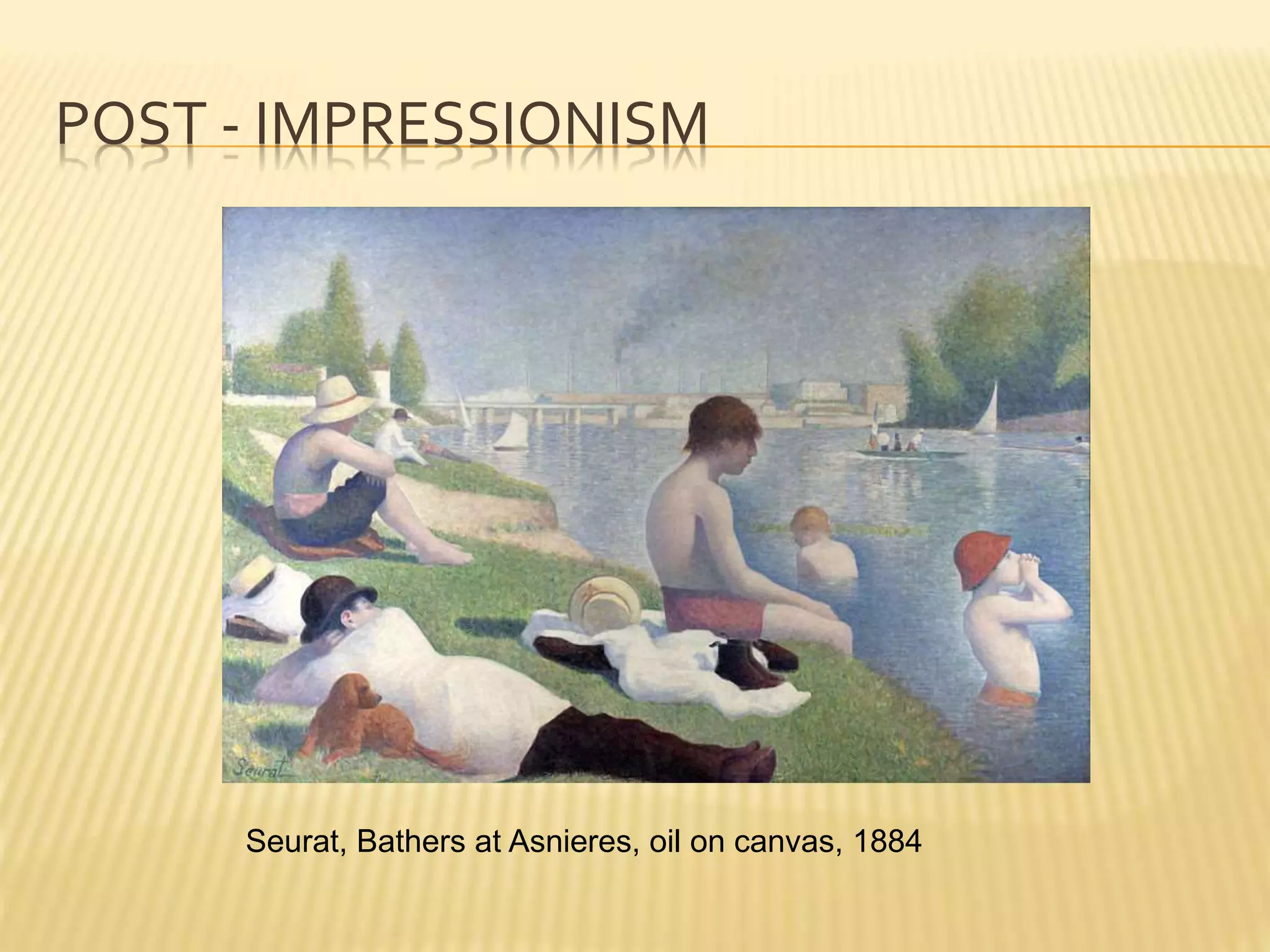
Seurat, Bathers at Asnieres, oil on canvas, 1884
POST - IMPRESSIONISM
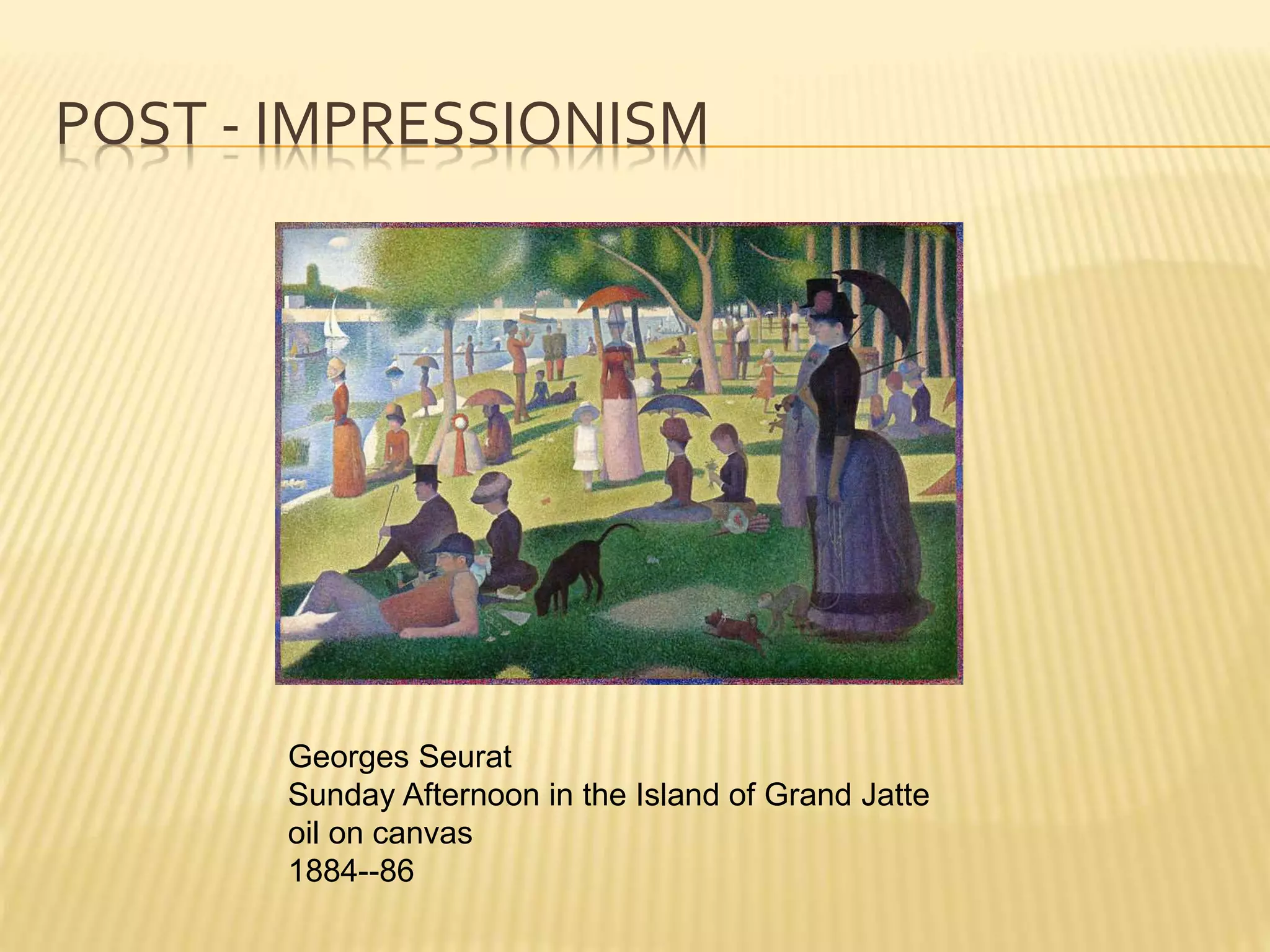
Georges Seurat
Sunday Afternoon in the Island of Grand Jatte
oil on canvas
1884--86
POST - IMPRESSIONISM
Vincent van Gogh
1853-1890
POST - IMPRESSIONISM
Self-Portrait
oil on pasteboard
1887
POST - IMPRESSIONISM
Starry Night over the
Rhone
1888
POST - IMPRESSIONISM
Wheat Field with
Cypresses
1889
POST - IMPRESSIONISM
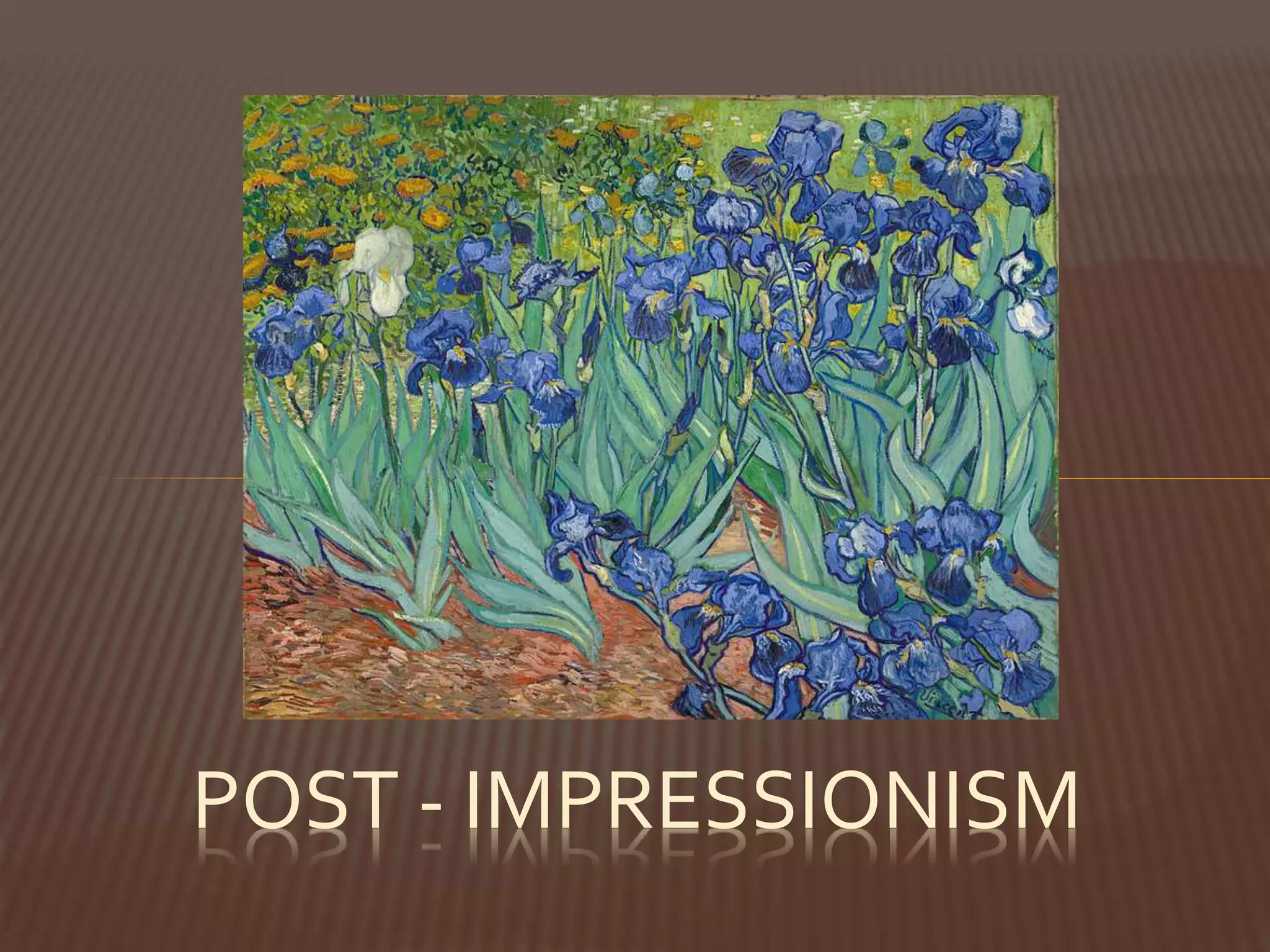
Irises
1889
POST - IMPRESSIONISM
Wheatfield with Crows
1890
POST - IMPRESSIONISM
Paul Gauguin
1848-1903
French artist Paul
Gauguin's bold colors,
exaggerated body
proportions and stark
contrasts helped him
achieve broad success
in the late 19th century.
Symbolism
POST - IMPRESSIONISM
The Yellow Christ
1889
POST - IMPRESSIONISM
Spirit of the Dead Watching
1892
POST - IMPRESSIONISM
Where Do We Come From, What Are We? Where Are We Going?
1897-1898
Oil on canvas
Museum of Fine Arts, Boston
POST - IMPRESSIONISM
Tahitian Women on
the Beach
oil on canvas
1891
POST - IMPRESSIONISM
Paul Cezanne
1839-1906
Precursor of 20th century art
POST - IMPRESSIONISM
He epitomized the reaction against it when he declared: ‘I wanted
to make of Impressionism something solid and enduring, like
the art in museums.’
Believing colour and form to be inseparable, he tried to
emphasize structure and solidity in his work, features he thought
neglected by the Impressionists.
POST - IMPRESSIONISM
For this reason he was a central figure in Post-Impressionism. He
rarely dated his works (and often did not sign them either), which
makes it hard to ascertain the chronology of his oeuvre with any
precision. Until the end of his life he received little public success and
was repeatedly rejected by the Paris Salon.
In his last years his work began to influence many younger artists,
including both the Fauves and the Cubists, making him a precursor of
20th-century art.
POST - IMPRESSIONISM
The Basket of Apples
1890-1894
POST - IMPRESSIONISM
Mont Saint-Victoire
1882-1885
POST - IMPRESSIONISM
Mont Saint-Victoire
1185-87
POST - IMPRESSIONISM
Madame Cezanne in the Greenhouse
1891-92
POST - IMPRESSIONISM
SUMMARY
According to the present state of discussion, Post-
Impressionism is a term best used within Rewald's
definition in a strictly historical manner, concentrating
on French art between 1886 and 1914, and re-
considering the altered positions of Impressionist
painters like Monet, Pissaro, Renoir, and others—as
well as all new brands at the turn of the century: from
Cloisonnism to Cubism. The declarations of war, in
July/August 1914, indicate probably far more than the
beginning of a World War—they signal a major break
in European cultural history, too.
JAPONISME
JAPONISME
 Japonisme, or Japonism, is a French term that was first
used by Jules Claretie in his book L’Art Francais en 1872.
 It refers both to influence and style of Japanese art on
Western art.
Vincent Van Gogh
Portrait of Pere Tanguy
1887-1888
JAPONISME
Precedents:
 Re-opening of Japanese trade with the West in 1854.
 Introduction of Japanese arts and crafts in Europe like fans,
porcelains, woodcuts and fans.
JAPONISME
 In 1862, a shop opens in Paris called “The Chinese Gate.”
The shop sold Japanese prints made from woodblocks,
which appealed greatly to 19th century artists. The best
Japanese prints could be found in Paris.
Kinryusan Temple at Asakusa: From the
series One Hundred Famous Views of Edo,
Edo period (1615–1868), 1856
Ando Hiroshige (Japanese, 1797–1858)
Oban format, woodblock print; ink and color
on paper
JAPONISME
 Articles on Japanese prints and art techniques of the Edo
era were featured in French magazines and newspapers.
 In 1867, Paris saw a formal exhibition of Japanese arts
when it joined the World Fair in Paris.
 In the late 1800s, there were many French artists and
collectors that went to Japan.
Japanese Satsuma
pavillion at the French
Expo 1867.
JAPONISME
The Japanese delegation to the 1867 Paris
World Fair.
Source: engraving from photograph, 1867
"Le Monde Illustre".
JAPONISME
What did French artists admire about Japanese prints?
 Its foreignness/exotic appeal.
 Its uniqueness that comes from specific elements employed
by Japanese painters.
JAPONISME
 One of these elements is the lack of distinction of shading
in Japanese prints. Artists, like Manet, who were influenced
by Japanese prints, began to break down distinctions
between depth.
Emphasis on flatness
JAPONISME
 Another element is Japanese artists’ disregard for
symmetry, something that had defined a lot of western
European art. Japanese techniques were so different from
the Greco-Roman art that has been a primary influence on
western art for centuries.
JAPONISME
 Other features include emphasis on nature, and recording
nature in an almost picturesque fashion, stressing the
verticality of their painting, and painting from aerial
perspective.
JAPONISME
 There were so many artists influenced by Japanese prints,
like, van Gogh, Mary Cassatt, Gauguin, Whistler, Degas,
Monet, Gustav Klimt, and even the architect Frank Lloyd
Wright.
JAPONISME
JAPONISME
JAPONISME
Edgar Degas
Portrait of James Tissot
Bet circa 1867 and 1868
oil on canvas
JAPONISME
James Abbott McNeil Whistler
The Princess from the Land
of Porcelain
oil on canvas
1863-65
JAPONISME
Henri Toulouse-Lautrec
Reine de Joie
Chromolithograph
1892
JAPONISME
 The color harmonies, simple designs, asymmetrical
compositions, and flat forms of Japanese wood
block prints strongly influenced the composition of
Impressionist & Post-Impressionist art, graphic
design and even industrial products.
END

Impressionism