D E S T I J L
M A G P A N T A Y, M a r c
M A R A S I G A N, C h y n n a
G A B A, G i n o
I N T R O D U C T I O N
“De Stijl” is Dutch for the style. It is also
known as Neoplasticism.
- founded in 1917 by Piet Mondrian and
Theo van Doesburg
- emerged largely in response to the horrors
of World War I and the wish to remake
society in its aftermath.
B E G I N N I N G S
K E Y I D E A S & C O N C E P T S
- Viewing art as a means of social and spiritual redemption,
the members of De Stijl embraced a utopian vision of art
and its transformative potential.
- search "for the universal, as the individual was losing its
significance."
- only primary colors and non-colors, only squares and
rectangles, only straight and horizontal or vertical lines
A R T I S T S
Bart van der Leck
(1876-1958)
Piet Mondrian (1872-
1944)
Theo van
Doesburg
(1883-1931)
Georges Vantongerloo
(1886-1965)
Marlow Moss (1889-
1958)
Friedrich Vordemberge-
Gildewart (1899-1962)
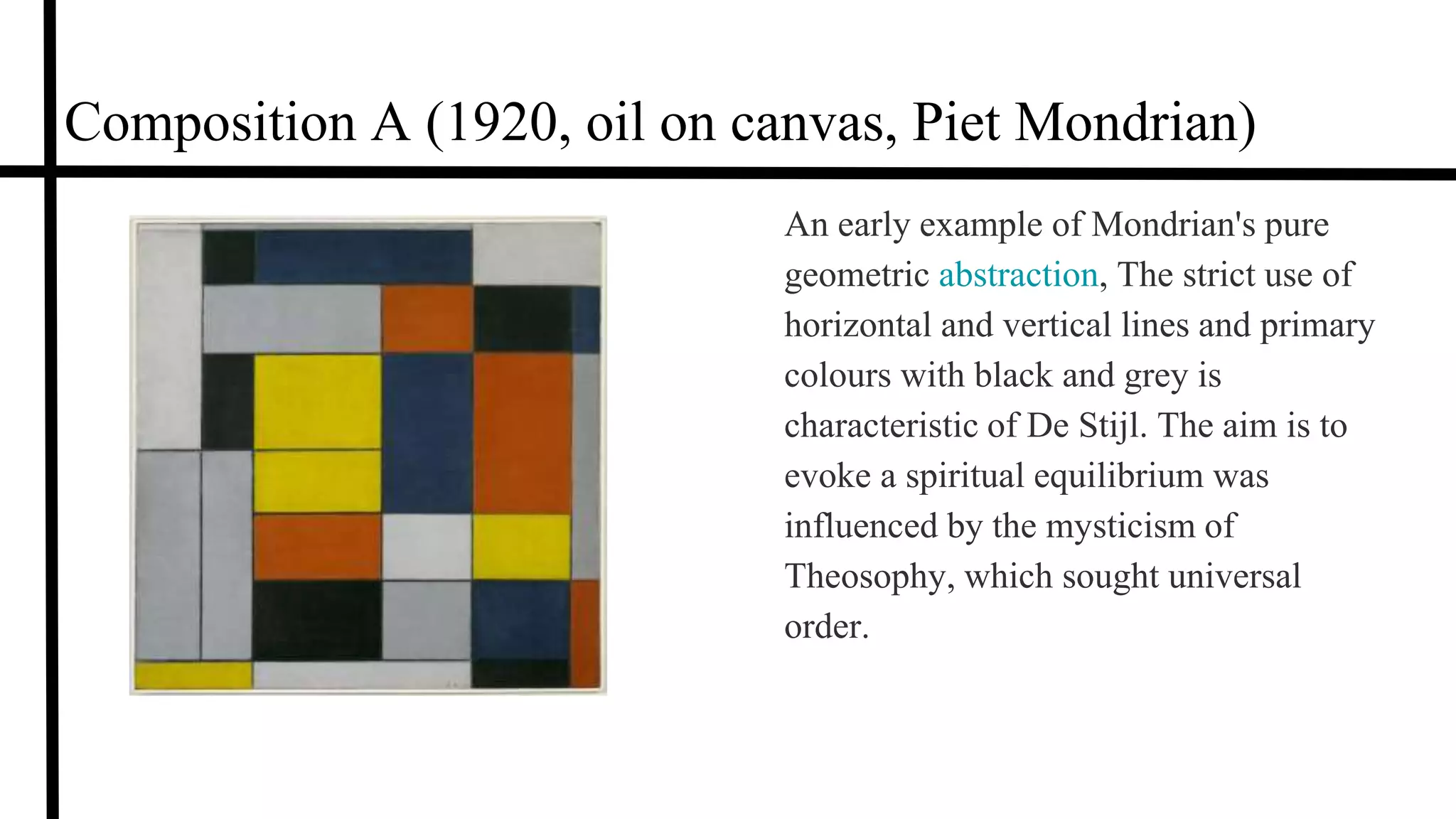
Composition A (1920, oil on canvas, Piet Mondrian)
An early example of Mondrian's pure
geometric abstraction, The strict use of
horizontal and vertical lines and primary
colours with black and grey is
characteristic of De Stijl. The aim is to
evoke a spiritual equilibrium was
influenced by the mysticism of
Theosophy, which sought universal
order.
Counter Composition V (1924, Theo van Doesburg)
The titles of his Counter Compositions
refer to the fact that the lines of the
compositions are at a 45-degree angle to
the sides of the picture rather than
parallel to them, resulting in a newly
energized relationship between the
composition and format of the canvas.
Mechano-Dancer (1922, photomontage, Vilmos Huszar)
The work's suggestion of a human figure
- accomplished by the arrangement of
geometric forms and placement of a cube
at the top, possibly representing a head -
is also unique in De Stijl art. Mechano-
Dancer's evocation of a hybrid man-
machine, also implied by its title,
suggests the influence of Dada and
Italian Futurism.
Arithmetic Composition (1929-30, Theo van Doesburg)
Arithmetic Composition reflects the artist's
experimentation with abstract geometric shapes
within a diagonal composition The work's diagonal
configuration, combination of pure positive and
negative space (black forms against white
background), and incorporation of a curious
backward "L" in the upper left corner, which
consumes one block, create a sense of movement,
making the shapes appear as if they are alternately
moving toward and away from the viewer.
Broadway Boogie-Woogie (1942 by Piet Mondrian)
This new tempo is perhaps the most striking
aspect. Whereas Mondrian's early paintings were
built up out of long continuous lines and large
planes, which could be compared to whole or half
notes in music, there now appear much smaller
forms, comparable to eighth and sixteenth notes,
contrasting only here and there with larger areas.
This innovation, which evidently took place while
Mondrian was working on the painting, gives the
canvas a new and sparkling vivacity. Mondrian
had always been attracted by the latest in
ballroom music, advocating the tango and one-
and two-steps over the waltz.
New York City I (1942 by Piet Mondrian)
The brisk allegro rhythm of this painting
there is a new feeling for harmony, which
Mondrian could have learned only in his
new surroundings: the rhythm of the
modern metropolis. In the early days of De
Stijl, Mondrian and his friends had striven
to have the human environment, the great
city, determined by the laws of harmony.
Now, an example of this new cultural
pattern, New York City, had a radical
influence on his painting.
Rietveld Schroder House (1924, Gerrit Rietveld)
Intended for the new home to be grand
and open ("without walls"), a veritable
manifesto for how an independent
modern woman should live her life.
Featuring the typical De Stijl palette of
primary colors, black, and white, the
building emphasizes its architectural
elements - slabs, posts, and beams -
reflecting the movement's emphasis on
form, construction, and function in its
architecture and design.
L A T E R D E V E L O P M E N T S
- De Stijl's influence was perhaps felt most noticeably in the realm
of architecture, helping give rise to the International Style of the
1920s and 1930s.
*International Style: emphasized balance, functionality,
and clean lines devoid of ornamentation;
more on glass and steel, less concrete
I N F L U E N C E & L E G A C Y
Works by De Stijl members are scattered all over the world, but De Stijl-themed
exhibitions are organised regularly. Museums with large De Stijl collections include the
Gemeentemuseum in The Hague (which owns the world's most extensive, although not
exclusively De Stijl-related, Mondrian collection) and Amsterdam's Stedelijk Museum,
where many works by Rietveld and Van Doesburg are on display. The Centraal Museum
of Utrecht has the largest Rietveld collection worldwide; it also owns the Rietveld
Schröder House, Rietveld's adjacent "show house", and the Rietveld Schröder Archives.
Gemeentemuseum Den Haag
Stedelijik Museum, Amsterdam
I n f l u e n c e i n t h e P h i l i p p i n e s
L O V E
Strengths:
- It was easy to make an artwork with the De Stijl art style.
Weaknesses:
- It was hard to the find the meanings of different artworks.
- De Stijl is not acceptable for artists who value aesthetics and
creative methods
Resources
http://www.tate.org.uk/art/art-terms/d/de-stijl
http://www.theartstory.org/movement-de-stijl.html
http://www.kemperartmuseum.wustl.edu/collection/explore/artwork/484
https://www.piet-mondrian.org/broadway-boogie-woogie.jsp
https://www.piet-mondrian.org/new-york-city.jsp
https://urbandud.wordpress.com/2011/02/12/de-stijl-how-to-paint-abet-style-part-2/

De Stijl

  • 1.
    D E ST I J L M A G P A N T A Y, M a r c M A R A S I G A N, C h y n n a G A B A, G i n o
  • 2.
    I N TR O D U C T I O N “De Stijl” is Dutch for the style. It is also known as Neoplasticism.
  • 3.
    - founded in1917 by Piet Mondrian and Theo van Doesburg - emerged largely in response to the horrors of World War I and the wish to remake society in its aftermath. B E G I N N I N G S
  • 4.
    K E YI D E A S & C O N C E P T S - Viewing art as a means of social and spiritual redemption, the members of De Stijl embraced a utopian vision of art and its transformative potential. - search "for the universal, as the individual was losing its significance." - only primary colors and non-colors, only squares and rectangles, only straight and horizontal or vertical lines
  • 5.
    A R TI S T S Bart van der Leck (1876-1958) Piet Mondrian (1872- 1944) Theo van Doesburg (1883-1931)
  • 6.
    Georges Vantongerloo (1886-1965) Marlow Moss(1889- 1958) Friedrich Vordemberge- Gildewart (1899-1962)
  • 7.
    Composition A (1920,oil on canvas, Piet Mondrian) An early example of Mondrian's pure geometric abstraction, The strict use of horizontal and vertical lines and primary colours with black and grey is characteristic of De Stijl. The aim is to evoke a spiritual equilibrium was influenced by the mysticism of Theosophy, which sought universal order.
  • 8.
    Counter Composition V(1924, Theo van Doesburg) The titles of his Counter Compositions refer to the fact that the lines of the compositions are at a 45-degree angle to the sides of the picture rather than parallel to them, resulting in a newly energized relationship between the composition and format of the canvas.
  • 9.
    Mechano-Dancer (1922, photomontage,Vilmos Huszar) The work's suggestion of a human figure - accomplished by the arrangement of geometric forms and placement of a cube at the top, possibly representing a head - is also unique in De Stijl art. Mechano- Dancer's evocation of a hybrid man- machine, also implied by its title, suggests the influence of Dada and Italian Futurism.
  • 10.
    Arithmetic Composition (1929-30,Theo van Doesburg) Arithmetic Composition reflects the artist's experimentation with abstract geometric shapes within a diagonal composition The work's diagonal configuration, combination of pure positive and negative space (black forms against white background), and incorporation of a curious backward "L" in the upper left corner, which consumes one block, create a sense of movement, making the shapes appear as if they are alternately moving toward and away from the viewer.
  • 11.
    Broadway Boogie-Woogie (1942by Piet Mondrian) This new tempo is perhaps the most striking aspect. Whereas Mondrian's early paintings were built up out of long continuous lines and large planes, which could be compared to whole or half notes in music, there now appear much smaller forms, comparable to eighth and sixteenth notes, contrasting only here and there with larger areas. This innovation, which evidently took place while Mondrian was working on the painting, gives the canvas a new and sparkling vivacity. Mondrian had always been attracted by the latest in ballroom music, advocating the tango and one- and two-steps over the waltz.
  • 12.
    New York CityI (1942 by Piet Mondrian) The brisk allegro rhythm of this painting there is a new feeling for harmony, which Mondrian could have learned only in his new surroundings: the rhythm of the modern metropolis. In the early days of De Stijl, Mondrian and his friends had striven to have the human environment, the great city, determined by the laws of harmony. Now, an example of this new cultural pattern, New York City, had a radical influence on his painting.
  • 13.
    Rietveld Schroder House(1924, Gerrit Rietveld) Intended for the new home to be grand and open ("without walls"), a veritable manifesto for how an independent modern woman should live her life. Featuring the typical De Stijl palette of primary colors, black, and white, the building emphasizes its architectural elements - slabs, posts, and beams - reflecting the movement's emphasis on form, construction, and function in its architecture and design.
  • 14.
    L A TE R D E V E L O P M E N T S - De Stijl's influence was perhaps felt most noticeably in the realm of architecture, helping give rise to the International Style of the 1920s and 1930s. *International Style: emphasized balance, functionality, and clean lines devoid of ornamentation; more on glass and steel, less concrete
  • 15.
    I N FL U E N C E & L E G A C Y Works by De Stijl members are scattered all over the world, but De Stijl-themed exhibitions are organised regularly. Museums with large De Stijl collections include the Gemeentemuseum in The Hague (which owns the world's most extensive, although not exclusively De Stijl-related, Mondrian collection) and Amsterdam's Stedelijk Museum, where many works by Rietveld and Van Doesburg are on display. The Centraal Museum of Utrecht has the largest Rietveld collection worldwide; it also owns the Rietveld Schröder House, Rietveld's adjacent "show house", and the Rietveld Schröder Archives.
  • 16.
  • 17.
  • 18.
    I n fl u e n c e i n t h e P h i l i p p i n e s
  • 19.
  • 20.
    Strengths: - It waseasy to make an artwork with the De Stijl art style. Weaknesses: - It was hard to the find the meanings of different artworks. - De Stijl is not acceptable for artists who value aesthetics and creative methods
  • 21.