PRESENTED BY
  KEVAL CHHEDA
    (1024050)
        &
KHUSHBOO BARARIA
    (1024025)
ABOUT


 HISTORY


 ARTISTS


CONCLUSION
 ThePost Impressionist period came when several         ABOUT

 former Impressionist painters became dissatisfied
 with the movements insistence on light and color.
                                                         HISTORY


 The post-Impressionists aspired to find more depth
                                                         ARTISTS
 in the roles of color, form and solidity in painting.

 The term post-impressionism is used to denote the
 effort at self-expression, emotion, mood and rather
 than representation of object.
 The  style of the work, developing a new method          ABOUT

  of paint application or viewing the piece from
  multiple angles, was more important than
                                                           HISTORY
  subject matter.
 Characteristics:
 -see brushstrokes                                         ARTISTS
 -personally expressive
 -style over fidelity
 -no fleeting light or moment (multiple moments or
 angles)
 -bright palette
 -moved away from journalistic detail of earlier periods
 -art is for the artist’s sake
 The Post-Impressionists were several artists of the   ABOUT

 late 19th century, who saw the work of the French
 Impressionist painters and were influenced by
                                                        HISTORY
 them. Their art styles grew out of the style called
 "Impressionism".
                                                        ARTISTS


 Theword "Post" means after, so "Post-
 Impressionist" art came after "Impressionist" art.
 Related to Pointillism, a technique of painting in     ABOUT

 which small, distinct dots of pure color is applied
 in patterns to form an image. Georges Seurat
                                                         HISTORY
 developed the technique in 1886, branching from
 Impressionism
                                                         ARTISTS


 John Rewald, one of the first professional art
 historians to focus on the birth of early modern art,
 limited the scope to the years between 1886 and
 1892 in his pioneering publication on Post-
 Impressionism
 The  sculptor Auguste Rodin is sometimes        ABOUT

  called an Impressionist for the way he used
  roughly modeled surfaces to suggest
                                                  HISTORY
  transient light effects.
 Pictorialists photographers whose work is
  characterized by soft focus and atmospheric     ARTISTS

  effects have also been called Impressionists.
 French Impressionist Cinema is a term
  applied to a loosely defined group of films
  and filmmakers in France from 1919-1929,
  although these years are debatable.
 Henri de Toulouse-Lautrec                                     ABOUT
  Disabled poster artist known as one of the first Graphic
  Designers
 Paul Cezanne                                                  HISTORY
  Large block-like brushstrokes; Still life's, Landscapes
 Vincent Van Gogh
  Disturbed painter of loose brushstrokes and bright, vivid     ARTISTS
  colors
 Paul Gauguin
  Rejected Urban Life and choose secondary-colored Tahitian
  women
 Auguste Rodin
  Bronze sculptor; Very loose and not detailed. “The Thinker”
   Often called the Father of Modern art.                    ABOUT


   Influenced by the Impressionist Camille Pissarro,         HISTORY
    Cezanne was a master of still life, portraiture, genre-
    painting and landscape.
                                                              ARTISTS

   Paul Cezanne painted more than 200 still-life
    compositions in his lifetime


   His works had a huge influence on the prototype
    Cubism of Picasso and Braque.
ABOUT


HISTORY


ARTISTS
ABOUT


HISTORY


ARTISTS
   An important contributor to the foundations of Modern art.              ABOUT


   Van Gogh suffered from temporal lobe epilepsy as well as other
    mental and physical conditions.                                         HISTORY


   He produced more than 2,000 artworks, consisting of around 900
    paintings and 1,100 drawings.                                           ARTISTS


   Vincent shot himself in France, but did not die until 2 days later at
    the age of 37.
   Today many of his pieces—including his numerous self portraits,
    landscapes, portraits and sunflowers—are among the world's most
    recognizable and expensive works of art and sketches.
ABOUT


HISTORY


ARTISTS
ABOUT


HISTORY


ARTISTS
 Eugène   Henri Paul was a leading Post-              ABOUT

  Impressionist.
 An artist, painter, sculptor, printmaker, ceramist   HISTORY
  and writer.
 He was influenced by Camille Pissaro and Georgia
                                                       ARTISTS
  O’ Keeffe and was a friend of Vincent Van Gogh
 Gauguin introduced exotic and primitive elements
  into the art of the time and his colour and
  symbolism gave his paintings great intensity.
ABOUT


HISTORY


ARTISTS
 Generally   considered the progenitor of modern    ABOUT

  sculptor.
 Departing with centuries of tradition, he turned   HISTORY
  away from the idealism of the Greeks, and the
  decorative beauty of the Baroque and neo-Baroque
  movements.                                         ARTISTS


 His sculpture emphasized the individual and the
  concreteness of flesh, and suggested emotion
  through detailed, textured surfaces, and the
  interplay of light and shadow.
ABOUT


HISTORY


ARTISTS
ABOUT


HISTORY


ARTISTS
 Was a French painter, printmaker, draughtsman, and       ABOUT
  illustrator.
 He painted social taboos and sordid truths of Parisian
  life in a straightforward unsentimental manner.          HISTORY

 Throughout his career, which spanned less than 20
  years, Toulouse-Lautrec created 737 canvases, 275
  watercolours, 363 prints and posters, 5,084 drawings,    ARTISTS

  some ceramic and stained glass work, and an unknown
  number of lost works
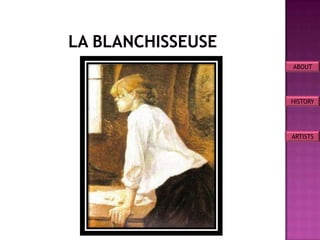
 In a 2005 auction at Christie’s auction house a new
  record was set when "La blanchisseuse", an early
  painting of a young laundress, sold for $22.4 million
  U.S.
ABOUT


HISTORY


ARTISTS
ABOUT


HISTORY


ARTISTS
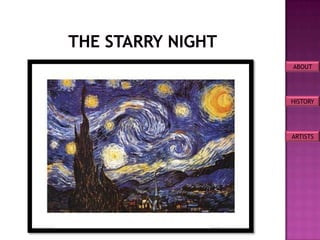
 The transformed contrasting short brushstrokes of    ABOUT

 Impressionism into curving, vibrant lines of color,
 exaggerated even beyond Impressionist brilliance,
                                                       HISTORY
 that convey emotionally charged and ecstatic
 responses to the natural landscape. In general,
 Post-Impressionism led away from a naturalistic       ARTISTS

 approach and toward the two major movements of
 early 20th-century art that superseded Cubism and
 Fauvism, which sought to evoke emotion through
 color and line.
Post impressionism

Post impressionism

  • 1.
    PRESENTED BY KEVAL CHHEDA (1024050) & KHUSHBOO BARARIA (1024025)
  • 2.
  • 3.
     ThePost Impressionistperiod came when several ABOUT former Impressionist painters became dissatisfied with the movements insistence on light and color. HISTORY  The post-Impressionists aspired to find more depth ARTISTS in the roles of color, form and solidity in painting.  The term post-impressionism is used to denote the effort at self-expression, emotion, mood and rather than representation of object.
  • 4.
     The style of the work, developing a new method ABOUT of paint application or viewing the piece from multiple angles, was more important than HISTORY subject matter.  Characteristics: -see brushstrokes ARTISTS -personally expressive -style over fidelity -no fleeting light or moment (multiple moments or angles) -bright palette -moved away from journalistic detail of earlier periods -art is for the artist’s sake
  • 5.
     The Post-Impressionistswere several artists of the ABOUT late 19th century, who saw the work of the French Impressionist painters and were influenced by HISTORY them. Their art styles grew out of the style called "Impressionism". ARTISTS  Theword "Post" means after, so "Post- Impressionist" art came after "Impressionist" art.
  • 6.
     Related toPointillism, a technique of painting in ABOUT which small, distinct dots of pure color is applied in patterns to form an image. Georges Seurat HISTORY developed the technique in 1886, branching from Impressionism ARTISTS  John Rewald, one of the first professional art historians to focus on the birth of early modern art, limited the scope to the years between 1886 and 1892 in his pioneering publication on Post- Impressionism
  • 7.
     The sculptor Auguste Rodin is sometimes ABOUT called an Impressionist for the way he used roughly modeled surfaces to suggest HISTORY transient light effects.  Pictorialists photographers whose work is characterized by soft focus and atmospheric ARTISTS effects have also been called Impressionists.  French Impressionist Cinema is a term applied to a loosely defined group of films and filmmakers in France from 1919-1929, although these years are debatable.
  • 8.
     Henri deToulouse-Lautrec ABOUT Disabled poster artist known as one of the first Graphic Designers  Paul Cezanne HISTORY Large block-like brushstrokes; Still life's, Landscapes  Vincent Van Gogh Disturbed painter of loose brushstrokes and bright, vivid ARTISTS colors  Paul Gauguin Rejected Urban Life and choose secondary-colored Tahitian women  Auguste Rodin Bronze sculptor; Very loose and not detailed. “The Thinker”
  • 9.
    Often called the Father of Modern art. ABOUT  Influenced by the Impressionist Camille Pissarro, HISTORY Cezanne was a master of still life, portraiture, genre- painting and landscape. ARTISTS  Paul Cezanne painted more than 200 still-life compositions in his lifetime  His works had a huge influence on the prototype Cubism of Picasso and Braque.
  • 10.
  • 11.
  • 12.
    An important contributor to the foundations of Modern art. ABOUT  Van Gogh suffered from temporal lobe epilepsy as well as other mental and physical conditions. HISTORY  He produced more than 2,000 artworks, consisting of around 900 paintings and 1,100 drawings. ARTISTS  Vincent shot himself in France, but did not die until 2 days later at the age of 37.  Today many of his pieces—including his numerous self portraits, landscapes, portraits and sunflowers—are among the world's most recognizable and expensive works of art and sketches.
  • 13.
  • 14.
  • 15.
     Eugène Henri Paul was a leading Post- ABOUT Impressionist.  An artist, painter, sculptor, printmaker, ceramist HISTORY and writer.  He was influenced by Camille Pissaro and Georgia ARTISTS O’ Keeffe and was a friend of Vincent Van Gogh  Gauguin introduced exotic and primitive elements into the art of the time and his colour and symbolism gave his paintings great intensity.
  • 16.
  • 17.
     Generally considered the progenitor of modern ABOUT sculptor.  Departing with centuries of tradition, he turned HISTORY away from the idealism of the Greeks, and the decorative beauty of the Baroque and neo-Baroque movements. ARTISTS  His sculpture emphasized the individual and the concreteness of flesh, and suggested emotion through detailed, textured surfaces, and the interplay of light and shadow.
  • 18.
  • 19.
  • 20.
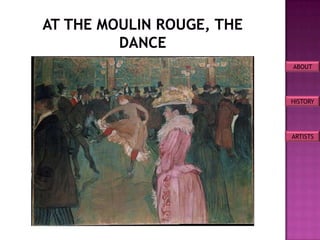
     Was aFrench painter, printmaker, draughtsman, and ABOUT illustrator.  He painted social taboos and sordid truths of Parisian life in a straightforward unsentimental manner. HISTORY  Throughout his career, which spanned less than 20 years, Toulouse-Lautrec created 737 canvases, 275 watercolours, 363 prints and posters, 5,084 drawings, ARTISTS some ceramic and stained glass work, and an unknown number of lost works  In a 2005 auction at Christie’s auction house a new record was set when "La blanchisseuse", an early painting of a young laundress, sold for $22.4 million U.S.
  • 21.
  • 22.
  • 23.
     The transformedcontrasting short brushstrokes of ABOUT Impressionism into curving, vibrant lines of color, exaggerated even beyond Impressionist brilliance, HISTORY that convey emotionally charged and ecstatic responses to the natural landscape. In general, Post-Impressionism led away from a naturalistic ARTISTS approach and toward the two major movements of early 20th-century art that superseded Cubism and Fauvism, which sought to evoke emotion through color and line.