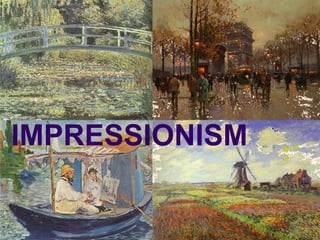
IMPRESSIONISM

                1
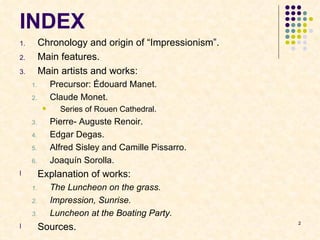
INDEX
1.        Chronology and origin of “Impressionism”.
2.        Main features.
3.        Main artists and works:
     1.        Precursor: Édouard Manet.
     2.        Claude Monet.
                Series of Rouen Cathedral.
     3.        Pierre- Auguste Renoir.
     4.        Edgar Degas.
     5.        Alfred Sisley and Camille Pissarro.
     6.        Joaquín Sorolla.
l         Explanation of works:
     1.        The Luncheon on the grass.
     2.        Impression, Sunrise.
     3.        Luncheon at the Boating Party.
                                                      2
l         Sources.
CHRONOLOGY AND
 ORIGIN OF “IMPRESSIONISM”
Impressionism is the plastic movement
developed in the 2nd half of the 19th
century, mainly in France.

                                        The word “Impressionism”
                                        comes from “impression”, the
                                        name of Monet’s
                                        painting, Impression, Sunrise.
                                        The critic Louis Leroy used for
                                        the first time this word in
                                        1874. He used it in a pejorative
                                        way to refer to the paintings of
                                        group of artists in Paris,
                                        whose independent exhibitions
                                        opposed to conventional art in
                                        France.
                                                                           3
MAIN FEATURES
   Landscape: the Impressionists usually
    represented the contact with nature and
    light. These paintings also represent
    natural elements such as water, sky or
    ice.
   Fast technique with large brushstrokes.
   Colours: they didn’t use the black colour.
    As for the white colour, they also thought
    it doesn’t exist. They used pure colours
    and they could mix them on canvas.
                                                    Monet’s garden, Claude Monet
                                            • Light is the most important thing.
                                            • No use of vanishing point they made
                                            flat and two-dimensional compositions.
                                            • Main themes: portraits, landscapes,
                                            urban life scenes, an optimistic vision
                                            of the world, society and they usually
                                            painted the life in Paris.
                                            • They usually painted in the open air.
                                                                                 4

      Poppies, Claude Monet
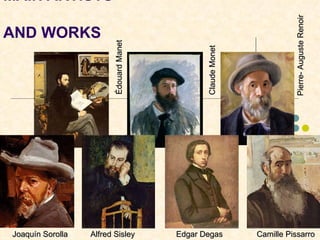
MAIN ARTISTS


                                                                        Pierre- Auguste Renoir
AND WORKS


                        Édouard Manet


                                               Claude Monet
                                                                             5

Joaquín Sorolla   Alfred Sisley         Edgar Degas           Camille Pissarro
Édouard Manet was the precursor of Impressionism


                          The Luncheon on the grass          A bar at the Folies Bergére
 The balcony


Music in the Tuilleries                                               Olympia              6
                                                      The fifer
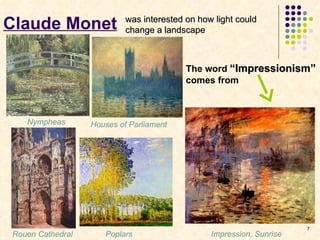
Claude Monet               was interested on how light could
                           change a landscape


                                          The word “Impressionism”
                                          comes from


   Nympheas       Houses of Parliament


                                                                      7
Rouen Cathedral      Poplars                    Impression, Sunrise
Rising Sun       Dawn
                                 CATHEDRAL


Foggy Light      Full Sunlight
                                 SERIES OF ROUEN


Late Afternoon   Afternoon Sun
 8


Night Light      Morning Light
Pierre- Auguste Renoir


                                        Luncheon at the Boating Party

  The Swing        Girls at the piano


                                        Dance at the Moulin de la Galette
                                                                            9
       The Large Bathers
Edgar Degas used to focus on human
                             figure and movement. He
                             painted scenes of dancers
                             and horse races.


                                                         The Tub


Dancer with a Bouquet of Flowers


                                       The dance class


                                   Ballet rehearsal
                                                         L’ Absinthe   10
Alfred Sisley and
               Camille Pissarro
                painted scenes in the open air.


  Flood at Port- Marly                        Boulevard Montmartre

                                                                     11
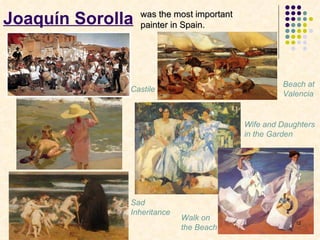
Joaquín Sorolla   was the most important
                  painter in Spain.


                                                    Beach at
              Castile
                                                    Valencia


                                           Wife and Daughters
                                           in the Garden


              Sad
              Inheritance
                            Walk on
                                                        12
                            the Beach
EXPLANATION
  OF WORKS

              13
The Luncheon on the grass
   Artist: Édouard Manet.
   Chronology: 1863.
   Material used: Oil on canvas.
   Present location: Orsay Museum, Paris.
   Description: It represents a naked woman
    with two men. The woman is completely
    illuminated and is looking to the viewer. In
    front of them, we can see the woman’s
    clothes, a fruit’s basket and bread. In the
    background a woman with a white dress
    appears and she is bathing in a stream.
   Explanation: Declaration in favour of the
    artist’s individual freedom. Manet portrayed
    his wife (Suzanne), and his favourite model
    (Meurent). Both women posed for the naked
    woman: the face belongs to Meurent and the
    body to Suzanne. The two men are Manet’s
    brother (Gustave) and his brother in law
    (Ferdinand).
   Influence: Manet influenced Claude Monet,
    who also painted his own Luncheon on the
    grass.
   Interesting information: The painting’s style
    wasn’t common in that period. For that reason
    there were several critiques. He didn’t try to
    eliminate the brushstrokes. In fact, the
    painting seems unfinished in some parts of
    the scene. It can be interpreted as a modern
    version of Pastoral concert from the             14
    Renaissance painter, Titian.
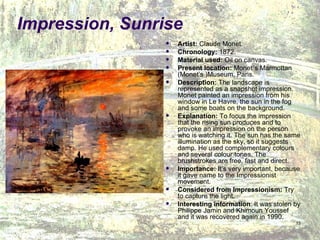
Impression, Sunrise
                    Artist: Claude Monet.
                    Chronology: 1872.
                    Material used: Oil on canvas.
                    Present location: Monet´s Marmottan
                     (Monet’s )Museum, Paris.
                    Description: The landscape is
                     represented as a snapshot impression.
                     Monet painted an impression from his
                     window in Le Havre, the sun in the fog
                     and some boats on the background.
                    Explanation: To focus the impression
                     that the rising sun produces and to
                     provoke an impression on the person
                     who is watching it. The sun has the same
                     illumination as the sky, so it suggests
                     damp. He used complementary colours
                     and several colour tones. The
                     brushstrokes are free, fast and direct.
                    Importance: It’s very important, because
                     it gave name to the Impressionist
                     movement.
                    Considered from Impressionism: Try
                     to capture the light.
                    Interesting information: It was stolen by
                     Philippe Jamin and Khimoun Youssef
                     and it was recovered again in 1990.
                                                            15
Luncheon at the Boating Party
   Artist: Pierre- Auguste Renoir.
   Chronology: 1881.
   Material used: Oil on canvas.
   Bought by: Paul Durand- Ruel and
    later from his son by Duncan Phillips.
   Present location: Phillips Collection,
    Washington DC.
   Description: A group of friends
    relaxing in the Maison Fournaise’s
    balcony on the Seine River in Chatou,
    France. On the right, we can see
    Renoir and the patron, Gustave
    Caillebote, sitting down. On the left,
    Aline Charigot, Renoir’s wife, is playing
    with a dog.
   Explanation: Renoir captured a big
    quantity of light. Most of the light
    comes from the back of the painting;
    the men’s t-shirts from the background
    and the tablecloth reflect most of the
    light.
   Interesting information: This is an
    ordinary life scene, one of the
    Impressionist painters’ favourite
    themes.
                                                16
SOURCES:
WEBSITES:
      Wikipedia, Wikimedia Foundation, Inc. 26 March 2012,

<http://es.wikipedia.org/wiki/Le_D%C3%A9jeuner_sur_l%27Herbe>
      Wikipedia, Wikimedia Foundation, Inc. 1 March 2012, <
     http://es.wikipedia.org/wiki/Impresi%C3%B3n,_sol_naciente>
     Wikipedia, Wikimedia Foundation, Inc. 21 February 2012,

         <http://es.wikipedia.org/wiki/Almuerzo_de_remeros>
                      Emagister, 13 December, <
  http://grupos.emagister.com/debate/claude_monet_1840_1926/1040-7608
                                     >
BOOKS:
  Cristina Blanco Carrasco and Paqui Pérez Fons. 2011.SOCIAL
          SCIENCES HISTORY 4º ESO. Campo de Criptana.

                                                              17

Impressionism

  • 1.
  • 2.
    INDEX 1. Chronology and origin of “Impressionism”. 2. Main features. 3. Main artists and works: 1. Precursor: Édouard Manet. 2. Claude Monet.  Series of Rouen Cathedral. 3. Pierre- Auguste Renoir. 4. Edgar Degas. 5. Alfred Sisley and Camille Pissarro. 6. Joaquín Sorolla. l Explanation of works: 1. The Luncheon on the grass. 2. Impression, Sunrise. 3. Luncheon at the Boating Party. 2 l Sources.
  • 3.
    CHRONOLOGY AND ORIGINOF “IMPRESSIONISM” Impressionism is the plastic movement developed in the 2nd half of the 19th century, mainly in France. The word “Impressionism” comes from “impression”, the name of Monet’s painting, Impression, Sunrise. The critic Louis Leroy used for the first time this word in 1874. He used it in a pejorative way to refer to the paintings of group of artists in Paris, whose independent exhibitions opposed to conventional art in France. 3
  • 4.
    MAIN FEATURES  Landscape: the Impressionists usually represented the contact with nature and light. These paintings also represent natural elements such as water, sky or ice.  Fast technique with large brushstrokes.  Colours: they didn’t use the black colour. As for the white colour, they also thought it doesn’t exist. They used pure colours and they could mix them on canvas. Monet’s garden, Claude Monet • Light is the most important thing. • No use of vanishing point they made flat and two-dimensional compositions. • Main themes: portraits, landscapes, urban life scenes, an optimistic vision of the world, society and they usually painted the life in Paris. • They usually painted in the open air. 4 Poppies, Claude Monet
  • 5.
    MAIN ARTISTS Pierre- Auguste Renoir AND WORKS Édouard Manet Claude Monet 5 Joaquín Sorolla Alfred Sisley Edgar Degas Camille Pissarro
  • 6.
    Édouard Manet wasthe precursor of Impressionism The Luncheon on the grass A bar at the Folies Bergére The balcony Music in the Tuilleries Olympia 6 The fifer
  • 7.
    Claude Monet was interested on how light could change a landscape The word “Impressionism” comes from Nympheas Houses of Parliament 7 Rouen Cathedral Poplars Impression, Sunrise
  • 8.
    Rising Sun Dawn CATHEDRAL Foggy Light Full Sunlight SERIES OF ROUEN Late Afternoon Afternoon Sun 8 Night Light Morning Light
  • 9.
    Pierre- Auguste Renoir Luncheon at the Boating Party The Swing Girls at the piano Dance at the Moulin de la Galette 9 The Large Bathers
  • 10.
    Edgar Degas usedto focus on human figure and movement. He painted scenes of dancers and horse races. The Tub Dancer with a Bouquet of Flowers The dance class Ballet rehearsal L’ Absinthe 10
  • 11.
    Alfred Sisley and Camille Pissarro painted scenes in the open air. Flood at Port- Marly Boulevard Montmartre 11
  • 12.
    Joaquín Sorolla was the most important painter in Spain. Beach at Castile Valencia Wife and Daughters in the Garden Sad Inheritance Walk on 12 the Beach
  • 13.
  • 14.
    The Luncheon onthe grass  Artist: Édouard Manet.  Chronology: 1863.  Material used: Oil on canvas.  Present location: Orsay Museum, Paris.  Description: It represents a naked woman with two men. The woman is completely illuminated and is looking to the viewer. In front of them, we can see the woman’s clothes, a fruit’s basket and bread. In the background a woman with a white dress appears and she is bathing in a stream.  Explanation: Declaration in favour of the artist’s individual freedom. Manet portrayed his wife (Suzanne), and his favourite model (Meurent). Both women posed for the naked woman: the face belongs to Meurent and the body to Suzanne. The two men are Manet’s brother (Gustave) and his brother in law (Ferdinand).  Influence: Manet influenced Claude Monet, who also painted his own Luncheon on the grass.  Interesting information: The painting’s style wasn’t common in that period. For that reason there were several critiques. He didn’t try to eliminate the brushstrokes. In fact, the painting seems unfinished in some parts of the scene. It can be interpreted as a modern version of Pastoral concert from the 14 Renaissance painter, Titian.
  • 15.
    Impression, Sunrise  Artist: Claude Monet.  Chronology: 1872.  Material used: Oil on canvas.  Present location: Monet´s Marmottan (Monet’s )Museum, Paris.  Description: The landscape is represented as a snapshot impression. Monet painted an impression from his window in Le Havre, the sun in the fog and some boats on the background.  Explanation: To focus the impression that the rising sun produces and to provoke an impression on the person who is watching it. The sun has the same illumination as the sky, so it suggests damp. He used complementary colours and several colour tones. The brushstrokes are free, fast and direct.  Importance: It’s very important, because it gave name to the Impressionist movement.  Considered from Impressionism: Try to capture the light.  Interesting information: It was stolen by Philippe Jamin and Khimoun Youssef and it was recovered again in 1990. 15
  • 16.
    Luncheon at theBoating Party  Artist: Pierre- Auguste Renoir.  Chronology: 1881.  Material used: Oil on canvas.  Bought by: Paul Durand- Ruel and later from his son by Duncan Phillips.  Present location: Phillips Collection, Washington DC.  Description: A group of friends relaxing in the Maison Fournaise’s balcony on the Seine River in Chatou, France. On the right, we can see Renoir and the patron, Gustave Caillebote, sitting down. On the left, Aline Charigot, Renoir’s wife, is playing with a dog.  Explanation: Renoir captured a big quantity of light. Most of the light comes from the back of the painting; the men’s t-shirts from the background and the tablecloth reflect most of the light.  Interesting information: This is an ordinary life scene, one of the Impressionist painters’ favourite themes. 16
  • 17.
    SOURCES: WEBSITES:  Wikipedia, Wikimedia Foundation, Inc. 26 March 2012, <http://es.wikipedia.org/wiki/Le_D%C3%A9jeuner_sur_l%27Herbe>  Wikipedia, Wikimedia Foundation, Inc. 1 March 2012, < http://es.wikipedia.org/wiki/Impresi%C3%B3n,_sol_naciente>  Wikipedia, Wikimedia Foundation, Inc. 21 February 2012, <http://es.wikipedia.org/wiki/Almuerzo_de_remeros>  Emagister, 13 December, < http://grupos.emagister.com/debate/claude_monet_1840_1926/1040-7608 > BOOKS:  Cristina Blanco Carrasco and Paqui Pérez Fons. 2011.SOCIAL SCIENCES HISTORY 4º ESO. Campo de Criptana. 17