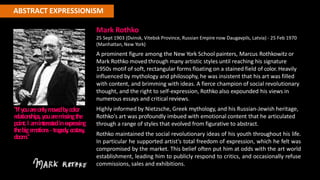
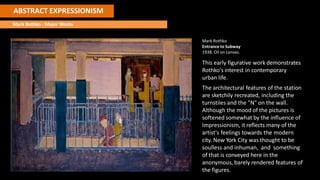
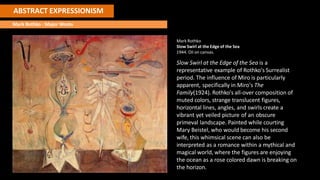
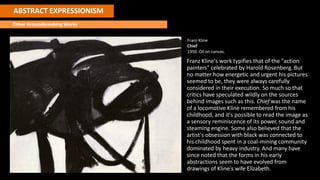
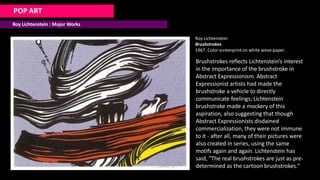
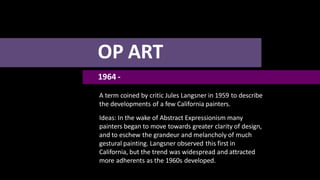
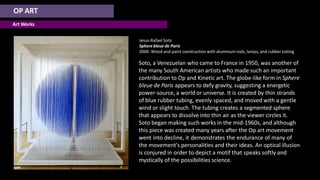
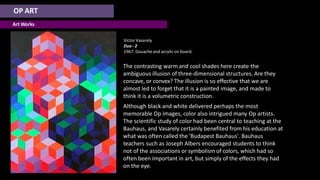
ART MOVEMENTS
FROM 1870 TO THE PRESENT
PREPARED BY EDELIZA V. MACALANDAG, UAP
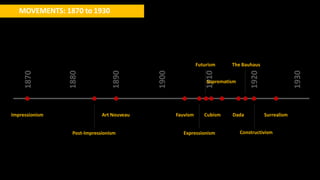
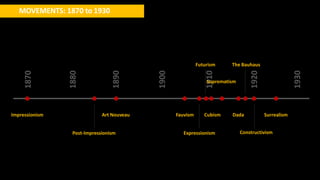
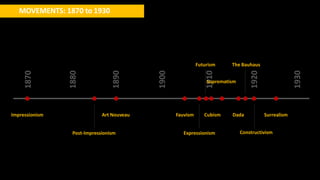
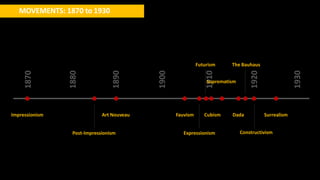
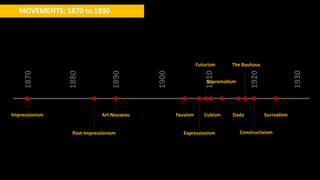
MOVEMENTS: 1870 to 1930
1900
1870
1880
1890
1910
1920
1930
Impressionism Art Nouveau Fauvism Cubism Dada Surrealism
Post-Impressionism Expressionism
Futurism
Suprematism
The Bauhaus
Constructivism
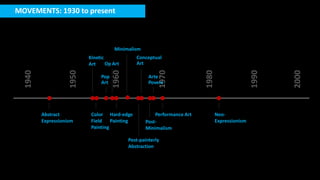
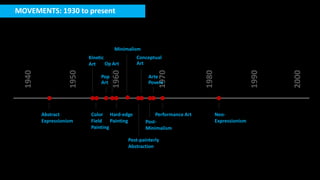
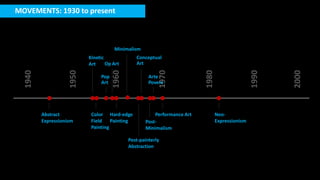
MOVEMENTS: 1930 to present
1970
1940
1950
1960
1980
1990
2000
Abstract
Expressionism
Kinetic
Art
Post-painterly
Abstraction
Color
Field
Painting
Pop
Art
Op Art
Hard-edge
Painting
Minimalism
Conceptual
Art
Arte
Povera
Post-
Minimalism
Performance Art Neo-
Expressionism
IMPRESSIONSISM
EARLY 1872 – EARLY 1892
IMPRESSIONISM
Birth: A movement in French painting which was at its height from the late
1860s to mid 1880s, and whose influence was felt until 1900.
Ideas: Turning away from the stress on fine finish and realistic rendering in
academic art, French Impressionists sought new ways to describe effects of
light and movement, often using rich colors.
Drawn to modern life, they often painted the city, but they also captured
landscapes and scenes of middle-class leisure-taking in the suburbs.
Edouard Manet Claude Monet Edgar Degas Pierre-Auguste Renoir Berthe Morisot Camille Pissarro
KEY
ARTISTS
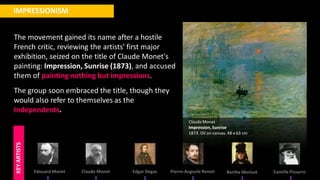
The movement gained its name after a hostile
French critic, reviewing the artists' first major
exhibition, seized on the title of Claude Monet's
painting: Impression, Sunrise (1873), and accused
them of painting nothing but impressions.
The group soon embraced the title, though they
would also refer to themselves as the
Independents.
IMPRESSIONISM
Edouard Manet Claude Monet Edgar Degas Pierre-Auguste Renoir Berthe Morisot Camille Pissarro
KEY
ARTISTS
ClaudeMonet
Impression, Sunrise
1873. Oil on canvas. 48 x 63 cm
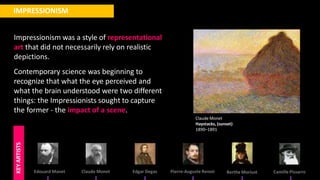
Impressionism was a style of representational
art that did not necessarily rely on realistic
depictions.
Contemporary science was beginning to
recognize that what the eye perceived and
what the brain understood were two different
things: the Impressionists sought to capture
the former - the impact of a scene.
IMPRESSIONISM
Edouard Manet Claude Monet Edgar Degas Pierre-Auguste Renoir Berthe Morisot Camille Pissarro
KEY
ARTISTS
Claude Monet
Haystacks, (sunset)
1890–1891
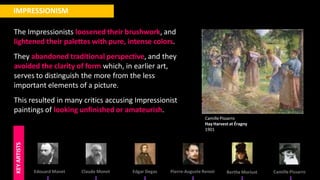
The Impressionists loosened their brushwork, and
lightened their palettes with pure, intense colors.
They abandoned traditional perspective, and they
avoided the clarity of form which, in earlier art,
serves to distinguish the more from the less
important elements of a picture.
This resulted in many critics accusing Impressionist
paintings of looking unfinished or amateurish.
IMPRESSIONISM
Edouard Manet Claude Monet Edgar Degas Pierre-Auguste Renoir Berthe Morisot Camille Pissarro
KEY
ARTISTS
CamillePissarro
Hay Harvest at Éragny
1901
IMPRESSIONISM
"The
rearenoline
sin
nature,onlyare
asofcolor,
oneagainstanother
."
Edouard Manet
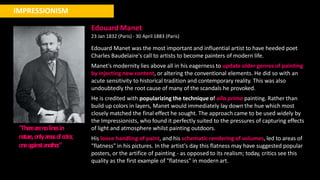
23 Jan 1832 (Paris) - 30 April 1883 (Paris)
Edouard Manet was the most important and influential artist to have heeded poet
Charles Baudelaire's call to artists to become painters of modern life.
Manet's modernity lies above all in his eagerness to update older genres of painting
by injecting new content, or altering the conventional elements. He did so with an
acute sensitivity to historical tradition and contemporary reality. This was also
undoubtedly the root cause of many of the scandals he provoked.
He is credited with popularizing the technique of alla prima painting. Rather than
build up colors in layers, Manet would immediately lay down the hue which most
closely matched the final effect he sought. The approach came to be used widely by
the Impressionists, who found it perfectly suited to the pressures of capturing effects
of light and atmosphere whilst painting outdoors.
His loose handling of paint, and his schematic rendering of volumes, led to areas of
"flatness" in his pictures. In the artist's day this flatness may have suggested popular
posters, or the artifice of painting - as opposed to its realism; today, critics see this
quality as the first example of "flatness" in modern art.
IMPRESSIONISM
Edouard Manet : Major Works
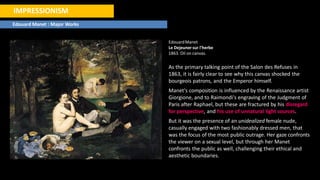
EdouardManet
Le Dejeuner sur l'herbe
1863. Oil on canvas.
As the primary talking point of the Salon des Refuses in
1863, it is fairly clear to see why this canvas shocked the
bourgeois patrons, and the Emperor himself.
Manet's composition is influenced by the Renaissance artist
Giorgione, and to Raimondi's engraving of the Judgment of
Paris after Raphael, but these are fractured by his disregard
for perspective, and his use of unnatural light sources.
But it was the presence of an unidealized female nude,
casually engaged with two fashionably dressed men, that
was the focus of the most public outrage. Her gaze confronts
the viewer on a sexual level, but through her Manet
confronts the public as well, challenging their ethical and
aesthetic boundaries.
IMPRESSIONISM
Edouard Manet : Major Works
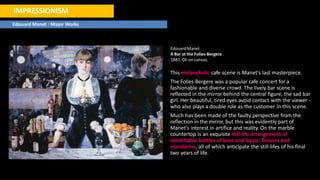
EdouardManet
A Bar at the Folies-Bergere
1881. Oil on canvas.
This melancholic cafe scene is Manet's last masterpiece.
The Folies-Bergere was a popular cafe concert for a
fashionable and diverse crowd. The lively bar scene is
reflected in the mirror behind the central figure, the sad bar
girl. Her beautiful, tired eyes avoid contact with the viewer -
who also plays a double role as the customer in this scene.
Much has been made of the faulty perspective from the
reflection in the mirror, but this was evidently part of
Manet's interest in artifice and reality. On the marble
countertop is an exquisite still-life arrangement of
identifiable bottles of beer and liquor, flowers and
mandarins, all of which anticipate the still-lifes of his final
two years of life.
IMPRESSIONISM
"Them
otifisinsignificantfor
m
e
;w
hatI w
anttore
pre
sentis
w
hatlie
sbe
tw
e
e
nthem
otif&
me."
Claude Monet
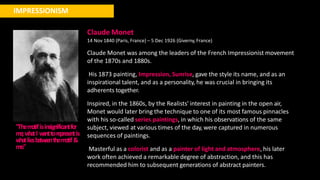
14 Nov 1840 (Paris, France) – 5 Dec 1926 (Giverny, France)
Claude Monet was among the leaders of the French Impressionist movement
of the 1870s and 1880s.
His 1873 painting, Impression, Sunrise, gave the style its name, and as an
inspirational talent, and as a personality, he was crucial in bringing its
adherents together.
Inspired, in the 1860s, by the Realists' interest in painting in the open air,
Monet would later bring the technique to one of its most famous pinnacles
with his so-called series paintings, in which his observations of the same
subject, viewed at various times of the day, were captured in numerous
sequences of paintings.
Masterful as a colorist and as a painter of light and atmosphere, his later
work often achieved a remarkable degree of abstraction, and this has
recommended him to subsequent generations of abstract painters.
IMPRESSIONISM
Claude Monet : Major Works
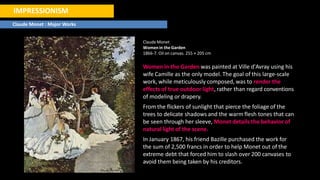
Claude Monet
Womenin the Garden
1866-7. Oil on canvas. 255 × 205 cm
Women in the Garden was painted at Ville d'Avray using his
wife Camille as the only model. The goal of this large-scale
work, while meticulously composed, was to render the
effects of true outdoor light, rather than regard conventions
of modeling or drapery.
From the flickers of sunlight that pierce the foliage of the
trees to delicate shadows and the warm flesh tones that can
be seen through her sleeve, Monet details the behavior of
natural light of the scene.
In January 1867, his friend Bazille purchased the work for
the sum of 2,500 francs in order to help Monet out of the
extreme debt that forced him to slash over 200 canvases to
avoid them being taken by his creditors.
IMPRESSIONISM
Claude Monet : Major Works
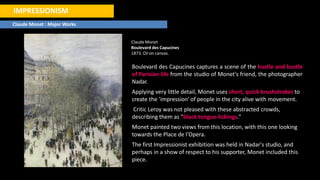
ClaudeMonet
Boulevard des Capucines
1873. Oil on canvas.
Boulevard des Capucines captures a scene of the hustle and bustle
of Parisian life from the studio of Monet's friend, the photographer
Nadar.
Applying very little detail, Monet uses short, quick brushstrokes to
create the 'impression' of people in the city alive with movement.
Critic Leroy was not pleased with these abstracted crowds,
describing them as "black tongue-lickings."
Monet painted two views from this location, with this one looking
towards the Place de l'Opera.
The first Impressionist exhibition was held in Nadar's studio, and
perhaps in a show of respect to his supporter, Monet included this
piece.
IMPRESSIONISM
Claude Monet : Major Works
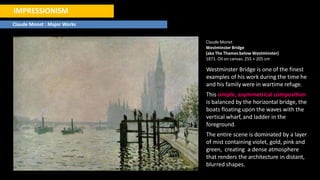
ClaudeMonet
Westminster Bridge
(aka The Thames below Westminster)
1871. Oil on canvas. 255 × 205 cm
Westminster Bridge is one of the finest
examples of his work during the time he
and his family were in wartime refuge.
This simple, asymmetrical composition
is balanced by the horizontal bridge, the
boats floating upon the waves with the
vertical wharf, and ladder in the
foreground.
The entire scene is dominated by a layer
of mist containing violet, gold, pink and
green, creating a dense atmosphere
that renders the architecture in distant,
blurred shapes.
IMPRESSIONISM
Claude Monet : Major Works
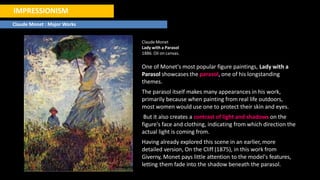
Claude Monet
Lady with a Parasol
1886. Oil on canvas.
One of Monet's most popular figure paintings, Lady with a
Parasol showcases the parasol, one of his longstanding
themes.
The parasol itself makes many appearances in his work,
primarily because when painting from real life outdoors,
most women would use one to protect their skin and eyes.
But it also creates a contrast of light and shadows on the
figure's face and clothing, indicating from which direction the
actual light is coming from.
Having already explored this scene in an earlier, more
detailed version, On the Cliff (1875), in this work from
Giverny, Monet pays little attention to the model's features,
letting them fade into the shadow beneath the parasol.
IMPRESSIONISM
Claude Monet : Major Works
ClaudeMonet
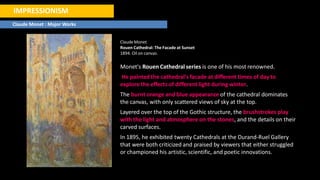
Rouen Cathedral: The Facade at Sunset
1894. Oil on canvas.
Monet's Rouen Cathedral series is one of his most renowned.
He painted the cathedral's facade at different times of day to
explore the effects of different light during winter.
The burnt orange and blue appearance of the cathedral dominates
the canvas, with only scattered views of sky at the top.
Layered over the top of the Gothic structure, the brushstrokes play
with the light and atmosphere on the stones, and the details on their
carved surfaces.
In 1895, he exhibited twenty Cathedrals at the Durand-Ruel Gallery
that were both criticized and praised by viewers that either struggled
or championed his artistic, scientific, and poetic innovations.
IMPRESSIONISM
Claude Monet : Major Works
ClaudeMonet
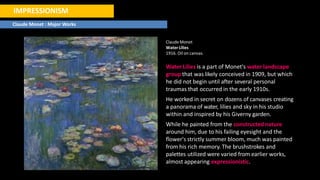
WaterLilies
1916. Oil on canvas.
Water Lilies is a part of Monet's water landscape
group that was likely conceived in 1909, but which
he did not begin until after several personal
traumas that occurred in the early 1910s.
He worked in secret on dozens of canvases creating
a panorama of water, lilies and sky in his studio
within and inspired by his Giverny garden.
While he painted from the constructed nature
around him, due to his failing eyesight and the
flower's strictly summer bloom, much was painted
from his rich memory. The brushstrokes and
palettes utilized were varied from earlier works,
almost appearing expressionistic.
IMPRESSIONISM
“
Artisnotw
hatyouse
e
,but
w
hatyoum
akeothe
rsse
e
.n
Edgar Degas
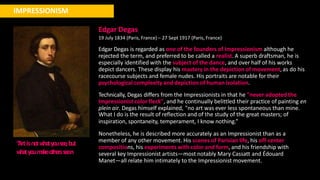
19 July 1834 (Paris, France) – 27 Sept 1917 (Paris, France)
Edgar Degas is regarded as one of the founders of Impressionism although he
rejected the term, and preferred to be called a realist. A superb draftsman, he is
especially identified with the subject of the dance, and over half of his works
depict dancers. These display his mastery in the depiction of movement, as do his
racecourse subjects and female nudes. His portraits are notable for their
psychological complexity and depiction of human isolation.
Technically, Degas differs from the Impressionists in that he "never adopted the
Impressionist color fleck", and he continually belittled their practice of painting en
plein air. Degas himself explained, "no art was ever less spontaneous than mine.
What I do is the result of reflection and of the study of the great masters; of
inspiration, spontaneity, temperament, I know nothing.”
Nonetheless, he is described more accurately as an Impressionist than as a
member of any other movement. His scenes of Parisian life, his off-center
compositions, his experiments with color and form, and his friendship with
several key Impressionist artists—most notably Mary Cassatt and Édouard
Manet—all relate him intimately to the Impressionist movement.
IMPRESSIONISM
Edgar Degas : Major Works
Edgar Degas
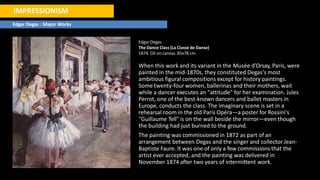
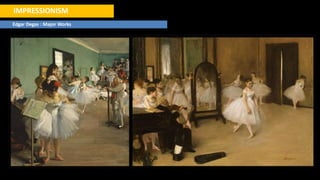
The Dance Class (La Classe de Danse)
1874. Oil on canvas. 85x78 cm.
When this work and its variant in the Musée d'Orsay, Paris, were
painted in the mid-1870s, they constituted Degas's most
ambitious figural compositions except for history paintings.
Some twenty-four women, ballerinas and their mothers, wait
while a dancer executes an "attitude" for her examination. Jules
Perrot, one of the best-known dancers and ballet masters in
Europe, conducts the class. The imaginary scene is set in a
rehearsal room in the old Paris Opéra—a poster for Rossini's
"Guillaume Tell" is on the wall beside the mirror—even though
the building had just burned to the ground.
The painting was commissioned in 1872 as part of an
arrangement between Degas and the singer and collector Jean-
Baptiste Faure. It was one of only a few commissions that the
artist ever accepted, and the painting was delivered in
November 1874 after two years of intermittent work.
IMPRESSIONISM
Edgar Degas : Major Works
IMPRESSIONISM
Edgar Degas : Major Works
Edgar Degas
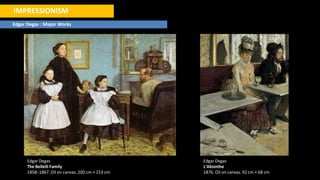
The Bellelli Family
1858–1867. Oil on canvas. 200 cm × 253 cm
Edgar Degas
L’Absinthe
1876. Oil on canvas. 92 cm × 68 cm
IMPRESSIONISM
"Ifthepainterw
orksdire
ctlyfrom
nature,heultima
t
elylooksfor
nothingbutm
om
e
ntarye
ffe
cts;he
doe
snottrytocom
pose,and
soonhege
tsm
onotonous."
Pierre-Auguste Renoir
25 Feb 1841 (Haute-Vienne, France) – 3 Dec 1919 (Provence-Alpes-Côte d'Azur,France)
Renoir was a French artist who was a leading painter in the development of the
Impressionist style.
Renoir's paintings are notable for their vibrant light and saturated color, most
often focusing on people in intimate and candid compositions. The female nude
was one of his primary subjects. In characteristic Impressionist style, Renoir
suggested the details of a scene through freely brushed touches of color, so that
his figures softly fuse with one another and their surroundings.
In the late 1860s, through the practice of painting light and water en plein air (in
the open air), he and his friend Claude Monet discovered that the color of
shadows is not brown or black, but the reflected color of the objects surrounding
them, an effect today known as diffuse reflection.
A prolific artist, he made several thousand paintings. The warm sensuality of
Renoir's style made his paintings some of the most well-known and frequently-
reproduced works in the history of art.
IMPRESSIONISM
Pierre-Auguste Renoir : Major Works
Pierre-AugusteRenoir
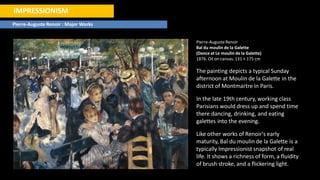
Bal du moulin de la Galette
(Dance at Le moulin de la Galette)
1876. Oil on canvas. 131 × 175 cm
The painting depicts a typical Sunday
afternoon at Moulin de la Galette in the
district of Montmartre in Paris.
In the late 19th century, working class
Parisians would dress up and spend time
there dancing, drinking, and eating
galettes into the evening.
Like other works of Renoir's early
maturity, Bal du moulin de la Galette is a
typically Impressionist snapshot of real
life. It shows a richness of form, a fluidity
of brush stroke, and a flickering light.
IMPRESSIONISM
Pierre-Auguste Renoir : Major Works
Pierre-Auguste Renoir
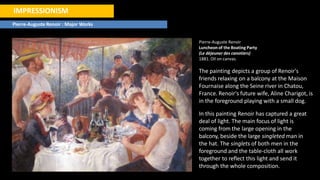
Luncheon of the Boating Party
(Le déjeuner des canotiers)
1881. Oil on canvas.
The painting depicts a group of Renoir's
friends relaxing on a balcony at the Maison
Fournaise along the Seine river in Chatou,
France. Renoir's future wife, Aline Charigot, is
in the foreground playing with a small dog.
In this painting Renoir has captured a great
deal of light. The main focus of light is
coming from the large opening in the
balcony, beside the large singleted man in
the hat. The singlets of both men in the
foreground and the table-cloth all work
together to reflect this light and send it
through the whole composition.
IMPRESSIONISM
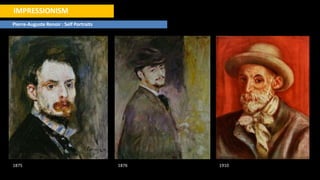
1875
Pierre-Auguste Renoir : Self Portraits
1876 1910
IMPRESSIONISM
Itisim
portanttoe
xpressone
se
lf...
providedthefe
e
lingsarere
al andare
takenfromyouro
w
nexperience.
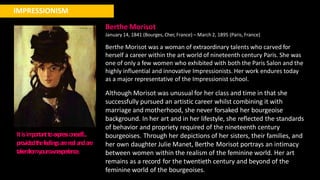
Berthe Morisot
January 14, 1841 (Bourges, Cher, France) – March 2, 1895 (Paris, France)
Berthe Morisot was a woman of extraordinary talents who carved for
herself a career within the art world of nineteenth century Paris. She was
one of only a few women who exhibited with both the Paris Salon and the
highly influential and innovative Impressionists. Her work endures today
as a major representative of the Impressionist school.
Although Morisot was unusual for her class and time in that she
successfully pursued an artistic career whilst combining it with
marriage and motherhood, she never forsaked her bourgeoise
background. In her art and in her lifestyle, she reflected the standards
of behavior and propriety required of the nineteenth century
bourgeoises. Through her depictions of her sisters, their families, and
her own daughter Julie Manet, Berthe Morisot portrays an intimacy
between women within the realism of the feminine world. Her art
remains as a record for the twentieth century and beyond of the
feminine world of the bourgeoises.
IMPRESSIONISM
Berthe Morisot : Major Works
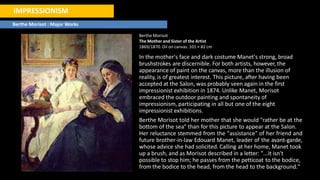
Berthe Morisot
The Mother and Sister of the Artist
1869/1870. Oil on canvas. 101 × 82 cm
In the mother's face and dark costume Manet's strong, broad
brushstrokes are discernible. For both artists, however, the
appearance of paint on the canvas, more than the illusion of
reality, is of greatest interest. This picture, after having been
accepted at the Salon, was probably seen again in the first
impressionist exhibition in 1874. Unlike Manet, Morisot
embraced the outdoor painting and spontaneity of
impressionism, participating in all but one of the eight
impressionist exhibitions.
Berthe Morisot told her mother that she would "rather be at the
bottom of the sea" than for this picture to appear at the Salon.
Her reluctance stemmed from the "assistance" of her friend and
future brother-in-law Edouard Manet, leader of the avant-garde,
whose advice she had solicited. Calling at her home, Manet took
up a brush, and as Morisot described in a letter: "...it isn't
possible to stop him; he passes from the petticoat to the bodice,
from the bodice to the head, from the head to the background."
IMPRESSIONISM
Berthe Morisot : Major Works
Berthe Morisot
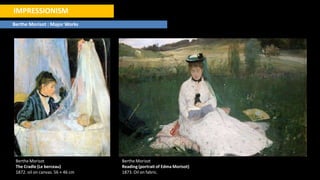
The Cradle (Le berceau)
1872. oil on canvas. 56 × 46 cm
Berthe Morisot
Reading (portrait of Edma Morisot)
1873. Oil on fabric.
IMPRESSIONISM
“W
o
rka
tthesa
m
etim
eo
nsky
,w
a
te
r
,b
ra
nche
s,
gro
und
,ke
e
p
inge
ve
rythinggo
ingo
na
ne
q
ua
l
basis...Don'tb
eafraidofputtingoncolour
...
Paintgenerouslyandunhesitatingly
,foritisbestno
t
tolo
sethefirstim
p
re
ssio
n.
n
Jacob Abraham Camille Pissarro
10 July 1830 (Charlotte Amalie, Danish West Indies) - 13 November 1903 (Paris, France)
Camille Pissarro was a French Impressionist and Neo-Impressionist painter born
on the island of St Thomas (now in the US Virgin Islands, but then in the Danish
West Indies). Known as the "Father of Impressionism," he used his own painterly
style to depict urban daily life, landscapes, and rural scenes, his importance
resides in his contributions to both Impressionism and Post-Impressionism, as he
was the only artist to exhibit in both forms. Pissarro studied from great
forerunners, including Gustave Courbet and Jean-Baptiste-Camille Corot. He
later studied and worked alongside Georges Seurat and Paul Signac when he
took on the Neo-Impressionist style at the age of 54.
In 1873 he helped establish a collective society of fifteen aspiring artists,
becoming the “pivotal” figure in holding the group together and encouraging the
other members. Art historian John Rewald called Pissarro the “dean of the
Impressionist painters", not only because he was the oldest of the group, but
also "by virtue of his wisdom and his balanced, kind, and warmhearted
personality”.
Pissarro is the only artist to have shown his work at all eight Paris Impressionist
exhibitions, from 1874 to 1886. As a stylistic forerunner of Impressionism, he is
today considered a "father figure not only to the Impressionists" but to all four
of the major Post-Impressionists, including Georges Seurat, Paul Cézanne,
Vincent van Gogh and Paul Gauguin.
IMPRESSIONISM
Camille Pissarro : Major Works
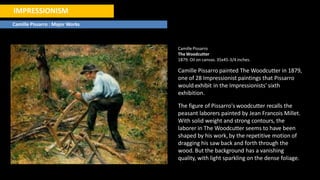
CamillePissarro
The Woodcutter
1879. Oil on canvas. 35x45-3/4 inches.
Camille Pissarro painted The Woodcutter in 1879,
one of 28 Impressionist paintings that Pissarro
would exhibit in the Impressionists' sixth
exhibition.
The figure of Pissarro's woodcutter recalls the
peasant laborers painted by Jean Francois Millet.
With solid weight and strong contours, the
laborer in The Woodcutter seems to have been
shaped by his work, by the repetitive motion of
dragging his saw back and forth through the
wood. But the background has a vanishing
quality, with light sparkling on the dense foliage.
IMPRESSIONISM
Camille Pissarro : Major Works
Camille Pissarro
The Boulevard Montmartreon a Winter Morning
1897. Oil on canvas.
IMPRESSIONISM
Camille Pissarro : Major Works
Camille Pissarro
Boulevard Montmartre,Spring
1897. Oil on canvas. 65 x 81 cm.
IMPRESSIONISM
Camille Pissarro : Major Works
Camille Pissarro
Boulevard Montmartre
1897. Oil on canvas. 74 × 92.8 cm
IMPRESSIONISM
Camille Pissarro : Major Works
Camille Pissarro
Boulevard Montmartrela nuit
1898. Oil on canvas. 55 × 65 cm.
MOVEMENTS: 1870 to 1930
1900
1870
1880
1890
1910
1920
1930
Impressionism Art Nouveau Fauvism Cubism Dada Surrealism
Post-Impressionism Expressionism
Futurism
Suprematism
The Bauhaus
Constructivism
POST-IMPRESSIONISM
EARLY 1880s – MID 1910s
POST-IMPRESSIONISM
Post-Impressionism is a catch-all term for the many and disparate reactions against
the naturalism, and issues of light and color, which had inspired the Impressionists.
Birth: A term coined by critic Roger Fry to describe various reactions against
Impressionism which began around 1886. The movement encompassed Symbolism
and Neo-Impressionism before ceding to Fauvism around 1905
Ideas: Post-Impressionists turned away from effects of light and atmosphere to
explore new avenues such as color theory and personal feeling.
Paul Cézanne
KEY
ARTISTS
Vincent van Gogh Georges Seurat
POST-IMPRESSIONISM
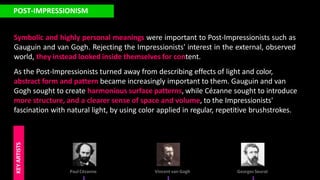
Symbolic and highly personal meanings were important to Post-Impressionists such as
Gauguin and van Gogh. Rejecting the Impressionists' interest in the external, observed
world, they instead looked inside themselves for content.
As the Post-Impressionists turned away from describing effects of light and color,
abstract form and pattern became increasingly important to them. Gauguin and van
Gogh sought to create harmonious surface patterns, while Cézanne sought to introduce
more structure, and a clearer sense of space and volume, to the Impressionists'
fascination with natural light, by using color applied in regular, repetitive brushstrokes.
Paul Cézanne
KEY
ARTISTS
Vincent van Gogh Georges Seurat
POST-IMPRESSIONISM
Paul Cezanne
19 January 1839 (Aix-en-Provence, France) - 22 October 1906 (Aix-en-Provence, France)
Paul Cezanne was the preeminent French artist of the Post-Impressionist era,
widely appreciated toward the end of his life for insisting that painting stay in
touch with its material, if not virtually sculptural origins.
Also known as the "Master of Aix" after his ancestral home in the South of France,
Cezanne is credited with paving the way for the emergence of modern art, both
visually and conceptually. In retrospect, his work constitutes the most powerful
and essential link between the ephemeral aspects of Impressionism and the more
materialist, early 20th century artistic movements of Fauvism, Cubism,
Expressionism, and even complete abstraction.
Cézanne's work demonstrates a mastery of design, colour, tone, composition and
draughtsmanship. His often repetitive, sensitive and exploratory brushstrokes are
highly characteristic and clearly recognizable. He used planes of colour and small
brushstrokes that build up to form complex fields, at once both a direct expression
of the sensations of the observing eye and an abstraction from observed nature.
The paintings convey Cézanne's intense study of his subjects, a searching gaze and
a dogged struggle to deal with the complexity of human visual perception.
"I ow
eyouthetruthin
paintingandI w
illte
llitto
you"
POST-IMPRESSIONISM
Paul Cezanne : Major Works
PaulCezanne
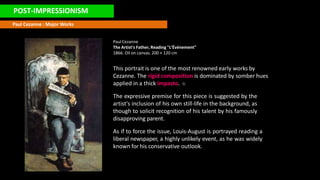
The Artist's Father, Reading "L'Événement"
1866. Oil on canvas. 200 × 120 cm
This portrait is one of the most renowned early works by
Cezanne. The rigid composition is dominated by somber hues
applied in a thick impasto.
The expressive premise for this piece is suggested by the
artist's inclusion of his own still-life in the background, as
though to solicit recognition of his talent by his famously
disapproving parent.
As if to force the issue, Louis-August is portrayed reading a
liberal newspaper, a highly unlikely event, as he was widely
known for his conservative outlook.
POST-IMPRESSIONISM
Paul Cezanne : Major Works
PaulCezanne
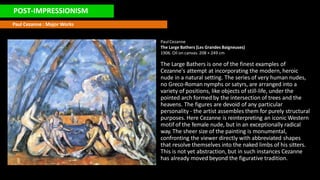
The Large Bathers (Les Grandes Baigneuses)
1906. Oil on canvas. 208 × 249 cm
The Large Bathers is one of the finest examples of
Cezanne's attempt at incorporating the modern, heroic
nude in a natural setting. The series of very human nudes,
no Greco-Roman nymphs or satyrs, are arranged into a
variety of positions, like objects of still-life, under the
pointed arch formed by the intersection of trees and the
heavens. The figures are devoid of any particular
personality - the artist assembles them for purely structural
purposes. Here Cezanne is reinterpreting an iconic Western
motif of the female nude, but in an exceptionally radical
way. The sheer size of the painting is monumental,
confronting the viewer directly with abbreviated shapes
that resolve themselves into the naked limbs of his sitters.
This is not yet abstraction, but in such instances Cezanne
has already moved beyond the figurative tradition.
POST-IMPRESSIONISM
Paul Cezanne : Major Works
PaulCezanne
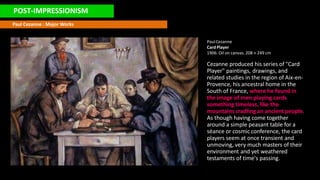
Card Player
1906. Oil on canvas. 208 × 249 cm
Cezanne produced his series of "Card
Player" paintings, drawings, and
related studies in the region of Aix-en-
Provence, his ancestral home in the
South of France, where he found in
the image of men playing cards
something timeless, like the
mountains cradling an ancient people.
As though having come together
around a simple peasant table for a
séance or cosmic conference, the card
players seem at once transient and
unmoving, very much masters of their
environment and yet weathered
testaments of time's passing.
POST-IMPRESSIONISM
Vincent Willem van Gogh
30 March 1853 (Zundert, Netherlands) - 29 July 1890 (Auvers-sur-Oise, France)
Dutch Post-Impressionist Vincent van Gogh's unique vision, brushwork and use of
color provide stylistic links from Impressionism to the conceptual practice of Abstract
Expressionism. Although he produced his most acclaimed work in a span of less than
three years, his technique, subject matter, sense of movement and vibration in his
compositions influenced many artists of his day and of the future. His gestural use of
line and distortion of reality for emotional effect became a guiding principle for the
Abstract Expressionist artists of the New York School.
Van Gogh's dedication to articulating the inner spirituality of man and nature led to a
unique fusion of style and content that resulted in dramatic, imaginative, rhythmic,
and emotional canvases.
His personal temperament came to symbolize the romantic image of the tortured
artist and was an icon of self-destructive talent that would be echoed in the lives of
many artists in the 20th century and beyond.
Van Gogh used an impulsive, gestural application of paint and symbolic colors to
express subjective emotions. These methods and practice came to define Abstract
Expressionism.
"Insteadoftryingtore
produce
e
xactlyw
hatI se
ebe
forem
e
,I
m
akem
orearbitraryuseofcolor
toe
xpre
ssm
yse
lfm
ore
forcefully."
POST-IMPRESSIONISM
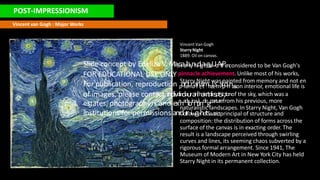
Starry Night was painted from memory and not en
naturalistic landscapes. In Starry Night, Van Gogh
Vincent van Gogh : Major Works
Vincent Van Gogh
Starry Night
1889. Oil on canvas.
Slide concept by Edeliza V. MaS
ct
aa
r
lar
y
nN
di
g
ah
gt
,i
s
Uo
Af
t
Pe
nconsidered to be Van Gogh's
FOR EDUCATIONAL USE ONLY pinnacle achievement. Unlike most of his works,
For publication, reproduction p
ol
re
i
tn
ra
ai
nr
;
st
mh
e
ie
sm
sip
oh
na
s
i
son interior, emotional life is
of images, please contact indivcliedaurain
lhaisrtdiesptsic,tionof the sky, which was a
estates, photographers and exrhadibiciatlindegparturefrom his previous, more
institutions for permissions anfdollroiwgehdtsa.strictprincipal of structure and
composition: the distribution of forms across the
surface of the canvas is in exacting order. The
result is a landscape perceived through swirling
curves and lines, its seeming chaos subverted by a
rigorous formal arrangement. Since 1941, The
Museum of Modern Art in New York City has held
Starry Night in its permanent collection.
POST-IMPRESSIONISM
Vincent van Gogh : Major Works
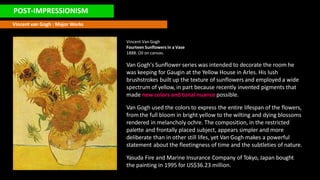
Vincent Van Gogh
Fourteen Sunflowers in a Vase
1888. Oil on canvas.
Van Gogh's Sunflower series was intended to decorate the room he
was keeping for Gaugin at the Yellow House in Arles. His lush
brushstrokes built up the texture of sunflowers and employed a wide
spectrum of yellow, in part because recently invented pigments that
made new colors and tonal nuance possible.
Van Gogh used the colors to express the entire lifespan of the flowers,
from the full bloom in bright yellow to the wilting and dying blossoms
rendered in melancholy ochre. The composition, in the restricted
palette and frontally placed subject, appears simpler and more
deliberate than in other still lifes, yet Van Gogh makes a powerful
statement about the fleetingness of time and the subtleties of nature.
Yasuda Fire and Marine Insurance Company of Tokyo, Japan bought
the painting in 1995 for US$36.23 million.
POST-IMPRESSIONISM
Vincent van Gogh : Major Works
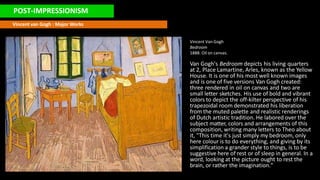
Vincent Van Gogh
Bedroom
1888. Oil on canvas.
Van Gogh's Bedroom depicts his living quarters
at 2, Place Lamartine, Arles, known as the Yellow
House. It is one of his most well known images
and is one of five versions Van Gogh created:
three rendered in oil on canvas and two are
small letter sketches. His use of bold and vibrant
colors to depict the off-kilter perspective of his
trapezoidal room demonstrated his liberation
from the muted palette and realistic renderings
of Dutch artistic tradition. He labored over the
subject matter, colors and arrangements of this
composition, writing many letters to Theo about
it, "This time it's just simply my bedroom, only
here colour is to do everything, and giving by its
simplification a grander style to things, is to be
suggestive here of rest or of sleep in general. In a
word, looking at the picture ought to rest the
brain, or rather the imagination."
IMPRESSIONISM
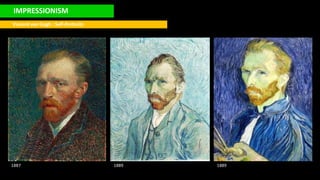
1887
Vincent van Gogh : Self-Portraits
1889 1889
POST-IMPRESSIONISM
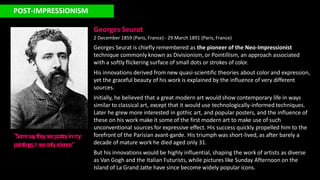
Georges Seurat
2 December 1859 (Paris, France) - 29 March 1891 (Paris, France)
Georges Seurat is chiefly remembered as the pioneer of the Neo-Impressionist
technique commonly known as Divisionism, or Pointillism, an approach associated
with a softly flickering surface of small dots or strokes of color.
His innovations derived from new quasi-scientific theories about color and expression,
yet the graceful beauty of his work is explained by the influence of very different
sources.
Initially, he believed that a great modern art would show contemporary life in ways
similar to classical art, except that it would use technologically-informed techniques.
Later he grew more interested in gothic art, and popular posters, and the influence of
these on his work make it some of the first modern art to make use of such
unconventional sources for expressive effect. His success quickly propelled him to the
forefront of the Parisian avant-garde. His triumph was short-lived, as after barely a
decade of mature work he died aged only 31.
But his innovations would be highly influential, shaping the work of artists as diverse
as Van Gogh and the Italian Futurists, while pictures like Sunday Afternoon on the
Island of La Grand Jatte have since become widely popular icons.
"Som
esa
ythe
yse
epoe
tryinm
y
paintings;I se
eonlyscie
nce
."
POST-IMPRESSIONISM
Georges Seurat : Major Works
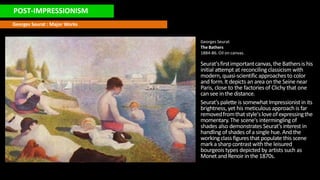
Georges Seurat
The Bathers
1884-86. Oil on canvas.
Seurat'sfirstimportantcanvas,the Bathersis his
initial attempt at reconcilingclassicism with
modern, quasi-scientificapproachesto color
and form.It depicts anarea onthe Seinenear
Paris, close to the factoriesof Clichy that one
can see in the distance.
Seurat'spalette is somewhat Impressionistin its
brightness, yet his meticulous approachis far
removedfromthat style'sloveofexpressingthe
momentary.The scene's intermingling of
shades also demonstrates Seurat'sinterest in
handling ofshades ofa single hue. And the
workingclass figuresthat populate this scene
marka sharpcontrastwith the leisured
bourgeoistypes depicted by artists such as
Monet and Renoirin the 1870s.
POST-IMPRESSIONISM
Georges Seurat : Major Works
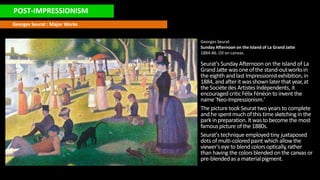
Georges Seurat
Sunday Afternoon on the Island of La Grand Jatte
1884-86. Oil on canvas.
Seurat'sSunday Afternoon on the Island of La
GrandJatte wasoneofthe stand-outworksin
the eighth and last Impressionistexhibition,in
1884, and afterit wasshownlaterthat year,at
the Sociétedes ArtistesIndépendents, it
encouraged criticFélix Fénéon to invent the
name 'Neo-Impressionism.'
The picture took Seurat two years to complete
and he spentmuchofthis time sketching in the
park inpreparation. It wasto become the most
famouspicture ofthe 1880s.
Seurat'stechnique employedtiny juxtaposed
dots ofmulti-coloredpaint which allowthe
viewer'seye to blend colorsoptically,rather
than having the colorsblended on the canvas or
pre-blendedas a materialpigment.
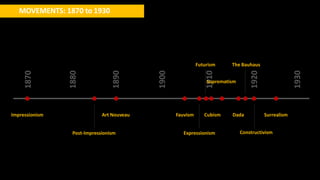
MOVEMENTS: 1870 to 1930
1900
1870
1880
1890
1910
1920
1930
Impressionism Art Nouveau Fauvism Cubism Dada Surrealism
Post-Impressionism Expressionism
Futurism
Suprematism
The Bauhaus
Constructivism
ART NOUVEAU
1890-1905
ART NOUVEAU
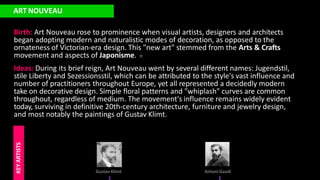
Birth: Art Nouveau rose to prominence when visual artists, designers and architects
began adopting modern and naturalistic modes of decoration, as opposed to the
ornateness of Victorian-era design. This "new art" stemmed from the Arts & Crafts
movement and aspects of Japonisme.
Ideas: During its brief reign, Art Nouveau went by several different names: Jugendstil,
stile Liberty and Sezessionsstil, which can be attributed to the style's vast influence and
number of practitioners throughout Europe, yet all represented a decidedly modern
take on decorative design. Simple floral patterns and "whiplash" curves are common
throughout, regardless of medium. The movement's influence remains widely evident
today, surviving in definitive 20th-century architecture, furniture and jewelry design,
and most notably the paintings of Gustav Klimt.
Gustav Klimt
KEY
ARTISTS
Antoni Gaudi
Gustav Klimt
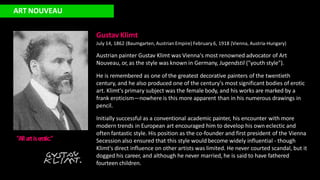
July 14, 1862 (Baumgarten, Austrian Empire) February 6, 1918 (Vienna, Austria-Hungary)
Austrian painter Gustav Klimt was Vienna's most renowned advocator of Art
Nouveau, or, as the style was known in Germany, Jugendstil ("youth style").
He is remembered as one of the greatest decorative painters of the twentieth
century, and he also produced one of the century's most significant bodies of erotic
art. Klimt's primary subject was the female body, and his works are marked by a
frank eroticism—nowhere is this more apparent than in his numerous drawings in
pencil.
Initially successful as a conventional academic painter, his encounter with more
modern trends in European art encouraged him to develop his own eclectic and
often fantastic style. His position as the co-founder and first president of the Vienna
Secession also ensured that this style would become widely influential - though
Klimt's direct influence on other artists was limited. He never courted scandal, but it
dogged his career, and although he never married, he is said to have fathered
fourteen children.
ART NOUVEAU
"All artise
rotic."
ART NOUVEAU
Gustav Klimt : Major Works
Gustav Klimt
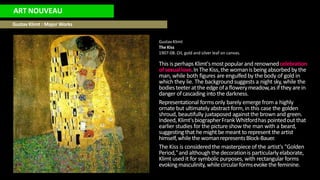
The Kiss
1907-08. Oil, gold and silver leaf on canvas.
This is perhapsKlimt'smostpopularand renownedcelebration
ofsexuallove.In The Kiss,the womanis being absorbedby the
man, while both figures are engulfed by the body of gold in
which they lie. The backgroundsuggests a night sky, while the
bodiesteeteratthe edge ofa flowerymeadow,as ifthey arein
danger ofcascading into the darkness.
Representational formsonly barely emerge from a highly
ornate but ultimately abstract form,in this case the golden
shroud, beautifully juxtaposed against the brown and green.
Indeed,Klimt'sbiographerFrankWhitfordhas pointedout that
earlier studies for the picture show the man with a beard,
suggesting that he might be meant to represent the artist
himself,while the womanrepresentsBlock-Bauer.
The Kiss is consideredthe masterpieceof the artist's "Golden
Period,"and although the decorationis particularlyelaborate,
Klimt used it for symbolicpurposes, with rectangular forms
evokingmasculinity, whilecircularformsevokethe feminine.
ART NOUVEAU
Gustav Klimt : Major Works
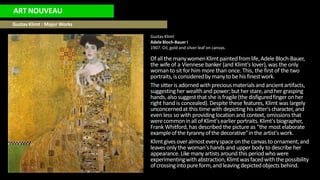
GustavKlimt
Adele Bloch-Bauer I
1907. Oil, gold and silver leaf on canvas.
Ofallthe manywomenKlimtpaintedfromlife,Adele Bloch-Bauer,
the wife of a Viennese banker (and Klimt's lover), was the only
woman to sit for him more than once. This, the first of the two
portraits,isconsideredby manytobe his finestwork.
The sitteris adornedwithpreciousmaterialsand ancientartifacts,
suggestingher wealthand power;but herstare,and her grasping
hands,alsosuggestthat she isfragile(the disfiguredfingeronher
right hand is concealed).Despite these features, Klimt was largely
unconcernedat this time with depicting his sitter's character, and
even less so with providinglocation and context, omissions that
werecommonin all ofKlimt'searlierportraits.Klimt'sbiographer,
Frank Whitford,has described the picture as "the most elaborate
exampleofthe tyrannyofthe decorative"inthe artist'swork.
Klimtgivesoveralmosteveryspace onthe canvas to ornament,and
leaves only the woman's hands and upper body to describe her
appearance.Like many artists around this periodwho were
experimentingwithabstraction,Klimtwasfacedwiththe possibility
ofcrossingintopureform,andleavingdepictedobjectsbehind.
ART NOUVEAU
Antoni Gaudí i Cornet
25 June 1852 (Reus, Catalonia, Spain) - 10 June 1926 (Barcelona, Catalonia, Spain)
Antoni Gaudi was a Spanish Catalan architect, and the most popular representative
of the Catalan Modernista movement, which combined elements of Art Nouveau,
Japonisme, Gothic design, and geometric forms. Gaudi's design style has been
referred to as "global," indicating a profound attention to every detail of his work,
from a building's structure and placement down to its smallest decorative details.
Gaudi's masterpiece is considered to be the Sagrada Familia, a distinctly modern
Roman Catholic church in Barcelona.
Gaudí rarely drew detailed plans of his works, instead preferring to create them as
three-dimensional scale models and molding the details as he was conceiving them.
Gaudí’s work enjoys widespread international appeal and many studies are devoted
to understanding his architecture. Today, his work finds admirers among architects
and the general public alike. His masterpiece, the still-uncompleted Sagrada Família,
is one of the most visited monuments in Spain.[4] Between 1984 and 2005, seven of
his works were declared World Heritage Sites by UNESCO. Gaudí’s Roman Catholic
faith intensified during his life and religious images permeate his work. This earned
him the nickname "God's Architect" and led to calls for his beatification.
“Thosew
holookforthelaw
sof
Natureasasupportforthe
irne
w
w
orkscollaboratew
iththe
creator
.n
ART NOUVEAU
Antoni Gaudi : Major Works
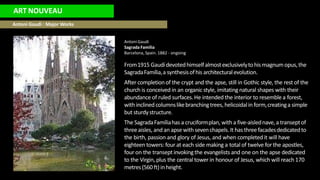
Antoni Gaudi
Sagrada Familia
Barcelona, Spain. 1882 - ongoing
From1915 Gaudídevotedhimselfalmostexclusivelytohis magnumopus,the
SagradaFamília,a synthesisofhis architecturalevolution.
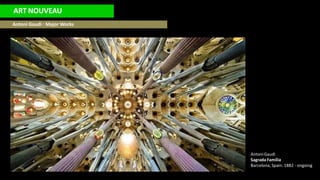
After completionof the crypt and the apse, still in Gothic style, the rest of the
church is conceived in an organicstyle, imitating natural shapes with their
abundance of ruled surfaces.He intended the interior to resemble a forest,
with inclined columnslikebranchingtrees, helicoidalin form,creatinga simple
but sturdystructure.
The SagradaFamíliahas a cruciformplan, with a five-aislednave,a transeptof
threeaisles, and an apse with sevenchapels.It has threefacadesdedicatedto
the birth, passion and glory of Jesus, and when completedit will have
eighteen towers:four at each side making a total of twelve for the apostles,
four on the transept invokingthe evangelists and one on the apse dedicated
to the Virgin, plus the central tower in honour of Jesus, which will reach 170
metres(560 ft)in height.
ART NOUVEAU
Antoni Gaudi : Major Works
AntoniGaudi
Sagrada Familia
Barcelona, Spain. 1882 - ongoing
ART NOUVEAU
Antoni Gaudi : Major Works
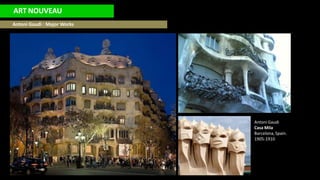
Antoni Gaudi
Casa Mila
Barcelona, Spain.
1905-1910
MOVEMENTS: 1870 to 1930
1900
1870
1880
1890
1910
1920
1930
Impressionism Art Nouveau Fauvism Cubism Dada Surrealism
Post-Impressionism Expressionism
Futurism
Suprematism
The Bauhaus
Constructivism
FAUVISM
1899-1908
FAUVISM
Fauvism was the first 20th century movement in modern art.
Inspired by the examples of van Gogh, Gauguin, and Neo-
Impressionists such as Seurat and Signac, it grew out of a
loosely allied group of French painters with shared interests.
Henri Matisse was eventually recognized as the leader of Les
Fauves, or The Wild Beasts as they were called in French, and
like the group, he emphasized the use of intense color as a
vehicle for describing light and space, but also for
communicating emotion. Birth: A movement in French painting
that began around 1898 but reached its peak and quickly
dissolved around 1906
Ideas: Evolving out of Post-Impressionism and Symbolism, the
loosely affiliated group of artists developed a decorative, anti-
naturalistic style to express personal feelings towards their
subjects. Formally, their work is characterized by vivid, often
unmixed color, striking surface design and a bold approach to
execution.
Henri Matisse
KEY
ARTIST
FAUVISM
Henri Matisse
31 Dec 1869 (Le Cateau-Cambrésis, Nord) - 3 Nov 1954 (Nice, Alpes-Maritimes)
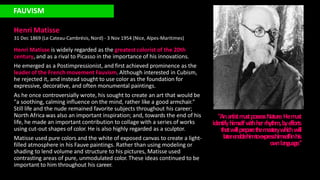
Henri Matisse is widely regarded as the greatest colorist of the 20th
century, and as a rival to Picasso in the importance of his innovations.
He emerged as a Postimpressionist, and first achieved prominence as the
leader of the French movement Fauvism. Although interested in Cubism,
he rejected it, and instead sought to use color as the foundation for
expressive, decorative, and often monumental paintings.
As he once controversially wrote, his sought to create an art that would be
"a soothing, calming influence on the mind, rather like a good armchair."
Still life and the nude remained favorite subjects throughout his career;
North Africa was also an important inspiration; and, towards the end of his
life, he made an important contribution to collage with a series of works
using cut-out shapes of color. He is also highly regarded as a sculptor.
Matisse used pure colors and the white of exposed canvas to create a light-
filled atmosphere in his Fauve paintings. Rather than using modeling or
shading to lend volume and structure to his pictures, Matisse used
contrasting areas of pure, unmodulated color. These ideas continued to be
important to him throughout his career.
"Anartistm
ustposse
ssNature
.Hem
ust
ide
ntifyhim
se
lfw
ithhe
rrhythm,bye
fforts
thatwillpreparethemasterywhichwill
laterenablehimtoexpresshimselfinhis
ow
nlanguage
."
FAUVISM
Henri Matisse : Major Works
HenriMatisse
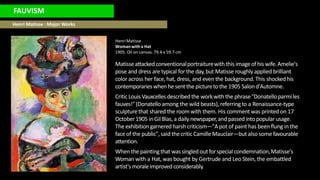
Womanwith a Hat
1905. Oil on canvas. 79.4 x 59.7 cm
Matisseattackedconventionalportraiturewith this imageofhis wife.Amelie's
pose and dress are typical for the day,but Matisse roughly applied brilliant
color across her face, hat, dress, and even the background.This shocked his
contemporarieswhenhe sent the picturetothe 1905 Salond'Automne.
CriticLouisVauxcelles describedthe workwith the phrase"Donatelloparmiles
fauves!"(Donatelloamong the wild beasts), referringto a Renaissance-type
sculpturethat shared the room with them. His comment was printed on 17
October1905 inGilBlas,a daily newspaper,andpassedintopopularusage.
The exhibition garnered harshcriticism—"A pot of paint has been flung in the
faceof the public",said the criticCamilleMauclair—but also somefavourable
attention.
When the paintingthat wassingledoutforspecialcondemnation,Matisse's
Woman with a Hat, was bought by Gertrude and Leo Stein, the embattled
artist'smoraleimprovedconsiderably.
FAUVISM
Henri Matisse : Major Works
HenriMatisse
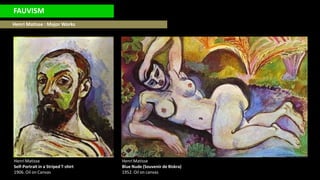
Self-Portrait in a Striped T-shirt
1906. Oil on Canvas
HenriMatisse
Blue Nude (Souvenir de Biskra)
1952. Oil on canvas
FAUVISM
Henri Matisse : Major Works
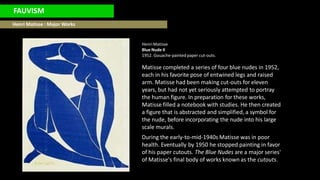
HenriMatisse
Blue Nude II
1952. Gouache-painted paper cut-outs.
Matisse completed a series of four blue nudes in 1952,
each in his favorite pose of entwined legs and raised
arm. Matisse had been making cut-outs for eleven
years, but had not yet seriously attempted to portray
the human figure. In preparation for these works,
Matisse filled a notebook with studies. He then created
a figure that is abstracted and simplified, a symbol for
the nude, before incorporating the nude into his large
scale murals.
During the early-to-mid-1940s Matisse was in poor
health. Eventually by 1950 he stopped painting in favor
of his paper cutouts. The Blue Nudes are a major series'
of Matisse's final body of works known as the cutouts.
MOVEMENTS: 1870 to 1930
1900
1870
1880
1890
1910
1920
1930
Impressionism Art Nouveau Fauvism Cubism Dada Surrealism
Post-Impressionism Expressionism
Futurism
Suprematism
The Bauhaus
Constructivism
EXPRESSIONISM
1905-1933
Expressionism is a broad term for a host of movements
in early twentieth-century Germany, from Die Brücke
(1905) and Der Blaue Reiter (1911) to the early Neue
Sachlichkeit painters in the 20s and 30s. Many German
Expressionists used vivid colors and abstracted forms to
create spiritually or psychologically intense works, while
others focused on depictions of war, alienation, and the
modern city.
Futurism
1909- LATE 1920s
Futurism developed in interwar Italy as an
ideology that celebrated the speed, movement,
machinery, and violence of modern times.
Blending realism with collage and Cubist
abstraction, its visual components include lines
of force and dynamism to indicate objects
moving through space.
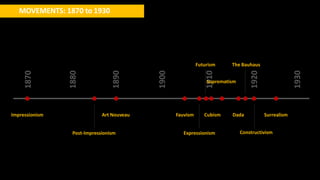
MOVEMENTS: 1870 to 1930
1900
1870
1880
1890
1910
1920
1930
Impressionism Art Nouveau Fauvism Cubism Dada Surrealism
Post-Impressionism Expressionism
Futurism
Suprematism
The Bauhaus
Constructivism
CUBISM
1907-1922
CUBISM
Birth: Developed by Picasso and Braque around 1907, the approach influenced artists
on an international scale into the early 1920s and well beyond.
Pablo Picasso
KEY
ARTIST
Ideas: Narrowly conceived, the approach focussed on a new way of describing space,
volume and mass in art, and led to the development of important new pictorial devices.
More generally, Cubism pointed new paths towards abstract art, and suggested ways of
describing the appearance and experience of life in the modern urban world.
The movement has been described as having two stages: 'Analytic' Cubism, in which
forms seem to be 'analyzed' and fragmented; and 'Synthetic' Cubism, in which
newspaper and other foreign materials such as chair caning and wood veneer, are
collaged to the surface of the canvas as 'synthetic' signs for depicted objects.
Cubism paved the way for geometric abstract art by putting an
entirely new emphasis on the unity between the depicted
scene in a picture, and the surface of the canvas. Its
innovations would be taken up by the likes of Piet Mondrian,
who continued to explore its use of the grid, its abstract
system of signs, and its shallow space.
CUBISM
Pablo Picasso
25 October 1881 (Málaga, Spain) - 8 April 1973 (Mougins, France)
Pablo Diego José Francisco de Paula Juan Nepomuceno María de
los Remedios Cipriano de la Santísima Trinidad Ruiz y Picasso,
known as Pablo Picasso was the most dominant and influential
artist of the first half of the twentieth century.
Associated most of all with pioneering Cubism,
alongside Georges Braque, he also invented collage, and made
major contributions to Symbolism, Surrealism, and to the
classical styles of the 1920s.
He saw himself above all as a painter, and yet his sculpture was
greatly influential, and he also explored areas as diverse as print-
making and ceramics.
Finally, he was a famously charismatic personality: his many
relationships with women not only filtered into his art but may
have directed its course; and his behavior has come to embody
that of the bohemian modern artist in the popular imagination.
"Eve
ryactofcre
ationisfirstanact
ofde
struction."
Pablo Picasso
KEY
ARTIST
CUBISM
Pablo Picasso : Major Works
Pablo Picasso
Guernica
1937. Oil on canvas. 349 cm × 776 cm
CUBISM
Pablo Picasso : Major Works
PabloPicasso
Les Demoiselles d'Avignon.
1907. Oil on Canvas. 244 x 234 cm
Although it is probably the single most heavily
analyzed picture of the century, ironically, Les
Demoiselles d'Avignon was not exhibited in public
until 1916. Picasso's friends felt that the highly
distorted brothel scene would be too
controversial.
The work of Paul Cezanne, and also African masks,
were crucial in shaping it, and for many years it
was regarded as the first Cubist painting. Critics
have since concluded that it is a transitional work,
but this has done nothing to dampen its enormous
power or influence. Willem de
Kooning's Woman series, for example, was directly
informed by this work.
CUBISM
Pablo Picasso : Major Works
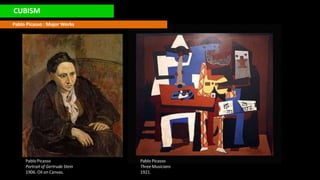
PabloPicasso
Portrait of Gertrude Stein
1906. Oil on Canvas.
Pablo Picasso
ThreeMusicians
1921.
MOVEMENTS: 1870 to 1930
1900
1870
1880
1890
1910
1920
1930
Impressionism Art Nouveau Fauvism Cubism Dada Surrealism
Post-Impressionism Expressionism
Futurism
Suprematism
The Bauhaus
Constructivism
SUPREMATISM
1913 – 1920s
The brainchild of Kazimir Malevich, Suprematism grew out of Russian
Futurism and the ideas of avant-garde poets, and also literary critics of the
early 1910s who were interested in the functioning of language and the
nature of literature as an art.
An interest in the nature of language encouraged Suprematists to reduce
art to its essentials. They devised a radically abstract art composed mostly
of simple geometric forms. Generally expressed through painting, it often
emphasized the texture of the paint as one of the fundamental, irreducible
characteristics of the medium. Although inspired by rational enquiry, the
movement occasionally took on a strange, absurdist tone, and its devotion
to abstraction made it sometimes seem mystical.
DADA
1916 - 1924
Launched in Zurich in 1916 and quickly inspired similar
groups in New York, Berlin, Cologne, Paris and
elsewhere. Its influence waned after the Paris group
collapsed and ceded to Surrealism.
Inspired by revulsion at the carnage of WWI, the artistic
and literary movement developed an anarchic
opposition to nationalism, rationalism and all dominant
bourgeois values. All the various Dada groups opposed
realism and embraced avant-garde shock tactics, but
their tone differed; German Dada was far more political
than the bohemian French strain.
DADA
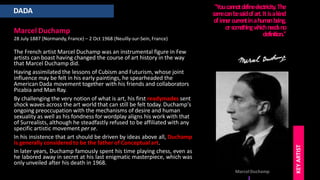
Marcel Duchamp
28 July 1887 (Normandy, France) – 2 Oct 1968 (Neuilly-sur-Sein, France)
The French artist Marcel Duchamp was an instrumental figure in Few
artists can boast having changed the course of art history in the way
that Marcel Duchamp did.
Having assimilated the lessons of Cubism and Futurism, whose joint
influence may be felt in his early paintings, he spearheaded the
American Dada movement together with his friends and collaborators
Picabia and Man Ray.
By challenging the very notion of what is art, his first readymades sent
shock waves across the art world that can still be felt today. Duchamp's
ongoing preoccupation with the mechanisms of desire and human
sexuality as well as his fondness for wordplay aligns his work with that
of Surrealists, although he steadfastly refused to be affiliated with any
specific artistic movement per se.
In his insistence that art should be driven by ideas above all, Duchamp
is generally considered to be the father of Conceptual art.
In later years, Duchamp famously spent his time playing chess, even as
he labored away in secret at his last enigmatic masterpiece, which was
only unveiled after his death in 1968.
"Youcannotde
finee
le
ctricity.The
sam
ecanbesaidofart.Itisakind
ofinne
rcurrentinahum
anbe
ing,
orsom
e
thingw
hichne
e
dsno
definition."
MarcelDuchamp
KEY
ARTIST
DADA
Marcel Duchamp : Major Works
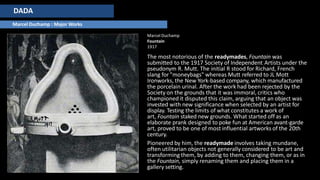
Marcel Duchamp
Fountain
1917
The most notorious of the readymades, Fountain was
submitted to the 1917 Society of Independent Artists under the
pseudonym R. Mutt. The initial R stood for Richard, French
slang for "moneybags" whereas Mutt referred to JL Mott
Ironworks, the New York-based company, which manufactured
the porcelain urinal. After the work had been rejected by the
Society on the grounds that it was immoral, critics who
championed it disputed this claim, arguing that an object was
invested with new significance when selected by an artist for
display. Testing the limits of what constitutes a work of
art, Fountain staked new grounds. What started off as an
elaborate prank designed to poke fun at American avant-garde
art, proved to be one of most influential artworks of the 20th
century.
Pioneered by him, the readymade involves taking mundane,
often utilitarian objects not generally considered to be art and
transforming them, by adding to them, changing them, or as in
the Fountain, simply renaming them and placing them in a
gallery setting.
DADA
Marcel Duchamp : Major Works
Marcel Duchamp
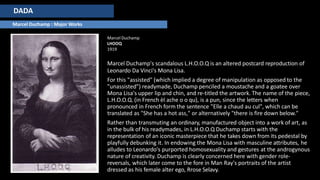
LHOOQ
1919
Marcel Duchamp's scandalous L.H.O.O.Q is an altered postcard reproduction of
Leonardo Da Vinci's Mona Lisa.
For this "assisted" (which implied a degree of manipulation as opposed to the
"unassisted") readymade, Duchamp penciled a moustache and a goatee over
Mona Lisa's upper lip and chin, and re-titled the artwork. The name of the piece,
L.H.O.O.Q. (in French èl ache o o qu), is a pun, since the letters when
pronounced in French form the sentence "Elle a chaud au cul", which can be
translated as "She has a hot ass," or alternatively "there is fire down below."
Rather than transmuting an ordinary, manufactured object into a work of art, as
in the bulk of his readymades, in L.H.O.O.Q Duchamp starts with the
representation of an iconic masterpiece that he takes down from its pedestal by
playfully debunking it. In endowing the Mona Lisa with masculine attributes, he
alludes to Leonardo's purported homosexuality and gestures at the androgynous
nature of creativity. Duchamp is clearly concerned here with gender role-
reversals, which later come to the fore in Man Ray's portraits of the artist
dressed as his female alter ego, Rrose Selavy.
BAUHAUS
1919 - 1933
The Bauhaus was the most influential modernist art school of
the 20th century, one whose approach to teaching, and
understanding art's relationship to society and technology, had a
major impact both in Europe and the United States long after it
closed. It was shaped by the 19th and early 20th centuries
trends such as Arts and Crafts movement, which had sought to
level the distinction between fine and applied arts, and to
reunite creativity and manufacturing.
The school is also renowned for its faculty, which included
artists Wassily Kandinsky, Josef Albers, László Moholy-Nagy, Paul
Klee and Johannes Itten, architects Walter Gropius and Ludwig
Mies van der Rohe, and designer Marcel Breuer.
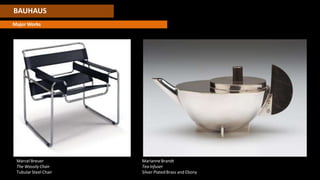
BAUHAUS
Major Works
Marcel Breuer
The Wassily Chair
Tubular Steel Chair
MarianneBrandt
Tea Infuser
Silver PlatedBrass and Ebony
CONSTRUCTIVISM
1915 – LATE 1930s
Constructivism was the last and most influential modern art movement to flourish in
Russia in the 20th century. It evolved as the Bolsheviks came to power in the October
Revolution of 1917, and initially acted as a lightning rod for the hopes and ideas of
many of the most advanced Russian artists who supported the revolution's goals.
Constructivism borrowed ideas from Cubism, Suprematism and Futurism, but bent
them into a new approach to making objects, one which sought to abolish the
traditional artistic concern with composition, and replace it with 'construction.' It
stressed the inherent physical characteristics of materials, rather than any symbolic
associations they might support. While seeking to express the dynamism of the
modern world, and that of the rapidly changing Russian society, Constructivists also
hoped to develop ideas that could be put to use in mass production.
MOVEMENTS: 1870 to 1930
1900
1870
1880
1890
1910
1920
1930
Impressionism Art Nouveau Fauvism Cubism Dada Surrealism
Post-Impressionism Expressionism
Futurism
Suprematism
The Bauhaus
Constructivism
SURREALISM
1924 – LATE 1966
Developed out of the collapse of the Paris Dada movement in
1924, it remained powerful until WWII and maintained a
presence through the mid-1960s.
Surrealism shared the anarchic rejection of conventional
bourgeois values that motivated the Dada movement.
Powerfully influenced by Freudian theories, Surrealists sought
ways to challenge reality by expressing the unconscious in art.
SURREALISM
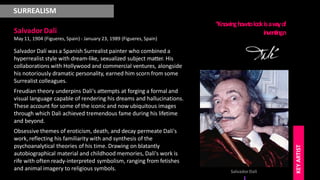
Salvador Dali
May 11, 1904 (Figueres, Spain) - January 23, 1989 (Figueres, Spain)
Salvador Dalí was a Spanish Surrealist painter who combined a
hyperrealist style with dream-like, sexualized subject matter. His
collaborations with Hollywood and commercial ventures, alongside
his notoriously dramatic personality, earned him scorn from some
Surrealist colleagues.
Freudian theory underpins Dali's attempts at forging a formal and
visual language capable of rendering his dreams and hallucinations.
These account for some of the iconic and now ubiquitous images
through which Dali achieved tremendous fame during his lifetime
and beyond.
Obsessive themes of eroticism, death, and decay permeate Dali's
work, reflecting his familiarity with and synthesis of the
psychoanalytical theories of his time. Drawing on blatantly
autobiographical material and childhood memories, Dali's work is
rife with often ready-interpreted symbolism, ranging from fetishes
and animal imagery to religious symbols.
“Know
inghowtolookisaw
a
yof
inventing.n
SalvadorDali
KEY
ARTIST
SURREALISM
Salvador Dali : Major Works
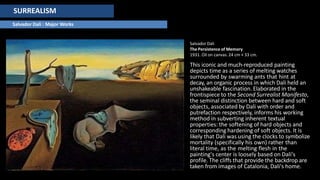
SalvadorDali
The Persistence of Memory
1931. Oil on canvas. 24 cm × 33 cm.
This iconic and much-reproduced painting
depicts time as a series of melting watches
surrounded by swarming ants that hint at
decay, an organic process in which Dali held an
unshakeable fascination. Elaborated in the
frontispiece to the Second Surrealist Manifesto,
the seminal distinction between hard and soft
objects, associated by Dali with order and
putrefaction respectively, informs his working
method in subverting inherent textual
properties: the softening of hard objects and
corresponding hardening of soft objects. It is
likely that Dali was using the clocks to symbolize
mortality (specifically his own) rather than
literal time, as the melting flesh in the
painting's center is loosely based on Dali's
profile. The cliffs that provide the backdrop are
taken from images of Catalonia, Dali's home.
SURREALISM
Salvador Dali : Major Works
SalvadorDali
Soft Constructionwith Boiled Beans
(Premonitionof Civil War)
1936. Oil on canvas. 100 cm × 99 cm
This painting is an allegorical response to the Spanish Civil War
of 1936-1939, but it is also a garish and gruesome depiction of
a body destroying itself. Dali painted this work prior to General
Franco's invasion, yet it predicts the violence, anxiety, and
doom many Spaniards felt during Franco's later rule.
Soft Construction with Boiled Beans is a fine example of a Dali
composition that simultaneously expresses his sexual
obsessions as well as his political outrage.
This painting expresses the destruction during the Spanish Civil
War. The monster in this painting is self destructive just as a
Civil War is. This painting is not meant to depict choosing sides
although Dali had many reasons to choose sides in the Spanish
Civil War. His sister was tortured and imprisoned by communist
soldiers fighting for the Republic and his good friend from art
school was murdered by a fascist firing squad[1] Dali also made
this painting look very realistic and yet continued to bring in
surreal concepts.
MOVEMENTS: 1930 to present
1970
1940
1950
1960
1980
1990
2000
Abstract
Expressionism
Kinetic
Art
Post-painterly
Abstraction
Color
Field
Painting
Pop
Art
Op Art
Hard-edge
Painting
Minimalism
Conceptual
Art
Arte
Povera
Post-
Minimalism
Performance Art Neo-
Expressionism
ABSTRACT EXPRESSIONISM
1924 – MID 1960s
The most influential movement in post-war abstract painting, it
flourished in New York in the 1940s and 1950s.
The Abstract Expressionists were committed to an expressive art of
profound emotion and universal themes. They were interested in
myth and archetypal symbols, and understood painting as a
struggle between self-expression and the chaos of the unconscious.
Sometimes called the ‘New York School,’ they included both color
field painters and painters of gestural abstraction.
ABSTRACT EXPRESSIONISM
JacksonPollock
KEY
ARTISTS
Willem De Kooning Mark Rothko
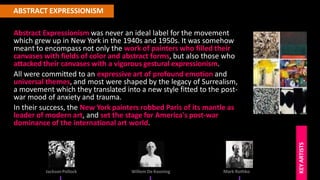
Abstract Expressionism was never an ideal label for the movement
which grew up in New York in the 1940s and 1950s. It was somehow
meant to encompass not only the work of painters who filled their
canvases with fields of color and abstract forms, but also those who
attacked their canvases with a vigorous gestural expressionism.
All were committed to an expressive art of profound emotion and
universal themes, and most were shaped by the legacy of Surrealism,
a movement which they translated into a new style fitted to the post-
war mood of anxiety and trauma.
In their success, the New York painters robbed Paris of its mantle as
leader of modern art, and set the stage for America's post-war
dominance of the international art world.
ABSTRACT EXPRESSIONISM
Jackson Pollock
January 28, 1912 (Cody, Wyoming, U.S.) - august 11, 1956 (Springs, New York, U.S.)
Jackson Pollock was the most well-known Abstract Expressionist and the key
example of Action Painting.
In its edition of August 8th, 1949, Life magazine ran a feature article about Jackson
Pollock that bore this question in the headline: "Is he the greatest living painter in
the United States?" Could a painter who flung paint at canvases with a stick, who
poured and hurled it to create roiling vortexes of color and line, possibly be
considered "great"? New York's critics certainly thought so, and Pollock's pre-
eminence among the Abstract Expressionists has endured, cemented by the legend
of his alcoholism and his early death. The famous 'drip paintings' that he began to
produce in the late 1940s represent one of the most original bodies of work of the
century. At times they could suggest the life-force in nature itself, at others they
could evoke man's entrapment - in the body, in the anxious mind, and in the newly
frightening modern world.
Pollock's greatness lies in developing one of the most radical abstract styles in the
history of modern art, detaching line from color, redefining the categories of
drawing and painting, and finding new means to describe pictorial space.
"Itdoe
sn'tm
akem
uchdiffe
rence
howthepaintisputonaslongas
som
e
thinghasbe
e
nsaid.Te
chnique
isjustam
e
ansofarrivingata
statement."
ABSTRACT EXPRESSIONISM
Jackson Pollock : Major Works
Jackson Pollock
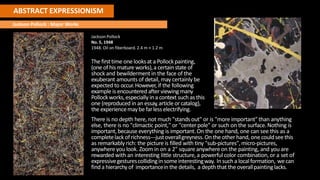
No. 5, 1948
1948. Oil on fiberboard.2.4 m × 1.2 m
The firsttime one looksat a Pollockpainting,
(one ofhis mature works),a certain state of
shock and bewildermentin the face of the
exuberant amounts of detail, may certainly be
expected to occur.However, if the following
example is encountered after viewing many
Pollockworks,especially in a context such as this
one (reproduced in an essay,article orcatalog),
the experiencemaybe farlesselectrifying.
There is no depth here, not much "stands out" or is "more important"than anything
else, there is no "climactic point," or "center pole" or such on the surface.Nothing is
important,because everything is important.On the one hand, one can see this as a
completelack ofrichness---justoverallgreyness.Onthe otherhand, onecouldseethis
as remarkably rich: the picture is filled with tiny "sub-pictures",micro-pictures,
anywhere you look. Zoom in on a 2" square anywhereon the painting, and you are
rewarded with an interesting little structure, a powerful color combination,or a set of
expressivegesturescollidingin someinterestingway. Insucha localformation, wecan
finda hierarchyof importancein the details, a depththat the overallpaintinglacks.
ABSTRACT EXPRESSIONISM
JacksonPollock
KEY
ARTISTS
Willem De Kooning
Jackson Pollock : Major Works
Jackson Pollock
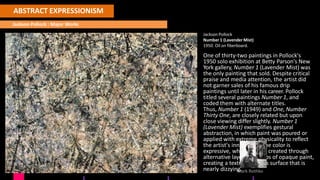
Number 1 (Lavender Mist)
1950. Oil on fiberboard.
One of thirty-two paintings in Pollock's
1950 solo exhibition at Betty Parson's New
York gallery, Number 1 (Lavender Mist) was
the only painting that sold. Despite critical
praise and media attention, the artist did
not garner sales of his famous drip
paintings until later in his career. Pollock
titled several paintings Number 1, and
coded them with alternate titles.
Thus, Number 1 (1949) and One, Number
Thirty One, are closely related but upon
close viewing differ slightly. Number 1
(Lavender Mist) exemplifies gestural
abstraction, in which paint was poured or
applied with extreme physicality to reflect
the artist's inner mind. The color is
expressive, while space is created through
alternative layers and drips of opaque paint,
creating a textured canvas surface that is
nearly dizzyinM
g.ark Rothko
ABSTRACT EXPRESSIONISM
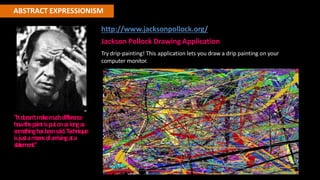
http://www.jacksonpollock.org/
Jackson Pollock Drawing Application
Try drip-painting! This application lets you draw a drip painting on your
computer monitor.
"Itdoe
sn'tm
akem
uchdiffe
rence
howthepaintisputonaslongas
som
e
thinghasbe
e
nsaid.Te
chnique
isjustam
e
ansofarrivingata
statement."
ABSTRACT EXPRESSIONISM
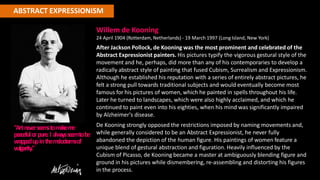
Willem de Kooning
24 April 1904 (Rotterdam, Netherlands) - 19 March 1997 (Long Island, New York)
After Jackson Pollock, de Kooning was the most prominent and celebrated of the
Abstract Expressionist painters. His pictures typify the vigorous gestural style of the
movement and he, perhaps, did more than any of his contemporaries to develop a
radically abstract style of painting that fused Cubism, Surrealism and Expressionism.
Although he established his reputation with a series of entirely abstract pictures, he
felt a strong pull towards traditional subjects and would eventually become most
famous for his pictures of women, which he painted in spells throughout his life.
Later he turned to landscapes, which were also highly acclaimed, and which he
continued to paint even into his eighties, when his mind was significantly impaired
by Alzheimer's disease.
De Kooning strongly opposed the restrictions imposed by naming movements and,
while generally considered to be an Abstract Expressionist, he never fully
abandoned the depiction of the human figure. His paintings of women feature a
unique blend of gestural abstraction and figuration. Heavily influenced by the
Cubism of Picasso, de Kooning became a master at ambiguously blending figure and
ground in his pictures while dismembering, re-assembling and distorting his figures
in the process.
"Artne
ve
rse
e
m
stom
akem
e
pe
ace
fulorpure
.I alw
a
ysse
e
mtobe
w
rapp
edupinthem
e
lodram
aof
vulgarity."
ABSTRACT EXPRESSIONISM
Willem de Kooning : Major Works
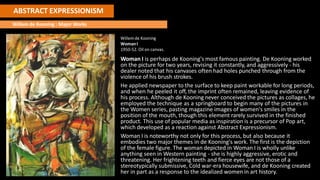
Willem de Kooning
WomanI
1950-52. Oil on canvas.
Woman I is perhaps de Kooning's most famous painting. De Kooning worked
on the picture for two years, revising it constantly, and aggressively - his
dealer noted that his canvases often had holes punched through from the
violence of his brush strokes.
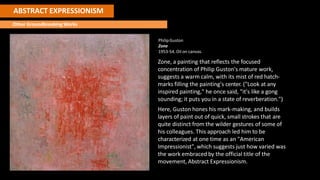
He applied newspaper to the surface to keep paint workable for long periods,
and when he peeled it off, the imprint often remained, leaving evidence of
his process. Although de Kooning never conceived the pictures as collages, he
employed the technique as a springboard to begin many of the pictures in
the Women series, pasting magazine images of women's smiles in the
position of the mouth, though this element rarely survived in the finished
product. This use of popular media as inspiration is a precursor of Pop art,
which developed as a reaction against Abstract Expressionism.
Woman I is noteworthy not only for this process, but also because it
embodies two major themes in de Kooning's work. The first is the depiction
of the female figure. The woman depicted in Woman I is wholly unlike
anything seen in Western painting - she is highly aggressive, erotic and
threatening. Her frightening teeth and fierce eyes are not those of a
stereotypically submissive, Cold war-era housewife, and de Kooning created
her in part as a response to the idealized women in art history.
ABSTRACT EXPRESSIONISM
Willem de Kooning : Major Works
Willem de Kooning
WomanIII
1953. Oil on canvas.
Willem de Kooning
WomanV
1952-53. Oil on canvas.
ABSTRACT EXPRESSIONISM
Mark Rothko
25 Sept 1903 (Dvinsk, Vitebsk Province, Russian Empire now Daugavpils, Latvia) - 25 Feb 1970
(Manhattan, New York)
A prominent figure among the New York School painters, Marcus Rothkowitz or
Mark Rothko moved through many artistic styles until reaching his signature
1950s motif of soft, rectangular forms floating on a stained field of color. Heavily
influenced by mythology and philosophy, he was insistent that his art was filled
with content, and brimming with ideas. A fierce champion of social revolutionary
thought, and the right to self-expression, Rothko also expounded his views in
numerous essays and critical reviews.
Highly informed by Nietzsche, Greek mythology, and his Russian-Jewish heritage,
Rothko's art was profoundly imbued with emotional content that he articulated
through a range of styles that evolved from figurative to abstract.
Rothko maintained the social revolutionary ideas of his youth throughout his life.
In particular he supported artist's total freedom of expression, which he felt was
compromised by the market. This belief often put him at odds with the art world
establishment, leading him to publicly respond to critics, and occasionally refuse
commissions, sales and exhibitions.
"Ifyouareonlym
ove
dbycolor
re
lationships,youarem
issingthe
point.I aminte
re
ste
dine
xpressing
thebige
m
otions- trage
dy
,e
cstasy,
doom."
ABSTRACT EXPRESSIONISM
Mark Rothko : Major Works
Mark Rothko
Entrance to Subway
1938. Oil on canvas.
This early figurative work demonstrates
Rothko's interest in contemporary
urban life.
The architectural features of the station
are sketchily recreated, including the
turnstiles and the "N" on the wall.
Although the mood of the pictures is
softened somewhat by the influence of
Impressionism, it reflects many of the
artist's feelings towards the modern
city. New York City was thought to be
soulless and inhuman, and something
of that is conveyed here in the
anonymous, barely rendered features of
the figures.
ABSTRACT EXPRESSIONISM
Mark Rothko : Major Works
Mark Rothko
Slow Swirl at the Edge of the Sea
1944. Oil on canvas.
Slow Swirl at the Edge of the Sea is a
representative example of Rothko's Surrealist
period. The influence of Miro is particularly
apparent, specifically in Miro's The
Family(1924). Rothko's all-over composition of
muted colors, strange translucent figures,
horizontal lines, angles, and swirls create a
vibrant yet veiled picture of an obscure
primeval landscape. Painted while courting
Mary Beistel, who would become his second
wife, this whimsical scene can also be
interpreted as a romance within a mythical and
magical world, where the figures are enjoying
the ocean as a rose colored dawn is breaking on
the horizon.
ABSTRACT EXPRESSIONISM
Other Groundbreaking Works
Franz Kline
Chief
1950. Oil on canvas.
Franz Kline's work typifies that of the "action
painters" celebrated by Harold Rosenberg. But
no matter how energetic and urgent his pictures
seemed to be, they were always carefully
considered in their execution. So much so that
critics have speculated wildly on the sources
behind images such as this. Chief was the name
of a locomotive Kline remembered from his
childhood, and it's possible to read the image as
a sensory reminiscence of its power, sound and
steaming engine. Some also believed that the
artist's obsession with black was connected to
his childhood spent in a coal-mining community
dominated by heavy industry. And many have
since noted that the forms in his early
abstractions seem to have evolved from
drawings of Kline's wife Elizabeth.
ABSTRACT EXPRESSIONISM
Other Groundbreaking Works
PhilipGuston
Zone
1953-54. Oil on canvas.
Zone, a painting that reflects the focused
concentration of Philip Guston's mature work,
suggests a warm calm, with its mist of red hatch-
marks filling the painting's center. ("Look at any
inspired painting," he once said, "it's like a gong
sounding; it puts you in a state of reverberation.")
Here, Guston hones his mark-making, and builds
layers of paint out of quick, small strokes that are
quite distinct from the wilder gestures of some of
his colleagues. This approach led him to be
characterized at one time as an "American
Impressionist", which suggests just how varied was
the work embraced by the official title of the
movement, Abstract Expressionism.
KINETIC ART
1954 -
Kinetic art is usually a sculptural construction comprised of
moving components, powered by wind, a motor or the
viewers themselves. Its kinesis is what gives the artwork its
overall effect, hence the name. The first artwork generally
credited as Kinetic Art was Marcel Duchamp's Bicycle Wheel
(1913). Some of the medium's most famous practitioners
include Alexander Calder, Naum Gabo and Jean Tingeuly
KINETIC ART
Groundbreaking Works
Bridget Riley
Blaze
1964. Screen print on paper.
The zigzag black and white lines in Blaze create
the perception of a vortex. As the brain interprets
the image, the alternating pattern appears to
shift back and forth; the interlocking lines add
depth to the form as it rhythmically curves
around the center of the page. And, although the
image is black and white, prismatic color appears
when the eye focuses on the image.
The perception of motion in what is a static object
demonstrates the interest in virtual movement
that occupied the Op art wing of the Kinetic
movement.
KINETIC ART
Groundbreaking Works
NaumGabo
Kinetic Construction(StandingWave)
1919-20 . Metal, painted wood and electrical mechanism
Kinetic Construction (Standing Wave) was initially created by
Naum Gabo to demonstrate kinetic energy to a class. Here a
metal strip stand is mechanized to create a motion that produces
the illusion of volume. The abstracted form embraces the
elements of time and space in a constructed form. It reflects the
origins of Kinetic art in some of the radical approaches to
sculpture born with Constructivism. What is remarkable about
the object is that, when immobile and stationary, it fails entirely
as a sculpture, being nothing more than a vertical strip of metal;
it is only movement that lends it interest, and that interest is the
product of an optical illusion. In that sense the artistry of
Gabo's Kinetic Construction is a fleeting thing, nothing more than
a mirage that can be gone in an instant.
COLOR FIELD PAINTING
LATE 1940s – MID 1960s
A term designating a trend within Abstract Expressionism. It was
coined by Clement Greenberg in the essay "American-type
Painting", 1955, and his support for it encouraged its survival into
the 1970s.
Greenberg believed that there was a tendency in modern
painting to apply color in fields, and some recent painters were
bringing that to a climax. Some early color field painting
suggested grand and lyrical moods, while later work bearing
geometric motifs bordered on Conceptual and Pop Art.later work
bearing geometric motifs bordered on Conceptual and Pop Art.
COLOR FIELD PAINTING
Groundbreaking Works
Frank Stella
The MetropolitanMuseum of Art 1870-1970
1970. Color offset lithograph poster.
By 1970, color field artists like Frank Stella, Kenneth
Noland and the late Morris Louis had long established
their style as the next phase in modern abstraction. Stella
in particular was best known for his color field spectrums,
in which bands of varying colors were situated in such a
way as to render the canvas a three-dimensional field of
pure color. What made these paintings unique, and thus a
distinctive characteristic of most color field work, was the
absence of any representation or figurative forms.
In Metropolitan Museum of Art 1870-1970, commissioned
by the museum for its 100th anniversary, Stella carefully
balanced alternating color bands to create a visual plane
and framed this plane within a field of primary blue.
COLOR FIELD PAINTING
Groundbreaking Works
Helen Frankenthaler
Nature Abhors a Vacuum
1973. Acrylic on canvas.
Helen Frankenthaler played a crucial role in the
evolution of color field painting. Some time in or
around 1952, Clement Greenberg invited Morris
Louis and Kenneth Noland to pay a visit to
Frankenthaler's studio in order to witness her
technique of staining untreated canvas with paint.
This seminal moment marked a turning point for
Abstract Expressionism, and soon this new group
of artists were simplifying the painting process by
applying large bands (or waves, circles, lines, etc.)
of uniform color to the canvas, and color field
painting advanced further.
COLOR FIELD PAINTING
Groundbreaking Works
Mark Rothko
No. 2, Green, Red and Blue
1953. Oil on canvas.
Although Rothko never considered himself a color field
painter, his signature approach - balancing large portions of
washed colors - matches up to critics' understanding of the
style.
Rothko considered color to be a mere instrument that
served a greater purpose. He believed his fields of color
were spiritual planes that could tap into our most basic
human emotions. For Rothko, color evoked emotion.
Therefore each of Rothko's works was intended to evoke
different meanings depending on the viewer. In the
time No. 2, Green, Red and Blue was made, Rothko was still
using lighter tones, but as more years passed and Rothko's
mental health increasingly declined, his color fields were
constituted by somber blacks, blues, and grays.
MOVEMENTS: 1930 to present
1970
1940
1950
1960
1980
1990
2000
Abstract
Expressionism
Kinetic
Art
Post-painterly
Abstraction
Color
Field
Painting
Pop
Art
Op Art
Hard-edge
Painting
Minimalism
Conceptual
Art
Arte
Povera
Post-
Minimalism
Performance Art Neo-
Expressionism
POP ART
MID 1950s – EARLY 1970s
The movement developed simultaneously in various cities in the
mid 1950s. Its influence is still felt in contemporary art.
London's Independent Group may have been the first to consciously
explore popular subject matter in their art, but Jasper Johns and
Robert Rauschenberg also made use of popular imagery as a route
away from Abstract Expressionism, and towards a Neo-Dada style in
the late 1950s. The movement truly flourished in New York in the
1960s, but it also saw manifestations in Paris, with Nouveau
Realisme, and in the work of German artists such as Sigmar Polke
and Gerhard Richter.
POP ART
Andy Warhol
6 Aug 1928 (Pittsburgh, Pennsylvania) - 22 Feb 1987 (New York City)
Andy Warhol was a leading figure in the visual art movement - pop
art. After a successful career as a commercial illustrator, Warhol
became a renowned and sometimes controversial artist. His works
explore the relationship between artistic expression, celebrity
culture and advertisement. He worked in a range of media,
including painting, printmaking, sculpture, film, and music. He
founded Interview Magazine and was the author of numerous
books, including The Philosophy of Andy Warhol and Popism: The
Warhol Sixties. Andy Warhol is also notable as a gay man who lived
openly as such before the gay liberation movement. His studio, The
Factory, was a famous gathering place that brought together
distinguished intellectuals, drag queens, playwrights, Bohemian
street people, Hollywood celebrities, and wealthy patrons.
Warhol has been the subject of numerous retrospective exhibitions,
books, and feature and documentary films. He coined the widely
used expression "15 minutes of fame".
The highest price ever paid for a Warhol painting is US$100 million
for a 1963 canvas titled Eight Elvises. The private transaction was
reported in a 2009 article in The Economist, which described Warhol
as the "bellwether of the art market". Warhol's works include some
of the most expensive paintings ever sold.
"Howcanyousayonestyleisbetterthananother?You
oughttobeabletobeanAbstractExpre
ssionistnext
week,oraPopartist,orarealist,withoutfeelingyou've
givenupsomething…I thinkthatwouldbesogre
at,tobe
abletochangestyles.AndI thinkthat'swhat'sis
goingtohappen,that'sgoingtobethe
w
holene
wsce
ne
."
AndyWarhol
KEY
ARTIST
POP ART
Andy Warhol : Major Works
Andy Warhol
Campbell's Soup Cans
1962. Synthetic
polymer paint on
canvas. Each 50.8 cm ×
40.6 cm
POP ART
Andy Warhol : Major Works
Andy Warhol
Untitled from Marilyn Monroe (Marilyn)
1967. Silkscreen.
After her sudden death in August 1962, Marilyn
Monroe's life and career became a worldwide
obsession. Warhol, being infatuated with fame and
pop culture, obtained a black-and-white publicity
photo of her, taken in 1953 for her film Niagara, and
used the photo to create several series of images.
Each Marilyn work was an experiment of
dramatically shifting colors and shadow. With the
help of his assistants, and the printing technique
used, Warhol was able to recreate images such as
this at a fast rate. Marilyn is an example of the
successful evolution of Warhol's goal of erasing signs
of the artist's hand from the production process.
POP ART
Andy Warhol : Major Works
Andy Warhol
Mao
1973. Synthetic polymer paint and silkscreen ink on canvas
Warhol combines paint and silkscreen in this image of
Mao Zedong, a series that he created in direct reaction
to President Richard Nixon's recent visit to China.
The painting is very large, 448.3cm by 346.7 cm, its scale
evoking the dominating nature of Mao's rule over China.
It also echoes the towering propagandistic
representations that were being displayed throughout
China during the Cultural Revolution.
The graffiti-like splashes of color, red rouge and blue eye
shadow, literally 'de-faces' Mao's image - an act of
rebellion against the Communist propaganda machine
by using its own devices against itself.
POP ART
Roy Lichtenstein
27 Oct 1923 (Manhattan, New York) - 29 Sept 1997 (Manhattan, New York)
Roy Lichtenstein was one of the first American Pop artists to
achieve widespread renown, and he became a lightning rod for
criticism of the movement.
His early work ranged widely in style and subject matter, and
displayed considerable understanding of modernist painting:
Lichtenstein would often maintain that he was as interested in
the abstract qualities of his images as he was in their subject
matter. However, the mature Pop style he arrived at in 1961,
which was inspired by comic strips, was greeted by accusations
of banality, lack of originality and, later, even copying.
His high-impact, iconic images have since become synonymous
with Pop art, and his method of creating images, which blended
aspects of mechanical reproduction and drawing by hand, has
become central to critics' understanding of the significance of the
movement.
"I'mne
ve
rdraw
ingtheobje
ctitse
lf;I'm
onlydraw
ingade
pictionoftheobje
ct- a
kindofcrystallizedsym
bol ofit."
Roy Lichtenstein
KEY
ARTIST
POP ART
Roy Lichtenstein : Major Works
Roy Lichtenstein
Drowning Girl
1963. Oil and syntheticpolymer paint on canvas.
In the early 1960s Lichtenstein gained renown as a leading
Pop Artists for paintings sourced from comic books,
specifically DC Comics. His work, along with that of Andy
Warhol, heralded the beginning of the Pop Art movement,
and, essentially, the end of Abstract Expressionism as the
dominant style. Lichtenstein did not simply copy comic pages
directly, he employed a complex technique which involved
cropping images to create entirely new, dramatic
compositions, as in Drowning Girl, whose source image
included the woman's boyfriend standing on a boat above
her. Lichtenstein also condensed the text of the comic book
panels, locating language as another, crucial visual element;
re-appropriating this emblematic aspect of commercial art
for his paintings further challenged existing views about
definitions of "high" art.
POP ART
Roy Lichtenstein : Major Works
Roy Lichtenstein
Brushstrokes
1967. Color screenprint on white wove paper.
Brushstrokes reflects Lichtenstein’s interest
in the importance of the brushstroke in
Abstract Expressionism. Abstract
Expressionist artists had made the
brushstroke a vehicle to directly
communicate feelings; Lichtenstein
brushstroke made a mockery of this
aspiration, also suggesting that though
Abstract Expressionists disdained
commercialization, they were not immune
to it - after all, many of their pictures were
also created in series, using the same
motifs again and again. Lichtenstein has
said, "The real brushstrokes are just as pre-
determined as the cartoon brushstrokes."
OP ART
1964 -
A term coined by critic Jules Langsner in 1959 to describe
the developments of a few California painters.
Ideas: In the wake of Abstract Expressionism many
painters began to move towards greater clarity of design,
and to eschew the grandeur and melancholy of much
gestural painting. Langsner observed this first in
California, but the trend was widespread and attracted
more adherents as the 1960s developed.
OP ART
Art Works
Jesus-Rafael Soto
Sphere bleue de Paris
2000. Wood and paint construction with aluminum rods, lamps, and rubber tubing
Soto, a Venezuelan who came to France in 1950, was another of
the many South American artists who made such an important
contribution to Op and Kinetic art. The globe-like form in Sphere
bleue de Paris appears to defy gravity, suggesting a energetic
power-source, a world or universe. It is created by thin strands
of blue rubber tubing, evenly spaced, and moved with a gentle
wind or slight touch. The tubing creates a segmented sphere
that appears to dissolve into thin air as the viewer circles it.
Soto began making such works in the mid-1960s, and although
this piece was created many years after the Op art movement
went into decline, it demonstrates the endurance of many of
the movement's personalities and their ideas. An optical illusion
is conjured in order to depict a motif that speaks softly and
mystically of the possibilities science.
OP ART
Art Works
Victor Vasarely
Duo - 2
1967. Gouache and acrylic on board.
The contrasting warm and cool shades here create the
ambiguous illusion of three-dimensional structures. Are they
concave, or convex? The illusion is so effective that we are
almost led to forget that it is a painted image, and made to
think it is a volumetric construction.
Although black and white delivered perhaps the most
memorable Op images, color also intrigued many Op artists.
The scientific study of color had been central to teaching at the
Bauhaus, and Vasarely certainly benefited from his education at
what was often called the 'Budapest Bauhaus'. Bauhaus
teachers such as Joseph Albers encouraged students to think
not of the associations or symbolism of colors, which had so
often been important in art, but simply of the effects they had
on the eye.
MINIMALISM
EARLY 1960s – LATE 1960s
A loosely affiliated group of mostly New York-based artists
began to work in a similar mode in the early 1960s.
An approach to art - principally sculptural - which stressed
anonymous, industrial manufacturing and austere, geometric
forms. Led by articulate spokesmen such as former critic
Donald Judd, the movement became a highly self-conscious
attempt to overturn previous conventions of sculpture, to
create objects with simple, indivisible forms, and to reject the
appearance of art.
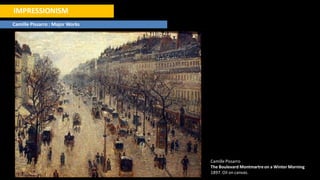
MINIMALISM
Groundbreaking Works
Donald Judd
Untitled
1969. Brass and colored fluorescent plexiglass on steel brackets
Throughout the 1960s, Judd created multiple
versions of this untitled work, always retaining the
same scale but never using the same color or
materials. He wanted his work to exist in real
three-dimensional space, rather than representing
a space, or another world, as painting or even
traditional figurative sculpture tends to do.
Referring to his sculptures as "primary structures,"
he discarded the conventions of traditional
sculpture (the plinth, the figure etc..), and instead
created objects which, although oddly cold,
everyday, and industrial in appearance, seemed to
aspire to the condition of art by the way in which
their shape and size confronted the viewer's own
body.
MINIMALISM
Groundbreaking Works
Tony Smith
Free Ride
1962. PaintedSteel.
A lot of Minimalism displays a "less is more"
approach to art, and Tony Smith's work is no
different.
Smith minimized the number of shapes, lines and
colors in his sculpture, and in Free Ride sought to
create an ambiguous experience of form - partly
evoking a figure, perhaps, or partly a landscape.
Although he was close to Abstract Expressionists
like Pollock and Newman, the most notable
influence on him was his former teacher Frank
Lloyd Wright. Some of his works even recall
Wright's building designs, which famously sought
to fuse harmoniously with the natural landscape in
which they were situated.
MOVEMENTS: 1930 to present
1970
1940
1950
1960
1980
1990
2000
Abstract
Expressionism
Kinetic
Art
Post-painterly
Abstraction
Color
Field
Painting
Pop
Art
Op Art
Hard-edge
Painting
Minimalism
Conceptual
Art
Arte
Povera
Post-
Minimalism
Performance Art Neo-
Expressionism
POST-PAINTERLY ABSTRACTION
EARLY 1950s – MID 1970s
Post-Painterly Abstraction was a term developed by critic
Clement Greenberg in 1964 to describe a diverse range of
abstract painters who rejected the gestural styles of the
Abstract Expressionists and favored instead what he called
"openness or clarity."
Painters as different as Ellsworth Kelly and Helen
Frankenthaler were described by the term. Some employed
geometric form, others veils of stained color.
POST-PAINTERLY ABSTRACTION
Groundbreaking Works
Kenneth Noland
Cycle
1960. Oil on canvas.
One of Noland's signature series of paintings was
the Targetpaintings, which for him also doubled as his own
brand of color field painting and geometric abstraction.
In Cycle Noland created something particularly
uncomplicated and, in fact, the near opposite of the color
field style. Cycle's central target is entirely surrounded by
bare canvas; a compositional decision also made by fellow
painter Morris Louis. What Noland achieved with this
painting was most likely what Greenberg had in mind when
he wrote about the post-painterly rejection of the "doctrine"
of Abstract Expressionism. By creating a strikingly simple
geometric form and emphasizing more canvas than paint,
Noland was definitely moving beyond the visual confines of
free-formabstract painting.
POST-PAINTERLY ABSTRACTION
Groundbreaking Works
Howard Mehring
The Key
1963. Magna on canvas.
In Greenberg's essay for the Post-Painterly Abstraction
catalog, he was careful to point out that the post-
painterly artists were in fact rejecting the technique of
action painting, but this rejection in no way constituted
an attempt to return to neo-plasticism or synthetic
Cubism. This assertion is difficult to believe upon
looking at Mehring's The Key (which was part of
the Post-Painterly exhibit), which visibly recalls
Mondrian's geometric abstractions, at least in form if
not in color. However, what set Mehring's painting
apart was his use of perfect symmetry, both in
depicted and literal shape (painterly form and canvas
measurement, respectively), for which Mondrian was
not known. In fact, all three of Mehring's paintings at
the 1964 show measured 78"x78".
POST-PAINTERLY ABSTRACTION
Groundbreaking Works
EllsworthKelly
Red Blue
1963. Oil on canvas.
Kelly's Red Blue recalls in many ways Barnett Newman's
signature "zip" paintings, with the single dividing line
cutting through an otherwise unified field of color. What
set Kelly's painting apart was the way in which he
applied the pigment. Kelly allowed his diluted oil paints
to soak into the canvas, rendering the surface a clean
and utterly flat picture plane. Kelly's red divider is also
much wider than Newman's "zips," and applied to
create a cleaner, simpler hard-edged line. Another key
characteristic of Kelly's hard-edge, color field paintings
was his tendency to only use two opposing colors.
CONCEPTUAL ART
MID 1950s –
Developed simultaneously in the mid 1960s in the United
States, Latin America and Europe. The movement waned in the
mid 1970s but its influence is still profound.
The movement is marked by a focus on ideas and
communication rather than visual perception. Some of its
practitioners have been drawn to a highly intellectual critique
of the institution of art itself. Many eschew objects altogether,
yet others have created a diverse output of media, from maps
and found objects to texts and photographs.
CONCEPTUAL ART
Groundbreaking Works
Robert Rauschenberg
Erased de KooningDrawing
1953. Charcoal, pencil, crayon and ink drawing by Willem de Kooning, erased
In 1953 Robert Rauschenberg visited Willem de Kooning's loft,
requesting to take one of de Kooning's drawings and completely
erase it. Rauschenberg believed that in order for this idea to become
a work of art, the work had to be someone else's and not his own; if
he erased one of his own drawings then the result would be nothing
more than a negated drawing. Although disapproving at first, de
Kooning admitted to understanding the concept and reluctantly
consented, but on the condition that he (de Kooning) would only
give away something he knew he would miss, thus making the
erasure that much more profound in the end, and secondly that the
drawing would be a challenge to completely erase. It took
Rauschenberg a little over a month and an estimated fifteen erasers
in all to "finish" the work. "It's not a negation," Rauschenberg once
said, "it's a celebration..it's just the idea!"
CONCEPTUAL ART
Groundbreaking Works
JosephKosuth
One and Three Chairs
1953. Wood folding chair, mounted photographof a chair, and
photographicenlargement of a dictionary definition of "chair"
A physical chair sits between a to-scale photograph of a
chair and a printed definition of the word "chair."
Emblematic of Conceptual art, One and Three Chairs makes
people question what constitutes the art - the object, the
idea, the photograph, or a combination of all three.
Joseph Kosuth once wrote, "The art I call conceptual is such
because it is based on an inquiry into the nature of art.
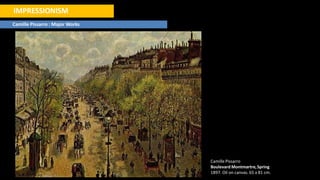
Thus, it is..a thinking out of all the implications, of all
aspects of the concept 'art.'" With this work, not only is the
nature of art in question, but also the authenticity of the
objects he has chosen to display. The title evokes the
question: is there only one chair or three? And if the answer
is the latter, we have just redefined the concept of "chair."
POST MINIMALISM
1966 -
Born almost simultaneously in the mid-1960s with the movement that fathered it,
Minimalism, Post-Minimalism was less a coherent avant-garde than a splintered
collection of tendencies including Process art, Performance, Land art and Body art.
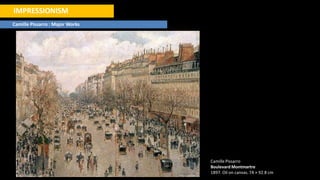
Post-Minimalism describes a collection of reactions against the abstraction,
austerity, and formalism of the Minimalist style. But it also describes work that
extended its ideas: some Process artists pushed further its interests in the
materiality of sculpture; some elaborated its notion that sculpture could expand
beyond the object – they developed new ideas about the placement of sculpture,
and pioneered Land art; and others, including many feminist artists, reintroduced
qualities of emotional expression into Minimalism’s highly impersonal style.
POST MINIMALISM
Major Works
Bruce Nauman
The True Artist Helps the World by Revealing Mystic Truths, (Window or Wall Sign)
1967. Neon tubing and clear glass tubing
This seminal work was created in the studio Nauman established in
an abandoned grocery store in San Francisco and modeled after the
neon advertisement signs nearby. It acts as an advertisement of a
different kind. Its colorful, circular text proclaims the words of the
title: "The True Artist Helps the World by Revealing Mystic Truths."
It is characteristic of Nauman's early neon works, and typical of the
tone of dry satire in much of his oeuvre. Commenting on high art in
the materials of low culture and advertising, it sets up a clash that
questions old assumptions about the purpose of art and artists, like
are artists just ordinary salesmen? One might say that the piece is
Post-Minimalist simply by virtue of standing at the borders of so
many different styles and approaches of the period, borrowing from
Pop art's interest in advertising, and Conceptual art's interest in
language.
POST MINIMALISM
Major Works
Richard Long
A Line Made by Walking
1967. Photographand pencil on board
A Line Made by Walking is highly characteristic of the
conceptual Earth art created by British artist Richard
Long. In making a line across the grass by the simple act
of walking, Long creates a type of drawing-without-
drawing, doing away completely with the conventional
tools and using instead his body and nature. Abandoning
the traditional art object in this way is typical of Post-
Minimalism, as is the way in which Long's line draws
attention to the passing of time and the specific, fleeting
moment in which the line was made.
ART POVERA
1962 – 1972
The Arte Povera ("poor art") movement emerged in 1960s Italy, when an artist
collective adopted a radical stance against all established modes of aesthetic order
and widely accepted artistic taste. A key influencer of the movement was Italian art
critic Germano Celant, whose 1967 book, Arte Povera, promoted ideas of a new
art, free from convention.
Prominent Arte Povera artists, such as Alighiero Boetti, Jannis Kounellis, Mario
Merz and Michelangelo Pistoletto, practiced everything from painting and
embroidery to conceptual art and performance, all designed to represent an utterly
original phase in modern art, away from the dominance of pure abstraction. The
artists' common ground was a stance against a market-driven art world, wherein
the need for commerce trumped the importance of individual expression.
ART POVERA
Major Works
LucianoFabro
Floor Tautology
1967. Floor, newspapers
By the time he joined the Arte Povera group,
Luciano Fabro was already a well-known artist
associated with the likes of Piero Manzoni and Lucio
Fontana, two important precursors of the
movement.
His Floor Tautology involves an area of floor, kept
polished and covered with newspapers to dry.
Shown in Germano Celant's first survey of Arte
Povera, Fabro's celebration of an ordinary task was
instrumental in his attempt to recalibrate the
concept of fine art. The elevation of a duty
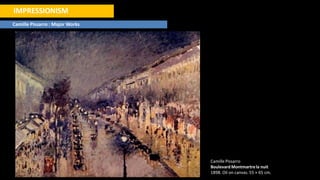
associated with housework - and most often coded
as women's work - became a theme in his later
pieces that utilized bed sheets and other fabrics.
ART POVERA
Major Works
Mario Merz
Giap's Igloo
1968. Metal tubing, wire mesh, neon tubing,
dirt in bags, batteries, accumulators
Mario Merz held the distinction of being the oldest of
the Arte Povera artists; he was also married to the
group's only female member, Marisa Merz. In the first
of his signature igloos, Merz uses a phrase taken from a
Vietnamese military general: "Se il nemico si concentra
perde terreno se il disperde perde forza" ("If the enemy
masses his forces, he loses ground; if he scatters, he
loses strength"). Merz's igloos provide a focus for his
preoccupation with the necessities of life - shelter,
warmth, and food - though, as here, they also often
contain neon tubes that suggest more sophisticated
and modern experiences, such as those of advertising
and consumption.
PERFORMANCE ART
1910 -
Performance was first embraced by Futurism and Dada, but it has been
exploited by many avant-gardes. It flourished as a movement itself in the
1960s and found exponents internationally. Performance art of this period
was particularly focused on the body and is often referred to as Body Art.
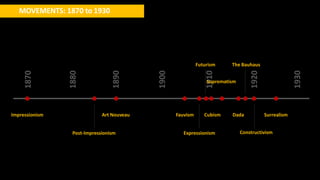
Performance is a genre in which art is presented "live," usually by the artist
but sometimes with collaborators or performers. Artists have turned to it
whenever they have become disenchanted with conventional media such as
painting and sculpture, and are seeking to rejuvenate art. In the 1960s, the
movement reflected widespread attempts to escape the boundaries of the
traditional art object. In some ways it extended the “action painting” of the
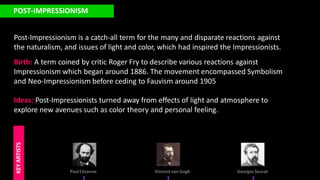
Abstract Expressionists, in other ways it gave expression to politics, to the
rise of feminism and the anti-war movement.
NEO-EXPRESSIONISM
LATE 1970s – EARLY 1990s
Neo-Expressionism can be traced to the rise of German artist
Georg Baselitz and his Neue Wilden group from the late 1960s,
but it flourished internationally in the 1980s.
Disaffected with the intellectualism of Minimalism and
Conceptual Art, many artists returned to painting in an
expressionist style which reasserted the creative power of the
individual. This took place almost simultaneously throughout
the world and was marked by interests in primitivism, graffiti,
and the revival of historical styles.
NEO-EXPRESSIONISM
Major Works
Jean-MichelBasquiat
MonaLisa
1983. Acrylic and oil stick on canvas
This provocative painting is both a satirical
homage to Leonardo's Mona Lisa and a work of
political commentary on the converging worlds of
art and money. Basquiat's depiction of a
warpedMona Lisa smile fixed within a dollar bill
frame was the artist's way of saying that, even
though art and money are essentially different
things, they are both forms of currency. Like most
of his paintings, there is a visible urgency to
Basquiat's brush strokes and thick oil stick lines, as
if he were applying these fleeting mental images
onto the canvas before they vanished altogether.
NEO-EXPRESSIONISM
Major Works
AnselmKiefer
Zim Zum
1990. Acrylic, emulsion, crayon,
shellac, ashes, and canvas on lead
Kiefer's Neo-Expressionist
works are marked by a dark,
almost post-apocalyptic
bleakness; topographies that
have been ravished and
fractured by war.With Zim
Zum, his forms are enigmatic,
yet at the same time eerily
recognizable, as if he were
imagining these quasi-abstract
scenes for the viewer and
creating fields of tone, form
and destitution.
NEO-EXPRESSIONISM
Major Works
Francesco Clemente
Scissors andButterflies
1999. Oil on linen.
Clemente was one of the few Italian painters who
was a part of the international array of Neo-
Expressionist artists. Employing a highly sensual style
with quasi-abstract forms combining human and
animal figures, Clemente mixed elements of erotica
with red-hot anger in this 1999 work. As was typical
of his work, a metamorphosis takes place.
In Scissors and Butterflies, these metamorphoses
occur between human and animal, the feminine and
masculine, the violent and the sexual. These inner
conflicts of existential expressiveness are often found
in Neo-Expressionism.
IMPASTO Painting that applies the pigment thickly so that brush or palette knife marks are visible
JAPONSIM OR JAPONISME Ageneral term for the influence of the arts of Japan on those of the West,
whereas in France, Japonisme is applied to such influence and is in addition the name of a specific
French style (late 1800s).
ARTS AND CRAFTS An international design movement that flourished between 1860 and 1910, that
stood for traditional craftsmanship using simple forms and often applied medieval, romantic or folk
styles of decoration and advocated economic and social reform and has been said to be essentially
anti-industrial.
GLOSSARY
SOURCES

scribd.vdownloaders.com_artid121-art-movements-from-1870-present.pptx

  • 1.
    ART MOVEMENTS FROM 1870TO THE PRESENT PREPARED BY EDELIZA V. MACALANDAG, UAP
  • 2.
    MOVEMENTS: 1870 to1930 1900 1870 1880 1890 1910 1920 1930 Impressionism Art Nouveau Fauvism Cubism Dada Surrealism Post-Impressionism Expressionism Futurism Suprematism The Bauhaus Constructivism
  • 3.
    MOVEMENTS: 1930 topresent 1970 1940 1950 1960 1980 1990 2000 Abstract Expressionism Kinetic Art Post-painterly Abstraction Color Field Painting Pop Art Op Art Hard-edge Painting Minimalism Conceptual Art Arte Povera Post- Minimalism Performance Art Neo- Expressionism
  • 4.
  • 5.
    IMPRESSIONISM Birth: A movementin French painting which was at its height from the late 1860s to mid 1880s, and whose influence was felt until 1900. Ideas: Turning away from the stress on fine finish and realistic rendering in academic art, French Impressionists sought new ways to describe effects of light and movement, often using rich colors. Drawn to modern life, they often painted the city, but they also captured landscapes and scenes of middle-class leisure-taking in the suburbs. Edouard Manet Claude Monet Edgar Degas Pierre-Auguste Renoir Berthe Morisot Camille Pissarro KEY ARTISTS
  • 6.
    The movement gainedits name after a hostile French critic, reviewing the artists' first major exhibition, seized on the title of Claude Monet's painting: Impression, Sunrise (1873), and accused them of painting nothing but impressions. The group soon embraced the title, though they would also refer to themselves as the Independents. IMPRESSIONISM Edouard Manet Claude Monet Edgar Degas Pierre-Auguste Renoir Berthe Morisot Camille Pissarro KEY ARTISTS ClaudeMonet Impression, Sunrise 1873. Oil on canvas. 48 x 63 cm
  • 7.
    Impressionism was astyle of representational art that did not necessarily rely on realistic depictions. Contemporary science was beginning to recognize that what the eye perceived and what the brain understood were two different things: the Impressionists sought to capture the former - the impact of a scene. IMPRESSIONISM Edouard Manet Claude Monet Edgar Degas Pierre-Auguste Renoir Berthe Morisot Camille Pissarro KEY ARTISTS Claude Monet Haystacks, (sunset) 1890–1891
  • 8.
    The Impressionists loosenedtheir brushwork, and lightened their palettes with pure, intense colors. They abandoned traditional perspective, and they avoided the clarity of form which, in earlier art, serves to distinguish the more from the less important elements of a picture. This resulted in many critics accusing Impressionist paintings of looking unfinished or amateurish. IMPRESSIONISM Edouard Manet Claude Monet Edgar Degas Pierre-Auguste Renoir Berthe Morisot Camille Pissarro KEY ARTISTS CamillePissarro Hay Harvest at Éragny 1901
  • 9.
    IMPRESSIONISM "The rearenoline sin nature,onlyare asofcolor, oneagainstanother ." Edouard Manet 23 Jan1832 (Paris) - 30 April 1883 (Paris) Edouard Manet was the most important and influential artist to have heeded poet Charles Baudelaire's call to artists to become painters of modern life. Manet's modernity lies above all in his eagerness to update older genres of painting by injecting new content, or altering the conventional elements. He did so with an acute sensitivity to historical tradition and contemporary reality. This was also undoubtedly the root cause of many of the scandals he provoked. He is credited with popularizing the technique of alla prima painting. Rather than build up colors in layers, Manet would immediately lay down the hue which most closely matched the final effect he sought. The approach came to be used widely by the Impressionists, who found it perfectly suited to the pressures of capturing effects of light and atmosphere whilst painting outdoors. His loose handling of paint, and his schematic rendering of volumes, led to areas of "flatness" in his pictures. In the artist's day this flatness may have suggested popular posters, or the artifice of painting - as opposed to its realism; today, critics see this quality as the first example of "flatness" in modern art.
  • 10.
    IMPRESSIONISM Edouard Manet :Major Works EdouardManet Le Dejeuner sur l'herbe 1863. Oil on canvas. As the primary talking point of the Salon des Refuses in 1863, it is fairly clear to see why this canvas shocked the bourgeois patrons, and the Emperor himself. Manet's composition is influenced by the Renaissance artist Giorgione, and to Raimondi's engraving of the Judgment of Paris after Raphael, but these are fractured by his disregard for perspective, and his use of unnatural light sources. But it was the presence of an unidealized female nude, casually engaged with two fashionably dressed men, that was the focus of the most public outrage. Her gaze confronts the viewer on a sexual level, but through her Manet confronts the public as well, challenging their ethical and aesthetic boundaries.
  • 11.
    IMPRESSIONISM Edouard Manet :Major Works EdouardManet A Bar at the Folies-Bergere 1881. Oil on canvas. This melancholic cafe scene is Manet's last masterpiece. The Folies-Bergere was a popular cafe concert for a fashionable and diverse crowd. The lively bar scene is reflected in the mirror behind the central figure, the sad bar girl. Her beautiful, tired eyes avoid contact with the viewer - who also plays a double role as the customer in this scene. Much has been made of the faulty perspective from the reflection in the mirror, but this was evidently part of Manet's interest in artifice and reality. On the marble countertop is an exquisite still-life arrangement of identifiable bottles of beer and liquor, flowers and mandarins, all of which anticipate the still-lifes of his final two years of life.
  • 12.
    IMPRESSIONISM "Them otifisinsignificantfor m e ;w hatI w anttore pre sentis w hatlie sbe tw e e nthem otif& me." Claude Monet 14Nov 1840 (Paris, France) – 5 Dec 1926 (Giverny, France) Claude Monet was among the leaders of the French Impressionist movement of the 1870s and 1880s. His 1873 painting, Impression, Sunrise, gave the style its name, and as an inspirational talent, and as a personality, he was crucial in bringing its adherents together. Inspired, in the 1860s, by the Realists' interest in painting in the open air, Monet would later bring the technique to one of its most famous pinnacles with his so-called series paintings, in which his observations of the same subject, viewed at various times of the day, were captured in numerous sequences of paintings. Masterful as a colorist and as a painter of light and atmosphere, his later work often achieved a remarkable degree of abstraction, and this has recommended him to subsequent generations of abstract painters.
  • 13.
    IMPRESSIONISM Claude Monet :Major Works Claude Monet Womenin the Garden 1866-7. Oil on canvas. 255 × 205 cm Women in the Garden was painted at Ville d'Avray using his wife Camille as the only model. The goal of this large-scale work, while meticulously composed, was to render the effects of true outdoor light, rather than regard conventions of modeling or drapery. From the flickers of sunlight that pierce the foliage of the trees to delicate shadows and the warm flesh tones that can be seen through her sleeve, Monet details the behavior of natural light of the scene. In January 1867, his friend Bazille purchased the work for the sum of 2,500 francs in order to help Monet out of the extreme debt that forced him to slash over 200 canvases to avoid them being taken by his creditors.
  • 14.
    IMPRESSIONISM Claude Monet :Major Works ClaudeMonet Boulevard des Capucines 1873. Oil on canvas. Boulevard des Capucines captures a scene of the hustle and bustle of Parisian life from the studio of Monet's friend, the photographer Nadar. Applying very little detail, Monet uses short, quick brushstrokes to create the 'impression' of people in the city alive with movement. Critic Leroy was not pleased with these abstracted crowds, describing them as "black tongue-lickings." Monet painted two views from this location, with this one looking towards the Place de l'Opera. The first Impressionist exhibition was held in Nadar's studio, and perhaps in a show of respect to his supporter, Monet included this piece.
  • 15.
    IMPRESSIONISM Claude Monet :Major Works ClaudeMonet Westminster Bridge (aka The Thames below Westminster) 1871. Oil on canvas. 255 × 205 cm Westminster Bridge is one of the finest examples of his work during the time he and his family were in wartime refuge. This simple, asymmetrical composition is balanced by the horizontal bridge, the boats floating upon the waves with the vertical wharf, and ladder in the foreground. The entire scene is dominated by a layer of mist containing violet, gold, pink and green, creating a dense atmosphere that renders the architecture in distant, blurred shapes.
  • 16.
    IMPRESSIONISM Claude Monet :Major Works Claude Monet Lady with a Parasol 1886. Oil on canvas. One of Monet's most popular figure paintings, Lady with a Parasol showcases the parasol, one of his longstanding themes. The parasol itself makes many appearances in his work, primarily because when painting from real life outdoors, most women would use one to protect their skin and eyes. But it also creates a contrast of light and shadows on the figure's face and clothing, indicating from which direction the actual light is coming from. Having already explored this scene in an earlier, more detailed version, On the Cliff (1875), in this work from Giverny, Monet pays little attention to the model's features, letting them fade into the shadow beneath the parasol.
  • 17.
    IMPRESSIONISM Claude Monet :Major Works ClaudeMonet Rouen Cathedral: The Facade at Sunset 1894. Oil on canvas. Monet's Rouen Cathedral series is one of his most renowned. He painted the cathedral's facade at different times of day to explore the effects of different light during winter. The burnt orange and blue appearance of the cathedral dominates the canvas, with only scattered views of sky at the top. Layered over the top of the Gothic structure, the brushstrokes play with the light and atmosphere on the stones, and the details on their carved surfaces. In 1895, he exhibited twenty Cathedrals at the Durand-Ruel Gallery that were both criticized and praised by viewers that either struggled or championed his artistic, scientific, and poetic innovations.
  • 18.
    IMPRESSIONISM Claude Monet :Major Works ClaudeMonet WaterLilies 1916. Oil on canvas. Water Lilies is a part of Monet's water landscape group that was likely conceived in 1909, but which he did not begin until after several personal traumas that occurred in the early 1910s. He worked in secret on dozens of canvases creating a panorama of water, lilies and sky in his studio within and inspired by his Giverny garden. While he painted from the constructed nature around him, due to his failing eyesight and the flower's strictly summer bloom, much was painted from his rich memory. The brushstrokes and palettes utilized were varied from earlier works, almost appearing expressionistic.
  • 19.
    IMPRESSIONISM “ Artisnotw hatyouse e ,but w hatyoum akeothe rsse e .n Edgar Degas 19 July1834 (Paris, France) – 27 Sept 1917 (Paris, France) Edgar Degas is regarded as one of the founders of Impressionism although he rejected the term, and preferred to be called a realist. A superb draftsman, he is especially identified with the subject of the dance, and over half of his works depict dancers. These display his mastery in the depiction of movement, as do his racecourse subjects and female nudes. His portraits are notable for their psychological complexity and depiction of human isolation. Technically, Degas differs from the Impressionists in that he "never adopted the Impressionist color fleck", and he continually belittled their practice of painting en plein air. Degas himself explained, "no art was ever less spontaneous than mine. What I do is the result of reflection and of the study of the great masters; of inspiration, spontaneity, temperament, I know nothing.” Nonetheless, he is described more accurately as an Impressionist than as a member of any other movement. His scenes of Parisian life, his off-center compositions, his experiments with color and form, and his friendship with several key Impressionist artists—most notably Mary Cassatt and Édouard Manet—all relate him intimately to the Impressionist movement.
  • 20.
    IMPRESSIONISM Edgar Degas :Major Works Edgar Degas The Dance Class (La Classe de Danse) 1874. Oil on canvas. 85x78 cm. When this work and its variant in the Musée d'Orsay, Paris, were painted in the mid-1870s, they constituted Degas's most ambitious figural compositions except for history paintings. Some twenty-four women, ballerinas and their mothers, wait while a dancer executes an "attitude" for her examination. Jules Perrot, one of the best-known dancers and ballet masters in Europe, conducts the class. The imaginary scene is set in a rehearsal room in the old Paris Opéra—a poster for Rossini's "Guillaume Tell" is on the wall beside the mirror—even though the building had just burned to the ground. The painting was commissioned in 1872 as part of an arrangement between Degas and the singer and collector Jean- Baptiste Faure. It was one of only a few commissions that the artist ever accepted, and the painting was delivered in November 1874 after two years of intermittent work.
  • 21.
  • 22.
    IMPRESSIONISM Edgar Degas :Major Works Edgar Degas The Bellelli Family 1858–1867. Oil on canvas. 200 cm × 253 cm Edgar Degas L’Absinthe 1876. Oil on canvas. 92 cm × 68 cm
  • 23.
    IMPRESSIONISM "Ifthepainterw orksdire ctlyfrom nature,heultima t elylooksfor nothingbutm om e ntarye ffe cts;he doe snottrytocom pose,and soonhege tsm onotonous." Pierre-Auguste Renoir 25 Feb1841 (Haute-Vienne, France) – 3 Dec 1919 (Provence-Alpes-Côte d'Azur,France) Renoir was a French artist who was a leading painter in the development of the Impressionist style. Renoir's paintings are notable for their vibrant light and saturated color, most often focusing on people in intimate and candid compositions. The female nude was one of his primary subjects. In characteristic Impressionist style, Renoir suggested the details of a scene through freely brushed touches of color, so that his figures softly fuse with one another and their surroundings. In the late 1860s, through the practice of painting light and water en plein air (in the open air), he and his friend Claude Monet discovered that the color of shadows is not brown or black, but the reflected color of the objects surrounding them, an effect today known as diffuse reflection. A prolific artist, he made several thousand paintings. The warm sensuality of Renoir's style made his paintings some of the most well-known and frequently- reproduced works in the history of art.
  • 24.
    IMPRESSIONISM Pierre-Auguste Renoir :Major Works Pierre-AugusteRenoir Bal du moulin de la Galette (Dance at Le moulin de la Galette) 1876. Oil on canvas. 131 × 175 cm The painting depicts a typical Sunday afternoon at Moulin de la Galette in the district of Montmartre in Paris. In the late 19th century, working class Parisians would dress up and spend time there dancing, drinking, and eating galettes into the evening. Like other works of Renoir's early maturity, Bal du moulin de la Galette is a typically Impressionist snapshot of real life. It shows a richness of form, a fluidity of brush stroke, and a flickering light.
  • 25.
    IMPRESSIONISM Pierre-Auguste Renoir :Major Works Pierre-Auguste Renoir Luncheon of the Boating Party (Le déjeuner des canotiers) 1881. Oil on canvas. The painting depicts a group of Renoir's friends relaxing on a balcony at the Maison Fournaise along the Seine river in Chatou, France. Renoir's future wife, Aline Charigot, is in the foreground playing with a small dog. In this painting Renoir has captured a great deal of light. The main focus of light is coming from the large opening in the balcony, beside the large singleted man in the hat. The singlets of both men in the foreground and the table-cloth all work together to reflect this light and send it through the whole composition.
  • 26.
  • 27.
    IMPRESSIONISM Itisim portanttoe xpressone se lf... providedthefe e lingsarere al andare takenfromyouro w nexperience. Berthe Morisot January14, 1841 (Bourges, Cher, France) – March 2, 1895 (Paris, France) Berthe Morisot was a woman of extraordinary talents who carved for herself a career within the art world of nineteenth century Paris. She was one of only a few women who exhibited with both the Paris Salon and the highly influential and innovative Impressionists. Her work endures today as a major representative of the Impressionist school. Although Morisot was unusual for her class and time in that she successfully pursued an artistic career whilst combining it with marriage and motherhood, she never forsaked her bourgeoise background. In her art and in her lifestyle, she reflected the standards of behavior and propriety required of the nineteenth century bourgeoises. Through her depictions of her sisters, their families, and her own daughter Julie Manet, Berthe Morisot portrays an intimacy between women within the realism of the feminine world. Her art remains as a record for the twentieth century and beyond of the feminine world of the bourgeoises.
  • 28.
    IMPRESSIONISM Berthe Morisot :Major Works Berthe Morisot The Mother and Sister of the Artist 1869/1870. Oil on canvas. 101 × 82 cm In the mother's face and dark costume Manet's strong, broad brushstrokes are discernible. For both artists, however, the appearance of paint on the canvas, more than the illusion of reality, is of greatest interest. This picture, after having been accepted at the Salon, was probably seen again in the first impressionist exhibition in 1874. Unlike Manet, Morisot embraced the outdoor painting and spontaneity of impressionism, participating in all but one of the eight impressionist exhibitions. Berthe Morisot told her mother that she would "rather be at the bottom of the sea" than for this picture to appear at the Salon. Her reluctance stemmed from the "assistance" of her friend and future brother-in-law Edouard Manet, leader of the avant-garde, whose advice she had solicited. Calling at her home, Manet took up a brush, and as Morisot described in a letter: "...it isn't possible to stop him; he passes from the petticoat to the bodice, from the bodice to the head, from the head to the background."
  • 29.
    IMPRESSIONISM Berthe Morisot :Major Works Berthe Morisot The Cradle (Le berceau) 1872. oil on canvas. 56 × 46 cm Berthe Morisot Reading (portrait of Edma Morisot) 1873. Oil on fabric.
  • 30.
    IMPRESSIONISM “W o rka tthesa m etim eo nsky ,w a te r ,b ra nche s, gro und ,ke e p inge ve rythinggo ingo na ne q ua l basis...Don'tb eafraidofputtingoncolour ... Paintgenerouslyandunhesitatingly ,foritisbestno t tolo sethefirstim p re ssio n. n Jacob Abraham CamillePissarro 10 July 1830 (Charlotte Amalie, Danish West Indies) - 13 November 1903 (Paris, France) Camille Pissarro was a French Impressionist and Neo-Impressionist painter born on the island of St Thomas (now in the US Virgin Islands, but then in the Danish West Indies). Known as the "Father of Impressionism," he used his own painterly style to depict urban daily life, landscapes, and rural scenes, his importance resides in his contributions to both Impressionism and Post-Impressionism, as he was the only artist to exhibit in both forms. Pissarro studied from great forerunners, including Gustave Courbet and Jean-Baptiste-Camille Corot. He later studied and worked alongside Georges Seurat and Paul Signac when he took on the Neo-Impressionist style at the age of 54. In 1873 he helped establish a collective society of fifteen aspiring artists, becoming the “pivotal” figure in holding the group together and encouraging the other members. Art historian John Rewald called Pissarro the “dean of the Impressionist painters", not only because he was the oldest of the group, but also "by virtue of his wisdom and his balanced, kind, and warmhearted personality”. Pissarro is the only artist to have shown his work at all eight Paris Impressionist exhibitions, from 1874 to 1886. As a stylistic forerunner of Impressionism, he is today considered a "father figure not only to the Impressionists" but to all four of the major Post-Impressionists, including Georges Seurat, Paul Cézanne, Vincent van Gogh and Paul Gauguin.
  • 31.
    IMPRESSIONISM Camille Pissarro :Major Works CamillePissarro The Woodcutter 1879. Oil on canvas. 35x45-3/4 inches. Camille Pissarro painted The Woodcutter in 1879, one of 28 Impressionist paintings that Pissarro would exhibit in the Impressionists' sixth exhibition. The figure of Pissarro's woodcutter recalls the peasant laborers painted by Jean Francois Millet. With solid weight and strong contours, the laborer in The Woodcutter seems to have been shaped by his work, by the repetitive motion of dragging his saw back and forth through the wood. But the background has a vanishing quality, with light sparkling on the dense foliage.
  • 32.
    IMPRESSIONISM Camille Pissarro :Major Works Camille Pissarro The Boulevard Montmartreon a Winter Morning 1897. Oil on canvas.
  • 33.
    IMPRESSIONISM Camille Pissarro :Major Works Camille Pissarro Boulevard Montmartre,Spring 1897. Oil on canvas. 65 x 81 cm.
  • 34.
    IMPRESSIONISM Camille Pissarro :Major Works Camille Pissarro Boulevard Montmartre 1897. Oil on canvas. 74 × 92.8 cm
  • 35.
    IMPRESSIONISM Camille Pissarro :Major Works Camille Pissarro Boulevard Montmartrela nuit 1898. Oil on canvas. 55 × 65 cm.
  • 36.
    MOVEMENTS: 1870 to1930 1900 1870 1880 1890 1910 1920 1930 Impressionism Art Nouveau Fauvism Cubism Dada Surrealism Post-Impressionism Expressionism Futurism Suprematism The Bauhaus Constructivism
  • 37.
  • 38.
    POST-IMPRESSIONISM Post-Impressionism is acatch-all term for the many and disparate reactions against the naturalism, and issues of light and color, which had inspired the Impressionists. Birth: A term coined by critic Roger Fry to describe various reactions against Impressionism which began around 1886. The movement encompassed Symbolism and Neo-Impressionism before ceding to Fauvism around 1905 Ideas: Post-Impressionists turned away from effects of light and atmosphere to explore new avenues such as color theory and personal feeling. Paul Cézanne KEY ARTISTS Vincent van Gogh Georges Seurat
  • 39.
    POST-IMPRESSIONISM Symbolic and highlypersonal meanings were important to Post-Impressionists such as Gauguin and van Gogh. Rejecting the Impressionists' interest in the external, observed world, they instead looked inside themselves for content. As the Post-Impressionists turned away from describing effects of light and color, abstract form and pattern became increasingly important to them. Gauguin and van Gogh sought to create harmonious surface patterns, while Cézanne sought to introduce more structure, and a clearer sense of space and volume, to the Impressionists' fascination with natural light, by using color applied in regular, repetitive brushstrokes. Paul Cézanne KEY ARTISTS Vincent van Gogh Georges Seurat
  • 40.
    POST-IMPRESSIONISM Paul Cezanne 19 January1839 (Aix-en-Provence, France) - 22 October 1906 (Aix-en-Provence, France) Paul Cezanne was the preeminent French artist of the Post-Impressionist era, widely appreciated toward the end of his life for insisting that painting stay in touch with its material, if not virtually sculptural origins. Also known as the "Master of Aix" after his ancestral home in the South of France, Cezanne is credited with paving the way for the emergence of modern art, both visually and conceptually. In retrospect, his work constitutes the most powerful and essential link between the ephemeral aspects of Impressionism and the more materialist, early 20th century artistic movements of Fauvism, Cubism, Expressionism, and even complete abstraction. Cézanne's work demonstrates a mastery of design, colour, tone, composition and draughtsmanship. His often repetitive, sensitive and exploratory brushstrokes are highly characteristic and clearly recognizable. He used planes of colour and small brushstrokes that build up to form complex fields, at once both a direct expression of the sensations of the observing eye and an abstraction from observed nature. The paintings convey Cézanne's intense study of his subjects, a searching gaze and a dogged struggle to deal with the complexity of human visual perception. "I ow eyouthetruthin paintingandI w illte llitto you"
  • 41.
    POST-IMPRESSIONISM Paul Cezanne :Major Works PaulCezanne The Artist's Father, Reading "L'Événement" 1866. Oil on canvas. 200 × 120 cm This portrait is one of the most renowned early works by Cezanne. The rigid composition is dominated by somber hues applied in a thick impasto. The expressive premise for this piece is suggested by the artist's inclusion of his own still-life in the background, as though to solicit recognition of his talent by his famously disapproving parent. As if to force the issue, Louis-August is portrayed reading a liberal newspaper, a highly unlikely event, as he was widely known for his conservative outlook.
  • 42.
    POST-IMPRESSIONISM Paul Cezanne :Major Works PaulCezanne The Large Bathers (Les Grandes Baigneuses) 1906. Oil on canvas. 208 × 249 cm The Large Bathers is one of the finest examples of Cezanne's attempt at incorporating the modern, heroic nude in a natural setting. The series of very human nudes, no Greco-Roman nymphs or satyrs, are arranged into a variety of positions, like objects of still-life, under the pointed arch formed by the intersection of trees and the heavens. The figures are devoid of any particular personality - the artist assembles them for purely structural purposes. Here Cezanne is reinterpreting an iconic Western motif of the female nude, but in an exceptionally radical way. The sheer size of the painting is monumental, confronting the viewer directly with abbreviated shapes that resolve themselves into the naked limbs of his sitters. This is not yet abstraction, but in such instances Cezanne has already moved beyond the figurative tradition.
  • 43.
    POST-IMPRESSIONISM Paul Cezanne :Major Works PaulCezanne Card Player 1906. Oil on canvas. 208 × 249 cm Cezanne produced his series of "Card Player" paintings, drawings, and related studies in the region of Aix-en- Provence, his ancestral home in the South of France, where he found in the image of men playing cards something timeless, like the mountains cradling an ancient people. As though having come together around a simple peasant table for a séance or cosmic conference, the card players seem at once transient and unmoving, very much masters of their environment and yet weathered testaments of time's passing.
  • 44.
    POST-IMPRESSIONISM Vincent Willem vanGogh 30 March 1853 (Zundert, Netherlands) - 29 July 1890 (Auvers-sur-Oise, France) Dutch Post-Impressionist Vincent van Gogh's unique vision, brushwork and use of color provide stylistic links from Impressionism to the conceptual practice of Abstract Expressionism. Although he produced his most acclaimed work in a span of less than three years, his technique, subject matter, sense of movement and vibration in his compositions influenced many artists of his day and of the future. His gestural use of line and distortion of reality for emotional effect became a guiding principle for the Abstract Expressionist artists of the New York School. Van Gogh's dedication to articulating the inner spirituality of man and nature led to a unique fusion of style and content that resulted in dramatic, imaginative, rhythmic, and emotional canvases. His personal temperament came to symbolize the romantic image of the tortured artist and was an icon of self-destructive talent that would be echoed in the lives of many artists in the 20th century and beyond. Van Gogh used an impulsive, gestural application of paint and symbolic colors to express subjective emotions. These methods and practice came to define Abstract Expressionism. "Insteadoftryingtore produce e xactlyw hatI se ebe forem e ,I m akem orearbitraryuseofcolor toe xpre ssm yse lfm ore forcefully."
  • 45.
    POST-IMPRESSIONISM Starry Night waspainted from memory and not en naturalistic landscapes. In Starry Night, Van Gogh Vincent van Gogh : Major Works Vincent Van Gogh Starry Night 1889. Oil on canvas. Slide concept by Edeliza V. MaS ct aa r lar y nN di g ah gt ,i s Uo Af t Pe nconsidered to be Van Gogh's FOR EDUCATIONAL USE ONLY pinnacle achievement. Unlike most of his works, For publication, reproduction p ol re i tn ra ai nr ; st mh e ie sm sip oh na s i son interior, emotional life is of images, please contact indivcliedaurain lhaisrtdiesptsic,tionof the sky, which was a estates, photographers and exrhadibiciatlindegparturefrom his previous, more institutions for permissions anfdollroiwgehdtsa.strictprincipal of structure and composition: the distribution of forms across the surface of the canvas is in exacting order. The result is a landscape perceived through swirling curves and lines, its seeming chaos subverted by a rigorous formal arrangement. Since 1941, The Museum of Modern Art in New York City has held Starry Night in its permanent collection.
  • 46.
    POST-IMPRESSIONISM Vincent van Gogh: Major Works Vincent Van Gogh Fourteen Sunflowers in a Vase 1888. Oil on canvas. Van Gogh's Sunflower series was intended to decorate the room he was keeping for Gaugin at the Yellow House in Arles. His lush brushstrokes built up the texture of sunflowers and employed a wide spectrum of yellow, in part because recently invented pigments that made new colors and tonal nuance possible. Van Gogh used the colors to express the entire lifespan of the flowers, from the full bloom in bright yellow to the wilting and dying blossoms rendered in melancholy ochre. The composition, in the restricted palette and frontally placed subject, appears simpler and more deliberate than in other still lifes, yet Van Gogh makes a powerful statement about the fleetingness of time and the subtleties of nature. Yasuda Fire and Marine Insurance Company of Tokyo, Japan bought the painting in 1995 for US$36.23 million.
  • 47.
    POST-IMPRESSIONISM Vincent van Gogh: Major Works Vincent Van Gogh Bedroom 1888. Oil on canvas. Van Gogh's Bedroom depicts his living quarters at 2, Place Lamartine, Arles, known as the Yellow House. It is one of his most well known images and is one of five versions Van Gogh created: three rendered in oil on canvas and two are small letter sketches. His use of bold and vibrant colors to depict the off-kilter perspective of his trapezoidal room demonstrated his liberation from the muted palette and realistic renderings of Dutch artistic tradition. He labored over the subject matter, colors and arrangements of this composition, writing many letters to Theo about it, "This time it's just simply my bedroom, only here colour is to do everything, and giving by its simplification a grander style to things, is to be suggestive here of rest or of sleep in general. In a word, looking at the picture ought to rest the brain, or rather the imagination."
  • 48.
    IMPRESSIONISM 1887 Vincent van Gogh: Self-Portraits 1889 1889
  • 49.
    POST-IMPRESSIONISM Georges Seurat 2 December1859 (Paris, France) - 29 March 1891 (Paris, France) Georges Seurat is chiefly remembered as the pioneer of the Neo-Impressionist technique commonly known as Divisionism, or Pointillism, an approach associated with a softly flickering surface of small dots or strokes of color. His innovations derived from new quasi-scientific theories about color and expression, yet the graceful beauty of his work is explained by the influence of very different sources. Initially, he believed that a great modern art would show contemporary life in ways similar to classical art, except that it would use technologically-informed techniques. Later he grew more interested in gothic art, and popular posters, and the influence of these on his work make it some of the first modern art to make use of such unconventional sources for expressive effect. His success quickly propelled him to the forefront of the Parisian avant-garde. His triumph was short-lived, as after barely a decade of mature work he died aged only 31. But his innovations would be highly influential, shaping the work of artists as diverse as Van Gogh and the Italian Futurists, while pictures like Sunday Afternoon on the Island of La Grand Jatte have since become widely popular icons. "Som esa ythe yse epoe tryinm y paintings;I se eonlyscie nce ."
  • 50.
    POST-IMPRESSIONISM Georges Seurat :Major Works Georges Seurat The Bathers 1884-86. Oil on canvas. Seurat'sfirstimportantcanvas,the Bathersis his initial attempt at reconcilingclassicism with modern, quasi-scientificapproachesto color and form.It depicts anarea onthe Seinenear Paris, close to the factoriesof Clichy that one can see in the distance. Seurat'spalette is somewhat Impressionistin its brightness, yet his meticulous approachis far removedfromthat style'sloveofexpressingthe momentary.The scene's intermingling of shades also demonstrates Seurat'sinterest in handling ofshades ofa single hue. And the workingclass figuresthat populate this scene marka sharpcontrastwith the leisured bourgeoistypes depicted by artists such as Monet and Renoirin the 1870s.
  • 51.
    POST-IMPRESSIONISM Georges Seurat :Major Works Georges Seurat Sunday Afternoon on the Island of La Grand Jatte 1884-86. Oil on canvas. Seurat'sSunday Afternoon on the Island of La GrandJatte wasoneofthe stand-outworksin the eighth and last Impressionistexhibition,in 1884, and afterit wasshownlaterthat year,at the Sociétedes ArtistesIndépendents, it encouraged criticFélix Fénéon to invent the name 'Neo-Impressionism.' The picture took Seurat two years to complete and he spentmuchofthis time sketching in the park inpreparation. It wasto become the most famouspicture ofthe 1880s. Seurat'stechnique employedtiny juxtaposed dots ofmulti-coloredpaint which allowthe viewer'seye to blend colorsoptically,rather than having the colorsblended on the canvas or pre-blendedas a materialpigment.
  • 52.
    MOVEMENTS: 1870 to1930 1900 1870 1880 1890 1910 1920 1930 Impressionism Art Nouveau Fauvism Cubism Dada Surrealism Post-Impressionism Expressionism Futurism Suprematism The Bauhaus Constructivism
  • 53.
  • 54.
    ART NOUVEAU Birth: ArtNouveau rose to prominence when visual artists, designers and architects began adopting modern and naturalistic modes of decoration, as opposed to the ornateness of Victorian-era design. This "new art" stemmed from the Arts & Crafts movement and aspects of Japonisme. Ideas: During its brief reign, Art Nouveau went by several different names: Jugendstil, stile Liberty and Sezessionsstil, which can be attributed to the style's vast influence and number of practitioners throughout Europe, yet all represented a decidedly modern take on decorative design. Simple floral patterns and "whiplash" curves are common throughout, regardless of medium. The movement's influence remains widely evident today, surviving in definitive 20th-century architecture, furniture and jewelry design, and most notably the paintings of Gustav Klimt. Gustav Klimt KEY ARTISTS Antoni Gaudi
  • 55.
    Gustav Klimt July 14,1862 (Baumgarten, Austrian Empire) February 6, 1918 (Vienna, Austria-Hungary) Austrian painter Gustav Klimt was Vienna's most renowned advocator of Art Nouveau, or, as the style was known in Germany, Jugendstil ("youth style"). He is remembered as one of the greatest decorative painters of the twentieth century, and he also produced one of the century's most significant bodies of erotic art. Klimt's primary subject was the female body, and his works are marked by a frank eroticism—nowhere is this more apparent than in his numerous drawings in pencil. Initially successful as a conventional academic painter, his encounter with more modern trends in European art encouraged him to develop his own eclectic and often fantastic style. His position as the co-founder and first president of the Vienna Secession also ensured that this style would become widely influential - though Klimt's direct influence on other artists was limited. He never courted scandal, but it dogged his career, and although he never married, he is said to have fathered fourteen children. ART NOUVEAU "All artise rotic."
  • 56.
    ART NOUVEAU Gustav Klimt: Major Works Gustav Klimt The Kiss 1907-08. Oil, gold and silver leaf on canvas. This is perhapsKlimt'smostpopularand renownedcelebration ofsexuallove.In The Kiss,the womanis being absorbedby the man, while both figures are engulfed by the body of gold in which they lie. The backgroundsuggests a night sky, while the bodiesteeteratthe edge ofa flowerymeadow,as ifthey arein danger ofcascading into the darkness. Representational formsonly barely emerge from a highly ornate but ultimately abstract form,in this case the golden shroud, beautifully juxtaposed against the brown and green. Indeed,Klimt'sbiographerFrankWhitfordhas pointedout that earlier studies for the picture show the man with a beard, suggesting that he might be meant to represent the artist himself,while the womanrepresentsBlock-Bauer. The Kiss is consideredthe masterpieceof the artist's "Golden Period,"and although the decorationis particularlyelaborate, Klimt used it for symbolicpurposes, with rectangular forms evokingmasculinity, whilecircularformsevokethe feminine.
  • 57.
    ART NOUVEAU Gustav Klimt: Major Works GustavKlimt Adele Bloch-Bauer I 1907. Oil, gold and silver leaf on canvas. Ofallthe manywomenKlimtpaintedfromlife,Adele Bloch-Bauer, the wife of a Viennese banker (and Klimt's lover), was the only woman to sit for him more than once. This, the first of the two portraits,isconsideredby manytobe his finestwork. The sitteris adornedwithpreciousmaterialsand ancientartifacts, suggestingher wealthand power;but herstare,and her grasping hands,alsosuggestthat she isfragile(the disfiguredfingeronher right hand is concealed).Despite these features, Klimt was largely unconcernedat this time with depicting his sitter's character, and even less so with providinglocation and context, omissions that werecommonin all ofKlimt'searlierportraits.Klimt'sbiographer, Frank Whitford,has described the picture as "the most elaborate exampleofthe tyrannyofthe decorative"inthe artist'swork. Klimtgivesoveralmosteveryspace onthe canvas to ornament,and leaves only the woman's hands and upper body to describe her appearance.Like many artists around this periodwho were experimentingwithabstraction,Klimtwasfacedwiththe possibility ofcrossingintopureform,andleavingdepictedobjectsbehind.
  • 58.
    ART NOUVEAU Antoni Gaudíi Cornet 25 June 1852 (Reus, Catalonia, Spain) - 10 June 1926 (Barcelona, Catalonia, Spain) Antoni Gaudi was a Spanish Catalan architect, and the most popular representative of the Catalan Modernista movement, which combined elements of Art Nouveau, Japonisme, Gothic design, and geometric forms. Gaudi's design style has been referred to as "global," indicating a profound attention to every detail of his work, from a building's structure and placement down to its smallest decorative details. Gaudi's masterpiece is considered to be the Sagrada Familia, a distinctly modern Roman Catholic church in Barcelona. Gaudí rarely drew detailed plans of his works, instead preferring to create them as three-dimensional scale models and molding the details as he was conceiving them. Gaudí’s work enjoys widespread international appeal and many studies are devoted to understanding his architecture. Today, his work finds admirers among architects and the general public alike. His masterpiece, the still-uncompleted Sagrada Família, is one of the most visited monuments in Spain.[4] Between 1984 and 2005, seven of his works were declared World Heritage Sites by UNESCO. Gaudí’s Roman Catholic faith intensified during his life and religious images permeate his work. This earned him the nickname "God's Architect" and led to calls for his beatification. “Thosew holookforthelaw sof Natureasasupportforthe irne w w orkscollaboratew iththe creator .n
  • 59.
    ART NOUVEAU Antoni Gaudi: Major Works Antoni Gaudi Sagrada Familia Barcelona, Spain. 1882 - ongoing From1915 Gaudídevotedhimselfalmostexclusivelytohis magnumopus,the SagradaFamília,a synthesisofhis architecturalevolution. After completionof the crypt and the apse, still in Gothic style, the rest of the church is conceived in an organicstyle, imitating natural shapes with their abundance of ruled surfaces.He intended the interior to resemble a forest, with inclined columnslikebranchingtrees, helicoidalin form,creatinga simple but sturdystructure. The SagradaFamíliahas a cruciformplan, with a five-aislednave,a transeptof threeaisles, and an apse with sevenchapels.It has threefacadesdedicatedto the birth, passion and glory of Jesus, and when completedit will have eighteen towers:four at each side making a total of twelve for the apostles, four on the transept invokingthe evangelists and one on the apse dedicated to the Virgin, plus the central tower in honour of Jesus, which will reach 170 metres(560 ft)in height.
  • 60.
    ART NOUVEAU Antoni Gaudi: Major Works AntoniGaudi Sagrada Familia Barcelona, Spain. 1882 - ongoing
  • 61.
    ART NOUVEAU Antoni Gaudi: Major Works Antoni Gaudi Casa Mila Barcelona, Spain. 1905-1910
  • 62.
    MOVEMENTS: 1870 to1930 1900 1870 1880 1890 1910 1920 1930 Impressionism Art Nouveau Fauvism Cubism Dada Surrealism Post-Impressionism Expressionism Futurism Suprematism The Bauhaus Constructivism
  • 63.
  • 64.
    FAUVISM Fauvism was thefirst 20th century movement in modern art. Inspired by the examples of van Gogh, Gauguin, and Neo- Impressionists such as Seurat and Signac, it grew out of a loosely allied group of French painters with shared interests. Henri Matisse was eventually recognized as the leader of Les Fauves, or The Wild Beasts as they were called in French, and like the group, he emphasized the use of intense color as a vehicle for describing light and space, but also for communicating emotion. Birth: A movement in French painting that began around 1898 but reached its peak and quickly dissolved around 1906 Ideas: Evolving out of Post-Impressionism and Symbolism, the loosely affiliated group of artists developed a decorative, anti- naturalistic style to express personal feelings towards their subjects. Formally, their work is characterized by vivid, often unmixed color, striking surface design and a bold approach to execution. Henri Matisse KEY ARTIST
  • 65.
    FAUVISM Henri Matisse 31 Dec1869 (Le Cateau-Cambrésis, Nord) - 3 Nov 1954 (Nice, Alpes-Maritimes) Henri Matisse is widely regarded as the greatest colorist of the 20th century, and as a rival to Picasso in the importance of his innovations. He emerged as a Postimpressionist, and first achieved prominence as the leader of the French movement Fauvism. Although interested in Cubism, he rejected it, and instead sought to use color as the foundation for expressive, decorative, and often monumental paintings. As he once controversially wrote, his sought to create an art that would be "a soothing, calming influence on the mind, rather like a good armchair." Still life and the nude remained favorite subjects throughout his career; North Africa was also an important inspiration; and, towards the end of his life, he made an important contribution to collage with a series of works using cut-out shapes of color. He is also highly regarded as a sculptor. Matisse used pure colors and the white of exposed canvas to create a light- filled atmosphere in his Fauve paintings. Rather than using modeling or shading to lend volume and structure to his pictures, Matisse used contrasting areas of pure, unmodulated color. These ideas continued to be important to him throughout his career. "Anartistm ustposse ssNature .Hem ust ide ntifyhim se lfw ithhe rrhythm,bye fforts thatwillpreparethemasterywhichwill laterenablehimtoexpresshimselfinhis ow nlanguage ."
  • 66.
    FAUVISM Henri Matisse :Major Works HenriMatisse Womanwith a Hat 1905. Oil on canvas. 79.4 x 59.7 cm Matisseattackedconventionalportraiturewith this imageofhis wife.Amelie's pose and dress are typical for the day,but Matisse roughly applied brilliant color across her face, hat, dress, and even the background.This shocked his contemporarieswhenhe sent the picturetothe 1905 Salond'Automne. CriticLouisVauxcelles describedthe workwith the phrase"Donatelloparmiles fauves!"(Donatelloamong the wild beasts), referringto a Renaissance-type sculpturethat shared the room with them. His comment was printed on 17 October1905 inGilBlas,a daily newspaper,andpassedintopopularusage. The exhibition garnered harshcriticism—"A pot of paint has been flung in the faceof the public",said the criticCamilleMauclair—but also somefavourable attention. When the paintingthat wassingledoutforspecialcondemnation,Matisse's Woman with a Hat, was bought by Gertrude and Leo Stein, the embattled artist'smoraleimprovedconsiderably.
  • 67.
    FAUVISM Henri Matisse :Major Works HenriMatisse Self-Portrait in a Striped T-shirt 1906. Oil on Canvas HenriMatisse Blue Nude (Souvenir de Biskra) 1952. Oil on canvas
  • 68.
    FAUVISM Henri Matisse :Major Works HenriMatisse Blue Nude II 1952. Gouache-painted paper cut-outs. Matisse completed a series of four blue nudes in 1952, each in his favorite pose of entwined legs and raised arm. Matisse had been making cut-outs for eleven years, but had not yet seriously attempted to portray the human figure. In preparation for these works, Matisse filled a notebook with studies. He then created a figure that is abstracted and simplified, a symbol for the nude, before incorporating the nude into his large scale murals. During the early-to-mid-1940s Matisse was in poor health. Eventually by 1950 he stopped painting in favor of his paper cutouts. The Blue Nudes are a major series' of Matisse's final body of works known as the cutouts.
  • 69.
    MOVEMENTS: 1870 to1930 1900 1870 1880 1890 1910 1920 1930 Impressionism Art Nouveau Fauvism Cubism Dada Surrealism Post-Impressionism Expressionism Futurism Suprematism The Bauhaus Constructivism
  • 70.
    EXPRESSIONISM 1905-1933 Expressionism is abroad term for a host of movements in early twentieth-century Germany, from Die Brücke (1905) and Der Blaue Reiter (1911) to the early Neue Sachlichkeit painters in the 20s and 30s. Many German Expressionists used vivid colors and abstracted forms to create spiritually or psychologically intense works, while others focused on depictions of war, alienation, and the modern city.
  • 71.
    Futurism 1909- LATE 1920s Futurismdeveloped in interwar Italy as an ideology that celebrated the speed, movement, machinery, and violence of modern times. Blending realism with collage and Cubist abstraction, its visual components include lines of force and dynamism to indicate objects moving through space.
  • 72.
    MOVEMENTS: 1870 to1930 1900 1870 1880 1890 1910 1920 1930 Impressionism Art Nouveau Fauvism Cubism Dada Surrealism Post-Impressionism Expressionism Futurism Suprematism The Bauhaus Constructivism
  • 73.
  • 74.
    CUBISM Birth: Developed byPicasso and Braque around 1907, the approach influenced artists on an international scale into the early 1920s and well beyond. Pablo Picasso KEY ARTIST Ideas: Narrowly conceived, the approach focussed on a new way of describing space, volume and mass in art, and led to the development of important new pictorial devices. More generally, Cubism pointed new paths towards abstract art, and suggested ways of describing the appearance and experience of life in the modern urban world. The movement has been described as having two stages: 'Analytic' Cubism, in which forms seem to be 'analyzed' and fragmented; and 'Synthetic' Cubism, in which newspaper and other foreign materials such as chair caning and wood veneer, are collaged to the surface of the canvas as 'synthetic' signs for depicted objects. Cubism paved the way for geometric abstract art by putting an entirely new emphasis on the unity between the depicted scene in a picture, and the surface of the canvas. Its innovations would be taken up by the likes of Piet Mondrian, who continued to explore its use of the grid, its abstract system of signs, and its shallow space.
  • 75.
    CUBISM Pablo Picasso 25 October1881 (Málaga, Spain) - 8 April 1973 (Mougins, France) Pablo Diego José Francisco de Paula Juan Nepomuceno María de los Remedios Cipriano de la Santísima Trinidad Ruiz y Picasso, known as Pablo Picasso was the most dominant and influential artist of the first half of the twentieth century. Associated most of all with pioneering Cubism, alongside Georges Braque, he also invented collage, and made major contributions to Symbolism, Surrealism, and to the classical styles of the 1920s. He saw himself above all as a painter, and yet his sculpture was greatly influential, and he also explored areas as diverse as print- making and ceramics. Finally, he was a famously charismatic personality: his many relationships with women not only filtered into his art but may have directed its course; and his behavior has come to embody that of the bohemian modern artist in the popular imagination. "Eve ryactofcre ationisfirstanact ofde struction." Pablo Picasso KEY ARTIST
  • 76.
    CUBISM Pablo Picasso :Major Works Pablo Picasso Guernica 1937. Oil on canvas. 349 cm × 776 cm
  • 77.
    CUBISM Pablo Picasso :Major Works PabloPicasso Les Demoiselles d'Avignon. 1907. Oil on Canvas. 244 x 234 cm Although it is probably the single most heavily analyzed picture of the century, ironically, Les Demoiselles d'Avignon was not exhibited in public until 1916. Picasso's friends felt that the highly distorted brothel scene would be too controversial. The work of Paul Cezanne, and also African masks, were crucial in shaping it, and for many years it was regarded as the first Cubist painting. Critics have since concluded that it is a transitional work, but this has done nothing to dampen its enormous power or influence. Willem de Kooning's Woman series, for example, was directly informed by this work.
  • 78.
    CUBISM Pablo Picasso :Major Works PabloPicasso Portrait of Gertrude Stein 1906. Oil on Canvas. Pablo Picasso ThreeMusicians 1921.
  • 79.
    MOVEMENTS: 1870 to1930 1900 1870 1880 1890 1910 1920 1930 Impressionism Art Nouveau Fauvism Cubism Dada Surrealism Post-Impressionism Expressionism Futurism Suprematism The Bauhaus Constructivism
  • 80.
    SUPREMATISM 1913 – 1920s Thebrainchild of Kazimir Malevich, Suprematism grew out of Russian Futurism and the ideas of avant-garde poets, and also literary critics of the early 1910s who were interested in the functioning of language and the nature of literature as an art. An interest in the nature of language encouraged Suprematists to reduce art to its essentials. They devised a radically abstract art composed mostly of simple geometric forms. Generally expressed through painting, it often emphasized the texture of the paint as one of the fundamental, irreducible characteristics of the medium. Although inspired by rational enquiry, the movement occasionally took on a strange, absurdist tone, and its devotion to abstraction made it sometimes seem mystical.
  • 81.
    DADA 1916 - 1924 Launchedin Zurich in 1916 and quickly inspired similar groups in New York, Berlin, Cologne, Paris and elsewhere. Its influence waned after the Paris group collapsed and ceded to Surrealism. Inspired by revulsion at the carnage of WWI, the artistic and literary movement developed an anarchic opposition to nationalism, rationalism and all dominant bourgeois values. All the various Dada groups opposed realism and embraced avant-garde shock tactics, but their tone differed; German Dada was far more political than the bohemian French strain.
  • 82.
    DADA Marcel Duchamp 28 July1887 (Normandy, France) – 2 Oct 1968 (Neuilly-sur-Sein, France) The French artist Marcel Duchamp was an instrumental figure in Few artists can boast having changed the course of art history in the way that Marcel Duchamp did. Having assimilated the lessons of Cubism and Futurism, whose joint influence may be felt in his early paintings, he spearheaded the American Dada movement together with his friends and collaborators Picabia and Man Ray. By challenging the very notion of what is art, his first readymades sent shock waves across the art world that can still be felt today. Duchamp's ongoing preoccupation with the mechanisms of desire and human sexuality as well as his fondness for wordplay aligns his work with that of Surrealists, although he steadfastly refused to be affiliated with any specific artistic movement per se. In his insistence that art should be driven by ideas above all, Duchamp is generally considered to be the father of Conceptual art. In later years, Duchamp famously spent his time playing chess, even as he labored away in secret at his last enigmatic masterpiece, which was only unveiled after his death in 1968. "Youcannotde finee le ctricity.The sam ecanbesaidofart.Itisakind ofinne rcurrentinahum anbe ing, orsom e thingw hichne e dsno definition." MarcelDuchamp KEY ARTIST
  • 83.
    DADA Marcel Duchamp :Major Works Marcel Duchamp Fountain 1917 The most notorious of the readymades, Fountain was submitted to the 1917 Society of Independent Artists under the pseudonym R. Mutt. The initial R stood for Richard, French slang for "moneybags" whereas Mutt referred to JL Mott Ironworks, the New York-based company, which manufactured the porcelain urinal. After the work had been rejected by the Society on the grounds that it was immoral, critics who championed it disputed this claim, arguing that an object was invested with new significance when selected by an artist for display. Testing the limits of what constitutes a work of art, Fountain staked new grounds. What started off as an elaborate prank designed to poke fun at American avant-garde art, proved to be one of most influential artworks of the 20th century. Pioneered by him, the readymade involves taking mundane, often utilitarian objects not generally considered to be art and transforming them, by adding to them, changing them, or as in the Fountain, simply renaming them and placing them in a gallery setting.
  • 84.
    DADA Marcel Duchamp :Major Works Marcel Duchamp LHOOQ 1919 Marcel Duchamp's scandalous L.H.O.O.Q is an altered postcard reproduction of Leonardo Da Vinci's Mona Lisa. For this "assisted" (which implied a degree of manipulation as opposed to the "unassisted") readymade, Duchamp penciled a moustache and a goatee over Mona Lisa's upper lip and chin, and re-titled the artwork. The name of the piece, L.H.O.O.Q. (in French èl ache o o qu), is a pun, since the letters when pronounced in French form the sentence "Elle a chaud au cul", which can be translated as "She has a hot ass," or alternatively "there is fire down below." Rather than transmuting an ordinary, manufactured object into a work of art, as in the bulk of his readymades, in L.H.O.O.Q Duchamp starts with the representation of an iconic masterpiece that he takes down from its pedestal by playfully debunking it. In endowing the Mona Lisa with masculine attributes, he alludes to Leonardo's purported homosexuality and gestures at the androgynous nature of creativity. Duchamp is clearly concerned here with gender role- reversals, which later come to the fore in Man Ray's portraits of the artist dressed as his female alter ego, Rrose Selavy.
  • 85.
    BAUHAUS 1919 - 1933 TheBauhaus was the most influential modernist art school of the 20th century, one whose approach to teaching, and understanding art's relationship to society and technology, had a major impact both in Europe and the United States long after it closed. It was shaped by the 19th and early 20th centuries trends such as Arts and Crafts movement, which had sought to level the distinction between fine and applied arts, and to reunite creativity and manufacturing. The school is also renowned for its faculty, which included artists Wassily Kandinsky, Josef Albers, László Moholy-Nagy, Paul Klee and Johannes Itten, architects Walter Gropius and Ludwig Mies van der Rohe, and designer Marcel Breuer.
  • 86.
    BAUHAUS Major Works Marcel Breuer TheWassily Chair Tubular Steel Chair MarianneBrandt Tea Infuser Silver PlatedBrass and Ebony
  • 87.
    CONSTRUCTIVISM 1915 – LATE1930s Constructivism was the last and most influential modern art movement to flourish in Russia in the 20th century. It evolved as the Bolsheviks came to power in the October Revolution of 1917, and initially acted as a lightning rod for the hopes and ideas of many of the most advanced Russian artists who supported the revolution's goals. Constructivism borrowed ideas from Cubism, Suprematism and Futurism, but bent them into a new approach to making objects, one which sought to abolish the traditional artistic concern with composition, and replace it with 'construction.' It stressed the inherent physical characteristics of materials, rather than any symbolic associations they might support. While seeking to express the dynamism of the modern world, and that of the rapidly changing Russian society, Constructivists also hoped to develop ideas that could be put to use in mass production.
  • 88.
    MOVEMENTS: 1870 to1930 1900 1870 1880 1890 1910 1920 1930 Impressionism Art Nouveau Fauvism Cubism Dada Surrealism Post-Impressionism Expressionism Futurism Suprematism The Bauhaus Constructivism
  • 89.
    SURREALISM 1924 – LATE1966 Developed out of the collapse of the Paris Dada movement in 1924, it remained powerful until WWII and maintained a presence through the mid-1960s. Surrealism shared the anarchic rejection of conventional bourgeois values that motivated the Dada movement. Powerfully influenced by Freudian theories, Surrealists sought ways to challenge reality by expressing the unconscious in art.
  • 90.
    SURREALISM Salvador Dali May 11,1904 (Figueres, Spain) - January 23, 1989 (Figueres, Spain) Salvador Dalí was a Spanish Surrealist painter who combined a hyperrealist style with dream-like, sexualized subject matter. His collaborations with Hollywood and commercial ventures, alongside his notoriously dramatic personality, earned him scorn from some Surrealist colleagues. Freudian theory underpins Dali's attempts at forging a formal and visual language capable of rendering his dreams and hallucinations. These account for some of the iconic and now ubiquitous images through which Dali achieved tremendous fame during his lifetime and beyond. Obsessive themes of eroticism, death, and decay permeate Dali's work, reflecting his familiarity with and synthesis of the psychoanalytical theories of his time. Drawing on blatantly autobiographical material and childhood memories, Dali's work is rife with often ready-interpreted symbolism, ranging from fetishes and animal imagery to religious symbols. “Know inghowtolookisaw a yof inventing.n SalvadorDali KEY ARTIST
  • 91.
    SURREALISM Salvador Dali :Major Works SalvadorDali The Persistence of Memory 1931. Oil on canvas. 24 cm × 33 cm. This iconic and much-reproduced painting depicts time as a series of melting watches surrounded by swarming ants that hint at decay, an organic process in which Dali held an unshakeable fascination. Elaborated in the frontispiece to the Second Surrealist Manifesto, the seminal distinction between hard and soft objects, associated by Dali with order and putrefaction respectively, informs his working method in subverting inherent textual properties: the softening of hard objects and corresponding hardening of soft objects. It is likely that Dali was using the clocks to symbolize mortality (specifically his own) rather than literal time, as the melting flesh in the painting's center is loosely based on Dali's profile. The cliffs that provide the backdrop are taken from images of Catalonia, Dali's home.
  • 92.
    SURREALISM Salvador Dali :Major Works SalvadorDali Soft Constructionwith Boiled Beans (Premonitionof Civil War) 1936. Oil on canvas. 100 cm × 99 cm This painting is an allegorical response to the Spanish Civil War of 1936-1939, but it is also a garish and gruesome depiction of a body destroying itself. Dali painted this work prior to General Franco's invasion, yet it predicts the violence, anxiety, and doom many Spaniards felt during Franco's later rule. Soft Construction with Boiled Beans is a fine example of a Dali composition that simultaneously expresses his sexual obsessions as well as his political outrage. This painting expresses the destruction during the Spanish Civil War. The monster in this painting is self destructive just as a Civil War is. This painting is not meant to depict choosing sides although Dali had many reasons to choose sides in the Spanish Civil War. His sister was tortured and imprisoned by communist soldiers fighting for the Republic and his good friend from art school was murdered by a fascist firing squad[1] Dali also made this painting look very realistic and yet continued to bring in surreal concepts.
  • 93.
    MOVEMENTS: 1930 topresent 1970 1940 1950 1960 1980 1990 2000 Abstract Expressionism Kinetic Art Post-painterly Abstraction Color Field Painting Pop Art Op Art Hard-edge Painting Minimalism Conceptual Art Arte Povera Post- Minimalism Performance Art Neo- Expressionism
  • 94.
    ABSTRACT EXPRESSIONISM 1924 –MID 1960s The most influential movement in post-war abstract painting, it flourished in New York in the 1940s and 1950s. The Abstract Expressionists were committed to an expressive art of profound emotion and universal themes. They were interested in myth and archetypal symbols, and understood painting as a struggle between self-expression and the chaos of the unconscious. Sometimes called the ‘New York School,’ they included both color field painters and painters of gestural abstraction.
  • 95.
    ABSTRACT EXPRESSIONISM JacksonPollock KEY ARTISTS Willem DeKooning Mark Rothko Abstract Expressionism was never an ideal label for the movement which grew up in New York in the 1940s and 1950s. It was somehow meant to encompass not only the work of painters who filled their canvases with fields of color and abstract forms, but also those who attacked their canvases with a vigorous gestural expressionism. All were committed to an expressive art of profound emotion and universal themes, and most were shaped by the legacy of Surrealism, a movement which they translated into a new style fitted to the post- war mood of anxiety and trauma. In their success, the New York painters robbed Paris of its mantle as leader of modern art, and set the stage for America's post-war dominance of the international art world.
  • 96.
    ABSTRACT EXPRESSIONISM Jackson Pollock January28, 1912 (Cody, Wyoming, U.S.) - august 11, 1956 (Springs, New York, U.S.) Jackson Pollock was the most well-known Abstract Expressionist and the key example of Action Painting. In its edition of August 8th, 1949, Life magazine ran a feature article about Jackson Pollock that bore this question in the headline: "Is he the greatest living painter in the United States?" Could a painter who flung paint at canvases with a stick, who poured and hurled it to create roiling vortexes of color and line, possibly be considered "great"? New York's critics certainly thought so, and Pollock's pre- eminence among the Abstract Expressionists has endured, cemented by the legend of his alcoholism and his early death. The famous 'drip paintings' that he began to produce in the late 1940s represent one of the most original bodies of work of the century. At times they could suggest the life-force in nature itself, at others they could evoke man's entrapment - in the body, in the anxious mind, and in the newly frightening modern world. Pollock's greatness lies in developing one of the most radical abstract styles in the history of modern art, detaching line from color, redefining the categories of drawing and painting, and finding new means to describe pictorial space. "Itdoe sn'tm akem uchdiffe rence howthepaintisputonaslongas som e thinghasbe e nsaid.Te chnique isjustam e ansofarrivingata statement."
  • 97.
    ABSTRACT EXPRESSIONISM Jackson Pollock: Major Works Jackson Pollock No. 5, 1948 1948. Oil on fiberboard.2.4 m × 1.2 m The firsttime one looksat a Pollockpainting, (one ofhis mature works),a certain state of shock and bewildermentin the face of the exuberant amounts of detail, may certainly be expected to occur.However, if the following example is encountered after viewing many Pollockworks,especially in a context such as this one (reproduced in an essay,article orcatalog), the experiencemaybe farlesselectrifying. There is no depth here, not much "stands out" or is "more important"than anything else, there is no "climactic point," or "center pole" or such on the surface.Nothing is important,because everything is important.On the one hand, one can see this as a completelack ofrichness---justoverallgreyness.Onthe otherhand, onecouldseethis as remarkably rich: the picture is filled with tiny "sub-pictures",micro-pictures, anywhere you look. Zoom in on a 2" square anywhereon the painting, and you are rewarded with an interesting little structure, a powerful color combination,or a set of expressivegesturescollidingin someinterestingway. Insucha localformation, wecan finda hierarchyof importancein the details, a depththat the overallpaintinglacks.
  • 98.
    ABSTRACT EXPRESSIONISM JacksonPollock KEY ARTISTS Willem DeKooning Jackson Pollock : Major Works Jackson Pollock Number 1 (Lavender Mist) 1950. Oil on fiberboard. One of thirty-two paintings in Pollock's 1950 solo exhibition at Betty Parson's New York gallery, Number 1 (Lavender Mist) was the only painting that sold. Despite critical praise and media attention, the artist did not garner sales of his famous drip paintings until later in his career. Pollock titled several paintings Number 1, and coded them with alternate titles. Thus, Number 1 (1949) and One, Number Thirty One, are closely related but upon close viewing differ slightly. Number 1 (Lavender Mist) exemplifies gestural abstraction, in which paint was poured or applied with extreme physicality to reflect the artist's inner mind. The color is expressive, while space is created through alternative layers and drips of opaque paint, creating a textured canvas surface that is nearly dizzyinM g.ark Rothko
  • 99.
    ABSTRACT EXPRESSIONISM http://www.jacksonpollock.org/ Jackson PollockDrawing Application Try drip-painting! This application lets you draw a drip painting on your computer monitor. "Itdoe sn'tm akem uchdiffe rence howthepaintisputonaslongas som e thinghasbe e nsaid.Te chnique isjustam e ansofarrivingata statement."
  • 100.
    ABSTRACT EXPRESSIONISM Willem deKooning 24 April 1904 (Rotterdam, Netherlands) - 19 March 1997 (Long Island, New York) After Jackson Pollock, de Kooning was the most prominent and celebrated of the Abstract Expressionist painters. His pictures typify the vigorous gestural style of the movement and he, perhaps, did more than any of his contemporaries to develop a radically abstract style of painting that fused Cubism, Surrealism and Expressionism. Although he established his reputation with a series of entirely abstract pictures, he felt a strong pull towards traditional subjects and would eventually become most famous for his pictures of women, which he painted in spells throughout his life. Later he turned to landscapes, which were also highly acclaimed, and which he continued to paint even into his eighties, when his mind was significantly impaired by Alzheimer's disease. De Kooning strongly opposed the restrictions imposed by naming movements and, while generally considered to be an Abstract Expressionist, he never fully abandoned the depiction of the human figure. His paintings of women feature a unique blend of gestural abstraction and figuration. Heavily influenced by the Cubism of Picasso, de Kooning became a master at ambiguously blending figure and ground in his pictures while dismembering, re-assembling and distorting his figures in the process. "Artne ve rse e m stom akem e pe ace fulorpure .I alw a ysse e mtobe w rapp edupinthem e lodram aof vulgarity."
  • 101.
    ABSTRACT EXPRESSIONISM Willem deKooning : Major Works Willem de Kooning WomanI 1950-52. Oil on canvas. Woman I is perhaps de Kooning's most famous painting. De Kooning worked on the picture for two years, revising it constantly, and aggressively - his dealer noted that his canvases often had holes punched through from the violence of his brush strokes. He applied newspaper to the surface to keep paint workable for long periods, and when he peeled it off, the imprint often remained, leaving evidence of his process. Although de Kooning never conceived the pictures as collages, he employed the technique as a springboard to begin many of the pictures in the Women series, pasting magazine images of women's smiles in the position of the mouth, though this element rarely survived in the finished product. This use of popular media as inspiration is a precursor of Pop art, which developed as a reaction against Abstract Expressionism. Woman I is noteworthy not only for this process, but also because it embodies two major themes in de Kooning's work. The first is the depiction of the female figure. The woman depicted in Woman I is wholly unlike anything seen in Western painting - she is highly aggressive, erotic and threatening. Her frightening teeth and fierce eyes are not those of a stereotypically submissive, Cold war-era housewife, and de Kooning created her in part as a response to the idealized women in art history.
  • 102.
    ABSTRACT EXPRESSIONISM Willem deKooning : Major Works Willem de Kooning WomanIII 1953. Oil on canvas. Willem de Kooning WomanV 1952-53. Oil on canvas.
  • 103.
    ABSTRACT EXPRESSIONISM Mark Rothko 25Sept 1903 (Dvinsk, Vitebsk Province, Russian Empire now Daugavpils, Latvia) - 25 Feb 1970 (Manhattan, New York) A prominent figure among the New York School painters, Marcus Rothkowitz or Mark Rothko moved through many artistic styles until reaching his signature 1950s motif of soft, rectangular forms floating on a stained field of color. Heavily influenced by mythology and philosophy, he was insistent that his art was filled with content, and brimming with ideas. A fierce champion of social revolutionary thought, and the right to self-expression, Rothko also expounded his views in numerous essays and critical reviews. Highly informed by Nietzsche, Greek mythology, and his Russian-Jewish heritage, Rothko's art was profoundly imbued with emotional content that he articulated through a range of styles that evolved from figurative to abstract. Rothko maintained the social revolutionary ideas of his youth throughout his life. In particular he supported artist's total freedom of expression, which he felt was compromised by the market. This belief often put him at odds with the art world establishment, leading him to publicly respond to critics, and occasionally refuse commissions, sales and exhibitions. "Ifyouareonlym ove dbycolor re lationships,youarem issingthe point.I aminte re ste dine xpressing thebige m otions- trage dy ,e cstasy, doom."
  • 104.
    ABSTRACT EXPRESSIONISM Mark Rothko: Major Works Mark Rothko Entrance to Subway 1938. Oil on canvas. This early figurative work demonstrates Rothko's interest in contemporary urban life. The architectural features of the station are sketchily recreated, including the turnstiles and the "N" on the wall. Although the mood of the pictures is softened somewhat by the influence of Impressionism, it reflects many of the artist's feelings towards the modern city. New York City was thought to be soulless and inhuman, and something of that is conveyed here in the anonymous, barely rendered features of the figures.
  • 105.
    ABSTRACT EXPRESSIONISM Mark Rothko: Major Works Mark Rothko Slow Swirl at the Edge of the Sea 1944. Oil on canvas. Slow Swirl at the Edge of the Sea is a representative example of Rothko's Surrealist period. The influence of Miro is particularly apparent, specifically in Miro's The Family(1924). Rothko's all-over composition of muted colors, strange translucent figures, horizontal lines, angles, and swirls create a vibrant yet veiled picture of an obscure primeval landscape. Painted while courting Mary Beistel, who would become his second wife, this whimsical scene can also be interpreted as a romance within a mythical and magical world, where the figures are enjoying the ocean as a rose colored dawn is breaking on the horizon.
  • 106.
    ABSTRACT EXPRESSIONISM Other GroundbreakingWorks Franz Kline Chief 1950. Oil on canvas. Franz Kline's work typifies that of the "action painters" celebrated by Harold Rosenberg. But no matter how energetic and urgent his pictures seemed to be, they were always carefully considered in their execution. So much so that critics have speculated wildly on the sources behind images such as this. Chief was the name of a locomotive Kline remembered from his childhood, and it's possible to read the image as a sensory reminiscence of its power, sound and steaming engine. Some also believed that the artist's obsession with black was connected to his childhood spent in a coal-mining community dominated by heavy industry. And many have since noted that the forms in his early abstractions seem to have evolved from drawings of Kline's wife Elizabeth.
  • 107.
    ABSTRACT EXPRESSIONISM Other GroundbreakingWorks PhilipGuston Zone 1953-54. Oil on canvas. Zone, a painting that reflects the focused concentration of Philip Guston's mature work, suggests a warm calm, with its mist of red hatch- marks filling the painting's center. ("Look at any inspired painting," he once said, "it's like a gong sounding; it puts you in a state of reverberation.") Here, Guston hones his mark-making, and builds layers of paint out of quick, small strokes that are quite distinct from the wilder gestures of some of his colleagues. This approach led him to be characterized at one time as an "American Impressionist", which suggests just how varied was the work embraced by the official title of the movement, Abstract Expressionism.
  • 108.
    KINETIC ART 1954 - Kineticart is usually a sculptural construction comprised of moving components, powered by wind, a motor or the viewers themselves. Its kinesis is what gives the artwork its overall effect, hence the name. The first artwork generally credited as Kinetic Art was Marcel Duchamp's Bicycle Wheel (1913). Some of the medium's most famous practitioners include Alexander Calder, Naum Gabo and Jean Tingeuly
  • 109.
    KINETIC ART Groundbreaking Works BridgetRiley Blaze 1964. Screen print on paper. The zigzag black and white lines in Blaze create the perception of a vortex. As the brain interprets the image, the alternating pattern appears to shift back and forth; the interlocking lines add depth to the form as it rhythmically curves around the center of the page. And, although the image is black and white, prismatic color appears when the eye focuses on the image. The perception of motion in what is a static object demonstrates the interest in virtual movement that occupied the Op art wing of the Kinetic movement.
  • 110.
    KINETIC ART Groundbreaking Works NaumGabo KineticConstruction(StandingWave) 1919-20 . Metal, painted wood and electrical mechanism Kinetic Construction (Standing Wave) was initially created by Naum Gabo to demonstrate kinetic energy to a class. Here a metal strip stand is mechanized to create a motion that produces the illusion of volume. The abstracted form embraces the elements of time and space in a constructed form. It reflects the origins of Kinetic art in some of the radical approaches to sculpture born with Constructivism. What is remarkable about the object is that, when immobile and stationary, it fails entirely as a sculpture, being nothing more than a vertical strip of metal; it is only movement that lends it interest, and that interest is the product of an optical illusion. In that sense the artistry of Gabo's Kinetic Construction is a fleeting thing, nothing more than a mirage that can be gone in an instant.
  • 111.
    COLOR FIELD PAINTING LATE1940s – MID 1960s A term designating a trend within Abstract Expressionism. It was coined by Clement Greenberg in the essay "American-type Painting", 1955, and his support for it encouraged its survival into the 1970s. Greenberg believed that there was a tendency in modern painting to apply color in fields, and some recent painters were bringing that to a climax. Some early color field painting suggested grand and lyrical moods, while later work bearing geometric motifs bordered on Conceptual and Pop Art.later work bearing geometric motifs bordered on Conceptual and Pop Art.
  • 112.
    COLOR FIELD PAINTING GroundbreakingWorks Frank Stella The MetropolitanMuseum of Art 1870-1970 1970. Color offset lithograph poster. By 1970, color field artists like Frank Stella, Kenneth Noland and the late Morris Louis had long established their style as the next phase in modern abstraction. Stella in particular was best known for his color field spectrums, in which bands of varying colors were situated in such a way as to render the canvas a three-dimensional field of pure color. What made these paintings unique, and thus a distinctive characteristic of most color field work, was the absence of any representation or figurative forms. In Metropolitan Museum of Art 1870-1970, commissioned by the museum for its 100th anniversary, Stella carefully balanced alternating color bands to create a visual plane and framed this plane within a field of primary blue.
  • 113.
    COLOR FIELD PAINTING GroundbreakingWorks Helen Frankenthaler Nature Abhors a Vacuum 1973. Acrylic on canvas. Helen Frankenthaler played a crucial role in the evolution of color field painting. Some time in or around 1952, Clement Greenberg invited Morris Louis and Kenneth Noland to pay a visit to Frankenthaler's studio in order to witness her technique of staining untreated canvas with paint. This seminal moment marked a turning point for Abstract Expressionism, and soon this new group of artists were simplifying the painting process by applying large bands (or waves, circles, lines, etc.) of uniform color to the canvas, and color field painting advanced further.
  • 114.
    COLOR FIELD PAINTING GroundbreakingWorks Mark Rothko No. 2, Green, Red and Blue 1953. Oil on canvas. Although Rothko never considered himself a color field painter, his signature approach - balancing large portions of washed colors - matches up to critics' understanding of the style. Rothko considered color to be a mere instrument that served a greater purpose. He believed his fields of color were spiritual planes that could tap into our most basic human emotions. For Rothko, color evoked emotion. Therefore each of Rothko's works was intended to evoke different meanings depending on the viewer. In the time No. 2, Green, Red and Blue was made, Rothko was still using lighter tones, but as more years passed and Rothko's mental health increasingly declined, his color fields were constituted by somber blacks, blues, and grays.
  • 115.
    MOVEMENTS: 1930 topresent 1970 1940 1950 1960 1980 1990 2000 Abstract Expressionism Kinetic Art Post-painterly Abstraction Color Field Painting Pop Art Op Art Hard-edge Painting Minimalism Conceptual Art Arte Povera Post- Minimalism Performance Art Neo- Expressionism
  • 116.
    POP ART MID 1950s– EARLY 1970s The movement developed simultaneously in various cities in the mid 1950s. Its influence is still felt in contemporary art. London's Independent Group may have been the first to consciously explore popular subject matter in their art, but Jasper Johns and Robert Rauschenberg also made use of popular imagery as a route away from Abstract Expressionism, and towards a Neo-Dada style in the late 1950s. The movement truly flourished in New York in the 1960s, but it also saw manifestations in Paris, with Nouveau Realisme, and in the work of German artists such as Sigmar Polke and Gerhard Richter.
  • 117.
    POP ART Andy Warhol 6Aug 1928 (Pittsburgh, Pennsylvania) - 22 Feb 1987 (New York City) Andy Warhol was a leading figure in the visual art movement - pop art. After a successful career as a commercial illustrator, Warhol became a renowned and sometimes controversial artist. His works explore the relationship between artistic expression, celebrity culture and advertisement. He worked in a range of media, including painting, printmaking, sculpture, film, and music. He founded Interview Magazine and was the author of numerous books, including The Philosophy of Andy Warhol and Popism: The Warhol Sixties. Andy Warhol is also notable as a gay man who lived openly as such before the gay liberation movement. His studio, The Factory, was a famous gathering place that brought together distinguished intellectuals, drag queens, playwrights, Bohemian street people, Hollywood celebrities, and wealthy patrons. Warhol has been the subject of numerous retrospective exhibitions, books, and feature and documentary films. He coined the widely used expression "15 minutes of fame". The highest price ever paid for a Warhol painting is US$100 million for a 1963 canvas titled Eight Elvises. The private transaction was reported in a 2009 article in The Economist, which described Warhol as the "bellwether of the art market". Warhol's works include some of the most expensive paintings ever sold. "Howcanyousayonestyleisbetterthananother?You oughttobeabletobeanAbstractExpre ssionistnext week,oraPopartist,orarealist,withoutfeelingyou've givenupsomething…I thinkthatwouldbesogre at,tobe abletochangestyles.AndI thinkthat'swhat'sis goingtohappen,that'sgoingtobethe w holene wsce ne ." AndyWarhol KEY ARTIST
  • 118.
    POP ART Andy Warhol: Major Works Andy Warhol Campbell's Soup Cans 1962. Synthetic polymer paint on canvas. Each 50.8 cm × 40.6 cm
  • 119.
    POP ART Andy Warhol: Major Works Andy Warhol Untitled from Marilyn Monroe (Marilyn) 1967. Silkscreen. After her sudden death in August 1962, Marilyn Monroe's life and career became a worldwide obsession. Warhol, being infatuated with fame and pop culture, obtained a black-and-white publicity photo of her, taken in 1953 for her film Niagara, and used the photo to create several series of images. Each Marilyn work was an experiment of dramatically shifting colors and shadow. With the help of his assistants, and the printing technique used, Warhol was able to recreate images such as this at a fast rate. Marilyn is an example of the successful evolution of Warhol's goal of erasing signs of the artist's hand from the production process.
  • 120.
    POP ART Andy Warhol: Major Works Andy Warhol Mao 1973. Synthetic polymer paint and silkscreen ink on canvas Warhol combines paint and silkscreen in this image of Mao Zedong, a series that he created in direct reaction to President Richard Nixon's recent visit to China. The painting is very large, 448.3cm by 346.7 cm, its scale evoking the dominating nature of Mao's rule over China. It also echoes the towering propagandistic representations that were being displayed throughout China during the Cultural Revolution. The graffiti-like splashes of color, red rouge and blue eye shadow, literally 'de-faces' Mao's image - an act of rebellion against the Communist propaganda machine by using its own devices against itself.
  • 121.
    POP ART Roy Lichtenstein 27Oct 1923 (Manhattan, New York) - 29 Sept 1997 (Manhattan, New York) Roy Lichtenstein was one of the first American Pop artists to achieve widespread renown, and he became a lightning rod for criticism of the movement. His early work ranged widely in style and subject matter, and displayed considerable understanding of modernist painting: Lichtenstein would often maintain that he was as interested in the abstract qualities of his images as he was in their subject matter. However, the mature Pop style he arrived at in 1961, which was inspired by comic strips, was greeted by accusations of banality, lack of originality and, later, even copying. His high-impact, iconic images have since become synonymous with Pop art, and his method of creating images, which blended aspects of mechanical reproduction and drawing by hand, has become central to critics' understanding of the significance of the movement. "I'mne ve rdraw ingtheobje ctitse lf;I'm onlydraw ingade pictionoftheobje ct- a kindofcrystallizedsym bol ofit." Roy Lichtenstein KEY ARTIST
  • 122.
    POP ART Roy Lichtenstein: Major Works Roy Lichtenstein Drowning Girl 1963. Oil and syntheticpolymer paint on canvas. In the early 1960s Lichtenstein gained renown as a leading Pop Artists for paintings sourced from comic books, specifically DC Comics. His work, along with that of Andy Warhol, heralded the beginning of the Pop Art movement, and, essentially, the end of Abstract Expressionism as the dominant style. Lichtenstein did not simply copy comic pages directly, he employed a complex technique which involved cropping images to create entirely new, dramatic compositions, as in Drowning Girl, whose source image included the woman's boyfriend standing on a boat above her. Lichtenstein also condensed the text of the comic book panels, locating language as another, crucial visual element; re-appropriating this emblematic aspect of commercial art for his paintings further challenged existing views about definitions of "high" art.
  • 123.
    POP ART Roy Lichtenstein: Major Works Roy Lichtenstein Brushstrokes 1967. Color screenprint on white wove paper. Brushstrokes reflects Lichtenstein’s interest in the importance of the brushstroke in Abstract Expressionism. Abstract Expressionist artists had made the brushstroke a vehicle to directly communicate feelings; Lichtenstein brushstroke made a mockery of this aspiration, also suggesting that though Abstract Expressionists disdained commercialization, they were not immune to it - after all, many of their pictures were also created in series, using the same motifs again and again. Lichtenstein has said, "The real brushstrokes are just as pre- determined as the cartoon brushstrokes."
  • 124.
    OP ART 1964 - Aterm coined by critic Jules Langsner in 1959 to describe the developments of a few California painters. Ideas: In the wake of Abstract Expressionism many painters began to move towards greater clarity of design, and to eschew the grandeur and melancholy of much gestural painting. Langsner observed this first in California, but the trend was widespread and attracted more adherents as the 1960s developed.
  • 125.
    OP ART Art Works Jesus-RafaelSoto Sphere bleue de Paris 2000. Wood and paint construction with aluminum rods, lamps, and rubber tubing Soto, a Venezuelan who came to France in 1950, was another of the many South American artists who made such an important contribution to Op and Kinetic art. The globe-like form in Sphere bleue de Paris appears to defy gravity, suggesting a energetic power-source, a world or universe. It is created by thin strands of blue rubber tubing, evenly spaced, and moved with a gentle wind or slight touch. The tubing creates a segmented sphere that appears to dissolve into thin air as the viewer circles it. Soto began making such works in the mid-1960s, and although this piece was created many years after the Op art movement went into decline, it demonstrates the endurance of many of the movement's personalities and their ideas. An optical illusion is conjured in order to depict a motif that speaks softly and mystically of the possibilities science.
  • 126.
    OP ART Art Works VictorVasarely Duo - 2 1967. Gouache and acrylic on board. The contrasting warm and cool shades here create the ambiguous illusion of three-dimensional structures. Are they concave, or convex? The illusion is so effective that we are almost led to forget that it is a painted image, and made to think it is a volumetric construction. Although black and white delivered perhaps the most memorable Op images, color also intrigued many Op artists. The scientific study of color had been central to teaching at the Bauhaus, and Vasarely certainly benefited from his education at what was often called the 'Budapest Bauhaus'. Bauhaus teachers such as Joseph Albers encouraged students to think not of the associations or symbolism of colors, which had so often been important in art, but simply of the effects they had on the eye.
  • 127.
    MINIMALISM EARLY 1960s –LATE 1960s A loosely affiliated group of mostly New York-based artists began to work in a similar mode in the early 1960s. An approach to art - principally sculptural - which stressed anonymous, industrial manufacturing and austere, geometric forms. Led by articulate spokesmen such as former critic Donald Judd, the movement became a highly self-conscious attempt to overturn previous conventions of sculpture, to create objects with simple, indivisible forms, and to reject the appearance of art.
  • 128.
    MINIMALISM Groundbreaking Works Donald Judd Untitled 1969.Brass and colored fluorescent plexiglass on steel brackets Throughout the 1960s, Judd created multiple versions of this untitled work, always retaining the same scale but never using the same color or materials. He wanted his work to exist in real three-dimensional space, rather than representing a space, or another world, as painting or even traditional figurative sculpture tends to do. Referring to his sculptures as "primary structures," he discarded the conventions of traditional sculpture (the plinth, the figure etc..), and instead created objects which, although oddly cold, everyday, and industrial in appearance, seemed to aspire to the condition of art by the way in which their shape and size confronted the viewer's own body.
  • 129.
    MINIMALISM Groundbreaking Works Tony Smith FreeRide 1962. PaintedSteel. A lot of Minimalism displays a "less is more" approach to art, and Tony Smith's work is no different. Smith minimized the number of shapes, lines and colors in his sculpture, and in Free Ride sought to create an ambiguous experience of form - partly evoking a figure, perhaps, or partly a landscape. Although he was close to Abstract Expressionists like Pollock and Newman, the most notable influence on him was his former teacher Frank Lloyd Wright. Some of his works even recall Wright's building designs, which famously sought to fuse harmoniously with the natural landscape in which they were situated.
  • 130.
    MOVEMENTS: 1930 topresent 1970 1940 1950 1960 1980 1990 2000 Abstract Expressionism Kinetic Art Post-painterly Abstraction Color Field Painting Pop Art Op Art Hard-edge Painting Minimalism Conceptual Art Arte Povera Post- Minimalism Performance Art Neo- Expressionism
  • 131.
    POST-PAINTERLY ABSTRACTION EARLY 1950s– MID 1970s Post-Painterly Abstraction was a term developed by critic Clement Greenberg in 1964 to describe a diverse range of abstract painters who rejected the gestural styles of the Abstract Expressionists and favored instead what he called "openness or clarity." Painters as different as Ellsworth Kelly and Helen Frankenthaler were described by the term. Some employed geometric form, others veils of stained color.
  • 132.
    POST-PAINTERLY ABSTRACTION Groundbreaking Works KennethNoland Cycle 1960. Oil on canvas. One of Noland's signature series of paintings was the Targetpaintings, which for him also doubled as his own brand of color field painting and geometric abstraction. In Cycle Noland created something particularly uncomplicated and, in fact, the near opposite of the color field style. Cycle's central target is entirely surrounded by bare canvas; a compositional decision also made by fellow painter Morris Louis. What Noland achieved with this painting was most likely what Greenberg had in mind when he wrote about the post-painterly rejection of the "doctrine" of Abstract Expressionism. By creating a strikingly simple geometric form and emphasizing more canvas than paint, Noland was definitely moving beyond the visual confines of free-formabstract painting.
  • 133.
    POST-PAINTERLY ABSTRACTION Groundbreaking Works HowardMehring The Key 1963. Magna on canvas. In Greenberg's essay for the Post-Painterly Abstraction catalog, he was careful to point out that the post- painterly artists were in fact rejecting the technique of action painting, but this rejection in no way constituted an attempt to return to neo-plasticism or synthetic Cubism. This assertion is difficult to believe upon looking at Mehring's The Key (which was part of the Post-Painterly exhibit), which visibly recalls Mondrian's geometric abstractions, at least in form if not in color. However, what set Mehring's painting apart was his use of perfect symmetry, both in depicted and literal shape (painterly form and canvas measurement, respectively), for which Mondrian was not known. In fact, all three of Mehring's paintings at the 1964 show measured 78"x78".
  • 134.
    POST-PAINTERLY ABSTRACTION Groundbreaking Works EllsworthKelly RedBlue 1963. Oil on canvas. Kelly's Red Blue recalls in many ways Barnett Newman's signature "zip" paintings, with the single dividing line cutting through an otherwise unified field of color. What set Kelly's painting apart was the way in which he applied the pigment. Kelly allowed his diluted oil paints to soak into the canvas, rendering the surface a clean and utterly flat picture plane. Kelly's red divider is also much wider than Newman's "zips," and applied to create a cleaner, simpler hard-edged line. Another key characteristic of Kelly's hard-edge, color field paintings was his tendency to only use two opposing colors.
  • 135.
    CONCEPTUAL ART MID 1950s– Developed simultaneously in the mid 1960s in the United States, Latin America and Europe. The movement waned in the mid 1970s but its influence is still profound. The movement is marked by a focus on ideas and communication rather than visual perception. Some of its practitioners have been drawn to a highly intellectual critique of the institution of art itself. Many eschew objects altogether, yet others have created a diverse output of media, from maps and found objects to texts and photographs.
  • 136.
    CONCEPTUAL ART Groundbreaking Works RobertRauschenberg Erased de KooningDrawing 1953. Charcoal, pencil, crayon and ink drawing by Willem de Kooning, erased In 1953 Robert Rauschenberg visited Willem de Kooning's loft, requesting to take one of de Kooning's drawings and completely erase it. Rauschenberg believed that in order for this idea to become a work of art, the work had to be someone else's and not his own; if he erased one of his own drawings then the result would be nothing more than a negated drawing. Although disapproving at first, de Kooning admitted to understanding the concept and reluctantly consented, but on the condition that he (de Kooning) would only give away something he knew he would miss, thus making the erasure that much more profound in the end, and secondly that the drawing would be a challenge to completely erase. It took Rauschenberg a little over a month and an estimated fifteen erasers in all to "finish" the work. "It's not a negation," Rauschenberg once said, "it's a celebration..it's just the idea!"
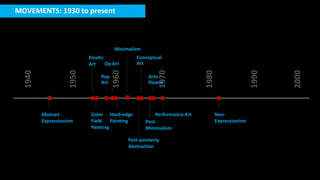
  • 137.
    CONCEPTUAL ART Groundbreaking Works JosephKosuth Oneand Three Chairs 1953. Wood folding chair, mounted photographof a chair, and photographicenlargement of a dictionary definition of "chair" A physical chair sits between a to-scale photograph of a chair and a printed definition of the word "chair." Emblematic of Conceptual art, One and Three Chairs makes people question what constitutes the art - the object, the idea, the photograph, or a combination of all three. Joseph Kosuth once wrote, "The art I call conceptual is such because it is based on an inquiry into the nature of art. Thus, it is..a thinking out of all the implications, of all aspects of the concept 'art.'" With this work, not only is the nature of art in question, but also the authenticity of the objects he has chosen to display. The title evokes the question: is there only one chair or three? And if the answer is the latter, we have just redefined the concept of "chair."
  • 138.
    POST MINIMALISM 1966 - Bornalmost simultaneously in the mid-1960s with the movement that fathered it, Minimalism, Post-Minimalism was less a coherent avant-garde than a splintered collection of tendencies including Process art, Performance, Land art and Body art. Post-Minimalism describes a collection of reactions against the abstraction, austerity, and formalism of the Minimalist style. But it also describes work that extended its ideas: some Process artists pushed further its interests in the materiality of sculpture; some elaborated its notion that sculpture could expand beyond the object – they developed new ideas about the placement of sculpture, and pioneered Land art; and others, including many feminist artists, reintroduced qualities of emotional expression into Minimalism’s highly impersonal style.
  • 139.
    POST MINIMALISM Major Works BruceNauman The True Artist Helps the World by Revealing Mystic Truths, (Window or Wall Sign) 1967. Neon tubing and clear glass tubing This seminal work was created in the studio Nauman established in an abandoned grocery store in San Francisco and modeled after the neon advertisement signs nearby. It acts as an advertisement of a different kind. Its colorful, circular text proclaims the words of the title: "The True Artist Helps the World by Revealing Mystic Truths." It is characteristic of Nauman's early neon works, and typical of the tone of dry satire in much of his oeuvre. Commenting on high art in the materials of low culture and advertising, it sets up a clash that questions old assumptions about the purpose of art and artists, like are artists just ordinary salesmen? One might say that the piece is Post-Minimalist simply by virtue of standing at the borders of so many different styles and approaches of the period, borrowing from Pop art's interest in advertising, and Conceptual art's interest in language.
  • 140.
    POST MINIMALISM Major Works RichardLong A Line Made by Walking 1967. Photographand pencil on board A Line Made by Walking is highly characteristic of the conceptual Earth art created by British artist Richard Long. In making a line across the grass by the simple act of walking, Long creates a type of drawing-without- drawing, doing away completely with the conventional tools and using instead his body and nature. Abandoning the traditional art object in this way is typical of Post- Minimalism, as is the way in which Long's line draws attention to the passing of time and the specific, fleeting moment in which the line was made.
  • 141.
    ART POVERA 1962 –1972 The Arte Povera ("poor art") movement emerged in 1960s Italy, when an artist collective adopted a radical stance against all established modes of aesthetic order and widely accepted artistic taste. A key influencer of the movement was Italian art critic Germano Celant, whose 1967 book, Arte Povera, promoted ideas of a new art, free from convention. Prominent Arte Povera artists, such as Alighiero Boetti, Jannis Kounellis, Mario Merz and Michelangelo Pistoletto, practiced everything from painting and embroidery to conceptual art and performance, all designed to represent an utterly original phase in modern art, away from the dominance of pure abstraction. The artists' common ground was a stance against a market-driven art world, wherein the need for commerce trumped the importance of individual expression.
  • 142.
    ART POVERA Major Works LucianoFabro FloorTautology 1967. Floor, newspapers By the time he joined the Arte Povera group, Luciano Fabro was already a well-known artist associated with the likes of Piero Manzoni and Lucio Fontana, two important precursors of the movement. His Floor Tautology involves an area of floor, kept polished and covered with newspapers to dry. Shown in Germano Celant's first survey of Arte Povera, Fabro's celebration of an ordinary task was instrumental in his attempt to recalibrate the concept of fine art. The elevation of a duty associated with housework - and most often coded as women's work - became a theme in his later pieces that utilized bed sheets and other fabrics.
  • 143.
    ART POVERA Major Works MarioMerz Giap's Igloo 1968. Metal tubing, wire mesh, neon tubing, dirt in bags, batteries, accumulators Mario Merz held the distinction of being the oldest of the Arte Povera artists; he was also married to the group's only female member, Marisa Merz. In the first of his signature igloos, Merz uses a phrase taken from a Vietnamese military general: "Se il nemico si concentra perde terreno se il disperde perde forza" ("If the enemy masses his forces, he loses ground; if he scatters, he loses strength"). Merz's igloos provide a focus for his preoccupation with the necessities of life - shelter, warmth, and food - though, as here, they also often contain neon tubes that suggest more sophisticated and modern experiences, such as those of advertising and consumption.
  • 144.
    PERFORMANCE ART 1910 - Performancewas first embraced by Futurism and Dada, but it has been exploited by many avant-gardes. It flourished as a movement itself in the 1960s and found exponents internationally. Performance art of this period was particularly focused on the body and is often referred to as Body Art. Performance is a genre in which art is presented "live," usually by the artist but sometimes with collaborators or performers. Artists have turned to it whenever they have become disenchanted with conventional media such as painting and sculpture, and are seeking to rejuvenate art. In the 1960s, the movement reflected widespread attempts to escape the boundaries of the traditional art object. In some ways it extended the “action painting” of the Abstract Expressionists, in other ways it gave expression to politics, to the rise of feminism and the anti-war movement.
  • 145.
    NEO-EXPRESSIONISM LATE 1970s –EARLY 1990s Neo-Expressionism can be traced to the rise of German artist Georg Baselitz and his Neue Wilden group from the late 1960s, but it flourished internationally in the 1980s. Disaffected with the intellectualism of Minimalism and Conceptual Art, many artists returned to painting in an expressionist style which reasserted the creative power of the individual. This took place almost simultaneously throughout the world and was marked by interests in primitivism, graffiti, and the revival of historical styles.
  • 146.
    NEO-EXPRESSIONISM Major Works Jean-MichelBasquiat MonaLisa 1983. Acrylicand oil stick on canvas This provocative painting is both a satirical homage to Leonardo's Mona Lisa and a work of political commentary on the converging worlds of art and money. Basquiat's depiction of a warpedMona Lisa smile fixed within a dollar bill frame was the artist's way of saying that, even though art and money are essentially different things, they are both forms of currency. Like most of his paintings, there is a visible urgency to Basquiat's brush strokes and thick oil stick lines, as if he were applying these fleeting mental images onto the canvas before they vanished altogether.
  • 147.
    NEO-EXPRESSIONISM Major Works AnselmKiefer Zim Zum 1990.Acrylic, emulsion, crayon, shellac, ashes, and canvas on lead Kiefer's Neo-Expressionist works are marked by a dark, almost post-apocalyptic bleakness; topographies that have been ravished and fractured by war.With Zim Zum, his forms are enigmatic, yet at the same time eerily recognizable, as if he were imagining these quasi-abstract scenes for the viewer and creating fields of tone, form and destitution.
  • 148.
    NEO-EXPRESSIONISM Major Works Francesco Clemente ScissorsandButterflies 1999. Oil on linen. Clemente was one of the few Italian painters who was a part of the international array of Neo- Expressionist artists. Employing a highly sensual style with quasi-abstract forms combining human and animal figures, Clemente mixed elements of erotica with red-hot anger in this 1999 work. As was typical of his work, a metamorphosis takes place. In Scissors and Butterflies, these metamorphoses occur between human and animal, the feminine and masculine, the violent and the sexual. These inner conflicts of existential expressiveness are often found in Neo-Expressionism.
  • 149.
    IMPASTO Painting thatapplies the pigment thickly so that brush or palette knife marks are visible JAPONSIM OR JAPONISME Ageneral term for the influence of the arts of Japan on those of the West, whereas in France, Japonisme is applied to such influence and is in addition the name of a specific French style (late 1800s). ARTS AND CRAFTS An international design movement that flourished between 1860 and 1910, that stood for traditional craftsmanship using simple forms and often applied medieval, romantic or folk styles of decoration and advocated economic and social reform and has been said to be essentially anti-industrial. GLOSSARY
  • 150.