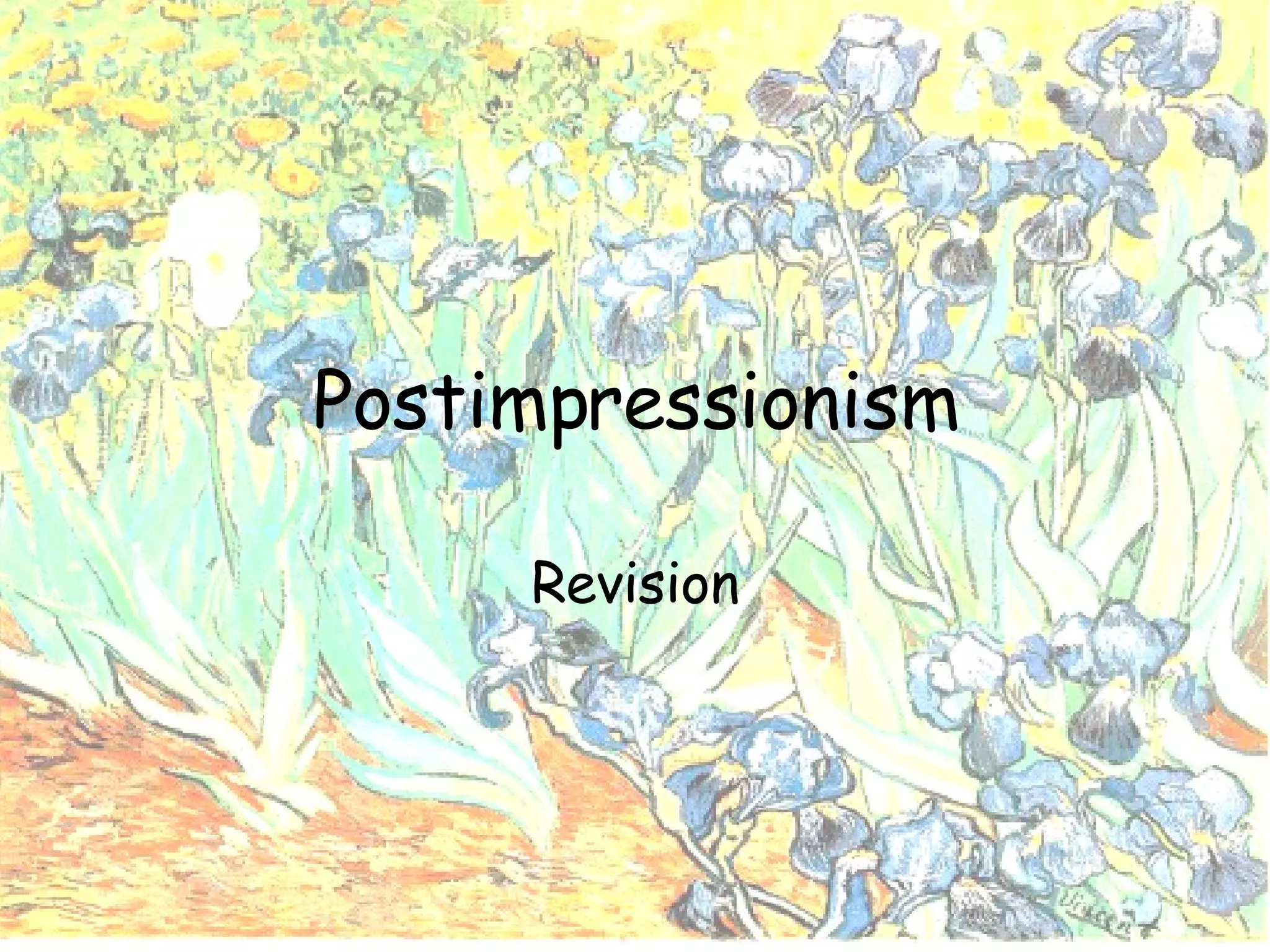
Postimpressionism Revision
Postimpressionism The development of the  Impressionism led to forms being dissolved and the loss of the drawing  At the end of the 19th century and beginning of the 20th other painters, starting from the impressionism, it developed a more personal style, that is going to be the advance of some of the pictorial movements of the 29th century.
Postimpressionism Some of the characteristics of the movement are: The recovery of the importance of drawing The worry about capturing not only the light but also expression of both, things and people
General characteristics Interest in building the shape, the drawing and the expression of objects and human images Equilibrium between the volume and the pure aesthetic taste (Cezanne)
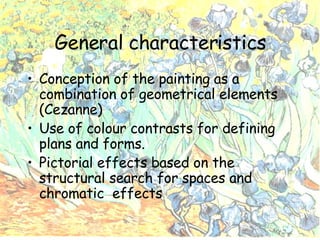
General characteristics Conception of the painting as a combination of geometrical elements (Cezanne) Use of colour contrasts for defining plans and forms. Pictorial effects based on the structural search for spaces and chromatic  effects
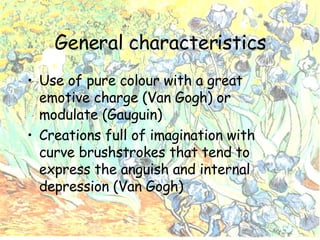
General characteristics Use of pure colour with a great emotive charge (Van Gogh) or modulate (Gauguin) Creations full of imagination with curve brushstrokes that tend to express the anguish and internal depression (Van Gogh)
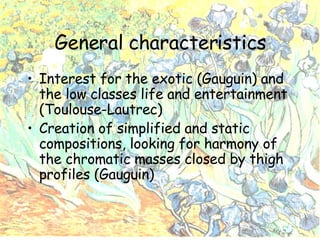
General characteristics Interest for the exotic (Gauguin) and the low classes life and entertainment (Toulouse-Lautrec) Creation of simplified and static compositions, looking for harmony of the chromatic masses closed by thigh profiles (Gauguin)
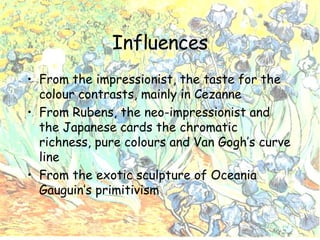
Influences From the impressionist, the taste for the colour contrasts, mainly in Cezanne From Rubens, the neo-impressionist and the Japanese cards the chromatic richness, pure colours and Van Gogh’s curve line From the exotic sculpture of Oceania Gauguin’s primitivism
Painters Gauguin: He began in the Impressionism with Pisarro He abandoned the comfort of his life to live in Paris, Bretagne and Tahiti In Tahiti he painted his series of Tahitian women
Painters He made an expressive use of colour, in strong tonalities, lively and frequently arbitrary  He painted big plans limited by curved lineal rhythms He had to main subjects: The Tahitian exotism The primitivism of Bretagne
Painters His work is a reference for the symbolism  His sense of colour was influential on fauves and expressionists He renounced to the perspective He suppressed the model and shades and identified the sense of flat the same as in Japanese painting.
Painters Cezanne: His painting recovered the volume thanks to the geometry, drawing and the definition of the forms through the building brushstrokes He did not renounce to the colour of high intensity with contrasts and coloured shades.
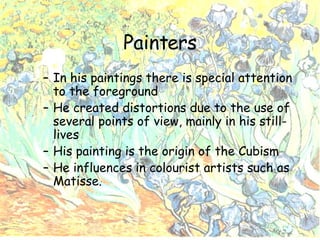
Painters In his paintings there is special attention to the foreground He created distortions due to the use of several points of view, mainly in his still-lives His painting is the origin of the Cubism He influences in colourist artists such as Matisse.
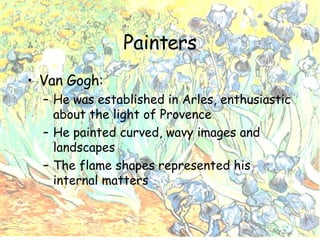
Painters Van Gogh: He was established in Arles, enthusiastic about the light of Provence He painted curved, wavy images and landscapes The flame shapes represented his internal matters
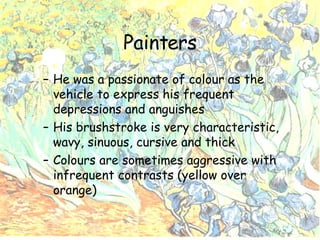
Painters He was a passionate of colour as the vehicle to express his frequent depressions and anguishes His brushstroke is very characteristic, wavy, sinuous, cursive and thick  Colours are sometimes aggressive with infrequent contrasts (yellow over orange)
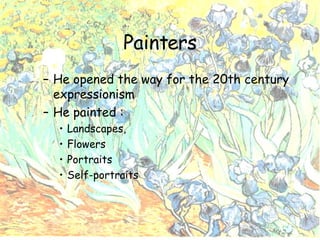
Painters He opened the way for the 20th century expressionism He painted : Landscapes,  Flowers Portraits Self-portraits
Painters Toulouse-Lautrec: He reflected the atmosphere of night clubs: Dancers Singers Prostitutes He was the impellor of wall adverts
Painters In his technique the characteristics are: Drawing technique Caption of movement Ironical charge Caricature  Flat representations.

Post-Impressionism

  • 1.
  • 2.
    Postimpressionism The developmentof the Impressionism led to forms being dissolved and the loss of the drawing At the end of the 19th century and beginning of the 20th other painters, starting from the impressionism, it developed a more personal style, that is going to be the advance of some of the pictorial movements of the 29th century.
  • 3.
    Postimpressionism Some ofthe characteristics of the movement are: The recovery of the importance of drawing The worry about capturing not only the light but also expression of both, things and people
  • 4.
    General characteristics Interestin building the shape, the drawing and the expression of objects and human images Equilibrium between the volume and the pure aesthetic taste (Cezanne)
  • 5.
    General characteristics Conceptionof the painting as a combination of geometrical elements (Cezanne) Use of colour contrasts for defining plans and forms. Pictorial effects based on the structural search for spaces and chromatic effects
  • 6.
    General characteristics Useof pure colour with a great emotive charge (Van Gogh) or modulate (Gauguin) Creations full of imagination with curve brushstrokes that tend to express the anguish and internal depression (Van Gogh)
  • 7.
    General characteristics Interestfor the exotic (Gauguin) and the low classes life and entertainment (Toulouse-Lautrec) Creation of simplified and static compositions, looking for harmony of the chromatic masses closed by thigh profiles (Gauguin)
  • 8.
    Influences From theimpressionist, the taste for the colour contrasts, mainly in Cezanne From Rubens, the neo-impressionist and the Japanese cards the chromatic richness, pure colours and Van Gogh’s curve line From the exotic sculpture of Oceania Gauguin’s primitivism
  • 9.
    Painters Gauguin: Hebegan in the Impressionism with Pisarro He abandoned the comfort of his life to live in Paris, Bretagne and Tahiti In Tahiti he painted his series of Tahitian women
  • 10.
    Painters He madean expressive use of colour, in strong tonalities, lively and frequently arbitrary He painted big plans limited by curved lineal rhythms He had to main subjects: The Tahitian exotism The primitivism of Bretagne
  • 11.
    Painters His workis a reference for the symbolism His sense of colour was influential on fauves and expressionists He renounced to the perspective He suppressed the model and shades and identified the sense of flat the same as in Japanese painting.
  • 12.
    Painters Cezanne: Hispainting recovered the volume thanks to the geometry, drawing and the definition of the forms through the building brushstrokes He did not renounce to the colour of high intensity with contrasts and coloured shades.
  • 13.
    Painters In hispaintings there is special attention to the foreground He created distortions due to the use of several points of view, mainly in his still-lives His painting is the origin of the Cubism He influences in colourist artists such as Matisse.
  • 14.
    Painters Van Gogh:He was established in Arles, enthusiastic about the light of Provence He painted curved, wavy images and landscapes The flame shapes represented his internal matters
  • 15.
    Painters He wasa passionate of colour as the vehicle to express his frequent depressions and anguishes His brushstroke is very characteristic, wavy, sinuous, cursive and thick Colours are sometimes aggressive with infrequent contrasts (yellow over orange)
  • 16.
    Painters He openedthe way for the 20th century expressionism He painted : Landscapes, Flowers Portraits Self-portraits
  • 17.
    Painters Toulouse-Lautrec: Hereflected the atmosphere of night clubs: Dancers Singers Prostitutes He was the impellor of wall adverts
  • 18.
    Painters In histechnique the characteristics are: Drawing technique Caption of movement Ironical charge Caricature Flat representations.