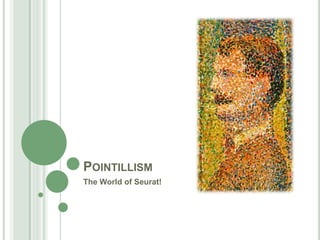
POINTILLISM
The World of Seurat!
PRINCIPLES OF DESIGN
   Movement: shows actions or the path the viewer's
    eye follows throughout an artwork. In movement,
    the art should flow because the artist has the ability
    to control the viewer's eye. The artists control what
    the viewers see and how they see it, like a path
    leading across the page to the item the artist wants
    the viewer's attention focused on.

   Harmony: achieved in a body of work by using
    similar elements throughout the work, harmony
    gives an uncomplicated look to a piece of artwork
    or sculpture.
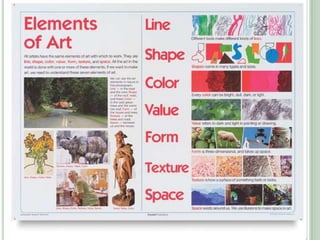
ELEMENTS OF ART
   Color: Comes from the three primaries and black and
    white. They have three properties – hue, value, and
    intensity.
   Shape: Pertains to the use of areas in two dimensional
    space that can be defined by edges, setting one flat
    specific space apart from another. Shapes can be
    geometric (e.g.: square, circle, triangle, hexagon, etc.)
    or organic (such as the shape of a puddle, blob, leaf,
    boomerang, etc.) in nature.
   Space: Area provided for a particular purpose. Space
    includes the background, foreground and middle
    ground. Space refers to the distances or areas around,
    between or within components of a piece.
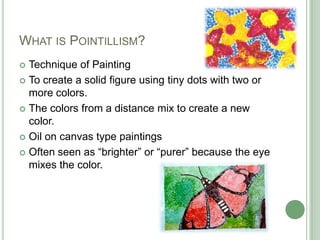
WHAT IS POINTILLISM?
 Technique of Painting
 To create a solid figure using tiny dots with two or
  more colors.
 The colors from a distance mix to create a new
  color.
 Oil on canvas type paintings

 Often seen as “brighter” or “purer” because the eye
  mixes the color.
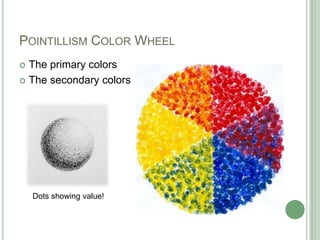
POINTILLISM COLOR WHEEL
 The primary colors
 The secondary colors


    Dots showing value!
YOUR EYE IS PLAYING TRICKS!
   The primary colors that are painted near one
    another can show a whole different color from the
    distance!
       THINK ABOUT YOUR TELEVISION!
FACTS OF POINTILLISM!
 Developed by Georges Seurat in 1886
 As well as his followers in 19th century
  France
 Post-Impressionist Movement
       Extended Impressionism while rejecting its
        limitations: they continued using vivid
        colors, thick application of paint, distinctive
        brush strokes, and real-life subject matter,
        but they were more likely to emphasize
        geometric forms, to distort form for
        expressive effect, and to use unnatural
        color.
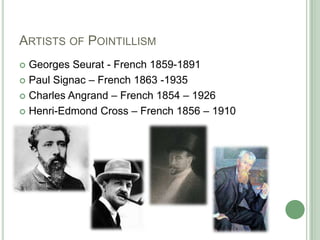
ARTISTS OF POINTILLISM
 Georges Seurat - French 1859-1891
 Paul Signac – French 1863 -1935

 Charles Angrand – French 1854 – 1926

 Henri-Edmond Cross – French 1856 – 1910
SEURAT – “A SUNDAY ON LA GRANDE JATTE
WHAT DO YOU THINK?
Over the past several decades,
 many scholars have attempted to
 explain the meaning of this great
 painting. For some, it shows the
 growing middle class at leisure.
 Others think it shows social
 tensions between city dwellers of
 different social classes, all of
 whom gather in the same public
 space but do not interact.
                       http://www.youtube.com/watch?v=_a0atJIN
                       FAI&feature=related
SEURAT – “BANKS OF SEINE”
SEURAT – “THE CIRCUS”
PAUL SIGNAC – “PORT ST. TROPEZ”
CHARLES ANGRAND – “LE PETIT PORT”
HENRI EDMOND CROSS – “PAYSAGE AVEC LE CAP NÈGRE’’
STUDIO TIME
 First, Find a Landscape Image in a Magazine
 Draw it out!
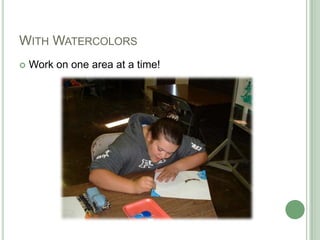
WITH WATERCOLORS
   Work on one area at a time!
COLORS
   Do not mix your colors!


                              http://www.youtube.com/watch?v=lxMT
                              KSp_TsY&NR=1&feature=endscreen

Pointillism

  • 1.
  • 2.
    PRINCIPLES OF DESIGN  Movement: shows actions or the path the viewer's eye follows throughout an artwork. In movement, the art should flow because the artist has the ability to control the viewer's eye. The artists control what the viewers see and how they see it, like a path leading across the page to the item the artist wants the viewer's attention focused on.  Harmony: achieved in a body of work by using similar elements throughout the work, harmony gives an uncomplicated look to a piece of artwork or sculpture.
  • 3.
    ELEMENTS OF ART  Color: Comes from the three primaries and black and white. They have three properties – hue, value, and intensity.  Shape: Pertains to the use of areas in two dimensional space that can be defined by edges, setting one flat specific space apart from another. Shapes can be geometric (e.g.: square, circle, triangle, hexagon, etc.) or organic (such as the shape of a puddle, blob, leaf, boomerang, etc.) in nature.  Space: Area provided for a particular purpose. Space includes the background, foreground and middle ground. Space refers to the distances or areas around, between or within components of a piece.
  • 5.
    WHAT IS POINTILLISM? Technique of Painting  To create a solid figure using tiny dots with two or more colors.  The colors from a distance mix to create a new color.  Oil on canvas type paintings  Often seen as “brighter” or “purer” because the eye mixes the color.
  • 6.
    POINTILLISM COLOR WHEEL The primary colors  The secondary colors Dots showing value!
  • 7.
    YOUR EYE ISPLAYING TRICKS!  The primary colors that are painted near one another can show a whole different color from the distance!  THINK ABOUT YOUR TELEVISION!
  • 8.
    FACTS OF POINTILLISM! Developed by Georges Seurat in 1886  As well as his followers in 19th century France  Post-Impressionist Movement  Extended Impressionism while rejecting its limitations: they continued using vivid colors, thick application of paint, distinctive brush strokes, and real-life subject matter, but they were more likely to emphasize geometric forms, to distort form for expressive effect, and to use unnatural color.
  • 9.
    ARTISTS OF POINTILLISM Georges Seurat - French 1859-1891  Paul Signac – French 1863 -1935  Charles Angrand – French 1854 – 1926  Henri-Edmond Cross – French 1856 – 1910
  • 10.
    SEURAT – “ASUNDAY ON LA GRANDE JATTE
  • 11.
    WHAT DO YOUTHINK? Over the past several decades, many scholars have attempted to explain the meaning of this great painting. For some, it shows the growing middle class at leisure. Others think it shows social tensions between city dwellers of different social classes, all of whom gather in the same public space but do not interact. http://www.youtube.com/watch?v=_a0atJIN FAI&feature=related
  • 12.
  • 13.
  • 14.
    PAUL SIGNAC –“PORT ST. TROPEZ”
  • 15.
    CHARLES ANGRAND –“LE PETIT PORT”
  • 16.
    HENRI EDMOND CROSS– “PAYSAGE AVEC LE CAP NÈGRE’’
  • 17.
    STUDIO TIME  First,Find a Landscape Image in a Magazine  Draw it out!
  • 18.
    WITH WATERCOLORS  Work on one area at a time!
  • 19.
    COLORS  Do not mix your colors! http://www.youtube.com/watch?v=lxMT KSp_TsY&NR=1&feature=endscreen