Look at the
way the artist
used the
medium.
-Describe the
way the
medium was
used in one
sentence.
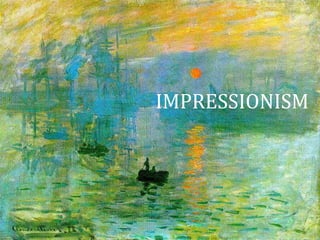
IMPRESSIONISM
IMPRESSIONISM
A 19th-century art movement that originated
with a group of Paris-based artists. Their
independent exhibitions made them popular
during the 1870s and 1880s, in spite of harsh
opposition from the conventional, realistic art
community in France. Instead, colors are applied
side-by-side with as little mixing as possible,
creating a vibrant surface while focusing on the
play of light.
Impressionism Characteristics
1. Short, thick strokes of paint/pastel that quickly capture the essence of the
subject, rather than its details.
2. By using pure, unblended colors, the optical mixing of colors occurs in the eye
of the viewer by placing colors side by side.
3. Grays and dark tones are produced by mixing complementary colors.
4. Rather than neutral white, grays, and blacks, Impressionists often rendered
shadows and highlights in color. Pure impressionism avoids the use of black
paint.
5. The play of natural light is emphasized. Close attention is paid to the
reflection of colors from object to object.
6. In paintings made en plein air (outdoors), shadows are boldly painted with
the blue of the sky as it is reflected onto surfaces, giving a sense of freshness
previously not represented in painting. (Blue shadows on snow inspired the
technique.)
7. Impressionist often worked in the evening to produce effets de soir—the
shadowy effects of evening or twilight.
The artists' loose brushwork gives an effect of spontaneity and
effortlessness that masks their often carefully constructed
compositions, such as: Alfred Sisley (1878)-
Allée of Chestnut Trees
History of Impressionism
• In 1874, a group of artists called the Anonymous
Society of Painters, Sculptors, Printmakers, etc.
organized an exhibition in Paris that launched the
movement called Impressionism. They broke free from
the Salon and the Royal Academy.
• Its founding members included Claude Monet and
Edgar Degas, among others.
• While conservative critics panned their work for its
unfinished, sketch-like appearance, more progressive
writers praised it for its depiction of modern life.
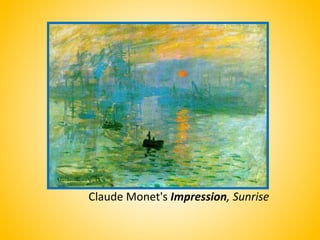
• Claude Monet's Impression, Sunrise, exhibited in 1874,
gave the Impressionist movement its name when the
critic Louis Leroy accused it of being a sketch or
"impression," not a finished painting.
Claude Monet's Impression, Sunrise
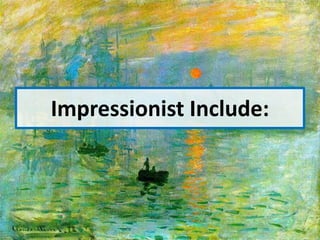
Impressionist Include:
Claude Monet (1840–1926): the most prolific of the
Impressionists and the one who embodies their
aesthetic most obviously
Red Boats at Argenteuil
Edgar Degas (1834–1917)
He despised the term Impressionist . He also differed from the
Impressionists in that he "never adopted the Impressionist color
fleck",[and he disliked painting en plein air.
Blue Dancers; c. 1899
Paul Cézanne (1839–1906): Cézanne can be said to form
the bridge between late 19th-century Impressionism and
the early 20th century's new line of artistic enquiry, Cubism.
The Basket of Apples
Mary Cassatt (1844–1926): American-born, she lived in Paris and
participated in four Impressionist exhibitions. She also introduced
pastels as a main for of medium to the United States.
Breakfast in Bed
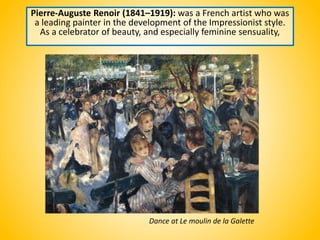
Pierre-Auguste Renoir (1841–1919): was a French artist who was
a leading painter in the development of the Impressionist style.
As a celebrator of beauty, and especially feminine sensuality,
Dance at Le moulin de la Galette
Édouard Manet (1832–1883): Though he did not participate
in any of the Impressionist exhibitions, he was a pivotal figure
in the transition from Realism to Impressionism.
The Grand Canal of Venice
Dance at Le moulin de la Galette
Berthe Morisot (1841–1895): Protégé of Édouard Manet. The
leading female Impressionist painter; breaking barriers for
female artists.
The Cradle
Dance at Le moulin de la Galette
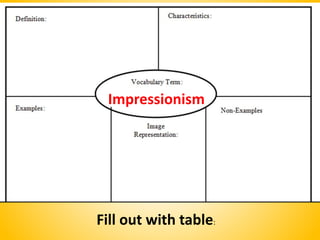
Impressionism
Fill out with table:

Impressionism

  • 1.
    Look at the waythe artist used the medium. -Describe the way the medium was used in one sentence.
  • 2.
  • 3.
    IMPRESSIONISM A 19th-century artmovement that originated with a group of Paris-based artists. Their independent exhibitions made them popular during the 1870s and 1880s, in spite of harsh opposition from the conventional, realistic art community in France. Instead, colors are applied side-by-side with as little mixing as possible, creating a vibrant surface while focusing on the play of light.
  • 4.
    Impressionism Characteristics 1. Short,thick strokes of paint/pastel that quickly capture the essence of the subject, rather than its details. 2. By using pure, unblended colors, the optical mixing of colors occurs in the eye of the viewer by placing colors side by side. 3. Grays and dark tones are produced by mixing complementary colors. 4. Rather than neutral white, grays, and blacks, Impressionists often rendered shadows and highlights in color. Pure impressionism avoids the use of black paint. 5. The play of natural light is emphasized. Close attention is paid to the reflection of colors from object to object. 6. In paintings made en plein air (outdoors), shadows are boldly painted with the blue of the sky as it is reflected onto surfaces, giving a sense of freshness previously not represented in painting. (Blue shadows on snow inspired the technique.) 7. Impressionist often worked in the evening to produce effets de soir—the shadowy effects of evening or twilight.
  • 5.
    The artists' loosebrushwork gives an effect of spontaneity and effortlessness that masks their often carefully constructed compositions, such as: Alfred Sisley (1878)- Allée of Chestnut Trees
  • 6.
    History of Impressionism •In 1874, a group of artists called the Anonymous Society of Painters, Sculptors, Printmakers, etc. organized an exhibition in Paris that launched the movement called Impressionism. They broke free from the Salon and the Royal Academy. • Its founding members included Claude Monet and Edgar Degas, among others. • While conservative critics panned their work for its unfinished, sketch-like appearance, more progressive writers praised it for its depiction of modern life. • Claude Monet's Impression, Sunrise, exhibited in 1874, gave the Impressionist movement its name when the critic Louis Leroy accused it of being a sketch or "impression," not a finished painting.
  • 7.
  • 8.
  • 9.
    Claude Monet (1840–1926):the most prolific of the Impressionists and the one who embodies their aesthetic most obviously Red Boats at Argenteuil
  • 10.
    Edgar Degas (1834–1917) Hedespised the term Impressionist . He also differed from the Impressionists in that he "never adopted the Impressionist color fleck",[and he disliked painting en plein air. Blue Dancers; c. 1899
  • 11.
    Paul Cézanne (1839–1906):Cézanne can be said to form the bridge between late 19th-century Impressionism and the early 20th century's new line of artistic enquiry, Cubism. The Basket of Apples
  • 12.
    Mary Cassatt (1844–1926):American-born, she lived in Paris and participated in four Impressionist exhibitions. She also introduced pastels as a main for of medium to the United States. Breakfast in Bed
  • 13.
    Pierre-Auguste Renoir (1841–1919):was a French artist who was a leading painter in the development of the Impressionist style. As a celebrator of beauty, and especially feminine sensuality, Dance at Le moulin de la Galette
  • 14.
    Édouard Manet (1832–1883):Though he did not participate in any of the Impressionist exhibitions, he was a pivotal figure in the transition from Realism to Impressionism. The Grand Canal of Venice Dance at Le moulin de la Galette
  • 15.
    Berthe Morisot (1841–1895):Protégé of Édouard Manet. The leading female Impressionist painter; breaking barriers for female artists. The Cradle Dance at Le moulin de la Galette
  • 16.