FAUVISM
Fauvism
Style of French painting from c. 1898 to 1906 characterized by a
violence of colours, often applied unmixed from commercially
produced tubes of paint in broad flat areas, by a spontaneity
and even roughness of execution and by a bold sense of surface
design.
Fauvism
It was the first of a succession of avant-garde movements in
20th-century art and was influential on near-contemporary and
later trends such as Expressionism, Orphism and the
development of abstract art.
Fauvism
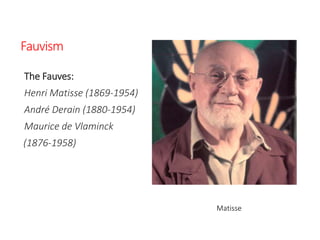
The Fauves:
Henri Matisse (1869-1954)
André Derain (1880-1954)
Maurice de Vlaminck
(1876-1958)
Matisse
Fauvism
"My choice of colors does not rest on
any scientific theory; it is based on
observation, on sensitivity, on felt
experience."
– Henri Matisse
Fauvism
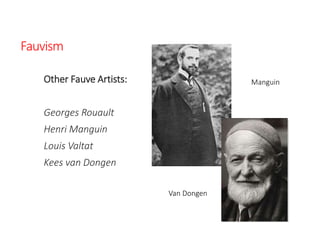
Other Fauve Artists:
Georges Rouault
Henri Manguin
Louis Valtat
Kees van Dongen
Manguin
Van Dongen
Fauvism
Fauvism wasn't officially a movement. It had no written
guidelines or manifesto, no membership roster, and no
exclusive group exhibitions.
"Fauvism" is simply a word of periodization used in
place of: "An assortment of painters who were loosely
acquainted with one another, and experimented with
color in roughly the same way at roughly the same
time."
Fauvism
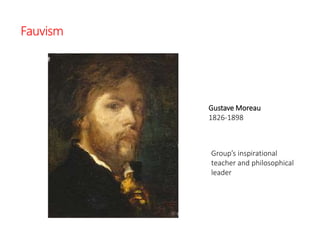
Gustave Moreau
1826-1898
Group’s inspirational
teacher and philosophical
leader
Fauvism
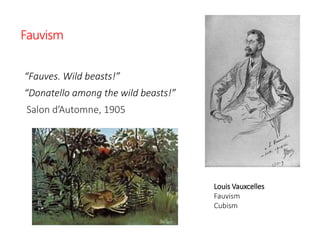
“Fauves. Wild beasts!”
“Donatello among the wild beasts!”
Salon d’Automne, 1905
Louis Vauxcelles
Fauvism
Cubism
Fauvism
Key characteristics:
COLOR –vivid, raw, pure colors
Andre Derain
Maurice de Vlaminck
oil on cardboard
1906
Fauvism
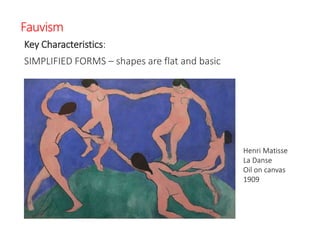
Key Characteristics:
SIMPLIFIED FORMS – shapes are flat and basic
Henri Matisse
La Danse
Oil on canvas
1909
Fauvism
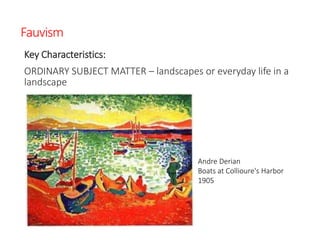
Key Characteristics:
ORDINARY SUBJECT MATTER – landscapes or everyday life in a
landscape
Andre Derian
Boats at Collioure's Harbor
1905
Fauvism
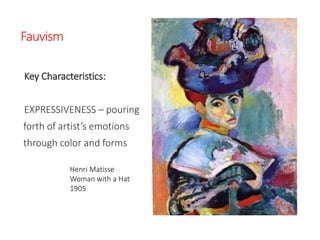
Key Characteristics:
EXPRESSIVENESS – pouring
forth of artist’s emotions
through color and forms
Henri Matisse
Woman with a Hat
1905
Fauvism
Influences:
Georges Seurat
Paul Signac
Henri Matisse
Luxury, Calm and Pleasure
1904
Fauvism
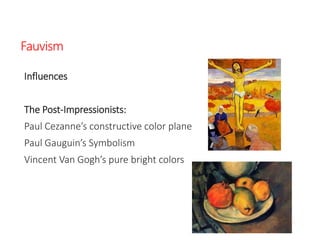
Influences
The Post-Impressionists:
Paul Cezanne’s constructive color plane
Paul Gauguin’s Symbolism
Vincent Van Gogh’s pure bright colors
Fauvism
Movements, styles and artists influenced by Fauvism:
German Expressionists (Max Beckmann, Oskar Kokoschka, Egon
Schiele, George Baselitz)
Abstract Expressionists (Pollock, Rothko, etc.)
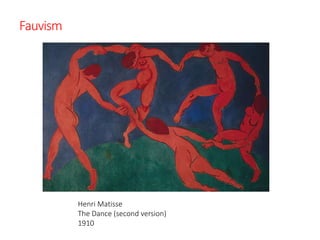
Fauvism
Henri Matisse
The Dance (second version)
1910
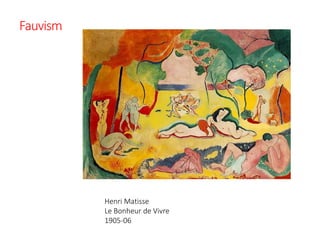
Fauvism
Henri Matisse
Le Bonheur de Vivre
1905-06
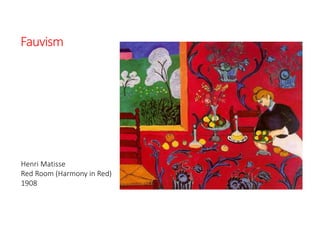
Fauvism
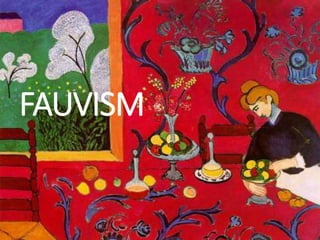
Henri Matisse
Red Room (Harmony in Red)
1908
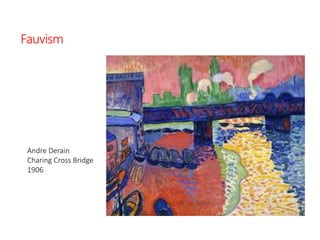
Fauvism
Andre Derain
Charing Cross Bridge
1906
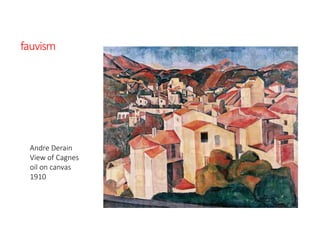
fauvism
Andre Derain
View of Cagnes
oil on canvas
1910
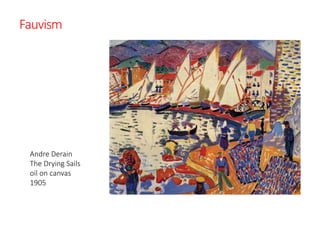
Fauvism
Andre Derain
The Drying Sails
oil on canvas
1905
Fauvism
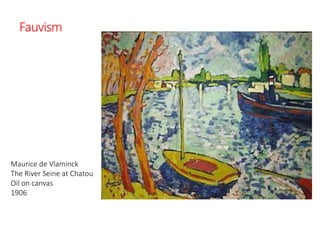
Maurice de Vlaminck
The River Seine at Chatou
Oil on canvas
1906
Fauvism
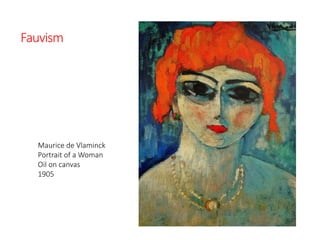
Maurice de Vlaminck
Portrait of a Woman
Oil on canvas
1905
Fauvism
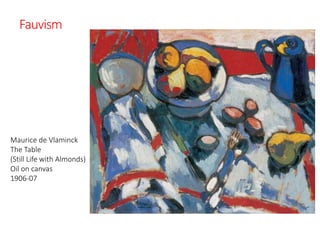
Maurice de Vlaminck
The Table
(Still Life with Almonds)
Oil on canvas
1906-07
Fauvism
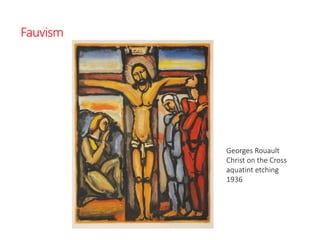
Georges Rouault
Christ on the Cross
aquatint etching
1936
Fauvism
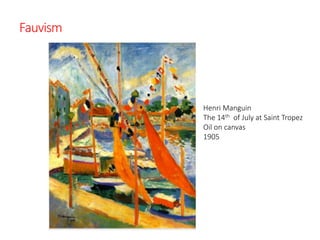
Henri Manguin
The 14th of July at Saint Tropez
Oil on canvas
1905
Fauvism
Derain -- after a brief flirtation with Cubism, became a widely
popular painter in a somewhat neoclassical manner.
Matisse -- pursued the course he had pioneered, achieving a
sophisticated balance between his own emotions and the world
he painted.
*Braque -- cofounder of Cubism along with Picasso
Fauvism
For most of these artists, Fauvism was a transitional,
learning stage.
By 1908, a revived interest in Paul Cézanne's vision of
the order and structure of nature had led many of them
to reject the turbulent emotionalism of Fauvism in favor
of the logic of Cubism.

Fauvism