Impressionism
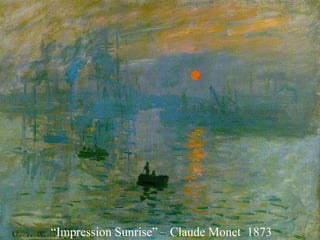
“ Impression Sunrise” – Claude Monet  1873
“ Ballet Rehearsal on the Stage”  - Edgar Degas 1874
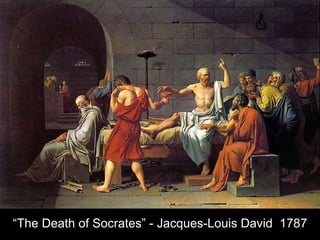
“ The Death of Socrates” - Jacques-Louis David  1787
“ Liberty Leading the People” – Eugene Delacroix  1830
“ The Stone Breakers”  - Gustave Courbet  1850
“ The Painter's Studio” - Gustave Courbet  1855
“ Portrait of Charles Baudelaire” – Gustave Courbet  1848
“ Edouard Manet” –  Henri Fantin-Latour  1867
“ Music in the Tuileries” – Edouard Manet  1862
“ Luncheon on the Grass” – Edouard Manet  1863
“ Olympia” – Edouard Manet  1863
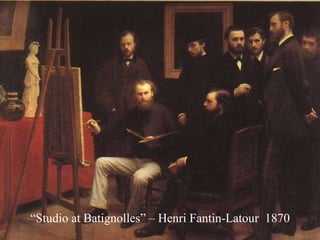
“ Studio at Batignolles” – Henri Fantin-Latour  1870
“ Impression Sunrise” – Claude Monet  1873
“ The Terrace at St. Adresse” – Claude Monet  1867
Rouan Cathedral series – Claude Monet  1892
“ Woman of Algiers” – Pierre-Auguste Renoir  1870 or  “Odalisque”
“ The Ball at Moulin de la Galette” – Pierre-Auguste Renoir  1876
“ La Loge” –  Pierre-Auguste Renoir  1874
“ The Bar at the Folies Bergere” – Edouard Manet  1882
“ Ballet Rehearsal on the Stage”  - Edgar Degas 1874
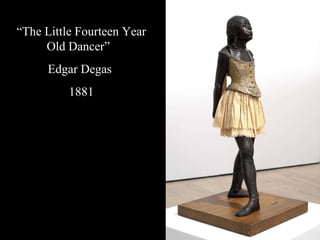
“ The Little Fourteen Year Old Dancer”  Edgar Degas  1881
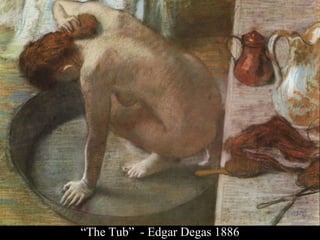
“ The Tub”  - Edgar Degas 1886
“ Tea” Mary Cassatt - 1880
“ Interior” Berthe Morisot - 1872
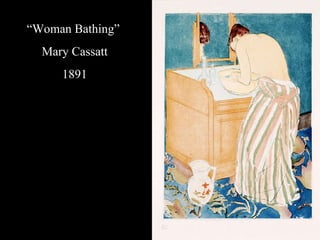
“ Woman Bathing”  Mary Cassatt 1891
“ Not Stupid Enough” Barbara Kruger 1997
“ Untitled” Mark Rothko
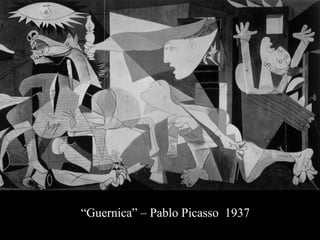
“ Guernica” – Pablo Picasso  1937
“ The More the Better:  Three channel video installation with 1,003 monitors and steel structure”  Nam June Paik 1988
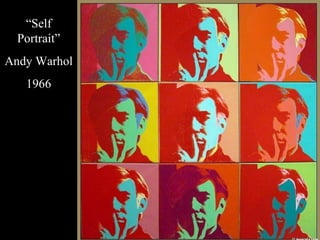
“ Self Portrait” Andy Warhol 1966
“ Canal Street” – Robert Frank 1958
“ Fountain” Marcel Duchamp 1917
END

Impressionism

Editor's Notes

  • #31 That the function of art is to address the contemporary. To raise challenging issues and ask difficult questions of the artist, society and the viewer. Barbara Kruger in using mass media style raises questions of identity and self-definition and the way that media is involved in the process of defining the self.
  • #32 That the perspective of the artist is as important as what they are depicting , sometimes more so. Rothko, in completely abstract paintings, with no representation whatsoever, addresses his inner emotional and spiritual state. The subjective view of the artist is the subject of the art.
  • #33 That art does NOT have to be concerned with replicating reality as it appears to the eye. That sometimes what is most meaningful to say is best communicated through forms that suggest another level of reality rather than literal depiction. Picasso addresses the bombing of a village and the horror of the massacre in ways that address more than could be done with literal representation.
  • #34 The idea that the medium of art itself could be the subject of the art. That it wasn’t simply an invisible method to communicate an idea, but that the medium itself IS the content. Nam June Paik uses the very material of televisions and media to comment on the pervasiveness of video in out culture and our attitudes toward it.
  • #35 Separated art from the patronage system and developed the relationship of artist/critic/dealer . Art and artists could be marketed and sold, and even in the case of Andy Warhol duplicated quickly for consumption. His studio called “The Factory.” Even though this has its problems, it puts more control in the hands of the artist, and allows for more people to be involved in the consumption of art. One step in the democratization of art.
  • #36 Democratization of art . Art could be produced by anyone, about anyone, and for anyone. Frank portrays rough candid shots of common people, addressing and crossing economic, social and racial boundary lines. The art of photography is much more democratic in that almost anyone can participate in the production of it. Since they can be easily reproduced they can be purchased cheaply, allowing access to art for almost anyone. The movement by Impressionism away from academic art and toward an art that represents normal people, made art accessible to the public at large.
  • #37 That the function of art, rather than promoting an ideas or providing an answer, can be to confront, challenge and ask questions – without providing answers . This involves the viewer rather than placing them as a passive observer. They are involved in creating meaning and struggle to provide answers. Art is about the audience, as much as the artist. Duchamp’s “Fountain” challenged every notion of what defines art and asks us to consider the question – what is art? What is its purpose? Duchamp does not provide an answer for us.