





MINIMALISM
JACOB MENDOZA
ROME BAYOLA
MIGGY JIMENEZ
INTRODUCTION
Minimalism started during the early 1960s in New York. Minimalists aims to
achieve creating art by removing suggestions of biography and metaphors of any
kind. They thought that art should not reflect the artists own personal expressions.
They pushed to create works of art that aims not to refer to anything other than
itself. They used industrial materials in order to break away from traditional
sculptures and describe these artworks in literal ways, calling them ‘modulas’ or
‘specific Objects’.
KEY IDEAS / CONCEPTS
- To make art of pure aestheticism because it was highly revolutionary that
time.
- To achieve minimalism, artists tried to remove elements of self-expressionism
like composition, themes, reference, emotion, personal expression, etc.
- The use of modern materials to break from old and traditional art style
- Creating simple sculptures and artworks made from industrial materials like
metal sheets, plywoods, and bricks.
IMPORTANT ARTWORKS
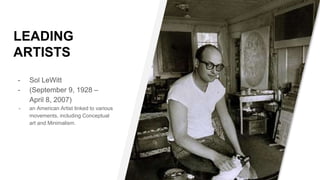
LEADING
ARTISTS
- Sol LeWitt
- (September 9, 1928 –
April 8, 2007)
- an American Artist linked to various
movements, including Conceptual
art and Minimalism.
IMPORTANT ARTWORKS
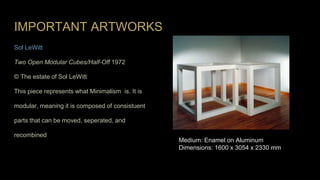
Sol LeWitt
Two Open Modular Cubes/Half-Off 1972
© The estate of Sol LeWitt
This piece represents what Minimalism is. It is
modular, meaning it is composed of consistuent
parts that can be moved, seperated, and
recombined
Medium: Enamel on Aluminum
Dimensions: 1600 x 3054 x 2330 mm
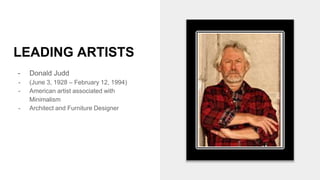
LEADING ARTISTS
- Donald Judd
- (June 3, 1928 – February 12, 1994)
- American artist associated with
Minimalism
- Architect and Furniture Designer
IMPORTANT ARTWORKS
Donald Judd
Untitled 1972
© Donald Judd Foundation
This piece shows lack of expression, with no trace
of emotion. This kind of artwork rejects the notion
of the artwork as a reflection of personal expressions
like what Minimalists we’re really trying to do, create
objects as neutral as possible.
Medium: Copper, enamel and aluminum
Dimensions: 916 x 1555 x 1782 mm
LEADING ARTISTS
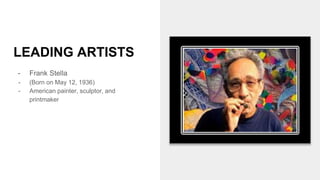
- Frank Stella
- (Born on May 12, 1936)
- American painter, sculptor, and
printmaker
IMPORTANT ARTWORKS
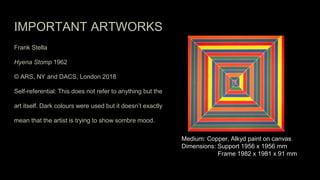
Frank Stella
Hyena Stomp 1962
© ARS, NY and DACS, London 2018
Self-referential: This does not refer to anything but the
art itself. Dark colours were used but it doesn’t exactly
mean that the artist is trying to show sombre mood.
Medium: Copper, Alkyd paint on canvas
Dimensions: Support 1956 x 1956 mm
Frame 1982 x 1981 x 91 mm
IMPORTANT ARTWORKS
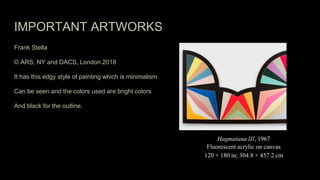
Frank Stella
© ARS, NY and DACS, London 2018
It has this edgy style of painting which is minimalism
Can be seen and the colors used are bright colors
And black for the outline.
Hagmatana III, 1967
Fluorescent acrylic on canvas
120 × 180 in; 304.8 × 457.2 cm
LEADING ARTISTS
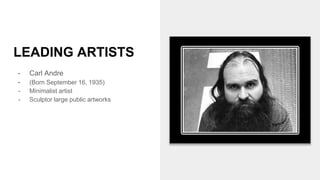
- Carl Andre
- (Born September 16, 1935)
- Minimalist artist
- Sculptor large public artworks
IMPORTANT ARTWORKS
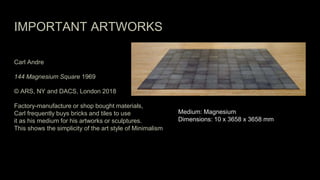
Carl Andre
144 Magnesium Square 1969
© ARS, NY and DACS, London 2018
Factory-manufacture or shop bought materials,
Carl frequently buys bricks and tiles to use
it as his medium for his artworks or sculptures.
This shows the simplicity of the art style of Minimalism
Medium: Magnesium
Dimensions: 10 x 3658 x 3658 mm
IMPORTANT ARTWORKS
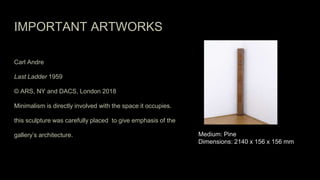
Carl Andre
Last Ladder 1959
© ARS, NY and DACS, London 2018
Minimalism is directly involved with the space it occupies.
this sculpture was carefully placed to give emphasis of the
gallery’s architecture. Medium: Pine
Dimensions: 2140 x 156 x 156 mm
INFLUENCE AND LEGACY
1. De Stijl Art Movement
De Stijl is Dutch for the “the style”. It started in the Netherlands and featured a distillation of of aesthetics
into basic elements such as geometric forms and primary colors.
It was a reaction to the aftermath of World War I. The Netherlands remained neutral during the war and
were not able to leave the country. Thus, they were practically uninfluenced by the international art world.
INFLUENCE AND LEGACY
2. Traditional Japanese
Traditional Japanese design can also be considered a predecessor of minimalism. Most of Japanese
aesthetics and ideals value simplicity stemming from the Zen philosophy of impermanence and
imperfection. Traditional Japanese ideals include the concepts of Wabi (simple, austere beauty), Sabi
(beauty that comes from age). Wabi-sabi appreciates the value of simple and plain objects. Objects
designed in this ideal contain no unnecessary features. Imperfections and asymmetry are often associated
with this concept.
INFLUENCE AND LEGACY
3. Mies Van der Rohe
Ludwig Mies van der Rohe was a German-born architect and was one of the pioneers of modern
architecture. He was an educator who was influenced with the philosophy and principles of constructivism
on efficiency, and De Stijl’s use of space.
His style can be described as functional and simple. He emphasized the use of open space as a part of
the design, as well as efficient assembly of components which serve multiple purposes.
PHILIPPINE ART
WORKS
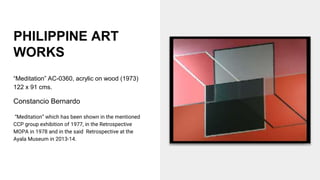
“Meditation” AC-0360, acrylic on wood (1973)
122 x 91 cms.
Constancio Bernardo
“Meditation” which has been shown in the mentioned
CCP group exhibition of 1977, in the Retrospective
MOPA in 1978 and in the said Retrospective at the
Ayala Museum in 2013-14.
PHILIPPINE
ART WORKS
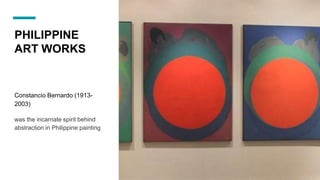
Constancio Bernardo (1913-
2003)
was the incarnate spirit behind
abstraction in Philippine painting
PHILIPPINE ART
WORKS
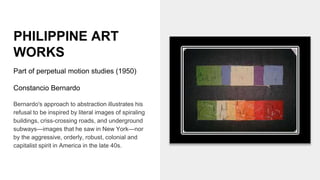
Part of perpetual motion studies (1950)
Constancio Bernardo
Bernardo's approach to abstraction illustrates his
refusal to be inspired by literal images of spiraling
buildings, criss-crossing roads, and underground
subways—images that he saw in New York—nor
by the aggressive, orderly, robust, colonial and
capitalist spirit in America in the late 40s.
GROUP EVALUATION OF ART MOVEMENT
( Strengths and Weaknesses)
STRENGTHS - For us the art movement is really powerful and it’s still being used by
artists in our generation. The fact that houses are some made with the concept of
minimalism and it’s much appreciated by the people who’s more into a simple and clean
creation.
WEAKNESSES - Our society and generation evolves so that this kind of art movement
can maybe be forgotten and replaced by new ones or better ones. Our generation are pretty
much into over or drastic creation especially with the improvement and by the rise of
Technology.
RESOURCES
https://www.theartstory.org/artist-andre-carl.htm
https://publicdelivery.org/sol-lewitt-wall-drawings/
https://en.wikipedia.org/wiki/Sol_LeWitt
https://www.theartstory.org/artist-stella-frank.htm
https://www.artsy.net/artwork/frank-stella-hagmatana-iii

Minimalism

  • 1.
  • 2.
    INTRODUCTION Minimalism started duringthe early 1960s in New York. Minimalists aims to achieve creating art by removing suggestions of biography and metaphors of any kind. They thought that art should not reflect the artists own personal expressions. They pushed to create works of art that aims not to refer to anything other than itself. They used industrial materials in order to break away from traditional sculptures and describe these artworks in literal ways, calling them ‘modulas’ or ‘specific Objects’.
  • 3.
    KEY IDEAS /CONCEPTS - To make art of pure aestheticism because it was highly revolutionary that time. - To achieve minimalism, artists tried to remove elements of self-expressionism like composition, themes, reference, emotion, personal expression, etc. - The use of modern materials to break from old and traditional art style - Creating simple sculptures and artworks made from industrial materials like metal sheets, plywoods, and bricks.
  • 4.
  • 5.
    LEADING ARTISTS - Sol LeWitt -(September 9, 1928 – April 8, 2007) - an American Artist linked to various movements, including Conceptual art and Minimalism.
  • 6.
    IMPORTANT ARTWORKS Sol LeWitt TwoOpen Modular Cubes/Half-Off 1972 © The estate of Sol LeWitt This piece represents what Minimalism is. It is modular, meaning it is composed of consistuent parts that can be moved, seperated, and recombined Medium: Enamel on Aluminum Dimensions: 1600 x 3054 x 2330 mm
  • 7.
    LEADING ARTISTS - DonaldJudd - (June 3, 1928 – February 12, 1994) - American artist associated with Minimalism - Architect and Furniture Designer
  • 8.
    IMPORTANT ARTWORKS Donald Judd Untitled1972 © Donald Judd Foundation This piece shows lack of expression, with no trace of emotion. This kind of artwork rejects the notion of the artwork as a reflection of personal expressions like what Minimalists we’re really trying to do, create objects as neutral as possible. Medium: Copper, enamel and aluminum Dimensions: 916 x 1555 x 1782 mm
  • 9.
    LEADING ARTISTS - FrankStella - (Born on May 12, 1936) - American painter, sculptor, and printmaker
  • 10.
    IMPORTANT ARTWORKS Frank Stella HyenaStomp 1962 © ARS, NY and DACS, London 2018 Self-referential: This does not refer to anything but the art itself. Dark colours were used but it doesn’t exactly mean that the artist is trying to show sombre mood. Medium: Copper, Alkyd paint on canvas Dimensions: Support 1956 x 1956 mm Frame 1982 x 1981 x 91 mm
  • 11.
    IMPORTANT ARTWORKS Frank Stella ©ARS, NY and DACS, London 2018 It has this edgy style of painting which is minimalism Can be seen and the colors used are bright colors And black for the outline. Hagmatana III, 1967 Fluorescent acrylic on canvas 120 × 180 in; 304.8 × 457.2 cm
  • 12.
    LEADING ARTISTS - CarlAndre - (Born September 16, 1935) - Minimalist artist - Sculptor large public artworks
  • 13.
    IMPORTANT ARTWORKS Carl Andre 144Magnesium Square 1969 © ARS, NY and DACS, London 2018 Factory-manufacture or shop bought materials, Carl frequently buys bricks and tiles to use it as his medium for his artworks or sculptures. This shows the simplicity of the art style of Minimalism Medium: Magnesium Dimensions: 10 x 3658 x 3658 mm
  • 14.
    IMPORTANT ARTWORKS Carl Andre LastLadder 1959 © ARS, NY and DACS, London 2018 Minimalism is directly involved with the space it occupies. this sculpture was carefully placed to give emphasis of the gallery’s architecture. Medium: Pine Dimensions: 2140 x 156 x 156 mm
  • 15.
    INFLUENCE AND LEGACY 1.De Stijl Art Movement De Stijl is Dutch for the “the style”. It started in the Netherlands and featured a distillation of of aesthetics into basic elements such as geometric forms and primary colors. It was a reaction to the aftermath of World War I. The Netherlands remained neutral during the war and were not able to leave the country. Thus, they were practically uninfluenced by the international art world.
  • 16.
    INFLUENCE AND LEGACY 2.Traditional Japanese Traditional Japanese design can also be considered a predecessor of minimalism. Most of Japanese aesthetics and ideals value simplicity stemming from the Zen philosophy of impermanence and imperfection. Traditional Japanese ideals include the concepts of Wabi (simple, austere beauty), Sabi (beauty that comes from age). Wabi-sabi appreciates the value of simple and plain objects. Objects designed in this ideal contain no unnecessary features. Imperfections and asymmetry are often associated with this concept.
  • 17.
    INFLUENCE AND LEGACY 3.Mies Van der Rohe Ludwig Mies van der Rohe was a German-born architect and was one of the pioneers of modern architecture. He was an educator who was influenced with the philosophy and principles of constructivism on efficiency, and De Stijl’s use of space. His style can be described as functional and simple. He emphasized the use of open space as a part of the design, as well as efficient assembly of components which serve multiple purposes.
  • 18.
    PHILIPPINE ART WORKS “Meditation” AC-0360,acrylic on wood (1973) 122 x 91 cms. Constancio Bernardo “Meditation” which has been shown in the mentioned CCP group exhibition of 1977, in the Retrospective MOPA in 1978 and in the said Retrospective at the Ayala Museum in 2013-14.
  • 19.
    PHILIPPINE ART WORKS Constancio Bernardo(1913- 2003) was the incarnate spirit behind abstraction in Philippine painting
  • 20.
    PHILIPPINE ART WORKS Part ofperpetual motion studies (1950) Constancio Bernardo Bernardo's approach to abstraction illustrates his refusal to be inspired by literal images of spiraling buildings, criss-crossing roads, and underground subways—images that he saw in New York—nor by the aggressive, orderly, robust, colonial and capitalist spirit in America in the late 40s.
  • 21.
    GROUP EVALUATION OFART MOVEMENT ( Strengths and Weaknesses) STRENGTHS - For us the art movement is really powerful and it’s still being used by artists in our generation. The fact that houses are some made with the concept of minimalism and it’s much appreciated by the people who’s more into a simple and clean creation. WEAKNESSES - Our society and generation evolves so that this kind of art movement can maybe be forgotten and replaced by new ones or better ones. Our generation are pretty much into over or drastic creation especially with the improvement and by the rise of Technology.
  • 22.