
WELCOME
BEST OF LUCK
FOR
SUCCESSFUL
PROFESSIONAL
EDUCATION
OUR TOPIC
• IMMUNITY
Course components
• TYPES OF IMMUNITY
• B CELLS FUNCTION
• T CELLS FUNCTION
• REGULATION ,DISORDERS
RECAPITULATION
DEFINITION OF “IMMUNITY”
The human body has the ability to
resist almost all
types of organisms or toxins that
tend to damage the
tissues and organs. This capability is
called immunity.
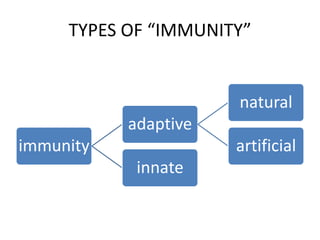
TYPES OF “IMMUNITY”
immunity
adaptive
natural
artificial
innate
innate immunity
The immunity resulting from general
processes, rather than from
processes directed at specific disease
organisms is innate immunity.
Innate immunity is non specific, it is
not directed against any particular
virus, bacteria , or toxin
It includes the following:
PHAGOCYTOSIS
1. Phagocytosis of bacteria and other
invaders by white blood cells and
cells of the tissue macrophage
system.
GASTROINTESTINAL BARRIER
2. Destruction of swallowed organisms
by the acid secretions of the stomach
and the digestive enzymes.
SKIN BARRIER
3. Resistance of the skin to invasion by
organisms.
Compounds
4. Presence in the blood of certain
chemical compounds that attach to
foreign organisms or toxins and
destroy them.
Some of these compounds are
Lysozyme
(a) lysozyme,
a mucolytic polysaccharide
that attacks bacteria
and causes them to dissolute;
basic polypeptides
(b) basic polypeptides,
which react with
and inactivate
certain types of bacteria;
complement complex
(c)the complement complex ,
a system of about 20 proteins
that can be activated
in various ways
to destroy bacteria;
natural killer lymphocytes
(d) natural killer lymphocytes
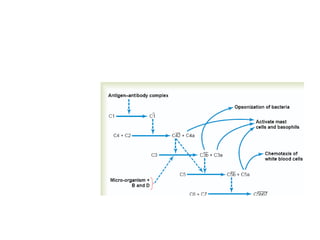
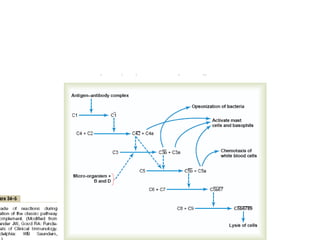
that can recognize
and destroy
foreign cells,
tumor cells,
and even some infected cells.
HUMANS ARE RESISTANT TO
ANIMAL INFECTIONS
This innate immunity makes the human body
resistant to such diseases as
some paralytic viral infections of animals, hog
cholera, cattle plague,
and distemper—
a viral disease that kills a large percentage of
dogs that become afflicted with it.
acquired immunity
Much of immunity is acquired immunity that
does not develop until after the body is first
attacked by a bacterium, virus, or toxin,
requiring weeks or months to develop the
immunity.
acquired or adaptive immunity
the human body has the ability to develop
extremely powerful specific immunity against
individual invading agents such as
lethal bacteria,
viruses,
toxins,
and even foreign tissues from other humans or
animals..
Acquired immunity
Acquired immunity is
caused by a special immune system that forms
antibodies and/or
activated lymphocytes
that attack and destroy
the specific invading organism or toxin.
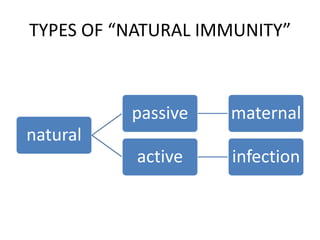
TYPES OF “NATURAL IMMUNITY”
natural
passive maternal
active infection
Naturally acquired passive immunity
Maternal passive immunity is a type of
naturally acquired passive immunity, and
refers to antibody-mediated immunity
conveyed to a fetus by its mother during
pregnancy.
THROUGH PLACENTA
Maternal antibodies (MatAb) are passed
through the placenta to the fetus by an FcRn
receptor on placental cells.
This occurs around the third month of
gestation.
IgG is the only antibody isotype that can pass
through the placenta.
THROUGH BREAST FEEDING
Passive immunity is also provided through the
transfer of IgA antibodies found in breast milk
that are transferred to the gut of the infant,
protecting against bacterial infections, until
the newborn can synthesize its own
antibodies.
Artificially acquired passive immunity
is a short-term immunization
induced by the transfer of antibodies,
which can be administered in several forms;
(1)as human or animal blood plasma,
(2)as pooled human immunoglobulin for
intravenous (IVIG) or intramuscular (IG) use,
(3) monoclonal antibodies (MAb).
TREATING INFECTIONS
The artificial induction of passive immunity has
been used for over a century to treat infectious
disease, and prior to the advent of antibiotics,
was often the only specific treatment for certain
infections. Immunoglobulin therapy continued to
be a first line therapy in the treatment of severe
respiratory diseases until the 1930s, even after
sulfonamide lot antibiotics were introduced.
SHORTCOMINGS OF
PASSIVE IMMUNITY
Immunity derived from passive immunization
lasts for only a short period of time, and there
is also a potential risk for hypersensitivity
reactions, and serum sickness, especially from
gamma globulin of non-human origin.
USES OF PASSIVE IMMUNITY
• Passive transfer is used prophylactically in the
case of immunodeficiency diseases, such as
hypogammaglobulinemia.
• It is also used in the treatment of several
types of acute infection, and to treat
poisoning.
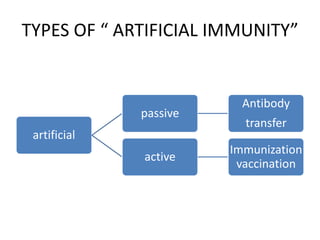
TYPES OF “ ARTIFICIAL IMMUNITY”
artificial
passive
Antibody
transfer
active
Immunization
vaccination
Naturally acquired active immunity
occurs when a person is exposed to a live
pathogen, and develops a primary immune
response, which leads to immunological
memory. This type of immunity is “natural”
because it is not induced by deliberate
exposure
vaccine,
Artificially acquired active immunity
can be induced by a vaccine, a
substance that contains antigen.
A vaccine stimulates a primary
response against the antigen without
causing symptoms of the disease.
types of traditional vaccines
vaccine contents Used for
Subunit vaccine small fragments of
disease causing virus
Hepatitis B virus
Toxoids inactivated toxic
compounds from micro-
organisms
tetanus and diphtheria
Live, attenuated
vaccines
micro-organisms that
have been cultivated to
disable their ability to
induce disease.
yellow fever, measles,
rubella, and mumps.
Inactivated vaccines micro-organisms that
have been killed with
chemicals and/or heat
and are no longer able
to cause any harm.
flu, cholera, plague, and
hepatitis A.
summary
Immunity
Innate Adaptive
Phagocyto
sis
natural Artificial
Stomach Passive active passive active
Skin Maternal infection Plasma vaccine
Lysozyme Placental antibody
Polypeptid
es
lactation
Compleme
nt
NK cells
DUAL RESPONSE TO ANTIGENIC CHALLENGE.
1.ANTIBODIES
2.ACTIVATED LYMPHOCYTES
End of
Segment 1
Types of immunity
SEGMENT 2 STARTS
B CELL FUNCTIONS
What is a B cell?
B cell or B lymphocyte
is a subtype of lymphocyte.
Lymphocyte is a subtype of white blood cells.
Why these lymphocytes are called
“B” lymphocytes
This population of cells was first discovered in
birds, which have a special preprocessing
organ called the bursa of Fabricius. For this
reason, these lymphocytes are called “B”
lymphocytes to designate the role of the
bursa, and they are responsible for humoral
immunity.
Humoral immunity or B-cell immunity
B lymphocytes produce the antibodies.
which are globulin molecules in the blood
plasma that are capable of attacking the
invading agent.
This type of immunity is called
Humoral immunity or
B-cell immunity .
where are the the lymphocytes
found in the body?
The lymphocytes are located in the
lymph nodes,
the spleen,
gastrointestinal tract
thymus
bone marrow.
Where are the antibodies formed?
the antibodies
are formed in the
lymphoid tissues
of the body.
GASTROINTESTINAL BARRIER
the lymphoid tissue of the gastrointestinal
walls is exposed immediately to antigens
invading
from the gut.
BLOOD BARRIER
the lymphoid tissue of
the spleen, thymus, and bone marrow plays the
specific
role of intercepting antigenic agents that have
succeeded in reaching the circulating blood.
lymph nodes
The lymphoid tissue in the lymph nodes
is exposed to antigens that invade the peripheral
tissues of the body.
the tonsils and adenoids
The lymphoid tissue of the throat and
pharynx (the tonsils and adenoids) is well
located to
intercept antigens that enter by way of the
upper respiratory
tract.
Origin of lymphocytes
lymphocytes
are derived originally in
the embryo from
pluripotent hematopoietic stem cells
That form lymphocytes
as they differentiate.
Preprocessing of B lymphocytes
The population of lymphocytes,
the B lymphocytes,
that are destined to form antibodies,
are preprocessed
in the liver in midfetal life
and in the bone marrow
in late fetal life and after birth.
antigens (antibody generators)
Each toxin or each type of organism
almost always contains one or more specific
chemical compounds in its makeup that are
different from all other compounds.
In general, these are proteins or large
polysaccharides,
and it is they that initiate the acquired immunity.
These substances are called antigens (antibody
generators).
epitopes,
For a substance to be antigenic, it usually must
have
a high molecular weight, 8000 or greater.
the process of antigenicity usually depends on
regularly recurring molecular groups, called
epitopes,
on the surface of the large molecule.
Formation of Antibodies by Plasma
Cells.
Foreign antigen→
macrophages→
dormant lymphocytes→
activated B lymphocytes.
foreign antigen →
helper T cells →
dormant lymphocytes→
activated B lymphocytes.
B lymphocyte→ lymphoblasts →
plasmablasts→ plasma cell
Those B lymphocytes specific for the antigen enlarge
and take on the appearance of lymphoblasts. Some
of the lymphoblasts further differentiate to form
plasmablasts, which are precursors of plasma cells.
The mature plasma cell then produces gamma
globulin antibodies.
2000 molecules per second for each plasma cell.
the antibodies are secreted into the lymph
and carried to the circulating blood.
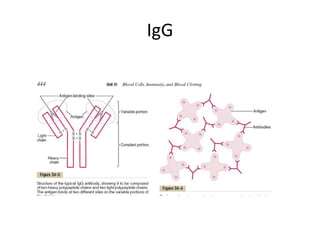
IgG
Variable portion
constant portion
a designated end of each light and heavy chain,
called the variable portion;
the remainder of each chain
is called the constant portion.
The variable portion is different for each specificity of antibody, and it is
this portion that attaches specifically to a particular type of antigen.
The constant portion of antibody determines other properties of antibody,
establishing such factors as
diffusivity of the antibody in the tissues,
adherence of the antibody to specific structures within the tissues,
attachment to the complement complex,
the ease with which the antibodies pass through membranes, and
other biological properties of the antibody.
Specificity of Antibodies
Each antibody is specific for a
particular antigen; this is caused
by its unique structural
organization of amino acids in the
variable portions of both the light
and heavy chains resulting in
tight bonding between the antibody
and the antigen.
Nature of the Antibodies
The antibodies are gamma globulins called immunoglobulins (Ig)
molecular weights between 160,000 and 970,000.
20 per cent of all the plasma proteins.
combinations of light and heavy polypeptide chains.
Most are a combination of two light and two heavy chains,
some have combinations of 10 heavy and 10 light chains
each heavy chain has a light chain forming a heavy-light pair,
there are always at least 2 and as many as 10 such pairs in each.
Mechanisms of Action of Antibodies
Antibodies act in two ways to protect the body
against invading agents:
(1) by direct attack on the invader and
(2) by activation of the “complement system”.
direct actions of antibodies
are NOT strong enough
These direct actions of antibodies attacking
the antigenic invaders often are
not strong enough
to play a major role in protecting the body
against the invader.
Most of the protection comes through the
amplifying effects of the complement system
Types of Actions of Antibodies
The antibodies can inactivate the invading
agent in one of several ways, as follows:
1. Agglutination
2. Precipitation
3. Neutralization
4. Lysis
1. Agglutination
multiple large particles
with antigens on their surfaces,
such as bacteria or
red cells,
are bound together into a clump
2. Precipitation
The molecular complex of
soluble antigen (such as tetanus toxin) and
antibody becomes so large that it is rendered
insoluble and precipitates
3. Neutralization
the antibodies cover the
toxic sites of the antigenic agent
4. Lysis
some potent antibodies are
occasionally capable of directly attacking
membranes of cellular agents and thereby cause
rupture of the agent
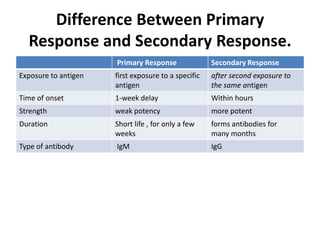
Difference Between Primary
Response and Secondary Response.
Primary Response Secondary Response
Exposure to antigen first exposure to a specific
antigen
after second exposure to
the same antigen
Time of onset 1-week delay Within hours
Strength weak potency more potent
Duration Short life , for only a few
weeks
forms antibodies for
many months
Type of antibody IgM IgG
summary
What is a B cell?
Why these lymphocytes are called “B” lymphocytes?
What is Humoral immunity or B-cell immunity?
Where are the the lymphocytes found in the body?
Where are the antibodies formed?
What is the origin of lymphocytes .
What is the site of Preprocessing of B lymphocytes.
What is the reason of Specificity of Antibodies.
Describe the Nature of the Antibodies .
What is the Mechanism of Action of Antibodies .
Enumerate theTypes of Actions of Antibodies .
Describe the Difference Between Primary Response and Secondary Response.
END OF SEGMENT 2
START OF SEGMENT 3
role of
the thymus.
The lymphocytes that are destined to
eventually form activated T lymphocytes first
migrate to and are preprocessed in the
thymus gland, and thus they are called “T”
lymphocytes to designate the role of the
thymus.
They are responsible for cell-mediated
immunity.
Antigen causes activation
of T lymphocytes
When specific antigens come in
contact with T and B
lymphocytes in the lymphoid
tissue, certain of the T
lymphocytes become activated to
form activated T
cells, and certain of the B
lymphocytes become activated
to form antibodies.
The activated T cells and
antibodies in turn react highly specifically
against the
particular types of antigens that initiated their
development.
The mechanism of specificity
Millions of Specific Types of Lymphocytes Are
Stored in the
Lymphoid Tissue. Millions of different types of
preformed
B lymphocytes and preformed T lymphocytes
that are capable of forming highly specific types of
antibodies or T cells have been stored in the lymph
tissue, a
a clone of lymphocytes
All the different lymphocytes that are capable of
forming one specificity of antibody or T cell are
called
a clone of lymphocytes. That is, the lymphocytes in
each clone are alike and are derived originally from
one or a few early lymphocytes of its sp
• Complement System for Antibody Action
• “Complement” is a collective term that describes a
• system of about 20 proteins, many of which are enzyme
• precursors. The principal actors in this system are 11
• proteins designated C1 through C9, B, and D, shown
• in Figure 34–5. All these are present normally among
• the plasma proteins in the blood as well as among the
• proteins that leak out of the capillaries into the tissue
• spaces. The enzyme precursors are normally inactive,
• but they can be activated mainly by the so-called
• classic pathway.
• Classic Pathway. The classic pathway is initiated by an
• antigen-antibody reaction. That is, when an antibody
• binds with an antigen, a specific reactive site on the
• “constant” portion of the antibody becomes uncovered,
• or “activated,” and this in turn binds directly with
• the C1 molecule of the complement system, setting
• into motion a “cascade” of sequential reactions, shown
• in Figure 34–5, beginning with activation of the proenzyme
• C1 itself. The C1 enzymes that are formed then
• activate successively increasing quantities of enzymes in
• the later stages of the system, so that from a small
• beginning, an extremely large “amplified” reaction
• occurs. Multiple end products are formed, as shown to
• the right in the figure, and several of these cause
• important effects that help to prevent damage to the
• body’s tissues caused by the invading organism or
• toxin.
• 1. Opsonization and phagocytosis. One of the
• products of the complement cascade, C3b,
• strongly activates phagocytosis by both
• neutrophils and macrophages, causing these cells
• to engulf the bacteria to which the
antigenantibody
• complexes are attached. This process is
• called opsonization. It often enhances the number
• of bacteria that can be destroyed by many
• hundredfold.
• 2. Lysis. One of the most important of all the
• products of the complement cascade is the lytic
• complex, which is a combination of multiple
• complement factors and designated C5b6789.
• This has a direct effect of rupturing the cell
• membranes of bacteria or other invading
• organisms.
•
• 3. Agglutination. The complement products
also
• change the surfaces of the invading
organisms,
• causing them to adhere to one another, thus
• promoting agglutination.
• 4. Neutralization of viruses. The complement
• enzymes and other complement products can
• attack the structures of some viruses and
thereby
• render them nonvirulent.
•
• 5. Chemotaxis. Fragment C5a initiates
chemotaxis of
• neutrophils and macrophages, thus causing
large
• numbers of these phagocytes to migrate into
the
• tissue area adjacent to the antigenic agent.
•
• 6. Activation of mast cells and basophils. Fragments
• C3a, C4a, and C5a activate mast cells and
• basophils, causing them to release histamine,
• heparin, and several other substances into the
• local fluids. These substances in turn cause
• increased local blood flow, increased leakage of
• fluid and plasma protein into the tissue, and other
• local tissue reactions that help inactivate or
• immobilize the antigenic agent. The same factors
• and in allergy, as we
• discuss later.
•
• 7. Inflammatory effects. In addition to inflammatory
• effects caused by activation of the mast cells and
• basophils, several other complement products
• contribute to local inflammation. These products
• cause (1) the already increased blood flow to
• increase still further, (2) the capillary leakage of
• proteins to be increased, and (3) the interstitial
• fluid proteins to coagulate in the tissue spaces,
• thus preventing movement of the invading
• organism through the tissues.
•
Millions of Specific Types of
Lymphocytes Are Stored in the
Lymphoid Tissue
Millions of different types of preformed B
lymphocytes and preformed T lymphocytes that
are capable of forming highly specific types of
antibodies or T cells have been stored in the
lymph tissue, as explained earlier. Each of these
preformed lymphocytes is capable of forming
only one type of antibody or one type of T cell
with a single type of specificity. And only the
specific type of antigen with which it can react
can activate it.
Formation of “Memory” Cells
A few of the lympholasts formed by activation of a clone of
B lymphocytes do not go on to form plasma cells but
instead form moderate numbers of new B lymphocytes
similar to those of the original clone. They also circulate
throughout the body to populate all the lymphoid tissue;
immunologically, however, they remain dormant until
activated once again by a new quantity of the same
antigen. These lymphocytes are called memory cells.
Subsequent exposure to the same antigen will cause a
much more rapid and much more potent antibody
response this second time around, because there are many
more memory cells than there were original B lymphocytes
of the specific clone.
Role of the T Cells in Activation of the
B Lymphocytes
A ntigens activate both T lymphocytes and B lymphocytes
at the same time. Some of the T cells that are
formed, called helper cells, secrete specific substances
(collectively called lymphokines) that activate the
specific B lymphocytes. Indeed, without the aid of
these helper T cells, the quantity of antibodies formed
by the B lymphocytes is usually slight.We will discuss
this cooperative relationship between helper T cells
and B cells again after we have an opportunity
to describe the mechanisms of the T-cell system of
immunity.
Role of Macrophages in the Activation
Process
Aside from the lymphocytes in lymphoid tissue, literally millions
of macrophages are also present in the same tissue.
These line the sinusoids of the lymph nodes, spleen,
and other lymphoid tissue.
Most invading organisms are first phagocytized and partially
digested by the macrophages, and the antigenic products are
liberated into the macrophage cytosol. The macrophages then
pass these antigens by cell-to-cell contact directly to the
lymphocytes, thus leading to activation of the specified
lymphocytic clones. The macrophages, secrete a special
activating substance that promotes still further growth and
reproduction of the specific lymphocytes. This substance
is called interleukin-1.
Mechanism for Activating a Clone
of Lymphocytes
Each clone of lymphocytes is responsive to only a single type
of antigen. When the appropriate antigen comes along, it
immediately attaches to the antibody in the cell membrane;
this leads to the activation process,
In the case of the T lymphocytes, molecules similar to
antibodies, called surface receptor proteins (or T-cell markers),
are on the surface of the T-cell membrane, and these, too,
are highly specific for one specified activating antigen.
single antigen specificity
Because there are several hundred types of gene
segments, as well as millions of different combinations
in which the segments can be arranged in single cells,
one can understand the millions of different cell gene
types that can occur. For each functional T or B
lymphocyte
that is finally formed, the gene structure codes
for only a single antigen specificity.These mature cells
then become the highly specific T and B cells that
spread to and populate the lymphoid tissue.
“gene segments”
The whole gene for forming each type of T cell or B
cell is never present in the original stem cells from
which the functional immune cells are formed. Instead,
there are only “gene segments”—actually, hundreds of
such segments—but not whole genes. During
preprocessing
of the respective T- and B-cell lymphocytes,
these gene segments become mixed with one another
in random combinations, in this way finally forming
whole genes.
Origin of the Many Clones
of Lymphocytes
Only several hundred to a few thousand genes code
for the millions of different types of antibodies and
T lymphocytes.
so few genes to code for the millions of different
specificities of antibody molecules or T cells that
can be produced by the lymphoid tissue,
disorders of immune system
Many disorders of immune system function
can affect the formation of active immunity
such as immunodeficiency (both acquired and
congenital forms) and immunosuppression.
cell-mediated immunity or T-cell
immunity
The second type of acquired immunity is
achieved through the formation of large
numbers of activated T lymphocytes that are
specifically crafted in the lymph nodes to
destroy the foreign agent.
This type of immunity is called cell-mediated
immunity or T-cell immunity (because the
activated lymphocytes are T lymphocytes).
lymphoid
tissues of the body.
both the antibodies and
the activated lymphocytes
are formed in the
lymphoid tissues
of the body.

Immunity

  • 1.
  • 2.
  • 3.
    Course components • TYPESOF IMMUNITY • B CELLS FUNCTION • T CELLS FUNCTION • REGULATION ,DISORDERS
  • 4.
  • 5.
    DEFINITION OF “IMMUNITY” Thehuman body has the ability to resist almost all types of organisms or toxins that tend to damage the tissues and organs. This capability is called immunity.
  • 6.
  • 7.
    innate immunity The immunityresulting from general processes, rather than from processes directed at specific disease organisms is innate immunity. Innate immunity is non specific, it is not directed against any particular virus, bacteria , or toxin It includes the following:
  • 8.
    PHAGOCYTOSIS 1. Phagocytosis ofbacteria and other invaders by white blood cells and cells of the tissue macrophage system.
  • 9.
    GASTROINTESTINAL BARRIER 2. Destructionof swallowed organisms by the acid secretions of the stomach and the digestive enzymes.
  • 10.
    SKIN BARRIER 3. Resistanceof the skin to invasion by organisms.
  • 11.
    Compounds 4. Presence inthe blood of certain chemical compounds that attach to foreign organisms or toxins and destroy them. Some of these compounds are
  • 12.
    Lysozyme (a) lysozyme, a mucolyticpolysaccharide that attacks bacteria and causes them to dissolute;
  • 13.
    basic polypeptides (b) basicpolypeptides, which react with and inactivate certain types of bacteria;
  • 14.
    complement complex (c)the complementcomplex , a system of about 20 proteins that can be activated in various ways to destroy bacteria;
  • 15.
    natural killer lymphocytes (d)natural killer lymphocytes that can recognize and destroy foreign cells, tumor cells, and even some infected cells.
  • 16.
    HUMANS ARE RESISTANTTO ANIMAL INFECTIONS This innate immunity makes the human body resistant to such diseases as some paralytic viral infections of animals, hog cholera, cattle plague, and distemper— a viral disease that kills a large percentage of dogs that become afflicted with it.
  • 17.
    acquired immunity Much ofimmunity is acquired immunity that does not develop until after the body is first attacked by a bacterium, virus, or toxin, requiring weeks or months to develop the immunity.
  • 18.
    acquired or adaptiveimmunity the human body has the ability to develop extremely powerful specific immunity against individual invading agents such as lethal bacteria, viruses, toxins, and even foreign tissues from other humans or animals..
  • 19.
    Acquired immunity Acquired immunityis caused by a special immune system that forms antibodies and/or activated lymphocytes that attack and destroy the specific invading organism or toxin.
  • 20.
    TYPES OF “NATURALIMMUNITY” natural passive maternal active infection
  • 21.
    Naturally acquired passiveimmunity Maternal passive immunity is a type of naturally acquired passive immunity, and refers to antibody-mediated immunity conveyed to a fetus by its mother during pregnancy.
  • 22.
    THROUGH PLACENTA Maternal antibodies(MatAb) are passed through the placenta to the fetus by an FcRn receptor on placental cells. This occurs around the third month of gestation. IgG is the only antibody isotype that can pass through the placenta.
  • 23.
    THROUGH BREAST FEEDING Passiveimmunity is also provided through the transfer of IgA antibodies found in breast milk that are transferred to the gut of the infant, protecting against bacterial infections, until the newborn can synthesize its own antibodies.
  • 24.
    Artificially acquired passiveimmunity is a short-term immunization induced by the transfer of antibodies, which can be administered in several forms; (1)as human or animal blood plasma, (2)as pooled human immunoglobulin for intravenous (IVIG) or intramuscular (IG) use, (3) monoclonal antibodies (MAb).
  • 25.
    TREATING INFECTIONS The artificialinduction of passive immunity has been used for over a century to treat infectious disease, and prior to the advent of antibiotics, was often the only specific treatment for certain infections. Immunoglobulin therapy continued to be a first line therapy in the treatment of severe respiratory diseases until the 1930s, even after sulfonamide lot antibiotics were introduced.
  • 26.
    SHORTCOMINGS OF PASSIVE IMMUNITY Immunityderived from passive immunization lasts for only a short period of time, and there is also a potential risk for hypersensitivity reactions, and serum sickness, especially from gamma globulin of non-human origin.
  • 27.
    USES OF PASSIVEIMMUNITY • Passive transfer is used prophylactically in the case of immunodeficiency diseases, such as hypogammaglobulinemia. • It is also used in the treatment of several types of acute infection, and to treat poisoning.
  • 28.
    TYPES OF “ARTIFICIAL IMMUNITY” artificial passive Antibody transfer active Immunization vaccination
  • 29.
    Naturally acquired activeimmunity occurs when a person is exposed to a live pathogen, and develops a primary immune response, which leads to immunological memory. This type of immunity is “natural” because it is not induced by deliberate exposure
  • 30.
    vaccine, Artificially acquired activeimmunity can be induced by a vaccine, a substance that contains antigen. A vaccine stimulates a primary response against the antigen without causing symptoms of the disease.
  • 31.
    types of traditionalvaccines vaccine contents Used for Subunit vaccine small fragments of disease causing virus Hepatitis B virus Toxoids inactivated toxic compounds from micro- organisms tetanus and diphtheria Live, attenuated vaccines micro-organisms that have been cultivated to disable their ability to induce disease. yellow fever, measles, rubella, and mumps. Inactivated vaccines micro-organisms that have been killed with chemicals and/or heat and are no longer able to cause any harm. flu, cholera, plague, and hepatitis A.
  • 32.
    summary Immunity Innate Adaptive Phagocyto sis natural Artificial StomachPassive active passive active Skin Maternal infection Plasma vaccine Lysozyme Placental antibody Polypeptid es lactation Compleme nt NK cells
  • 33.
    DUAL RESPONSE TOANTIGENIC CHALLENGE. 1.ANTIBODIES 2.ACTIVATED LYMPHOCYTES
  • 34.
  • 35.
    SEGMENT 2 STARTS BCELL FUNCTIONS
  • 36.
    What is aB cell? B cell or B lymphocyte is a subtype of lymphocyte. Lymphocyte is a subtype of white blood cells.
  • 37.
    Why these lymphocytesare called “B” lymphocytes This population of cells was first discovered in birds, which have a special preprocessing organ called the bursa of Fabricius. For this reason, these lymphocytes are called “B” lymphocytes to designate the role of the bursa, and they are responsible for humoral immunity.
  • 38.
    Humoral immunity orB-cell immunity B lymphocytes produce the antibodies. which are globulin molecules in the blood plasma that are capable of attacking the invading agent. This type of immunity is called Humoral immunity or B-cell immunity .
  • 39.
    where are thethe lymphocytes found in the body? The lymphocytes are located in the lymph nodes, the spleen, gastrointestinal tract thymus bone marrow.
  • 40.
    Where are theantibodies formed? the antibodies are formed in the lymphoid tissues of the body.
  • 41.
    GASTROINTESTINAL BARRIER the lymphoidtissue of the gastrointestinal walls is exposed immediately to antigens invading from the gut.
  • 42.
    BLOOD BARRIER the lymphoidtissue of the spleen, thymus, and bone marrow plays the specific role of intercepting antigenic agents that have succeeded in reaching the circulating blood.
  • 43.
    lymph nodes The lymphoidtissue in the lymph nodes is exposed to antigens that invade the peripheral tissues of the body.
  • 44.
    the tonsils andadenoids The lymphoid tissue of the throat and pharynx (the tonsils and adenoids) is well located to intercept antigens that enter by way of the upper respiratory tract.
  • 45.
    Origin of lymphocytes lymphocytes arederived originally in the embryo from pluripotent hematopoietic stem cells That form lymphocytes as they differentiate.
  • 46.
    Preprocessing of Blymphocytes The population of lymphocytes, the B lymphocytes, that are destined to form antibodies, are preprocessed in the liver in midfetal life and in the bone marrow in late fetal life and after birth.
  • 47.
    antigens (antibody generators) Eachtoxin or each type of organism almost always contains one or more specific chemical compounds in its makeup that are different from all other compounds. In general, these are proteins or large polysaccharides, and it is they that initiate the acquired immunity. These substances are called antigens (antibody generators).
  • 48.
    epitopes, For a substanceto be antigenic, it usually must have a high molecular weight, 8000 or greater. the process of antigenicity usually depends on regularly recurring molecular groups, called epitopes, on the surface of the large molecule.
  • 49.
    Formation of Antibodiesby Plasma Cells. Foreign antigen→ macrophages→ dormant lymphocytes→ activated B lymphocytes. foreign antigen → helper T cells → dormant lymphocytes→ activated B lymphocytes.
  • 50.
    B lymphocyte→ lymphoblasts→ plasmablasts→ plasma cell Those B lymphocytes specific for the antigen enlarge and take on the appearance of lymphoblasts. Some of the lymphoblasts further differentiate to form plasmablasts, which are precursors of plasma cells. The mature plasma cell then produces gamma globulin antibodies. 2000 molecules per second for each plasma cell. the antibodies are secreted into the lymph and carried to the circulating blood.
  • 51.
  • 52.
    Variable portion constant portion adesignated end of each light and heavy chain, called the variable portion; the remainder of each chain is called the constant portion. The variable portion is different for each specificity of antibody, and it is this portion that attaches specifically to a particular type of antigen. The constant portion of antibody determines other properties of antibody, establishing such factors as diffusivity of the antibody in the tissues, adherence of the antibody to specific structures within the tissues, attachment to the complement complex, the ease with which the antibodies pass through membranes, and other biological properties of the antibody.
  • 53.
    Specificity of Antibodies Eachantibody is specific for a particular antigen; this is caused by its unique structural organization of amino acids in the variable portions of both the light and heavy chains resulting in tight bonding between the antibody and the antigen.
  • 54.
    Nature of theAntibodies The antibodies are gamma globulins called immunoglobulins (Ig) molecular weights between 160,000 and 970,000. 20 per cent of all the plasma proteins. combinations of light and heavy polypeptide chains. Most are a combination of two light and two heavy chains, some have combinations of 10 heavy and 10 light chains each heavy chain has a light chain forming a heavy-light pair, there are always at least 2 and as many as 10 such pairs in each.
  • 55.
    Mechanisms of Actionof Antibodies Antibodies act in two ways to protect the body against invading agents: (1) by direct attack on the invader and (2) by activation of the “complement system”.
  • 56.
    direct actions ofantibodies are NOT strong enough These direct actions of antibodies attacking the antigenic invaders often are not strong enough to play a major role in protecting the body against the invader. Most of the protection comes through the amplifying effects of the complement system
  • 57.
    Types of Actionsof Antibodies The antibodies can inactivate the invading agent in one of several ways, as follows: 1. Agglutination 2. Precipitation 3. Neutralization 4. Lysis
  • 58.
    1. Agglutination multiple largeparticles with antigens on their surfaces, such as bacteria or red cells, are bound together into a clump
  • 59.
    2. Precipitation The molecularcomplex of soluble antigen (such as tetanus toxin) and antibody becomes so large that it is rendered insoluble and precipitates
  • 60.
    3. Neutralization the antibodiescover the toxic sites of the antigenic agent
  • 61.
    4. Lysis some potentantibodies are occasionally capable of directly attacking membranes of cellular agents and thereby cause rupture of the agent
  • 62.
    Difference Between Primary Responseand Secondary Response. Primary Response Secondary Response Exposure to antigen first exposure to a specific antigen after second exposure to the same antigen Time of onset 1-week delay Within hours Strength weak potency more potent Duration Short life , for only a few weeks forms antibodies for many months Type of antibody IgM IgG
  • 63.
    summary What is aB cell? Why these lymphocytes are called “B” lymphocytes? What is Humoral immunity or B-cell immunity? Where are the the lymphocytes found in the body? Where are the antibodies formed? What is the origin of lymphocytes . What is the site of Preprocessing of B lymphocytes. What is the reason of Specificity of Antibodies. Describe the Nature of the Antibodies . What is the Mechanism of Action of Antibodies . Enumerate theTypes of Actions of Antibodies . Describe the Difference Between Primary Response and Secondary Response.
  • 64.
    END OF SEGMENT2 START OF SEGMENT 3
  • 65.
    role of the thymus. Thelymphocytes that are destined to eventually form activated T lymphocytes first migrate to and are preprocessed in the thymus gland, and thus they are called “T” lymphocytes to designate the role of the thymus. They are responsible for cell-mediated immunity.
  • 66.
    Antigen causes activation ofT lymphocytes When specific antigens come in contact with T and B lymphocytes in the lymphoid tissue, certain of the T lymphocytes become activated to form activated T cells, and certain of the B lymphocytes become activated to form antibodies.
  • 67.
    The activated Tcells and antibodies in turn react highly specifically against the particular types of antigens that initiated their development.
  • 68.
    The mechanism ofspecificity Millions of Specific Types of Lymphocytes Are Stored in the Lymphoid Tissue. Millions of different types of preformed B lymphocytes and preformed T lymphocytes that are capable of forming highly specific types of antibodies or T cells have been stored in the lymph tissue, a
  • 69.
    a clone oflymphocytes All the different lymphocytes that are capable of forming one specificity of antibody or T cell are called a clone of lymphocytes. That is, the lymphocytes in each clone are alike and are derived originally from one or a few early lymphocytes of its sp
  • 72.
    • Complement Systemfor Antibody Action • “Complement” is a collective term that describes a • system of about 20 proteins, many of which are enzyme • precursors. The principal actors in this system are 11 • proteins designated C1 through C9, B, and D, shown • in Figure 34–5. All these are present normally among • the plasma proteins in the blood as well as among the • proteins that leak out of the capillaries into the tissue • spaces. The enzyme precursors are normally inactive, • but they can be activated mainly by the so-called • classic pathway.
  • 73.
    • Classic Pathway.The classic pathway is initiated by an • antigen-antibody reaction. That is, when an antibody • binds with an antigen, a specific reactive site on the • “constant” portion of the antibody becomes uncovered, • or “activated,” and this in turn binds directly with • the C1 molecule of the complement system, setting • into motion a “cascade” of sequential reactions, shown • in Figure 34–5, beginning with activation of the proenzyme • C1 itself. The C1 enzymes that are formed then • activate successively increasing quantities of enzymes in • the later stages of the system, so that from a small • beginning, an extremely large “amplified” reaction • occurs. Multiple end products are formed, as shown to • the right in the figure, and several of these cause • important effects that help to prevent damage to the • body’s tissues caused by the invading organism or • toxin.
  • 74.
    • 1. Opsonizationand phagocytosis. One of the • products of the complement cascade, C3b, • strongly activates phagocytosis by both • neutrophils and macrophages, causing these cells • to engulf the bacteria to which the antigenantibody • complexes are attached. This process is • called opsonization. It often enhances the number • of bacteria that can be destroyed by many • hundredfold.
  • 75.
    • 2. Lysis.One of the most important of all the • products of the complement cascade is the lytic • complex, which is a combination of multiple • complement factors and designated C5b6789. • This has a direct effect of rupturing the cell • membranes of bacteria or other invading • organisms. •
  • 76.
    • 3. Agglutination.The complement products also • change the surfaces of the invading organisms, • causing them to adhere to one another, thus • promoting agglutination.
  • 77.
    • 4. Neutralizationof viruses. The complement • enzymes and other complement products can • attack the structures of some viruses and thereby • render them nonvirulent. •
  • 78.
    • 5. Chemotaxis.Fragment C5a initiates chemotaxis of • neutrophils and macrophages, thus causing large • numbers of these phagocytes to migrate into the • tissue area adjacent to the antigenic agent. •
  • 79.
    • 6. Activationof mast cells and basophils. Fragments • C3a, C4a, and C5a activate mast cells and • basophils, causing them to release histamine, • heparin, and several other substances into the • local fluids. These substances in turn cause • increased local blood flow, increased leakage of • fluid and plasma protein into the tissue, and other • local tissue reactions that help inactivate or • immobilize the antigenic agent. The same factors • and in allergy, as we • discuss later. •
  • 80.
    • 7. Inflammatoryeffects. In addition to inflammatory • effects caused by activation of the mast cells and • basophils, several other complement products • contribute to local inflammation. These products • cause (1) the already increased blood flow to • increase still further, (2) the capillary leakage of • proteins to be increased, and (3) the interstitial • fluid proteins to coagulate in the tissue spaces, • thus preventing movement of the invading • organism through the tissues. •
  • 81.
    Millions of SpecificTypes of Lymphocytes Are Stored in the Lymphoid Tissue Millions of different types of preformed B lymphocytes and preformed T lymphocytes that are capable of forming highly specific types of antibodies or T cells have been stored in the lymph tissue, as explained earlier. Each of these preformed lymphocytes is capable of forming only one type of antibody or one type of T cell with a single type of specificity. And only the specific type of antigen with which it can react can activate it.
  • 82.
    Formation of “Memory”Cells A few of the lympholasts formed by activation of a clone of B lymphocytes do not go on to form plasma cells but instead form moderate numbers of new B lymphocytes similar to those of the original clone. They also circulate throughout the body to populate all the lymphoid tissue; immunologically, however, they remain dormant until activated once again by a new quantity of the same antigen. These lymphocytes are called memory cells. Subsequent exposure to the same antigen will cause a much more rapid and much more potent antibody response this second time around, because there are many more memory cells than there were original B lymphocytes of the specific clone.
  • 83.
    Role of theT Cells in Activation of the B Lymphocytes A ntigens activate both T lymphocytes and B lymphocytes at the same time. Some of the T cells that are formed, called helper cells, secrete specific substances (collectively called lymphokines) that activate the specific B lymphocytes. Indeed, without the aid of these helper T cells, the quantity of antibodies formed by the B lymphocytes is usually slight.We will discuss this cooperative relationship between helper T cells and B cells again after we have an opportunity to describe the mechanisms of the T-cell system of immunity.
  • 84.
    Role of Macrophagesin the Activation Process Aside from the lymphocytes in lymphoid tissue, literally millions of macrophages are also present in the same tissue. These line the sinusoids of the lymph nodes, spleen, and other lymphoid tissue. Most invading organisms are first phagocytized and partially digested by the macrophages, and the antigenic products are liberated into the macrophage cytosol. The macrophages then pass these antigens by cell-to-cell contact directly to the lymphocytes, thus leading to activation of the specified lymphocytic clones. The macrophages, secrete a special activating substance that promotes still further growth and reproduction of the specific lymphocytes. This substance is called interleukin-1.
  • 85.
    Mechanism for Activatinga Clone of Lymphocytes Each clone of lymphocytes is responsive to only a single type of antigen. When the appropriate antigen comes along, it immediately attaches to the antibody in the cell membrane; this leads to the activation process, In the case of the T lymphocytes, molecules similar to antibodies, called surface receptor proteins (or T-cell markers), are on the surface of the T-cell membrane, and these, too, are highly specific for one specified activating antigen.
  • 86.
    single antigen specificity Becausethere are several hundred types of gene segments, as well as millions of different combinations in which the segments can be arranged in single cells, one can understand the millions of different cell gene types that can occur. For each functional T or B lymphocyte that is finally formed, the gene structure codes for only a single antigen specificity.These mature cells then become the highly specific T and B cells that spread to and populate the lymphoid tissue.
  • 87.
    “gene segments” The wholegene for forming each type of T cell or B cell is never present in the original stem cells from which the functional immune cells are formed. Instead, there are only “gene segments”—actually, hundreds of such segments—but not whole genes. During preprocessing of the respective T- and B-cell lymphocytes, these gene segments become mixed with one another in random combinations, in this way finally forming whole genes.
  • 88.
    Origin of theMany Clones of Lymphocytes Only several hundred to a few thousand genes code for the millions of different types of antibodies and T lymphocytes. so few genes to code for the millions of different specificities of antibody molecules or T cells that can be produced by the lymphoid tissue,
  • 89.
    disorders of immunesystem Many disorders of immune system function can affect the formation of active immunity such as immunodeficiency (both acquired and congenital forms) and immunosuppression.
  • 90.
    cell-mediated immunity orT-cell immunity The second type of acquired immunity is achieved through the formation of large numbers of activated T lymphocytes that are specifically crafted in the lymph nodes to destroy the foreign agent. This type of immunity is called cell-mediated immunity or T-cell immunity (because the activated lymphocytes are T lymphocytes).
  • 91.
    lymphoid tissues of thebody. both the antibodies and the activated lymphocytes are formed in the lymphoid tissues of the body.