Specific Host Defenses: TheSpecific Host Defenses: The
Immune ResponseImmune Response
The Immune ResponseThe Immune Response
ImmunityImmunity: “Free from burden”. Ability of: “Free from burden”. Ability of
an organism to recognize and defend itselfan organism to recognize and defend itself
againstagainst specificspecific pathogens or antigens.pathogens or antigens.
Immune ResponseImmune Response: Third line of defense.: Third line of defense.
Involves production of antibodies andInvolves production of antibodies and
generation of specialized lymphocytesgeneration of specialized lymphocytes
against specific antigens.against specific antigens.
AntigenAntigen: Molecules from a pathogen or: Molecules from a pathogen or
foreign organism that provoke a specificforeign organism that provoke a specific
immune response.immune response.
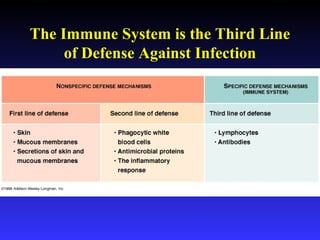
The Immune System is the Third Line
of Defense Against Infection
Innate or Genetic ImmunityInnate or Genetic Immunity: Immunity an: Immunity an
organism is born with.organism is born with.
Genetically determined.Genetically determined.
May be due to lack of receptors or otherMay be due to lack of receptors or other
molecules required for infection.molecules required for infection.
Innate human immunity to canine distemper.Innate human immunity to canine distemper.
Immunity of mice to poliovirus.Immunity of mice to poliovirus.
Acquired ImmunityAcquired Immunity:Immunity that an:Immunity that an
organismorganism developsdevelops during lifetime.during lifetime.
Not genetically determined.Not genetically determined.
May be acquired naturally or artificially.May be acquired naturally or artificially.
Development of immunity to measles in response toDevelopment of immunity to measles in response to
infection or vaccination.infection or vaccination.
Components of Human Immune System
Types of Acquired ImmunityTypes of Acquired Immunity
I. Naturally Acquired ImmunityI. Naturally Acquired Immunity: Obtained in: Obtained in
the course of daily life.the course of daily life.
A. Naturally Acquired Active ImmunityA. Naturally Acquired Active Immunity::
AntigensAntigens or pathogens enter body naturally.or pathogens enter body naturally.
Body generates an immune response to antigens.Body generates an immune response to antigens.
Immunity may be lifelong (chickenpox or mumps)Immunity may be lifelong (chickenpox or mumps)
or temporary (influenza or intestinal infections).or temporary (influenza or intestinal infections).
B. Naturally Acquired Passive ImmunityB. Naturally Acquired Passive Immunity::
AntibodiesAntibodies pass from mother to fetus via placentapass from mother to fetus via placenta
or breast feeding (or breast feeding (colostrumcolostrum).).
No immune response to antigens.No immune response to antigens.
Immunity is usuallyImmunity is usually short-livedshort-lived (weeks to months).(weeks to months).
Protection until child’s immune system develops.Protection until child’s immune system develops.
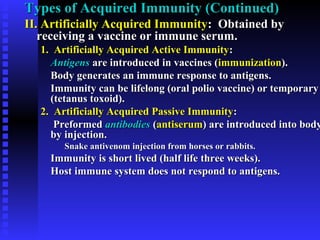
Types of Acquired Immunity (Continued)Types of Acquired Immunity (Continued)
II. Artificially Acquired ImmunityII. Artificially Acquired Immunity: Obtained by: Obtained by
receiving a vaccine or immune serum.receiving a vaccine or immune serum.
1. Artificially Acquired Active Immunity1. Artificially Acquired Active Immunity::
AntigensAntigens are introduced in vaccines (are introduced in vaccines (immunizationimmunization).).
Body generates an immune response to antigens.Body generates an immune response to antigens.
Immunity can be lifelong (oral polio vaccine) or temporaryImmunity can be lifelong (oral polio vaccine) or temporary
(tetanus toxoid).(tetanus toxoid).
2. Artificially Acquired Passive Immunity2. Artificially Acquired Passive Immunity::
PreformedPreformed antibodiesantibodies ((antiserumantiserum) are introduced into body) are introduced into body
by injection.by injection.
Snake antivenom injection from horses or rabbits.Snake antivenom injection from horses or rabbits.
Immunity is short lived (half life three weeks).Immunity is short lived (half life three weeks).
Host immune system does not respond to antigens.Host immune system does not respond to antigens.
SerumSerum: Fluid that remains after blood has clotted: Fluid that remains after blood has clotted
and cells have been removed.and cells have been removed.
AntiserumAntiserum: Serum containing antibodies to a: Serum containing antibodies to a
specific antigen(s). Obtained from injecting anspecific antigen(s). Obtained from injecting an
animal (horse, rabbit, goat) with antigen (snakeanimal (horse, rabbit, goat) with antigen (snake
venom, botulism or diphtheria toxin).venom, botulism or diphtheria toxin).
SerologySerology: The study of reactions between: The study of reactions between
antibodies and antigens.antibodies and antigens.
Gamma GlobulinsGamma Globulins: Fraction of serum that: Fraction of serum that
contains most of the antibodies.contains most of the antibodies.
Serum SicknessSerum Sickness: Disease caused by multiple: Disease caused by multiple
injections of antiserum. Immune response toinjections of antiserum. Immune response to
foreign proteins. May cause fever, kidneyforeign proteins. May cause fever, kidney
problems, and joint pain. Rare today.problems, and joint pain. Rare today.
Duality of Immune SystemDuality of Immune System
I. Humoral (Antibody-Mediated) ImmunityI. Humoral (Antibody-Mediated) Immunity
Involves production of antibodies against foreignInvolves production of antibodies against foreign
antigens.antigens.
Antibodies are produced by a subset of lymphocytesAntibodies are produced by a subset of lymphocytes
calledcalled B cellsB cells..
B cells that are stimulated will actively secreteB cells that are stimulated will actively secrete
antibodies and are calledantibodies and are called plasma cellsplasma cells..
Antibodies are found inAntibodies are found in extracellular fluidsextracellular fluids (blood(blood
plasma, lymph, mucus, etc.) and the surface of B cells.plasma, lymph, mucus, etc.) and the surface of B cells.
Defense against bacteria, bacterial toxins, and virusesDefense against bacteria, bacterial toxins, and viruses
that circulate freely in body fluids,that circulate freely in body fluids, beforebefore they enterthey enter
cells.cells.
Also cause certain reactions against transplantedAlso cause certain reactions against transplanted
tissue.tissue.
Antibodies are Produced by B Lymphocytes
Antibodies are Proteins that Recognize Specific Antigens
Duality of Immune System (Continued)Duality of Immune System (Continued)
II. Cell Mediated ImmunityII. Cell Mediated Immunity
Involves specialized set of lymphocytes calledInvolves specialized set of lymphocytes called T cellsT cells
that recognize foreign antigens on the surface of cells,that recognize foreign antigens on the surface of cells,
organisms, or tissues:organisms, or tissues:
Helper T cellsHelper T cells
Cytotoxic T cellsCytotoxic T cells
T cellsT cells regulateregulate proliferation and activity of other cellsproliferation and activity of other cells
of the immune system: B cells, macrophages,of the immune system: B cells, macrophages,
neutrophils, etc.neutrophils, etc.
Defense against:Defense against:
Bacteria and viruses that are inside host cells and areBacteria and viruses that are inside host cells and are
inaccessible to antibodies.inaccessible to antibodies.
Fungi, protozoa, and helminthsFungi, protozoa, and helminths
Cancer cellsCancer cells
Transplanted tissueTransplanted tissue
Cell Mediated Immunity is Carried Out by T Lymphocytes
AntigensAntigens
Most areMost are proteinsproteins or largeor large polysaccharidespolysaccharides fromfrom
a foreign organism.a foreign organism.
MicrobesMicrobes: Capsules, cell walls, toxins, viral capsids,: Capsules, cell walls, toxins, viral capsids,
flagella, etc.flagella, etc.
NonmicrobesNonmicrobes: Pollen, egg white , red blood cell: Pollen, egg white , red blood cell
surface molecules, serum proteins, and surfacesurface molecules, serum proteins, and surface
molecules from transplanted tissue.molecules from transplanted tissue.
Lipids and nucleic acids are only antigenic whenLipids and nucleic acids are only antigenic when
combinedcombined with proteins or polysaccharides.with proteins or polysaccharides.
Molecular weight of 10,000 or higher.Molecular weight of 10,000 or higher.
HaptenHapten: Small foreign molecule that is not antigenic. Must be: Small foreign molecule that is not antigenic. Must be
coupled to acoupled to a carriercarrier molecule to be antigenic. Once antibodiesmolecule to be antigenic. Once antibodies
are formed they will recognize hapten.are formed they will recognize hapten.
AntigensAntigens
EpitopeEpitope::
Small part of an antigen that interactsSmall part of an antigen that interacts
with an antibody.with an antibody.
Any given antigen may have severalAny given antigen may have several
epitopes.epitopes.
Each epitope is recognized by a differentEach epitope is recognized by a different
antibody.antibody.
Epitopes: Antigen Regions that Interact
with Antibodies
AntibodiesAntibodies
ProteinsProteins that recognize and bind to a particularthat recognize and bind to a particular
antigen with very highantigen with very high specificityspecificity..
Made in response to exposure to the antigen.Made in response to exposure to the antigen.
One virus or microbe may have severalOne virus or microbe may have several antigenicantigenic
determinant sitesdeterminant sites, to which different antibodies, to which different antibodies
may bind.may bind.
Each antibody has at least two identical sitesEach antibody has at least two identical sites
that bind antigen:that bind antigen: Antigen binding sitesAntigen binding sites..
Valence of an antibodyValence of an antibody: Number of antigen: Number of antigen
binding sites. Most arebinding sites. Most are bivalentbivalent..
Belong to a group of serum proteins calledBelong to a group of serum proteins called
immunoglobulins (Igs).immunoglobulins (Igs).
Antibody StructureAntibody Structure
MonomerMonomer: A flexible Y-shaped molecule with: A flexible Y-shaped molecule with
four protein chains:four protein chains:
2 identical2 identical lightlight chainschains
2 identical2 identical heavyheavy chainschains
Variable RegionsVariable Regions: Two sections at the end of: Two sections at the end of
Y’s arms. Contain theY’s arms. Contain the antigen binding sitesantigen binding sites
(Fab)(Fab). Identical on the same antibody, but vary. Identical on the same antibody, but vary
from one antibody to another.from one antibody to another.
Constant RegionsConstant Regions: Stem of monomer and lower: Stem of monomer and lower
parts of Y arms.parts of Y arms.
Fc regionFc region: Stem of monomer only. Important: Stem of monomer only. Important
because they can bind to complement or cells.because they can bind to complement or cells.
Antibody Structure
Immunoglobulin ClassesImmunoglobulin Classes
I. IgGI. IgG
Structure:Structure: MonomerMonomer
Percentage serum antibodies:Percentage serum antibodies: 80%80%
Location:Location: Blood, lymph, intestineBlood, lymph, intestine
Half-life in serum:Half-life in serum: 23 days23 days
Complement Fixation:Complement Fixation: YesYes
Placental Transfer:Placental Transfer: YesYes
Known Functions:Known Functions: Enhances phagocytosis,Enhances phagocytosis,
neutralizes toxins and viruses, protects fetus andneutralizes toxins and viruses, protects fetus and
newborn.newborn.
Immunoglobulin ClassesImmunoglobulin Classes
II. IgMII. IgM
Structure:Structure: PentamerPentamer
Percentage serum antibodies:Percentage serum antibodies: 5-10%5-10%
Location:Location: Blood, lymph, B cell surface (monomer)Blood, lymph, B cell surface (monomer)
Half-life in serum:Half-life in serum: 5 days5 days
Complement Fixation:Complement Fixation: YesYes
Placental Transfer:Placental Transfer: NoNo
Known Functions:Known Functions: First antibodies producedFirst antibodies produced
during an infection. Effective against microbes andduring an infection. Effective against microbes and
agglutinating antigens.agglutinating antigens.
Immunoglobulin ClassesImmunoglobulin Classes
III. IgAIII. IgA
Structure:Structure: DimerDimer
Percentage serum antibodies:Percentage serum antibodies: 10-15%10-15%
Location:Location: Secretions (tears, saliva, intestine, milk),Secretions (tears, saliva, intestine, milk),
blood and lymph.blood and lymph.
Half-life in serum:Half-life in serum: 6 days6 days
Complement Fixation:Complement Fixation: NoNo
Placental Transfer:Placental Transfer: NoNo
Known Functions:Known Functions: Localized protection ofLocalized protection of mucosalmucosal
surfaces. Provides immunity to infant digestivesurfaces. Provides immunity to infant digestive
tract.tract.
Immunoglobulin ClassesImmunoglobulin Classes
IV. IgDIV. IgD
Structure:Structure: MonomerMonomer
Percentage serum antibodies:Percentage serum antibodies: 0.2%0.2%
Location:Location: B-cell surface, blood, and lymphB-cell surface, blood, and lymph
Half-life in serum:Half-life in serum: 3 days3 days
Complement Fixation:Complement Fixation: NoNo
Placental Transfer:Placental Transfer: NoNo
Known Functions:Known Functions: In serum function is unknown.In serum function is unknown.
On B cell surface, initiate immune response.On B cell surface, initiate immune response.
Immunoglobulin ClassesImmunoglobulin Classes
V. IgEV. IgE
Structure:Structure: MonomerMonomer
Percentage serum antibodies:Percentage serum antibodies: 0.002%0.002%
Location:Location: Bound to mast cells and basophilsBound to mast cells and basophils
throughout body. Blood.throughout body. Blood.
Half-life in serum:Half-life in serum: 2 days2 days
Complement Fixation:Complement Fixation: NoNo
Placental Transfer:Placental Transfer: NoNo
Known Functions:Known Functions: Allergic reactions. PossiblyAllergic reactions. Possibly
lysis of worms.lysis of worms.
How Do B Cells Produce Antibodies?How Do B Cells Produce Antibodies?
B cells develop fromB cells develop from stem cellsstem cells in the bonein the bone
marrow of adults (liver of fetuses).marrow of adults (liver of fetuses).
After maturation B cells migrate to lymphoidAfter maturation B cells migrate to lymphoid
organs (lymph node or spleen).organs (lymph node or spleen).
Clonal SelectionClonal Selection: When a B cell encounters an: When a B cell encounters an
antigen it recognizes, it is stimulated and dividesantigen it recognizes, it is stimulated and divides
into many clones calledinto many clones called plasma cellsplasma cells, which, which
actively secrete antibodies.actively secrete antibodies.
Each B cell produces antibodies that willEach B cell produces antibodies that will
recognize only one antigenic determinant.recognize only one antigenic determinant.
Clonal Selection of B Cells is Caused
by Antigenic Stimulation
Humoral Immunity (Continued)Humoral Immunity (Continued)
ApoptosisApoptosis
Programmed cell death (“Falling away”).Programmed cell death (“Falling away”).
Human body makes 100 million lymphocytesHuman body makes 100 million lymphocytes
every day. If an equivalent number doesn’t die,every day. If an equivalent number doesn’t die,
will develop leukemia.will develop leukemia.
B cells that do not encounter stimulating antigenB cells that do not encounter stimulating antigen
will self-destruct and send signals to phagocyteswill self-destruct and send signals to phagocytes
to dispose of their remains.to dispose of their remains.
Many virus infected cells will undergo apoptosis,Many virus infected cells will undergo apoptosis,
to help prevent spread of the infection.to help prevent spread of the infection.
Humoral Immunity (Continued)Humoral Immunity (Continued)
Clonal SelectionClonal Selection
Clonal SelectionClonal Selection: B cells (and T cells) that: B cells (and T cells) that
encounter stimulating antigen will proliferate intoencounter stimulating antigen will proliferate into
a large group of cells.a large group of cells.
Why don’t we produce antibodies against ourWhy don’t we produce antibodies against our
own antigens? We have developedown antigens? We have developed tolerancetolerance toto
them.them.
Clonal DeletionClonal Deletion: B and T cells that react against: B and T cells that react against
selfself antigens appear to be destroyed during fetalantigens appear to be destroyed during fetal
development. Process is poorly understood.development. Process is poorly understood.
Consequences of Antigen-Antibody BindingConsequences of Antigen-Antibody Binding
Antigen-Antibody ComplexAntigen-Antibody Complex: Formed when an: Formed when an
antibody binds to an antigen it recognizes.antibody binds to an antigen it recognizes.
AffinityAffinity: A measure of binding strength.: A measure of binding strength.
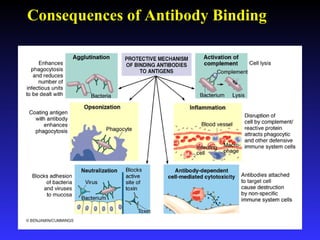
1. Agglutination:1. Agglutination: Antibodies cause antigensAntibodies cause antigens
(microbes) to clump together.(microbes) to clump together.
IgM (decavalent) is more effective that IgG (bivalent).IgM (decavalent) is more effective that IgG (bivalent).
HemagglutinationHemagglutination: Agglutination of red blood cells.: Agglutination of red blood cells.
Used to determine ABO blood types and to detectUsed to determine ABO blood types and to detect
influenza and measles viruses.influenza and measles viruses.
2. Opsonization:2. Opsonization: Antigen (microbe) is covered withAntigen (microbe) is covered with
antibodies that enhances its ingestion and lysis byantibodies that enhances its ingestion and lysis by
phagocytic cells.phagocytic cells.
Consequences of Antibody Binding
Humoral Immunity (Continued)Humoral Immunity (Continued)
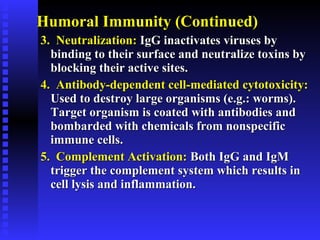
3. Neutralization:3. Neutralization: IgG inactivates viruses byIgG inactivates viruses by
binding to their surface and neutralize toxins bybinding to their surface and neutralize toxins by
blocking their active sites.blocking their active sites.
4. Antibody-dependent cell-mediated cytotoxicity:4. Antibody-dependent cell-mediated cytotoxicity:
Used to destroy large organisms (e.g.: worms).Used to destroy large organisms (e.g.: worms).
Target organism is coated with antibodies andTarget organism is coated with antibodies and
bombarded with chemicals from nonspecificbombarded with chemicals from nonspecific
immune cells.immune cells.
5. Complement Activation:5. Complement Activation: Both IgG and IgMBoth IgG and IgM
trigger the complement system which results intrigger the complement system which results in
cell lysis and inflammation.cell lysis and inflammation.
Consequences of Antibody Binding
Immunological MemoryImmunological Memory
Antibody Titer:Antibody Titer: The amount of antibody in theThe amount of antibody in the
serum.serum.
Pattern of Antibody Levels During InfectionPattern of Antibody Levels During Infection
Primary Response:Primary Response:
AfterAfter initialinitial exposure to antigen, no antibodies areexposure to antigen, no antibodies are
found in serum for several days.found in serum for several days.
A gradual increase in titer, first of IgM and thenA gradual increase in titer, first of IgM and then
of IgG is observed.of IgG is observed.
Most B cells become plasma cells, but some B cellsMost B cells become plasma cells, but some B cells
become long livingbecome long living memory cellsmemory cells..
Gradual decline of antibodies follows.Gradual decline of antibodies follows.
Immunological Memory (Continued)Immunological Memory (Continued)
Secondary Response:Secondary Response:
Subsequent exposure to the same antigen displaysSubsequent exposure to the same antigen displays
a faster and more intense antibody response.a faster and more intense antibody response.
Increased antibody response is due to theIncreased antibody response is due to the
existence of memory cells, which rapidly produceexistence of memory cells, which rapidly produce
plasma cells upon antigen stimulation.plasma cells upon antigen stimulation.
Antibody Response After Exposure to Antigen
T Cells and Cell Mediated ImmunityT Cells and Cell Mediated Immunity
Antigens that stimulate this response are mainlyAntigens that stimulate this response are mainly
intracellularintracellular..
Requires constant presence of antigen to remainRequires constant presence of antigen to remain
effective.effective.
Unlike humoral immunity, cell mediated immunityUnlike humoral immunity, cell mediated immunity
is not transferred to the fetus.is not transferred to the fetus.
Cytokines:Cytokines: Chemical messengers of immune cells.Chemical messengers of immune cells.
Over 100 have been identified.Over 100 have been identified.
Stimulate and/or regulate immune responses.Stimulate and/or regulate immune responses.
Interleukins:Interleukins: Communication between WBCs.Communication between WBCs.
InterferonsInterferons: Protect against viral infections.: Protect against viral infections.
ChemokinesChemokines: Attract WBCs to infected areas.: Attract WBCs to infected areas.
T Cells and Cell Mediated ImmunityT Cells and Cell Mediated Immunity
Cellular Components of Immunity:Cellular Components of Immunity:
T cells are key cellular component of immunity.T cells are key cellular component of immunity.
T cells have an antigen receptor that recognizesT cells have an antigen receptor that recognizes
and reacts to a specific antigen (and reacts to a specific antigen (T cell receptorT cell receptor).).
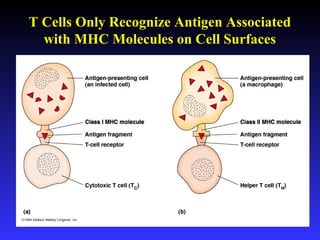
T cell receptor only recognize antigens combinedT cell receptor only recognize antigens combined
withwith majormajor histocompatabilityhistocompatability (MHC) proteins(MHC) proteins onon
thethe surfacesurface of cells.of cells.
MHC Class I: Found on all cells.MHC Class I: Found on all cells.
MHC Class II: Found on phagocytes.MHC Class II: Found on phagocytes.
Clonal selection increases number of T cells.Clonal selection increases number of T cells.
T Cells Only Recognize Antigen Associated
with MHC Molecules on Cell Surfaces
T Cells and Cell Mediated ImmunityT Cells and Cell Mediated Immunity
Types of T cellsTypes of T cells
1. T Helper (T1. T Helper (THH) Cells:) Cells: Central role in immuneCentral role in immune
response.response.
Most are CD4Most are CD4++
Recognize antigen on the surface of antigen presentingRecognize antigen on the surface of antigen presenting
cells (e.g.: macrophage).cells (e.g.: macrophage).
Activate macrophagesActivate macrophages
Induce formation of cytotoxic T cellsInduce formation of cytotoxic T cells
Stimulate B cells to produce antibodies.Stimulate B cells to produce antibodies.
Central Role of Helper T Cells
Types of T cells (Continued)Types of T cells (Continued)
2. Cytotoxic T (Tc) Cells:2. Cytotoxic T (Tc) Cells: Destroy target cells.Destroy target cells.
Most are CD4 negative (CD4Most are CD4 negative (CD4--
).).
Recognize antigens on the surface of all cells:Recognize antigens on the surface of all cells:
• Kill host cells that are infected with viruses or bacteria.Kill host cells that are infected with viruses or bacteria.
• Recognize and kill cancer cells.Recognize and kill cancer cells.
• Recognize and destroy transplanted tissue.Recognize and destroy transplanted tissue.
Release protein calledRelease protein called perforinperforin which forms a pore inwhich forms a pore in
target cell, causing lysis of infected cells.target cell, causing lysis of infected cells.
UndergoUndergo apoptosisapoptosis when stimulating antigen is gone.when stimulating antigen is gone.
Cytotoxic T Cells Lyse Infected Cells
Types of T cells (Continued)Types of T cells (Continued)
3. Delayed Hypersensitivity T (T3. Delayed Hypersensitivity T (TDD) Cells:) Cells: Mostly TMostly T
helper and a few cytotoxic T cells that arehelper and a few cytotoxic T cells that are
involved in some allergic reactions (poison ivy)involved in some allergic reactions (poison ivy)
and rejection of transplanted tissue.and rejection of transplanted tissue.
4. T Suppressor (Ts) Cells:4. T Suppressor (Ts) Cells: May shut downMay shut down
immune response.immune response.
Nonspecific Cellular ComponentsNonspecific Cellular Components
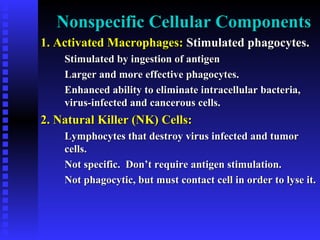
1. Activated Macrophages:1. Activated Macrophages: Stimulated phagocytes.Stimulated phagocytes.
Stimulated by ingestion of antigenStimulated by ingestion of antigen
Larger and more effective phagocytes.Larger and more effective phagocytes.
Enhanced ability to eliminate intracellular bacteria,Enhanced ability to eliminate intracellular bacteria,
virus-infected and cancerous cells.virus-infected and cancerous cells.
2. Natural Killer (NK) Cells:2. Natural Killer (NK) Cells:
Lymphocytes that destroy virus infected and tumorLymphocytes that destroy virus infected and tumor
cells.cells.
Not specific. Don’t require antigen stimulation.Not specific. Don’t require antigen stimulation.
Not phagocytic, but must contact cell in order to lyse it.Not phagocytic, but must contact cell in order to lyse it.
Relationship Between Cell-MediatedRelationship Between Cell-Mediated
and Humoral Immunityand Humoral Immunity
1. Antibody Production1. Antibody Production
T-Dependent Antigens:T-Dependent Antigens:
Antibody production requires assistance from T helper cells.Antibody production requires assistance from T helper cells.
A macrophage cells ingest antigen and presents it to TA macrophage cells ingest antigen and presents it to THH cell.cell.
TTHH cell stimulates B cells specific for antigen to become plasmacell stimulates B cells specific for antigen to become plasma
cells.cells.
Antigens are mainly proteins on viruses, bacteria, foreign redAntigens are mainly proteins on viruses, bacteria, foreign red
blood cells, and hapten-carrier molecules.blood cells, and hapten-carrier molecules.
T-Independent Antigens:T-Independent Antigens:
Antibody production does not require assistance from T cells.Antibody production does not require assistance from T cells.
Antigens are mainly polysaccharides or lipopolysaccharides withAntigens are mainly polysaccharides or lipopolysaccharides with
repeating subunits (bacterial capsules).repeating subunits (bacterial capsules).
Weaker immune response than for T-dependent antigens.Weaker immune response than for T-dependent antigens.
Humoral Response to T Dependent Antigens
Relationship Between Cell-MediatedRelationship Between Cell-Mediated
and Humoral Immunityand Humoral Immunity
2. Antibody Dependent Cell Mediated2. Antibody Dependent Cell Mediated
CytotoxicityCytotoxicity
Target cell is covered with antibodies, leaving FcTarget cell is covered with antibodies, leaving Fc
portion sticking outwards.portion sticking outwards.
Natural killer and other nonspecific cells that haveNatural killer and other nonspecific cells that have
receptors for Fc region are stimulated to kill targetedreceptors for Fc region are stimulated to kill targeted
cells.cells.
Target organism is lysed by substances secreted byTarget organism is lysed by substances secreted by
attacking cells.attacking cells.
Used to destroy large organisms that cannot beUsed to destroy large organisms that cannot be
phagocytosed.phagocytosed.
Destruction of Large Parasites by ADCC
Overview of the Immune Response

Specific defenses

  • 1.
    Specific Host Defenses:TheSpecific Host Defenses: The Immune ResponseImmune Response
  • 2.
    The Immune ResponseTheImmune Response ImmunityImmunity: “Free from burden”. Ability of: “Free from burden”. Ability of an organism to recognize and defend itselfan organism to recognize and defend itself againstagainst specificspecific pathogens or antigens.pathogens or antigens. Immune ResponseImmune Response: Third line of defense.: Third line of defense. Involves production of antibodies andInvolves production of antibodies and generation of specialized lymphocytesgeneration of specialized lymphocytes against specific antigens.against specific antigens. AntigenAntigen: Molecules from a pathogen or: Molecules from a pathogen or foreign organism that provoke a specificforeign organism that provoke a specific immune response.immune response.
  • 3.
    The Immune Systemis the Third Line of Defense Against Infection
  • 4.
    Innate or GeneticImmunityInnate or Genetic Immunity: Immunity an: Immunity an organism is born with.organism is born with. Genetically determined.Genetically determined. May be due to lack of receptors or otherMay be due to lack of receptors or other molecules required for infection.molecules required for infection. Innate human immunity to canine distemper.Innate human immunity to canine distemper. Immunity of mice to poliovirus.Immunity of mice to poliovirus. Acquired ImmunityAcquired Immunity:Immunity that an:Immunity that an organismorganism developsdevelops during lifetime.during lifetime. Not genetically determined.Not genetically determined. May be acquired naturally or artificially.May be acquired naturally or artificially. Development of immunity to measles in response toDevelopment of immunity to measles in response to infection or vaccination.infection or vaccination.
  • 5.
    Components of HumanImmune System
  • 6.
    Types of AcquiredImmunityTypes of Acquired Immunity I. Naturally Acquired ImmunityI. Naturally Acquired Immunity: Obtained in: Obtained in the course of daily life.the course of daily life. A. Naturally Acquired Active ImmunityA. Naturally Acquired Active Immunity:: AntigensAntigens or pathogens enter body naturally.or pathogens enter body naturally. Body generates an immune response to antigens.Body generates an immune response to antigens. Immunity may be lifelong (chickenpox or mumps)Immunity may be lifelong (chickenpox or mumps) or temporary (influenza or intestinal infections).or temporary (influenza or intestinal infections). B. Naturally Acquired Passive ImmunityB. Naturally Acquired Passive Immunity:: AntibodiesAntibodies pass from mother to fetus via placentapass from mother to fetus via placenta or breast feeding (or breast feeding (colostrumcolostrum).). No immune response to antigens.No immune response to antigens. Immunity is usuallyImmunity is usually short-livedshort-lived (weeks to months).(weeks to months). Protection until child’s immune system develops.Protection until child’s immune system develops.
  • 7.
    Types of AcquiredImmunity (Continued)Types of Acquired Immunity (Continued) II. Artificially Acquired ImmunityII. Artificially Acquired Immunity: Obtained by: Obtained by receiving a vaccine or immune serum.receiving a vaccine or immune serum. 1. Artificially Acquired Active Immunity1. Artificially Acquired Active Immunity:: AntigensAntigens are introduced in vaccines (are introduced in vaccines (immunizationimmunization).). Body generates an immune response to antigens.Body generates an immune response to antigens. Immunity can be lifelong (oral polio vaccine) or temporaryImmunity can be lifelong (oral polio vaccine) or temporary (tetanus toxoid).(tetanus toxoid). 2. Artificially Acquired Passive Immunity2. Artificially Acquired Passive Immunity:: PreformedPreformed antibodiesantibodies ((antiserumantiserum) are introduced into body) are introduced into body by injection.by injection. Snake antivenom injection from horses or rabbits.Snake antivenom injection from horses or rabbits. Immunity is short lived (half life three weeks).Immunity is short lived (half life three weeks). Host immune system does not respond to antigens.Host immune system does not respond to antigens.
  • 8.
    SerumSerum: Fluid thatremains after blood has clotted: Fluid that remains after blood has clotted and cells have been removed.and cells have been removed. AntiserumAntiserum: Serum containing antibodies to a: Serum containing antibodies to a specific antigen(s). Obtained from injecting anspecific antigen(s). Obtained from injecting an animal (horse, rabbit, goat) with antigen (snakeanimal (horse, rabbit, goat) with antigen (snake venom, botulism or diphtheria toxin).venom, botulism or diphtheria toxin). SerologySerology: The study of reactions between: The study of reactions between antibodies and antigens.antibodies and antigens. Gamma GlobulinsGamma Globulins: Fraction of serum that: Fraction of serum that contains most of the antibodies.contains most of the antibodies. Serum SicknessSerum Sickness: Disease caused by multiple: Disease caused by multiple injections of antiserum. Immune response toinjections of antiserum. Immune response to foreign proteins. May cause fever, kidneyforeign proteins. May cause fever, kidney problems, and joint pain. Rare today.problems, and joint pain. Rare today.
  • 9.
    Duality of ImmuneSystemDuality of Immune System I. Humoral (Antibody-Mediated) ImmunityI. Humoral (Antibody-Mediated) Immunity Involves production of antibodies against foreignInvolves production of antibodies against foreign antigens.antigens. Antibodies are produced by a subset of lymphocytesAntibodies are produced by a subset of lymphocytes calledcalled B cellsB cells.. B cells that are stimulated will actively secreteB cells that are stimulated will actively secrete antibodies and are calledantibodies and are called plasma cellsplasma cells.. Antibodies are found inAntibodies are found in extracellular fluidsextracellular fluids (blood(blood plasma, lymph, mucus, etc.) and the surface of B cells.plasma, lymph, mucus, etc.) and the surface of B cells. Defense against bacteria, bacterial toxins, and virusesDefense against bacteria, bacterial toxins, and viruses that circulate freely in body fluids,that circulate freely in body fluids, beforebefore they enterthey enter cells.cells. Also cause certain reactions against transplantedAlso cause certain reactions against transplanted tissue.tissue.
  • 10.
    Antibodies are Producedby B Lymphocytes
  • 11.
    Antibodies are Proteinsthat Recognize Specific Antigens
  • 12.
    Duality of ImmuneSystem (Continued)Duality of Immune System (Continued) II. Cell Mediated ImmunityII. Cell Mediated Immunity Involves specialized set of lymphocytes calledInvolves specialized set of lymphocytes called T cellsT cells that recognize foreign antigens on the surface of cells,that recognize foreign antigens on the surface of cells, organisms, or tissues:organisms, or tissues: Helper T cellsHelper T cells Cytotoxic T cellsCytotoxic T cells T cellsT cells regulateregulate proliferation and activity of other cellsproliferation and activity of other cells of the immune system: B cells, macrophages,of the immune system: B cells, macrophages, neutrophils, etc.neutrophils, etc. Defense against:Defense against: Bacteria and viruses that are inside host cells and areBacteria and viruses that are inside host cells and are inaccessible to antibodies.inaccessible to antibodies. Fungi, protozoa, and helminthsFungi, protozoa, and helminths Cancer cellsCancer cells Transplanted tissueTransplanted tissue
  • 13.
    Cell Mediated Immunityis Carried Out by T Lymphocytes
  • 14.
    AntigensAntigens Most areMost areproteinsproteins or largeor large polysaccharidespolysaccharides fromfrom a foreign organism.a foreign organism. MicrobesMicrobes: Capsules, cell walls, toxins, viral capsids,: Capsules, cell walls, toxins, viral capsids, flagella, etc.flagella, etc. NonmicrobesNonmicrobes: Pollen, egg white , red blood cell: Pollen, egg white , red blood cell surface molecules, serum proteins, and surfacesurface molecules, serum proteins, and surface molecules from transplanted tissue.molecules from transplanted tissue. Lipids and nucleic acids are only antigenic whenLipids and nucleic acids are only antigenic when combinedcombined with proteins or polysaccharides.with proteins or polysaccharides. Molecular weight of 10,000 or higher.Molecular weight of 10,000 or higher. HaptenHapten: Small foreign molecule that is not antigenic. Must be: Small foreign molecule that is not antigenic. Must be coupled to acoupled to a carriercarrier molecule to be antigenic. Once antibodiesmolecule to be antigenic. Once antibodies are formed they will recognize hapten.are formed they will recognize hapten.
  • 15.
    AntigensAntigens EpitopeEpitope:: Small part ofan antigen that interactsSmall part of an antigen that interacts with an antibody.with an antibody. Any given antigen may have severalAny given antigen may have several epitopes.epitopes. Each epitope is recognized by a differentEach epitope is recognized by a different antibody.antibody.
  • 16.
    Epitopes: Antigen Regionsthat Interact with Antibodies
  • 17.
    AntibodiesAntibodies ProteinsProteins that recognizeand bind to a particularthat recognize and bind to a particular antigen with very highantigen with very high specificityspecificity.. Made in response to exposure to the antigen.Made in response to exposure to the antigen. One virus or microbe may have severalOne virus or microbe may have several antigenicantigenic determinant sitesdeterminant sites, to which different antibodies, to which different antibodies may bind.may bind. Each antibody has at least two identical sitesEach antibody has at least two identical sites that bind antigen:that bind antigen: Antigen binding sitesAntigen binding sites.. Valence of an antibodyValence of an antibody: Number of antigen: Number of antigen binding sites. Most arebinding sites. Most are bivalentbivalent.. Belong to a group of serum proteins calledBelong to a group of serum proteins called immunoglobulins (Igs).immunoglobulins (Igs).
  • 18.
    Antibody StructureAntibody Structure MonomerMonomer:A flexible Y-shaped molecule with: A flexible Y-shaped molecule with four protein chains:four protein chains: 2 identical2 identical lightlight chainschains 2 identical2 identical heavyheavy chainschains Variable RegionsVariable Regions: Two sections at the end of: Two sections at the end of Y’s arms. Contain theY’s arms. Contain the antigen binding sitesantigen binding sites (Fab)(Fab). Identical on the same antibody, but vary. Identical on the same antibody, but vary from one antibody to another.from one antibody to another. Constant RegionsConstant Regions: Stem of monomer and lower: Stem of monomer and lower parts of Y arms.parts of Y arms. Fc regionFc region: Stem of monomer only. Important: Stem of monomer only. Important because they can bind to complement or cells.because they can bind to complement or cells.
  • 19.
  • 20.
    Immunoglobulin ClassesImmunoglobulin Classes I.IgGI. IgG Structure:Structure: MonomerMonomer Percentage serum antibodies:Percentage serum antibodies: 80%80% Location:Location: Blood, lymph, intestineBlood, lymph, intestine Half-life in serum:Half-life in serum: 23 days23 days Complement Fixation:Complement Fixation: YesYes Placental Transfer:Placental Transfer: YesYes Known Functions:Known Functions: Enhances phagocytosis,Enhances phagocytosis, neutralizes toxins and viruses, protects fetus andneutralizes toxins and viruses, protects fetus and newborn.newborn.
  • 21.
    Immunoglobulin ClassesImmunoglobulin Classes II.IgMII. IgM Structure:Structure: PentamerPentamer Percentage serum antibodies:Percentage serum antibodies: 5-10%5-10% Location:Location: Blood, lymph, B cell surface (monomer)Blood, lymph, B cell surface (monomer) Half-life in serum:Half-life in serum: 5 days5 days Complement Fixation:Complement Fixation: YesYes Placental Transfer:Placental Transfer: NoNo Known Functions:Known Functions: First antibodies producedFirst antibodies produced during an infection. Effective against microbes andduring an infection. Effective against microbes and agglutinating antigens.agglutinating antigens.
  • 22.
    Immunoglobulin ClassesImmunoglobulin Classes III.IgAIII. IgA Structure:Structure: DimerDimer Percentage serum antibodies:Percentage serum antibodies: 10-15%10-15% Location:Location: Secretions (tears, saliva, intestine, milk),Secretions (tears, saliva, intestine, milk), blood and lymph.blood and lymph. Half-life in serum:Half-life in serum: 6 days6 days Complement Fixation:Complement Fixation: NoNo Placental Transfer:Placental Transfer: NoNo Known Functions:Known Functions: Localized protection ofLocalized protection of mucosalmucosal surfaces. Provides immunity to infant digestivesurfaces. Provides immunity to infant digestive tract.tract.
  • 23.
    Immunoglobulin ClassesImmunoglobulin Classes IV.IgDIV. IgD Structure:Structure: MonomerMonomer Percentage serum antibodies:Percentage serum antibodies: 0.2%0.2% Location:Location: B-cell surface, blood, and lymphB-cell surface, blood, and lymph Half-life in serum:Half-life in serum: 3 days3 days Complement Fixation:Complement Fixation: NoNo Placental Transfer:Placental Transfer: NoNo Known Functions:Known Functions: In serum function is unknown.In serum function is unknown. On B cell surface, initiate immune response.On B cell surface, initiate immune response.
  • 24.
    Immunoglobulin ClassesImmunoglobulin Classes V.IgEV. IgE Structure:Structure: MonomerMonomer Percentage serum antibodies:Percentage serum antibodies: 0.002%0.002% Location:Location: Bound to mast cells and basophilsBound to mast cells and basophils throughout body. Blood.throughout body. Blood. Half-life in serum:Half-life in serum: 2 days2 days Complement Fixation:Complement Fixation: NoNo Placental Transfer:Placental Transfer: NoNo Known Functions:Known Functions: Allergic reactions. PossiblyAllergic reactions. Possibly lysis of worms.lysis of worms.
  • 25.
    How Do BCells Produce Antibodies?How Do B Cells Produce Antibodies? B cells develop fromB cells develop from stem cellsstem cells in the bonein the bone marrow of adults (liver of fetuses).marrow of adults (liver of fetuses). After maturation B cells migrate to lymphoidAfter maturation B cells migrate to lymphoid organs (lymph node or spleen).organs (lymph node or spleen). Clonal SelectionClonal Selection: When a B cell encounters an: When a B cell encounters an antigen it recognizes, it is stimulated and dividesantigen it recognizes, it is stimulated and divides into many clones calledinto many clones called plasma cellsplasma cells, which, which actively secrete antibodies.actively secrete antibodies. Each B cell produces antibodies that willEach B cell produces antibodies that will recognize only one antigenic determinant.recognize only one antigenic determinant.
  • 26.
    Clonal Selection ofB Cells is Caused by Antigenic Stimulation
  • 27.
    Humoral Immunity (Continued)HumoralImmunity (Continued) ApoptosisApoptosis Programmed cell death (“Falling away”).Programmed cell death (“Falling away”). Human body makes 100 million lymphocytesHuman body makes 100 million lymphocytes every day. If an equivalent number doesn’t die,every day. If an equivalent number doesn’t die, will develop leukemia.will develop leukemia. B cells that do not encounter stimulating antigenB cells that do not encounter stimulating antigen will self-destruct and send signals to phagocyteswill self-destruct and send signals to phagocytes to dispose of their remains.to dispose of their remains. Many virus infected cells will undergo apoptosis,Many virus infected cells will undergo apoptosis, to help prevent spread of the infection.to help prevent spread of the infection.
  • 28.
    Humoral Immunity (Continued)HumoralImmunity (Continued) Clonal SelectionClonal Selection Clonal SelectionClonal Selection: B cells (and T cells) that: B cells (and T cells) that encounter stimulating antigen will proliferate intoencounter stimulating antigen will proliferate into a large group of cells.a large group of cells. Why don’t we produce antibodies against ourWhy don’t we produce antibodies against our own antigens? We have developedown antigens? We have developed tolerancetolerance toto them.them. Clonal DeletionClonal Deletion: B and T cells that react against: B and T cells that react against selfself antigens appear to be destroyed during fetalantigens appear to be destroyed during fetal development. Process is poorly understood.development. Process is poorly understood.
  • 29.
    Consequences of Antigen-AntibodyBindingConsequences of Antigen-Antibody Binding Antigen-Antibody ComplexAntigen-Antibody Complex: Formed when an: Formed when an antibody binds to an antigen it recognizes.antibody binds to an antigen it recognizes. AffinityAffinity: A measure of binding strength.: A measure of binding strength. 1. Agglutination:1. Agglutination: Antibodies cause antigensAntibodies cause antigens (microbes) to clump together.(microbes) to clump together. IgM (decavalent) is more effective that IgG (bivalent).IgM (decavalent) is more effective that IgG (bivalent). HemagglutinationHemagglutination: Agglutination of red blood cells.: Agglutination of red blood cells. Used to determine ABO blood types and to detectUsed to determine ABO blood types and to detect influenza and measles viruses.influenza and measles viruses. 2. Opsonization:2. Opsonization: Antigen (microbe) is covered withAntigen (microbe) is covered with antibodies that enhances its ingestion and lysis byantibodies that enhances its ingestion and lysis by phagocytic cells.phagocytic cells.
  • 30.
  • 31.
    Humoral Immunity (Continued)HumoralImmunity (Continued) 3. Neutralization:3. Neutralization: IgG inactivates viruses byIgG inactivates viruses by binding to their surface and neutralize toxins bybinding to their surface and neutralize toxins by blocking their active sites.blocking their active sites. 4. Antibody-dependent cell-mediated cytotoxicity:4. Antibody-dependent cell-mediated cytotoxicity: Used to destroy large organisms (e.g.: worms).Used to destroy large organisms (e.g.: worms). Target organism is coated with antibodies andTarget organism is coated with antibodies and bombarded with chemicals from nonspecificbombarded with chemicals from nonspecific immune cells.immune cells. 5. Complement Activation:5. Complement Activation: Both IgG and IgMBoth IgG and IgM trigger the complement system which results intrigger the complement system which results in cell lysis and inflammation.cell lysis and inflammation.
  • 32.
  • 33.
    Immunological MemoryImmunological Memory AntibodyTiter:Antibody Titer: The amount of antibody in theThe amount of antibody in the serum.serum. Pattern of Antibody Levels During InfectionPattern of Antibody Levels During Infection Primary Response:Primary Response: AfterAfter initialinitial exposure to antigen, no antibodies areexposure to antigen, no antibodies are found in serum for several days.found in serum for several days. A gradual increase in titer, first of IgM and thenA gradual increase in titer, first of IgM and then of IgG is observed.of IgG is observed. Most B cells become plasma cells, but some B cellsMost B cells become plasma cells, but some B cells become long livingbecome long living memory cellsmemory cells.. Gradual decline of antibodies follows.Gradual decline of antibodies follows.
  • 34.
    Immunological Memory (Continued)ImmunologicalMemory (Continued) Secondary Response:Secondary Response: Subsequent exposure to the same antigen displaysSubsequent exposure to the same antigen displays a faster and more intense antibody response.a faster and more intense antibody response. Increased antibody response is due to theIncreased antibody response is due to the existence of memory cells, which rapidly produceexistence of memory cells, which rapidly produce plasma cells upon antigen stimulation.plasma cells upon antigen stimulation.
  • 35.
    Antibody Response AfterExposure to Antigen
  • 36.
    T Cells andCell Mediated ImmunityT Cells and Cell Mediated Immunity Antigens that stimulate this response are mainlyAntigens that stimulate this response are mainly intracellularintracellular.. Requires constant presence of antigen to remainRequires constant presence of antigen to remain effective.effective. Unlike humoral immunity, cell mediated immunityUnlike humoral immunity, cell mediated immunity is not transferred to the fetus.is not transferred to the fetus. Cytokines:Cytokines: Chemical messengers of immune cells.Chemical messengers of immune cells. Over 100 have been identified.Over 100 have been identified. Stimulate and/or regulate immune responses.Stimulate and/or regulate immune responses. Interleukins:Interleukins: Communication between WBCs.Communication between WBCs. InterferonsInterferons: Protect against viral infections.: Protect against viral infections. ChemokinesChemokines: Attract WBCs to infected areas.: Attract WBCs to infected areas.
  • 37.
    T Cells andCell Mediated ImmunityT Cells and Cell Mediated Immunity Cellular Components of Immunity:Cellular Components of Immunity: T cells are key cellular component of immunity.T cells are key cellular component of immunity. T cells have an antigen receptor that recognizesT cells have an antigen receptor that recognizes and reacts to a specific antigen (and reacts to a specific antigen (T cell receptorT cell receptor).). T cell receptor only recognize antigens combinedT cell receptor only recognize antigens combined withwith majormajor histocompatabilityhistocompatability (MHC) proteins(MHC) proteins onon thethe surfacesurface of cells.of cells. MHC Class I: Found on all cells.MHC Class I: Found on all cells. MHC Class II: Found on phagocytes.MHC Class II: Found on phagocytes. Clonal selection increases number of T cells.Clonal selection increases number of T cells.
  • 38.
    T Cells OnlyRecognize Antigen Associated with MHC Molecules on Cell Surfaces
  • 39.
    T Cells andCell Mediated ImmunityT Cells and Cell Mediated Immunity Types of T cellsTypes of T cells 1. T Helper (T1. T Helper (THH) Cells:) Cells: Central role in immuneCentral role in immune response.response. Most are CD4Most are CD4++ Recognize antigen on the surface of antigen presentingRecognize antigen on the surface of antigen presenting cells (e.g.: macrophage).cells (e.g.: macrophage). Activate macrophagesActivate macrophages Induce formation of cytotoxic T cellsInduce formation of cytotoxic T cells Stimulate B cells to produce antibodies.Stimulate B cells to produce antibodies.
  • 40.
    Central Role ofHelper T Cells
  • 41.
    Types of Tcells (Continued)Types of T cells (Continued) 2. Cytotoxic T (Tc) Cells:2. Cytotoxic T (Tc) Cells: Destroy target cells.Destroy target cells. Most are CD4 negative (CD4Most are CD4 negative (CD4-- ).). Recognize antigens on the surface of all cells:Recognize antigens on the surface of all cells: • Kill host cells that are infected with viruses or bacteria.Kill host cells that are infected with viruses or bacteria. • Recognize and kill cancer cells.Recognize and kill cancer cells. • Recognize and destroy transplanted tissue.Recognize and destroy transplanted tissue. Release protein calledRelease protein called perforinperforin which forms a pore inwhich forms a pore in target cell, causing lysis of infected cells.target cell, causing lysis of infected cells. UndergoUndergo apoptosisapoptosis when stimulating antigen is gone.when stimulating antigen is gone.
  • 42.
    Cytotoxic T CellsLyse Infected Cells
  • 43.
    Types of Tcells (Continued)Types of T cells (Continued) 3. Delayed Hypersensitivity T (T3. Delayed Hypersensitivity T (TDD) Cells:) Cells: Mostly TMostly T helper and a few cytotoxic T cells that arehelper and a few cytotoxic T cells that are involved in some allergic reactions (poison ivy)involved in some allergic reactions (poison ivy) and rejection of transplanted tissue.and rejection of transplanted tissue. 4. T Suppressor (Ts) Cells:4. T Suppressor (Ts) Cells: May shut downMay shut down immune response.immune response.
  • 44.
    Nonspecific Cellular ComponentsNonspecificCellular Components 1. Activated Macrophages:1. Activated Macrophages: Stimulated phagocytes.Stimulated phagocytes. Stimulated by ingestion of antigenStimulated by ingestion of antigen Larger and more effective phagocytes.Larger and more effective phagocytes. Enhanced ability to eliminate intracellular bacteria,Enhanced ability to eliminate intracellular bacteria, virus-infected and cancerous cells.virus-infected and cancerous cells. 2. Natural Killer (NK) Cells:2. Natural Killer (NK) Cells: Lymphocytes that destroy virus infected and tumorLymphocytes that destroy virus infected and tumor cells.cells. Not specific. Don’t require antigen stimulation.Not specific. Don’t require antigen stimulation. Not phagocytic, but must contact cell in order to lyse it.Not phagocytic, but must contact cell in order to lyse it.
  • 45.
    Relationship Between Cell-MediatedRelationshipBetween Cell-Mediated and Humoral Immunityand Humoral Immunity 1. Antibody Production1. Antibody Production T-Dependent Antigens:T-Dependent Antigens: Antibody production requires assistance from T helper cells.Antibody production requires assistance from T helper cells. A macrophage cells ingest antigen and presents it to TA macrophage cells ingest antigen and presents it to THH cell.cell. TTHH cell stimulates B cells specific for antigen to become plasmacell stimulates B cells specific for antigen to become plasma cells.cells. Antigens are mainly proteins on viruses, bacteria, foreign redAntigens are mainly proteins on viruses, bacteria, foreign red blood cells, and hapten-carrier molecules.blood cells, and hapten-carrier molecules. T-Independent Antigens:T-Independent Antigens: Antibody production does not require assistance from T cells.Antibody production does not require assistance from T cells. Antigens are mainly polysaccharides or lipopolysaccharides withAntigens are mainly polysaccharides or lipopolysaccharides with repeating subunits (bacterial capsules).repeating subunits (bacterial capsules). Weaker immune response than for T-dependent antigens.Weaker immune response than for T-dependent antigens.
  • 46.
    Humoral Response toT Dependent Antigens
  • 47.
    Humoral Response toT Dependent Antigens
  • 48.
    Relationship Between Cell-MediatedRelationshipBetween Cell-Mediated and Humoral Immunityand Humoral Immunity 2. Antibody Dependent Cell Mediated2. Antibody Dependent Cell Mediated CytotoxicityCytotoxicity Target cell is covered with antibodies, leaving FcTarget cell is covered with antibodies, leaving Fc portion sticking outwards.portion sticking outwards. Natural killer and other nonspecific cells that haveNatural killer and other nonspecific cells that have receptors for Fc region are stimulated to kill targetedreceptors for Fc region are stimulated to kill targeted cells.cells. Target organism is lysed by substances secreted byTarget organism is lysed by substances secreted by attacking cells.attacking cells. Used to destroy large organisms that cannot beUsed to destroy large organisms that cannot be phagocytosed.phagocytosed.
  • 49.
    Destruction of LargeParasites by ADCC
  • 50.
    Overview of theImmune Response