Microbiology
(Immunology)
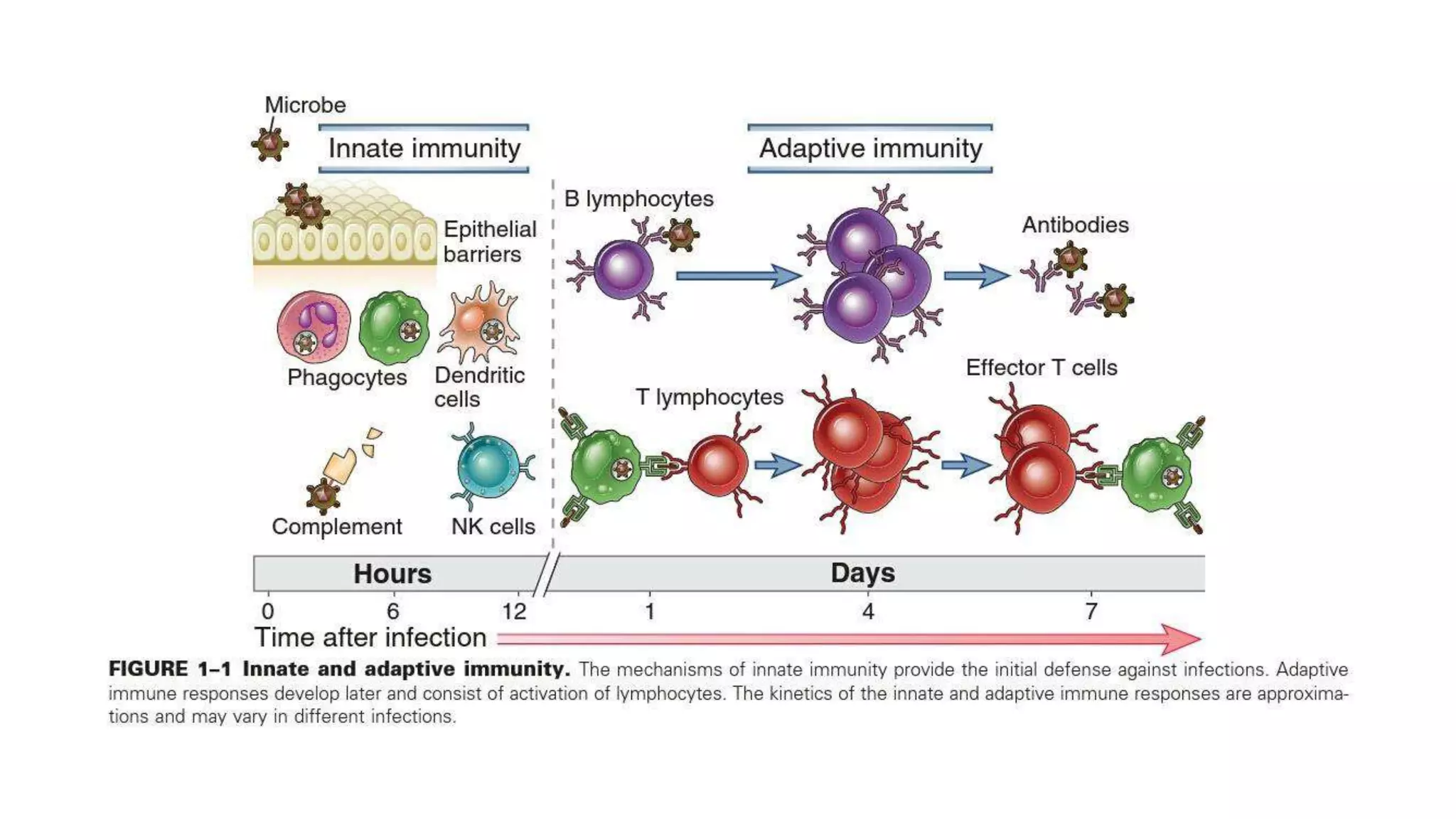
Overview of host response
• When a pathogen enters the body, it’s confronted by elements of the innate immune
system, which constitute the first line of defense.
• Once breached, the adaptive response takes over, but it typically takes few days to be
effective.
• Immunity is the processes that occur to defend the body against foreign organisms or
molecules.
• Immunity includes:
• Inflammation.
• Complement activation.
• Phagocytosis.
• Antibody synthesis.
• Effector T lymphocytes.
Types of immunity
Innate immunity
(nonspecific or natural)
• Born with it, do not need prior exposure
• The effectiveness of the immune response varies with age.
1. First line of defense: Designed to keep microorganisms out.
A. Physical barriers, such as epithelial cells (intact skin), trapping of bacteria in mucus.
B. Chemicals secreted by cells and tissues, such as acidic pH of skin surface,
complement, interferons, lysozymes.
2. Second line of defense:
A. Phagocytosis: The process of a white blood cell (WBC) engulfing bacteria.
B. Inflammation: Nonspecific response to tissue damage that includes:
• Chemical release.
• Cellular movement.
• Elimination of foreign material.
• Tissue repair.
• Inflammation
• Cardinal signs: Redness (rubor), Swelling (tumor), Heat (calor), Pain (dolor), Loss of function
(functio laesa).
• Sequenced events following tissue damage that protect the host from foreign invaders and attempt
to minimize tissue damage
• Increased vascular permeability
• a. Upon injury, capillaries, arterioles, and venules are dilated to increase blood flow to the
site of the injury.
• b. Because of increased vascular permeability, fluid moves from the circulation to the space
around the injury, bringing fibrinogen and PMNs to the injury site.
• Migration of neutrophils
• After the injury, chemotaxins and endothelial activating factors are released.
• PMNs adhere to activated endothelial cells.
• PMNs move between the endothelial cells to the site of tissue damage by a process called
diapedesis.
• Chemicals are released and more PMNs are released from the storage pool, and the injury site
is flooded with PMNs.
• Migration of mononuclear cells
• The macrophages release IL-1, which attracts monocytes, macrophages, and lymphocytes to
the injury site.
• About 4 hours after the injury, mononuclear cells migrate to the site of damage.
• Cellular proliferation and repair: Fibroblasts help repair the damage and return the injury site
to normal.
• Phagocyte oxidase(phox),
killing by reactive oxygen
species, ROS,(NO, H2O2).
Adaptive
(specific or acquired)
• Acquired only after a specific challenge is encountered and responds specifically to the
challenge.
• Two responses:
• 1. Humoral-mediated immunity (HMI)
• Against extracellular pathogens.
• B lymphocyte activated by T helper-2 cells (Th-2) to plasma cell.
• Antibody production by plasma cells.
• 2. Cell-mediated immunity (CMI)
• Against intracellular pathogens
• T helper-1 cells (Th-1).
• Natural killer (NK) cells: against viral and tumor cells
• Cytotoxic T lymphocytes (CTLs)
• Adaptive immunity can be passive or active.
• Active immunity:
• Natural: The host is exposed to foreign immunogen as a result of infection, and the host's
immune cells manufacture specific products to eliminate foreign immunogen.
• Artificial: Vaccination; immune system responds to an altered (noninfectious) organism
• Active immunity generally endures for life.
• Passive immunity:
• Natural: Maternal antibodies crosses placenta to protect infant
• Artificial: Immune products from another animal injected into the host (e.g., pooled
gamma-globulin).
• Passive transfer of lymphocytes is referred to as adoptive transfer.
• Passive immunity short term; no memory cells produced
• Cell-Mediated Immunity
• Mediated by TH 1 cells, a subset of T helper cells, that secrete cytokines that activate
other cells involved in the response
• Monocytes and macrophages are stimulated by cytokines from TH 1 cells, inflammatory
reaction cells that are activated by cytokines.
• CTLs are activated by cytokines from TH 1 cells and then destroy targets by cell-to-cell
contact. The main function of CTLs is to destroy virus infected
• cells.
• NK cells kill target cells without being previously sensitized. NK cell activities are
governed by cytokines.
• Humoral-Mediated Immunity
• B cell activation begins when antigen binds to antibody on B cell surface and the
antigen is internalized and linked to an MHC II molecule on the cell's surface.
• T and B cell interactions
• B cell processes and presents the antigen, stimulating the TH 2 cell to produce
cytokines.
• The cytokines stimulate the B cell to divide and differentiate into a memory B cell
or a plasma cell that will synthesize antibody.
• Antibody production:
• Primary and secondary antibody responses:
• 1. Primary antibody response:
• Produced when host first encounters antigen
• During the latent phase, no antibody is produced for about 5-7 days. During this
time, the host is producing plasma cells that will secrete antibodies.
• IgM is the first antibody produced.
• Antibody production starts slowly, peaks, levels off, then declines.
• 2. Secondary (anamnestic) response:
• Produced after the host has previously been exposed to an antigen
• Short latent phase (3-5 days)
• Higher antibody concentration
• IgG produced due to class switching
• IgG antibodies persist longer in circulation than lgM.
• Antibody-dependent cell-mediated cytotoxicity (ADCC): Cytolytic effector cells (e.g., NK
cells and PMNs) can lyse antibody coated target cells if there is direct contact.
Cells and tissues of the immune system
• Cells of the Immune System
• Phagocytes
• Mast cells, Basophils, and Eosinophils
• Antigens-Presenting Cells (APCs)
• Lymphocytes
• Lymphoid Tissues and Organs
• Primary Lymphoid Organs
• Secondary Lymphoid Organs
• Phagocytes:
• Phagocytes, are the cells whose primary function is to identify, ingest, and destroy
microbes.
• They comprise neutrophils and macrophages.
• They are also called “professional phagocytes”.
• Neutrophils (PMNs):
• The most abundant population of circulating leukocytes.
• They are the cells of acute inflammatory immune response.
• They have a segmented nucleus, hence the synonym “polymorphonuclear neutrophils”.
• They have two types of granules; specific ones, which are filled with enzymes such as
lysozyme, and azurophilic granules (lysosomes).
• Mononuclear phagocytes:
• This system is composed of the less-differentiated, circulating monocytes, and the mature
tissue macrophages.
• MØs are given special names according to their tissue of location, e.g. Kupffer cells in the
liver and microglial cells in the CNS.
• MØs perform several important functions in innate and adaptive immunity:
1. Phagocytosis
2.They clean dead cells and tissue debris (act as scavengers)
3.They secrete cytokines (monokines), such as TNF-α and IL-1
4.They function as APCs
• Macrophages have major histocompatibility complex (MHC) class II,
complement, and antibody Fc receptors on their surface.
• Mast cells, Basophils and Eosinophils:
• They have cytoplasmic granules filled with various inflammatory and antimicrobial mediators.
• They are involved in immune responses that protect against helminths and immune responses
that cause allergic diseases.
• They work in cooperation with IgE, since they have FcεR.
• Platelets (mediators): release substances that mediate immune reactions.
• The mediators produce increased vascular permeability, smooth muscle contraction,
chemotaxins for phagocytes, and increased inflammatory response.
• Antigen-Presenting cells (APCs):
• signature molecules in microbes, PRR).
• Are cell population that are specialized in capturing Ags, displaying them to lymphocytes to
stimulate their proliferation and differentiation.
• Macrophages, B-cells, and dendritic cells (DCs) express MHC class II and function as APCs.
• These cells represent the link between innate and adaptive immune responses.
• DCs are the most important APCs, being capable of presenting Ags to naïve T-cells.
• LYMPHOCYTES:
• Are the cells of the adaptive immunity.
• The only cells in the body that express “antigen-specific” receptors.
• They are said to be clonally distributed and antigenically committed.
• Morphologically, all lymphocytes are similar, but they differ in terms of their
function and surface markers.
• B lymphocytes (Bursa of Fabricius, Bone Marrow-derived):
• They express mIgM (BCR), and MHC class II.
• They secrete Abs, and differentiate into plasma cells (i.e. involved in humoral
immunity).
• Memory cell.
• T lymphocytes (Thymus-derived)
• They express TCR and CD3.
• Have two major subdivisions; CD4+ cells (helper T cells), and CD8+ cells (cytotoxic
T cells).
• Stimulate (Th cells) or suppress (Ts cells).
• Non-T non-B lymphocytes (Natural Killer cells or Null cells):
• NK cells are large granular lymphocytes (LGL).
• Guard the body against viral infection and tumor growth.
• They are non-specific.
LYMPHOID TISSUES AND ORGANS:
• Generative (primary, or central) lymphoid organs where lymphocytes develop and mature,
and express Ag-specific receptors (bone marrow and thymus gland).
• Peripheral or secondary lymphoid organs where lymphocytes respond to Ags. These include
lymph nodes, spleen, mucosa-associated lymphoid tissue (MALT).
. Lymph nodes: B cells migrate to the cortex and T cells to the paracortex.
• Primary follicle: Many small B cells
• Secondary follicle: After stimulation, primary follicle becomes a secondary follicle.
The germinal center has small and large lymphocytes, blast cells, macrophages, and
dendritic cells. The medulla contains plasma cells and large lymphocytes.
. Spleen
• Purpose: Filter blood
• Contains both T and B cells
Mucosal-associated lymphoid tissue (MALT)
• Gut-associated lymphoid tissue-GALT).
• Peyer's patch: Specialized MALT found in the lower ileum.
• Respiratory tract (bronchus-associated lymphoid tissue-BALT, nasal-associated
lymphoid tissue (NALT).
• Urogenital tract (UGALT).
• Cutaneous-associated lymphoid tissue (CALT).
• Antigens and immunogens:
• Self Ag: not induce immune response (auto tolerance).
• Immunogen: A substance capable of inducing an immune response
• Antigen: A substance that specifically interacts with cells or substances of the
immune system. Immunogens are also antigens, but not all antigens produce an
immune response.
• A hapten is a low-molecular-weight molecule that alone is too small to stimulate an
immune response but can combine with another molecule (a carrier) to induce a
response.
• Adjuvant is a compound that enhances an immune response. It is not immunogenic
and cannot induce an antibody response alone.
• Epitope: The portion of a molecule (i.e., antigen) that binds to an antibody or T cell
receptor.
• Thymic-dependent immunogens: Molecules that require T helper cells to stimulate
antibody formation.
• Thymic-independent immunogens: Molecules that initiate antibody production
without stimulating T helper cells.
• Immunogenicity characteristics:
• Foreignness: Must be recognized by the body as "nonself'
• Size: Greater than 10 kilodaltons
• Chemical composition: Proteins and carbohydrates are the most
immunogenic, whereas lipids and nucleic acids are weakly immunogenic.
• Complexity: The more complex a molecule, the more immunogenic it
becomes.
• Route of entry into the host also determines immunogenicity.
• Dose of immunogen affects immunogenicity.
• Degradability: The immunogen needs to be degraded and presented to cells
of the immune system.
Antibody (immunoglobulin [lg] or gammaglobulin)
• A proteins that binds to antigens. There are five classes: lgG, lgM, IgE, IgA, and lgD.
• Antibodies primarily migrate in the beta and gamma regions during protein electrophoresis.
• Antibodies are composed of two heavy polypeptide chains and two light polypeptide chains.
• Light chains:
• Two types: kappa and lambda.
• Heavy chains:
• Immunoglobulin classes are defined by a unique heavy chain: lgM-mu, IgG-gamrna, IgA-
alpha, IgD-delta, IgE-epsilon.
• Every heavy chain and light chain consists of one variable domain and one or more constant
domain.
• The variable domain defines the specificity of an antibody. This portion of the molecule is
referred to as the fragment of antigen binding (Fab ).
• The crystalline fragment (Fc) of the antibody is located at the carboxy-terminus. It is
responsible for the biological activity of the molecule, including activating complement,
binding phagocytic cells.
• J (joining) chain: Multiple monomers of IgM and IgA are linked by a J chain. One J chain is
needed for each IgM or IgA molecule that is linked together.
Antibody classes:
1. IgG:
• Predominant serum antibody, approximately 75% of immunoglobulins
in the blood
• Subclasses include IgGl, IgG2, IgG3, and IgG4.
• Only immunoglobulin that crosses the placenta
• Produced in secondary (anamnestic) antibody response
• IgG I, IgG2, and IgG3 activate the classical complement pathway.
2. IgM:
• Five monomers linked together by a J chain and interchain disulfide
bonds
• 10% of total serum immunoglobulins
• First antibody produced against an immunogen
• Produced in both primary and secondary immune responses
• It is the best activator of the classical pathway of complement-only one
molecule of IgM is required.
3. lgA:
• Serum and secretory forms: Serum IgA is a single immunoglobulin molecule,
whereas secretory IgA is a dimer held together by a J chain.
• Two subclasses: IgAI and IgA2
• Accounts for 15-20% of total serum antibody
• The functions of serum IgA are antigen clearance and immune regulation.
• The function of IgA in mucous membranes is to block attachment of viruses,
bacteria, and toxins to host cells.
4. IgD:
• Primarily a cell membrane surface component of B lymphocytes
• Short half-life (2-3 days)
5. lgE:
• Responsible for allergic (type I hypersensitivity) reactions
• The Fe portion binds to receptors on mast cells and basophils.
• Once attached to mast cells, IgE binding an allergen triggers degranulation of the
cell and release of allergic mediators such as histamine and leukotrienes.
• Elevated lgE concentrations are often found during parasitic infections.
• Immunoglobulins when injected into
another species can be immunogenic.
• Isotypic: differences in constant region
from one species to another.
• Allotypic: differences (alleles) that occur
in some individuals.
• Idiotypic: differences in variable regions,
will differ even on Abs of same isotype.
• Affinity: strength of the interaction
between single epitope and single
paratope.
• Avidity: overall strength of antigen-
antibody complex.
MAJOR HISTOCOMPATIBILITY COMPLEX
Human Leukocyte Antigens
• Human leukocyte antigens (HLAs) are cell surface markers that allow immune cells to
distinguish "self' from "nonself."
• These antigens were first described on white blood cells (leukocytes) and are coded for by
genes in the MHC located on chromosome six.
• Three Classes of MHC Products
• Class I
• loci: HLA-A, HLA-B, HLA-C, HLA-E, HLA-F, HLA-G, and HLA-J
• Molecules found on nearly every nucleated cell surface
• Antigen-presenting cells with MHC I molecules present antigens to CTLs.
• Class II:
• 13 loci, including HLA-DM, HLA-DO, HLA-DP, HLA-DQ, and HLA-DR
• Molecules located on the surface of monocytes, macrophages, B cells, activated T
cells, dendritic cells, Langerhans' cells, and some epithelial cells
• Antigen-presenting cells with MHC II molecules present antigens to T helper cells.
• Class III products:
• Complement proteins, TNFa and 13, and other proteins (e.g., heat shock protein) not
associated with cell membrane surfaces
Function of Antigen
presenting cells(APCs),
DCs, macrophages and
B-cells: capture,
processing and
presentation of Ags to
T-cell by MHC
molecules.
T and B lymphocytes
• Activation and Differentiation of T-Cells
• Activation and Differentiation of B-Cells
• Humoral vs Cellular Immunity
• The Clonal Selection Theory
T-Lymphocytes Activation
• Activation of T-cells require the interaction of TCR-CD3 complex with a processed
antigenic peptide bound to self-MHC molecule, this is termed signal 1.
• Signal 2 involves interactions between CD28 on the T-cell and members of the B7 family
on the APC (the co-stimulatory signal).
• Activation causes cells to enter the cell cycle, resulting in their proliferation and
differentiation into effector and memory cells.
B-Lymphocytes Activation
• In contrast to T-cells, B-cells recognize intact, unprocessed antigens via their mIgM.
• Like T-cells, two signals are required for activation. In addition to antigen binding
through BCR, the second signal is delivered differently in TD and TI antigens.
• Activation leads to proliferation and differentiation into plasma and memory cells.
Humoral vs Cellular Immunity
• Activation of Th cells is essential in developing the both types of immune response.
• Humoral immune response is concerned with extracellular antigens, mediated by
antibodies that are produced by plasma cells after the influence of Th₂ cytokines.
• CMI is responsible for eliminating intracellular antigens, either ingested in vesicles of
macrophages, or presented to CTLs. This requires the help of Th₁ cytokines.
Clonal Selection Theory
• A mature immunocompetent animal contains a large number of antigen-reactive clones
of T and B lymphocytes.
• When an antigen binds to a clone of cells with the same antigenic receptor for the
antigen, expansion of that clone occurs, thus, the antigen has “selected” the clone.
• Clonal selection results in many cells with the same specificity as the parent cell, and
production of memory cells.
Cytokines
• Soluble protein molecules secreted by one cell type that affect other cells, turn on genes in
target cells
• Interferons:
• Interferon-alpha (INF-alpha) and INF-beta are antiviral proteins that
inhibit viral replication and activate NK cells. They are produced by viral-
infected cells.
• INF-gamma, has antiviral effects, activates macrophages and NK cells, and
stimulates B cells to produce antibodies. It is produced by TH 1 cells.
• Tissue necrosis factors:
• Tumor necrosis factor-alpha (TNF-alpha): Produced by macrophages,
lymphocytes, and NK cells when encountering bacteria, viruses, tumor cells,
toxins, and complement protein C5a
• TNF-beta: Produced by CD4 and CD8 positive cells after exposure to a
specific antigen
Complement system
• The complement system is a set of around 35 serum proteins synthesized by the
liver that enhance the strength and activity of an innate as well as the adaptive
immune response.
• Exist as zymogens, once activated, interact in a cascade fashion.
• Phagocytic properties of neutrophils and macrophages are significantly
enhanced in the presence of complement proteins. Furthermore, chemotaxis by
cytokines is upregulated and bacterial killing is stronger with different proteins
of the complement system.
• Upon cleavage, the resultant smaller fragment is designated a, whereas the
larger one designated b (eg; C3b, C4a). C2 is an EXCEPTION!!!!!!
Complement Is Activated in Three Distinct Pathways
• The classical pathway; initiated by antigen-antibody complexes.
• The lectin pathway; initiated by CHO targets on microbes.
• The alternative pathway; initiated by microbial surfaces.
• Although the pathways are triggered differently, they converge in cleavage of the
central component C3, using C3 convertases.
• Adding C3b to the C3 convertases results in formation of C5 convertases, setting
in motion the formation of the membrane attack complex (MAC).
• MAC is formed by the association of the late acting components, C5b, C6, C7, C8,
and multiple C9.
• The resulting tube-like structure inserts into the microbial cell, causing osmotic
imbalance and cell lysis.
Complement Functions
• Lysis of cells, bacteria, and viruses through formation of MAC.
• Opsonization, which promotes phagocytosis, mediated by C3b and C4b.
• Promotion of inflammation, through production of smaller fragments
“anaphylatoxins”, namely, C3a, C4a, and C5a.
• Removal of immune complexes from the circulation and depositing them in the spleen
and the liver.
• Complement system: Enhances phagocytosis, stimulates inflammatory
response, and lyses foreign cells.
• Most abundant complement protein is C3.
• C3b is the best opsonin.
• C5a is the best chemotaxis .
• Alternative pathway also called properdin pathway, factor P, which stabilizes
the alternative pathway C3 and C5 convertases.
Hypersensitivity reaction
• Overreactive immune response to innocuous substances on re-exposure that can
result in tissue damage.
• Involve humoral- and cell-mediated responses.
• Types I through III are humoral mediated and immediate.
• Type IV is cell mediated and delayed.
• Allergen: Molecule that triggers a hypersensitivity reaction.
Type V (Stimulatory Type) Hypersensitivity
• In this type of hypersensitivity reaction, antibodies combine with antigens on cell surface, which
induces cells to proliferate and differentiate and enhances activity of effector cells.
• Type V hypersensitivity reaction plays an important role in pathogenesis of Graves’ disease, in
which thyroid hormones are produced in excess quantity. It is postulated that long-acting thyroid-
stimulating antibody, which is an autoantibody to thyroid membrane antigen, combines with thyroid-
stimulating hormone (TSH) receptors on a thyroid cell surface.
• Interaction with TSH receptor produces an effect similar to the TSH, resulting in an excess
production and secretion of thyroid hormone, which is responsible for Graves’ disease.
Alyazeed Hussein, BSc, SUST
This has been a presentation of Alyazeed Hussein
Thanks for your attention and kind patience
@elyazeed7
@Alyazeed7ussein

Medical Microbiology - Immunology

  • 1.
  • 2.
    Overview of hostresponse • When a pathogen enters the body, it’s confronted by elements of the innate immune system, which constitute the first line of defense. • Once breached, the adaptive response takes over, but it typically takes few days to be effective. • Immunity is the processes that occur to defend the body against foreign organisms or molecules. • Immunity includes: • Inflammation. • Complement activation. • Phagocytosis. • Antibody synthesis. • Effector T lymphocytes.
  • 3.
  • 4.
    Innate immunity (nonspecific ornatural) • Born with it, do not need prior exposure • The effectiveness of the immune response varies with age. 1. First line of defense: Designed to keep microorganisms out. A. Physical barriers, such as epithelial cells (intact skin), trapping of bacteria in mucus. B. Chemicals secreted by cells and tissues, such as acidic pH of skin surface, complement, interferons, lysozymes. 2. Second line of defense: A. Phagocytosis: The process of a white blood cell (WBC) engulfing bacteria. B. Inflammation: Nonspecific response to tissue damage that includes: • Chemical release. • Cellular movement. • Elimination of foreign material. • Tissue repair.
  • 8.
    • Inflammation • Cardinalsigns: Redness (rubor), Swelling (tumor), Heat (calor), Pain (dolor), Loss of function (functio laesa). • Sequenced events following tissue damage that protect the host from foreign invaders and attempt to minimize tissue damage • Increased vascular permeability • a. Upon injury, capillaries, arterioles, and venules are dilated to increase blood flow to the site of the injury. • b. Because of increased vascular permeability, fluid moves from the circulation to the space around the injury, bringing fibrinogen and PMNs to the injury site. • Migration of neutrophils • After the injury, chemotaxins and endothelial activating factors are released. • PMNs adhere to activated endothelial cells. • PMNs move between the endothelial cells to the site of tissue damage by a process called diapedesis. • Chemicals are released and more PMNs are released from the storage pool, and the injury site is flooded with PMNs. • Migration of mononuclear cells • The macrophages release IL-1, which attracts monocytes, macrophages, and lymphocytes to the injury site. • About 4 hours after the injury, mononuclear cells migrate to the site of damage. • Cellular proliferation and repair: Fibroblasts help repair the damage and return the injury site to normal.
  • 10.
    • Phagocyte oxidase(phox), killingby reactive oxygen species, ROS,(NO, H2O2).
  • 11.
    Adaptive (specific or acquired) •Acquired only after a specific challenge is encountered and responds specifically to the challenge. • Two responses: • 1. Humoral-mediated immunity (HMI) • Against extracellular pathogens. • B lymphocyte activated by T helper-2 cells (Th-2) to plasma cell. • Antibody production by plasma cells. • 2. Cell-mediated immunity (CMI) • Against intracellular pathogens • T helper-1 cells (Th-1). • Natural killer (NK) cells: against viral and tumor cells • Cytotoxic T lymphocytes (CTLs)
  • 12.
    • Adaptive immunitycan be passive or active. • Active immunity: • Natural: The host is exposed to foreign immunogen as a result of infection, and the host's immune cells manufacture specific products to eliminate foreign immunogen. • Artificial: Vaccination; immune system responds to an altered (noninfectious) organism • Active immunity generally endures for life. • Passive immunity: • Natural: Maternal antibodies crosses placenta to protect infant • Artificial: Immune products from another animal injected into the host (e.g., pooled gamma-globulin). • Passive transfer of lymphocytes is referred to as adoptive transfer. • Passive immunity short term; no memory cells produced
  • 14.
    • Cell-Mediated Immunity •Mediated by TH 1 cells, a subset of T helper cells, that secrete cytokines that activate other cells involved in the response • Monocytes and macrophages are stimulated by cytokines from TH 1 cells, inflammatory reaction cells that are activated by cytokines. • CTLs are activated by cytokines from TH 1 cells and then destroy targets by cell-to-cell contact. The main function of CTLs is to destroy virus infected • cells. • NK cells kill target cells without being previously sensitized. NK cell activities are governed by cytokines. • Humoral-Mediated Immunity • B cell activation begins when antigen binds to antibody on B cell surface and the antigen is internalized and linked to an MHC II molecule on the cell's surface. • T and B cell interactions • B cell processes and presents the antigen, stimulating the TH 2 cell to produce cytokines. • The cytokines stimulate the B cell to divide and differentiate into a memory B cell or a plasma cell that will synthesize antibody.
  • 15.
    • Antibody production: •Primary and secondary antibody responses: • 1. Primary antibody response: • Produced when host first encounters antigen • During the latent phase, no antibody is produced for about 5-7 days. During this time, the host is producing plasma cells that will secrete antibodies. • IgM is the first antibody produced. • Antibody production starts slowly, peaks, levels off, then declines. • 2. Secondary (anamnestic) response: • Produced after the host has previously been exposed to an antigen • Short latent phase (3-5 days) • Higher antibody concentration • IgG produced due to class switching • IgG antibodies persist longer in circulation than lgM. • Antibody-dependent cell-mediated cytotoxicity (ADCC): Cytolytic effector cells (e.g., NK cells and PMNs) can lyse antibody coated target cells if there is direct contact.
  • 17.
    Cells and tissuesof the immune system • Cells of the Immune System • Phagocytes • Mast cells, Basophils, and Eosinophils • Antigens-Presenting Cells (APCs) • Lymphocytes • Lymphoid Tissues and Organs • Primary Lymphoid Organs • Secondary Lymphoid Organs
  • 18.
    • Phagocytes: • Phagocytes,are the cells whose primary function is to identify, ingest, and destroy microbes. • They comprise neutrophils and macrophages. • They are also called “professional phagocytes”. • Neutrophils (PMNs): • The most abundant population of circulating leukocytes. • They are the cells of acute inflammatory immune response. • They have a segmented nucleus, hence the synonym “polymorphonuclear neutrophils”. • They have two types of granules; specific ones, which are filled with enzymes such as lysozyme, and azurophilic granules (lysosomes). • Mononuclear phagocytes: • This system is composed of the less-differentiated, circulating monocytes, and the mature tissue macrophages. • MØs are given special names according to their tissue of location, e.g. Kupffer cells in the liver and microglial cells in the CNS. • MØs perform several important functions in innate and adaptive immunity: 1. Phagocytosis 2.They clean dead cells and tissue debris (act as scavengers) 3.They secrete cytokines (monokines), such as TNF-α and IL-1 4.They function as APCs
  • 19.
    • Macrophages havemajor histocompatibility complex (MHC) class II, complement, and antibody Fc receptors on their surface.
  • 20.
    • Mast cells,Basophils and Eosinophils: • They have cytoplasmic granules filled with various inflammatory and antimicrobial mediators. • They are involved in immune responses that protect against helminths and immune responses that cause allergic diseases. • They work in cooperation with IgE, since they have FcεR. • Platelets (mediators): release substances that mediate immune reactions. • The mediators produce increased vascular permeability, smooth muscle contraction, chemotaxins for phagocytes, and increased inflammatory response. • Antigen-Presenting cells (APCs): • signature molecules in microbes, PRR). • Are cell population that are specialized in capturing Ags, displaying them to lymphocytes to stimulate their proliferation and differentiation. • Macrophages, B-cells, and dendritic cells (DCs) express MHC class II and function as APCs. • These cells represent the link between innate and adaptive immune responses.
  • 21.
    • DCs arethe most important APCs, being capable of presenting Ags to naïve T-cells.
  • 22.
    • LYMPHOCYTES: • Arethe cells of the adaptive immunity. • The only cells in the body that express “antigen-specific” receptors. • They are said to be clonally distributed and antigenically committed. • Morphologically, all lymphocytes are similar, but they differ in terms of their function and surface markers. • B lymphocytes (Bursa of Fabricius, Bone Marrow-derived): • They express mIgM (BCR), and MHC class II. • They secrete Abs, and differentiate into plasma cells (i.e. involved in humoral immunity). • Memory cell. • T lymphocytes (Thymus-derived) • They express TCR and CD3. • Have two major subdivisions; CD4+ cells (helper T cells), and CD8+ cells (cytotoxic T cells). • Stimulate (Th cells) or suppress (Ts cells). • Non-T non-B lymphocytes (Natural Killer cells or Null cells): • NK cells are large granular lymphocytes (LGL). • Guard the body against viral infection and tumor growth. • They are non-specific.
  • 25.
    LYMPHOID TISSUES ANDORGANS: • Generative (primary, or central) lymphoid organs where lymphocytes develop and mature, and express Ag-specific receptors (bone marrow and thymus gland). • Peripheral or secondary lymphoid organs where lymphocytes respond to Ags. These include lymph nodes, spleen, mucosa-associated lymphoid tissue (MALT). . Lymph nodes: B cells migrate to the cortex and T cells to the paracortex. • Primary follicle: Many small B cells • Secondary follicle: After stimulation, primary follicle becomes a secondary follicle. The germinal center has small and large lymphocytes, blast cells, macrophages, and dendritic cells. The medulla contains plasma cells and large lymphocytes. . Spleen • Purpose: Filter blood • Contains both T and B cells Mucosal-associated lymphoid tissue (MALT) • Gut-associated lymphoid tissue-GALT). • Peyer's patch: Specialized MALT found in the lower ileum. • Respiratory tract (bronchus-associated lymphoid tissue-BALT, nasal-associated lymphoid tissue (NALT). • Urogenital tract (UGALT). • Cutaneous-associated lymphoid tissue (CALT).
  • 27.
    • Antigens andimmunogens: • Self Ag: not induce immune response (auto tolerance). • Immunogen: A substance capable of inducing an immune response • Antigen: A substance that specifically interacts with cells or substances of the immune system. Immunogens are also antigens, but not all antigens produce an immune response. • A hapten is a low-molecular-weight molecule that alone is too small to stimulate an immune response but can combine with another molecule (a carrier) to induce a response. • Adjuvant is a compound that enhances an immune response. It is not immunogenic and cannot induce an antibody response alone. • Epitope: The portion of a molecule (i.e., antigen) that binds to an antibody or T cell receptor. • Thymic-dependent immunogens: Molecules that require T helper cells to stimulate antibody formation. • Thymic-independent immunogens: Molecules that initiate antibody production without stimulating T helper cells.
  • 28.
    • Immunogenicity characteristics: •Foreignness: Must be recognized by the body as "nonself' • Size: Greater than 10 kilodaltons • Chemical composition: Proteins and carbohydrates are the most immunogenic, whereas lipids and nucleic acids are weakly immunogenic. • Complexity: The more complex a molecule, the more immunogenic it becomes. • Route of entry into the host also determines immunogenicity. • Dose of immunogen affects immunogenicity. • Degradability: The immunogen needs to be degraded and presented to cells of the immune system.
  • 29.
    Antibody (immunoglobulin [lg]or gammaglobulin) • A proteins that binds to antigens. There are five classes: lgG, lgM, IgE, IgA, and lgD. • Antibodies primarily migrate in the beta and gamma regions during protein electrophoresis. • Antibodies are composed of two heavy polypeptide chains and two light polypeptide chains. • Light chains: • Two types: kappa and lambda. • Heavy chains: • Immunoglobulin classes are defined by a unique heavy chain: lgM-mu, IgG-gamrna, IgA- alpha, IgD-delta, IgE-epsilon. • Every heavy chain and light chain consists of one variable domain and one or more constant domain. • The variable domain defines the specificity of an antibody. This portion of the molecule is referred to as the fragment of antigen binding (Fab ). • The crystalline fragment (Fc) of the antibody is located at the carboxy-terminus. It is responsible for the biological activity of the molecule, including activating complement, binding phagocytic cells. • J (joining) chain: Multiple monomers of IgM and IgA are linked by a J chain. One J chain is needed for each IgM or IgA molecule that is linked together.
  • 31.
    Antibody classes: 1. IgG: •Predominant serum antibody, approximately 75% of immunoglobulins in the blood • Subclasses include IgGl, IgG2, IgG3, and IgG4. • Only immunoglobulin that crosses the placenta • Produced in secondary (anamnestic) antibody response • IgG I, IgG2, and IgG3 activate the classical complement pathway. 2. IgM: • Five monomers linked together by a J chain and interchain disulfide bonds • 10% of total serum immunoglobulins • First antibody produced against an immunogen • Produced in both primary and secondary immune responses • It is the best activator of the classical pathway of complement-only one molecule of IgM is required.
  • 32.
    3. lgA: • Serumand secretory forms: Serum IgA is a single immunoglobulin molecule, whereas secretory IgA is a dimer held together by a J chain. • Two subclasses: IgAI and IgA2 • Accounts for 15-20% of total serum antibody • The functions of serum IgA are antigen clearance and immune regulation. • The function of IgA in mucous membranes is to block attachment of viruses, bacteria, and toxins to host cells. 4. IgD: • Primarily a cell membrane surface component of B lymphocytes • Short half-life (2-3 days) 5. lgE: • Responsible for allergic (type I hypersensitivity) reactions • The Fe portion binds to receptors on mast cells and basophils. • Once attached to mast cells, IgE binding an allergen triggers degranulation of the cell and release of allergic mediators such as histamine and leukotrienes. • Elevated lgE concentrations are often found during parasitic infections.
  • 37.
    • Immunoglobulins wheninjected into another species can be immunogenic. • Isotypic: differences in constant region from one species to another. • Allotypic: differences (alleles) that occur in some individuals. • Idiotypic: differences in variable regions, will differ even on Abs of same isotype. • Affinity: strength of the interaction between single epitope and single paratope. • Avidity: overall strength of antigen- antibody complex.
  • 38.
    MAJOR HISTOCOMPATIBILITY COMPLEX HumanLeukocyte Antigens • Human leukocyte antigens (HLAs) are cell surface markers that allow immune cells to distinguish "self' from "nonself." • These antigens were first described on white blood cells (leukocytes) and are coded for by genes in the MHC located on chromosome six. • Three Classes of MHC Products • Class I • loci: HLA-A, HLA-B, HLA-C, HLA-E, HLA-F, HLA-G, and HLA-J • Molecules found on nearly every nucleated cell surface • Antigen-presenting cells with MHC I molecules present antigens to CTLs. • Class II: • 13 loci, including HLA-DM, HLA-DO, HLA-DP, HLA-DQ, and HLA-DR • Molecules located on the surface of monocytes, macrophages, B cells, activated T cells, dendritic cells, Langerhans' cells, and some epithelial cells • Antigen-presenting cells with MHC II molecules present antigens to T helper cells. • Class III products: • Complement proteins, TNFa and 13, and other proteins (e.g., heat shock protein) not associated with cell membrane surfaces
  • 39.
    Function of Antigen presentingcells(APCs), DCs, macrophages and B-cells: capture, processing and presentation of Ags to T-cell by MHC molecules.
  • 40.
    T and Blymphocytes • Activation and Differentiation of T-Cells • Activation and Differentiation of B-Cells • Humoral vs Cellular Immunity • The Clonal Selection Theory
  • 44.
    T-Lymphocytes Activation • Activationof T-cells require the interaction of TCR-CD3 complex with a processed antigenic peptide bound to self-MHC molecule, this is termed signal 1. • Signal 2 involves interactions between CD28 on the T-cell and members of the B7 family on the APC (the co-stimulatory signal). • Activation causes cells to enter the cell cycle, resulting in their proliferation and differentiation into effector and memory cells.
  • 47.
    B-Lymphocytes Activation • Incontrast to T-cells, B-cells recognize intact, unprocessed antigens via their mIgM. • Like T-cells, two signals are required for activation. In addition to antigen binding through BCR, the second signal is delivered differently in TD and TI antigens. • Activation leads to proliferation and differentiation into plasma and memory cells.
  • 52.
    Humoral vs CellularImmunity • Activation of Th cells is essential in developing the both types of immune response. • Humoral immune response is concerned with extracellular antigens, mediated by antibodies that are produced by plasma cells after the influence of Th₂ cytokines. • CMI is responsible for eliminating intracellular antigens, either ingested in vesicles of macrophages, or presented to CTLs. This requires the help of Th₁ cytokines.
  • 56.
    Clonal Selection Theory •A mature immunocompetent animal contains a large number of antigen-reactive clones of T and B lymphocytes. • When an antigen binds to a clone of cells with the same antigenic receptor for the antigen, expansion of that clone occurs, thus, the antigen has “selected” the clone. • Clonal selection results in many cells with the same specificity as the parent cell, and production of memory cells.
  • 58.
    Cytokines • Soluble proteinmolecules secreted by one cell type that affect other cells, turn on genes in target cells
  • 59.
    • Interferons: • Interferon-alpha(INF-alpha) and INF-beta are antiviral proteins that inhibit viral replication and activate NK cells. They are produced by viral- infected cells. • INF-gamma, has antiviral effects, activates macrophages and NK cells, and stimulates B cells to produce antibodies. It is produced by TH 1 cells. • Tissue necrosis factors: • Tumor necrosis factor-alpha (TNF-alpha): Produced by macrophages, lymphocytes, and NK cells when encountering bacteria, viruses, tumor cells, toxins, and complement protein C5a • TNF-beta: Produced by CD4 and CD8 positive cells after exposure to a specific antigen
  • 60.
    Complement system • Thecomplement system is a set of around 35 serum proteins synthesized by the liver that enhance the strength and activity of an innate as well as the adaptive immune response. • Exist as zymogens, once activated, interact in a cascade fashion. • Phagocytic properties of neutrophils and macrophages are significantly enhanced in the presence of complement proteins. Furthermore, chemotaxis by cytokines is upregulated and bacterial killing is stronger with different proteins of the complement system. • Upon cleavage, the resultant smaller fragment is designated a, whereas the larger one designated b (eg; C3b, C4a). C2 is an EXCEPTION!!!!!!
  • 61.
    Complement Is Activatedin Three Distinct Pathways • The classical pathway; initiated by antigen-antibody complexes. • The lectin pathway; initiated by CHO targets on microbes. • The alternative pathway; initiated by microbial surfaces. • Although the pathways are triggered differently, they converge in cleavage of the central component C3, using C3 convertases. • Adding C3b to the C3 convertases results in formation of C5 convertases, setting in motion the formation of the membrane attack complex (MAC). • MAC is formed by the association of the late acting components, C5b, C6, C7, C8, and multiple C9. • The resulting tube-like structure inserts into the microbial cell, causing osmotic imbalance and cell lysis.
  • 63.
    Complement Functions • Lysisof cells, bacteria, and viruses through formation of MAC. • Opsonization, which promotes phagocytosis, mediated by C3b and C4b. • Promotion of inflammation, through production of smaller fragments “anaphylatoxins”, namely, C3a, C4a, and C5a. • Removal of immune complexes from the circulation and depositing them in the spleen and the liver.
  • 64.
    • Complement system:Enhances phagocytosis, stimulates inflammatory response, and lyses foreign cells. • Most abundant complement protein is C3. • C3b is the best opsonin. • C5a is the best chemotaxis . • Alternative pathway also called properdin pathway, factor P, which stabilizes the alternative pathway C3 and C5 convertases.
  • 65.
    Hypersensitivity reaction • Overreactiveimmune response to innocuous substances on re-exposure that can result in tissue damage. • Involve humoral- and cell-mediated responses. • Types I through III are humoral mediated and immediate. • Type IV is cell mediated and delayed. • Allergen: Molecule that triggers a hypersensitivity reaction.
  • 67.
    Type V (StimulatoryType) Hypersensitivity • In this type of hypersensitivity reaction, antibodies combine with antigens on cell surface, which induces cells to proliferate and differentiate and enhances activity of effector cells. • Type V hypersensitivity reaction plays an important role in pathogenesis of Graves’ disease, in which thyroid hormones are produced in excess quantity. It is postulated that long-acting thyroid- stimulating antibody, which is an autoantibody to thyroid membrane antigen, combines with thyroid- stimulating hormone (TSH) receptors on a thyroid cell surface. • Interaction with TSH receptor produces an effect similar to the TSH, resulting in an excess production and secretion of thyroid hormone, which is responsible for Graves’ disease.
  • 72.
    Alyazeed Hussein, BSc,SUST This has been a presentation of Alyazeed Hussein Thanks for your attention and kind patience @elyazeed7 @Alyazeed7ussein