
Caution: biohazard
Contents
1. Biosafety concept
2. History & neccesity of biosafety
3. Types of biosafety levels
a. BSL 1
b. BSL 2
c. BSL 3
d. BSL 4
What is Biosafety?
 Biosafety:-
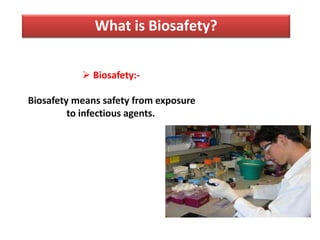
Biosafety means safety from exposure
to infectious agents.
History And Neccesity Of Biosafety
History:
On 18 april 1955 the first biological safety conferrence took place at Camp
Detrick in Fredrick, Maryland in presence of fourteen representatives from
three Principal Laboratories of U.S Army.
 Biosafety, chemical, radiological & industrial safety issues were discussed.
Later in the United States, the Centers for Disease Control (CDC) specified 4
different levels of biocontainment which ranges from Biosafety level 1 (BSL-1)
to Biosafety level 4 (BSL-4).
Neccesity:
In order to avoid infection/biohazard to the laboratory personnel & the
environment biosafety levels are very important.
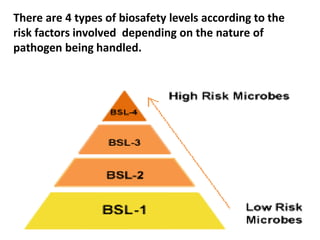
There are 4 types of biosafety levels according to the
risk factors involved depending on the nature of
pathogen being handled.
Types Of Biosafety Levels
BSL 1 (Basic teaching, Research)
This level is suitable for work involving well characterized
agents not known to cause disease to healthy adult human
& It gives minimal protection to the operating person.
Work is done on open benches or simple cabinet without
laminar air flow or with horizontal laminar (class 1) may be
used.
 Access limited when work in progress.
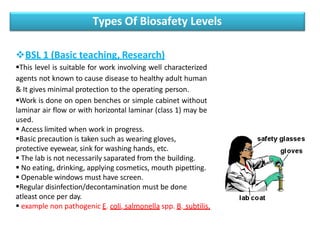
Basic precaution is taken such as wearing gloves,
protective eyewear, sink for washing hands, etc.
 The lab is not necessarily saparated from the building.
 No eating, drinking, applying cosmetics, mouth pipetting.
 Openable windows must have screen.
Regular disinfection/decontamination must be done
atleast once per day.
 example non pathogenic E. coli, salmonella spp. B. subtilis.
 BSL 2 (Primary health services, diagnostic service, research)
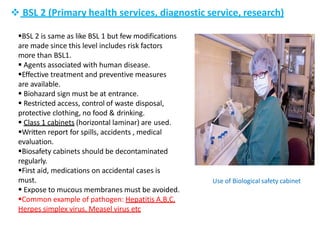
Use of Biological safety cabinet
BSL 2 is same as like BSL 1 but few modifications
are made since this level includes risk factors
more than BSL1.
 Agents associated with human disease.
Effective treatment and preventive measures
are available.
 Biohazard sign must be at entrance.
 Restricted access, control of waste disposal,
protective clothing, no food & drinking.
 Class 1 cabinets (horizontal laminar) are used.
Written report for spills, accidents , medical
evaluation.
Biosafety cabinets should be decontaminated
regularly.
First aid, medications on accidental cases is
must.
 Expose to mucous membranes must be avoided.
Common example of pathogen: Hepatitis A,B,C,
Herpes simplex virus, Measel virus etc
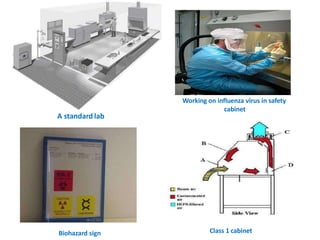
A standard lab
Working on influenza virus in safety
cabinet
Class 1 cabinet
Biohazard sign
 BSL 3 (Special diagnostic service, reasearch)
This level is applicable to clinical, diagnostic, teaching,
research, or production facilities in which work is done with
indigenous or exotic agents which may cause serious or
potentially lethal disease after inhalation.
It includes various bacteria, parasites and viruses that can
cause
severe to fatal disease in humans but for which treatments
exist.
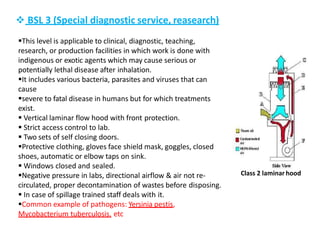
 Vertical laminar flow hood with front protection.
 Strict access control to lab.
 Two sets of self closing doors.
Protective clothing, gloves face shield mask, goggles, closed
shoes, automatic or elbow taps on sink.
 Windows closed and sealed.
Negative pressure in labs, directional airflow & air not re-
circulated, proper decontamination of wastes before disposing.
 In case of spillage trained staff deals with it.
Common example of pathogens: Yersinia pestis,
Mycobacterium tuberculosis, etc
Class 2 laminar hood
 BSL 4 (Dangerous pathogen units)
This level is required for work with dangerous and exotic
agents that pose a high individual risk of aerosol-
transmitted laboratory infections, agents which cause
severe to fatal disease in humans for which vaccines or
other treatments are not available.
Lab is separate.
Totally enclosed system.
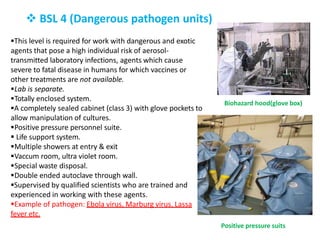
A completely sealed cabinet (class 3) with glove pockets to
allow manipulation of cultures.
Positive pressure personnel suite.
 Life support system.
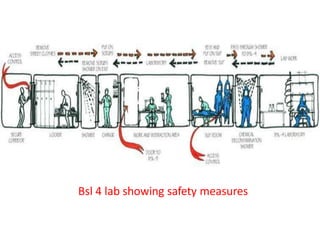
Multiple showers at entry & exit
Vaccum room, ultra violet room.
Special waste disposal.
Double ended autoclave through wall.
Supervised by qualified scientists who are trained and
experienced in working with these agents.
Example of pathogen: Ebola virus, Marburg virus, Lassa
fever etc.
Biohazard hood(glove box)
Positive pressure suits
Bsl 4 lab showing safety measures
Thank you!!!

Biosafety Levels

  • 1.
  • 2.
    Contents 1. Biosafety concept 2.History & neccesity of biosafety 3. Types of biosafety levels a. BSL 1 b. BSL 2 c. BSL 3 d. BSL 4
  • 3.
    What is Biosafety? Biosafety:- Biosafety means safety from exposure to infectious agents.
  • 4.
    History And NeccesityOf Biosafety History: On 18 april 1955 the first biological safety conferrence took place at Camp Detrick in Fredrick, Maryland in presence of fourteen representatives from three Principal Laboratories of U.S Army.  Biosafety, chemical, radiological & industrial safety issues were discussed. Later in the United States, the Centers for Disease Control (CDC) specified 4 different levels of biocontainment which ranges from Biosafety level 1 (BSL-1) to Biosafety level 4 (BSL-4). Neccesity: In order to avoid infection/biohazard to the laboratory personnel & the environment biosafety levels are very important.
  • 5.
    There are 4types of biosafety levels according to the risk factors involved depending on the nature of pathogen being handled.
  • 6.
    Types Of BiosafetyLevels BSL 1 (Basic teaching, Research) This level is suitable for work involving well characterized agents not known to cause disease to healthy adult human & It gives minimal protection to the operating person. Work is done on open benches or simple cabinet without laminar air flow or with horizontal laminar (class 1) may be used.  Access limited when work in progress. Basic precaution is taken such as wearing gloves, protective eyewear, sink for washing hands, etc.  The lab is not necessarily saparated from the building.  No eating, drinking, applying cosmetics, mouth pipetting.  Openable windows must have screen. Regular disinfection/decontamination must be done atleast once per day.  example non pathogenic E. coli, salmonella spp. B. subtilis.
  • 7.
     BSL 2(Primary health services, diagnostic service, research) Use of Biological safety cabinet BSL 2 is same as like BSL 1 but few modifications are made since this level includes risk factors more than BSL1.  Agents associated with human disease. Effective treatment and preventive measures are available.  Biohazard sign must be at entrance.  Restricted access, control of waste disposal, protective clothing, no food & drinking.  Class 1 cabinets (horizontal laminar) are used. Written report for spills, accidents , medical evaluation. Biosafety cabinets should be decontaminated regularly. First aid, medications on accidental cases is must.  Expose to mucous membranes must be avoided. Common example of pathogen: Hepatitis A,B,C, Herpes simplex virus, Measel virus etc
  • 8.
    A standard lab Workingon influenza virus in safety cabinet Class 1 cabinet Biohazard sign
  • 9.
     BSL 3(Special diagnostic service, reasearch) This level is applicable to clinical, diagnostic, teaching, research, or production facilities in which work is done with indigenous or exotic agents which may cause serious or potentially lethal disease after inhalation. It includes various bacteria, parasites and viruses that can cause severe to fatal disease in humans but for which treatments exist.  Vertical laminar flow hood with front protection.  Strict access control to lab.  Two sets of self closing doors. Protective clothing, gloves face shield mask, goggles, closed shoes, automatic or elbow taps on sink.  Windows closed and sealed. Negative pressure in labs, directional airflow & air not re- circulated, proper decontamination of wastes before disposing.  In case of spillage trained staff deals with it. Common example of pathogens: Yersinia pestis, Mycobacterium tuberculosis, etc Class 2 laminar hood
  • 10.
     BSL 4(Dangerous pathogen units) This level is required for work with dangerous and exotic agents that pose a high individual risk of aerosol- transmitted laboratory infections, agents which cause severe to fatal disease in humans for which vaccines or other treatments are not available. Lab is separate. Totally enclosed system. A completely sealed cabinet (class 3) with glove pockets to allow manipulation of cultures. Positive pressure personnel suite.  Life support system. Multiple showers at entry & exit Vaccum room, ultra violet room. Special waste disposal. Double ended autoclave through wall. Supervised by qualified scientists who are trained and experienced in working with these agents. Example of pathogen: Ebola virus, Marburg virus, Lassa fever etc. Biohazard hood(glove box) Positive pressure suits
  • 11.
    Bsl 4 labshowing safety measures
  • 12.