Exploratory Research Design:
Secondary Data
4-2
Primary vs. Secondary Data
 Primary data are originated by a researcher
for the specific purpose of addressing the
problem at hand. The collection of primary
data involves all six steps of the marketing
research process (Chapter 1).
 Secondary data are data which have
already been collected for purposes other
than the problem at hand. These data can be
located quickly and inexpensively.
4-3
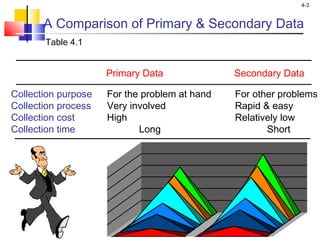
A Comparison of Primary & Secondary Data
Primary Data Secondary Data
Collection purpose For the problem at hand For other problems
Collection process Very involved Rapid & easy
Collection cost High Relatively low
Collection time Long Short
Table 4.1
4-4
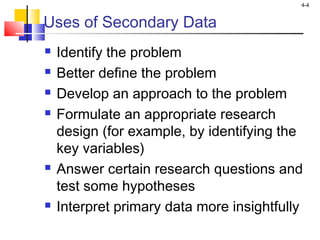
Uses of Secondary Data
 Identify the problem
 Better define the problem
 Develop an approach to the problem
 Formulate an appropriate research
design (for example, by identifying the
key variables)
 Answer certain research questions and
test some hypotheses
 Interpret primary data more insightfully
4-5
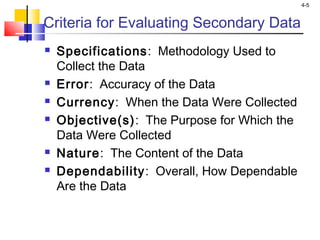
Criteria for Evaluating Secondary Data
 Specifications: Methodology Used to
Collect the Data
 Error: Accuracy of the Data
 Currency: When the Data Were Collected
 Objective(s): The Purpose for Which the
Data Were Collected
 Nature: The Content of the Data
 Dependability: Overall, How Dependable
Are the Data
4-6
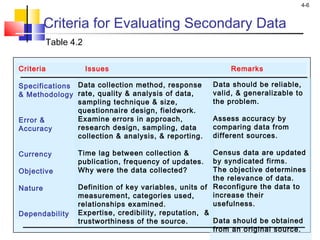
Criteria for Evaluating Secondary Data
Criteria Issues Remarks
Specifications
& Methodology
Error &
Accuracy
Currency
Objective
Nature
Dependability
Data collection method, response
rate, quality & analysis of data,
sampling technique & size,
questionnaire design, fieldwork.
Examine errors in approach,
research design, sampling, data
collection & analysis, & reporting.
Time lag between collection &
publication, frequency of updates.
Why were the data collected?
Definition of key variables, units of
measurement, categories used,
relationships examined.
Expertise, credibility, reputation, &
trustworthiness of the source.
Data should be reliable,
valid, & generalizable to
the problem.
Assess accuracy by
comparing data from
different sources.
Census data are updated
by syndicated firms.
The objective determines
the relevance of data.
Reconfigure the data to
increase their
usefulness.
Data should be obtained
from an original source.
Table 4.2
4-7
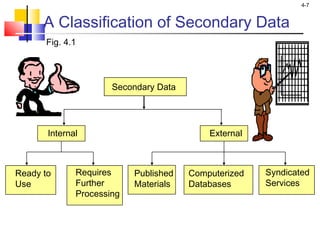
A Classification of Secondary Data
Secondary Data
Ready to
Use
Requires
Further
Processing
Published
Materials
Computerized
Databases
Syndicated
Services
Fig. 4.1
Internal External
4-8
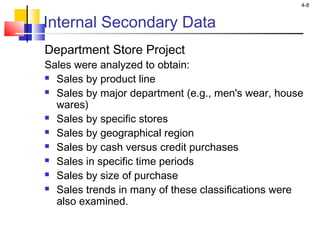
Internal Secondary Data
Department Store Project
Sales were analyzed to obtain:
 Sales by product line
 Sales by major department (e.g., men's wear, house
wares)
 Sales by specific stores
 Sales by geographical region
 Sales by cash versus credit purchases
 Sales in specific time periods
 Sales by size of purchase
 Sales trends in many of these classifications were
also examined.
4-9
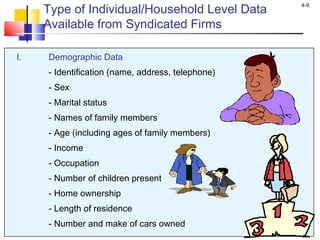
Type of Individual/Household Level Data
Available from Syndicated Firms
I. Demographic Data
- Identification (name, address, telephone)
- Sex
- Marital status
- Names of family members
- Age (including ages of family members)
- Income
- Occupation
- Number of children present
- Home ownership
- Length of residence
- Number and make of cars owned
4-10
Type of Individual/Household Level Data
Available from Syndicated Firms
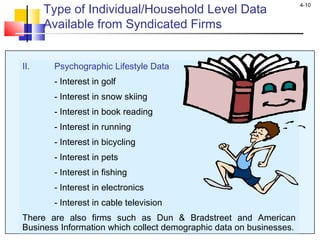
II. Psychographic Lifestyle Data
- Interest in golf
- Interest in snow skiing
- Interest in book reading
- Interest in running
- Interest in bicycling
- Interest in pets
- Interest in fishing
- Interest in electronics
- Interest in cable television
There are also firms such as Dun & Bradstreet and American
Business Information which collect demographic data on businesses.
4-11
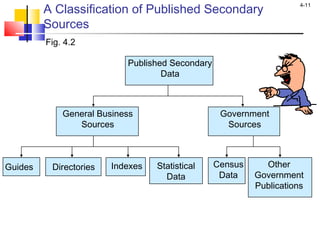
A Classification of Published Secondary
Sources
Statistical
Data
Guides Directories Indexes Census
Data
Other
Government
Publications
Fig. 4.2
Published Secondary
Data
General Business
Sources
Government
Sources
4-12
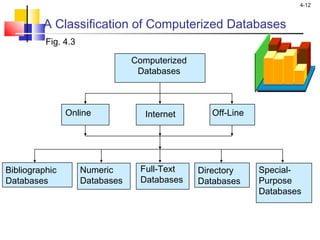
A Classification of Computerized Databases
Bibliographic
Databases
Numeric
Databases
Full-Text
Databases
Directory
Databases
Special-
Purpose
Databases
Fig. 4.3
Computerized
Databases
Online Off-LineInternet
4-13
Published External Secondary Sources
Guides
 An excellent source of standard or recurring information
 Helpful in identifying other important sources of directories,
trade associations, and trade publications
 One of the first sources a researcher should consult
Directories
 Helpful for identifying individuals or organizations that collect
specific data
 Examples: Consultants and Consulting Organizations
Directory, Encyclopedia of Associations, FINDEX: The Directory
of Market Research Reports, Studies and Surveys, and
Research Services Directory
Indices
 Helpful in locating information on a particular topic in several
different publications
4-14
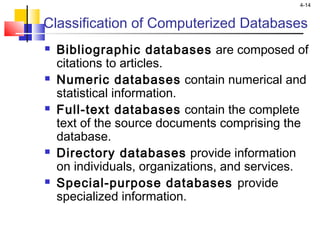
Classification of Computerized Databases
 Bibliographic databases are composed of
citations to articles.
 Numeric databases contain numerical and
statistical information.
 Full-text databases contain the complete
text of the source documents comprising the
database.
 Directory databases provide information
on individuals, organizations, and services.
 Special-purpose databases provide
specialized information.
4-15
Syndicated Services
 Companies that collect and sell common
pools of data of known commercial value
designed to serve a number of clients.
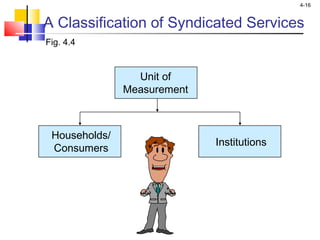
 Syndicated sources can be classified based
on the unit of measurement
(households/consumers or institutions).
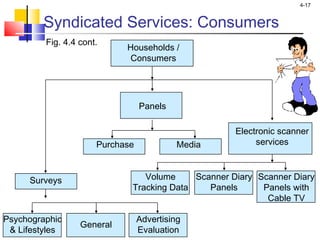
 Household/consumer data may be obtained
from surveys, diary panels, or electronic
scanner services.
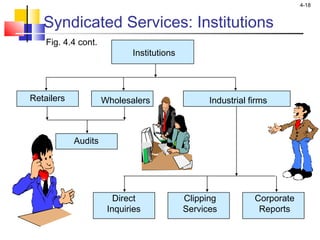
 Institutional data may be obtained from
retailers, wholesalers, or industrial firms.
4-16
A Classification of Syndicated Services
Unit of
Measurement
Fig. 4.4
Households/
Consumers
Institutions
4-17
Syndicated Services: Consumers
Fig. 4.4 cont.
Psychographic
& Lifestyles
General
Advertising
Evaluation
Households /
Consumers
Scanner Diary
Panels with
Cable TV
Surveys Volume
Tracking Data
Scanner Diary
Panels
Electronic scanner
servicesPurchase Media
Panels
4-18
Syndicated Services: Institutions
Audits
Direct
Inquiries
Clipping
Services
Corporate
Reports
Fig. 4.4 cont.
Institutions
Retailers Wholesalers Industrial firms
4-19
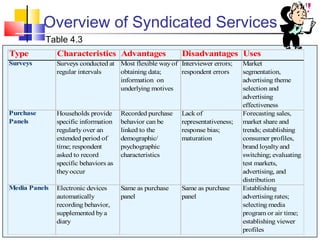
Overview of Syndicated Services
Table 4.3
Type Characteristics Advantages Disadvantages Uses
Surveys Surveys conducted at
regular intervals
Most flexible wayof
obtaining data;
information on
underlying motives
Interviewer errors;
respondent errors
Market
segmentation,
advertising theme
selection and
advertising
effectiveness
Purchase
Panels
Households provide
specific information
regularlyover an
extended period of
time; respondent
asked to record
specific behaviors as
theyoccur
Recorded purchase
behavior can be
linked to the
demographic/
psychographic
characteristics
Lack of
representativeness;
response bias;
maturation
Forecasting sales,
market share and
trends; establishing
consumer profiles,
brand loyaltyand
switching; evaluating
test markets,
advertising, and
distribution
Media Panels Electronic devices
automatically
recording behavior,
supplemented bya
diary
Same as purchase
panel
Same as purchase
panel
Establishing
advertising rates;
selecting media
program or air time;
establishing viewer
profiles
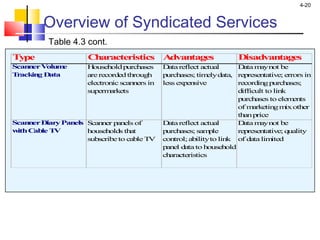
4-20
Table 4.3 cont.
Overview of Syndicated Services
Type Characteristics Advantages Disadvantages
ScannerVolume
Tracking Data
Householdpurchases
arerecordedthrough
electronicscanners in
supermarkets
Datareflect actual
purchases; timelydata,
less expensive
Datamaynot be
representative; errors in
recordingpurchases;
difficult to link
purchases to elements
of marketingmixother
thanprice
ScannerDiaryPanels
withCable TV
Scanner panels of
households that
subscribeto cableTV
Datareflect actual
purchases; sample
control; abilityto link
panel datato household
characteristics
Datamaynot be
representative; quality
of datalimited
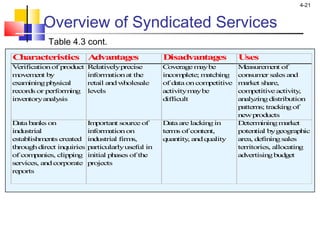
4-21
Table 4.3 cont.
Overview of Syndicated Services
Characteristics Advantages Disadvantages Uses
Verificationof product
movement by
examiningphysical
records or performing
inventoryanalysis
Relativelyprecise
informationat the
retail andwholesale
levels
Coveragemaybe
incomplete; matching
of dataoncompetitive
activitymaybe
difficult
Measurement of
consumer sales and
market share,
competitiveactivity,
analyzingdistribution
patterns; trackingof
newproducts
Databanks on
industrial
establishments created
throughdirect inquiries
of companies, clipping
services, andcorporate
reports
Important sourceof
informationon
industrial firms,
particularlyuseful in
initial phases of the
projects
Dataarelackingin
terms of content,
quantity, andquality
Determiningmarket
potential bygeographic
area, definingsales
territories, allocating
advertisingbudget
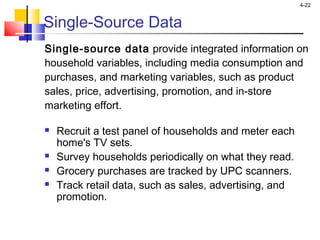
4-22
Single-Source Data
Single-source data provide integrated information on
household variables, including media consumption and
purchases, and marketing variables, such as product
sales, price, advertising, promotion, and in-store
marketing effort.
 Recruit a test panel of households and meter each
home's TV sets.
 Survey households periodically on what they read.
 Grocery purchases are tracked by UPC scanners.
 Track retail data, such as sales, advertising, and
promotion.

Exploratory research design secondary data

  • 1.
  • 2.
    4-2 Primary vs. SecondaryData  Primary data are originated by a researcher for the specific purpose of addressing the problem at hand. The collection of primary data involves all six steps of the marketing research process (Chapter 1).  Secondary data are data which have already been collected for purposes other than the problem at hand. These data can be located quickly and inexpensively.
  • 3.
    4-3 A Comparison ofPrimary & Secondary Data Primary Data Secondary Data Collection purpose For the problem at hand For other problems Collection process Very involved Rapid & easy Collection cost High Relatively low Collection time Long Short Table 4.1
  • 4.
    4-4 Uses of SecondaryData  Identify the problem  Better define the problem  Develop an approach to the problem  Formulate an appropriate research design (for example, by identifying the key variables)  Answer certain research questions and test some hypotheses  Interpret primary data more insightfully
  • 5.
    4-5 Criteria for EvaluatingSecondary Data  Specifications: Methodology Used to Collect the Data  Error: Accuracy of the Data  Currency: When the Data Were Collected  Objective(s): The Purpose for Which the Data Were Collected  Nature: The Content of the Data  Dependability: Overall, How Dependable Are the Data
  • 6.
    4-6 Criteria for EvaluatingSecondary Data Criteria Issues Remarks Specifications & Methodology Error & Accuracy Currency Objective Nature Dependability Data collection method, response rate, quality & analysis of data, sampling technique & size, questionnaire design, fieldwork. Examine errors in approach, research design, sampling, data collection & analysis, & reporting. Time lag between collection & publication, frequency of updates. Why were the data collected? Definition of key variables, units of measurement, categories used, relationships examined. Expertise, credibility, reputation, & trustworthiness of the source. Data should be reliable, valid, & generalizable to the problem. Assess accuracy by comparing data from different sources. Census data are updated by syndicated firms. The objective determines the relevance of data. Reconfigure the data to increase their usefulness. Data should be obtained from an original source. Table 4.2
  • 7.
    4-7 A Classification ofSecondary Data Secondary Data Ready to Use Requires Further Processing Published Materials Computerized Databases Syndicated Services Fig. 4.1 Internal External
  • 8.
    4-8 Internal Secondary Data DepartmentStore Project Sales were analyzed to obtain:  Sales by product line  Sales by major department (e.g., men's wear, house wares)  Sales by specific stores  Sales by geographical region  Sales by cash versus credit purchases  Sales in specific time periods  Sales by size of purchase  Sales trends in many of these classifications were also examined.
  • 9.
    4-9 Type of Individual/HouseholdLevel Data Available from Syndicated Firms I. Demographic Data - Identification (name, address, telephone) - Sex - Marital status - Names of family members - Age (including ages of family members) - Income - Occupation - Number of children present - Home ownership - Length of residence - Number and make of cars owned
  • 10.
    4-10 Type of Individual/HouseholdLevel Data Available from Syndicated Firms II. Psychographic Lifestyle Data - Interest in golf - Interest in snow skiing - Interest in book reading - Interest in running - Interest in bicycling - Interest in pets - Interest in fishing - Interest in electronics - Interest in cable television There are also firms such as Dun & Bradstreet and American Business Information which collect demographic data on businesses.
  • 11.
    4-11 A Classification ofPublished Secondary Sources Statistical Data Guides Directories Indexes Census Data Other Government Publications Fig. 4.2 Published Secondary Data General Business Sources Government Sources
  • 12.
    4-12 A Classification ofComputerized Databases Bibliographic Databases Numeric Databases Full-Text Databases Directory Databases Special- Purpose Databases Fig. 4.3 Computerized Databases Online Off-LineInternet
  • 13.
    4-13 Published External SecondarySources Guides  An excellent source of standard or recurring information  Helpful in identifying other important sources of directories, trade associations, and trade publications  One of the first sources a researcher should consult Directories  Helpful for identifying individuals or organizations that collect specific data  Examples: Consultants and Consulting Organizations Directory, Encyclopedia of Associations, FINDEX: The Directory of Market Research Reports, Studies and Surveys, and Research Services Directory Indices  Helpful in locating information on a particular topic in several different publications
  • 14.
    4-14 Classification of ComputerizedDatabases  Bibliographic databases are composed of citations to articles.  Numeric databases contain numerical and statistical information.  Full-text databases contain the complete text of the source documents comprising the database.  Directory databases provide information on individuals, organizations, and services.  Special-purpose databases provide specialized information.
  • 15.
    4-15 Syndicated Services  Companiesthat collect and sell common pools of data of known commercial value designed to serve a number of clients.  Syndicated sources can be classified based on the unit of measurement (households/consumers or institutions).  Household/consumer data may be obtained from surveys, diary panels, or electronic scanner services.  Institutional data may be obtained from retailers, wholesalers, or industrial firms.
  • 16.
    4-16 A Classification ofSyndicated Services Unit of Measurement Fig. 4.4 Households/ Consumers Institutions
  • 17.
    4-17 Syndicated Services: Consumers Fig.4.4 cont. Psychographic & Lifestyles General Advertising Evaluation Households / Consumers Scanner Diary Panels with Cable TV Surveys Volume Tracking Data Scanner Diary Panels Electronic scanner servicesPurchase Media Panels
  • 18.
  • 19.
    4-19 Overview of SyndicatedServices Table 4.3 Type Characteristics Advantages Disadvantages Uses Surveys Surveys conducted at regular intervals Most flexible wayof obtaining data; information on underlying motives Interviewer errors; respondent errors Market segmentation, advertising theme selection and advertising effectiveness Purchase Panels Households provide specific information regularlyover an extended period of time; respondent asked to record specific behaviors as theyoccur Recorded purchase behavior can be linked to the demographic/ psychographic characteristics Lack of representativeness; response bias; maturation Forecasting sales, market share and trends; establishing consumer profiles, brand loyaltyand switching; evaluating test markets, advertising, and distribution Media Panels Electronic devices automatically recording behavior, supplemented bya diary Same as purchase panel Same as purchase panel Establishing advertising rates; selecting media program or air time; establishing viewer profiles
  • 20.
    4-20 Table 4.3 cont. Overviewof Syndicated Services Type Characteristics Advantages Disadvantages ScannerVolume Tracking Data Householdpurchases arerecordedthrough electronicscanners in supermarkets Datareflect actual purchases; timelydata, less expensive Datamaynot be representative; errors in recordingpurchases; difficult to link purchases to elements of marketingmixother thanprice ScannerDiaryPanels withCable TV Scanner panels of households that subscribeto cableTV Datareflect actual purchases; sample control; abilityto link panel datato household characteristics Datamaynot be representative; quality of datalimited
  • 21.
    4-21 Table 4.3 cont. Overviewof Syndicated Services Characteristics Advantages Disadvantages Uses Verificationof product movement by examiningphysical records or performing inventoryanalysis Relativelyprecise informationat the retail andwholesale levels Coveragemaybe incomplete; matching of dataoncompetitive activitymaybe difficult Measurement of consumer sales and market share, competitiveactivity, analyzingdistribution patterns; trackingof newproducts Databanks on industrial establishments created throughdirect inquiries of companies, clipping services, andcorporate reports Important sourceof informationon industrial firms, particularlyuseful in initial phases of the projects Dataarelackingin terms of content, quantity, andquality Determiningmarket potential bygeographic area, definingsales territories, allocating advertisingbudget
  • 22.
    4-22 Single-Source Data Single-source dataprovide integrated information on household variables, including media consumption and purchases, and marketing variables, such as product sales, price, advertising, promotion, and in-store marketing effort.  Recruit a test panel of households and meter each home's TV sets.  Survey households periodically on what they read.  Grocery purchases are tracked by UPC scanners.  Track retail data, such as sales, advertising, and promotion.