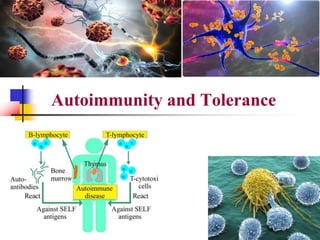
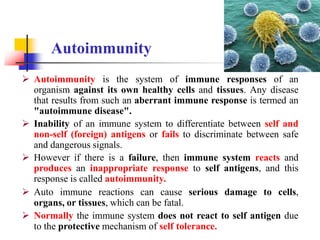

Autoimmunity and Tolerance
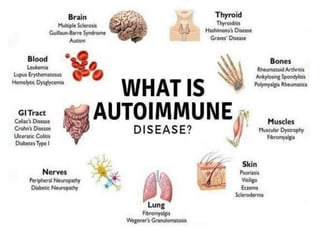
 Autoimmunity is the system of immune responses of an
organism against its own healthy cells and tissues. Any disease
that results from such an aberrant immune response is termed an
"autoimmune disease".
 Inability of an immune system to differentiate between self and
non-self (foreign) antigens or fails to discriminate between safe
and dangerous signals.
 However if there is a failure, then immune system reacts and
produces an inappropriate response to self antigens, and this
response is called autoimmunity.
 Auto immune reactions can cause serious damage to cells,
organs, or tissues, which can be fatal.
 Normally the immune system does not react to self antigen due
to the protective mechanism of self tolerance.
Autoimmunity
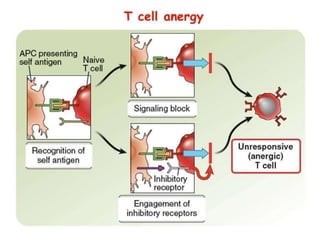
 Anergy is the a process by which the specialized T cell/B cell no
longer responds to its specific antigen (non- reactive) so, there
is the loss of immunity or suppressed immunity against a specific
antigen.
 Lymphocytes are said to be anergic when they fail to respond to
their specific antigen.
 Anergy is one of three processes that induce tolerance,
modifying the immune system to prevent self-destruction (the
others being clonal deletion and immunoregulation).
Anergy
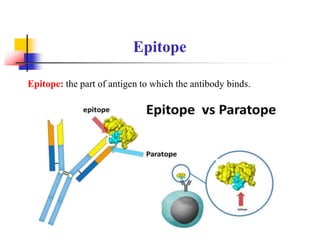
Epitope: the part of antigen to which the antibody binds.
Epitope
 Clonal deletion theory (body has ability to differentiate b/w self
and non self antigens)
 Body doesn’t produce antibodies against self antigens or its own
body.
 It is postulated whenever a child in a fetal stage, antibodies
corresponding to all types of antigens will be deleted during
birth or will not develop.
 When a child develops in a womb the antigens present in womb
corresponding antibodies will not develop.
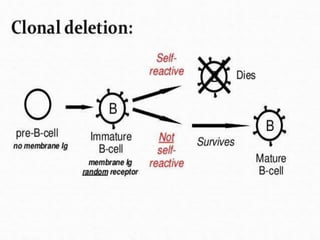
 Clonal deletion is the removal through apoptosis of B cells and T
cells that have expressed receptors for self before developing into
fully immunocompetent lymphocytes. This prevents destruction
of self host cells, making it a type of negative selection or central
tolerance.
Clonal Deletion Theory
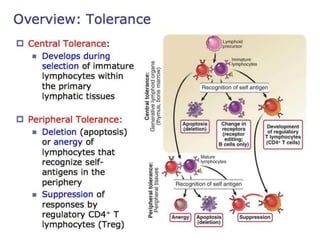
Immunological tolerance is a complex series of mechanisms that
damage the immune system to support responses against self
antigens. Failure or breakdown of immunological tolerance results in
autoimmunity and autoimmune diseases.
There are two major types of Immune Tolerance:
1. Central tolerance, also known as negative selection, is the
process of eliminating any developing T or B lymphocytes that are
reactive to self. Through removal of autoreactive lymphocytes,
tolerance ensures that the immune system does not attack self
peptides. Lymphocyte maturation (central tolerance) occurs in
primary lymphoid organs such as the bone marrow and the
thymus. In mammals, B cells mature in the bone marrow and T
cells mature in the thymus.
Immune Tolerance
Central tolerance is not perfect, so peripheral tolerance exists as a
secondary mechanism to ensure that T and B cells are not self-
reactive once they leave primary lymphoid organs. Peripheral
tolerance is distinct from central tolerance in that it occurs once
developing immune cells exit primary lymphoid organs (the thymus
and bone-marrow), prior to their export into the periphery.
2. Peripheral tolerance is the second branch of immunological
tolerance, after central tolerance. It takes place in the immune
periphery (after T and B cells outlet from primary lymphoid organs).
Its main purpose is to ensure that self-reactive T and B cells which
escaped central tolerance do not cause autoimmune disease.
 Mechanisms of peripheral tolerance include direct inactivation of
effector T cells by either clonal deletion, conversion to regulatory
T cells (Tregs) or induction of anergy.
Immune Tolerance
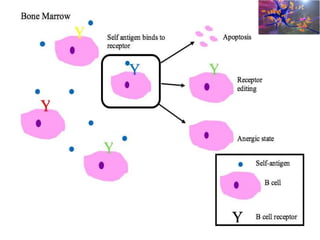
 Immature B cells in the bone marrow undergo negative selection
when they bind self peptides.
 Properly functioning B cell receptors recognize non-self antigen
or pathogen associated molecular proteins (PAMPs).
 Undergo Receptor editing is the process of ongoing antibody gene
rearrangement in a lymphocyte that already has a functional
antigen receptor.
B cell tolerance
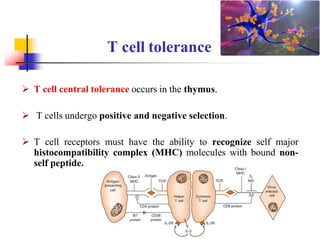
 T cell central tolerance occurs in the thymus.
 T cells undergo positive and negative selection.
 T cell receptors must have the ability to recognize self major
histocompatibility complex (MHC) molecules with bound non-
self peptide.
T cell tolerance
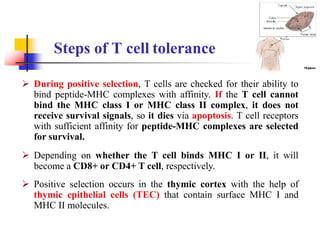
 During positive selection, T cells are checked for their ability to
bind peptide-MHC complexes with affinity. If the T cell cannot
bind the MHC class I or MHC class II complex, it does not
receive survival signals, so it dies via apoptosis. T cell receptors
with sufficient affinity for peptide-MHC complexes are selected
for survival.
 Depending on whether the T cell binds MHC I or II, it will
become a CD8+ or CD4+ T cell, respectively.
 Positive selection occurs in the thymic cortex with the help of
thymic epithelial cells (TEC) that contain surface MHC I and
MHC II molecules.
Steps of T cell tolerance
 During negative selection, T cells are tested for their affinity to
self. If they bind a self peptide, then they are signaled to apoptose
(process of clonal deletion).
 The thymic epithelial cells (TEC) display self antigen to the T
cells to test their affinity for self.
 Negative selection occurs in the cortico-medullary junction and
in the thymic medulla.
 The T cells that do not bind self, but do recognize antigen/MHC
complexes, and are either CD4+ or CD8+, migrate to secondary
lymphoid organs as mature naïve T cells.
 Regulatory T cells are another type of T cell that mature in the
thymus. T reg cells are important for regulating autoimmunity by
suppressing the immune system when it should not be active.
Steps of T cell tolerance
Causes of Autoimmunity
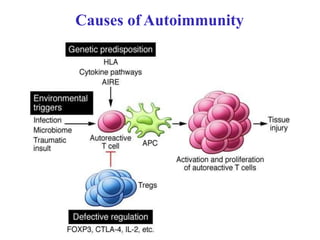
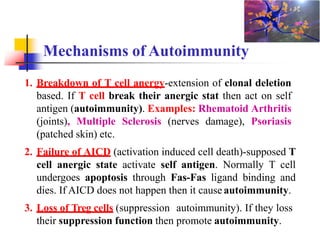
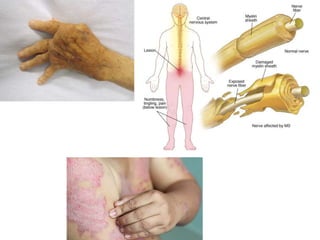
1. Breakdown of T cell anergy-extension of clonal deletion
based. If T cell break their anergic stat then act on self
antigen (autoimmunity). Examples: Rhematoid Arthritis
(joints), Multiple Sclerosis (nerves damage), Psoriasis
(patched skin) etc.
2. Failure of AICD (activation induced cell death)-supposed T
cell anergic state activate self antigen. Normally T cell
undergoes apoptosis through Fas-Fas ligand binding and
dies. If AICD does not happen then it cause autoimmunity.
3. Loss of Treg cells (suppression autoimmunity). If they loss
their suppression function then promote autoimmunity.
Mechanisms of Autoimmunity
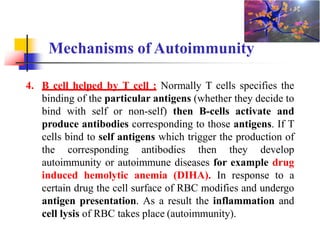
4. B cell helped by T cell : Normally T cells specifies the
binding of the particular antigens (whether they decide to
bind with self or non-self) then B-cells activate and
produce antibodies corresponding to those antigens. If T
cells bind to self antigens which trigger the production of
the corresponding antibodies then they develop
autoimmunity or autoimmune diseases for example drug
induced hemolytic anemia (DIHA). In response to a
certain drug the cell surface of RBC modifies and undergo
antigen presentation. As a result the inflammation and
cell lysis of RBC takes place (autoimmunity).
Mechanisms of Autoimmunity
5. Sequestered (hidden) antigen: There are certain areas of our
body that don’t have blood in the for example; testis (sperm)
and ovaries (ova) and they have entirely different DNA as
compared to the rest of the body cells. So, that is why they
have different antigens as well. Naturally, they are well
protected by antigen presenting cells (APCs).for example
“eye lens” (anterior chamber of an eye) if one eye blinded
by a trauma the other will also have blindness due the
production of antibodies against self antigens.
Mechanisms of Autoimmunity
6. Molecular mimics there are many biologically active
molecular compounds such as carbohydrate and protein
etc. which are shared or utilized by us and the microbes
and have same antigens. For example if a person have an
infection of Streptococcus then the body will produce
corresponding antibodies. After the bacterial infection the
antibodies will bind to heart valves surface receptors
having the same peptides. This results in the autoimmune
diseases such as Rheumatic Heart Failure (RHF) leading
to heart attack.
Mechanisms of Autoimmunity
7. Bystanding antigen (Ag-AB complex) are present in our
body to neutralize or defend against foreign invaders.
So, there are some bystanding immune cells (immune
system components) fighting against foreign antigens.
The antigen-antibody complexes can also damage
sometimes. bystanding healthy self immune cells.
8. Polyclonal immunity (Overexcited or overproduction of
antibodies) ag-ab complex (monoclonal). If polyclonal
complexes are formed and then there is the over
production of antibodies against the self antigens.
Mechanisms of Autoimmunity
Levinson,Table: 58-1: Comparison of T Cells and
B Cells
Table: 58-2: Cell Surface Proteins That Play an
Important Role in the Immune Response
Table 58–3: Main Functions of Helper T cells