ANTIGEN-ANTIBODY
INTERACTIONS
Dr Sufyan Akram
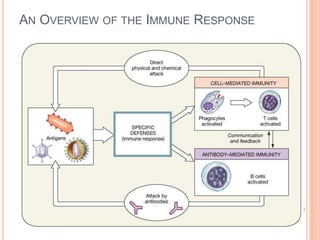
AN OVERVIEW OF THE IMMUNE RESPONSE
3
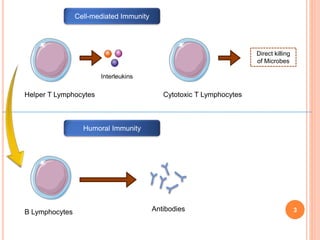
Helper T Lymphocytes
B Lymphocytes Antibodies
Cell-mediated Immunity
Humoral Immunity
Cytotoxic T Lymphocytes
Interleukins
Direct killing
of Microbes
ACTIVATION OF B LYMPHOCYTES
 On entry of a foreign antigen, macrophages in the
lymphoid tissue phagocytize the antigen and then
present it to adjacent B lymphocytes
 In addition, the antigen is presented to T cells at the
same time, and activated helper T cells are formed.
These helper cells also contribute to extreme
activation of the B lymphocytes
WHAT ARE ANTIGENS?
 An antigen is a substance that evokes the
production of one or more antibodies
 An immunogen is a specific type of antigen. An
immunogen is a substance that is able to provoke
an adaptive immune response if injected on its own
ANTIGENICITY
 Foreignness
 Size
 The larger the molecule the more immunogenic it is
 Chemical Composition
 In general, the more complex the substance is chemically the
more immunogenic it will be
 Physical form
 In general particulate antigens are more immunogenic than
soluble ones
 Degradability
 Antigens that are easily phagocytosed are generally more
immunogenic. This is because for most antigens the development
of an immune response requires that the antigen be
phagocytosed, processed and presented to helper T cells by an
antigen presenting cell (APC)
ANTIGENICITY
 Host Factors:
 Genetic Factors
 Some substances are immunogenic in one species but
not in another. Similarly, some substances are
immunogenic in one individual but not in others (i.e.
responders and non-responders)
 Age
 Age can also influence immunogenicity. Usually the very
young and the very old have a diminished ability to
mount and immune response in response to an
immunogen
HAPTENS
 Haptens are small molecules which could never
induce an immune response when administered by
themselves but which can when coupled to a carrier
molecule
 Free haptens, however, can react with products of
the immune response after such products have
been elicited
 Haptens have the property of antigenicity but not
immunogenicity
SUPERANTIGENS
 When the immune system encounters a
conventional T-dependent antigen, only a small
fraction of the T cell population is able to recognize
the antigen and become activated
 However, there are some antigens which
polyclonaly activate a large fraction of the T cells
(up to 25%). These antigens are called
superantigens…
 Examples of superantigens include: Staphylococcal
enterotoxins (food poisoning), Staphylococcal toxic
shock toxin (toxic shock syndrome) and Streptococcal
pyrogenic exotoxins (shock)
ANTIBODIES
FORMATION OF ANTIBODIES
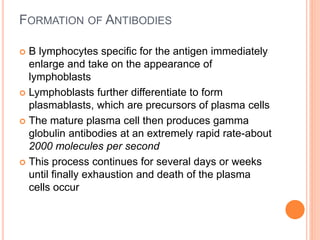
 B lymphocytes specific for the antigen immediately
enlarge and take on the appearance of
lymphoblasts
 Lymphoblasts further differentiate to form
plasmablasts, which are precursors of plasma cells
 The mature plasma cell then produces gamma
globulin antibodies at an extremely rapid rate-about
2000 molecules per second
 This process continues for several days or weeks
until finally exhaustion and death of the plasma
cells occur
MEMORY CELLS
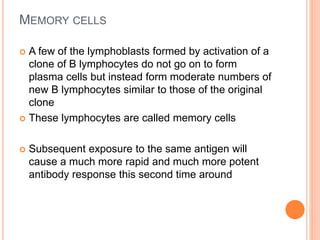
 A few of the lymphoblasts formed by activation of a
clone of B lymphocytes do not go on to form
plasma cells but instead form moderate numbers of
new B lymphocytes similar to those of the original
clone
 These lymphocytes are called memory cells
 Subsequent exposure to the same antigen will
cause a much more rapid and much more potent
antibody response this second time around
PRIMARY RESPONSE AND SECONDARY RESPONSE
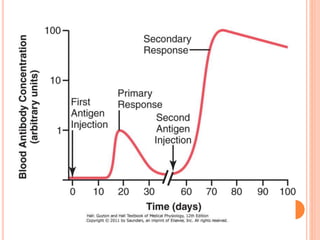
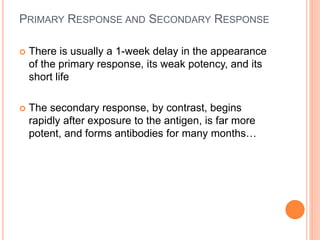
 There is usually a 1-week delay in the appearance
of the primary response, its weak potency, and its
short life
 The secondary response, by contrast, begins
rapidly after exposure to the antigen, is far more
potent, and forms antibodies for many months…
PRIMARY RESPONSE AND SECONDARY RESPONSE
 The increased potency and duration of the
secondary response explain why immunization is
usually accomplished by injecting antigen in
multiple doses with periods of several weeks or
several months between injections
WHAT ARE ANTIBODIES
 The antibodies are gamma globulins called
immunoglobulins (Ig), and they have molecular
weights between 160,000 and 970,000
 All the immunoglobulins are composed of
combinations of light and heavy polypeptide chains
 Most are a combination of two light and two heavy
chains
 However, some of the immunoglobulins have
combinations of as many as 10 heavy and 10 light
chains
STRUCTURE OF ANTIBODIES
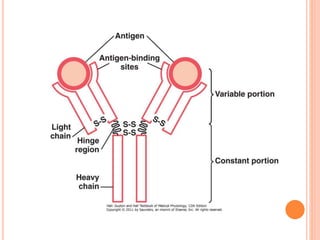
 A designated end of each light and heavy chain,
called the variable portion; the remainder of each
chain is called the constant portion
 The variable portion is different for each specificity
of antibody, and it is this portion that attaches
specifically to a particular type of antigen
 The constant portion of the antibody determines
other properties of the antibody
 such as diffusivity of the antibody in the tissues and
other biological properties of the antibody
SPECIFICITY OF ANTIBODIES
 Each antibody is specific for a particular antigen;
this is caused by its unique structural organization
of amino acids in the variable portions of both the
light and heavy chains
 On a bivalent antibody, there are two variable sites
for attachment of antigens
 A small proportion of the antibodies, which consist
of combinations of up to 10 light and 10 heavy
chains, have as many as 10 binding sites
TYPES OF ANTIBODIES
 There are five general classes of antibodies,
respectively named IgM, IgG, IgA, IgD, and IgE
 IgG, a bivalent antibody, constitutes about 75
percent of the antibodies of the normal person
 The IgM class is also interesting because a
large share of the antibodies formed during the
primary response are of this type. These
antibodies have 10 binding sites that make
them exceedingly effective in protecting the
body against invaders
ANTIGEN-ANTIBODY INTERACTIONS
ANTIGEN ANTIBODY INTERACTIONS
 Lock and Key Concept- The combining site of an
antibody is located in the Fab portion of the
molecule and is constructed from the hypervariable
regions of the heavy and light chains
 Non-covalent Bonds- The bonds that hold the
antigen to the antibody combining site are all non-
covalent in nature. These include hydrogen bonds,
electrostatic bonds, Van der Waals forces and
hydrophobic bonds
 Since antigen-antibody reactions occur via non-
covalent bonds, they are by their nature reversible
AFFINITY AND AVIDITY
 Affinity- is the strength of the reaction between a single
antigenic determinant and a single combining site on the
antibody
 Affinity is the equilibrium constant that describes the
antigen-antibody reaction. Most antibodies have a high
affinity for their antigens
 Avidity- is a measure of the overall strength of binding of
an antigen with many antigenic determinants and
multivalent antibodies
 Affinity refers to the strength of binding between a single
antigenic determinant and an individual antibody
combining site whereas avidity refers to the overall
strength of binding between multivalent antigens and
antibodies
SPECIFICITY AND CROSS REACTIVITY
 Specificity- refers to the ability of an individual antibody
combining site to react with only one antigenic
determinant. In general, there is a high degree of
specificity in antigen-antibody reactions. Antibodies can
distinguish differences in:
 The primary structure of an antigen
 Isomeric forms of an antigen
 Secondary and tertiary structure of an antigen
 Cross reactivity- Cross reactivity refers to the ability of
an individual antibody combining site to react with more
than one antigenic determinant
 Cross reactions arise because the cross reacting
antigen shares an epitope in common with the
immunizing antigen
TESTS FOR ANTIGEN-ANTIBODY REACTIONS
 Agglutination tests
 Agglutination/Hemagglutination
 Coomb's Test (Antiglobulin Test)
 Precipitation tests
 Radial Immunodiffusion
 Immunoelectrophoresis
 ELISA/ RIA
 Immunofluorescence
 Flow Cytometry
 Complement Fixation
TESTS FOR ANTIGEN-ANTIBODY REACTIONS
 Some examples…
 Blood typing…..
 Qualitative Agglutination Test
 Bacterial Infections…..
 Quantitative Agglutination Test
 Detection of Rh antibodies…..
 Coomb’s Test
 Qualitative analysis of complex mixtures of antigens…..
 Immunoelectrophoresis
 Quantitative analysis of Antigens/ Antibodies…..
 ELISA
 Detection of cell-associated antigens…..
 Immunofluorescence, Flow Cytometry
HOW DO ANTIBODIES WORK?
 Antibodies act mainly in two ways to protect the
body against invading agents:
 (1) by direct attack on the invader (Antigen-
Antibody Interaction), and
 (2) by activation of the "complement system" that
then has multiple means of its own for destroying
the invader
DIRECT ACTION OF ANTIBODIES ON INVADING
AGENTS
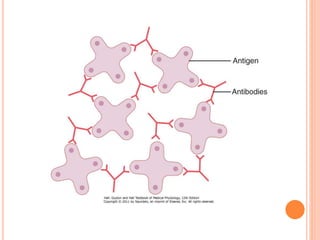
 Agglutination: multiple large particles with antigens on
their surfaces, such as bacteria or red cells, are bound
together into a clump
 Precipitation: the molecular complex of soluble antigen
and antibody becomes so large that it is rendered

insoluble and precipitates
 Neutralization: the antibodies cover the toxic sites of the
antigenic agent
 Lysis: some potent antibodies attack membranes of
cellular agents and cause their rupture
COMPLEMENT SYSTEM FOR ANTIBODY ACTION
 "Complement" is a collective term that describes a
system of about 20 proteins, many of which are enzyme
precursors
 All these are present normally in the blood
 When an antibody binds with an antigen, a specific
reactive site on the "constant" portion of the antibody
becomes "activated," and this in turn binds directly with
the C1 molecule of the complement system…
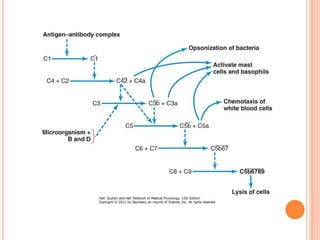
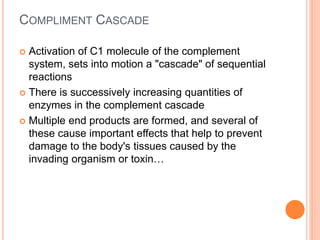
COMPLIMENT CASCADE
 Activation of C1 molecule of the complement
system, sets into motion a "cascade" of sequential
reactions
 There is successively increasing quantities of
enzymes in the complement cascade
 Multiple end products are formed, and several of
these cause important effects that help to prevent
damage to the body's tissues caused by the
invading organism or toxin…
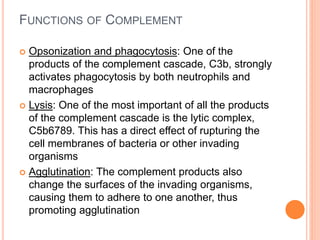
FUNCTIONS OF COMPLEMENT
 Opsonization and phagocytosis: One of the
products of the complement cascade, C3b, strongly
activates phagocytosis by both neutrophils and
macrophages
 Lysis: One of the most important of all the products
of the complement cascade is the lytic complex,
C5b6789. This has a direct effect of rupturing the
cell membranes of bacteria or other invading
organisms
 Agglutination: The complement products also
change the surfaces of the invading organisms,
causing them to adhere to one another, thus
promoting agglutination
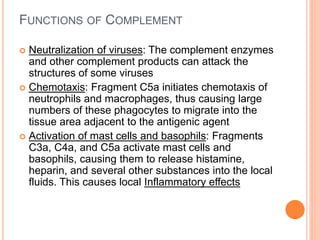
FUNCTIONS OF COMPLEMENT
 Neutralization of viruses: The complement enzymes
and other complement products can attack the
structures of some viruses
 Chemotaxis: Fragment C5a initiates chemotaxis of
neutrophils and macrophages, thus causing large
numbers of these phagocytes to migrate into the
tissue area adjacent to the antigenic agent
 Activation of mast cells and basophils: Fragments
C3a, C4a, and C5a activate mast cells and
basophils, causing them to release histamine,
heparin, and several other substances into the local
fluids. This causes local Inflammatory effects
CLINICAL APPLICATIONS
IMMUNIZATION BY INJECTION OF ANTIGENS
 Immunization has been used for many years to
produce acquired immunity against specific
diseases
 A person can be immunized by
 Injecting dead organisms that are no longer capable of
causing disease but that still have some of their
chemical antigens
 Immunity can be achieved against toxins that have been
treated with chemicals so that their toxic nature has
been destroyed even though their antigens for causing
immunity are still intact
 And, finally, a person can be immunized by being
infected with live organisms that have been "attenuated"
PASSIVE IMMUNITY
 Temporary immunity can be achieved in a person
by infusing antibodies obtained from the blood of
someone else or from some other animal that has
been actively immunized against the antigen
 Antibodies last in the body of the recipient for 2 to 3
weeks, and during that time, the person is protected
against the invading disease
SOME DRUGS MAY ACT AS HAPTENS !!
 Hydralazine, a blood pressure-lowering drug
occasionally can produce drug-induced lupus
erythematosus in certain individuals
 The anaesthetic gas halothane can cause a life-
threatening hepatitis
 Some penicillin-class drugs may cause
autoimmune hemolytic anemia
REFERENCES
Guyton and Hall Textbook of Medical Physiology, 12th
edition, 2011
Naish Medical Sciences, 1st edition, 2011

Antigen antibody interactions

  • 1.
  • 2.
    AN OVERVIEW OFTHE IMMUNE RESPONSE
  • 3.
    3 Helper T Lymphocytes BLymphocytes Antibodies Cell-mediated Immunity Humoral Immunity Cytotoxic T Lymphocytes Interleukins Direct killing of Microbes
  • 4.
    ACTIVATION OF BLYMPHOCYTES  On entry of a foreign antigen, macrophages in the lymphoid tissue phagocytize the antigen and then present it to adjacent B lymphocytes  In addition, the antigen is presented to T cells at the same time, and activated helper T cells are formed. These helper cells also contribute to extreme activation of the B lymphocytes
  • 5.
  • 6.
     An antigenis a substance that evokes the production of one or more antibodies  An immunogen is a specific type of antigen. An immunogen is a substance that is able to provoke an adaptive immune response if injected on its own
  • 7.
    ANTIGENICITY  Foreignness  Size The larger the molecule the more immunogenic it is  Chemical Composition  In general, the more complex the substance is chemically the more immunogenic it will be  Physical form  In general particulate antigens are more immunogenic than soluble ones  Degradability  Antigens that are easily phagocytosed are generally more immunogenic. This is because for most antigens the development of an immune response requires that the antigen be phagocytosed, processed and presented to helper T cells by an antigen presenting cell (APC)
  • 8.
    ANTIGENICITY  Host Factors: Genetic Factors  Some substances are immunogenic in one species but not in another. Similarly, some substances are immunogenic in one individual but not in others (i.e. responders and non-responders)  Age  Age can also influence immunogenicity. Usually the very young and the very old have a diminished ability to mount and immune response in response to an immunogen
  • 9.
    HAPTENS  Haptens aresmall molecules which could never induce an immune response when administered by themselves but which can when coupled to a carrier molecule  Free haptens, however, can react with products of the immune response after such products have been elicited  Haptens have the property of antigenicity but not immunogenicity
  • 10.
    SUPERANTIGENS  When theimmune system encounters a conventional T-dependent antigen, only a small fraction of the T cell population is able to recognize the antigen and become activated  However, there are some antigens which polyclonaly activate a large fraction of the T cells (up to 25%). These antigens are called superantigens…  Examples of superantigens include: Staphylococcal enterotoxins (food poisoning), Staphylococcal toxic shock toxin (toxic shock syndrome) and Streptococcal pyrogenic exotoxins (shock)
  • 11.
  • 12.
    FORMATION OF ANTIBODIES B lymphocytes specific for the antigen immediately enlarge and take on the appearance of lymphoblasts  Lymphoblasts further differentiate to form plasmablasts, which are precursors of plasma cells  The mature plasma cell then produces gamma globulin antibodies at an extremely rapid rate-about 2000 molecules per second  This process continues for several days or weeks until finally exhaustion and death of the plasma cells occur
  • 13.
    MEMORY CELLS  Afew of the lymphoblasts formed by activation of a clone of B lymphocytes do not go on to form plasma cells but instead form moderate numbers of new B lymphocytes similar to those of the original clone  These lymphocytes are called memory cells  Subsequent exposure to the same antigen will cause a much more rapid and much more potent antibody response this second time around
  • 15.
    PRIMARY RESPONSE ANDSECONDARY RESPONSE  There is usually a 1-week delay in the appearance of the primary response, its weak potency, and its short life  The secondary response, by contrast, begins rapidly after exposure to the antigen, is far more potent, and forms antibodies for many months…
  • 16.
    PRIMARY RESPONSE ANDSECONDARY RESPONSE  The increased potency and duration of the secondary response explain why immunization is usually accomplished by injecting antigen in multiple doses with periods of several weeks or several months between injections
  • 17.
    WHAT ARE ANTIBODIES The antibodies are gamma globulins called immunoglobulins (Ig), and they have molecular weights between 160,000 and 970,000  All the immunoglobulins are composed of combinations of light and heavy polypeptide chains  Most are a combination of two light and two heavy chains  However, some of the immunoglobulins have combinations of as many as 10 heavy and 10 light chains
  • 19.
    STRUCTURE OF ANTIBODIES A designated end of each light and heavy chain, called the variable portion; the remainder of each chain is called the constant portion  The variable portion is different for each specificity of antibody, and it is this portion that attaches specifically to a particular type of antigen  The constant portion of the antibody determines other properties of the antibody  such as diffusivity of the antibody in the tissues and other biological properties of the antibody
  • 20.
    SPECIFICITY OF ANTIBODIES Each antibody is specific for a particular antigen; this is caused by its unique structural organization of amino acids in the variable portions of both the light and heavy chains  On a bivalent antibody, there are two variable sites for attachment of antigens  A small proportion of the antibodies, which consist of combinations of up to 10 light and 10 heavy chains, have as many as 10 binding sites
  • 21.
    TYPES OF ANTIBODIES There are five general classes of antibodies, respectively named IgM, IgG, IgA, IgD, and IgE  IgG, a bivalent antibody, constitutes about 75 percent of the antibodies of the normal person  The IgM class is also interesting because a large share of the antibodies formed during the primary response are of this type. These antibodies have 10 binding sites that make them exceedingly effective in protecting the body against invaders
  • 22.
  • 23.
    ANTIGEN ANTIBODY INTERACTIONS Lock and Key Concept- The combining site of an antibody is located in the Fab portion of the molecule and is constructed from the hypervariable regions of the heavy and light chains  Non-covalent Bonds- The bonds that hold the antigen to the antibody combining site are all non- covalent in nature. These include hydrogen bonds, electrostatic bonds, Van der Waals forces and hydrophobic bonds  Since antigen-antibody reactions occur via non- covalent bonds, they are by their nature reversible
  • 24.
    AFFINITY AND AVIDITY Affinity- is the strength of the reaction between a single antigenic determinant and a single combining site on the antibody  Affinity is the equilibrium constant that describes the antigen-antibody reaction. Most antibodies have a high affinity for their antigens  Avidity- is a measure of the overall strength of binding of an antigen with many antigenic determinants and multivalent antibodies  Affinity refers to the strength of binding between a single antigenic determinant and an individual antibody combining site whereas avidity refers to the overall strength of binding between multivalent antigens and antibodies
  • 25.
    SPECIFICITY AND CROSSREACTIVITY  Specificity- refers to the ability of an individual antibody combining site to react with only one antigenic determinant. In general, there is a high degree of specificity in antigen-antibody reactions. Antibodies can distinguish differences in:  The primary structure of an antigen  Isomeric forms of an antigen  Secondary and tertiary structure of an antigen  Cross reactivity- Cross reactivity refers to the ability of an individual antibody combining site to react with more than one antigenic determinant  Cross reactions arise because the cross reacting antigen shares an epitope in common with the immunizing antigen
  • 26.
    TESTS FOR ANTIGEN-ANTIBODYREACTIONS  Agglutination tests  Agglutination/Hemagglutination  Coomb's Test (Antiglobulin Test)  Precipitation tests  Radial Immunodiffusion  Immunoelectrophoresis  ELISA/ RIA  Immunofluorescence  Flow Cytometry  Complement Fixation
  • 27.
    TESTS FOR ANTIGEN-ANTIBODYREACTIONS  Some examples…  Blood typing…..  Qualitative Agglutination Test  Bacterial Infections…..  Quantitative Agglutination Test  Detection of Rh antibodies…..  Coomb’s Test  Qualitative analysis of complex mixtures of antigens…..  Immunoelectrophoresis  Quantitative analysis of Antigens/ Antibodies…..  ELISA  Detection of cell-associated antigens…..  Immunofluorescence, Flow Cytometry
  • 28.
    HOW DO ANTIBODIESWORK?  Antibodies act mainly in two ways to protect the body against invading agents:  (1) by direct attack on the invader (Antigen- Antibody Interaction), and  (2) by activation of the "complement system" that then has multiple means of its own for destroying the invader
  • 29.
    DIRECT ACTION OFANTIBODIES ON INVADING AGENTS  Agglutination: multiple large particles with antigens on their surfaces, such as bacteria or red cells, are bound together into a clump  Precipitation: the molecular complex of soluble antigen and antibody becomes so large that it is rendered insoluble and precipitates  Neutralization: the antibodies cover the toxic sites of the antigenic agent  Lysis: some potent antibodies attack membranes of cellular agents and cause their rupture
  • 31.
    COMPLEMENT SYSTEM FORANTIBODY ACTION  "Complement" is a collective term that describes a system of about 20 proteins, many of which are enzyme precursors  All these are present normally in the blood  When an antibody binds with an antigen, a specific reactive site on the "constant" portion of the antibody becomes "activated," and this in turn binds directly with the C1 molecule of the complement system…
  • 33.
    COMPLIMENT CASCADE  Activationof C1 molecule of the complement system, sets into motion a "cascade" of sequential reactions  There is successively increasing quantities of enzymes in the complement cascade  Multiple end products are formed, and several of these cause important effects that help to prevent damage to the body's tissues caused by the invading organism or toxin…
  • 34.
    FUNCTIONS OF COMPLEMENT Opsonization and phagocytosis: One of the products of the complement cascade, C3b, strongly activates phagocytosis by both neutrophils and macrophages  Lysis: One of the most important of all the products of the complement cascade is the lytic complex, C5b6789. This has a direct effect of rupturing the cell membranes of bacteria or other invading organisms  Agglutination: The complement products also change the surfaces of the invading organisms, causing them to adhere to one another, thus promoting agglutination
  • 35.
    FUNCTIONS OF COMPLEMENT Neutralization of viruses: The complement enzymes and other complement products can attack the structures of some viruses  Chemotaxis: Fragment C5a initiates chemotaxis of neutrophils and macrophages, thus causing large numbers of these phagocytes to migrate into the tissue area adjacent to the antigenic agent  Activation of mast cells and basophils: Fragments C3a, C4a, and C5a activate mast cells and basophils, causing them to release histamine, heparin, and several other substances into the local fluids. This causes local Inflammatory effects
  • 36.
  • 37.
    IMMUNIZATION BY INJECTIONOF ANTIGENS  Immunization has been used for many years to produce acquired immunity against specific diseases  A person can be immunized by  Injecting dead organisms that are no longer capable of causing disease but that still have some of their chemical antigens  Immunity can be achieved against toxins that have been treated with chemicals so that their toxic nature has been destroyed even though their antigens for causing immunity are still intact  And, finally, a person can be immunized by being infected with live organisms that have been "attenuated"
  • 38.
    PASSIVE IMMUNITY  Temporaryimmunity can be achieved in a person by infusing antibodies obtained from the blood of someone else or from some other animal that has been actively immunized against the antigen  Antibodies last in the body of the recipient for 2 to 3 weeks, and during that time, the person is protected against the invading disease
  • 39.
    SOME DRUGS MAYACT AS HAPTENS !!  Hydralazine, a blood pressure-lowering drug occasionally can produce drug-induced lupus erythematosus in certain individuals  The anaesthetic gas halothane can cause a life- threatening hepatitis  Some penicillin-class drugs may cause autoimmune hemolytic anemia
  • 40.
    REFERENCES Guyton and HallTextbook of Medical Physiology, 12th edition, 2011 Naish Medical Sciences, 1st edition, 2011