• SALMA ASGHAR
• 1126-19-520-001
• M.Sc. (Nutrition and
Dietetics)
 The word immunity is derived from the latin
word 'immunis' meaning 'to exempt'.
 Immunity is the ability of the body to protect against all
types of foreign bodies like bacteria, virus, toxic substances
etc. which enter the body.
Immunity is defined as "resistance exhibited by the host
against any foreign antigen including microorganisms."
As it protects us from disease it is also called disease
resistance.
 Lack of immunity is known as susceptibility.
 Immunity is done by immune system which is a complex
network of lymphoid organs such as bone marrow, thymus,
spleen etc.
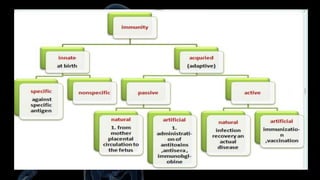
INNATE IMMUNITY-
• Innate immunity is know as birth immunity
• Natural
• Genetically passed on from one generation to other
generation.
• Provides first line of defense
• Commonly divided into 2 types
1. Specific immunity
2. Non-specific immunity
LEVELS OF INNATE IMMUNITY-
1. Species immunity- It is the total immunity shown by all members of
a species against pathogen; e.g. birds immune to tetanus
2. Racial immunity- It is that in which various races show marked
difference in their resistance to certain infectious disease.Eg-
Brahman cattle are resistant to the protozoan parasite responsible
for tick fever in other breeds of cattle.Black Africans affected by
sickle cell anaemia, a genetic disease, are resistant to malaria while
malaria affects other human races.
3. Individual immunity- It is very specific for each and every
individual despite having same racial background and opportunity
for exposure. Eg- children are more susceptible to diseases such as
measles and chicken pox, while aged individuals are susceptible to
other diseases like pneumonia.
ACQUIRED IMMUNITY-
• Acquired immunity (also called specific or adaptive immunity) refers
to an immunity that is developed by the host in its body after
exposure to a suitable antigen or after transfer of antibodies or
lymphocytes from an immune donor.
CHARACTERISTICS OF ACQUIRED IMMUNITY- Acquired immunity is
highly adaptive and is capable of specifically recognizing and selectively
eliminating foreign microorganisms and macromolecules, i.e., antigens.
1. Specificity
2. Diversity
3. Memory
4. Discrimination between “Self’ and “Nonself”
(i) Specificity:
Acquired immunity is extremely antigenic specific as it acts
against a particular microbial pathogen or foreign
macromolecule and immunity to this antigen usually does
not confer resistance to others. It is the ability of the
antibodies to differentiate between antigen molecules differs
even by a single amino acid.
(ii) Diversity:
The acquired immune system generates tremendous diversity
in its recognition molecules. As a result, it is able to
specifically recognise billions of different structures on
foreign antigens.
(iii) Memory:
Once the acquired immune system has recognised and responded to an
antigen, it is able to respond this antigen more quickly and strongly
following a subsequent exposure. This is due to the constitution of
immunologic memory that makes the basis for long-term immunity in
the body of the host.
(iv) Discrimination between “Self’ and “Nonself”:
The immune system almost always recognizes self and nonself antigens
and responds only to nonself antigens. This ability to recognize self
antigens from nonself ones is critical for normal functioning of the
immune system. Sometimes this feature fails and, as a result, there
develops autoimmune disease in the host.
COMPONENTS OF ACQUIRED IMMUNITY-
1. Lymphocytes are one of the many types of white blood cells
(leucocytes) generated in bone marrow by the process of
hematopoiesis. They migrate from bone marrow, circulate in the
blood and lymphatic system, and reside in various lymphoid organs.
Lymphocytes possess antigen-binding cell-surface receptors and are
responsible for the specificity, diversity, memory, and self/nonself
recognition by the immune system.
2. Antigen-presenting cells (APCs) have class II MHC (major
histocompatibility complex) molecules on their plasma membrane.
These MHC molecules bind to antigen-derived peptides and present
them to a group of lymphocytes, which are then activated to mount
the immune response.
ACTIVE
IMMUNITY
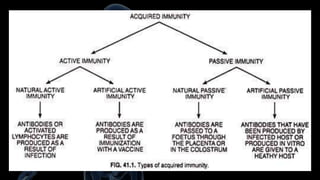
• Active immunity is the most common type. It develops in response to
an infection or vaccination. These methods expose your immune
system to a type of germ or pathogen (in vaccinations, just a small
amount).
• Also known as adaptive immunity
• Resistance developed by an individual as a result of an antigenic
stimulus
• Used for prophylaxis to increase body resistance
• 2 types:
1. Natural active immunity
2. Artificial active immunity
Naturally Acquired Active Immunity:
• This immunity develops after antigens (e.g., microbial
pathogens) enter the body by natural processes such as
infection and, in response, the body’s immune system forms
antibodies.
• In some cases, the immunity may be life-long as with
smallpox, measles, chickenpox, yellow fever etc.
• In other cases, however, the immunity may be lost after only
a few years (e.g., diphtheria, tetanus) or even for lesser
period (e.g., influenza, pneumonia).
Premunition: “special type of immunity seen in syphilis”.
• Also known as infection immunity.
• This type of immunity is relatively rapid, progressively
acquired, short-lived, and partially effective.
• Immunity to the re-infection lasts only as long as the
original infection remains active.(once the disease is cured
the patient becomes susceptible to the spirochetes again)
Artificially Acquired Active Immunity:
• Resistance induced by vaccination.
• When a carefully chosen antigen (e.g., vaccine, chemically
altered toxins called toxoids) is intentionally introduced into
a body to be immunized, the latter develops immunity that is
called artificially acquired active immunity.
• This immunity is artificial because the antigens are
intentionally or purposely introduced, and it is active
because the recipient’s immune system synthesizes
antibodies in response.
• Vaccines provide usually long-term immunity.
• Vaccines are now available against many infectious
diseases such as cholera, tuberculosis, plague,
pneumonia, rocky mountain spotted fever, smallpox,
polio, tetanus, influenza, measles, rabies, yellow fever
etc.
• Toxoids are currently available for protection against
diphtheria and tetanus, the two diseases whose major
effects are due to toxins.
VACCINES: preparations of live or killed microorganisms and
their products (antigens or toxoids)
1. Bacterial vaccines:
• live or attenuated- BCG for tuberculosis
• killed- Cholera vaccine
• Subunit- Typhoid Vi antigen
• Bacterial products- Tetanus toxoids
2. Viral Vaccines:
• live or attenuated-oral polio vacine-Sabin
• killed-injectable polio vaccine-Salk
• Subunit-Hepatitis B Vaccine
Mechanism of active immunity
• Body’s immune system provide protection by synthesizing antibodies
or immunoglobulins in response to an antigen.
• Primary immune response takes place when the host is attacked by
certain microbes for first time. The antibodies start to generate after
certain period as the binding of an antigen with its particular antibody
is very specific.
• Secondary immune response occurs when an individual is being
attacked by the same antigen subsequently. It is a rapid process.
• Acquired active immune response takes two distinct forms- humoral
and cell mediated response
Humoral Immune Response:
• Humoral immune response is also called B-cell mediated
immunity because B-lymphocytes are involved.
• Humoral immune response is to defend the body against
pathogens that may invade body fluids.
• B cells are antigen specific.
• During immune response, B cells, specific for the antigen,
enlarge to become lymphoblasts that further differentiate to
form plasma cells.
• The mature plasma cells produce gamma globulins
or immunoglobulins called antibodies at a rapid rate of
about 2000 molecules per second for each plasma cell.
• The antibodies secreted into the lymph eventually enter the
blood.
• The antibody molecule is the basic functional unit of this
type of immune response.
• So this immune response is also called antibody-
mediated immune response.
HUMORAL IMMUNITY:
• The antibody-mediated or humoral immunity is that where the B-
lymphocytes synthesize antibodies response to the detection of
antigens and these antibodies counteract with those antigens.
• Antibody-mediated immunity is often referred to as humoral
immunity because the antibody molecules flow extracellularly
through the blood and other vital body fluids.
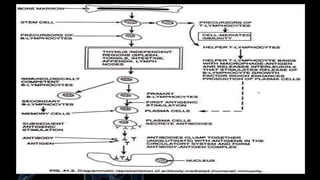
• The precursors of B-lymphocytes, which originate from the stem cells
of bone marrow, processed within thymus-independent tissues of the
lymphatic system (the spleen, tonsils, intestine, appendix, and lymph
nodes) and become immunologically competent.
• In response to antigenic stimulation, the immunologically competent
B-lymphocytes convert into primary B-lymphocytes and secondary B-
lymphocytes.
• The primary B-lymphocytes show response to the first antigenic
stimulation enter the process of their conversion into plasma cells.
• The secondary B-lymphocytes do not show any response to the first
antigenic stimulation and constitute memory cells which transform
into plasma cells in response to subsequent exposure to antigens,
perhaps years later.
• These are the plasma cells which secrete antibodies.
• Once thought to be totally independent system, the conversion of
immunologically competent B- lymphocytes into antibody producing
plasma cells is cooperated by helper T-lymphocytes (helper T-cells).
An antigen with at-least two different antigenic determinants first
attaches on the surface of a macrophage cell which then migrates to
lymphatic tissues and interact with helper T-lymphocyte.
• Once the helper T-lymphocyte binds with the antigen present on the
surface of macrophage cell, it releases interleukin-2 that stimulates
multiplication of helper T-lymphocytes and also the release of B-
lymphocyte growth factor, which in turn enhances the division of
immunologically competent B-lymphocytes and their conversion into
plasma cells.
• The antibodies secreted by plasma cells clump together (agglutinate)
with antigens present in body’s circulatory system forming antibody-
antigen-complexes which are up-taken by scavenger white blood
cells.
Cell Mediated Immune Response:
• Cell mediated immune response is carried out by the T-cells or T
lymphocytes.
• So, it is also called T-cell immunity.
• This type of immune response is to defend against pathogens that
may invade host cells.
• The surface of the T-cell has receptor molecule that can bind with
antigens.
• These receptor molecules are made of a variable unit similar to the
variable portion of the humoral antibody.
• A single T-cell has about 100,000 receptor sites.
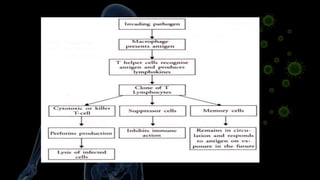
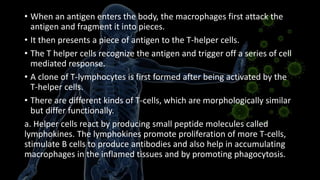
• When an antigen enters the body, the macrophages first attack the
antigen and fragment it into pieces.
• It then presents a piece of antigen to the T-helper cells.
• The T helper cells recognize the antigen and trigger off a series of cell
mediated response.
• A clone of T-lymphocytes is first formed after being activated by the
T-helper cells.
• There are different kinds of T-cells, which are morphologically similar
but differ functionally.
a. Helper cells react by producing small peptide molecules called
lymphokines. The lymphokines promote proliferation of more T-cells,
stimulate B cells to produce antibodies and also help in accumulating
macrophages in the inflamed tissues and by promoting phagocytosis.
b. Cytotoxic cells or Killer cells kill cells infected by viruses,
cancerous cells and transplants.
c. Suppressor cells, the third type of T-cells produce
lymphokines that suppress the action of the phagocytes and
the different types of WBC cells. They play an important role
in immunotolerance.
d. Some of the cells remain as the memory cells that get
lodged in the lymphoid tissue throughout the body. These on
subsequent exposure to the same antigen can cause an
immune response more rapidly than the first exposure.
CELL MEDIATED IMMUNITY
• The cell-mediated or cellular immunity is that where the T-
lymphocytes destroy other cells having antigens on their surface
without any antibodies.
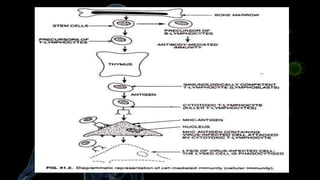
• The precursors of T-lymphocytes produced by stem cells of bone
marrow pass through liver and spleen before reaching the thymus
where they are processed, hence called thymus-dependent (T)
lymphocytes.
• These lymphocytes come under the influence of the hormone
“thymosin” and become immunologically competent and are called
lymplioblasts.
• When stimulated by an antigen, the lymphoblasts divide and
differentiate into cytotoxic T-lymphocyte (killer T-Iymphocytes),
helper T-cells, and suppressor T-cells.
• The cytotoxic T-lymphocytes, in addition with other T-lymphocytes,
release biologically active soluble factors collectively called
lymphokines which act as a biochemical mediators of cellular
immunity.
• Unlike B-lymphocytes which are normally stimulated by free antigens
in the circulatory system of the body, the cytotoxic T-lymphocytes
possess specific cell surface proteins, called T-cell receptors, on their
surface and respond to only major histocompatibility complex
antigens (MHC-antigens) bound to the surface of other cells.
• After the interaction between T-cell receptor and MHC-antigen is
established and the cytotoxic T-lymphocyte cells binds the MHC-
antigen containing cell, the latter undergoes lysis and is phagocytised
• The cell-mediated immunity is important in controlling those
infections where the pathogens are intracellular and
reproduce within the infected cells (e.g., viruses, rickettsia,
chlamydia, some protozoans like Trypanosomes, etc.).
• The cellular immunity is considered to play an important role
in monitoring and regulating the proliferation of abnormal
type of cells, (e.g., would be tumor cells), and thus, inhibiting
the tumor development.
THANK YOU

Active immunity

  • 1.
    • SALMA ASGHAR •1126-19-520-001 • M.Sc. (Nutrition and Dietetics)
  • 2.
     The wordimmunity is derived from the latin word 'immunis' meaning 'to exempt'.  Immunity is the ability of the body to protect against all types of foreign bodies like bacteria, virus, toxic substances etc. which enter the body. Immunity is defined as "resistance exhibited by the host against any foreign antigen including microorganisms." As it protects us from disease it is also called disease resistance.  Lack of immunity is known as susceptibility.  Immunity is done by immune system which is a complex network of lymphoid organs such as bone marrow, thymus, spleen etc.
  • 4.
    INNATE IMMUNITY- • Innateimmunity is know as birth immunity • Natural • Genetically passed on from one generation to other generation. • Provides first line of defense • Commonly divided into 2 types 1. Specific immunity 2. Non-specific immunity
  • 5.
    LEVELS OF INNATEIMMUNITY- 1. Species immunity- It is the total immunity shown by all members of a species against pathogen; e.g. birds immune to tetanus 2. Racial immunity- It is that in which various races show marked difference in their resistance to certain infectious disease.Eg- Brahman cattle are resistant to the protozoan parasite responsible for tick fever in other breeds of cattle.Black Africans affected by sickle cell anaemia, a genetic disease, are resistant to malaria while malaria affects other human races. 3. Individual immunity- It is very specific for each and every individual despite having same racial background and opportunity for exposure. Eg- children are more susceptible to diseases such as measles and chicken pox, while aged individuals are susceptible to other diseases like pneumonia.
  • 6.
    ACQUIRED IMMUNITY- • Acquiredimmunity (also called specific or adaptive immunity) refers to an immunity that is developed by the host in its body after exposure to a suitable antigen or after transfer of antibodies or lymphocytes from an immune donor. CHARACTERISTICS OF ACQUIRED IMMUNITY- Acquired immunity is highly adaptive and is capable of specifically recognizing and selectively eliminating foreign microorganisms and macromolecules, i.e., antigens. 1. Specificity 2. Diversity 3. Memory 4. Discrimination between “Self’ and “Nonself”
  • 7.
    (i) Specificity: Acquired immunityis extremely antigenic specific as it acts against a particular microbial pathogen or foreign macromolecule and immunity to this antigen usually does not confer resistance to others. It is the ability of the antibodies to differentiate between antigen molecules differs even by a single amino acid. (ii) Diversity: The acquired immune system generates tremendous diversity in its recognition molecules. As a result, it is able to specifically recognise billions of different structures on foreign antigens.
  • 8.
    (iii) Memory: Once theacquired immune system has recognised and responded to an antigen, it is able to respond this antigen more quickly and strongly following a subsequent exposure. This is due to the constitution of immunologic memory that makes the basis for long-term immunity in the body of the host. (iv) Discrimination between “Self’ and “Nonself”: The immune system almost always recognizes self and nonself antigens and responds only to nonself antigens. This ability to recognize self antigens from nonself ones is critical for normal functioning of the immune system. Sometimes this feature fails and, as a result, there develops autoimmune disease in the host.
  • 9.
    COMPONENTS OF ACQUIREDIMMUNITY- 1. Lymphocytes are one of the many types of white blood cells (leucocytes) generated in bone marrow by the process of hematopoiesis. They migrate from bone marrow, circulate in the blood and lymphatic system, and reside in various lymphoid organs. Lymphocytes possess antigen-binding cell-surface receptors and are responsible for the specificity, diversity, memory, and self/nonself recognition by the immune system. 2. Antigen-presenting cells (APCs) have class II MHC (major histocompatibility complex) molecules on their plasma membrane. These MHC molecules bind to antigen-derived peptides and present them to a group of lymphocytes, which are then activated to mount the immune response.
  • 11.
  • 12.
    • Active immunityis the most common type. It develops in response to an infection or vaccination. These methods expose your immune system to a type of germ or pathogen (in vaccinations, just a small amount). • Also known as adaptive immunity • Resistance developed by an individual as a result of an antigenic stimulus • Used for prophylaxis to increase body resistance • 2 types: 1. Natural active immunity 2. Artificial active immunity
  • 13.
    Naturally Acquired ActiveImmunity: • This immunity develops after antigens (e.g., microbial pathogens) enter the body by natural processes such as infection and, in response, the body’s immune system forms antibodies. • In some cases, the immunity may be life-long as with smallpox, measles, chickenpox, yellow fever etc. • In other cases, however, the immunity may be lost after only a few years (e.g., diphtheria, tetanus) or even for lesser period (e.g., influenza, pneumonia).
  • 14.
    Premunition: “special typeof immunity seen in syphilis”. • Also known as infection immunity. • This type of immunity is relatively rapid, progressively acquired, short-lived, and partially effective. • Immunity to the re-infection lasts only as long as the original infection remains active.(once the disease is cured the patient becomes susceptible to the spirochetes again)
  • 15.
    Artificially Acquired ActiveImmunity: • Resistance induced by vaccination. • When a carefully chosen antigen (e.g., vaccine, chemically altered toxins called toxoids) is intentionally introduced into a body to be immunized, the latter develops immunity that is called artificially acquired active immunity. • This immunity is artificial because the antigens are intentionally or purposely introduced, and it is active because the recipient’s immune system synthesizes antibodies in response.
  • 16.
    • Vaccines provideusually long-term immunity. • Vaccines are now available against many infectious diseases such as cholera, tuberculosis, plague, pneumonia, rocky mountain spotted fever, smallpox, polio, tetanus, influenza, measles, rabies, yellow fever etc. • Toxoids are currently available for protection against diphtheria and tetanus, the two diseases whose major effects are due to toxins.
  • 17.
    VACCINES: preparations oflive or killed microorganisms and their products (antigens or toxoids) 1. Bacterial vaccines: • live or attenuated- BCG for tuberculosis • killed- Cholera vaccine • Subunit- Typhoid Vi antigen • Bacterial products- Tetanus toxoids 2. Viral Vaccines: • live or attenuated-oral polio vacine-Sabin • killed-injectable polio vaccine-Salk • Subunit-Hepatitis B Vaccine
  • 18.
    Mechanism of activeimmunity • Body’s immune system provide protection by synthesizing antibodies or immunoglobulins in response to an antigen. • Primary immune response takes place when the host is attacked by certain microbes for first time. The antibodies start to generate after certain period as the binding of an antigen with its particular antibody is very specific. • Secondary immune response occurs when an individual is being attacked by the same antigen subsequently. It is a rapid process. • Acquired active immune response takes two distinct forms- humoral and cell mediated response
  • 19.
    Humoral Immune Response: •Humoral immune response is also called B-cell mediated immunity because B-lymphocytes are involved. • Humoral immune response is to defend the body against pathogens that may invade body fluids. • B cells are antigen specific. • During immune response, B cells, specific for the antigen, enlarge to become lymphoblasts that further differentiate to form plasma cells.
  • 20.
    • The matureplasma cells produce gamma globulins or immunoglobulins called antibodies at a rapid rate of about 2000 molecules per second for each plasma cell. • The antibodies secreted into the lymph eventually enter the blood. • The antibody molecule is the basic functional unit of this type of immune response. • So this immune response is also called antibody- mediated immune response.
  • 21.
    HUMORAL IMMUNITY: • Theantibody-mediated or humoral immunity is that where the B- lymphocytes synthesize antibodies response to the detection of antigens and these antibodies counteract with those antigens. • Antibody-mediated immunity is often referred to as humoral immunity because the antibody molecules flow extracellularly through the blood and other vital body fluids. • The precursors of B-lymphocytes, which originate from the stem cells of bone marrow, processed within thymus-independent tissues of the lymphatic system (the spleen, tonsils, intestine, appendix, and lymph nodes) and become immunologically competent. • In response to antigenic stimulation, the immunologically competent B-lymphocytes convert into primary B-lymphocytes and secondary B- lymphocytes.
  • 22.
    • The primaryB-lymphocytes show response to the first antigenic stimulation enter the process of their conversion into plasma cells. • The secondary B-lymphocytes do not show any response to the first antigenic stimulation and constitute memory cells which transform into plasma cells in response to subsequent exposure to antigens, perhaps years later. • These are the plasma cells which secrete antibodies. • Once thought to be totally independent system, the conversion of immunologically competent B- lymphocytes into antibody producing plasma cells is cooperated by helper T-lymphocytes (helper T-cells). An antigen with at-least two different antigenic determinants first attaches on the surface of a macrophage cell which then migrates to lymphatic tissues and interact with helper T-lymphocyte.
  • 23.
    • Once thehelper T-lymphocyte binds with the antigen present on the surface of macrophage cell, it releases interleukin-2 that stimulates multiplication of helper T-lymphocytes and also the release of B- lymphocyte growth factor, which in turn enhances the division of immunologically competent B-lymphocytes and their conversion into plasma cells. • The antibodies secreted by plasma cells clump together (agglutinate) with antigens present in body’s circulatory system forming antibody- antigen-complexes which are up-taken by scavenger white blood cells.
  • 25.
    Cell Mediated ImmuneResponse: • Cell mediated immune response is carried out by the T-cells or T lymphocytes. • So, it is also called T-cell immunity. • This type of immune response is to defend against pathogens that may invade host cells. • The surface of the T-cell has receptor molecule that can bind with antigens. • These receptor molecules are made of a variable unit similar to the variable portion of the humoral antibody. • A single T-cell has about 100,000 receptor sites.
  • 27.
    • When anantigen enters the body, the macrophages first attack the antigen and fragment it into pieces. • It then presents a piece of antigen to the T-helper cells. • The T helper cells recognize the antigen and trigger off a series of cell mediated response. • A clone of T-lymphocytes is first formed after being activated by the T-helper cells. • There are different kinds of T-cells, which are morphologically similar but differ functionally. a. Helper cells react by producing small peptide molecules called lymphokines. The lymphokines promote proliferation of more T-cells, stimulate B cells to produce antibodies and also help in accumulating macrophages in the inflamed tissues and by promoting phagocytosis.
  • 28.
    b. Cytotoxic cellsor Killer cells kill cells infected by viruses, cancerous cells and transplants. c. Suppressor cells, the third type of T-cells produce lymphokines that suppress the action of the phagocytes and the different types of WBC cells. They play an important role in immunotolerance. d. Some of the cells remain as the memory cells that get lodged in the lymphoid tissue throughout the body. These on subsequent exposure to the same antigen can cause an immune response more rapidly than the first exposure.
  • 29.
    CELL MEDIATED IMMUNITY •The cell-mediated or cellular immunity is that where the T- lymphocytes destroy other cells having antigens on their surface without any antibodies. • The precursors of T-lymphocytes produced by stem cells of bone marrow pass through liver and spleen before reaching the thymus where they are processed, hence called thymus-dependent (T) lymphocytes. • These lymphocytes come under the influence of the hormone “thymosin” and become immunologically competent and are called lymplioblasts. • When stimulated by an antigen, the lymphoblasts divide and differentiate into cytotoxic T-lymphocyte (killer T-Iymphocytes), helper T-cells, and suppressor T-cells.
  • 30.
    • The cytotoxicT-lymphocytes, in addition with other T-lymphocytes, release biologically active soluble factors collectively called lymphokines which act as a biochemical mediators of cellular immunity. • Unlike B-lymphocytes which are normally stimulated by free antigens in the circulatory system of the body, the cytotoxic T-lymphocytes possess specific cell surface proteins, called T-cell receptors, on their surface and respond to only major histocompatibility complex antigens (MHC-antigens) bound to the surface of other cells. • After the interaction between T-cell receptor and MHC-antigen is established and the cytotoxic T-lymphocyte cells binds the MHC- antigen containing cell, the latter undergoes lysis and is phagocytised
  • 32.
    • The cell-mediatedimmunity is important in controlling those infections where the pathogens are intracellular and reproduce within the infected cells (e.g., viruses, rickettsia, chlamydia, some protozoans like Trypanosomes, etc.). • The cellular immunity is considered to play an important role in monitoring and regulating the proliferation of abnormal type of cells, (e.g., would be tumor cells), and thus, inhibiting the tumor development.
  • 33.