Dr AlokTripathi
Department of Biotechnology
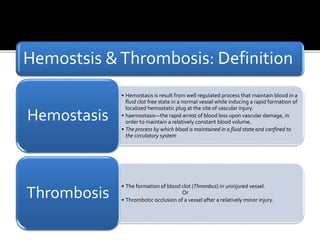
Hemostsis &Thrombosis: Definition
• Hemostasis is result from well regulated process that maintain blood in a
fluid clot free state in a normal vessel while inducing a rapid formation of
localized hemostatic plug at the site of vascular injury.
• haemostasis—the rapid arrest of blood loss upon vascular damage, in
order to maintain a relatively constant blood volume.
• The process by which blood is maintained in a fluid state and confined to
the circulatory system
Hemostasis
• The formation of blood clot (Thrombus) in uninjured vessel.
Or
• Thrombotic occlusion of a vessel after a relatively minor injury.
Thrombosis
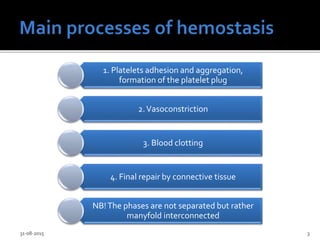
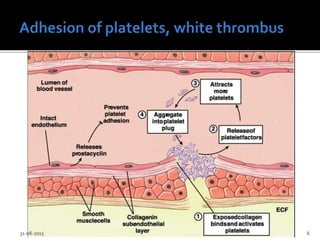
1. Platelets adhesion and aggregation,
formation of the platelet plug
2.Vasoconstriction
3. Blood clotting
4. Final repair by connective tissue
NB!The phases are not separated but rather
manyfold interconnected
31-08-2015 3
http://cwx.prenhall.com/bookbind/pubbooks/silverthorn2
31-08-2015 4
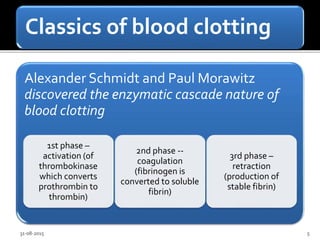
Classics of blood clotting
Alexander Schmidt and Paul Morawitz
discovered the enzymatic cascade nature of
blood clotting
1st phase –
activation (of
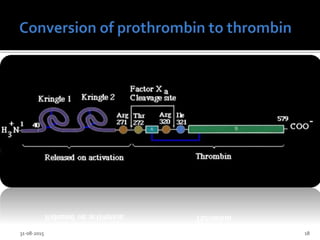
thrombokinase
which converts
prothrombin to
thrombin)
2nd phase --
coagulation
(fibrinogen is
converted to soluble
fibrin)
3rd phase –
retraction
(production of
stable fibrin)
31-08-2015 5
http://cwx.prenhall.com/bookbind/pubbooks/silverthorn2
31-08-2015 6
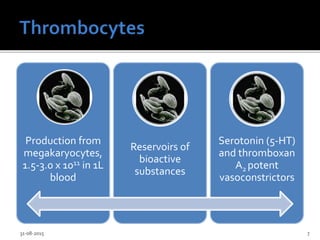
Production from
megakaryocytes,
1.5-3.0 x 10¹¹ in 1L
blood
Reservoirs of
bioactive
substances
Serotonin (5-HT)
and thromboxan
A2 potent
vasoconstrictors
31-08-2015 7
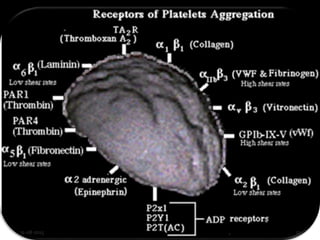
Factors influencing platelets adhesion
Collageen and plasma vonWillebrand factor
(vWf) iniate adhesion.
Adhesion is blocked by negative surface charge
of platelets, certain biochemical regulators (e.g.
NO, prostacyclin etc), and endothelial barrier
between collagen and blood.
31-08-2015 8
31-08-2015 9
31-08-2015 10
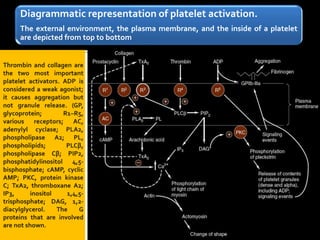
Diagrammatic representation of platelet activation.
The external environment, the plasma membrane, and the inside of a platelet
are depicted from top to bottom
31-08-2015 12
31-08-2015 13
31-08-2015 14
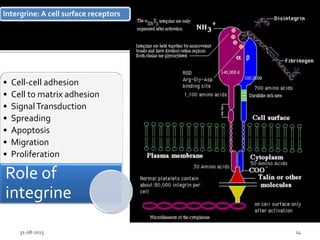
Intergrine: A cell surface receptors
• Cell-cell adhesion
• Cell to matrix adhesion
• SignalTransduction
• Spreading
• Apoptosis
• Migration
• Proliferation
Role of
integrine
Blood clots. “red thrombus”
31-08-2015 15
31-08-2015 16
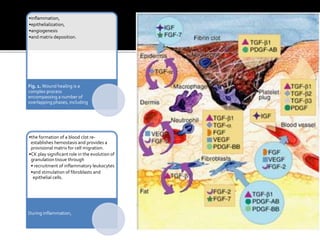
•inflammation,
•epithelialization,
•angiogenesis
•and matrix deposition.
Fig. 1. Wound healing is a
complex process
encompassing a number of
overlapping phases, including
•the formation of a blood clot re-
establishes hemostasis and provides a
provisional matrix for cell migration.
•CK play significant role in the evolution of
granulation tissue through
• recruitment of inflammatory leukocytes
•and stimulation of fibroblasts and
epithelial cells.
During inflammation,
31-08-2015 18
31-08-2015 19
31-08-2015 20
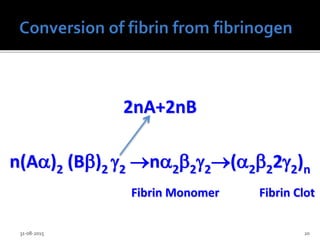
2nA+2nB
n(A)2 (B)2 2 n222(2222)n
Fibrin Monomer Fibrin Clot
31-08-2015 21
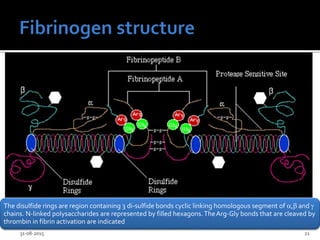
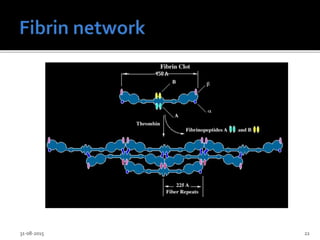
The disulfide rings are region containing 3 di-sulfide bonds cyclic linking homologous segment of , and 
chains. N-linked polysaccharides are represented by filled hexagons.TheArg-Gly bonds that are cleaved by
thrombin in fibrin activation are indicated
31-08-2015 22
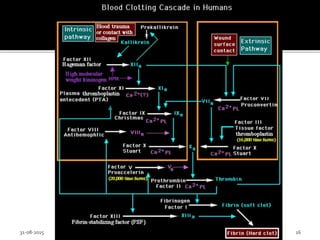
The extrinsic pathway is critical in
initiating of blood clotting.
The intrinsic pathway plays an important
role in maintenance of coagulation.
There is no bleeding disorders in case of
lack XII
31-08-2015 23
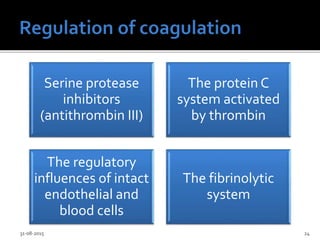
Serine protease
inhibitors
(antithrombin III)
The protein C
system activated
by thrombin
The regulatory
influences of intact
endothelial and
blood cells
The fibrinolytic
system
31-08-2015 24
Antithrombin III, tissue factor pathway
inhibitor (TFPI), alpha2-macroglobulin,
C1 inhibitor jt.
Antithrombin III inhibits mainly factor
X, and factorsVII, IX, XI, XII.
Heparin and glycosaminoglycans
increase the antithrombin III activity
1000 times.
31-08-2015 25
Thrombomodulin and protein C are
members of an endogenous anticoagulant
system.
Thrombin complexed with
thrombomodulin loses its procoagulatory
activity, while readily activating protein C
Proteiin C destroys factorsV andVIII
31-08-2015 26
31-08-2015 27
Endothelium
Modulate several
aspect of anti-
cougulating
properties
Anti-platelet ,Anti-
couagulent &
fibrinolytic
Exerts pro-
couagulent functions
It may activated by infectious
agents, hemodynamic factors
plasma mediators & CK
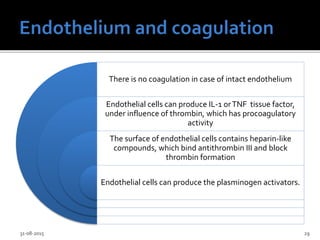
There is no coagulation in case of intact endothelium
Endothelial cells can produce IL-1 orTNF tissue factor,
under influence of thrombin, which has procoagulatory
activity
The surface of endothelial cells contains heparin-like
compounds, which bind antithrombin III and block
thrombin formation
Endothelial cells can produce the plasminogen activators.
31-08-2015 29
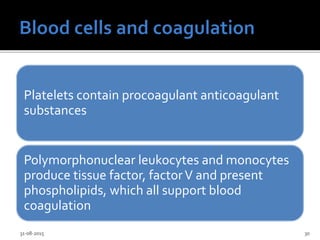
Platelets contain procoagulant anticoagulant
substances
Polymorphonuclear leukocytes and monocytes
produce tissue factor, factorV and present
phospholipids, which all support blood
coagulation
31-08-2015 30
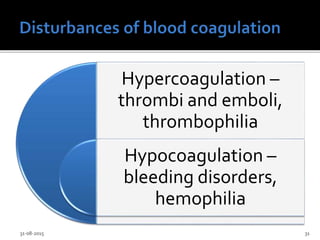
Hypercoagulation –
thrombi and emboli,
thrombophilia
Hypocoagulation –
bleeding disorders,
hemophilia
31-08-2015 31
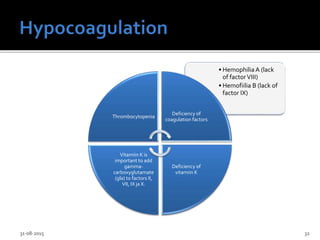
• HemophiliaA (lack
of factorVIII)
• Hemofiilia B (lack of
factor IX)
Thrombocytopenia
Deficiency of
coagulation factors
Deficiency of
vitamiin K
Vitamiin K is
important to add
gamma-
carboxyglutamate
(gla) to factors II,
VII, IX ja X.
31-08-2015 32
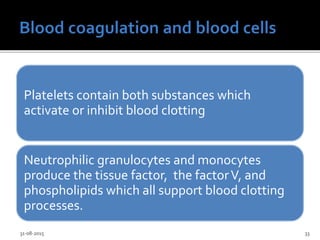
Platelets contain both substances which
activate or inhibit blood clotting
Neutrophilic granulocytes and monocytes
produce the tissue factor, the factorV, and
phospholipids which all support blood clotting
processes.
31-08-2015 33
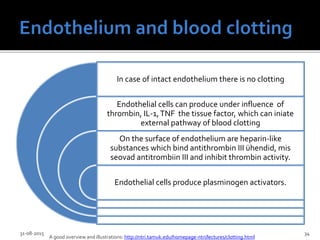
In case of intact endothelium there is no clotting
Endothelial cells can produce under influence of
thrombin, IL-1,TNF the tissue factor, which can iniate
external pathway of blood clotting
On the surface of endothelium are heparin-like
substances which bind antithrombin III ühendid, mis
seovad antitrombiin III and inhibit thrombin activity.
Endothelial cells produce plasminogen activators.
31-08-2015 34
A good overview and illustrations: http://ntri.tamuk.edu/homepage-ntri/lectures/clotting.html

Hemostasis : Blood clotting

  • 1.
  • 2.
    Hemostsis &Thrombosis: Definition •Hemostasis is result from well regulated process that maintain blood in a fluid clot free state in a normal vessel while inducing a rapid formation of localized hemostatic plug at the site of vascular injury. • haemostasis—the rapid arrest of blood loss upon vascular damage, in order to maintain a relatively constant blood volume. • The process by which blood is maintained in a fluid state and confined to the circulatory system Hemostasis • The formation of blood clot (Thrombus) in uninjured vessel. Or • Thrombotic occlusion of a vessel after a relatively minor injury. Thrombosis
  • 3.
    1. Platelets adhesionand aggregation, formation of the platelet plug 2.Vasoconstriction 3. Blood clotting 4. Final repair by connective tissue NB!The phases are not separated but rather manyfold interconnected 31-08-2015 3
  • 4.
  • 5.
    Classics of bloodclotting Alexander Schmidt and Paul Morawitz discovered the enzymatic cascade nature of blood clotting 1st phase – activation (of thrombokinase which converts prothrombin to thrombin) 2nd phase -- coagulation (fibrinogen is converted to soluble fibrin) 3rd phase – retraction (production of stable fibrin) 31-08-2015 5
  • 6.
  • 7.
    Production from megakaryocytes, 1.5-3.0 x10¹¹ in 1L blood Reservoirs of bioactive substances Serotonin (5-HT) and thromboxan A2 potent vasoconstrictors 31-08-2015 7
  • 8.
    Factors influencing plateletsadhesion Collageen and plasma vonWillebrand factor (vWf) iniate adhesion. Adhesion is blocked by negative surface charge of platelets, certain biochemical regulators (e.g. NO, prostacyclin etc), and endothelial barrier between collagen and blood. 31-08-2015 8
  • 9.
  • 10.
  • 11.
    Diagrammatic representation ofplatelet activation. The external environment, the plasma membrane, and the inside of a platelet are depicted from top to bottom
  • 12.
  • 13.
  • 14.
    31-08-2015 14 Intergrine: Acell surface receptors • Cell-cell adhesion • Cell to matrix adhesion • SignalTransduction • Spreading • Apoptosis • Migration • Proliferation Role of integrine
  • 15.
    Blood clots. “redthrombus” 31-08-2015 15
  • 16.
  • 17.
    •inflammation, •epithelialization, •angiogenesis •and matrix deposition. Fig.1. Wound healing is a complex process encompassing a number of overlapping phases, including •the formation of a blood clot re- establishes hemostasis and provides a provisional matrix for cell migration. •CK play significant role in the evolution of granulation tissue through • recruitment of inflammatory leukocytes •and stimulation of fibroblasts and epithelial cells. During inflammation,
  • 18.
  • 19.
  • 20.
    31-08-2015 20 2nA+2nB n(A)2 (B)22 n222(2222)n Fibrin Monomer Fibrin Clot
  • 21.
    31-08-2015 21 The disulfiderings are region containing 3 di-sulfide bonds cyclic linking homologous segment of , and  chains. N-linked polysaccharides are represented by filled hexagons.TheArg-Gly bonds that are cleaved by thrombin in fibrin activation are indicated
  • 22.
  • 23.
    The extrinsic pathwayis critical in initiating of blood clotting. The intrinsic pathway plays an important role in maintenance of coagulation. There is no bleeding disorders in case of lack XII 31-08-2015 23
  • 24.
    Serine protease inhibitors (antithrombin III) Theprotein C system activated by thrombin The regulatory influences of intact endothelial and blood cells The fibrinolytic system 31-08-2015 24
  • 25.
    Antithrombin III, tissuefactor pathway inhibitor (TFPI), alpha2-macroglobulin, C1 inhibitor jt. Antithrombin III inhibits mainly factor X, and factorsVII, IX, XI, XII. Heparin and glycosaminoglycans increase the antithrombin III activity 1000 times. 31-08-2015 25
  • 26.
    Thrombomodulin and proteinC are members of an endogenous anticoagulant system. Thrombin complexed with thrombomodulin loses its procoagulatory activity, while readily activating protein C Proteiin C destroys factorsV andVIII 31-08-2015 26
  • 27.
  • 28.
    Endothelium Modulate several aspect ofanti- cougulating properties Anti-platelet ,Anti- couagulent & fibrinolytic Exerts pro- couagulent functions It may activated by infectious agents, hemodynamic factors plasma mediators & CK
  • 29.
    There is nocoagulation in case of intact endothelium Endothelial cells can produce IL-1 orTNF tissue factor, under influence of thrombin, which has procoagulatory activity The surface of endothelial cells contains heparin-like compounds, which bind antithrombin III and block thrombin formation Endothelial cells can produce the plasminogen activators. 31-08-2015 29
  • 30.
    Platelets contain procoagulantanticoagulant substances Polymorphonuclear leukocytes and monocytes produce tissue factor, factorV and present phospholipids, which all support blood coagulation 31-08-2015 30
  • 31.
    Hypercoagulation – thrombi andemboli, thrombophilia Hypocoagulation – bleeding disorders, hemophilia 31-08-2015 31
  • 32.
    • HemophiliaA (lack offactorVIII) • Hemofiilia B (lack of factor IX) Thrombocytopenia Deficiency of coagulation factors Deficiency of vitamiin K Vitamiin K is important to add gamma- carboxyglutamate (gla) to factors II, VII, IX ja X. 31-08-2015 32
  • 33.
    Platelets contain bothsubstances which activate or inhibit blood clotting Neutrophilic granulocytes and monocytes produce the tissue factor, the factorV, and phospholipids which all support blood clotting processes. 31-08-2015 33
  • 34.
    In case ofintact endothelium there is no clotting Endothelial cells can produce under influence of thrombin, IL-1,TNF the tissue factor, which can iniate external pathway of blood clotting On the surface of endothelium are heparin-like substances which bind antithrombin III ühendid, mis seovad antitrombiin III and inhibit thrombin activity. Endothelial cells produce plasminogen activators. 31-08-2015 34 A good overview and illustrations: http://ntri.tamuk.edu/homepage-ntri/lectures/clotting.html