HEMOSTASIS
Dr G VENKATA RAMANA
MBBS DNB FAMILY MEDICINE
ENDOTHELIUM
• The balance between the anticoagulant and procoagulant activities of
endothelium often determines whether clot formation, propagation, or
dissolution occurs
• Normal endothelial cells express a multitude of factors that inhibit the
procoagulant activities of platelets and coagulation factors and that augment
fibrinolysis
• These factors act in concert to prevent thrombosis and to limit clotting to sites
of vascular damage
• However, if injured or exposed to proinflammatory factors, endothelial cells
lose many of their antithrombotic properties
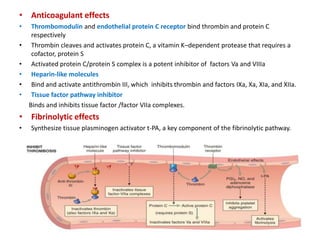
• Antithrombotic properties of endothelium
• Platelet inhibitory effects
• Serve as a barrier that shields platelets from subendothelial vWF and collagen
• Synthesize prostacyclin (PGI2), nitric oxide(NO), and adenosine diphosphatase
that inhibit platelet activation and aggregation
• Bind and alter the activity of thrombin, one of the most potent activators of
platelets
• Anticoagulant effects
• Thrombomodulin and endothelial protein C receptor bind thrombin and protein C
respectively
• Thrombin cleaves and activates protein C, a vitamin K–dependent protease that requires a
cofactor, protein S
• Activated protein C/protein S complex is a potent inhibitor of factors Va and VIIIa
• Heparin-like molecules
• Bind and activate antithrombin III, which inhibits thrombin and factors IXa, Xa, XIa, and XIIa.
• Tissue factor pathway inhibitor
Binds and inhibits tissue factor /factor VIIa complexes.
• Fibrinolytic effects
• Synthesize tissue plasminogen activator t-PA, a key component of the fibrinolytic pathway.
PLATELETS
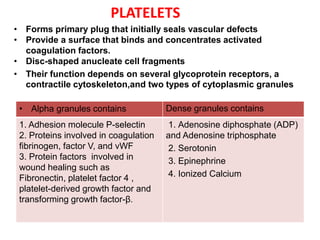
• Alpha granules contains Dense granules contains
1. Adhesion molecule P-selectin
2. Proteins involved in coagulation
fibrinogen, factor V, and vWF
3. Protein factors involved in
wound healing such as
Fibronectin, platelet factor 4 ,
platelet-derived growth factor and
transforming growth factor-β.
1. Adenosine diphosphate (ADP)
and Adenosine triphosphate
2. Serotonin
3. Epinephrine
4. Ionized Calcium
• Forms primary plug that initially seals vascular defects
• Provide a surface that binds and concentrates activated
coagulation factors.
• Disc-shaped anucleate cell fragments
• Their function depends on several glycoprotein receptors, a
contractile cytoskeleton,and two types of cytoplasmic granules
HEMOSTASIS
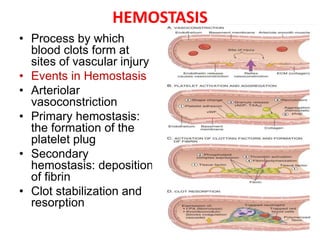
• Process by which
blood clots form at
sites of vascular injury
• Events in Hemostasis
• Arteriolar
vasoconstriction
• Primary hemostasis:
the formation of the
platelet plug
• Secondary
hemostasis: deposition
of fibrin
• Clot stabilization and
resorption
A.VASOCONSTRICTION
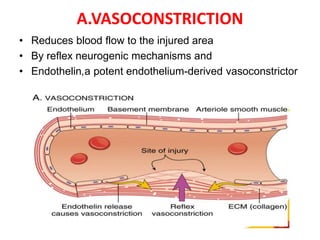
• Reduces blood flow to the injured area
• By reflex neurogenic mechanisms and
• Endothelin,a potent endothelium-derived vasoconstrictor
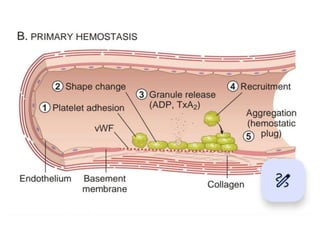
B.PRIMARY HEMOSTASIS
• Platelet adhesion
• Mediated largely via interactions with vWF
• vWF acts as a bridge between the platelet surface receptor
glycoprotein Ib (GpIb) and exposed collagen
• Genetic deficiencies of von willebrand factor (von Willebrand
disease),or GpIb (Bernard-Soulier syndrome) result in bleeding
disorders
• Shape change
• From smooth discs to spiky “sea urchins” with greatly
increased surface area.
• Alterations in glycoprotein IIb/IIIa that increase its affinity for
fibrinogen
• Translocation of negatively charged phospholipids
(phosphatidylserine) to the platelet surface
• Phospholipids bind calcium and serve as nucleation sites for
the assembly of coagulation factor complexes
• Secretion (release reaction) of granule contents
• Secretion of granule contents with changes in shape- platelet
activation
• Platelet activation is triggered by thrombin and ADP.
• Platelet activation and ADP release begets additional rounds
of platelet activation-recruitment
• Activated platelets also produce the prostaglandin
thromboxane A2 ,a potent inducer of platelet aggregation.
• Aspirin inhibits platelet aggregation and produces a mild
bleeding defect by inhibiting cyclooxygenase, a platelet
enzyme that is required for TxA2 synthesis.
• Platelet aggregation
• The conformational change in glycoprotein IIb/IIIa allows
binding of fibrinogen, a large bivalent plasma polypeptide that
forms bridges between adjacent platelets, leading to their
aggregation
• Inherited deficiency of GpIIb-IIIa results in a bleeding disorder
called Glanzmann thrombasthenia
Platelet aggregation
• The conformational change in glycoprotein
IIb/IIIa that occurs with platelet activation
allows binding of fibrinogen, a large
bivalent plasma polypeptide that forms
bridges between adjacent platelets,
leading to their aggregation.
• inherited deficiency of GpIIb-IIIa results in
a bleeding disorder called Glanzmann
thrombasthenia).
• C.SECONDARY HEMOSTASIS
• Vascular injury exposes tissue factor at the site of injury.
• Tissue factor binds and activates factor VII , setting in
motion a cascade of reactions that culiminates in thrombin
generation.
• Thrombin cleaves circulating fibrinogen into insoluble
fibrin, creating a fibrin meshwork,and also is a potent
activator of platelets, leading to additional platelet
aggregation at the site of injury
• D.THROMBUS AND ANTITHROMBOTIC EVENTS
• Clot stabilization and resorption
• Polymerized fibrin and platelet aggregates undergo
contraction to form a solid, permanent plug that prevents
further hemorrhage.
• At this stage, counterregulatory mechanisms (eg.t-PA) are
set into motion that limit clotting to the site of injury and
eventually lead to clot resorption and tissue repair
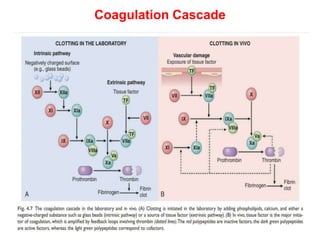
Coagulation Cascade
• The coagulation cascade is series of amplifying enzymatic
reactions that leads to the deposition of an insoluble fibrin
clot.
• Each reaction step involves an enzyme (an activated
coagulation factor), a substrate (an inactive proenzyme form
of a coagulation factor), and a cofactor (a reaction
accelerator).
• These components are assembled on a negatively charged
phospholipid surface, which is provided by activated platelets.
• Assembly of reaction complexes also depends on calcium,
which binds to γ-carboxylated glutamic acid residues that are
present in factors II, VII, IX, and X.
• The enzymatic reactions that produce γ-carboxylated glutamic
acid use vitamin K as a cofactor and are antagonized by
drugs such as Coumadin, a widely used anti-coagulant.
Coagulation Cascade
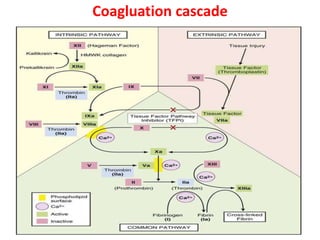
Coagluation cascade
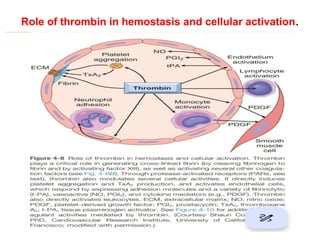
ROLE OF THROMBIN
• Conversion of fibrinogen into cross linked fibrin
• Thrombin directly converts soluble fibrinogen into fibrin monomers
that polymerize into an insoluble fibril, and also amplifies the
coagulation process, not only by activating factor XI, but also by
activating two critical cofactors: factors V and VIII.
• It also stabilizes the secondary hemostatic plug by activating factor
XIII, which covalently crosslinks fibrin
• Platelet activation through its ability to activate PARs
• Pro-inflammatory effects
• PARs also are expressed on inflammatory cells, endothelium, and
other cell types, and activation of these receptors by thrombin is
believed to mediate proinflammatory effects that contribute to tissue
repair and angiogenesis
• Anticoagulant effects
• on encountering normal endothelium, thrombin changes from a
procoagulant to an anticoagulant; this reversal in function prevents
clots from extending beyond the site of the vascular injury
Role of thrombin in hemostasis and cellular activation.
FACTORS THAT LIMIT COAGULATION
• Simple dilution blood flowing past the site of
injury washes out activated coagulation
factors, which are rapidly removed by the
liver.
• A second is the requirement for negatively
charged phospholipids,are mainly provided
by platelets that have been activated by
contact with subendothelial matrix at sites of
vascular injury.
• Counterregulatory mechanisms involve
factors that are expressed by intact
endothelium adjacent to the site of injury
FIBRINOLYTIC CASCADE
• limits the size of the clot and contributes to its later
dissolution
• Plasmin breaks down fibrin and interferes with its
polymerization
• generated by enzymatic catabolism of the inactive
circulating precursor plasminogen, either by a factor
XII–dependent pathway or by plasminogen activators.
• The most important plasminogen activator is t-PA; it is
synthesized by endothelium and is most active when
bound to fibrin
• Once activated, plasmin is in turn tightly controlled by
counterregulatory factors such as α2-plasmin inhibitor,
a plasma protein that binds and rapidly inhibits free
plasmin.
FIBRINOLYTIC SYSTEM

HEMOSTASIS.pptx

  • 1.
    HEMOSTASIS Dr G VENKATARAMANA MBBS DNB FAMILY MEDICINE
  • 2.
    ENDOTHELIUM • The balancebetween the anticoagulant and procoagulant activities of endothelium often determines whether clot formation, propagation, or dissolution occurs • Normal endothelial cells express a multitude of factors that inhibit the procoagulant activities of platelets and coagulation factors and that augment fibrinolysis • These factors act in concert to prevent thrombosis and to limit clotting to sites of vascular damage • However, if injured or exposed to proinflammatory factors, endothelial cells lose many of their antithrombotic properties • Antithrombotic properties of endothelium • Platelet inhibitory effects • Serve as a barrier that shields platelets from subendothelial vWF and collagen • Synthesize prostacyclin (PGI2), nitric oxide(NO), and adenosine diphosphatase that inhibit platelet activation and aggregation • Bind and alter the activity of thrombin, one of the most potent activators of platelets
  • 3.
    • Anticoagulant effects •Thrombomodulin and endothelial protein C receptor bind thrombin and protein C respectively • Thrombin cleaves and activates protein C, a vitamin K–dependent protease that requires a cofactor, protein S • Activated protein C/protein S complex is a potent inhibitor of factors Va and VIIIa • Heparin-like molecules • Bind and activate antithrombin III, which inhibits thrombin and factors IXa, Xa, XIa, and XIIa. • Tissue factor pathway inhibitor Binds and inhibits tissue factor /factor VIIa complexes. • Fibrinolytic effects • Synthesize tissue plasminogen activator t-PA, a key component of the fibrinolytic pathway.
  • 4.
    PLATELETS • Alpha granulescontains Dense granules contains 1. Adhesion molecule P-selectin 2. Proteins involved in coagulation fibrinogen, factor V, and vWF 3. Protein factors involved in wound healing such as Fibronectin, platelet factor 4 , platelet-derived growth factor and transforming growth factor-β. 1. Adenosine diphosphate (ADP) and Adenosine triphosphate 2. Serotonin 3. Epinephrine 4. Ionized Calcium • Forms primary plug that initially seals vascular defects • Provide a surface that binds and concentrates activated coagulation factors. • Disc-shaped anucleate cell fragments • Their function depends on several glycoprotein receptors, a contractile cytoskeleton,and two types of cytoplasmic granules
  • 7.
    HEMOSTASIS • Process bywhich blood clots form at sites of vascular injury • Events in Hemostasis • Arteriolar vasoconstriction • Primary hemostasis: the formation of the platelet plug • Secondary hemostasis: deposition of fibrin • Clot stabilization and resorption
  • 8.
    A.VASOCONSTRICTION • Reduces bloodflow to the injured area • By reflex neurogenic mechanisms and • Endothelin,a potent endothelium-derived vasoconstrictor
  • 9.
    B.PRIMARY HEMOSTASIS • Plateletadhesion • Mediated largely via interactions with vWF • vWF acts as a bridge between the platelet surface receptor glycoprotein Ib (GpIb) and exposed collagen • Genetic deficiencies of von willebrand factor (von Willebrand disease),or GpIb (Bernard-Soulier syndrome) result in bleeding disorders • Shape change • From smooth discs to spiky “sea urchins” with greatly increased surface area. • Alterations in glycoprotein IIb/IIIa that increase its affinity for fibrinogen • Translocation of negatively charged phospholipids (phosphatidylserine) to the platelet surface • Phospholipids bind calcium and serve as nucleation sites for the assembly of coagulation factor complexes
  • 10.
    • Secretion (releasereaction) of granule contents • Secretion of granule contents with changes in shape- platelet activation • Platelet activation is triggered by thrombin and ADP. • Platelet activation and ADP release begets additional rounds of platelet activation-recruitment • Activated platelets also produce the prostaglandin thromboxane A2 ,a potent inducer of platelet aggregation. • Aspirin inhibits platelet aggregation and produces a mild bleeding defect by inhibiting cyclooxygenase, a platelet enzyme that is required for TxA2 synthesis. • Platelet aggregation • The conformational change in glycoprotein IIb/IIIa allows binding of fibrinogen, a large bivalent plasma polypeptide that forms bridges between adjacent platelets, leading to their aggregation • Inherited deficiency of GpIIb-IIIa results in a bleeding disorder called Glanzmann thrombasthenia
  • 12.
    Platelet aggregation • Theconformational change in glycoprotein IIb/IIIa that occurs with platelet activation allows binding of fibrinogen, a large bivalent plasma polypeptide that forms bridges between adjacent platelets, leading to their aggregation. • inherited deficiency of GpIIb-IIIa results in a bleeding disorder called Glanzmann thrombasthenia).
  • 13.
    • C.SECONDARY HEMOSTASIS •Vascular injury exposes tissue factor at the site of injury. • Tissue factor binds and activates factor VII , setting in motion a cascade of reactions that culiminates in thrombin generation. • Thrombin cleaves circulating fibrinogen into insoluble fibrin, creating a fibrin meshwork,and also is a potent activator of platelets, leading to additional platelet aggregation at the site of injury • D.THROMBUS AND ANTITHROMBOTIC EVENTS • Clot stabilization and resorption • Polymerized fibrin and platelet aggregates undergo contraction to form a solid, permanent plug that prevents further hemorrhage. • At this stage, counterregulatory mechanisms (eg.t-PA) are set into motion that limit clotting to the site of injury and eventually lead to clot resorption and tissue repair
  • 15.
    Coagulation Cascade • Thecoagulation cascade is series of amplifying enzymatic reactions that leads to the deposition of an insoluble fibrin clot. • Each reaction step involves an enzyme (an activated coagulation factor), a substrate (an inactive proenzyme form of a coagulation factor), and a cofactor (a reaction accelerator). • These components are assembled on a negatively charged phospholipid surface, which is provided by activated platelets. • Assembly of reaction complexes also depends on calcium, which binds to γ-carboxylated glutamic acid residues that are present in factors II, VII, IX, and X. • The enzymatic reactions that produce γ-carboxylated glutamic acid use vitamin K as a cofactor and are antagonized by drugs such as Coumadin, a widely used anti-coagulant.
  • 16.
  • 17.
  • 19.
    ROLE OF THROMBIN •Conversion of fibrinogen into cross linked fibrin • Thrombin directly converts soluble fibrinogen into fibrin monomers that polymerize into an insoluble fibril, and also amplifies the coagulation process, not only by activating factor XI, but also by activating two critical cofactors: factors V and VIII. • It also stabilizes the secondary hemostatic plug by activating factor XIII, which covalently crosslinks fibrin • Platelet activation through its ability to activate PARs • Pro-inflammatory effects • PARs also are expressed on inflammatory cells, endothelium, and other cell types, and activation of these receptors by thrombin is believed to mediate proinflammatory effects that contribute to tissue repair and angiogenesis • Anticoagulant effects • on encountering normal endothelium, thrombin changes from a procoagulant to an anticoagulant; this reversal in function prevents clots from extending beyond the site of the vascular injury
  • 20.
    Role of thrombinin hemostasis and cellular activation.
  • 21.
    FACTORS THAT LIMITCOAGULATION • Simple dilution blood flowing past the site of injury washes out activated coagulation factors, which are rapidly removed by the liver. • A second is the requirement for negatively charged phospholipids,are mainly provided by platelets that have been activated by contact with subendothelial matrix at sites of vascular injury. • Counterregulatory mechanisms involve factors that are expressed by intact endothelium adjacent to the site of injury
  • 22.
    FIBRINOLYTIC CASCADE • limitsthe size of the clot and contributes to its later dissolution • Plasmin breaks down fibrin and interferes with its polymerization • generated by enzymatic catabolism of the inactive circulating precursor plasminogen, either by a factor XII–dependent pathway or by plasminogen activators. • The most important plasminogen activator is t-PA; it is synthesized by endothelium and is most active when bound to fibrin • Once activated, plasmin is in turn tightly controlled by counterregulatory factors such as α2-plasmin inhibitor, a plasma protein that binds and rapidly inhibits free plasmin.
  • 23.