54
Lecture 3: Hemostasis
Hemostasis
 Hemostasis :(”hemo” = blood;” stasis” = remain )
 It is the process by which the body stops bleeding only at the site of blood vessels injury
and maintains blood in the fluid state in the vascular compartment.
 Normal hemostasis involves a series of reactions designed to arrest bleeding from a site
of injury through formation of a platelet plug and fibrin clot.
 Coagulation is the process by which blood is converted from the liquid to the solid state,
namely, the fibrin clot.
 Blood coagulation is an essential component of hemostasis.
 When the process of hemostasis becomes impaired, the ability to effectively stop
bleeding is lost.
 In contrast, should the mechanisms involved in hemostasis and blood coagulation become
overly active, unwanted clots may form within the blood vessels or tissues.
Prime function of hemostasis
 To maintain blood in fluid state.
 To arrest bleeding followed by trauma
 To remove platelet plug when healing is complete.
Three hemostatic components
1- The extra-vascular (The tissues surrounding blood vessels) involved in Hemostasis when
local vessel is injured. It plays a part in Hemostasis by providing back-pressure on the injured
vessel through swelling and trapping of escaped blood.
2- The vascular (The blood vessels through which blood flow) it depends on the size, amount, of
smooth muscle within their walls and integrity of the endothelial cell lining.
3- The intra-vascular (The platelets and plasma proteins that circulate within the blood vessels).
 These components are involved in Coagulation (clot or thrombus formation) or Fibrinolysis
(clot or thrombus dissolution).
Normal Vessel wall, Blood flow & Coagulation Substances
 The hemostatic components remain inert in the presence of intact vascular tissue or
endothelium.
 In the absence of blood vessel damage, platelets are repelled from each other and from
the endothelium of blood vessels.
55
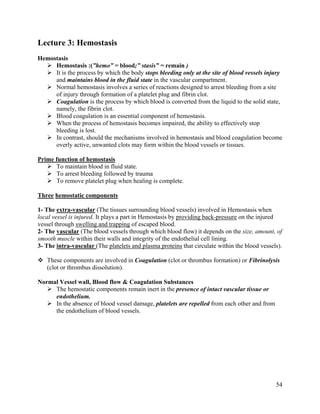
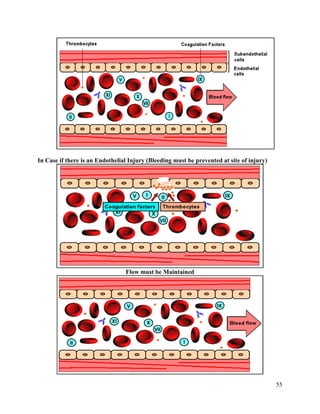
In Case if there is an Endothelial Injury (Bleeding must be prevented at site of injury)
Flow must be Maintained
56
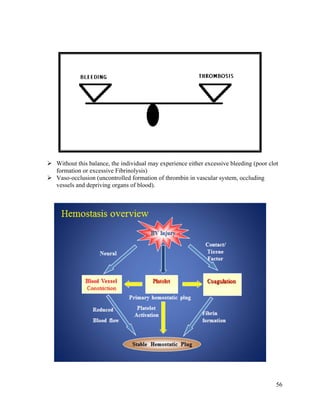
 Without this balance, the individual may experience either excessive bleeding (poor clot
formation or excessive Fibrinolysis)
 Vaso-occlusion (uncontrolled formation of thrombin in vascular system, occluding
vessels and depriving organs of blood).
57
Normal Hemostasis
Following an injury to blood vessels several actions may help prevent blood loss, including:
58
Platelets
 Platelets, or thrombocytes, are the smallest of the formed elements and are actually
fragments of large cells called megakaryocytes, which are found in bone marrow.
 Main regulator of Platelets production is the hormone thrombopoietin (TPO), which is
synthesized in the liver.
 Normal blood platelet count = 150,000–450,000/L.
 Platelets synthesis increases with inflammation and specifically by interleukin 6.
 Are very active, aneucleate (without nucleus) and they have limited capacity to
synthesize new proteins.
 Circulate with an average life span of 7–10 days before being destroyed by the spleen and
liver.
 Approximately 1/3 of the platelets reside in the spleen.
Steps (Components) of Hemostasis
The process of hemostasis may be divided into 5 key steps:
(1) Vascular spasm
(2) Formation of a platelet plug
 Platelet adhesion and activation
 Platelet aggregation (1o
hemostatic plug)-form a temporary plug-
(3) Activation of blood coagulation cascade
 Fibrin formation via cascade (2o
hemostasis)-stable insoluble plug -
(4) Formation of a fibrin clot
 Clot retraction (thrombasthenin)
 Fibrinolysis and healing
(5) Coagulation Inhibition System
 Natural inhibitors
59
(1) Vascular spasm
 Vasoconstriction occurs immediately following injury to a blood vessel wall to limit
blood flow out of the vessel.
 It is due to local spasm of the smooth muscle (sympathetic. reflex)
 A key mediator of the vasoconstriction appears to be thromboxane A2, which is
released both from circulating platelets in the area of injury and the damaged
endothelial cells themselves.
(2) Formation of platelet plug
 Platelets aggregate at the site of injury. The platelet plug is able to seal small
openings in blood vessel walls to stop minor bleeding.
 Injured blood vessel releases adenosine diphosphate (ADP), which attracts platelets to
the area of injury .
 At the site of injury, the exposure of the platelets to substances such as antigens,
collagen and bacterial toxins causes platelets to change shape and become “sticky.”
Adhesion & Activation
 These sticky platelets now adhere to exposed collagen on the basement membranes of
injured blood vessels. This process is called adhesion.
 Proper adhesion of platelets requires the release of a protein from vascular endothelial
cells called von Willebrand’s factor.
 This protein is essential for allowing platelets to adhere to collagen as well as to one
another.
 Once platelets have undergone the process of adhesion, substances such as thrombin,
thromboxane A2 and ADP lead to further platelet activation.
 Activated platelets now release the contents of their internal granules, which include
substances such as ADP, fibrinogen, thrombin, thromboxane A2 and von
Willebrand’s factor, which induce the aggregation of additional platelets at the injury
site.
(3) Activation of blood coagulation cascades
 Blood coagulation is the process in which fibrin protein strands wrap around
(‫ﺣﻮﻝ‬ ‫)ﻳﻠﺘﻒ‬ the platelet plug to form an insoluble clot.
 The process of blood coagulation occurs through two separate, but related pathways
called :
 The intrinsic coagulation pathway and
 The extrinsic coagulation pathway
60
 Intrinsic coagulation pathway:
 Initiated by protein factors found circulating in the blood.
 Activation of initial clotting factor XII (Hageman factor) occurs after
Vessel Injury through contact with exposed collagen or damaged
endothelium
 Extrinsic coagulation pathway:
 Initiated by protein factors located in the tissues.
 Activation of extrinsic pathway occurs when factor III (thromboplastin) is
released from tissues to activate clotting factor VII.
Intrinsic & Extrinsic pathways
 Both intrinsic and extrinsic pathways converge at clotting factor X, which originates both
in plasma and tissues.
 The final common sequence in both pathways involves a complex that includes activated
factor X , factor V, platelet phospholipids and Ca2+ that catalyzes the conversion of the
serum protein prothrombin to thrombin.
 Ca2+ are required for promotion and acceleration of almost all blood clotting reactions
Except: activation of XII and XI (intrinsic mechanism)
 In turn, thrombin converts plasma fibrinogen to fibrin, the substance that polymerizes
(‫)ﺗﺘﺼﻠﺐ‬ to form the insoluble clot.
 A final factor (XIII), called clot-stabilizing factor, is released by platelets trapped in the
platelet plug and stimulates polymerization and cross-linking of fibrin strands.
Stages of blood coagulation cascades
Stage I: Formation of prothrombin activator
 Extrinsic pathway :which normally is triggered by trauma.
 Intrinsic pathway :which begins in the bloodstream and is triggered by
internal damage to the wall of the vessel.
 Common pathway .
 All three pathways are dependent upon the 12 known clotting factors,
including Ca2+
and vitamin K.
Stage II: conversion of prothrombin to thrombin
Stage III: conversion of fibrinogen to fibrin
Clotting factors
 Clotting factors are secreted primarily by the liver and the platelets.
 The liver requires the fat-soluble vitamin K to produce many of them.
 Vitamin K (along with biotin and folate) is somewhat unusual among vitamins in that it is
not only consumed in the diet but is also synthesized by bacteria residing in the large
intestine.
61
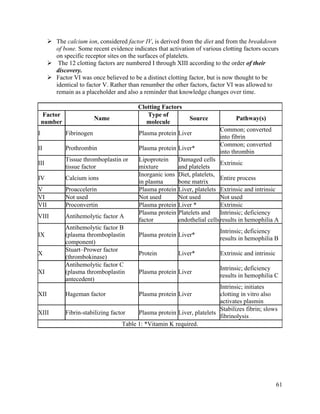
 The calcium ion, considered factor IV, is derived from the diet and from the breakdown
of bone. Some recent evidence indicates that activation of various clotting factors occurs
on specific receptor sites on the surfaces of platelets.
 The 12 clotting factors are numbered I through XIII according to the order of their
discovery.
 Factor VI was once believed to be a distinct clotting factor, but is now thought to be
identical to factor V. Rather than renumber the other factors, factor VI was allowed to
remain as a placeholder and also a reminder that knowledge changes over time.
Clotting Factors
Factor
number
Name
Type of
molecule
Source Pathway(s)
I Fibrinogen Plasma protein Liver
Common; converted
into fibrin
II Prothrombin Plasma protein Liver*
Common; converted
into thrombin
III
Tissue thromboplastin or
tissue factor
Lipoprotein
mixture
Damaged cells
and platelets
Extrinsic
IV Calcium ions
Inorganic ions
in plasma
Diet, platelets,
bone matrix
Entire process
V Proaccelerin Plasma protein Liver, platelets Extrinsic and intrinsic
VI Not used Not used Not used Not used
VII Proconvertin Plasma protein Liver * Extrinsic
VIII Antihemolytic factor A
Plasma protein
factor
Platelets and
endothelial cells
Intrinsic; deficiency
results in hemophilia A
IX
Antihemolytic factor B
(plasma thromboplastin
component)
Plasma protein Liver*
Intrinsic; deficiency
results in hemophilia B
X
Stuart–Prower factor
(thrombokinase)
Protein Liver* Extrinsic and intrinsic
XI
Antihemolytic factor C
(plasma thromboplastin
antecedent)
Plasma protein Liver
Intrinsic; deficiency
results in hemophilia C
XII Hageman factor Plasma protein Liver
Intrinsic; initiates
clotting in vitro also
activates plasmin
XIII Fibrin-stabilizing factor Plasma protein Liver, platelets
Stabilizes fibrin; slows
fibrinolysis
Table 1: *Vitamin K required.
62
63
Stage II: conversion of prothrombin to thrombin
• Prothrombin – inactive precursor of enzyme thrombin
• In the presence of prothrombin activator and Ca2+
prothrombin is converted to thrombin
• Thrombin itself increases its own rate of formation (positive feedback mechanism)
64
Stage III: conversion of fibrinogen to fibrin
• Fibrinogen – plasma protein produced by the liver
• Thrombin converts fibrinogen to fibrin
• Thrombin also activates fibrin-stabilizing factor (F XIII), which in the presence of Ca2+
,
stabilizes the fibrin polymer through covalent bonding of fibrin monomers
(4) Formation of fibrin clot
Clot retraction
 Retraction is a process that occurs once the fibrin clot has formed.
 It involves contraction and shrinkage of the fibrin strands and is induced by continued
release of factor XIII from platelets.
 Clot retraction serves to pull the edges of the damaged blood vessel together to facilitate
the repair process.
Fibrinolysis (clot dissolution)
 Once the damaged blood vessel is repaired, the fibrin clot is no longer needed and must
be removed from the blood vessel lining.
 This process of fibrinolysis or clot dissolution is accomplished by the enzyme plasmin
that digests the fibrin strands of the clot as well as several clotting factors.
 Plasmin travels in circulation as the inactive pro-enzyme plasminogen .
 Factors produced by the liver and vascular endothelium called plasminogen activators —
tissue type plasminogen activator (t-PA) and urokinase-type plasminogen activator (u-
PA) — convert the pro-enzyme plasminogen to the active fibrinolytic enzyme plasmin.
 The activity of plasmin is in turn regulated by the inhibitory enzyme alpha 2-plasmin
inhibitor, which rapidly inactivates it.
65
Summary Clot Dissolution
(5) Coagulation Inhibition System (Natural inhibitors-Anticoagulants-)
o Although tissue breakdown and platelets destruction are normal events in the
absence of trauma, intravascular clotting does not usually occur because:
o the amounts of procoagulants released are very small.
o natural anticoagulants are present (Antithrombin III, Heparin, Antithromboplastin,
Protein C and S, fibrin fibers)
Natural anticoagulants
 Antithrombin III – inhibits factor X and thrombin
 Heparin from basophils and mast cells potentiates effects of antithrombin III (together
they inhibit IX, X, XI, XII and thrombin)
 Antithromboplastin (inhibits „tissue factors” – tissue thromboplastins)
 Protein C and S – activated by thrombin; degrade factor Va and VIIIa
66
Summary: Coagulation mechanism is composed of an extrinsic and intrinsic pathway, which
eventually merge into one (common pathway)
Conditions leading to decreased coagulation
(1) Genetic defects
a. Hemophilia
b. von Willebrand’s disease
(2) Autoimmune defects
a. Idiopathic thrombocytopenia purpura
(3) Thrombocytopenia
(4) Acquired deficiencies
a. Vitamin K deficiency
b. Liver disease
Hemophilia
 Hemophilia is caused by a genetic deficiency or lack of certain clotting factors.
 Because the genes encoding these factors are on the X chromosome, these diseases
(termed “X-linked”).
 Three distinct types of hemophilia have been identified
Type A hemophilia
 Most common form (80% or more)
 X-linked recessive disorder (only males are affected)
 Results from a deficiency of clotting factor VIII
67
Type B hemophilia (Christmas disease)
 Second most common form of hemophilia (10 to 15%)
 X-linked autosomal recessive disorder
 Results from a deficiency of clotting factor IX
Type C hemophilia (Rosenthal’s disease)
 Least common of all hemophilia cases (<5%)
 Results from a deficiency of clotting factor XI
 Autosomal recessive disorder
 An autosomal recessive disorder means two copies of an abnormal gene must be present
in order for the disease or trait to develop
Summary :
Hemophilia
Manifestations:
 May present as a mild, moderate or severe bleeding disorder depending on
the activity of the clotting factors
 Excessive bleeding with trauma or surgery
 Bleeding into soft tissues, muscles and joints
68
Treatment:
 Avoidance of injury, prevention of bleeding
 Fresh frozen plasma (FFP) is the liquid part of blood (plasma) has all
types of clotting factors including F VIII and F IX , but in small amounts.
 NOW: Replacement with recombinant clotting factors: A Recombinant
product is genetically engineered factor product made without human
blood products, decreasing the risk of transmission of blood borne
infections.
 There was a significant incidence of HIV and hepatitis C in patients with hemophilia
before the advent of recombinant clotting factors because these factors were previously
derived from donor blood.
von Willebrand’s disease
 Most common hereditary bleeding disorder
 Caused by a genetic lack of von Willebrand’s factor
 Causes a reduction in platelet adhesion
 Symptoms may include excessive bruising and mild to moderate bleeding
 Bleeding may occur from gums, nose, gastrointestinal tract; blood flow during
menstruation may be especially heavy
 Treatment:
o Infusion of von Willebrand’s factor
o Desmopressin acetate— A vasopressin analogue that increases the activity of
factor VIII and may stimulate production of von Willebrand’s factor by
endothelial cells
69
Thrombocytopenia
 Thrombocytopenia is defined as any condition in which the platelet count is abnormally
low (<100,000/mm3).
 This causes spontaneous bleeding as a reaction to minor trauma in the skin - reddish-
purple blotchy rash
 It may result from:
 decreased production (toxins, radiation,cancer, infection,HIV, leukemias, deficiency
of vitamin B12 & folic acid)
 increased destruction (autoimmune processes)
 increased PLTs consumption (DIC)
70
Autoimmune defects
Idiopathic thrombocytopenia purpura
 Most commonly occurs in children and adolescents following a viral infection.
 Autoimmune disorder in which antibodies bind to platelets in circulation.
Antibody-bound platelets are now more susceptible to destruction in the spleen.
 Enlargement of the spleen may result.
 Patients may present with abnormal bruising and bleeding.
 A chronic, lifelong form of the disorder may also occur with lesser incidence.
 Treatment may include immunosuppressing drugs like corticosteroids, and
possible splenectomy for the chronic form.
Acquired deficiencies
 Vitamin K deficiency
 Vitamin K is essential for synthesis of factors II, VII, IX and X.
 It must be obtained from the diet via bacterial metabolism.
 Conditions that may lead to vitamin K deficiency include intestinal malabsorption
or destruction of intestinal flora by antibiotics.
 Treatment may include infusion of deficient factors and replacement of parenteral
vitamin K.
71
 Liver disease
 Because most of the clotting factors are synthesized by the liver, any disease or
condition that alters liver function may lead to defective production of clotting
factors.
 Diseases that can alter the function of the liver include the following:
• Hepatitis
• Cirrhosis
• Liver cancer
• Liver failure
• Hepatic failure
Drug-induced alterations in hemostasis and coagulation
 A number of pharmacologic agents can impair blood clotting by inhibiting platelet
function.
 These agents include the :
 nonsteroidal anti-inflammatories,
 β-lactam antibiotics,
 Certain antidepressants
 A number of cardiovascular drugs.
 Other drugs can interfere with the action of coagulation factors and may be used
therapeutically as anticoagulants
Anticoagulant Drugs
 Warfarin
o Used orally
o Acts by preventing the reduction of vitamin K, an essential cofactor in the
formation of clotting factors II, VII, IX and X
 Heparin
o Used only by injection
o A “family” of related compounds with molecular weights of 3000 to 40,000
o Enhances the actions of the natural anticoagulant antithrombin III
 Major unwanted effects of both oral and injected anticoagulant drugs are unwanted
bleeding and possible hemorrhage
Conditions leading to increased blood coagulation
 Individuals with hypercoagulability are at increased risk for venous thrombus and emboli.
 Conditions that can cause hypercoagulability include the following:
 Inherited disorders of coagulation
 Polycythemia
 Obesity
 Prolonged bed rest
 Cancer
 Venous stasis
 Sepsis
 Trauma or surgery
72
Disseminated intravascular coagulation (DIC)
Widespread coagulation  thrombosis in small blood vessels  increased fibrinolysis and
depletion of coagulating factors  generalized bleeding
73
Prothrombin time (PT) test – norm 11 -15 seconds
 evaluates extrinsic system (VII, X, V, II, fibrinogen)
 Prolonged PT indicates a deficiency in any of factors VII, X, V, prothrombin (factor II),
or fibrinogen (factor I).
 Prolonged PT is caused by:
- a vitamin K deficiency (vitamin K is a co-factor in the synthesis of functional factors
II (prothrombin), VII, IX and X)
- Liver disease
- Warfarin therapy
- DIC
- excesive heparin
International Normalised Ratio (INR)
 The result for the PT is expressed as a ratio (prothrombin clotting time for patient plasma
divided by time for control plasma);
 Correction factor (International Sensitivity Index) is applied to the prothrombin ratio and
the result issued as INR.
 Therapeutic interval: Therapeutic interval for oral anticoagulant therapy: 2.0-4.5.
Application: Monitoring oral anticoagulant therapy (eg. Warfarin);
 note that heparin will not prolong INR (heparinase is included within the INR reagent)!
For heparin therapy we monitor aPTT and/or aPTT ratio.
74
Activated Partial Thromboplastin Time test (aPTT) – norm: 25-35 seconds
 evaluates intrinsic system (VIII, IX, XI, XII, X, V, II, fibrinogen)
 an isolated prolongation of the aPTT (PT normal) suggests deficiency of factor VIII, IX,
XI or XII
 prolongation of both the APTT and PT suggests factor X, V, II or I (fibrinogen)
deficiency, all of which are rare.
 aPTT is normal in factor VII deficiency (PT prolonged) and factor XIII deficiency
 Most common case of prolonged aPTT is due to heparin!
Thrombin time (TT) – norm: 14-15 seconds
Prolonged TT:
 Heparin (much more sensitive to heparin than aPTT)
 Hypofibrinogenemia
Test Normal Value
Platelets Count 150,000-450,000/L
Bleeding Time (BT) 3-7 minutes
Prothrombin Time (PT) 11 -15 second
Activated Partial Thromboplastin
Time (aPTT)
25-35 second
Thrombin Time (TT) 14-15 second
Fibrnogen assay 200-400mb/dL
Fibrin Degradation products & D dimer 0-11 and <500 ng/ml
75
Glossary
anticoagulant:
substance such as heparin that opposes coagulation
antithrombin:
anticoagulant that inactivates factor X and opposes the conversion of prothrombin (factor
II) into thrombin in the common pathway
clotting factors:
group of 12 identified substances active in coagulation
coagulation:
formation of a blood clot; part of the process of hemostasis
common pathway:
final coagulation pathway activated either by the intrinsic or the extrinsic pathway, and
ending in the formation of a blood clot
76
embolus:
thrombus that has broken free from the blood vessel wall and entered the circulation
extrinsic pathway:
initial coagulation pathway that begins with tissue damage and results in the activation of
the common pathway
fibrin:
insoluble, filamentous protein that forms the structure of a blood clot
fibrinolysis:
gradual degradation of a blood clot
hemophilia:
genetic disorder characterized by inadequate synthesis of clotting factors
hemorrhage:
excessive bleeding
hemostasis:
physiological process by which bleeding ceases
heparin:
short-acting anticoagulant stored in mast cells and released when tissues are injured,
opposes prothrombin
intrinsic pathway:
initial coagulation pathway that begins with vascular damage or contact with foreign
substances, and results in the activation of the common pathway
plasmin:
blood protein active in fibrinolysis
platelet plug:
accumulation and adhesion of platelets at the site of blood vessel injury
serum:
blood plasma that does not contain clotting factors
thrombin:
enzyme essential for the final steps in formation of a fibrin clot
thrombosis:
excessive clot formation
thrombus:
aggregation of fibrin, platelets, and erythrocytes in an intact artery or vein
tissue factor:
protein thromboplastin, which initiates the extrinsic pathway when released in response
to tissue damage
vascular spasm:
initial step in hemostasis, in which the smooth muscle in the walls of the ruptured or
damaged blood vessel contracts
_______________

Pathology - Hemostasis

  • 1.
    54 Lecture 3: Hemostasis Hemostasis Hemostasis :(”hemo” = blood;” stasis” = remain )  It is the process by which the body stops bleeding only at the site of blood vessels injury and maintains blood in the fluid state in the vascular compartment.  Normal hemostasis involves a series of reactions designed to arrest bleeding from a site of injury through formation of a platelet plug and fibrin clot.  Coagulation is the process by which blood is converted from the liquid to the solid state, namely, the fibrin clot.  Blood coagulation is an essential component of hemostasis.  When the process of hemostasis becomes impaired, the ability to effectively stop bleeding is lost.  In contrast, should the mechanisms involved in hemostasis and blood coagulation become overly active, unwanted clots may form within the blood vessels or tissues. Prime function of hemostasis  To maintain blood in fluid state.  To arrest bleeding followed by trauma  To remove platelet plug when healing is complete. Three hemostatic components 1- The extra-vascular (The tissues surrounding blood vessels) involved in Hemostasis when local vessel is injured. It plays a part in Hemostasis by providing back-pressure on the injured vessel through swelling and trapping of escaped blood. 2- The vascular (The blood vessels through which blood flow) it depends on the size, amount, of smooth muscle within their walls and integrity of the endothelial cell lining. 3- The intra-vascular (The platelets and plasma proteins that circulate within the blood vessels).  These components are involved in Coagulation (clot or thrombus formation) or Fibrinolysis (clot or thrombus dissolution). Normal Vessel wall, Blood flow & Coagulation Substances  The hemostatic components remain inert in the presence of intact vascular tissue or endothelium.  In the absence of blood vessel damage, platelets are repelled from each other and from the endothelium of blood vessels.
  • 2.
    55 In Case ifthere is an Endothelial Injury (Bleeding must be prevented at site of injury) Flow must be Maintained
  • 3.
    56  Without thisbalance, the individual may experience either excessive bleeding (poor clot formation or excessive Fibrinolysis)  Vaso-occlusion (uncontrolled formation of thrombin in vascular system, occluding vessels and depriving organs of blood).
  • 4.
    57 Normal Hemostasis Following aninjury to blood vessels several actions may help prevent blood loss, including:
  • 5.
    58 Platelets  Platelets, orthrombocytes, are the smallest of the formed elements and are actually fragments of large cells called megakaryocytes, which are found in bone marrow.  Main regulator of Platelets production is the hormone thrombopoietin (TPO), which is synthesized in the liver.  Normal blood platelet count = 150,000–450,000/L.  Platelets synthesis increases with inflammation and specifically by interleukin 6.  Are very active, aneucleate (without nucleus) and they have limited capacity to synthesize new proteins.  Circulate with an average life span of 7–10 days before being destroyed by the spleen and liver.  Approximately 1/3 of the platelets reside in the spleen. Steps (Components) of Hemostasis The process of hemostasis may be divided into 5 key steps: (1) Vascular spasm (2) Formation of a platelet plug  Platelet adhesion and activation  Platelet aggregation (1o hemostatic plug)-form a temporary plug- (3) Activation of blood coagulation cascade  Fibrin formation via cascade (2o hemostasis)-stable insoluble plug - (4) Formation of a fibrin clot  Clot retraction (thrombasthenin)  Fibrinolysis and healing (5) Coagulation Inhibition System  Natural inhibitors
  • 6.
    59 (1) Vascular spasm Vasoconstriction occurs immediately following injury to a blood vessel wall to limit blood flow out of the vessel.  It is due to local spasm of the smooth muscle (sympathetic. reflex)  A key mediator of the vasoconstriction appears to be thromboxane A2, which is released both from circulating platelets in the area of injury and the damaged endothelial cells themselves. (2) Formation of platelet plug  Platelets aggregate at the site of injury. The platelet plug is able to seal small openings in blood vessel walls to stop minor bleeding.  Injured blood vessel releases adenosine diphosphate (ADP), which attracts platelets to the area of injury .  At the site of injury, the exposure of the platelets to substances such as antigens, collagen and bacterial toxins causes platelets to change shape and become “sticky.” Adhesion & Activation  These sticky platelets now adhere to exposed collagen on the basement membranes of injured blood vessels. This process is called adhesion.  Proper adhesion of platelets requires the release of a protein from vascular endothelial cells called von Willebrand’s factor.  This protein is essential for allowing platelets to adhere to collagen as well as to one another.  Once platelets have undergone the process of adhesion, substances such as thrombin, thromboxane A2 and ADP lead to further platelet activation.  Activated platelets now release the contents of their internal granules, which include substances such as ADP, fibrinogen, thrombin, thromboxane A2 and von Willebrand’s factor, which induce the aggregation of additional platelets at the injury site. (3) Activation of blood coagulation cascades  Blood coagulation is the process in which fibrin protein strands wrap around (‫ﺣﻮﻝ‬ ‫)ﻳﻠﺘﻒ‬ the platelet plug to form an insoluble clot.  The process of blood coagulation occurs through two separate, but related pathways called :  The intrinsic coagulation pathway and  The extrinsic coagulation pathway
  • 7.
    60  Intrinsic coagulationpathway:  Initiated by protein factors found circulating in the blood.  Activation of initial clotting factor XII (Hageman factor) occurs after Vessel Injury through contact with exposed collagen or damaged endothelium  Extrinsic coagulation pathway:  Initiated by protein factors located in the tissues.  Activation of extrinsic pathway occurs when factor III (thromboplastin) is released from tissues to activate clotting factor VII. Intrinsic & Extrinsic pathways  Both intrinsic and extrinsic pathways converge at clotting factor X, which originates both in plasma and tissues.  The final common sequence in both pathways involves a complex that includes activated factor X , factor V, platelet phospholipids and Ca2+ that catalyzes the conversion of the serum protein prothrombin to thrombin.  Ca2+ are required for promotion and acceleration of almost all blood clotting reactions Except: activation of XII and XI (intrinsic mechanism)  In turn, thrombin converts plasma fibrinogen to fibrin, the substance that polymerizes (‫)ﺗﺘﺼﻠﺐ‬ to form the insoluble clot.  A final factor (XIII), called clot-stabilizing factor, is released by platelets trapped in the platelet plug and stimulates polymerization and cross-linking of fibrin strands. Stages of blood coagulation cascades Stage I: Formation of prothrombin activator  Extrinsic pathway :which normally is triggered by trauma.  Intrinsic pathway :which begins in the bloodstream and is triggered by internal damage to the wall of the vessel.  Common pathway .  All three pathways are dependent upon the 12 known clotting factors, including Ca2+ and vitamin K. Stage II: conversion of prothrombin to thrombin Stage III: conversion of fibrinogen to fibrin Clotting factors  Clotting factors are secreted primarily by the liver and the platelets.  The liver requires the fat-soluble vitamin K to produce many of them.  Vitamin K (along with biotin and folate) is somewhat unusual among vitamins in that it is not only consumed in the diet but is also synthesized by bacteria residing in the large intestine.
  • 8.
    61  The calciumion, considered factor IV, is derived from the diet and from the breakdown of bone. Some recent evidence indicates that activation of various clotting factors occurs on specific receptor sites on the surfaces of platelets.  The 12 clotting factors are numbered I through XIII according to the order of their discovery.  Factor VI was once believed to be a distinct clotting factor, but is now thought to be identical to factor V. Rather than renumber the other factors, factor VI was allowed to remain as a placeholder and also a reminder that knowledge changes over time. Clotting Factors Factor number Name Type of molecule Source Pathway(s) I Fibrinogen Plasma protein Liver Common; converted into fibrin II Prothrombin Plasma protein Liver* Common; converted into thrombin III Tissue thromboplastin or tissue factor Lipoprotein mixture Damaged cells and platelets Extrinsic IV Calcium ions Inorganic ions in plasma Diet, platelets, bone matrix Entire process V Proaccelerin Plasma protein Liver, platelets Extrinsic and intrinsic VI Not used Not used Not used Not used VII Proconvertin Plasma protein Liver * Extrinsic VIII Antihemolytic factor A Plasma protein factor Platelets and endothelial cells Intrinsic; deficiency results in hemophilia A IX Antihemolytic factor B (plasma thromboplastin component) Plasma protein Liver* Intrinsic; deficiency results in hemophilia B X Stuart–Prower factor (thrombokinase) Protein Liver* Extrinsic and intrinsic XI Antihemolytic factor C (plasma thromboplastin antecedent) Plasma protein Liver Intrinsic; deficiency results in hemophilia C XII Hageman factor Plasma protein Liver Intrinsic; initiates clotting in vitro also activates plasmin XIII Fibrin-stabilizing factor Plasma protein Liver, platelets Stabilizes fibrin; slows fibrinolysis Table 1: *Vitamin K required.
  • 9.
  • 10.
    63 Stage II: conversionof prothrombin to thrombin • Prothrombin – inactive precursor of enzyme thrombin • In the presence of prothrombin activator and Ca2+ prothrombin is converted to thrombin • Thrombin itself increases its own rate of formation (positive feedback mechanism)
  • 11.
    64 Stage III: conversionof fibrinogen to fibrin • Fibrinogen – plasma protein produced by the liver • Thrombin converts fibrinogen to fibrin • Thrombin also activates fibrin-stabilizing factor (F XIII), which in the presence of Ca2+ , stabilizes the fibrin polymer through covalent bonding of fibrin monomers (4) Formation of fibrin clot Clot retraction  Retraction is a process that occurs once the fibrin clot has formed.  It involves contraction and shrinkage of the fibrin strands and is induced by continued release of factor XIII from platelets.  Clot retraction serves to pull the edges of the damaged blood vessel together to facilitate the repair process. Fibrinolysis (clot dissolution)  Once the damaged blood vessel is repaired, the fibrin clot is no longer needed and must be removed from the blood vessel lining.  This process of fibrinolysis or clot dissolution is accomplished by the enzyme plasmin that digests the fibrin strands of the clot as well as several clotting factors.  Plasmin travels in circulation as the inactive pro-enzyme plasminogen .  Factors produced by the liver and vascular endothelium called plasminogen activators — tissue type plasminogen activator (t-PA) and urokinase-type plasminogen activator (u- PA) — convert the pro-enzyme plasminogen to the active fibrinolytic enzyme plasmin.  The activity of plasmin is in turn regulated by the inhibitory enzyme alpha 2-plasmin inhibitor, which rapidly inactivates it.
  • 12.
    65 Summary Clot Dissolution (5)Coagulation Inhibition System (Natural inhibitors-Anticoagulants-) o Although tissue breakdown and platelets destruction are normal events in the absence of trauma, intravascular clotting does not usually occur because: o the amounts of procoagulants released are very small. o natural anticoagulants are present (Antithrombin III, Heparin, Antithromboplastin, Protein C and S, fibrin fibers) Natural anticoagulants  Antithrombin III – inhibits factor X and thrombin  Heparin from basophils and mast cells potentiates effects of antithrombin III (together they inhibit IX, X, XI, XII and thrombin)  Antithromboplastin (inhibits „tissue factors” – tissue thromboplastins)  Protein C and S – activated by thrombin; degrade factor Va and VIIIa
  • 13.
    66 Summary: Coagulation mechanismis composed of an extrinsic and intrinsic pathway, which eventually merge into one (common pathway) Conditions leading to decreased coagulation (1) Genetic defects a. Hemophilia b. von Willebrand’s disease (2) Autoimmune defects a. Idiopathic thrombocytopenia purpura (3) Thrombocytopenia (4) Acquired deficiencies a. Vitamin K deficiency b. Liver disease Hemophilia  Hemophilia is caused by a genetic deficiency or lack of certain clotting factors.  Because the genes encoding these factors are on the X chromosome, these diseases (termed “X-linked”).  Three distinct types of hemophilia have been identified Type A hemophilia  Most common form (80% or more)  X-linked recessive disorder (only males are affected)  Results from a deficiency of clotting factor VIII
  • 14.
    67 Type B hemophilia(Christmas disease)  Second most common form of hemophilia (10 to 15%)  X-linked autosomal recessive disorder  Results from a deficiency of clotting factor IX Type C hemophilia (Rosenthal’s disease)  Least common of all hemophilia cases (<5%)  Results from a deficiency of clotting factor XI  Autosomal recessive disorder  An autosomal recessive disorder means two copies of an abnormal gene must be present in order for the disease or trait to develop Summary : Hemophilia Manifestations:  May present as a mild, moderate or severe bleeding disorder depending on the activity of the clotting factors  Excessive bleeding with trauma or surgery  Bleeding into soft tissues, muscles and joints
  • 15.
    68 Treatment:  Avoidance ofinjury, prevention of bleeding  Fresh frozen plasma (FFP) is the liquid part of blood (plasma) has all types of clotting factors including F VIII and F IX , but in small amounts.  NOW: Replacement with recombinant clotting factors: A Recombinant product is genetically engineered factor product made without human blood products, decreasing the risk of transmission of blood borne infections.  There was a significant incidence of HIV and hepatitis C in patients with hemophilia before the advent of recombinant clotting factors because these factors were previously derived from donor blood. von Willebrand’s disease  Most common hereditary bleeding disorder  Caused by a genetic lack of von Willebrand’s factor  Causes a reduction in platelet adhesion  Symptoms may include excessive bruising and mild to moderate bleeding  Bleeding may occur from gums, nose, gastrointestinal tract; blood flow during menstruation may be especially heavy  Treatment: o Infusion of von Willebrand’s factor o Desmopressin acetate— A vasopressin analogue that increases the activity of factor VIII and may stimulate production of von Willebrand’s factor by endothelial cells
  • 16.
    69 Thrombocytopenia  Thrombocytopenia isdefined as any condition in which the platelet count is abnormally low (<100,000/mm3).  This causes spontaneous bleeding as a reaction to minor trauma in the skin - reddish- purple blotchy rash  It may result from:  decreased production (toxins, radiation,cancer, infection,HIV, leukemias, deficiency of vitamin B12 & folic acid)  increased destruction (autoimmune processes)  increased PLTs consumption (DIC)
  • 17.
    70 Autoimmune defects Idiopathic thrombocytopeniapurpura  Most commonly occurs in children and adolescents following a viral infection.  Autoimmune disorder in which antibodies bind to platelets in circulation. Antibody-bound platelets are now more susceptible to destruction in the spleen.  Enlargement of the spleen may result.  Patients may present with abnormal bruising and bleeding.  A chronic, lifelong form of the disorder may also occur with lesser incidence.  Treatment may include immunosuppressing drugs like corticosteroids, and possible splenectomy for the chronic form. Acquired deficiencies  Vitamin K deficiency  Vitamin K is essential for synthesis of factors II, VII, IX and X.  It must be obtained from the diet via bacterial metabolism.  Conditions that may lead to vitamin K deficiency include intestinal malabsorption or destruction of intestinal flora by antibiotics.  Treatment may include infusion of deficient factors and replacement of parenteral vitamin K.
  • 18.
    71  Liver disease Because most of the clotting factors are synthesized by the liver, any disease or condition that alters liver function may lead to defective production of clotting factors.  Diseases that can alter the function of the liver include the following: • Hepatitis • Cirrhosis • Liver cancer • Liver failure • Hepatic failure Drug-induced alterations in hemostasis and coagulation  A number of pharmacologic agents can impair blood clotting by inhibiting platelet function.  These agents include the :  nonsteroidal anti-inflammatories,  β-lactam antibiotics,  Certain antidepressants  A number of cardiovascular drugs.  Other drugs can interfere with the action of coagulation factors and may be used therapeutically as anticoagulants Anticoagulant Drugs  Warfarin o Used orally o Acts by preventing the reduction of vitamin K, an essential cofactor in the formation of clotting factors II, VII, IX and X  Heparin o Used only by injection o A “family” of related compounds with molecular weights of 3000 to 40,000 o Enhances the actions of the natural anticoagulant antithrombin III  Major unwanted effects of both oral and injected anticoagulant drugs are unwanted bleeding and possible hemorrhage Conditions leading to increased blood coagulation  Individuals with hypercoagulability are at increased risk for venous thrombus and emboli.  Conditions that can cause hypercoagulability include the following:  Inherited disorders of coagulation  Polycythemia  Obesity  Prolonged bed rest  Cancer  Venous stasis  Sepsis  Trauma or surgery
  • 19.
    72 Disseminated intravascular coagulation(DIC) Widespread coagulation  thrombosis in small blood vessels  increased fibrinolysis and depletion of coagulating factors  generalized bleeding
  • 20.
    73 Prothrombin time (PT)test – norm 11 -15 seconds  evaluates extrinsic system (VII, X, V, II, fibrinogen)  Prolonged PT indicates a deficiency in any of factors VII, X, V, prothrombin (factor II), or fibrinogen (factor I).  Prolonged PT is caused by: - a vitamin K deficiency (vitamin K is a co-factor in the synthesis of functional factors II (prothrombin), VII, IX and X) - Liver disease - Warfarin therapy - DIC - excesive heparin International Normalised Ratio (INR)  The result for the PT is expressed as a ratio (prothrombin clotting time for patient plasma divided by time for control plasma);  Correction factor (International Sensitivity Index) is applied to the prothrombin ratio and the result issued as INR.  Therapeutic interval: Therapeutic interval for oral anticoagulant therapy: 2.0-4.5. Application: Monitoring oral anticoagulant therapy (eg. Warfarin);  note that heparin will not prolong INR (heparinase is included within the INR reagent)! For heparin therapy we monitor aPTT and/or aPTT ratio.
  • 21.
    74 Activated Partial ThromboplastinTime test (aPTT) – norm: 25-35 seconds  evaluates intrinsic system (VIII, IX, XI, XII, X, V, II, fibrinogen)  an isolated prolongation of the aPTT (PT normal) suggests deficiency of factor VIII, IX, XI or XII  prolongation of both the APTT and PT suggests factor X, V, II or I (fibrinogen) deficiency, all of which are rare.  aPTT is normal in factor VII deficiency (PT prolonged) and factor XIII deficiency  Most common case of prolonged aPTT is due to heparin! Thrombin time (TT) – norm: 14-15 seconds Prolonged TT:  Heparin (much more sensitive to heparin than aPTT)  Hypofibrinogenemia Test Normal Value Platelets Count 150,000-450,000/L Bleeding Time (BT) 3-7 minutes Prothrombin Time (PT) 11 -15 second Activated Partial Thromboplastin Time (aPTT) 25-35 second Thrombin Time (TT) 14-15 second Fibrnogen assay 200-400mb/dL Fibrin Degradation products & D dimer 0-11 and <500 ng/ml
  • 22.
    75 Glossary anticoagulant: substance such asheparin that opposes coagulation antithrombin: anticoagulant that inactivates factor X and opposes the conversion of prothrombin (factor II) into thrombin in the common pathway clotting factors: group of 12 identified substances active in coagulation coagulation: formation of a blood clot; part of the process of hemostasis common pathway: final coagulation pathway activated either by the intrinsic or the extrinsic pathway, and ending in the formation of a blood clot
  • 23.
    76 embolus: thrombus that hasbroken free from the blood vessel wall and entered the circulation extrinsic pathway: initial coagulation pathway that begins with tissue damage and results in the activation of the common pathway fibrin: insoluble, filamentous protein that forms the structure of a blood clot fibrinolysis: gradual degradation of a blood clot hemophilia: genetic disorder characterized by inadequate synthesis of clotting factors hemorrhage: excessive bleeding hemostasis: physiological process by which bleeding ceases heparin: short-acting anticoagulant stored in mast cells and released when tissues are injured, opposes prothrombin intrinsic pathway: initial coagulation pathway that begins with vascular damage or contact with foreign substances, and results in the activation of the common pathway plasmin: blood protein active in fibrinolysis platelet plug: accumulation and adhesion of platelets at the site of blood vessel injury serum: blood plasma that does not contain clotting factors thrombin: enzyme essential for the final steps in formation of a fibrin clot thrombosis: excessive clot formation thrombus: aggregation of fibrin, platelets, and erythrocytes in an intact artery or vein tissue factor: protein thromboplastin, which initiates the extrinsic pathway when released in response to tissue damage vascular spasm: initial step in hemostasis, in which the smooth muscle in the walls of the ruptured or damaged blood vessel contracts _______________