HAIR FALL:
REASON & SOLUTION
Dr Alok Tripathi
aloksecondopinion@gmail.com
https://iiopinion.blogspot.in
Hair loss,
also known as alopecia or baldness
■ Alopecia is the general medical term for hair loss.
■ There are many types of hair loss with different symptoms and causes.
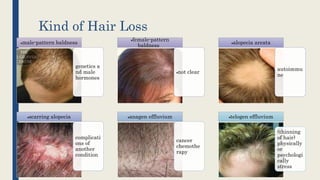
Kind of Hair Loss
genetics a
nd male
hormones
male-pattern baldness
not clear
female-pattern
baldness
autoimmu
ne
alopecia areata
complicati
ons of
another
condition
scarring alopecia
cancer
chemothe
rapy
anagen effluvium
(thinning
of hair)
physically
or
psychologi
cally
stress
telogen effluvium
Androgenetic Alopecia (AGA:
Male- and female-pattern baldness (most common)
When it affects women, it leads to diffuse alopecia over
the mid-frontal scalp (female pattern hair loss) [1].
Miniaturization of hair follicle is responsible for it, which
represents a progressive reduction in diameter,
pigmentation and length of the hair shaft [2,3].
Also androgens induced it in genetically susceptible
persons, which is manifested by increased 5α-reductase
activity and dihydrotestosterone (DHT) levels in hair
follicles.
In such genetically susceptible cases, the DHT binds to
the androgen receptor and the hormone-receptor complex,
activating the genes responsible for the transformation of
the normal hair follicle in miniaturized follicles [4, 5].
The reduction in the number of terminal fibers per
follicular unit will produce a diffuse alopecia [3]. The
impact of androgenetic alopecia is predominantly
psychological [6].
Alopecia Areata (AA) (~2%)
a nonscarring autoimmune, inflammatory
scalp, and/or body hair loss condition
characterized by patchy hair loss.
Histopathology shows an increased
number of the catagen and telogen follicles
and the presence of an inflammatory
lymphocytic infiltrate in the peribulbar
region [6].
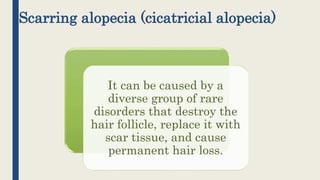
Scarring alopecia (cicatricial alopecia)
It can be caused by a
diverse group of rare
disorders that destroy the
hair follicle, replace it with
scar tissue, and cause
permanent hair loss.
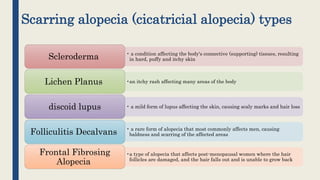
Scarring alopecia (cicatricial alopecia) types
• a condition affecting the body's connective (supporting) tissues, resulting
in hard, puffy and itchy skinScleroderma
•an itchy rash affecting many areas of the bodyLichen Planus
• a mild form of lupus affecting the skin, causing scaly marks and hair lossdiscoid lupus
• a rare form of alopecia that most commonly affects men, causing
baldness and scarring of the affected areasFolliculitis Decalvans
•a type of alopecia that affects post-menopausal women where the hair
follicles are damaged, and the hair falls out and is unable to grow back
Frontal Fibrosing
Alopecia
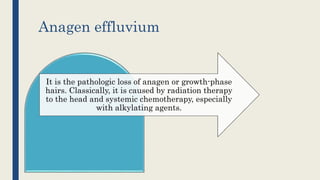
Anagen effluvium
It is the pathologic loss of anagen or growth-phase
hairs. Classically, it is caused by radiation therapy
to the head and systemic chemotherapy, especially
with alkylating agents.
Less common causes of hair loss without
inflammation or scarring include
pulling out of hair,
•including chemotherapy, HIV/AIDS, hypothyroidism,
certain medications
•including iron deficiency. Causes of hair loss that occurs with scarring or
inflammation include fungal infection,malnutrition
lupus erythematosus,
radiation therapy,
•Diagnosis of hair loss is partly based on the areas affected.[2]
sarcoidosis
Age-dependent changes & hair conditioners in
damage processes of hair cuticle
the dominant damage pattern shifts from type L to E
with aging.
Cuticle becomes gradually less resistant to daily
grooming stress.
dominance of type E damage accelerates cuticle loss.
Reduction of 18-MEA on weathered hair is accelerated
with aging on elder hair [w].
age-dependent changes in age of 40s
and 50s
Alterationinhairshaft,
suchas
diameter,
density,
cuticle becomes more
fragile
hair surface properties
deteriorate [x]
Hair color changes
by daily care
damages on
ultra-structure
which may be occur
due to damaged of
endocuticle layer in
form of hole n cavity
formation [y].
Nanoscale
characterization of
human hair and hair
conditioners [z]
Diagnosis
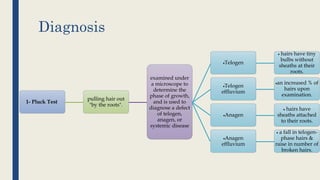
1- Pluck Test
pulling hair out
"by the roots".
examined under
a microscope to
determine the
phase of growth,
and is used to
diagnose a defect
of telogen,
anagen, or
systemic disease
Telogen
 hairs have tiny
bulbs without
sheaths at their
roots.
Telogen
effluvium
an increased % of
hairs upon
examination.
Anagen
 hairs have
sheaths attached
to their roots.
Anagen
effluvium
 a fall in telogen-
phase hairs &
raise in number of
broken hairs.
Diagnosis (contd)
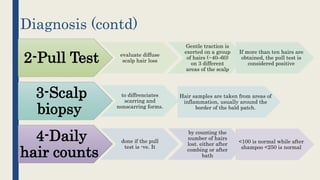
2-Pull Test evaluate diffuse
scalp hair loss
Gentle traction is
exerted on a group
of hairs (~40–60)
on 3 different
areas of the scalp
If more than ten hairs are
obtained, the pull test is
considered positive
3-Scalp
biopsy
to diffrenciates
scarring and
nonscarring forms.
Hair samples are taken from areas of
inflammation, usually around the
border of the bald patch.
4-Daily
hair counts
done if the pull
test is -ve. It
by counting the
number of hairs
lost. either after
combing or after
bath
<100 is normal while after
shampoo <250 is normal
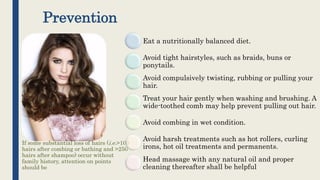
Prevention
If some substantial loss of hairs (i.e.>100
hairs after combing or bathing and >250
hairs after shampoo) occur without
family history, attention on points
should be
Eat a nutritionally balanced diet.
Avoid tight hairstyles, such as braids, buns or
ponytails.
Avoid compulsively twisting, rubbing or pulling your
hair.
Treat your hair gently when washing and brushing. A
wide-toothed comb may help prevent pulling out hair.
Avoid combing in wet condition.
Avoid harsh treatments such as hot rollers, curling
irons, hot oil treatments and permanents.
Head massage with any natural oil and proper
cleaning thereafter shall be helpful
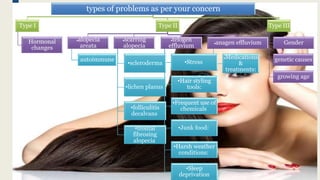
types of problems as per your concern
Type I
Hormonal
changes
Type II
alopecia
areata
autoimmune
scarring
alopecia
•scleroderma
•lichen planus
•folliculitis
decalvans
•frontal
fibrosing
alopecia
telogen
effluvium
•Stress
•Hair styling
tools:
•Frequent use of
chemicals
•Junk food:
•Harsh weather
conditions:
•Sleep
deprivation
anagen effluvium
Medications
&
treatments:
Type III
Gender
genetic causes
growing age
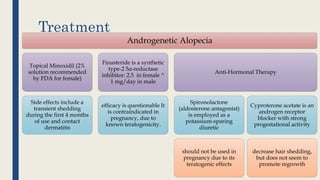
Treatment
Androgenetic Alopecia
Topical Minoxidil (2%
solution recommended
by FDA for female)
Side effects include a
transient shedding
during the first 4 months
of use and contact
dermatitis
Finasteride is a synthetic
type-2 5α-reductase
inhibitor: 2.5 in female ^
1 mg/day in male
efficacy is questionable It
is contraindicated in
pregnancy, due to
known teratogenicity.
Anti-Hormonal Therapy
Spironolactone
(aldosterone antagonist)
is employed as a
potassium-sparing
diuretic
should not be used in
pregnancy due to its
teratogenic effects
Cyproterone acetate is an
androgen receptor
blocker with strong
progestational activity
decrease hair shedding,
but does not seem to
promote regrowth
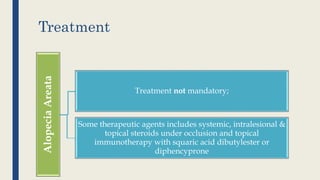
Treatment
AlopeciaAreata
Treatment not mandatory;
Some therapeutic agents includes systemic, intralesional &
topical steroids under occlusion and topical
immunotherapy with squaric acid dibutylester or
diphencyprone
Treatment
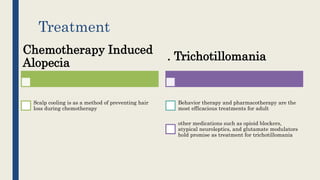
Chemotherapy Induced
Alopecia
Scalp cooling is as a method of preventing hair
loss during chemotherapy
. Trichotillomania
Behavior therapy and pharmacotherapy are the
most efficacious treatments for adult
other medications such as opioid blockers,
atypical neuroleptics, and glutamate modulators
hold promise as treatment for trichotillomania
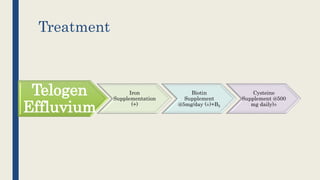
Treatment
Telogen
Effluvium
Iron
Supplementation
(+)
Biotin
Supplement
@5mg/day (±)+B5
Cysteine
Supplement @500
mg daily)±
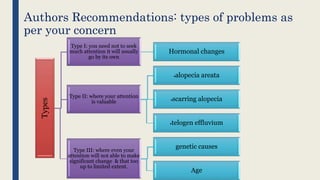
Authors Recommendations: types of problems as
per your concern
Types Type I: you need not to seek
much attention it will usually
go by its own
Hormonal changes
Type II: where your attention
is valuable
alopecia areata
scarring alopecia
telogen effluvium
Type III: where even your
attention will not able to make
significant change & that too
up to limited extent.
genetic causes
Age
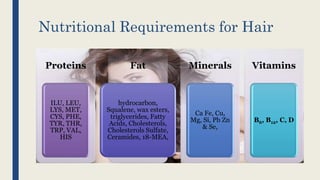
Nutritional Requirements for Hair
Proteins
ILU, LEU,
LYS, MET,
CYS, PHE,
TYR, THR,
TRP, VAL,
HIS
Fat
hydrocarbon,
Squalene, wax esters,
triglycerides, Fatty
Acids, Cholesterols,
Cholesterols Sulfate,
Ceramides, 18-MEA,
Minerals
Ca Fe, Cu,
Mg, Si, Pb Zn
& Se,
Vitamins
B6, B12, C, D
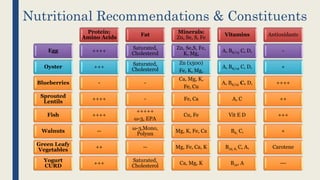
Nutritional Recommendations & Constituents
Egg
Oyster
Blueberries
Sprouted
Lentils
Fish
Walnuts
Green Leafy
Vegetables
Yogurt
CURD
Protein:
Amino Acids
++++
+++
-
++++
++++
--
++
+++
Fat
Saturated,
Cholesterol
Saturated,
Cholesterol
-
-
+++++
ω-3, EPA
ω-3,Mono,
Polyun
--
Saturated,
Cholesterol
Minerals:
Zn, Se, S, Fe
Zn, Se,S, Fe,
K, Mg,
Zn (x500)
Fe, K, Mg,
Ca, Mg, K,
Fe, Cu
Fe, Ca
Cu, Fe
Mg, K, Fe, Ca
Mg, Fe, Ca, K
Ca, Mg, K
Vitamins
A, B6/12 C, D,
A, B6/12 C, D,
A, B6/12 C, D,
A, C
Vit E D
B6, C,
B12, 6, C, A,
B12, A
Antioxidants
-
+
++++
++
+++
+
Carotene
---
For details please visit
https://iiopinion.blogspot.in/2017/01/hair-fall-scientific-
way-of-treatment.html

Hair fall: Cause & Solution

  • 1.
    HAIR FALL: REASON &SOLUTION Dr Alok Tripathi aloksecondopinion@gmail.com https://iiopinion.blogspot.in
  • 2.
    Hair loss, also knownas alopecia or baldness ■ Alopecia is the general medical term for hair loss. ■ There are many types of hair loss with different symptoms and causes.
  • 3.
    Kind of HairLoss genetics a nd male hormones male-pattern baldness not clear female-pattern baldness autoimmu ne alopecia areata complicati ons of another condition scarring alopecia cancer chemothe rapy anagen effluvium (thinning of hair) physically or psychologi cally stress telogen effluvium
  • 4.
    Androgenetic Alopecia (AGA: Male-and female-pattern baldness (most common) When it affects women, it leads to diffuse alopecia over the mid-frontal scalp (female pattern hair loss) [1]. Miniaturization of hair follicle is responsible for it, which represents a progressive reduction in diameter, pigmentation and length of the hair shaft [2,3]. Also androgens induced it in genetically susceptible persons, which is manifested by increased 5α-reductase activity and dihydrotestosterone (DHT) levels in hair follicles. In such genetically susceptible cases, the DHT binds to the androgen receptor and the hormone-receptor complex, activating the genes responsible for the transformation of the normal hair follicle in miniaturized follicles [4, 5]. The reduction in the number of terminal fibers per follicular unit will produce a diffuse alopecia [3]. The impact of androgenetic alopecia is predominantly psychological [6].
  • 5.
    Alopecia Areata (AA)(~2%) a nonscarring autoimmune, inflammatory scalp, and/or body hair loss condition characterized by patchy hair loss. Histopathology shows an increased number of the catagen and telogen follicles and the presence of an inflammatory lymphocytic infiltrate in the peribulbar region [6].
  • 6.
    Scarring alopecia (cicatricialalopecia) It can be caused by a diverse group of rare disorders that destroy the hair follicle, replace it with scar tissue, and cause permanent hair loss.
  • 7.
    Scarring alopecia (cicatricialalopecia) types • a condition affecting the body's connective (supporting) tissues, resulting in hard, puffy and itchy skinScleroderma •an itchy rash affecting many areas of the bodyLichen Planus • a mild form of lupus affecting the skin, causing scaly marks and hair lossdiscoid lupus • a rare form of alopecia that most commonly affects men, causing baldness and scarring of the affected areasFolliculitis Decalvans •a type of alopecia that affects post-menopausal women where the hair follicles are damaged, and the hair falls out and is unable to grow back Frontal Fibrosing Alopecia
  • 8.
    Anagen effluvium It isthe pathologic loss of anagen or growth-phase hairs. Classically, it is caused by radiation therapy to the head and systemic chemotherapy, especially with alkylating agents.
  • 9.
    Less common causesof hair loss without inflammation or scarring include pulling out of hair, •including chemotherapy, HIV/AIDS, hypothyroidism, certain medications •including iron deficiency. Causes of hair loss that occurs with scarring or inflammation include fungal infection,malnutrition lupus erythematosus, radiation therapy, •Diagnosis of hair loss is partly based on the areas affected.[2] sarcoidosis
  • 10.
    Age-dependent changes &hair conditioners in damage processes of hair cuticle the dominant damage pattern shifts from type L to E with aging. Cuticle becomes gradually less resistant to daily grooming stress. dominance of type E damage accelerates cuticle loss. Reduction of 18-MEA on weathered hair is accelerated with aging on elder hair [w].
  • 11.
    age-dependent changes inage of 40s and 50s Alterationinhairshaft, suchas diameter, density, cuticle becomes more fragile hair surface properties deteriorate [x]
  • 12.
    Hair color changes bydaily care damages on ultra-structure which may be occur due to damaged of endocuticle layer in form of hole n cavity formation [y]. Nanoscale characterization of human hair and hair conditioners [z]
  • 13.
    Diagnosis 1- Pluck Test pullinghair out "by the roots". examined under a microscope to determine the phase of growth, and is used to diagnose a defect of telogen, anagen, or systemic disease Telogen  hairs have tiny bulbs without sheaths at their roots. Telogen effluvium an increased % of hairs upon examination. Anagen  hairs have sheaths attached to their roots. Anagen effluvium  a fall in telogen- phase hairs & raise in number of broken hairs.
  • 14.
    Diagnosis (contd) 2-Pull Testevaluate diffuse scalp hair loss Gentle traction is exerted on a group of hairs (~40–60) on 3 different areas of the scalp If more than ten hairs are obtained, the pull test is considered positive 3-Scalp biopsy to diffrenciates scarring and nonscarring forms. Hair samples are taken from areas of inflammation, usually around the border of the bald patch. 4-Daily hair counts done if the pull test is -ve. It by counting the number of hairs lost. either after combing or after bath <100 is normal while after shampoo <250 is normal
  • 15.
    Prevention If some substantialloss of hairs (i.e.>100 hairs after combing or bathing and >250 hairs after shampoo) occur without family history, attention on points should be Eat a nutritionally balanced diet. Avoid tight hairstyles, such as braids, buns or ponytails. Avoid compulsively twisting, rubbing or pulling your hair. Treat your hair gently when washing and brushing. A wide-toothed comb may help prevent pulling out hair. Avoid combing in wet condition. Avoid harsh treatments such as hot rollers, curling irons, hot oil treatments and permanents. Head massage with any natural oil and proper cleaning thereafter shall be helpful
  • 16.
    types of problemsas per your concern Type I Hormonal changes Type II alopecia areata autoimmune scarring alopecia •scleroderma •lichen planus •folliculitis decalvans •frontal fibrosing alopecia telogen effluvium •Stress •Hair styling tools: •Frequent use of chemicals •Junk food: •Harsh weather conditions: •Sleep deprivation anagen effluvium Medications & treatments: Type III Gender genetic causes growing age
  • 17.
    Treatment Androgenetic Alopecia Topical Minoxidil(2% solution recommended by FDA for female) Side effects include a transient shedding during the first 4 months of use and contact dermatitis Finasteride is a synthetic type-2 5α-reductase inhibitor: 2.5 in female ^ 1 mg/day in male efficacy is questionable It is contraindicated in pregnancy, due to known teratogenicity. Anti-Hormonal Therapy Spironolactone (aldosterone antagonist) is employed as a potassium-sparing diuretic should not be used in pregnancy due to its teratogenic effects Cyproterone acetate is an androgen receptor blocker with strong progestational activity decrease hair shedding, but does not seem to promote regrowth
  • 18.
    Treatment AlopeciaAreata Treatment not mandatory; Sometherapeutic agents includes systemic, intralesional & topical steroids under occlusion and topical immunotherapy with squaric acid dibutylester or diphencyprone
  • 19.
    Treatment Chemotherapy Induced Alopecia Scalp coolingis as a method of preventing hair loss during chemotherapy . Trichotillomania Behavior therapy and pharmacotherapy are the most efficacious treatments for adult other medications such as opioid blockers, atypical neuroleptics, and glutamate modulators hold promise as treatment for trichotillomania
  • 20.
  • 21.
    Authors Recommendations: typesof problems as per your concern Types Type I: you need not to seek much attention it will usually go by its own Hormonal changes Type II: where your attention is valuable alopecia areata scarring alopecia telogen effluvium Type III: where even your attention will not able to make significant change & that too up to limited extent. genetic causes Age
  • 22.
    Nutritional Requirements forHair Proteins ILU, LEU, LYS, MET, CYS, PHE, TYR, THR, TRP, VAL, HIS Fat hydrocarbon, Squalene, wax esters, triglycerides, Fatty Acids, Cholesterols, Cholesterols Sulfate, Ceramides, 18-MEA, Minerals Ca Fe, Cu, Mg, Si, Pb Zn & Se, Vitamins B6, B12, C, D
  • 23.
    Nutritional Recommendations &Constituents Egg Oyster Blueberries Sprouted Lentils Fish Walnuts Green Leafy Vegetables Yogurt CURD Protein: Amino Acids ++++ +++ - ++++ ++++ -- ++ +++ Fat Saturated, Cholesterol Saturated, Cholesterol - - +++++ ω-3, EPA ω-3,Mono, Polyun -- Saturated, Cholesterol Minerals: Zn, Se, S, Fe Zn, Se,S, Fe, K, Mg, Zn (x500) Fe, K, Mg, Ca, Mg, K, Fe, Cu Fe, Ca Cu, Fe Mg, K, Fe, Ca Mg, Fe, Ca, K Ca, Mg, K Vitamins A, B6/12 C, D, A, B6/12 C, D, A, B6/12 C, D, A, C Vit E D B6, C, B12, 6, C, A, B12, A Antioxidants - + ++++ ++ +++ + Carotene ---
  • 24.
    For details pleasevisit https://iiopinion.blogspot.in/2017/01/hair-fall-scientific- way-of-treatment.html