NONSPECIFIC & SPECIFIC
IMMUNE RESPONSES
Dr Alok Tripathi
Department of Biotechnology
aquaimmuno@yahoo.co.in
Resistance: Ability to
ward off disease.
• Nonspecific Resistance:
Defenses that protect against
all pathogens.
• Specific Resistance: Protection
against specific pathogens.
Susceptibility:
Vulnerability or lack of
resistance.
Introduction
• Non-specific natural barriers which restrict entry
of pathogen.
• Examples: Skin and mucous membranes.
1. First
Line of
Defense:
• Innate non-specific immune defenses provide rapid
local response to pathogen after it has entered host.
• Examples: Fever, phagocytes (macrophages and
neutrophils), inflammation, and interferon.
2. Second
Line of
Defense:
• Antigen-specific immune responses, specifically
target and attack invaders that get past first two
lines of defense.
• Examples: Antibodies and lymphocytes.
3. Third
line of
defense:
Protection Against Invading Pathogens
Three Lines of Defense Against Infection
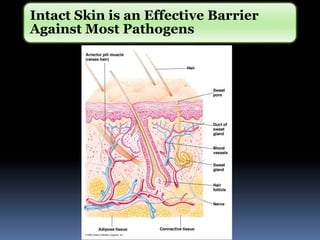
1. Skin has two Layers:
A. Epidermis: Thin outer
layer of epithelial tissue.
B. Dermis: Thick inner layer
of connective tissue.
Infections are rare in intact
skin. Exceptions:
Hookworms can penetrate
intact skin
Dermatophytes: “Skin
loving” fungi
• Contains Langerhans cells, dead
cells, and keratin (waterproof).
First Line of Defense:
• Skin and Mucous Membranes
I. Mechanical Defenses
Intact Skin is an Effective Barrier
Against Most Pathogens
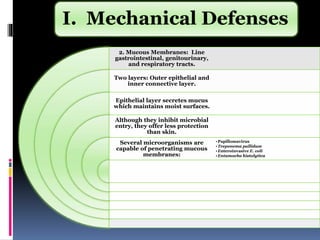
2. Mucous Membranes: Line
gastrointestinal, genitourinary,
and respiratory tracts.
Two layers: Outer epithelial and
inner connective layer.
Epithelial layer secretes mucus
which maintains moist surfaces.
Although they inhibit microbial
entry, they offer less protection
than skin.
Several microorganisms are
capable of penetrating mucous
membranes:
•Papillomavirus
•Treponema pallidum
•Enteroinvasive E. coli
•Entamoeba histolytica
I. Mechanical Defenses
• Continual washing and blinking prevents microbes
from settling on the eye surface.
3. Lacrimal
apparatus:
• Washes microbes from teeth and mouth mucous
membranes.4. Saliva:
• Thick secretion that traps many microbes.5. Mucus:
• Coated with mucus filter dust, pollen, and microbes.6. Nose Hair:
• Cilia on mucous membranes of lower respiratory
tract move upwards towards throat at 1-3 cm/hour.
7. Ciliary
Escalator:
I. Mechanical Defenses
• Expel foreign objects.
8. Coughing
and sneezing:
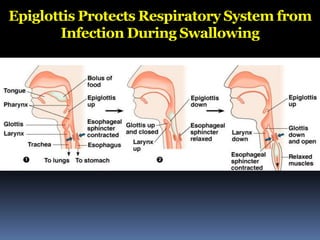
• Covers larynx during
swallowing.
9. Epiglottis:
• Cleanses urethra.
10.
Urination:
• Remove microbes from
genital tract.
11. Vaginal
Secretions:
I. Mechanical
Defenses
Epiglottis Protects Respiratory System from
Infection During Swallowing
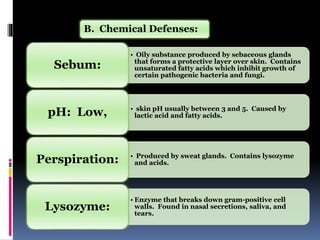
• Oily substance produced by sebaceous glands
that forms a protective layer over skin. Contains
unsaturated fatty acids which inhibit growth of
certain pathogenic bacteria and fungi.
Sebum:
• skin pH usually between 3 and 5. Caused by
lactic acid and fatty acids.pH: Low,
• Produced by sweat glands. Contains lysozyme
and acids.Perspiration:
• Enzyme that breaks down gram-positive cell
walls. Found in nasal secretions, saliva, and
tears.
Lysozyme:
B. Chemical Defenses:
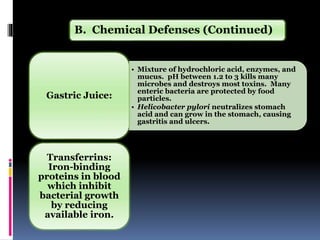
• Mixture of hydrochloric acid, enzymes, and
mucus. pH between 1.2 to 3 kills many
microbes and destroys most toxins. Many
enteric bacteria are protected by food
particles.
• Helicobacter pylori neutralizes stomach
acid and can grow in the stomach, causing
gastritis and ulcers.
Gastric Juice:
Transferrins:
Iron-binding
proteins in blood
which inhibit
bacterial growth
by reducing
available iron.
B. Chemical Defenses (Continued)
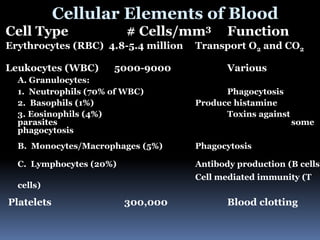
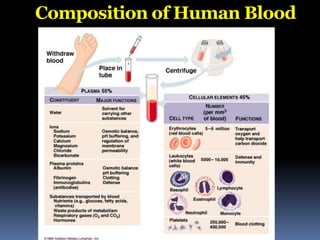
Cellular Elements of Blood
Cell Type # Cells/mm3 Function
Erythrocytes (RBC) 4.8-5.4 million Transport O2 and CO2
Leukocytes (WBC) 5000-9000 Various
A. Granulocytes:
1. Neutrophils (70% of WBC) Phagocytosis
2. Basophils (1%) Produce histamine
3. Eosinophils (4%) Toxins against
parasites some
phagocytosis
B. Monocytes/Macrophages (5%) Phagocytosis
C. Lymphocytes (20%) Antibody production (B cells)
Cell mediated immunity (T
cells)
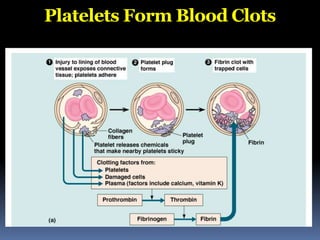
Platelets 300,000 Blood clotting
Composition of Human Blood
Platelets Form Blood Clots
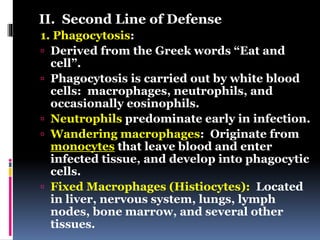
II. Second Line of Defense
1. Phagocytosis:
 Derived from the Greek words “Eat and
cell”.
 Phagocytosis is carried out by white blood
cells: macrophages, neutrophils, and
occasionally eosinophils.
 Neutrophils predominate early in infection.
 Wandering macrophages: Originate from
monocytes that leave blood and enter
infected tissue, and develop into phagocytic
cells.
 Fixed Macrophages (Histiocytes): Located
in liver, nervous system, lungs, lymph
nodes, bone marrow, and several other
tissues.
Phagocytic Cells: Macrophages
(Monocytes), Neutrophils, and Eosinophils
(Macrophages)
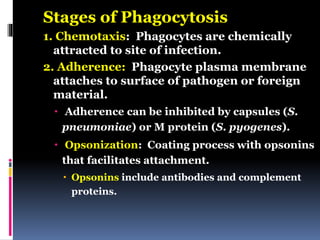
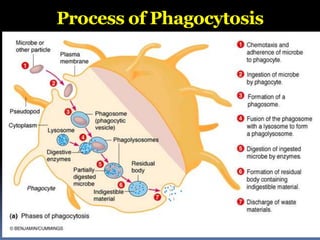
Stages of Phagocytosis
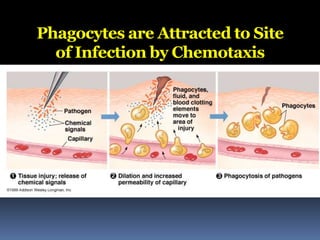
1. Chemotaxis: Phagocytes are chemically
attracted to site of infection.
2. Adherence: Phagocyte plasma membrane
attaches to surface of pathogen or foreign
material.
 Adherence can be inhibited by capsules (S.
pneumoniae) or M protein (S. pyogenes).
 Opsonization: Coating process with opsonins
that facilitates attachment.
 Opsonins include antibodies and complement
proteins.
Phagocytes are Attracted to Site
of Infection by Chemotaxis
Stages of Phagocytosis
(Continued)
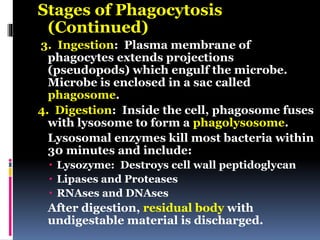
3. Ingestion: Plasma membrane of
phagocytes extends projections
(pseudopods) which engulf the microbe.
Microbe is enclosed in a sac called
phagosome.
4. Digestion: Inside the cell, phagosome fuses
with lysosome to form a phagolysosome.
Lysosomal enzymes kill most bacteria within
30 minutes and include:
 Lysozyme: Destroys cell wall peptidoglycan
 Lipases and Proteases
 RNAses and DNAses
After digestion, residual body with
undigestable material is discharged.
Process of Phagocytosis
Inflammation
Triggered by tissue damage due to infection,
heat, wound, etc.
Four Major Symptoms of Inflammation:
1. Redness
2. Pain
3. Heat
4. Swelling
May also observe:
5. Loss of function
Functions of Inflammation
1. Destroy and remove pathogens
2. If destruction is not possible, to
limit effects by confining the
pathogen and its products.
3. Repair and replace tissue damaged
by pathogen and its products.
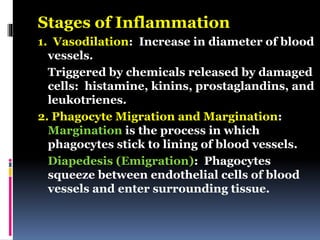
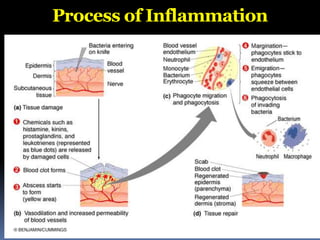
Stages of Inflammation
1. Vasodilation: Increase in diameter of blood
vessels.
Triggered by chemicals released by damaged
cells: histamine, kinins, prostaglandins, and
leukotrienes.
2. Phagocyte Migration and Margination:
Margination is the process in which
phagocytes stick to lining of blood vessels.
Diapedesis (Emigration): Phagocytes
squeeze between endothelial cells of blood
vessels and enter surrounding tissue.
Process of Inflammation
Stages of Inflammation
(Continued)
Phagocytes are attracted to site of infection
through chemotaxis.
Phagocytes destroy microbes, as well as
dead and damaged host cells.
3. Tissue Repair: Dead and damaged cells
are replaced.
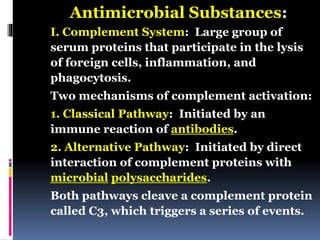
Antimicrobial Substances:
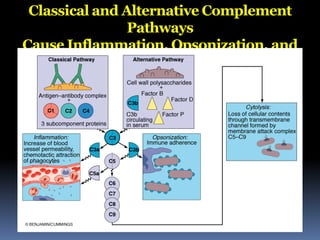
I. Complement System: Large group of
serum proteins that participate in the lysis
of foreign cells, inflammation, and
phagocytosis.
Two mechanisms of complement activation:
1. Classical Pathway: Initiated by an
immune reaction of antibodies.
2. Alternative Pathway: Initiated by direct
interaction of complement proteins with
microbial polysaccharides.
Both pathways cleave a complement protein
called C3, which triggers a series of events.
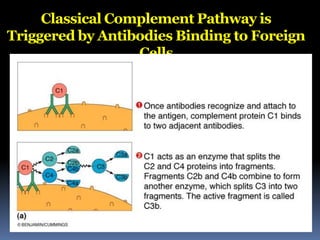
Classical Complement Pathway is
Triggered by Antibodies Binding to Foreign
Cells
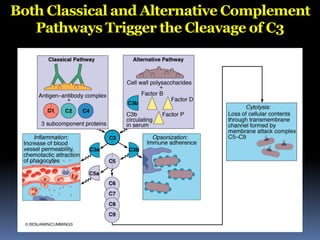
Both Classical and Alternative Complement
Pathways Trigger the Cleavage of C3
Consequences of Complement
Activation:
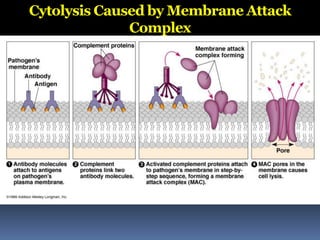
1. Cytolysis: Due to the formation of a
membrane attack complex (MAC) which
produces lesions in microbial membranes.
2. Inflammation: Complement components
(C3a) trigger the release of histamine, which
increases vascular permeability.
3. Opsonization: Complement components
(C3b) bind to microbial surface and promote
phagocytosis.
4. Inactivation of Complement: Regulatory
proteins limit damage to host cells that may
be caused by complement.
Classical and Alternative Complement
Pathways
Cause Inflammation, Opsonization, and
Cytolysis
Cytolysis Caused by Membrane Attack
Complex
II. Interferons: Antiviral proteins that
interfere with viral multiplication.
 Small proteins (15,000 to 30,000 kDa)
 Heat stable and resistant to low pH
 Important in acute and short term infections.
 Have no effect on infected cells.
 Host specific, but not virus specific.
Interferon alpha and beta: Produced by virus
infected cells and diffuse to neighboring cells.
Cause uninfected cells to produce antiviral
proteins (AVPs).
Interferon gamma: Produced by lymphocytes.
Causes neutrophils to kill bacteria.

Non-Specific Immune Response

  • 1.
    NONSPECIFIC & SPECIFIC IMMUNERESPONSES Dr Alok Tripathi Department of Biotechnology aquaimmuno@yahoo.co.in
  • 2.
    Resistance: Ability to wardoff disease. • Nonspecific Resistance: Defenses that protect against all pathogens. • Specific Resistance: Protection against specific pathogens. Susceptibility: Vulnerability or lack of resistance. Introduction
  • 3.
    • Non-specific naturalbarriers which restrict entry of pathogen. • Examples: Skin and mucous membranes. 1. First Line of Defense: • Innate non-specific immune defenses provide rapid local response to pathogen after it has entered host. • Examples: Fever, phagocytes (macrophages and neutrophils), inflammation, and interferon. 2. Second Line of Defense: • Antigen-specific immune responses, specifically target and attack invaders that get past first two lines of defense. • Examples: Antibodies and lymphocytes. 3. Third line of defense: Protection Against Invading Pathogens
  • 4.
    Three Lines ofDefense Against Infection
  • 5.
    1. Skin hastwo Layers: A. Epidermis: Thin outer layer of epithelial tissue. B. Dermis: Thick inner layer of connective tissue. Infections are rare in intact skin. Exceptions: Hookworms can penetrate intact skin Dermatophytes: “Skin loving” fungi • Contains Langerhans cells, dead cells, and keratin (waterproof). First Line of Defense: • Skin and Mucous Membranes I. Mechanical Defenses
  • 6.
    Intact Skin isan Effective Barrier Against Most Pathogens
  • 7.
    2. Mucous Membranes:Line gastrointestinal, genitourinary, and respiratory tracts. Two layers: Outer epithelial and inner connective layer. Epithelial layer secretes mucus which maintains moist surfaces. Although they inhibit microbial entry, they offer less protection than skin. Several microorganisms are capable of penetrating mucous membranes: •Papillomavirus •Treponema pallidum •Enteroinvasive E. coli •Entamoeba histolytica I. Mechanical Defenses
  • 8.
    • Continual washingand blinking prevents microbes from settling on the eye surface. 3. Lacrimal apparatus: • Washes microbes from teeth and mouth mucous membranes.4. Saliva: • Thick secretion that traps many microbes.5. Mucus: • Coated with mucus filter dust, pollen, and microbes.6. Nose Hair: • Cilia on mucous membranes of lower respiratory tract move upwards towards throat at 1-3 cm/hour. 7. Ciliary Escalator: I. Mechanical Defenses
  • 9.
    • Expel foreignobjects. 8. Coughing and sneezing: • Covers larynx during swallowing. 9. Epiglottis: • Cleanses urethra. 10. Urination: • Remove microbes from genital tract. 11. Vaginal Secretions: I. Mechanical Defenses
  • 10.
    Epiglottis Protects RespiratorySystem from Infection During Swallowing
  • 11.
    • Oily substanceproduced by sebaceous glands that forms a protective layer over skin. Contains unsaturated fatty acids which inhibit growth of certain pathogenic bacteria and fungi. Sebum: • skin pH usually between 3 and 5. Caused by lactic acid and fatty acids.pH: Low, • Produced by sweat glands. Contains lysozyme and acids.Perspiration: • Enzyme that breaks down gram-positive cell walls. Found in nasal secretions, saliva, and tears. Lysozyme: B. Chemical Defenses:
  • 12.
    • Mixture ofhydrochloric acid, enzymes, and mucus. pH between 1.2 to 3 kills many microbes and destroys most toxins. Many enteric bacteria are protected by food particles. • Helicobacter pylori neutralizes stomach acid and can grow in the stomach, causing gastritis and ulcers. Gastric Juice: Transferrins: Iron-binding proteins in blood which inhibit bacterial growth by reducing available iron. B. Chemical Defenses (Continued)
  • 13.
    Cellular Elements ofBlood Cell Type # Cells/mm3 Function Erythrocytes (RBC) 4.8-5.4 million Transport O2 and CO2 Leukocytes (WBC) 5000-9000 Various A. Granulocytes: 1. Neutrophils (70% of WBC) Phagocytosis 2. Basophils (1%) Produce histamine 3. Eosinophils (4%) Toxins against parasites some phagocytosis B. Monocytes/Macrophages (5%) Phagocytosis C. Lymphocytes (20%) Antibody production (B cells) Cell mediated immunity (T cells) Platelets 300,000 Blood clotting
  • 14.
  • 15.
  • 16.
    II. Second Lineof Defense 1. Phagocytosis:  Derived from the Greek words “Eat and cell”.  Phagocytosis is carried out by white blood cells: macrophages, neutrophils, and occasionally eosinophils.  Neutrophils predominate early in infection.  Wandering macrophages: Originate from monocytes that leave blood and enter infected tissue, and develop into phagocytic cells.  Fixed Macrophages (Histiocytes): Located in liver, nervous system, lungs, lymph nodes, bone marrow, and several other tissues.
  • 17.
    Phagocytic Cells: Macrophages (Monocytes),Neutrophils, and Eosinophils (Macrophages)
  • 18.
    Stages of Phagocytosis 1.Chemotaxis: Phagocytes are chemically attracted to site of infection. 2. Adherence: Phagocyte plasma membrane attaches to surface of pathogen or foreign material.  Adherence can be inhibited by capsules (S. pneumoniae) or M protein (S. pyogenes).  Opsonization: Coating process with opsonins that facilitates attachment.  Opsonins include antibodies and complement proteins.
  • 19.
    Phagocytes are Attractedto Site of Infection by Chemotaxis
  • 20.
    Stages of Phagocytosis (Continued) 3.Ingestion: Plasma membrane of phagocytes extends projections (pseudopods) which engulf the microbe. Microbe is enclosed in a sac called phagosome. 4. Digestion: Inside the cell, phagosome fuses with lysosome to form a phagolysosome. Lysosomal enzymes kill most bacteria within 30 minutes and include:  Lysozyme: Destroys cell wall peptidoglycan  Lipases and Proteases  RNAses and DNAses After digestion, residual body with undigestable material is discharged.
  • 21.
  • 22.
    Inflammation Triggered by tissuedamage due to infection, heat, wound, etc. Four Major Symptoms of Inflammation: 1. Redness 2. Pain 3. Heat 4. Swelling May also observe: 5. Loss of function
  • 23.
    Functions of Inflammation 1.Destroy and remove pathogens 2. If destruction is not possible, to limit effects by confining the pathogen and its products. 3. Repair and replace tissue damaged by pathogen and its products.
  • 24.
    Stages of Inflammation 1.Vasodilation: Increase in diameter of blood vessels. Triggered by chemicals released by damaged cells: histamine, kinins, prostaglandins, and leukotrienes. 2. Phagocyte Migration and Margination: Margination is the process in which phagocytes stick to lining of blood vessels. Diapedesis (Emigration): Phagocytes squeeze between endothelial cells of blood vessels and enter surrounding tissue.
  • 25.
  • 26.
    Stages of Inflammation (Continued) Phagocytesare attracted to site of infection through chemotaxis. Phagocytes destroy microbes, as well as dead and damaged host cells. 3. Tissue Repair: Dead and damaged cells are replaced.
  • 27.
    Antimicrobial Substances: I. ComplementSystem: Large group of serum proteins that participate in the lysis of foreign cells, inflammation, and phagocytosis. Two mechanisms of complement activation: 1. Classical Pathway: Initiated by an immune reaction of antibodies. 2. Alternative Pathway: Initiated by direct interaction of complement proteins with microbial polysaccharides. Both pathways cleave a complement protein called C3, which triggers a series of events.
  • 28.
    Classical Complement Pathwayis Triggered by Antibodies Binding to Foreign Cells
  • 29.
    Both Classical andAlternative Complement Pathways Trigger the Cleavage of C3
  • 30.
    Consequences of Complement Activation: 1.Cytolysis: Due to the formation of a membrane attack complex (MAC) which produces lesions in microbial membranes. 2. Inflammation: Complement components (C3a) trigger the release of histamine, which increases vascular permeability. 3. Opsonization: Complement components (C3b) bind to microbial surface and promote phagocytosis. 4. Inactivation of Complement: Regulatory proteins limit damage to host cells that may be caused by complement.
  • 31.
    Classical and AlternativeComplement Pathways Cause Inflammation, Opsonization, and Cytolysis
  • 32.
    Cytolysis Caused byMembrane Attack Complex
  • 33.
    II. Interferons: Antiviralproteins that interfere with viral multiplication.  Small proteins (15,000 to 30,000 kDa)  Heat stable and resistant to low pH  Important in acute and short term infections.  Have no effect on infected cells.  Host specific, but not virus specific. Interferon alpha and beta: Produced by virus infected cells and diffuse to neighboring cells. Cause uninfected cells to produce antiviral proteins (AVPs). Interferon gamma: Produced by lymphocytes. Causes neutrophils to kill bacteria.