Dr Alok Tripathi
aquaimmuno@yahoo.co.in
+919795894495
Animation 1
Animation 2
Animation 3
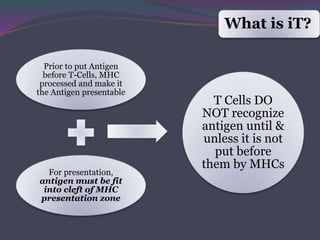
What is iT?
Prior to put Antigen
before T-Cells, MHC
processed and make it
the Antigen presentable
For presentation,
antigen must be fit
into cleft of MHC
presentation zone
T Cells DO
NOT recognize
antigen until &
unless it is not
put before
them by MHCs
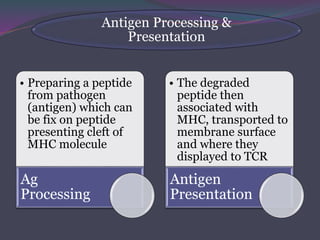
Antigen Processing &
Presentation
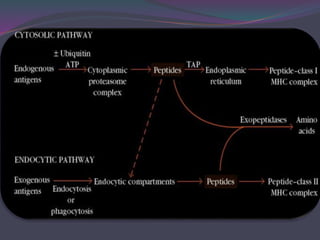
• Preparing a peptide
from pathogen
(antigen) which can
be fix on peptide
presenting cleft of
MHC molecule
Ag
Processing
• The degraded
peptide then
associated with
MHC, transported to
membrane surface
and where they
displayed to TCR
Antigen
Presentation
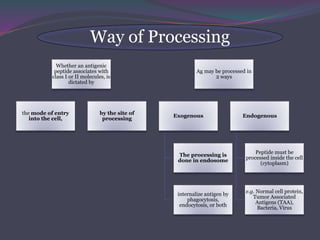
Way of Processing
Whether an antigenic
peptide associates with
class I or II molecules, is
dictated by
the mode of entry
into the cell,
by the site of
processing
Ag may be processed in
2 ways
Exogenous
The processing is
done in endosome
internalize antigen by
phagocytosis,
endocytosis, or both
Endogenous
Peptide must be
processed inside the cell
(cytoplasm)
e.g. Normal cell protein,
Tumor Associated
Antigens (TAA),
Bacteria, Virus
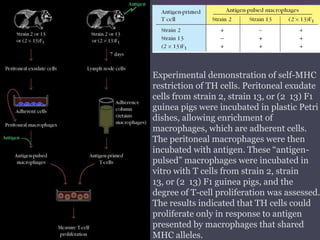
Experimental demonstration of self-MHC
restriction of TH cells. Peritoneal exudate
cells from strain 2, strain 13, or (2 13) F1
guinea pigs were incubated in plastic Petri
dishes, allowing enrichment of
macrophages, which are adherent cells.
The peritoneal macrophages were then
incubated with antigen. These “antigen-
pulsed” macrophages were incubated in
vitro with T cells from strain 2, strain
13, or (2 13) F1 guinea pigs, and the
degree of T-cell proliferation was assessed.
The results indicated that TH cells could
proliferate only in response to antigen
presented by macrophages that shared
MHC alleles.
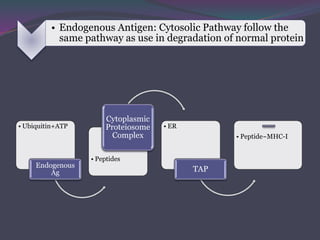
• Endogenous Antigen: Cytosolic Pathway follow the
same pathway as use in degradation of normal protein
• Ubiquitin+ATP
Endogenous
Ag
• Peptides
Cytoplasmic
Proteiosome
Complex
• ER
TAP
• Peptide~MHC-I
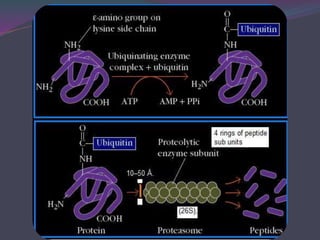
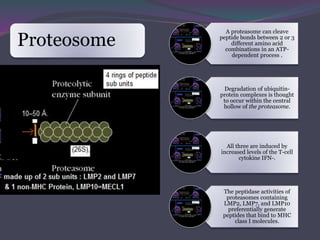
A proteasome can cleave
peptide bonds between 2 or 3
different amino acid
combinations in an ATP-
dependent process .
Degradation of ubiquitin-
protein complexes is thought
to occur within the central
hollow of the proteasome.
All three are induced by
increased levels of the T-cell
cytokine IFN-.
The peptidase activities of
proteasomes containing
LMP2, LMP7, and LMP10
preferentially generate
peptides that bind to MHC
class I molecules.
Proteosome
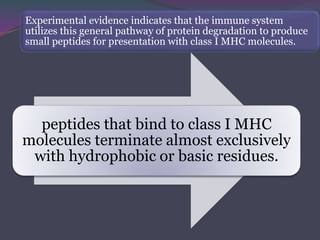
Experimental evidence indicates that the immune system
utilizes this general pathway of protein degradation to produce
small peptides for presentation with class I MHC molecules.
peptides that bind to class I MHC
molecules terminate almost exclusively
with hydrophobic or basic residues.
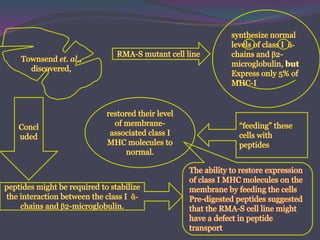
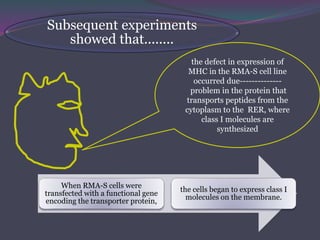
Subsequent experiments
showed that........
the defect in expression of
MHC in the RMA-S cell line
occurred due--------------
problem in the protein that
transports peptides from the
cytoplasm to the RER, where
class I molecules are
synthesized
When RMA-S cells were
transfected with a functional gene
encoding the transporter protein,
the cells began to express class I
molecules on the membrane.
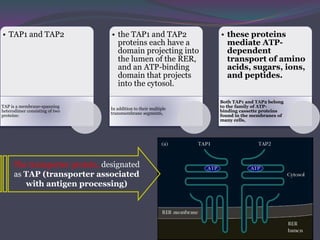
• TAP1 and TAP2
TAP is a membrane-spanning
heterodimer consisting of two
proteins:
• the TAP1 and TAP2
proteins each have a
domain projecting into
the lumen of the RER,
and an ATP-binding
domain that projects
into the cytosol.
In addition to their multiple
transmembrane segments,
• these proteins
mediate ATP-
dependent
transport of amino
acids, sugars, ions,
and peptides.
Both TAP1 and TAP2 belong
to the family of ATP-
binding cassette proteins
found in the membranes of
many cells,
The transporter protein, designated
as TAP (transporter associated
with antigen processing)
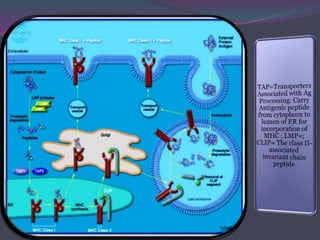
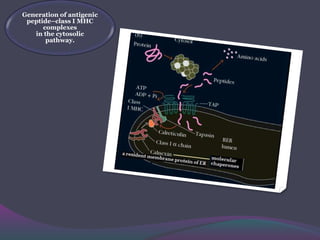
Generation of antigenic
peptide–class I MHC
complexes
in the cytosolic
pathway.
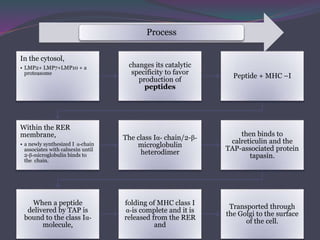
Process
In the cytosol,
• LMP2+ LMP7+LMP10 + a
proteasome
changes its catalytic
specificity to favor
production of
peptides
Peptide + MHC –I
Within the RER
membrane,
• a newly synthesized I α-chain
associates with calnexin until
2-β-microglobulin binds to
the chain.
The class Iα- chain/2-β-
microglobulin
heterodimer
then binds to
calreticulin and the
TAP-associated protein
tapasin.
When a peptide
delivered by TAP is
bound to the class Iα-
molecule,
folding of MHC class I
α-is complete and it is
released from the RER
and
Transported through
the Golgi to the surface
of the cell.
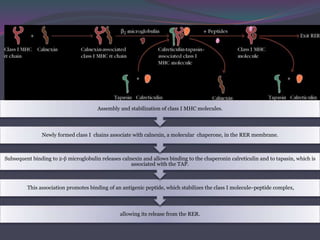
allowing its release from the RER.
This association promotes binding of an antigenic peptide, which stabilizes the class I molecule–peptide complex,
Subsequent binding to 2-β microglobulin releases calnexin and allows binding to the chaperonin calreticulin and to tapasin, which is
associated with the TAP.
Newly formed class I chains associate with calnexin, a molecular chaperone, in the RER membrane.
Assembly and stabilization of class I MHC molecules.
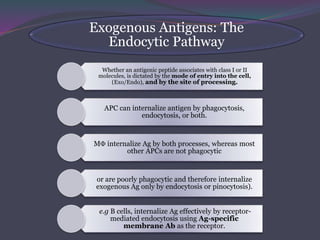
Exogenous Antigens: The
Endocytic Pathway
Whether an antigenic peptide associates with class I or II
molecules, is dictated by the mode of entry into the cell,
(Exo/Endo), and by the site of processing.
APC can internalize antigen by phagocytosis,
endocytosis, or both.
MΦ internalize Ag by both processes, whereas most
other APCs are not phagocytic
or are poorly phagocytic and therefore internalize
exogenous Ag only by endocytosis or pinocytosis).
e.g B cells, internalize Ag effectively by receptor-
mediated endocytosis using Ag-specific
membrane Ab as the receptor.
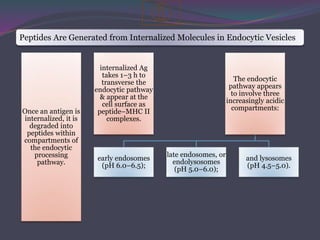
Peptides Are Generated from Internalized Molecules in Endocytic Vesicles
Once an antigen is
internalized, it is
degraded into
peptides within
compartments of
the endocytic
processing
pathway.
internalized Ag
takes 1–3 h to
transverse the
endocytic pathway
& appear at the
cell surface as
peptide–MHC II
complexes.
The endocytic
pathway appears
to involve three
increasingly acidic
compartments:
early endosomes
(pH 6.0–6.5);
late endosomes, or
endolysosomes
(pH 5.0–6.0);
and lysosomes
(pH 4.5–5.0).
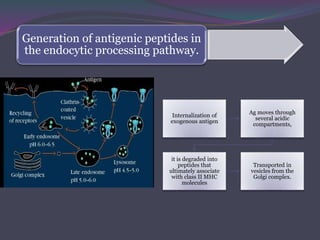
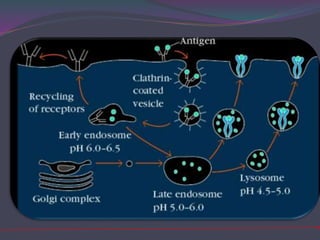
Generation of antigenic peptides in
the endocytic processing pathway.
Internalization of
exogenous antigen
Ag moves through
several acidic
compartments,
it is degraded into
peptides that
ultimately associate
with class II MHC
molecules
Transported in
vesicles from the
Golgi complex.
The Invariant Chain [Ii]Guides Transport of Class II MHC
Molecules to Endocytic Vesicles
Since antigen-presenting
cells express both class I
and class II MHC
molecules,
Some mechanism must
exist to prevent class II
MHC molecules from
binding to the same set of
antigenic peptides as the
class I molecules.
When class II MHC
molecule are
synthesized within
the RER, 3 pairs of
class II chains
associate with a
preassembled trimer
of a protein called
invariant chain (Ii,
CD74).
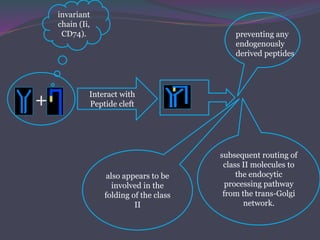
+ Interact with
Peptide cleft
preventing any
endogenously
derived peptides
invariant
chain (Ii,
CD74).
subsequent routing of
class II molecules to
the endocytic
processing pathway
from the trans-Golgi
network.
also appears to be
involved in the
folding of the class
II
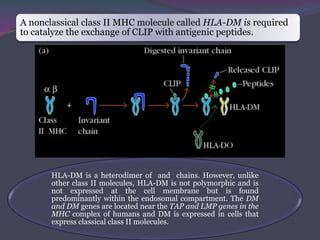
A nonclassical class II MHC molecule called HLA-DM is required
to catalyze the exchange of CLIP with antigenic peptides.
HLA-DM is a heterodimer of and chains. However, unlike
other class II molecules, HLA-DM is not polymorphic and is
not expressed at the cell membrane but is found
predominantly within the endosomal compartment. The DM
and DM genes are located near the TAP and LMP genes in the
MHC complex of humans and DM is expressed in cells that
express classical class II molecules.
The reaction between HLA-DM
and the class II CLIP complex
facilitating exchange of CLIP for
another peptide is impaired in the
presence of HLA-DO, which
binds to HLADM and lessens the
efficiency of the exchange
reaction.
HLADO, like HLA-DM, is a
nonclassical and non-
polymorphic class II molecule
that is also found in the MHC of
other species.
HLA-DO differs from HLA-DM in
that it is expressed only by B cells
and the thymus, and unlike other
class II molecules, its expression
is not induced by IFN-.
An additional difference is that
the genes encoding the and the
chains of HLA-DO are not
adjacent in the MHC as are all
other class II and pairs

Antigen processing & presentation

  • 1.
  • 2.
    What is iT? Priorto put Antigen before T-Cells, MHC processed and make it the Antigen presentable For presentation, antigen must be fit into cleft of MHC presentation zone T Cells DO NOT recognize antigen until & unless it is not put before them by MHCs
  • 3.
    Antigen Processing & Presentation •Preparing a peptide from pathogen (antigen) which can be fix on peptide presenting cleft of MHC molecule Ag Processing • The degraded peptide then associated with MHC, transported to membrane surface and where they displayed to TCR Antigen Presentation
  • 4.
    Way of Processing Whetheran antigenic peptide associates with class I or II molecules, is dictated by the mode of entry into the cell, by the site of processing Ag may be processed in 2 ways Exogenous The processing is done in endosome internalize antigen by phagocytosis, endocytosis, or both Endogenous Peptide must be processed inside the cell (cytoplasm) e.g. Normal cell protein, Tumor Associated Antigens (TAA), Bacteria, Virus
  • 6.
    Experimental demonstration ofself-MHC restriction of TH cells. Peritoneal exudate cells from strain 2, strain 13, or (2 13) F1 guinea pigs were incubated in plastic Petri dishes, allowing enrichment of macrophages, which are adherent cells. The peritoneal macrophages were then incubated with antigen. These “antigen- pulsed” macrophages were incubated in vitro with T cells from strain 2, strain 13, or (2 13) F1 guinea pigs, and the degree of T-cell proliferation was assessed. The results indicated that TH cells could proliferate only in response to antigen presented by macrophages that shared MHC alleles.
  • 9.
    • Endogenous Antigen:Cytosolic Pathway follow the same pathway as use in degradation of normal protein • Ubiquitin+ATP Endogenous Ag • Peptides Cytoplasmic Proteiosome Complex • ER TAP • Peptide~MHC-I
  • 11.
    A proteasome cancleave peptide bonds between 2 or 3 different amino acid combinations in an ATP- dependent process . Degradation of ubiquitin- protein complexes is thought to occur within the central hollow of the proteasome. All three are induced by increased levels of the T-cell cytokine IFN-. The peptidase activities of proteasomes containing LMP2, LMP7, and LMP10 preferentially generate peptides that bind to MHC class I molecules. Proteosome
  • 12.
    Experimental evidence indicatesthat the immune system utilizes this general pathway of protein degradation to produce small peptides for presentation with class I MHC molecules. peptides that bind to class I MHC molecules terminate almost exclusively with hydrophobic or basic residues.
  • 14.
    Subsequent experiments showed that........ thedefect in expression of MHC in the RMA-S cell line occurred due-------------- problem in the protein that transports peptides from the cytoplasm to the RER, where class I molecules are synthesized When RMA-S cells were transfected with a functional gene encoding the transporter protein, the cells began to express class I molecules on the membrane.
  • 15.
    • TAP1 andTAP2 TAP is a membrane-spanning heterodimer consisting of two proteins: • the TAP1 and TAP2 proteins each have a domain projecting into the lumen of the RER, and an ATP-binding domain that projects into the cytosol. In addition to their multiple transmembrane segments, • these proteins mediate ATP- dependent transport of amino acids, sugars, ions, and peptides. Both TAP1 and TAP2 belong to the family of ATP- binding cassette proteins found in the membranes of many cells, The transporter protein, designated as TAP (transporter associated with antigen processing)
  • 16.
    Generation of antigenic peptide–classI MHC complexes in the cytosolic pathway.
  • 17.
    Process In the cytosol, •LMP2+ LMP7+LMP10 + a proteasome changes its catalytic specificity to favor production of peptides Peptide + MHC –I Within the RER membrane, • a newly synthesized I α-chain associates with calnexin until 2-β-microglobulin binds to the chain. The class Iα- chain/2-β- microglobulin heterodimer then binds to calreticulin and the TAP-associated protein tapasin. When a peptide delivered by TAP is bound to the class Iα- molecule, folding of MHC class I α-is complete and it is released from the RER and Transported through the Golgi to the surface of the cell.
  • 18.
    allowing its releasefrom the RER. This association promotes binding of an antigenic peptide, which stabilizes the class I molecule–peptide complex, Subsequent binding to 2-β microglobulin releases calnexin and allows binding to the chaperonin calreticulin and to tapasin, which is associated with the TAP. Newly formed class I chains associate with calnexin, a molecular chaperone, in the RER membrane. Assembly and stabilization of class I MHC molecules.
  • 19.
    Exogenous Antigens: The EndocyticPathway Whether an antigenic peptide associates with class I or II molecules, is dictated by the mode of entry into the cell, (Exo/Endo), and by the site of processing. APC can internalize antigen by phagocytosis, endocytosis, or both. MΦ internalize Ag by both processes, whereas most other APCs are not phagocytic or are poorly phagocytic and therefore internalize exogenous Ag only by endocytosis or pinocytosis). e.g B cells, internalize Ag effectively by receptor- mediated endocytosis using Ag-specific membrane Ab as the receptor.
  • 20.
    Peptides Are Generatedfrom Internalized Molecules in Endocytic Vesicles Once an antigen is internalized, it is degraded into peptides within compartments of the endocytic processing pathway. internalized Ag takes 1–3 h to transverse the endocytic pathway & appear at the cell surface as peptide–MHC II complexes. The endocytic pathway appears to involve three increasingly acidic compartments: early endosomes (pH 6.0–6.5); late endosomes, or endolysosomes (pH 5.0–6.0); and lysosomes (pH 4.5–5.0).
  • 21.
    Generation of antigenicpeptides in the endocytic processing pathway. Internalization of exogenous antigen Ag moves through several acidic compartments, it is degraded into peptides that ultimately associate with class II MHC molecules Transported in vesicles from the Golgi complex.
  • 22.
    The Invariant Chain[Ii]Guides Transport of Class II MHC Molecules to Endocytic Vesicles Since antigen-presenting cells express both class I and class II MHC molecules, Some mechanism must exist to prevent class II MHC molecules from binding to the same set of antigenic peptides as the class I molecules. When class II MHC molecule are synthesized within the RER, 3 pairs of class II chains associate with a preassembled trimer of a protein called invariant chain (Ii, CD74).
  • 23.
    + Interact with Peptidecleft preventing any endogenously derived peptides invariant chain (Ii, CD74). subsequent routing of class II molecules to the endocytic processing pathway from the trans-Golgi network. also appears to be involved in the folding of the class II
  • 25.
    A nonclassical classII MHC molecule called HLA-DM is required to catalyze the exchange of CLIP with antigenic peptides. HLA-DM is a heterodimer of and chains. However, unlike other class II molecules, HLA-DM is not polymorphic and is not expressed at the cell membrane but is found predominantly within the endosomal compartment. The DM and DM genes are located near the TAP and LMP genes in the MHC complex of humans and DM is expressed in cells that express classical class II molecules.
  • 26.
    The reaction betweenHLA-DM and the class II CLIP complex facilitating exchange of CLIP for another peptide is impaired in the presence of HLA-DO, which binds to HLADM and lessens the efficiency of the exchange reaction. HLADO, like HLA-DM, is a nonclassical and non- polymorphic class II molecule that is also found in the MHC of other species. HLA-DO differs from HLA-DM in that it is expressed only by B cells and the thymus, and unlike other class II molecules, its expression is not induced by IFN-. An additional difference is that the genes encoding the and the chains of HLA-DO are not adjacent in the MHC as are all other class II and pairs