NORMAL
HEMOSTASIS
PRESENTED BY-
DR. DHARMENDRA SINGH
JR 1
NORMAL HEMOSTASIS
 HEMO=BLOOD, STASIS=STANDING
 Normal physiological process by which blood clots form at sites
of vascular injury and preventing blood loss while maintaining
blood in a fluid state within vascular system.
IMPORTANCE OF HEMOSTASIS
 To maintain blood in a fluid state while it remains circulating within
the vascular system.
 To stop bleeding at the site of vascular injury by formation of
hemostatic plug.
 To limit hemostasis process to the site of damaged blood vessel.
 To ensure the eventual removal of the plug while healing is
completed.
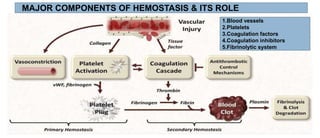
MAJOR COMPONENTS OF HEMOSTASIS & ITS ROLE
1.Blood vessels
2.Platelets
3.Coagulation factors
4.Coagulation inhibitors
5.Fibrinolytic system
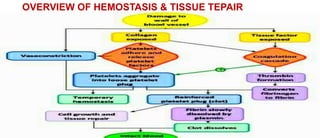
SEQUENCE OF HEMOSTASIS
I. Arteriolar vasoconstriction
II. Primary hemostasis : formation of platelet plug
III. Secondary hemostasis : coagulation of blood and deposition
of fibrin clots
IV. Fibrin clots retraction and stabilisation
V. Fibrinolysis
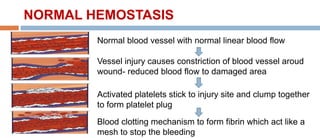
NORMAL HEMOSTASIS
Normal blood vessel with normal linear blood flow
Vessel injury causes constriction of blood vessel aroud
wound- reduced blood flow to damaged area
Activated platelets stick to injury site and clump together
to form platelet plug
Blood clotting mechanism to form fibrin which act like a
mesh to stop the bleeding
PHYSICAL PROPERTIES THAT PREVENT CLOT FORMATION IN NORMAL
BLOOD VESSELS
 Lamellar flow of blood in vessel-cellular components flow in center of
stream and away from endothelial surface.
 Smoothness of endothelial cell surface.
 A layer of glycocalyx on endothelium which repels clotting factors &
platelets.
 Surface of endothelium is negatively charged which repels circulating
platelets and proteins which are also negatively charged.
 Endothelium shields platelets from collagen, tissue factor & other pro-
aggregatory components of sub-endothelial layer.
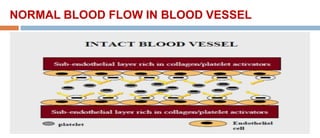
NORMAL BLOOD FLOW IN BLOOD VESSEL
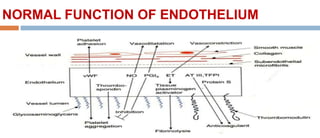
SUBSTANCES RELEASED FROM OR FOUND ON THE SURFACE OF
ENDOTHELIAL CELLS PREVENT CLOT FORMATION IN NORMAL
BLOOD VESSEL
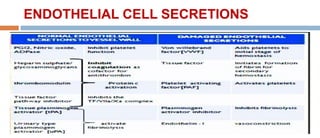
 Prostaglandin I2[PGI2]- produced from endothelium-prevents platelets
aggregation and its activation.
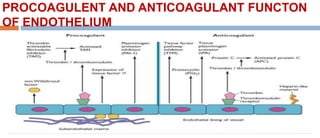
 Thrombomodulin- expressed on surface of endothelial cells-binds with
thrombin & modulates function of thrombin- activates Protein C –causes
inactivation of coagulation factor F Va & F VIIIa.
 Heparan sulfate- on surface of endothelium-binds & activates Antithrombin
III- inhibits thrombin & coagulation factor IXa, Xa, XIa & XIIa.
 Tissue plasminogen activator[tPA]- released from endothelium-
activates plasminogen to plasmin which breaks down abnormaly
formed fibrin into fibrin degradation product.
 Prostacyclin & Nitric oxide-inhibits platelet adhesion &
aggregation, promotes vasodilation.
 ATPase & ADPase-ATP & ADP produced by platelets are
inactivated.
 Tissue factor pathway inhibitors[TFPI]-binds and inhibits TF-F
VIIa complex
NORMAL FUNCTION OF ENDOTHELIUM
PROCOAGULENT AND ANTICOAGULANT FUNCTON
OF ENDOTHELIUM
ENDOTHELIAL CELL SECRETIONS
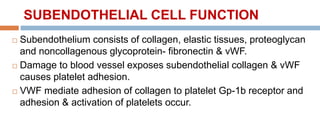
SUBENDOTHELIAL CELL FUNCTION
 Subendothelium consists of collagen, elastic tissues, proteoglycan
and noncollagenous glycoprotein- fibronectin & vWF.
 Damage to blood vessel exposes subendothelial collagen & vWF
causes platelet adhesion.
 VWF mediate adhesion of collagen to platelet Gp-1b receptor and
adhesion & activation of platelets occur.
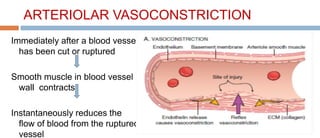
ARTERIOLAR VASOCONSTRICTION
Immediately after a blood vessel
has been cut or ruptured
Smooth muscle in blood vessel
wall contracts
Instantaneously reduces the
flow of blood from the ruptured
vessel
THE SMOOTH MUSCLE CONTRACTION RESULT FROM
1. Reflex neurogenic mechanism- pain nerve impulse from injured vessel and
nearby tissue.
2. Local myogenic spasm- due to direct damage to the vascular wall.
3. Local autocoid factors- potent local vasoconstrictor
I.Endothelin-Released by injured endothelium
II.Thromboxane A2 & Serotonin-Released by activated platlets.
 Decreased blood flow and pressure in damaged area lasts for several
minutes to even hours,during which time process of platelet plugging and
blood coagulation can take place.
PLATELETS
 Disc shaped anucleated cell fragment.
 Produced by cytoplasmic fragmentation of megakaryocytes in
bone marrow.
 Size- 1 to 4 micrometer.
 Lifespan- 7 to 12 days.
 Normal blood count- 1.5 lac to 4.5 lac/ml.
 Eliminated by tissue macrophage system in spleen.
 Adhere to the endothelial wall at the site of injury.
 Aggregate to form a plug at the site of vessel injury.
 Provide phospholipid surface for activated coagulation enzyme
complex.
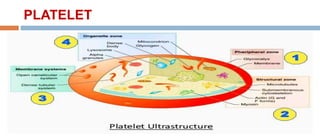
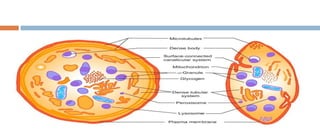
PLATELETS:STRUCTURE
 Contractile protein- Actin, Myosin & Thrombosthenin.
 ER & Golgi apparatus-synthesis of enzymes and store large quantities of
calcium.
 Mitrochondria- forming ATP & ADP.
 Enzyme system- prostaglandins synthesis.
 Growth factor-for multiplication & growth of endothelial cells,
smooth muscle cells & fibroblast.
Cell membrane of platelets is coated with a negative charge
glycoprotein glycocalyx that repulses adherence to normal
endothelium.
Membrane phospholipid- activate multiple stages in the blood
clotting process and provide surface for it.
PLATELET
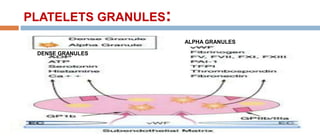
PLATELETS GRANULES:
ALPHA GRANULES
DENSE GRANULES
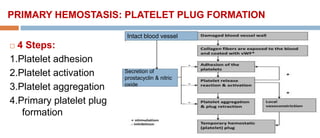
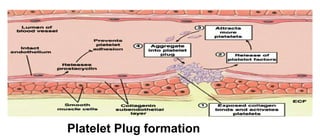
PRIMARY HEMOSTASIS: PLATELET PLUG FORMATION
 4 Steps:
1.Platelet adhesion
2.Platelet activation
3.Platelet aggregation
4.Primary platelet plug
formation
Intact blood vessel
Secretion of
prostacyclin & nitric
oxide
Platelet Plug formation
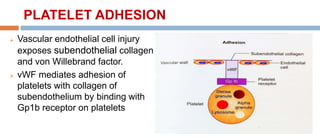
PLATELET ADHESION
 Vascular endothelial cell injury
exposes subendothelial collagen
and von Willebrand factor.
 vWF mediates adhesion of
platelets with collagen of
subendothelium by binding with
Gp1b receptor on platelets
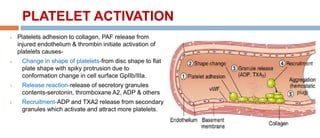
PLATELET ACTIVATION
 Platelets adhesion to collagen, PAF release from
injured endothelium & thrombin initiate activation of
platelets causes-
 Change in shape of platelets-from disc shape to flat
plate shape with spiky protrusion due to
conformation change in cell surface GpIIb/IIIa.
1. Release reaction-release of secretory granules
contents-serotonin, thromboxane A2, ADP & others
2. Recruitment-ADP and TXA2 release from secondary
granules which activate and attract more platelets.
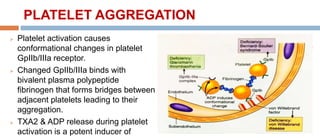
PLATELET AGGREGATION
 Platelet activation causes
conformational changes in platelet
GpIIb/IIIa receptor.
 Changed GpIIb/IIIa binds with
bivalent plasma polypeptide
fibrinogen that forms bridges between
adjacent platelets leading to their
aggregation.
 TXA2 & ADP release during platelet
activation is a potent inducer of
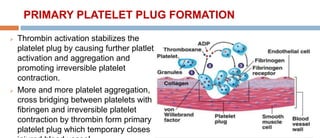
PRIMARY PLATELET PLUG FORMATION
 Thrombin activation stabilizes the
platelet plug by causing further platlet
activation and aggregation and
promoting irreversible platelet
contraction.
 More and more platelet aggregation,
cross bridging between platelets with
fibringen and irreversible platelet
contraction by thrombin form primary
platelet plug which temporary closes
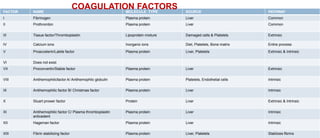
COAGULATION FACTORS
 Normally coagulation factors are circulating in the blood in an inactive
form.
 All coagulation factors are protein except tissue factor[thromboplastin] &
calcium.
 Most of coagulation factors are synthesised by liver except tissue factor
and calcium.
 Tissue factor synthesised by various tissues and calcium from bones
and diet.
 F V & F XIII synthesised by platelets in addition to liver.
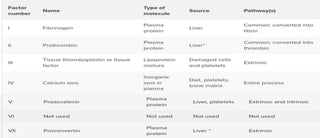
FACTOR NAME MOLECULE TYPE SOURCE PATHWAY
I Fibrinogen Plasma protein Liver Common
II Prothrombin Plasma protein Liver Common
III Tissue factor/Thromboplastin Lipoprotein mixture Damaged cells & Platelets Extrinsic
IV Calcium ions Inorganic ions Diet, Platelets, Bone matrix Entire process
V Proaccelerin/Labile factor Plasma protein Liver, Platelets Extrinsic & Intrinsic
VI Does not exist
VII Proconvertin/Stable factor Plasma protein Liver Extrinsic
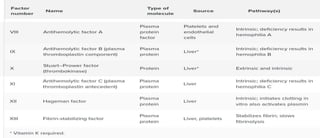
VIII Antihemophilicfactor A/ Antihemophlic globulin Plasma protein Platelets, Endothelial cells Intrinsic
IX Antihemophilic factor B/ Christmas factor Plasma protein Liver Intrinsic
X Stuart prower factor Protein Liver Extrinsic & Intrinsic
XI Antihemophilic factor C/ Plasma thromboplastin
anticedent
Plasma protein Liver Intrinsic
XII Hageman factor Plasma protein Liver Intrinsic
XIII Fibrin stabilizing factor Plasma protein Liver, Platelets Stablizes fibrins
COAGULATION FACTORS
SECONDARY HEMOSTASIS:COAGULATION OF BLOOD AND
DEPOSITION OF FIBRIN CLOTS
 Coagulation of blood is a series of amplìfying enzymatic reaction
that leads to deposition of an insoluble fibrin clots.
 These reactions occur on negatively charged phospholipid surface
which is provided by activated platelets.
 Each reaction step involves-
 An enzyme-an activated coagulation factor
 A substrate-an inactive proenzyme form of a coagulation factor
 A cofactor-a reaction accelerator
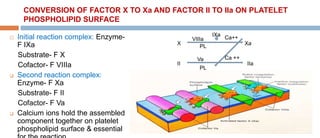
CONVERSION OF FACTOR X TO Xa AND FACTOR II TO IIa ON PLATELET
PHOSPHOLIPID SURFACE
 Initial reaction complex: Enzyme-
F IXa
Substrate- F X
Cofactor- F VIIIa
 Second reaction complex:
Enzyme- F Xa
Substrate- F II
Cofactor- F Va
 Calcium ions hold the assembled
component together on platelet
phospholipid surface & essential
X Xa
IXa
VIIIa Ca++
II IIa
Va Ca ++
PL
PL
MECHANISM OF BLOOD COAGULATION
 In normal blood stream flow, anticoagulant activity normally predominates
so blood does not coagulate.
 When there is injury to the vessel wall, procoagulant from the area of
damage tissue becomes activated and override the anticoagulant and
then coagulation process start.
 Initiator of coagulation:
 Trauma to vessel wall and adjacent tissue
 Trauma to the blood
 Contact of blood with damaged endothelial cells, collagen and other
tissue outside blood vessel.
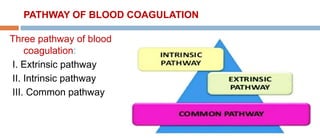
PATHWAY OF BLOOD COAGULATION
Three pathway of blood
coagulation:
I. Extrinsic pathway
II. Intrinsic pathway
III. Common pathway
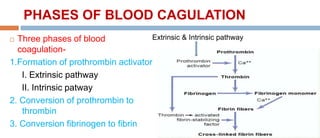
PHASES OF BLOOD CAGULATION
 Three phases of blood
coagulation-
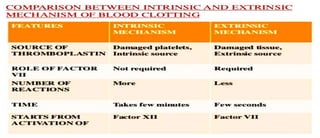
1.Formation of prothrombin activator
I. Extrinsic pathway
II. Intrinsic patway
2. Conversion of prothrombin to
thrombin
3. Conversion fibrinogen to fibrin
Extrinsic & Intrinsic pathway
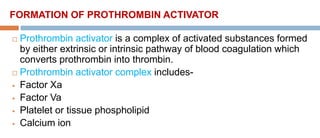
FORMATION OF PROTHROMBIN ACTIVATOR
 Prothrombin activator is a complex of activated substances formed
by either extrinsic or intrinsic pathway of blood coagulation which
converts prothrombin into thrombin.
 Prothrombin activator complex includes-
 Factor Xa
 Factor Va
 Platelet or tissue phospholipid
 Calcium ion
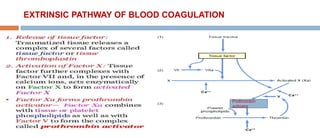
EXTRINSIC PATHWAY OF BLOOD COAGULATION
Prothrombin
activator
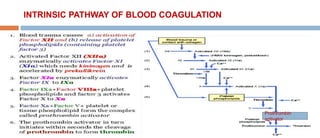
INTRINSIC PATHWAY OF BLOOD COAGULATION
Prothrombin
activator
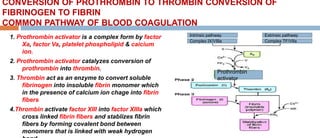
CONVERSION OF PROTHROMBIN TO THROMBIN CONVERSION OF
FIBRINOGEN TO FIBRIN
COMMON PATHWAY OF BLOOD COAGULATION
1. Prothrombin activator is a complex form by factor
Xa, factor Va, platelet phospholipid & caicium
ion.
2. Prothrombin activator catalyzes conversion of
prothrombin into thrombin.
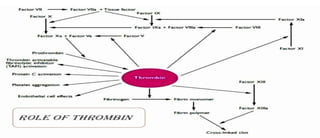
3. Thrombin act as an enzyme to convert soluble
fibrinogen into insoluble fibrin monomer which
in the presence of calcium ion chage into fibrin
fibers
4.Thrombin activate factor XIII into factor XIIIa which
cross linked fibrin fibers and stablizes fibrin
fibers by forming covalent bond between
monomers that is linked with weak hydrogen
Prothrombin
activator
Complex IX/VIIIa Complex TF/VIIa
Intrinsic pathway Extrinsic pathway
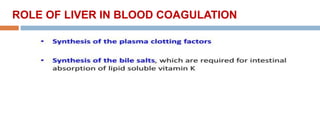
ROLE OF LIVER IN BLOOD COAGULATION
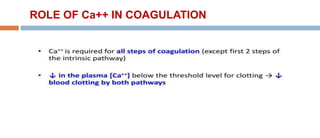
ROLE OF Ca++ IN COAGULATION
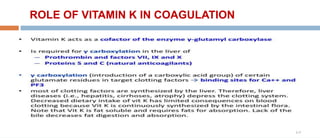
ROLE OF VITAMIN K IN COAGULATION
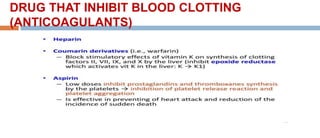
DRUG THAT INHIBIT BLOOD CLOTTING
(ANTICOAGULANTS)
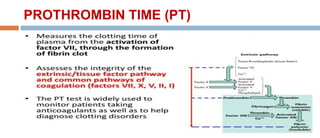
PROTHROMBIN TIME (PT)
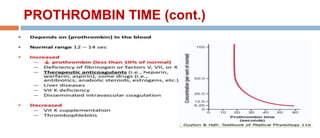
PROTHROMBIN TIME (cont.)
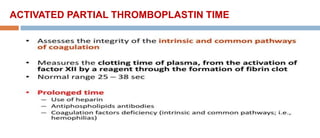
ACTIVATED PARTIAL THROMBOPLASTIN TIME
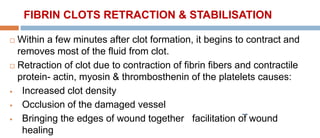
FIBRIN CLOTS RETRACTION & STABILISATION
 Within a few minutes after clot formation, it begins to contract and
removes most of the fluid from clot.
 Retraction of clot due to contraction of fibrin fibers and contractile
protein- actin, myosin & thrombosthenin of the platelets causes:
 Increased clot density
 Occlusion of the damaged vessel
 Bringing the edges of wound together facilitation of wound
healing
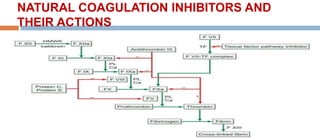
COAGULATION INHIBITORS
 Tissue factor pathway inhibitor[TFPI]-
o Release from endothelium of blood vessel.
o Inhibit TF-F VIIa complex- inhibit coagulation.
 Antithrombin III[AT III]-
o Synthesises in liver.
o Inhibit Thrombin[F IIa], Factor IXa, Xa, Xia, XIIa.
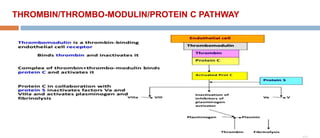
 Protein C & S-
o Protein C is activated by thrombin in presence of thrombomodulin on surface of
endothelium causes proteolysis of F Va, F VIIIa.
o Protein S act as a cofactor & inhance activity of protein C.
NATURAL COAGULATION INHIBITORS AND
THEIR ACTIONS
THROMBIN/THROMBO-MODULIN/PROTEIN C PATHWAY
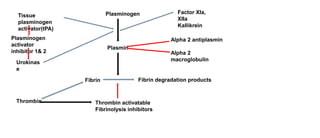
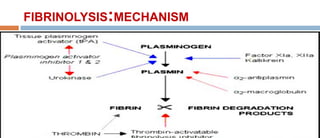
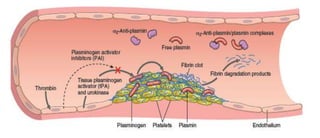
FIBRINOLYTIC SYSTEM
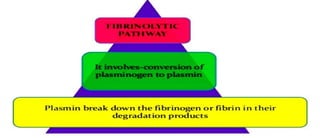
 Fibrinolysis is the the process of dissolution of blood clot to
limit the size of clot and to ensure free flow of blood in vascular
system.
FIBRINOLYTIC SYSTEM:ACTIVATOR
 Tissue plasminogen activator[tPA]-
 Secreted by endothelial cells.
 Activates Plasminogen to Plasmin.
 Urokinase-
 Produced by kidney.
 Activates plasminogen to plasmin.
 Plasmin-
 Degraded fibrinogen/fibrin into fibrinogen/fibrin degration
product[FDPs].
FIBRINOLYTIC SYSTEM:INHIBITORS
 Plasminogen activator inhibitor type 1& 2-
o Inhibit tPA.
 Alpha 2 antiplasmin, alpha 2 macroglobulin-
o Bind with free plasmin in plasma so inhibit action of plasmin on
fibrin/fibrinogen.
 Thrombin activable fibrinolysis inhibitors-
o Inhibit degradation of fibrin to fibrin degration product
Tissue
plasminogen
activator(tPA)
Plasminogen
activator
inhibitor 1& 2
Urokinas
e
Plasminogen
Plasmin
Fibrin Fibrin degradation products
Factor XIa,
XIIa
Kallikrein
Alpha 2 antiplasmin
Alpha 2
macroglobulin
Thrombin Thrombin activatable
Fibrinolysis inhibitors
FIBRINOLYSIS:MECHANISM
OVERVIEW OF HEMOSTASIS & TISSUE TEPAIR
NORMAL HEMOSTASIS
NORMAL HEMOSTASIS

NORMAL HEMOSTASIS

  • 1.
  • 2.
    NORMAL HEMOSTASIS  HEMO=BLOOD,STASIS=STANDING  Normal physiological process by which blood clots form at sites of vascular injury and preventing blood loss while maintaining blood in a fluid state within vascular system.
  • 3.
    IMPORTANCE OF HEMOSTASIS To maintain blood in a fluid state while it remains circulating within the vascular system.  To stop bleeding at the site of vascular injury by formation of hemostatic plug.  To limit hemostasis process to the site of damaged blood vessel.  To ensure the eventual removal of the plug while healing is completed.
  • 4.
    MAJOR COMPONENTS OFHEMOSTASIS & ITS ROLE 1.Blood vessels 2.Platelets 3.Coagulation factors 4.Coagulation inhibitors 5.Fibrinolytic system
  • 5.
    SEQUENCE OF HEMOSTASIS I.Arteriolar vasoconstriction II. Primary hemostasis : formation of platelet plug III. Secondary hemostasis : coagulation of blood and deposition of fibrin clots IV. Fibrin clots retraction and stabilisation V. Fibrinolysis
  • 6.
    NORMAL HEMOSTASIS Normal bloodvessel with normal linear blood flow Vessel injury causes constriction of blood vessel aroud wound- reduced blood flow to damaged area Activated platelets stick to injury site and clump together to form platelet plug Blood clotting mechanism to form fibrin which act like a mesh to stop the bleeding
  • 7.
    PHYSICAL PROPERTIES THATPREVENT CLOT FORMATION IN NORMAL BLOOD VESSELS  Lamellar flow of blood in vessel-cellular components flow in center of stream and away from endothelial surface.  Smoothness of endothelial cell surface.  A layer of glycocalyx on endothelium which repels clotting factors & platelets.  Surface of endothelium is negatively charged which repels circulating platelets and proteins which are also negatively charged.  Endothelium shields platelets from collagen, tissue factor & other pro- aggregatory components of sub-endothelial layer.
  • 8.
    NORMAL BLOOD FLOWIN BLOOD VESSEL
  • 9.
    SUBSTANCES RELEASED FROMOR FOUND ON THE SURFACE OF ENDOTHELIAL CELLS PREVENT CLOT FORMATION IN NORMAL BLOOD VESSEL  Prostaglandin I2[PGI2]- produced from endothelium-prevents platelets aggregation and its activation.  Thrombomodulin- expressed on surface of endothelial cells-binds with thrombin & modulates function of thrombin- activates Protein C –causes inactivation of coagulation factor F Va & F VIIIa.  Heparan sulfate- on surface of endothelium-binds & activates Antithrombin III- inhibits thrombin & coagulation factor IXa, Xa, XIa & XIIa.
  • 10.
     Tissue plasminogenactivator[tPA]- released from endothelium- activates plasminogen to plasmin which breaks down abnormaly formed fibrin into fibrin degradation product.  Prostacyclin & Nitric oxide-inhibits platelet adhesion & aggregation, promotes vasodilation.  ATPase & ADPase-ATP & ADP produced by platelets are inactivated.  Tissue factor pathway inhibitors[TFPI]-binds and inhibits TF-F VIIa complex
  • 11.
    NORMAL FUNCTION OFENDOTHELIUM
  • 12.
    PROCOAGULENT AND ANTICOAGULANTFUNCTON OF ENDOTHELIUM
  • 13.
  • 14.
    SUBENDOTHELIAL CELL FUNCTION Subendothelium consists of collagen, elastic tissues, proteoglycan and noncollagenous glycoprotein- fibronectin & vWF.  Damage to blood vessel exposes subendothelial collagen & vWF causes platelet adhesion.  VWF mediate adhesion of collagen to platelet Gp-1b receptor and adhesion & activation of platelets occur.
  • 15.
    ARTERIOLAR VASOCONSTRICTION Immediately aftera blood vessel has been cut or ruptured Smooth muscle in blood vessel wall contracts Instantaneously reduces the flow of blood from the ruptured vessel
  • 16.
    THE SMOOTH MUSCLECONTRACTION RESULT FROM 1. Reflex neurogenic mechanism- pain nerve impulse from injured vessel and nearby tissue. 2. Local myogenic spasm- due to direct damage to the vascular wall. 3. Local autocoid factors- potent local vasoconstrictor I.Endothelin-Released by injured endothelium II.Thromboxane A2 & Serotonin-Released by activated platlets.  Decreased blood flow and pressure in damaged area lasts for several minutes to even hours,during which time process of platelet plugging and blood coagulation can take place.
  • 17.
    PLATELETS  Disc shapedanucleated cell fragment.  Produced by cytoplasmic fragmentation of megakaryocytes in bone marrow.  Size- 1 to 4 micrometer.  Lifespan- 7 to 12 days.  Normal blood count- 1.5 lac to 4.5 lac/ml.
  • 18.
     Eliminated bytissue macrophage system in spleen.  Adhere to the endothelial wall at the site of injury.  Aggregate to form a plug at the site of vessel injury.  Provide phospholipid surface for activated coagulation enzyme complex.
  • 19.
    PLATELETS:STRUCTURE  Contractile protein-Actin, Myosin & Thrombosthenin.  ER & Golgi apparatus-synthesis of enzymes and store large quantities of calcium.  Mitrochondria- forming ATP & ADP.  Enzyme system- prostaglandins synthesis.
  • 20.
     Growth factor-formultiplication & growth of endothelial cells, smooth muscle cells & fibroblast. Cell membrane of platelets is coated with a negative charge glycoprotein glycocalyx that repulses adherence to normal endothelium. Membrane phospholipid- activate multiple stages in the blood clotting process and provide surface for it.
  • 21.
  • 23.
  • 24.
    PRIMARY HEMOSTASIS: PLATELETPLUG FORMATION  4 Steps: 1.Platelet adhesion 2.Platelet activation 3.Platelet aggregation 4.Primary platelet plug formation Intact blood vessel Secretion of prostacyclin & nitric oxide
  • 25.
  • 26.
    PLATELET ADHESION  Vascularendothelial cell injury exposes subendothelial collagen and von Willebrand factor.  vWF mediates adhesion of platelets with collagen of subendothelium by binding with Gp1b receptor on platelets
  • 27.
    PLATELET ACTIVATION  Plateletsadhesion to collagen, PAF release from injured endothelium & thrombin initiate activation of platelets causes-  Change in shape of platelets-from disc shape to flat plate shape with spiky protrusion due to conformation change in cell surface GpIIb/IIIa. 1. Release reaction-release of secretory granules contents-serotonin, thromboxane A2, ADP & others 2. Recruitment-ADP and TXA2 release from secondary granules which activate and attract more platelets.
  • 28.
    PLATELET AGGREGATION  Plateletactivation causes conformational changes in platelet GpIIb/IIIa receptor.  Changed GpIIb/IIIa binds with bivalent plasma polypeptide fibrinogen that forms bridges between adjacent platelets leading to their aggregation.  TXA2 & ADP release during platelet activation is a potent inducer of
  • 29.
    PRIMARY PLATELET PLUGFORMATION  Thrombin activation stabilizes the platelet plug by causing further platlet activation and aggregation and promoting irreversible platelet contraction.  More and more platelet aggregation, cross bridging between platelets with fibringen and irreversible platelet contraction by thrombin form primary platelet plug which temporary closes
  • 30.
    COAGULATION FACTORS  Normallycoagulation factors are circulating in the blood in an inactive form.  All coagulation factors are protein except tissue factor[thromboplastin] & calcium.  Most of coagulation factors are synthesised by liver except tissue factor and calcium.  Tissue factor synthesised by various tissues and calcium from bones and diet.  F V & F XIII synthesised by platelets in addition to liver.
  • 31.
    FACTOR NAME MOLECULETYPE SOURCE PATHWAY I Fibrinogen Plasma protein Liver Common II Prothrombin Plasma protein Liver Common III Tissue factor/Thromboplastin Lipoprotein mixture Damaged cells & Platelets Extrinsic IV Calcium ions Inorganic ions Diet, Platelets, Bone matrix Entire process V Proaccelerin/Labile factor Plasma protein Liver, Platelets Extrinsic & Intrinsic VI Does not exist VII Proconvertin/Stable factor Plasma protein Liver Extrinsic VIII Antihemophilicfactor A/ Antihemophlic globulin Plasma protein Platelets, Endothelial cells Intrinsic IX Antihemophilic factor B/ Christmas factor Plasma protein Liver Intrinsic X Stuart prower factor Protein Liver Extrinsic & Intrinsic XI Antihemophilic factor C/ Plasma thromboplastin anticedent Plasma protein Liver Intrinsic XII Hageman factor Plasma protein Liver Intrinsic XIII Fibrin stabilizing factor Plasma protein Liver, Platelets Stablizes fibrins COAGULATION FACTORS
  • 32.
    SECONDARY HEMOSTASIS:COAGULATION OFBLOOD AND DEPOSITION OF FIBRIN CLOTS  Coagulation of blood is a series of amplìfying enzymatic reaction that leads to deposition of an insoluble fibrin clots.  These reactions occur on negatively charged phospholipid surface which is provided by activated platelets.  Each reaction step involves-  An enzyme-an activated coagulation factor  A substrate-an inactive proenzyme form of a coagulation factor  A cofactor-a reaction accelerator
  • 33.
    CONVERSION OF FACTORX TO Xa AND FACTOR II TO IIa ON PLATELET PHOSPHOLIPID SURFACE  Initial reaction complex: Enzyme- F IXa Substrate- F X Cofactor- F VIIIa  Second reaction complex: Enzyme- F Xa Substrate- F II Cofactor- F Va  Calcium ions hold the assembled component together on platelet phospholipid surface & essential X Xa IXa VIIIa Ca++ II IIa Va Ca ++ PL PL
  • 34.
    MECHANISM OF BLOODCOAGULATION  In normal blood stream flow, anticoagulant activity normally predominates so blood does not coagulate.  When there is injury to the vessel wall, procoagulant from the area of damage tissue becomes activated and override the anticoagulant and then coagulation process start.  Initiator of coagulation:  Trauma to vessel wall and adjacent tissue  Trauma to the blood  Contact of blood with damaged endothelial cells, collagen and other tissue outside blood vessel.
  • 35.
    PATHWAY OF BLOODCOAGULATION Three pathway of blood coagulation: I. Extrinsic pathway II. Intrinsic pathway III. Common pathway
  • 36.
    PHASES OF BLOODCAGULATION  Three phases of blood coagulation- 1.Formation of prothrombin activator I. Extrinsic pathway II. Intrinsic patway 2. Conversion of prothrombin to thrombin 3. Conversion fibrinogen to fibrin Extrinsic & Intrinsic pathway
  • 37.
    FORMATION OF PROTHROMBINACTIVATOR  Prothrombin activator is a complex of activated substances formed by either extrinsic or intrinsic pathway of blood coagulation which converts prothrombin into thrombin.  Prothrombin activator complex includes-  Factor Xa  Factor Va  Platelet or tissue phospholipid  Calcium ion
  • 38.
    EXTRINSIC PATHWAY OFBLOOD COAGULATION Prothrombin activator
  • 39.
    INTRINSIC PATHWAY OFBLOOD COAGULATION Prothrombin activator
  • 40.
    CONVERSION OF PROTHROMBINTO THROMBIN CONVERSION OF FIBRINOGEN TO FIBRIN COMMON PATHWAY OF BLOOD COAGULATION 1. Prothrombin activator is a complex form by factor Xa, factor Va, platelet phospholipid & caicium ion. 2. Prothrombin activator catalyzes conversion of prothrombin into thrombin. 3. Thrombin act as an enzyme to convert soluble fibrinogen into insoluble fibrin monomer which in the presence of calcium ion chage into fibrin fibers 4.Thrombin activate factor XIII into factor XIIIa which cross linked fibrin fibers and stablizes fibrin fibers by forming covalent bond between monomers that is linked with weak hydrogen Prothrombin activator Complex IX/VIIIa Complex TF/VIIa Intrinsic pathway Extrinsic pathway
  • 42.
    ROLE OF LIVERIN BLOOD COAGULATION
  • 43.
    ROLE OF Ca++IN COAGULATION
  • 44.
    ROLE OF VITAMINK IN COAGULATION
  • 45.
    DRUG THAT INHIBITBLOOD CLOTTING (ANTICOAGULANTS)
  • 46.
  • 47.
  • 48.
  • 50.
    FIBRIN CLOTS RETRACTION& STABILISATION  Within a few minutes after clot formation, it begins to contract and removes most of the fluid from clot.  Retraction of clot due to contraction of fibrin fibers and contractile protein- actin, myosin & thrombosthenin of the platelets causes:  Increased clot density  Occlusion of the damaged vessel  Bringing the edges of wound together facilitation of wound healing
  • 51.
    COAGULATION INHIBITORS  Tissuefactor pathway inhibitor[TFPI]- o Release from endothelium of blood vessel. o Inhibit TF-F VIIa complex- inhibit coagulation.  Antithrombin III[AT III]- o Synthesises in liver. o Inhibit Thrombin[F IIa], Factor IXa, Xa, Xia, XIIa.  Protein C & S- o Protein C is activated by thrombin in presence of thrombomodulin on surface of endothelium causes proteolysis of F Va, F VIIIa. o Protein S act as a cofactor & inhance activity of protein C.
  • 52.
  • 53.
  • 55.
    FIBRINOLYTIC SYSTEM  Fibrinolysisis the the process of dissolution of blood clot to limit the size of clot and to ensure free flow of blood in vascular system.
  • 56.
    FIBRINOLYTIC SYSTEM:ACTIVATOR  Tissueplasminogen activator[tPA]-  Secreted by endothelial cells.  Activates Plasminogen to Plasmin.  Urokinase-  Produced by kidney.  Activates plasminogen to plasmin.  Plasmin-  Degraded fibrinogen/fibrin into fibrinogen/fibrin degration product[FDPs].
  • 57.
    FIBRINOLYTIC SYSTEM:INHIBITORS  Plasminogenactivator inhibitor type 1& 2- o Inhibit tPA.  Alpha 2 antiplasmin, alpha 2 macroglobulin- o Bind with free plasmin in plasma so inhibit action of plasmin on fibrin/fibrinogen.  Thrombin activable fibrinolysis inhibitors- o Inhibit degradation of fibrin to fibrin degration product
  • 58.
    Tissue plasminogen activator(tPA) Plasminogen activator inhibitor 1& 2 Urokinas e Plasminogen Plasmin FibrinFibrin degradation products Factor XIa, XIIa Kallikrein Alpha 2 antiplasmin Alpha 2 macroglobulin Thrombin Thrombin activatable Fibrinolysis inhibitors
  • 59.
  • 61.
    OVERVIEW OF HEMOSTASIS& TISSUE TEPAIR