I week of development
Dr. G. Prabavathy
Assistant Professor
Department of Anatomy
Objectives
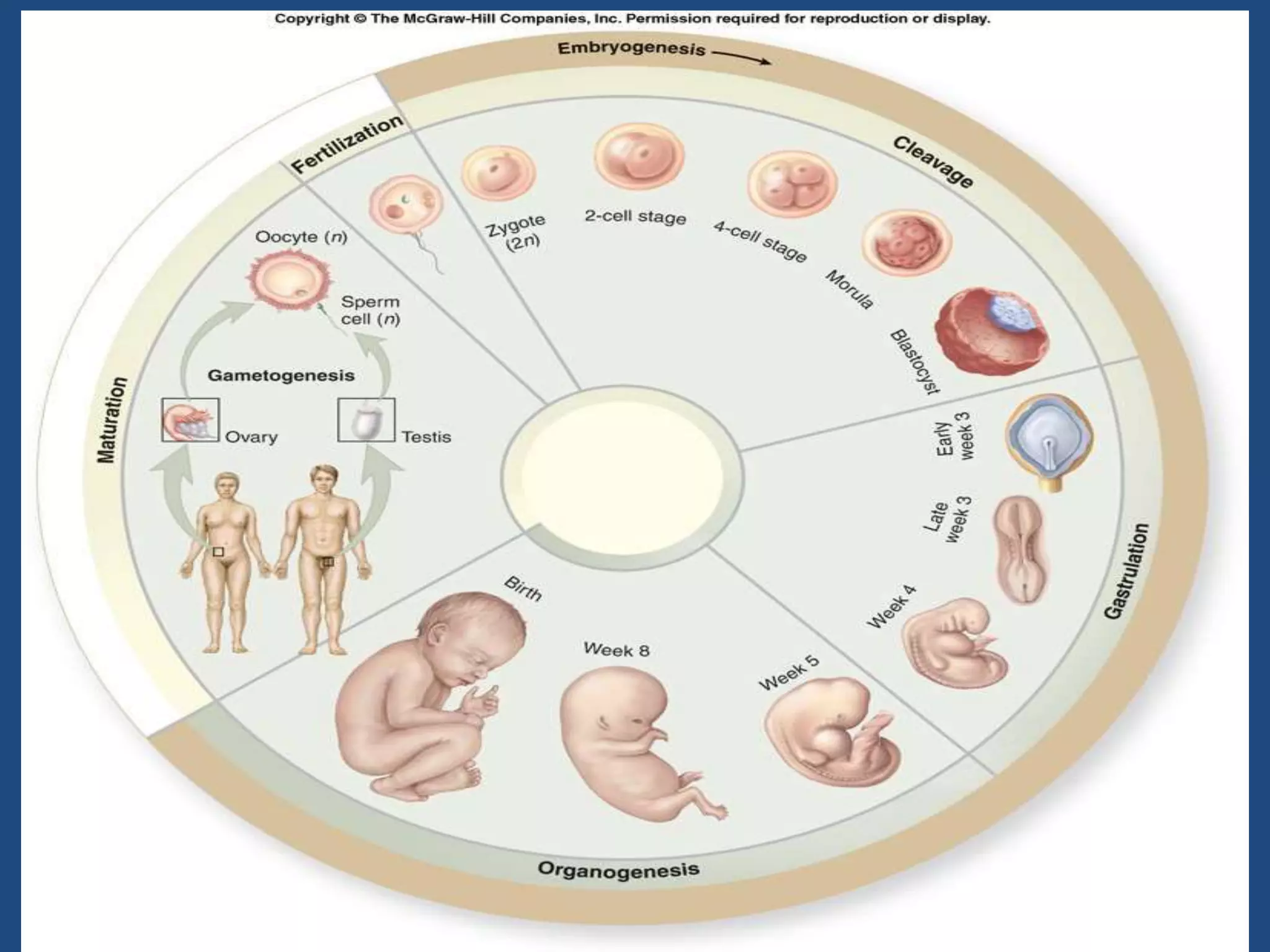
• Gametogenesis:
– Spermatogenesis
– Oogenesis
• Changes in the first week:
– Fertilisation- stages, effects of it
– Cleavage
– Morula
– Blastocyst
– Implantation
Fertilization
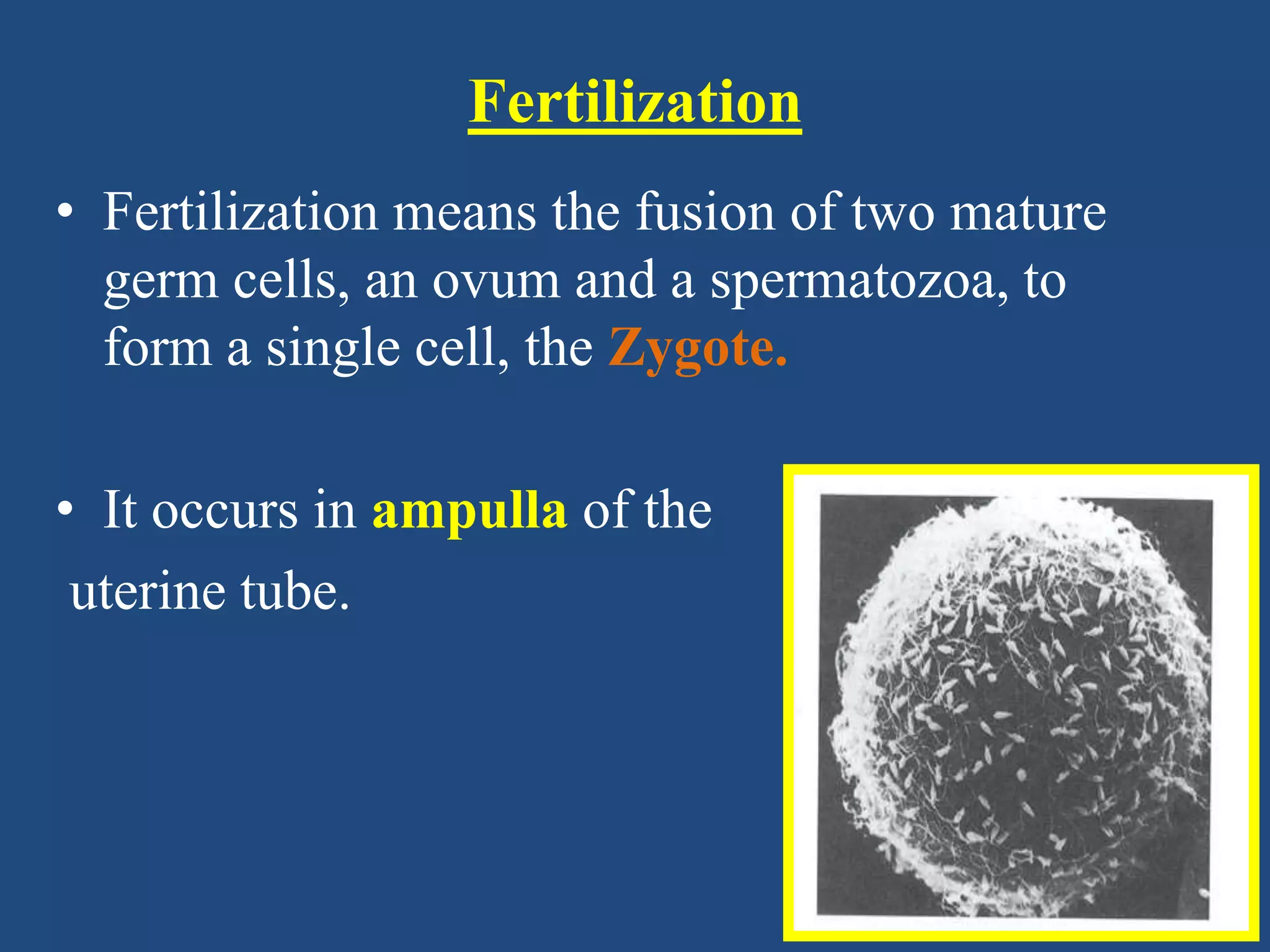
• Fertilization means the fusion of two mature
germ cells, an ovum and a spermatozoa, to
form a single cell, the Zygote.
• It occurs in ampulla of the
uterine tube.
Fertilization
Interstitial part
Stages of fertilization
a) Approximation of the gametes – involves
transport of sperms and ova – Prostaglandins,
Oxytocin
b) Contact and fusion of the gametes
c) Effects of fertilization
How the sperms reach
the site of fertilization?
1. By movement of their
tail.
2. By the movement of
uterine cilia.
3. By chemo attraction.
How the oocyte reaches
the site of fertilization?
1. By the movement
fimbria of the uterine
tube.
2. By peristaltic
movement of the
uterine tube.
Secondary oocyte
• Secondary
oocyte(metaphase of 2nd
meiotic division) with
corona radiata enters the
fallopian tube.
Vitelline
membrane
Contact and Fusion of the Gametes
• Out of 200 – 300 million
sperms-300-500 sperms
reach ovum; only one
unites with oocyte.
• 3 barriers protect female
gamete
– Corona radiata
– Zona pellucida
– Vitelline membrane
Vitelline
membrane
Before the sperm fertilizes the oocyte it must
undergo 2 processes
Capacitation:
• Final step of maturation of the spermatozoa in female
genital tract.
• Requires 7 hrs of time.
• Glycoprotein &seminal proteins are removed from
the surface of the sperm.
Acrosome Reaction:
• It occurs after capacitation where proteolytic
enzymes as acrosin, esterases, hyaluronidase, and
neuraminidase are liberated in order to penetrate the
zona pellucida.
• First barrier disintegration-
Hyaluronidase
• Second barrier – Acrosin-zona
reaction
• Third barrier – disintegrin
peptides
– Completion of second meiotic
division, formation of mature
ovum & extrusion of second
polar body.
Male pronucleus – sperm
head with its nuclear envelope
swollen, tail degenerates.
Female pronucleus – nucleus
of mature ovum.
Female
pronucleus
Effects of fertilization
a) Completion of second meiotic division – mature
ovum & 2nd polar body.
b) Restoration of diploid number of chromosomes in
zygote.
c) Determination of chromosomal sex.
d) Initiation of cleavage division of the zygote.
e) Determination of polarity of the embryo.
Assisted Reproductive Techniques
In vitro Fertilization (IVF)
Two or three of the resulting
zygotes are placed back in
the uterus (embryo
transfer ) after 3 days of
fertilization.
Intracytoplasmic sperm injection
It is the method of choice in cases of infertility due to the male
factor (severe oligospermia). It implies the same process as
IVF except that the best sperm is selected and injected into
the ovum cytoplasm.
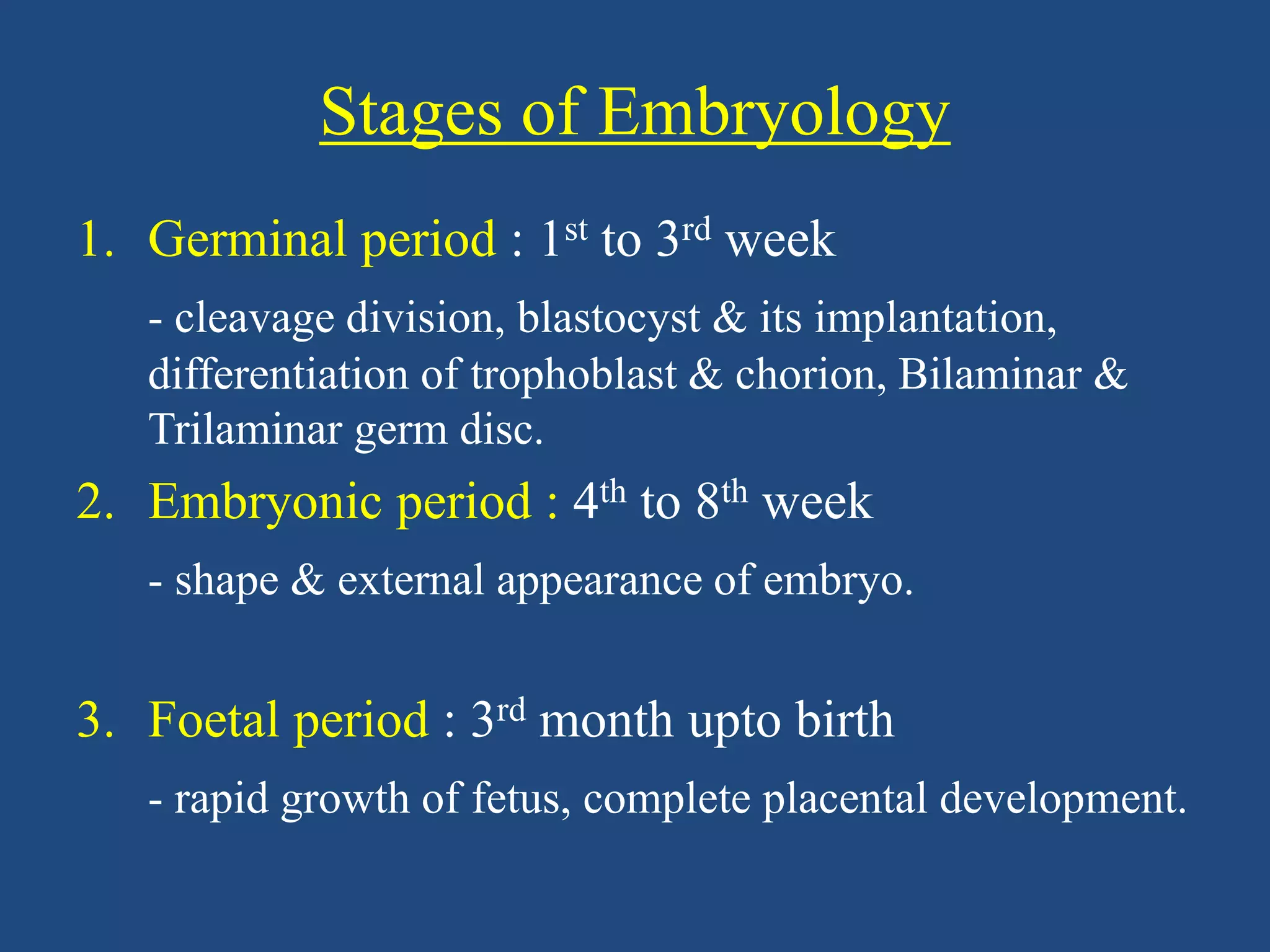
Stages of Embryology
1. Germinal period : 1st to 3rd week
- cleavage division, blastocyst & its implantation,
differentiation of trophoblast & chorion, Bilaminar &
Trilaminar germ disc.
2. Embryonic period : 4th to 8th week
- shape & external appearance of embryo.
3. Foetal period : 3rd month upto birth
- rapid growth of fetus, complete placental development.
Cleavage
Definition: It is the repeated mitotic divisions of the
zygote, resulting into a rapid increase in
the number of cells that are called blastomeres.
Site: The uterine tube medial to the ampula.
Cleavage
• 2 cell stage – 30hrs after
fertilization
• 4 cell stage – 40-50 hrs after ftz
• 12 cell stage – 72hrs after ftz
• 16 cell stage – 96 hrs after ftz.
• The zygote gradually migrates from uterine tube,
reaches the uterine cavity at 12 to 16 cell stage – 72
hrs after ftz.
Morula
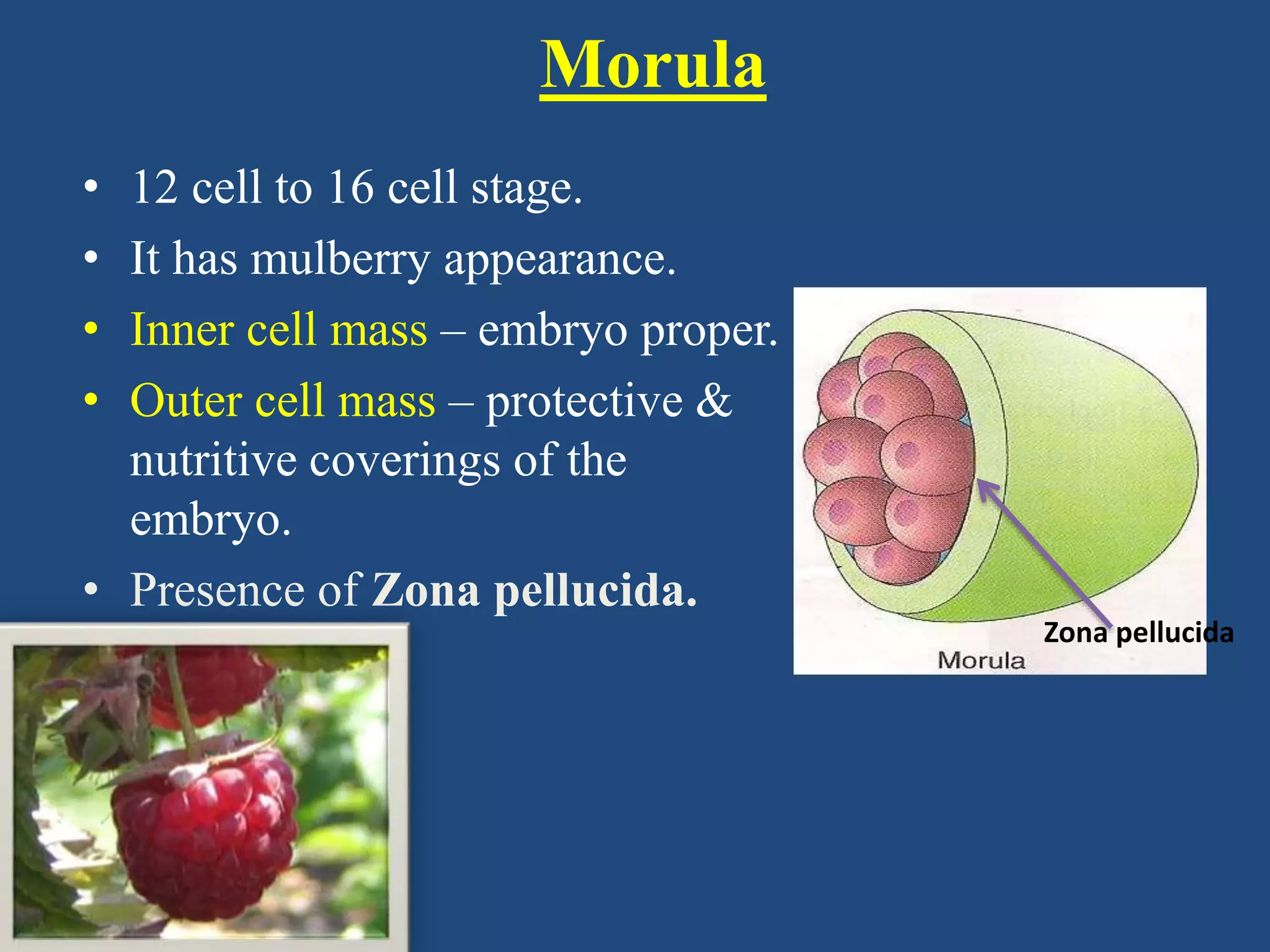
• 12 cell to 16 cell stage.
• It has mulberry appearance.
• Inner cell mass – embryo proper.
• Outer cell mass – protective &
nutritive coverings of the
embryo.
• Presence of Zona pellucida.
Zona pellucida
Blastocyst
• Shortly after the morula enters
the uterus, uterine fluid passes
through the ZP to form a fluid
filled cavity – Blastocele.
• The morula after the formation
of blastocele is called
blastocyst
• Outer cell mass – trophoblast
(future placenta)
• Inner cell mass – embryoblast
(future embryo)
• Blastocyst is formed
within ZP on 4th or 5th day
of fertilization .
• Zona pellucida disappears
– end of 5th day of
development
• Implantation of blastocyst
– 6th or 7th day after
fertilization.
Blastocele.
trophoblast.
embryoblast
Implantation
Implantation
Definition: Penetration of the blastocyst into the
superficial (compact) layer of the endometrium.
Time: Implantation occurs at the 6th day after
fertilization and is completed about the 11th day.
• Site: The normal site is the endometrium of the
posterior wall of the fundus of the uterus in or near
the middle line. The endometrium after implantation
is called decidua.
Types (parts) of decidua
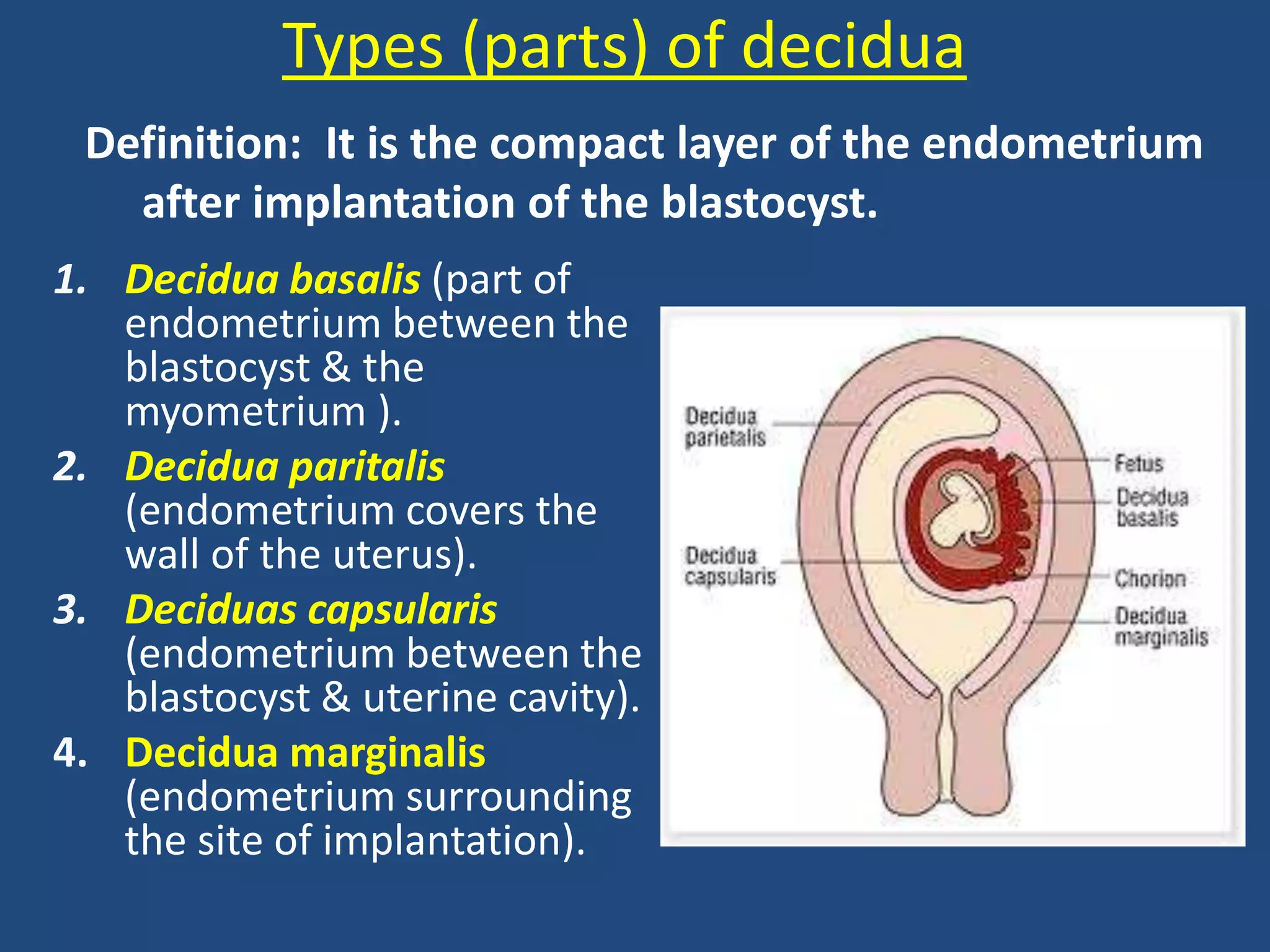
1. Decidua basalis (part of
endometrium between the
blastocyst & the
myometrium ).
2. Decidua paritalis
(endometrium covers the
wall of the uterus).
3. Deciduas capsularis
(endometrium between the
blastocyst & uterine cavity).
4. Decidua marginalis
(endometrium surrounding
the site of implantation).
Definition: It is the compact layer of the endometrium
after implantation of the blastocyst.
• By the 5th day the Zona pellucida degenerates.
• Trophoblast cells penetrate the epithelium of the
endometrium.
Stages of Implantation
By 6th day the blastocyst adheres to the endometrium
By 7th day, Trophoblast differentiated into 2 layers
• Cytotrophblast, inner layer,
mitotically active.
• Syncytiotrophoblast (outer
multinucleated mass, with
indistinct cell boundary.
By 8th day the blastocyst is
superficially embedded in
the compact layer of the
endometrium
Implantation - embedding of blastocyst into
uterine lining begins at day 7
Blastocyst - with blastocoele cavity
Trophoblast - outer layer of cells
Inner cell mass - will form embryo
Lacunae and primary villi formed by
trophoblast
All of these form placental tissues
Fig 28-3
Trophoblast forms syncytial trophoblast- erodes
into endometrium
Cellular trophoblast - carries nutrients to inner
cell mass
Implantation
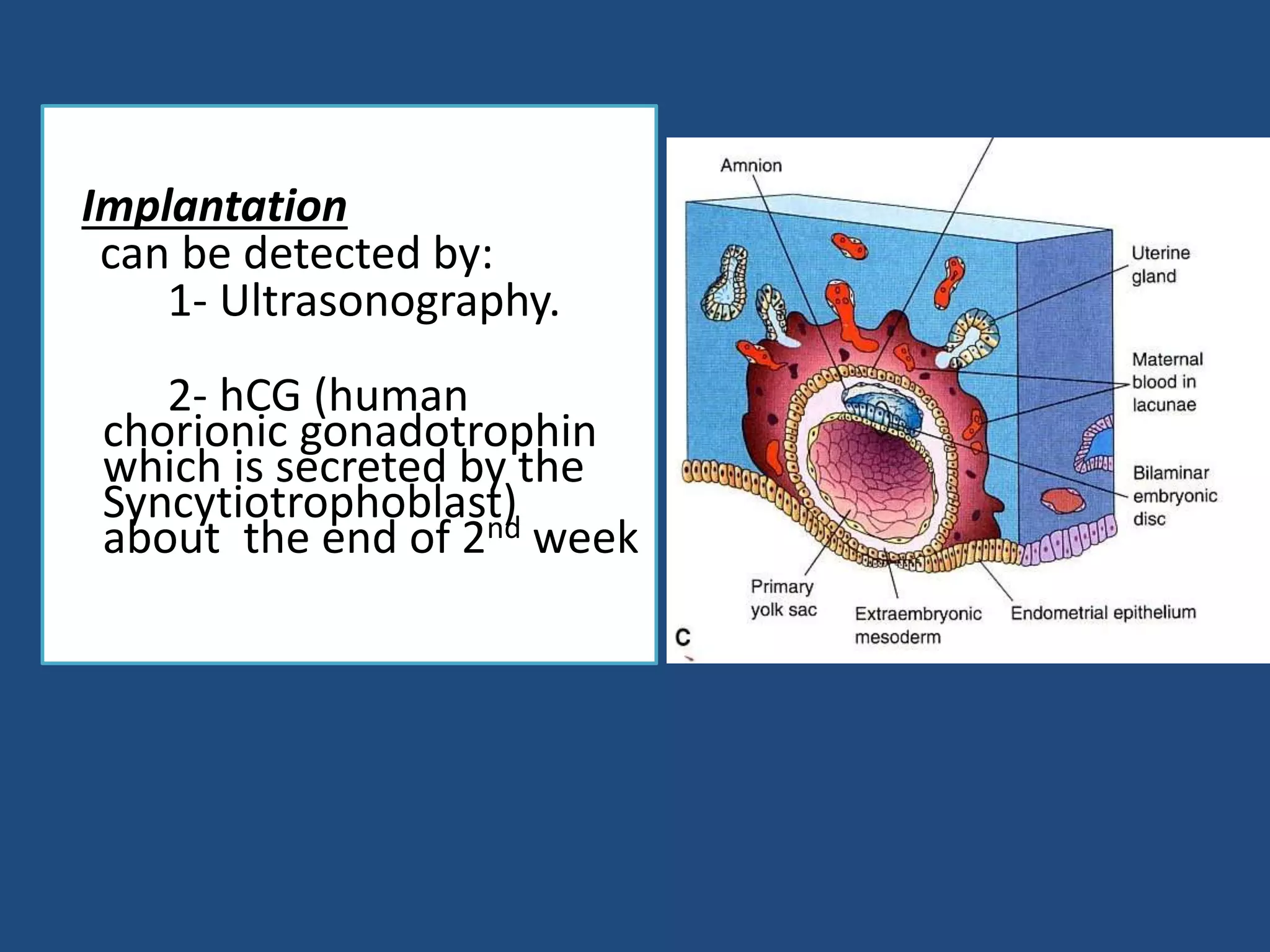
can be detected by:
1- Ultrasonography.
2- hCG (human
chorionic gonadotrophin
which is secreted by the
Syncytiotrophoblast)
about the end of 2nd week
Abnormal sites of implantation
1. Uterine ectopic pregnancy:
a. At the cornu of the uterus
(the site of attachment of
the uterine tube) leading
to early abortion.
b. At the lower uterine
segment leading to
placenta previa.
c. Cervix, leading to cervical
pregnancy and early
abortion.
mesentry
tube
ovary
Internal os
It is also called ectopic
pregnancy. It might result in
death of the embryo or early
abortion with severe internal
hemorrhage.
1,A
2,C
1,C
1,B
2,A
Extra uterine ectopic pregnancy:
a. The commonest site is in the Fallopian
tube leading to tubal pregnancy that
leads to early abortion or tubal rupture
with severe internal haemorrhage.
b. Ovary (ovarian pregnancy), broad
ligament or omentum (rare).
c. Peritoneum of Douglas pouch
(abdominal pregnancy).
Ectopic Pregnancy
Tubal Ectopic Pregnancy
PLACENTA PREVIA
Definition:
• Implantation of the blastocyst
in the lower segment of the
uterus close to the internal
os.
• Thus the placenta will
precede the fetus at delivery
(normally, the fetus is the
lowermost and fills the lower
segment). Previa = at the
front of the fetus.
Important questions
• Fertilisation
• Cleavage
• Morula
• Blastocyst
• Implantation
• Abnormal sites of implantation
Thank You

I week of development

  • 1.
    I week ofdevelopment Dr. G. Prabavathy Assistant Professor Department of Anatomy
  • 2.
    Objectives • Gametogenesis: – Spermatogenesis –Oogenesis • Changes in the first week: – Fertilisation- stages, effects of it – Cleavage – Morula – Blastocyst – Implantation
  • 4.
    Fertilization • Fertilization meansthe fusion of two mature germ cells, an ovum and a spermatozoa, to form a single cell, the Zygote. • It occurs in ampulla of the uterine tube.
  • 5.
  • 6.
  • 7.
    Stages of fertilization a)Approximation of the gametes – involves transport of sperms and ova – Prostaglandins, Oxytocin b) Contact and fusion of the gametes c) Effects of fertilization
  • 8.
    How the spermsreach the site of fertilization? 1. By movement of their tail. 2. By the movement of uterine cilia. 3. By chemo attraction. How the oocyte reaches the site of fertilization? 1. By the movement fimbria of the uterine tube. 2. By peristaltic movement of the uterine tube.
  • 9.
    Secondary oocyte • Secondary oocyte(metaphaseof 2nd meiotic division) with corona radiata enters the fallopian tube. Vitelline membrane
  • 10.
    Contact and Fusionof the Gametes • Out of 200 – 300 million sperms-300-500 sperms reach ovum; only one unites with oocyte. • 3 barriers protect female gamete – Corona radiata – Zona pellucida – Vitelline membrane Vitelline membrane
  • 12.
    Before the spermfertilizes the oocyte it must undergo 2 processes Capacitation: • Final step of maturation of the spermatozoa in female genital tract. • Requires 7 hrs of time. • Glycoprotein &seminal proteins are removed from the surface of the sperm. Acrosome Reaction: • It occurs after capacitation where proteolytic enzymes as acrosin, esterases, hyaluronidase, and neuraminidase are liberated in order to penetrate the zona pellucida.
  • 13.
    • First barrierdisintegration- Hyaluronidase • Second barrier – Acrosin-zona reaction • Third barrier – disintegrin peptides
  • 14.
    – Completion ofsecond meiotic division, formation of mature ovum & extrusion of second polar body. Male pronucleus – sperm head with its nuclear envelope swollen, tail degenerates. Female pronucleus – nucleus of mature ovum. Female pronucleus
  • 16.
    Effects of fertilization a)Completion of second meiotic division – mature ovum & 2nd polar body. b) Restoration of diploid number of chromosomes in zygote. c) Determination of chromosomal sex. d) Initiation of cleavage division of the zygote. e) Determination of polarity of the embryo.
  • 17.
    Assisted Reproductive Techniques Invitro Fertilization (IVF) Two or three of the resulting zygotes are placed back in the uterus (embryo transfer ) after 3 days of fertilization.
  • 18.
    Intracytoplasmic sperm injection Itis the method of choice in cases of infertility due to the male factor (severe oligospermia). It implies the same process as IVF except that the best sperm is selected and injected into the ovum cytoplasm.
  • 19.
    Stages of Embryology 1.Germinal period : 1st to 3rd week - cleavage division, blastocyst & its implantation, differentiation of trophoblast & chorion, Bilaminar & Trilaminar germ disc. 2. Embryonic period : 4th to 8th week - shape & external appearance of embryo. 3. Foetal period : 3rd month upto birth - rapid growth of fetus, complete placental development.
  • 20.
    Cleavage Definition: It isthe repeated mitotic divisions of the zygote, resulting into a rapid increase in the number of cells that are called blastomeres. Site: The uterine tube medial to the ampula.
  • 22.
    Cleavage • 2 cellstage – 30hrs after fertilization • 4 cell stage – 40-50 hrs after ftz • 12 cell stage – 72hrs after ftz • 16 cell stage – 96 hrs after ftz.
  • 23.
    • The zygotegradually migrates from uterine tube, reaches the uterine cavity at 12 to 16 cell stage – 72 hrs after ftz.
  • 24.
    Morula • 12 cellto 16 cell stage. • It has mulberry appearance. • Inner cell mass – embryo proper. • Outer cell mass – protective & nutritive coverings of the embryo. • Presence of Zona pellucida. Zona pellucida
  • 25.
    Blastocyst • Shortly afterthe morula enters the uterus, uterine fluid passes through the ZP to form a fluid filled cavity – Blastocele. • The morula after the formation of blastocele is called blastocyst • Outer cell mass – trophoblast (future placenta) • Inner cell mass – embryoblast (future embryo)
  • 26.
    • Blastocyst isformed within ZP on 4th or 5th day of fertilization . • Zona pellucida disappears – end of 5th day of development • Implantation of blastocyst – 6th or 7th day after fertilization. Blastocele. trophoblast. embryoblast
  • 27.
  • 28.
    Implantation Definition: Penetration ofthe blastocyst into the superficial (compact) layer of the endometrium. Time: Implantation occurs at the 6th day after fertilization and is completed about the 11th day.
  • 29.
    • Site: Thenormal site is the endometrium of the posterior wall of the fundus of the uterus in or near the middle line. The endometrium after implantation is called decidua.
  • 30.
    Types (parts) ofdecidua 1. Decidua basalis (part of endometrium between the blastocyst & the myometrium ). 2. Decidua paritalis (endometrium covers the wall of the uterus). 3. Deciduas capsularis (endometrium between the blastocyst & uterine cavity). 4. Decidua marginalis (endometrium surrounding the site of implantation). Definition: It is the compact layer of the endometrium after implantation of the blastocyst.
  • 31.
    • By the5th day the Zona pellucida degenerates. • Trophoblast cells penetrate the epithelium of the endometrium. Stages of Implantation
  • 32.
    By 6th daythe blastocyst adheres to the endometrium By 7th day, Trophoblast differentiated into 2 layers • Cytotrophblast, inner layer, mitotically active. • Syncytiotrophoblast (outer multinucleated mass, with indistinct cell boundary. By 8th day the blastocyst is superficially embedded in the compact layer of the endometrium
  • 34.
    Implantation - embeddingof blastocyst into uterine lining begins at day 7 Blastocyst - with blastocoele cavity Trophoblast - outer layer of cells Inner cell mass - will form embryo Lacunae and primary villi formed by trophoblast All of these form placental tissues Fig 28-3 Trophoblast forms syncytial trophoblast- erodes into endometrium Cellular trophoblast - carries nutrients to inner cell mass
  • 35.
    Implantation can be detectedby: 1- Ultrasonography. 2- hCG (human chorionic gonadotrophin which is secreted by the Syncytiotrophoblast) about the end of 2nd week
  • 37.
    Abnormal sites ofimplantation 1. Uterine ectopic pregnancy: a. At the cornu of the uterus (the site of attachment of the uterine tube) leading to early abortion. b. At the lower uterine segment leading to placenta previa. c. Cervix, leading to cervical pregnancy and early abortion. mesentry tube ovary Internal os It is also called ectopic pregnancy. It might result in death of the embryo or early abortion with severe internal hemorrhage. 1,A 2,C 1,C 1,B 2,A
  • 38.
    Extra uterine ectopicpregnancy: a. The commonest site is in the Fallopian tube leading to tubal pregnancy that leads to early abortion or tubal rupture with severe internal haemorrhage. b. Ovary (ovarian pregnancy), broad ligament or omentum (rare). c. Peritoneum of Douglas pouch (abdominal pregnancy).
  • 39.
  • 40.
  • 41.
    PLACENTA PREVIA Definition: • Implantationof the blastocyst in the lower segment of the uterus close to the internal os. • Thus the placenta will precede the fetus at delivery (normally, the fetus is the lowermost and fills the lower segment). Previa = at the front of the fetus.
  • 42.
    Important questions • Fertilisation •Cleavage • Morula • Blastocyst • Implantation • Abnormal sites of implantation
  • 43.