COMPLEMENT
Dr Alok Tripathi
Department of Biotechnology
LPU-Pb
Definition
A group of 20 serum proteins, along with cells of the immune
system work together to eliminate foreign cells.
By antibodies by themselves aren’t very effective at controlling
infections;
what makes them especially potent is their ability to induce a
series of enzymatic reactions that unleashes a extremely deadly
and diverse set of activities by other proteins that are present in
the blood—which collectively are called “complement”
8/31/2015 6:40:48 AM 2
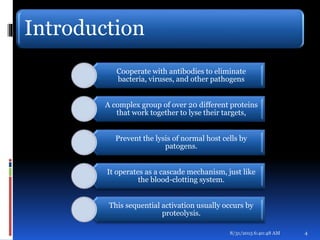
Role of complement can be shown as
8/31/2015 6:40:48 AM 3
Introduction
Cooperate with antibodies to eliminate
bacteria, viruses, and other pathogens
A complex group of over 20 different proteins
that work together to lyse their targets,
Prevent the lysis of normal host cells by
patogens.
It operates as a cascade mechanism, just like
the blood-clotting system.
This sequential activation usually occurs by
proteolysis.
8/31/2015 6:40:48 AM 4
There are two advantages of a cascade system
It ensures a
substantial
amplification of an
initial response.
This pathway can
be fairly easily
controlled in its
early stages by
inhibitors of
enzymatic activity.
• Since each successive
component of the
complement system is an
enzyme that can act on
many different substrates,
this system of successive
enzymatic steps gives a
great increase in the size of
the response.
• This is essential because
the C (complement)
system is, as we’ll see, very
destructive, and if it could
be activated easily and
spontaneously, it would
cause considerable harm
to the organism.
8/31/2015 6:40:48 AM 5
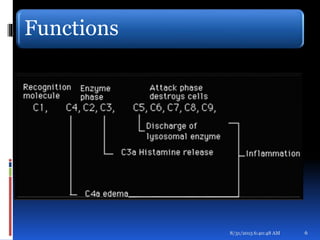
Functions
8/31/2015 6:40:48 AM 6
8/31/2015 6:40:48 AM 7
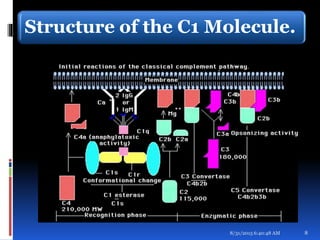
Structure of the C1 Molecule.
8/31/2015 6:40:48 AM 8
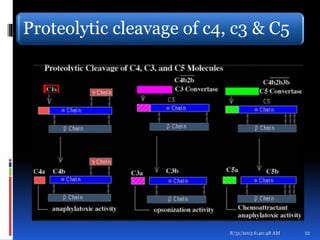
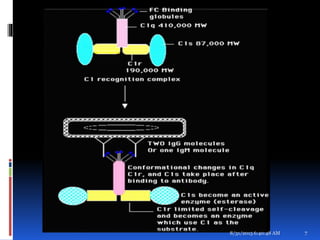
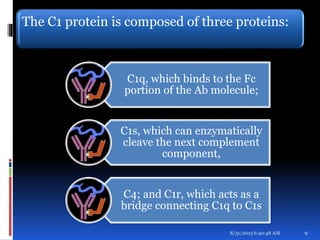
The C1 protein is composed of three proteins:
C1q, which binds to the Fc
portion of the Ab molecule;
C1s, which can enzymatically
cleave the next complement
component,
C4; and C1r, which acts as a
bridge connecting C1q to C1s
8/31/2015 6:40:48 AM 9
Classical Complement Pathway
C1+AbC4*, C2*, & C3*, formation of C5, C6, C7, C8
and C9.[MAC]
This eventually leads to the formation of the C5-C9
membrane attack complex (MAC), Lysis of Target cell
The classical complement pathway requires the presence
of antibodies,
either as immunoglobulin (IgG
or IgM) bound to cell surface
Ag
or as an Ag-Ab immune
complex.
8/31/2015 6:40:48 AM 10
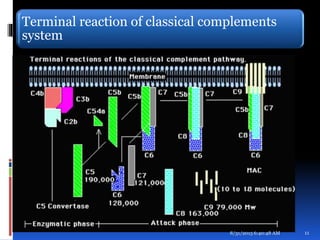
Terminal reaction of classical complements
system
8/31/2015 6:40:48 AM 11
Proteolytic cleavage of c4, c3 & C5
8/31/2015 6:40:48 AM 12
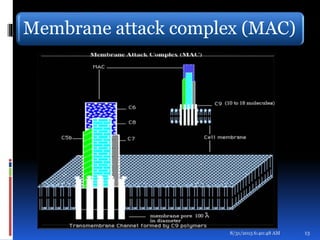
Membrane attack complex (MAC)
8/31/2015 6:40:48 AM 13
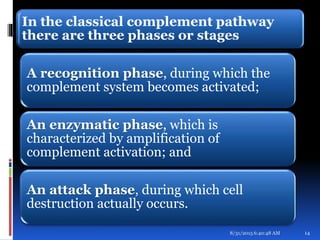
In the classical complement pathway
there are three phases or stages
A recognition phase, during which the
complement system becomes activated;
An enzymatic phase, which is
characterized by amplification of
complement activation; and
An attack phase, during which cell
destruction actually occurs.
8/31/2015 6:40:48 AM 14
Recognition Phase: Initiate
Pathway
Inactive C1 +
Fc portion 
• either cell-bound Ig (IgG or
IgM) or an immune
complex.
• Even though only one IgM-
bound molecule is
necessary to fix the C1
complex,
two molecules of
IgG bound in
close proximity
are required for
activation to
occur.
C1+Ca++
INACTIVE UNIT
1C1=[1C1q+2(C1r &
C1s)]
C1q~recepter site (Fc
region of 2 adjacent Abs)
Ag+AbAg~Ab complex
 These sites are exposed
After binding to the sites,
 C1q undergoes a
conformational change,
which causes C1r  C1*
(by itself by self-cleavage)
C1r now sees C1s as its
substrate and activation of
C1s gives rise to its ability
to cleave the next two
complement proteins, C4
and C2.
8/31/2015 6:40:48 AM 15
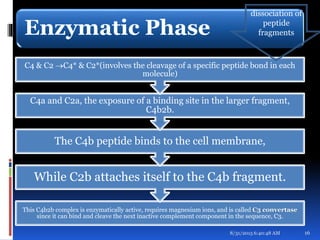
Enzymatic Phase
This C4b2b complex is enzymatically active, requires magnesium ions, and is called C3 convertase
since it can bind and cleave the next inactive complement component in the sequence, C3.
While C2b attaches itself to the C4b fragment.
The C4b peptide binds to the cell membrane,
C4a and C2a, the exposure of a binding site in the larger fragment,
C4b2b.
C4 & C2 C4* & C2*(involves the cleavage of a specific peptide bond in each
molecule)
8/31/2015 6:40:48 AM 16
dissociation of
peptide
fragments
Activation of C3
Initiates the generation of a second convertase
enzyme.
This occurs when C3 is cleaved into C3a and
C3b.
The larger C3b fragment attaches to both the cell
membrane and C4b2b complex, while the smaller
fragment, C3a, is released to the body fluids.
C4b2b3b [=C5 convertase (or C3/C5 convertase)],
8/31/2015 6:40:48 AM 17
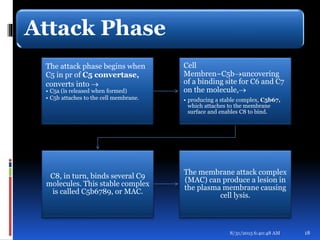
Attack Phase
The attack phase begins when
C5 in pr of C5 convertase,
converts into 
• C5a (is released when formed)
• C5b attaches to the cell membrane.
Cell
Membren~C5buncovering
of a binding site for C6 and C7
on the molecule,
• producing a stable complex, C5b67,
which attaches to the membrane
surface and enables C8 to bind.
C8, in turn, binds several C9
molecules. This stable complex
is called C5b6789, or MAC.
The membrane attack complex
(MAC) can produce a lesion in
the plasma membrane causing
cell lysis.
8/31/2015 6:40:48 AM 18
8/31/2015 6:40:48 AM 19
8/31/2015 6:40:48 AM 20
8/31/2015 6:40:48 AM 21
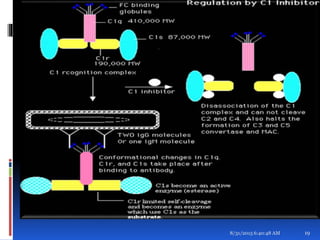
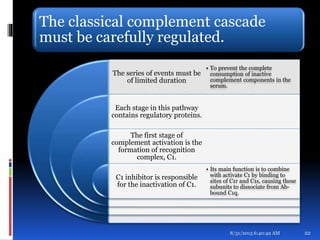
The classical complement cascade
must be carefully regulated.
The series of events must be
of limited duration
Each stage in this pathway
contains regulatory proteins.
The first stage of
complement activation is the
formation of recognition
complex, C1.
C1 inhibitor is responsible
for the inactivation of C1.
• To prevent the complete
consumption of inactive
complement components in the
serum.
• Its main function is to combine
with activate C1 by binding to
sites of C1r and C1s, causing these
subunits to dissociate from Ab-
bound C1q.
8/31/2015 6:40:49 AM 22
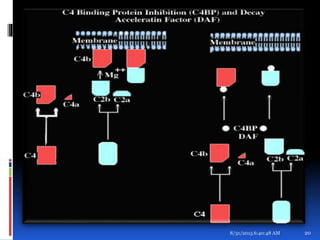
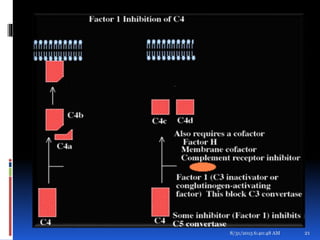
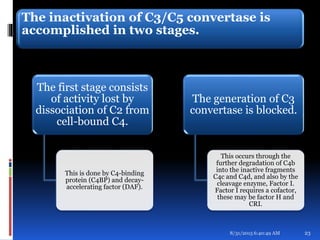
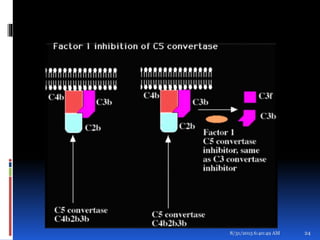
The inactivation of C3/C5 convertase is
accomplished in two stages.
The first stage consists
of activity lost by
dissociation of C2 from
cell-bound C4.
This is done by C4-binding
protein (C4BP) and decay-
accelerating factor (DAF).
The generation of C3
convertase is blocked.
This occurs through the
further degradation of C4b
into the inactive fragments
C4c and C4d, and also by the
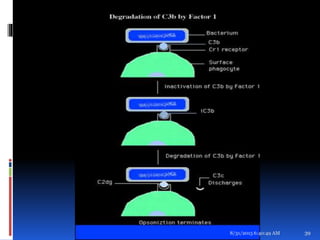
cleavage enzyme, Factor I.
Factor I requires a cofactor,
these may be factor H and
CRI.
8/31/2015 6:40:49 AM 23
8/31/2015 6:40:49 AM 24
8/31/2015 6:40:49 AM 25
8/31/2015 6:40:49 AM 26
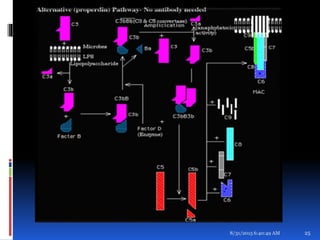
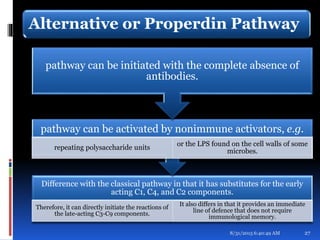
Alternative or Properdin Pathway
Difference with the classical pathway in that it has substitutes for the early
acting C1, C4, and C2 components.
Therefore, it can directly initiate the reactions of
the late-acting C3-C9 components.
It also differs in that it provides an immediate
line of defence that does not require
immunological memory.
pathway can be activated by nonimmune activators, e.g.
repeating polysaccharide units
or the LPS found on the cell walls of some
microbes.
pathway can be initiated with the complete absence of
antibodies.
8/31/2015 6:40:49 AM 27
8/31/2015 6:40:49 AM 28
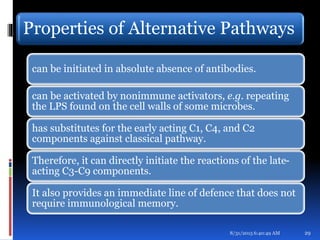
Properties of Alternative Pathways
can be initiated in absolute absence of antibodies.
can be activated by nonimmune activators, e.g. repeating
the LPS found on the cell walls of some microbes.
has substitutes for the early acting C1, C4, and C2
components against classical pathway.
Therefore, it can directly initiate the reactions of the late-
acting C3-C9 components.
It also provides an immediate line of defence that does not
require immunological memory.
8/31/2015 6:40:49 AM 29
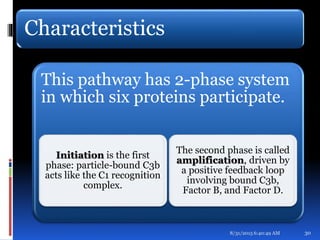
Characteristics
This pathway has 2-phase system
in which six proteins participate.
Initiation is the first
phase: particle-bound C3b
acts like the C1 recognition
complex.
The second phase is called
amplification, driven by
a positive feedback loop
involving bound C3b,
Factor B, and Factor D.
8/31/2015 6:40:49 AM 30
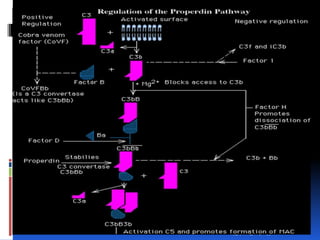
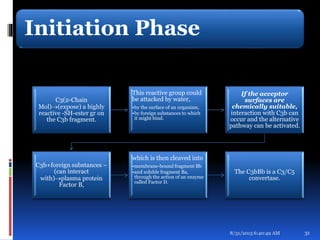
Initiation Phase
C3(2-Chain
Mol)(expose) a highly
reactive -SH-ester gr on
the C3b fragment.
This reactive group could
be attacked by water,
•by the surface of an organism,
•by foreign substances to which
it might bind.
If the acceptor
surfaces are
chemically suitable,
interaction with C3b can
occur and the alternative
pathway can be activated.
C3b+foreign substances –
(can interact
with)plasma protein
Factor B,
which is then cleaved into
•membrane-bound fragment Bb
•and soluble fragment Ba,
through the action of an enzyme
called Factor D.
The C3bBb is a C3/C5
convertase.
8/31/2015 6:40:49 AM 31
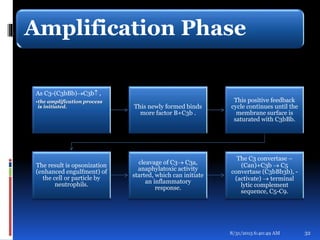
Amplification Phase
As C3-(C3bBb)C3b ,
•the amplification process
is initiated. This newly formed binds
more factor B+C3b .
This positive feedback
cycle continues until the
membrane surface is
saturated with C3bBb.
The result is opsonization
(enhanced engulfment) of
the cell or particle by
neutrophils.
cleavage of C3 C3a,
anaphylatoxic activity
started, which can initiate
an inflammatory
response.
The C3 convertase –
(Can)+C3b  C5
convertase (C3bBb3b), -
(activate)  terminal
lytic complement
sequence, C5-C9.
8/31/2015 6:40:49 AM 32
8/31/2015 6:40:49 AM 33
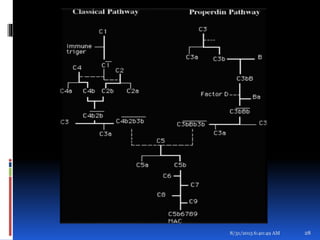
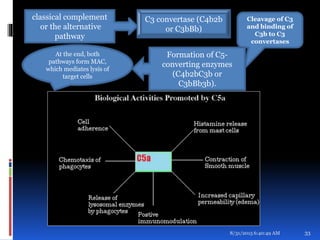
classical complement
or the alternative
pathway
C3 convertase (C4b2b
or C3bBb)
Cleavage of C3
and binding of
C3b to C3
convertases
Formation of C5-
converting enzymes
(C4b2bC3b or
C3bBb3b).
At the end, both
pathways form MAC,
which mediates lysis of
target cells
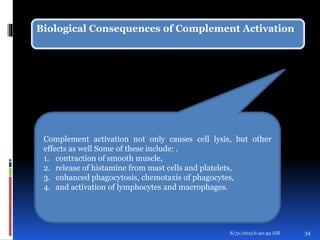
Biological Consequences of Complement Activation
8/31/2015 6:40:49 AM 34
Complement activation not only causes cell lysis, but other
effects as well Some of these include: .
1. contraction of smooth muscle,
2. release of histamine from mast cells and platelets,
3. enhanced phagocytosis, chemotaxis of phagocytes,
4. and activation of lymphocytes and macrophages.
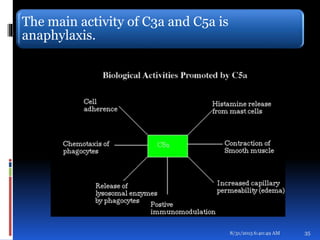
The main activity of C3a and C5a is
anaphylaxis.
8/31/2015 6:40:49 AM 35
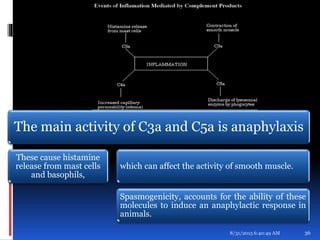
The main activity of C3a and C5a is anaphylaxis
These cause histamine
release from mast cells
and basophils,
which can affect the activity of smooth muscle.
Spasmogenicity, accounts for the ability of these
molecules to induce an anaphylactic response in
animals.
8/31/2015 6:40:49 AM 36
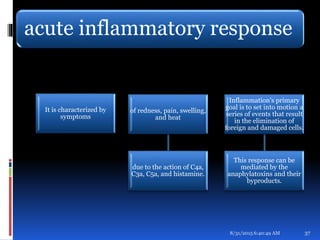
acute inflammatory response
It is characterized by
symptoms
of redness, pain, swelling,
and heat
due to the action of C4a,
C3a, C5a, and histamine.
Inflammation's primary
goal is to set into motion a
series of events that result
in the elimination of
foreign and damaged cells.
This response can be
mediated by the
anaphylatoxins and their
byproducts.
8/31/2015 6:40:49 AM 37
8/31/2015 6:40:49 AM 38
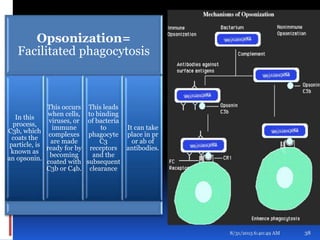
Opsonization=
Facilitated phagocytosis
In this
process,
C3b, which
coats the
particle, is
known as
an opsonin.
This occurs
when cells,
viruses, or
immune
complexes
are made
ready for by
becoming
coated with
C3b or C4b.
This leads
to binding
of bacteria
to
phagocyte
C3
receptors
and the
subsequent
clearance
It can take
place in pr
or ab of
antibodies.
8/31/2015 6:40:49 AM 39
8/31/2015 6:40:49 AM 40
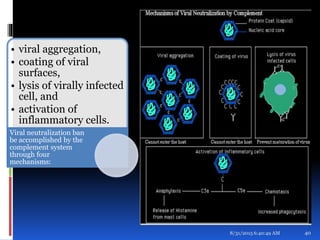
• viral aggregation,
• coating of viral
surfaces,
• lysis of virally infected
cell, and
• activation of
inflammatory cells.
Viral neutralization ban
be accomplished by the
complement system
through four
mechanisms:
8/31/2015 6:40:49 AM 41
8/31/2015 6:40:49 AM 42

Complement:

  • 1.
  • 2.
    Definition A group of20 serum proteins, along with cells of the immune system work together to eliminate foreign cells. By antibodies by themselves aren’t very effective at controlling infections; what makes them especially potent is their ability to induce a series of enzymatic reactions that unleashes a extremely deadly and diverse set of activities by other proteins that are present in the blood—which collectively are called “complement” 8/31/2015 6:40:48 AM 2
  • 3.
    Role of complementcan be shown as 8/31/2015 6:40:48 AM 3
  • 4.
    Introduction Cooperate with antibodiesto eliminate bacteria, viruses, and other pathogens A complex group of over 20 different proteins that work together to lyse their targets, Prevent the lysis of normal host cells by patogens. It operates as a cascade mechanism, just like the blood-clotting system. This sequential activation usually occurs by proteolysis. 8/31/2015 6:40:48 AM 4
  • 5.
    There are twoadvantages of a cascade system It ensures a substantial amplification of an initial response. This pathway can be fairly easily controlled in its early stages by inhibitors of enzymatic activity. • Since each successive component of the complement system is an enzyme that can act on many different substrates, this system of successive enzymatic steps gives a great increase in the size of the response. • This is essential because the C (complement) system is, as we’ll see, very destructive, and if it could be activated easily and spontaneously, it would cause considerable harm to the organism. 8/31/2015 6:40:48 AM 5
  • 6.
  • 7.
  • 8.
    Structure of theC1 Molecule. 8/31/2015 6:40:48 AM 8
  • 9.
    The C1 proteinis composed of three proteins: C1q, which binds to the Fc portion of the Ab molecule; C1s, which can enzymatically cleave the next complement component, C4; and C1r, which acts as a bridge connecting C1q to C1s 8/31/2015 6:40:48 AM 9
  • 10.
    Classical Complement Pathway C1+AbC4*,C2*, & C3*, formation of C5, C6, C7, C8 and C9.[MAC] This eventually leads to the formation of the C5-C9 membrane attack complex (MAC), Lysis of Target cell The classical complement pathway requires the presence of antibodies, either as immunoglobulin (IgG or IgM) bound to cell surface Ag or as an Ag-Ab immune complex. 8/31/2015 6:40:48 AM 10
  • 11.
    Terminal reaction ofclassical complements system 8/31/2015 6:40:48 AM 11
  • 12.
    Proteolytic cleavage ofc4, c3 & C5 8/31/2015 6:40:48 AM 12
  • 13.
    Membrane attack complex(MAC) 8/31/2015 6:40:48 AM 13
  • 14.
    In the classicalcomplement pathway there are three phases or stages A recognition phase, during which the complement system becomes activated; An enzymatic phase, which is characterized by amplification of complement activation; and An attack phase, during which cell destruction actually occurs. 8/31/2015 6:40:48 AM 14
  • 15.
    Recognition Phase: Initiate Pathway InactiveC1 + Fc portion  • either cell-bound Ig (IgG or IgM) or an immune complex. • Even though only one IgM- bound molecule is necessary to fix the C1 complex, two molecules of IgG bound in close proximity are required for activation to occur. C1+Ca++ INACTIVE UNIT 1C1=[1C1q+2(C1r & C1s)] C1q~recepter site (Fc region of 2 adjacent Abs) Ag+AbAg~Ab complex  These sites are exposed After binding to the sites,  C1q undergoes a conformational change, which causes C1r  C1* (by itself by self-cleavage) C1r now sees C1s as its substrate and activation of C1s gives rise to its ability to cleave the next two complement proteins, C4 and C2. 8/31/2015 6:40:48 AM 15
  • 16.
    Enzymatic Phase This C4b2bcomplex is enzymatically active, requires magnesium ions, and is called C3 convertase since it can bind and cleave the next inactive complement component in the sequence, C3. While C2b attaches itself to the C4b fragment. The C4b peptide binds to the cell membrane, C4a and C2a, the exposure of a binding site in the larger fragment, C4b2b. C4 & C2 C4* & C2*(involves the cleavage of a specific peptide bond in each molecule) 8/31/2015 6:40:48 AM 16 dissociation of peptide fragments
  • 17.
    Activation of C3 Initiatesthe generation of a second convertase enzyme. This occurs when C3 is cleaved into C3a and C3b. The larger C3b fragment attaches to both the cell membrane and C4b2b complex, while the smaller fragment, C3a, is released to the body fluids. C4b2b3b [=C5 convertase (or C3/C5 convertase)], 8/31/2015 6:40:48 AM 17
  • 18.
    Attack Phase The attackphase begins when C5 in pr of C5 convertase, converts into  • C5a (is released when formed) • C5b attaches to the cell membrane. Cell Membren~C5buncovering of a binding site for C6 and C7 on the molecule, • producing a stable complex, C5b67, which attaches to the membrane surface and enables C8 to bind. C8, in turn, binds several C9 molecules. This stable complex is called C5b6789, or MAC. The membrane attack complex (MAC) can produce a lesion in the plasma membrane causing cell lysis. 8/31/2015 6:40:48 AM 18
  • 19.
  • 20.
  • 21.
  • 22.
    The classical complementcascade must be carefully regulated. The series of events must be of limited duration Each stage in this pathway contains regulatory proteins. The first stage of complement activation is the formation of recognition complex, C1. C1 inhibitor is responsible for the inactivation of C1. • To prevent the complete consumption of inactive complement components in the serum. • Its main function is to combine with activate C1 by binding to sites of C1r and C1s, causing these subunits to dissociate from Ab- bound C1q. 8/31/2015 6:40:49 AM 22
  • 23.
    The inactivation ofC3/C5 convertase is accomplished in two stages. The first stage consists of activity lost by dissociation of C2 from cell-bound C4. This is done by C4-binding protein (C4BP) and decay- accelerating factor (DAF). The generation of C3 convertase is blocked. This occurs through the further degradation of C4b into the inactive fragments C4c and C4d, and also by the cleavage enzyme, Factor I. Factor I requires a cofactor, these may be factor H and CRI. 8/31/2015 6:40:49 AM 23
  • 24.
  • 25.
  • 26.
  • 27.
    Alternative or ProperdinPathway Difference with the classical pathway in that it has substitutes for the early acting C1, C4, and C2 components. Therefore, it can directly initiate the reactions of the late-acting C3-C9 components. It also differs in that it provides an immediate line of defence that does not require immunological memory. pathway can be activated by nonimmune activators, e.g. repeating polysaccharide units or the LPS found on the cell walls of some microbes. pathway can be initiated with the complete absence of antibodies. 8/31/2015 6:40:49 AM 27
  • 28.
  • 29.
    Properties of AlternativePathways can be initiated in absolute absence of antibodies. can be activated by nonimmune activators, e.g. repeating the LPS found on the cell walls of some microbes. has substitutes for the early acting C1, C4, and C2 components against classical pathway. Therefore, it can directly initiate the reactions of the late- acting C3-C9 components. It also provides an immediate line of defence that does not require immunological memory. 8/31/2015 6:40:49 AM 29
  • 30.
    Characteristics This pathway has2-phase system in which six proteins participate. Initiation is the first phase: particle-bound C3b acts like the C1 recognition complex. The second phase is called amplification, driven by a positive feedback loop involving bound C3b, Factor B, and Factor D. 8/31/2015 6:40:49 AM 30
  • 31.
    Initiation Phase C3(2-Chain Mol)(expose) ahighly reactive -SH-ester gr on the C3b fragment. This reactive group could be attacked by water, •by the surface of an organism, •by foreign substances to which it might bind. If the acceptor surfaces are chemically suitable, interaction with C3b can occur and the alternative pathway can be activated. C3b+foreign substances – (can interact with)plasma protein Factor B, which is then cleaved into •membrane-bound fragment Bb •and soluble fragment Ba, through the action of an enzyme called Factor D. The C3bBb is a C3/C5 convertase. 8/31/2015 6:40:49 AM 31
  • 32.
    Amplification Phase As C3-(C3bBb)C3b, •the amplification process is initiated. This newly formed binds more factor B+C3b . This positive feedback cycle continues until the membrane surface is saturated with C3bBb. The result is opsonization (enhanced engulfment) of the cell or particle by neutrophils. cleavage of C3 C3a, anaphylatoxic activity started, which can initiate an inflammatory response. The C3 convertase – (Can)+C3b  C5 convertase (C3bBb3b), - (activate)  terminal lytic complement sequence, C5-C9. 8/31/2015 6:40:49 AM 32
  • 33.
    8/31/2015 6:40:49 AM33 classical complement or the alternative pathway C3 convertase (C4b2b or C3bBb) Cleavage of C3 and binding of C3b to C3 convertases Formation of C5- converting enzymes (C4b2bC3b or C3bBb3b). At the end, both pathways form MAC, which mediates lysis of target cells
  • 34.
    Biological Consequences ofComplement Activation 8/31/2015 6:40:49 AM 34 Complement activation not only causes cell lysis, but other effects as well Some of these include: . 1. contraction of smooth muscle, 2. release of histamine from mast cells and platelets, 3. enhanced phagocytosis, chemotaxis of phagocytes, 4. and activation of lymphocytes and macrophages.
  • 35.
    The main activityof C3a and C5a is anaphylaxis. 8/31/2015 6:40:49 AM 35
  • 36.
    The main activityof C3a and C5a is anaphylaxis These cause histamine release from mast cells and basophils, which can affect the activity of smooth muscle. Spasmogenicity, accounts for the ability of these molecules to induce an anaphylactic response in animals. 8/31/2015 6:40:49 AM 36
  • 37.
    acute inflammatory response Itis characterized by symptoms of redness, pain, swelling, and heat due to the action of C4a, C3a, C5a, and histamine. Inflammation's primary goal is to set into motion a series of events that result in the elimination of foreign and damaged cells. This response can be mediated by the anaphylatoxins and their byproducts. 8/31/2015 6:40:49 AM 37
  • 38.
    8/31/2015 6:40:49 AM38 Opsonization= Facilitated phagocytosis In this process, C3b, which coats the particle, is known as an opsonin. This occurs when cells, viruses, or immune complexes are made ready for by becoming coated with C3b or C4b. This leads to binding of bacteria to phagocyte C3 receptors and the subsequent clearance It can take place in pr or ab of antibodies.
  • 39.
  • 40.
    8/31/2015 6:40:49 AM40 • viral aggregation, • coating of viral surfaces, • lysis of virally infected cell, and • activation of inflammatory cells. Viral neutralization ban be accomplished by the complement system through four mechanisms:
  • 41.
  • 42.