Zakia: 2016-KIU-1067
Nargis: 2018-KIU-1385
Ahmad: 2018-KIU-1387
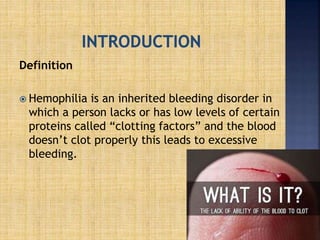
Definition
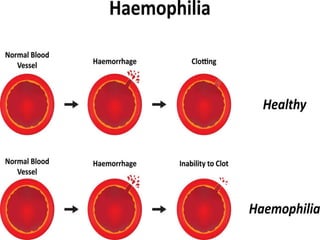
 Hemophilia is an inherited bleeding disorder in
which a person lacks or has low levels of certain
proteins called “clotting factors” and the blood
doesn’t clot properly this leads to excessive
bleeding.
 Hemophilia has been called a "royal
disease".
 This is because the hemophilia gene was
passed from Queen Victoria, who became
Queen of England in 1837, to the ruling
families of Russia, Spain, and Germany.
 It was caused by spontaneous mutation.
 Secondary homeostasis, as arrest the blood
loss from ruptured vessels.
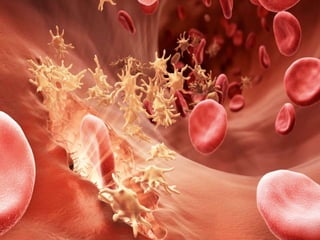
 Clotting factors are proteins in the blood
that work together with platelets to stop or
control bleeding.
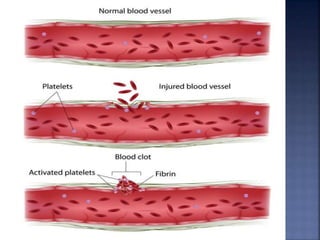
 If the lining of the blood vessels becomes
damaged, platelets are recruited to the
injured area to form an initial plug.
 These activated platelets release chemicals
that start the clotting cascade, activating
the series of 13 proteins known as clotting
factors.
 First factor X is released at injured area.
 Factor X results in the cleavage
of prothrombin (factor II) to thrombin (factor
IIa).
 Thrombin, in turn, catalyzes the conversion
of fibrinogen a soluble plasma protein—into
long, sticky threads of insoluble fibrin.
 Ultimately, fibrin is formed, the protein that
crosslink with itself to form a mesh that
makes up the final blood clot.
 hemophilia A & B caused by a genetic
mutation.
 A defect in genes for determining clotting
factor VIII,IX or XI.
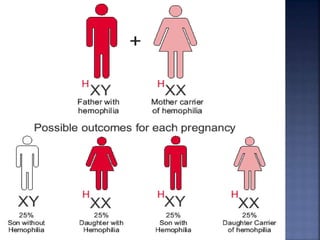
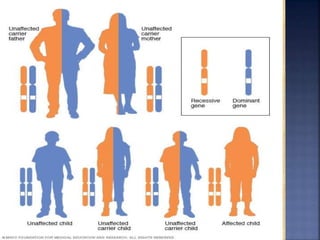
 Only X chromosome carries gene for clotting
factors.
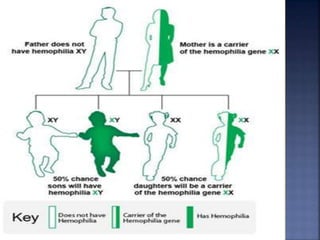
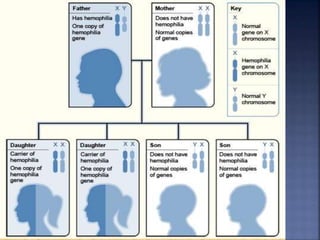
 Males are most likely to affected because it is
X-linked recessive disease.
 When Female have one hemophilia gene, she
is a carrier for hemophilia.
 She can pass onto the next generation
 About 70% of all people with hemophilia A or
B inherited the disease.
 The other 30% develop from a
spontaneous genetic mutation.
The major types of this condition are:
 hemophilia A (classic hemophilia or factor VIII
deficiency)
 hemophilia B (Christmas disease or factor IX
deficiency).
 Hemophilia C (Rosenthal syndrome) results from a
deficiency in factor 11).
 It is a genetic disorder in which gene or
clotting factor VIII mutated.
 Leads to spontaneous bleeding following
injury, cut or surgery.
 Inherited as X-linked recessive trait.
 Also called classic hemophilia
 Over 80% of patients have hemophilia A.
 The partial thromboplastin time(PTT) is
usually prolonged.
 Hemophilia A affects between one in 5,000 to
one in 10,000 males in most populations.
 It results due to inherited mutation of gene
for factor IX.
 prothrombin time is usually prolonged.
 The disease is named as Christmas disease
for Stephen Christmas, who was the first
person diagnosed with the condition in 1952.
 It affects only 15-20% of people
with hemophilia.
 Hemophilia C is a mild form of the disease that’s
caused by a deficiency of factor XI.
 Hemophilia C is an autosomal inherited form of
the disease, meaning that it affects males and
females equally.
 People with this rare type of hemophilia often
don’t experience spontaneous bleeding.
 Hemorrhaging typically occurs after dental
extraction, trauma or surgery.
 Also called plasma thromboplastin
antecedent deficiency (PTA
deficiency), and Rosenthal syndrome.
 First recognized in 1953.
 It has been observed mostly in
persons of Ashkenazi Jewish ancestry.
 In the United States, it is thought to affect 1
in 100,000 of the adult population.
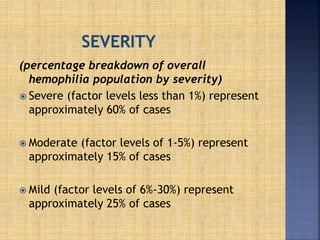
(percentage breakdown of overall
hemophilia population by severity)
 Severe (factor levels less than 1%) represent
approximately 60% of cases
 Moderate (factor levels of 1-5%) represent
approximately 15% of cases
 Mild (factor levels of 6%-30%) represent
approximately 25% of cases
Signs and symptoms of spontaneous bleeding include:
 Unexplained and excessive bleeding from cuts or
injuries, or after surgery or dental work
 Unusual bleeding after vaccinations
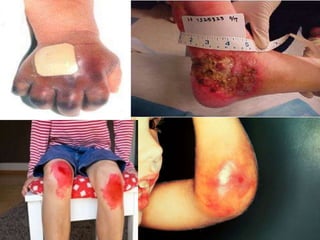
 Pain, swelling or tightness in your joints, it often
affects the knees, elbows, and ankles.
 Blood in urine or stool
 Nosebleeds without a known cause
 In infants, unexplained irritability
 Painful, prolonged headache
 Repeated vomiting
 Sleepiness or lethargy
 Double vision
 Sudden weakness or clumsiness
 Convulsions or seizure
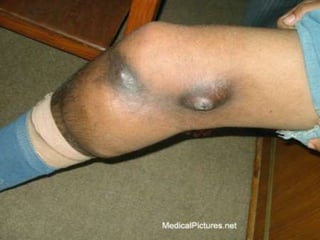
 Bleeding into the skin (which is bruising)
 Bleeding in the muscle and soft tissue
causing a build-up of blood in the area
(called a hematoma).
 Bleeding of the mouth and gums, and
bleeding that is hard to stop after losing a
tooth.
 One recent study estimated the prevalence
of hemophilia was 13.4 cases per 100,000 US.
 Males (10.5 hemophilia A and
2.9 hemophilia B).
 By race/ethnicity, the prevalence was 13.2
 cases/100,000 among white, 11.0 among
African-American,
and 11.5 among Hispanic males.
 Genetic testing
 Blood test, platelet count
 Clotting factor VIII, IX, XI test factor assays
 Check Signs and symptoms of hemophilia in
newborn baby
 an activated partial thromboplastin time test
 a prothrombin time tests
 a fibrinogen test
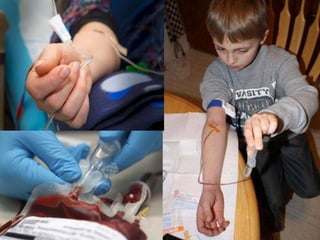
 Coagulation factor replacement therapy.
 hemophilia can be treated by infusing patient
blood with donor clotting factors VIII or IX.
 Clotting factors may be synthetic called
recombinant clotting factors.
 Aminocaproic acid prevents the breakdown of
blood clots. It is often recommended before
dental procedures, and to treat nose and mouth
bleeds.
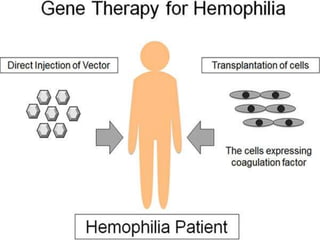
 Gene therapy:
introduction of a normal gene into an
individual’s genome in order to repair a
mutation that causes a genetic disease.
 A carrier called a vector is genetically
engineered to deliver the gene.
 Certain viruses are often used as vectors
because they can deliver the new gene by
infecting the cell.
 Applying desmopressin acetate to small wounds
to stop the bleeding that stimulates clotting
factors.
 by performing the infusions on a regular basis
(called prophylaxis), can even prevent most
bleeding episodes.
 Good quality medical care from doctors and
nurses.
 hemophilia C can be treated using plasma
infusion, The infusion works to stop profuse
bleeding.
 Hormone therapy – administered as birth-
control pills, injections and intrauterine
devices (IUDs) for hemophilia C.
 Physical therapy for rehabilitation if joints
are damaged by hemophilia.
 Bleeding within joints that can lead to
chronic joint disease and pain.
 Bleeding in the head and sometimes in the
brain which can cause long term problems,
such as seizures and paralysis.
 Death can occur if the bleeding cannot be
stopped or if it occurs in a vital organ such as
the brain.
Infections:
 People with hemophilia are likelier to have
blood transfusions, increasing their risk of
receiving contaminated blood products.
 Blood products became safer after the mid-
1980s due to screening of donated blood for
hepatitis and HIV.
Adverse reaction to clotting factor treatment:
 In some people with hemophilia, the immune
system has a negative reaction to the clotting
factors used to treat bleeding.
 When this happens, the immune system
develops proteins (known as inhibitors) that
inactivate the clotting factors, making
treatment less effective.
 Get an annual comprehensive checkup at a
hemophilia treatment center.
 Get vaccinated—Hepatitis A and B are
preventable.
 Treat bleeds early and adequately.
 Exercise and maintain a healthy weight to
protect your joints.
 Get tested regularly for blood-borne infections.
Hemophilia

Hemophilia

  • 1.
  • 2.
    Definition  Hemophilia isan inherited bleeding disorder in which a person lacks or has low levels of certain proteins called “clotting factors” and the blood doesn’t clot properly this leads to excessive bleeding.
  • 4.
     Hemophilia hasbeen called a "royal disease".  This is because the hemophilia gene was passed from Queen Victoria, who became Queen of England in 1837, to the ruling families of Russia, Spain, and Germany.  It was caused by spontaneous mutation.
  • 5.
     Secondary homeostasis,as arrest the blood loss from ruptured vessels.  Clotting factors are proteins in the blood that work together with platelets to stop or control bleeding.  If the lining of the blood vessels becomes damaged, platelets are recruited to the injured area to form an initial plug.
  • 6.
     These activatedplatelets release chemicals that start the clotting cascade, activating the series of 13 proteins known as clotting factors.  First factor X is released at injured area.  Factor X results in the cleavage of prothrombin (factor II) to thrombin (factor IIa).
  • 7.
     Thrombin, inturn, catalyzes the conversion of fibrinogen a soluble plasma protein—into long, sticky threads of insoluble fibrin.  Ultimately, fibrin is formed, the protein that crosslink with itself to form a mesh that makes up the final blood clot.
  • 9.
     hemophilia A& B caused by a genetic mutation.  A defect in genes for determining clotting factor VIII,IX or XI.  Only X chromosome carries gene for clotting factors.  Males are most likely to affected because it is X-linked recessive disease.
  • 10.
     When Femalehave one hemophilia gene, she is a carrier for hemophilia.  She can pass onto the next generation  About 70% of all people with hemophilia A or B inherited the disease.  The other 30% develop from a spontaneous genetic mutation.
  • 14.
    The major typesof this condition are:  hemophilia A (classic hemophilia or factor VIII deficiency)  hemophilia B (Christmas disease or factor IX deficiency).  Hemophilia C (Rosenthal syndrome) results from a deficiency in factor 11).
  • 15.
     It isa genetic disorder in which gene or clotting factor VIII mutated.  Leads to spontaneous bleeding following injury, cut or surgery.  Inherited as X-linked recessive trait.  Also called classic hemophilia  Over 80% of patients have hemophilia A.
  • 16.
     The partialthromboplastin time(PTT) is usually prolonged.  Hemophilia A affects between one in 5,000 to one in 10,000 males in most populations.
  • 17.
     It resultsdue to inherited mutation of gene for factor IX.  prothrombin time is usually prolonged.  The disease is named as Christmas disease for Stephen Christmas, who was the first person diagnosed with the condition in 1952.  It affects only 15-20% of people with hemophilia.
  • 18.
     Hemophilia Cis a mild form of the disease that’s caused by a deficiency of factor XI.  Hemophilia C is an autosomal inherited form of the disease, meaning that it affects males and females equally.  People with this rare type of hemophilia often don’t experience spontaneous bleeding.  Hemorrhaging typically occurs after dental extraction, trauma or surgery.
  • 20.
     Also calledplasma thromboplastin antecedent deficiency (PTA deficiency), and Rosenthal syndrome.  First recognized in 1953.  It has been observed mostly in persons of Ashkenazi Jewish ancestry.  In the United States, it is thought to affect 1 in 100,000 of the adult population.
  • 21.
    (percentage breakdown ofoverall hemophilia population by severity)  Severe (factor levels less than 1%) represent approximately 60% of cases  Moderate (factor levels of 1-5%) represent approximately 15% of cases  Mild (factor levels of 6%-30%) represent approximately 25% of cases
  • 23.
    Signs and symptomsof spontaneous bleeding include:  Unexplained and excessive bleeding from cuts or injuries, or after surgery or dental work  Unusual bleeding after vaccinations  Pain, swelling or tightness in your joints, it often affects the knees, elbows, and ankles.  Blood in urine or stool  Nosebleeds without a known cause
  • 26.
     In infants,unexplained irritability  Painful, prolonged headache  Repeated vomiting  Sleepiness or lethargy  Double vision  Sudden weakness or clumsiness  Convulsions or seizure
  • 29.
     Bleeding intothe skin (which is bruising)  Bleeding in the muscle and soft tissue causing a build-up of blood in the area (called a hematoma).  Bleeding of the mouth and gums, and bleeding that is hard to stop after losing a tooth.
  • 30.
     One recentstudy estimated the prevalence of hemophilia was 13.4 cases per 100,000 US.  Males (10.5 hemophilia A and 2.9 hemophilia B).  By race/ethnicity, the prevalence was 13.2  cases/100,000 among white, 11.0 among African-American, and 11.5 among Hispanic males.
  • 31.
     Genetic testing Blood test, platelet count  Clotting factor VIII, IX, XI test factor assays  Check Signs and symptoms of hemophilia in newborn baby  an activated partial thromboplastin time test  a prothrombin time tests  a fibrinogen test
  • 32.
     Coagulation factorreplacement therapy.  hemophilia can be treated by infusing patient blood with donor clotting factors VIII or IX.  Clotting factors may be synthetic called recombinant clotting factors.  Aminocaproic acid prevents the breakdown of blood clots. It is often recommended before dental procedures, and to treat nose and mouth bleeds.
  • 33.
     Gene therapy: introductionof a normal gene into an individual’s genome in order to repair a mutation that causes a genetic disease.  A carrier called a vector is genetically engineered to deliver the gene.  Certain viruses are often used as vectors because they can deliver the new gene by infecting the cell.
  • 36.
     Applying desmopressinacetate to small wounds to stop the bleeding that stimulates clotting factors.  by performing the infusions on a regular basis (called prophylaxis), can even prevent most bleeding episodes.  Good quality medical care from doctors and nurses.
  • 37.
     hemophilia Ccan be treated using plasma infusion, The infusion works to stop profuse bleeding.  Hormone therapy – administered as birth- control pills, injections and intrauterine devices (IUDs) for hemophilia C.  Physical therapy for rehabilitation if joints are damaged by hemophilia.
  • 38.
     Bleeding withinjoints that can lead to chronic joint disease and pain.  Bleeding in the head and sometimes in the brain which can cause long term problems, such as seizures and paralysis.  Death can occur if the bleeding cannot be stopped or if it occurs in a vital organ such as the brain.
  • 39.
    Infections:  People withhemophilia are likelier to have blood transfusions, increasing their risk of receiving contaminated blood products.  Blood products became safer after the mid- 1980s due to screening of donated blood for hepatitis and HIV.
  • 40.
    Adverse reaction toclotting factor treatment:  In some people with hemophilia, the immune system has a negative reaction to the clotting factors used to treat bleeding.  When this happens, the immune system develops proteins (known as inhibitors) that inactivate the clotting factors, making treatment less effective.
  • 41.
     Get anannual comprehensive checkup at a hemophilia treatment center.  Get vaccinated—Hepatitis A and B are preventable.  Treat bleeds early and adequately.  Exercise and maintain a healthy weight to protect your joints.  Get tested regularly for blood-borne infections.