THROMBOCYTOPAENIA
Modarator:
Prof (Dr.) Tushar Kanti Das, HOD
by Dr Sweta Biswas Das
2nd Year PGT
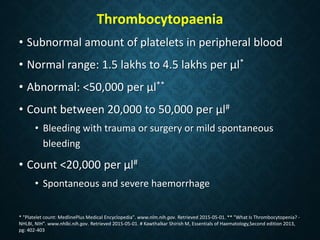
Thrombocytopaenia
• Subnormal amount of platelets in peripheral blood
• Normal range: 1.5 lakhs to 4.5 lakhs per µl*
• Abnormal: <50,000 per µl**
• Count between 20,000 to 50,000 per µl#
• Bleeding with trauma or surgery or mild spontaneous
bleeding
• Count <20,000 per µl#
• Spontaneous and severe haemorrhage
* "Platelet count: MedlinePlus Medical Encyclopedia". www.nlm.nih.gov. Retrieved 2015-05-01. ** "What Is Thrombocytopenia? -
NHLBI, NIH". www.nhlbi.nih.gov. Retrieved 2015-05-01. # Kawthalkar Shirish M, Essentials of Haematology,Second edition 2013,
pg: 402-403
Causes of Thrombocytopaenia
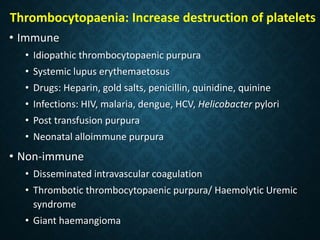
Thrombocytopaenia: Increase destruction of platelets
• Immune
• Idiopathic thrombocytopaenic purpura
• Systemic lupus erythemaetosus
• Drugs: Heparin, gold salts, penicillin, quinidine, quinine
• Infections: HIV, malaria, dengue, HCV, Helicobacter pylori
• Post transfusion purpura
• Neonatal alloimmune purpura
• Non-immune
• Disseminated intravascular coagulation
• Thrombotic thrombocytopaenic purpura/ Haemolytic Uremic
syndrome
• Giant haemangioma
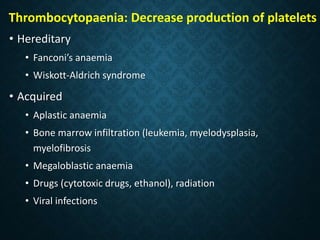
Thrombocytopaenia: Decrease production of platelets
• Hereditary
• Fanconi’s anaemia
• Wiskott-Aldrich syndrome
• Acquired
• Aplastic anaemia
• Bone marrow infiltration (leukemia, myelodysplasia,
myelofibrosis
• Megaloblastic anaemia
• Drugs (cytotoxic drugs, ethanol), radiation
• Viral infections
Thrombocytopaenia: Others
• Dilutional thrombocytopaenia
• Massive blood transfusion
• Increased sequestration
• Hypersplenism
Idiopathic thrombocytopaenic purpura (ITP)
• Autoantibodies or immunocomplexes binds with
platelets
• Causes premature peripheral destruction
• Two types
• Acute ITP
• Chronic ITP
Idiopathic thrombocytopaenic purpura (ITP):
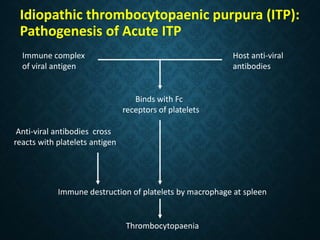
Pathogenesis of Acute ITP
Immune complex
of viral antigen
Host anti-viral
antibodies
Binds with Fc
receptors of platelets
Immune destruction of platelets by macrophage at spleen
Thrombocytopaenia
Anti-viral antibodies cross
reacts with platelets antigen
Idiopathic thrombocytopaenic purpura (ITP):
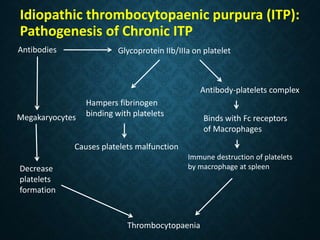
Pathogenesis of Chronic ITP
Thrombocytopaenia
Antibodies Glycoprotein IIb/IIIa on platelet
Megakaryocytes
Decrease
platelets
formation
Antibody-platelets complex
Binds with Fc receptors
of Macrophages
Immune destruction of platelets
by macrophage at spleen
Hampers fibrinogen
binding with platelets
Causes platelets malfunction
Idiopathic thrombocytopaenic purpura (ITP):
Clinical features of acute and chronic ITP
Parameter Acute ITP Chronic ITP
Age Childhood Young adults
Sex No sex preference Common in females
H/o preceding viral
infection or
vaccination
Common No
Onset of bleeding Sudden Insidious
Degree of
thrombocytopenia
Severe Moderate
Duration of disease
Self-limited (2-6
months)
Many years
Spontaneous
remission
Usual Rare
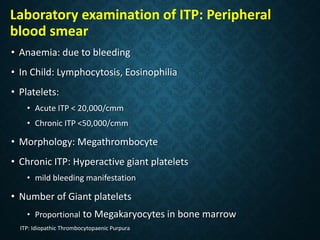
• Anaemia: due to bleeding
• In Child: Lymphocytosis, Eosinophilia
• Platelets:
• Acute ITP < 20,000/cmm
• Chronic ITP <50,000/cmm
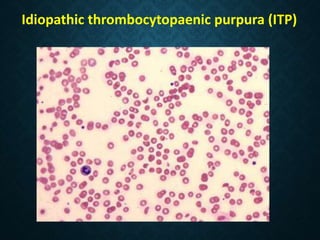
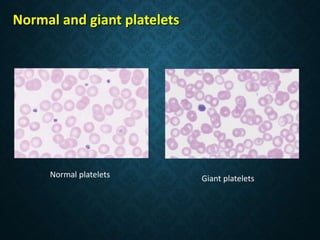
• Morphology: Megathrombocyte
• Chronic ITP: Hyperactive giant platelets
• mild bleeding manifestation
• Number of Giant platelets
• Proportional to Megakaryocytes in bone marrow
Laboratory examination of ITP: Peripheral
blood smear
ITP: Idiopathic Thrombocytopaenic Purpura
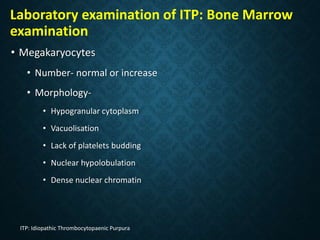
Laboratory examination of ITP: Bone Marrow
examination
• Megakaryocytes
• Number- normal or increase
• Morphology-
• Hypogranular cytoplasm
• Vacuolisation
• Lack of platelets budding
• Nuclear hypolobulation
• Dense nuclear chromatin
ITP: Idiopathic Thrombocytopaenic Purpura
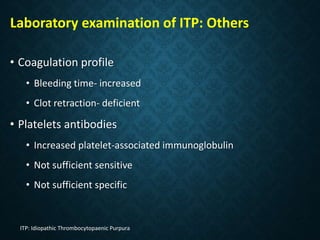
Laboratory examination of ITP: Others
• Coagulation profile
• Bleeding time- increased
• Clot retraction- deficient
• Platelets antibodies
• Increased platelet-associated immunoglobulin
• Not sufficient sensitive
• Not sufficient specific
ITP: Idiopathic Thrombocytopaenic Purpura
Idiopathic thrombocytopaenic purpura (ITP)
Idiopathic thrombocytopaenic purpura (ITP):
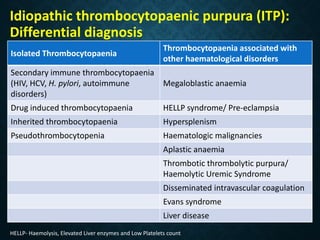
Differential diagnosis
Isolated Thrombocytopaenia
Thrombocytopaenia associated with
other haematological disorders
Secondary immune thrombocytopaenia
(HIV, HCV, H. pylori, autoimmune
disorders)
Megaloblastic anaemia
Drug induced thrombocytopaenia HELLP syndrome/ Pre-eclampsia
Inherited thrombocytopaenia Hypersplenism
Pseudothrombocytopenia Haematologic malignancies
Aplastic anaemia
Thrombotic thrombolytic purpura/
Haemolytic Uremic Syndrome
Disseminated intravascular coagulation
Evans syndrome
Liver disease
HELLP- Haemolysis, Elevated Liver enzymes and Low Platelets count
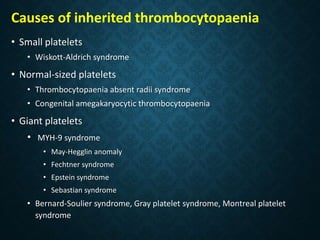
Causes of inherited thrombocytopaenia
• Small platelets
• Wiskott-Aldrich syndrome
• Normal-sized platelets
• Thrombocytopaenia absent radii syndrome
• Congenital amegakaryocytic thrombocytopaenia
• Giant platelets
• MYH-9 syndrome
• May-Hegglin anomaly
• Fechtner syndrome
• Epstein syndrome
• Sebastian syndrome
• Bernard-Soulier syndrome, Gray platelet syndrome, Montreal platelet
syndrome
Normal and giant platelets
Normal platelets Giant platelets
Idiopathic thrombocytopaenic purpura (ITP):
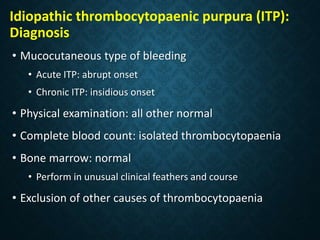
Diagnosis
• Mucocutaneous type of bleeding
• Acute ITP: abrupt onset
• Chronic ITP: insidious onset
• Physical examination: all other normal
• Complete blood count: isolated thrombocytopaenia
• Bone marrow: normal
• Perform in unusual clinical feathers and course
• Exclusion of other causes of thrombocytopaenia
Idiopathic thrombocytopaenic purpura (ITP):
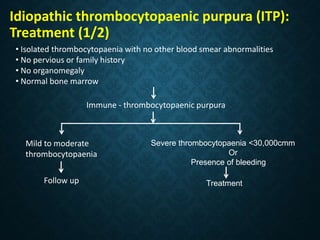
Treatment (1/2)
• Isolated thrombocytopaenia with no other blood smear abnormalities
• No pervious or family history
• No organomegaly
• Normal bone marrow
Immune - thrombocytopaenic purpura
Mild to moderate
thrombocytopaenia
Follow up
Severe thrombocytopaenia <30,000cmm
Or
Presence of bleeding
Treatment
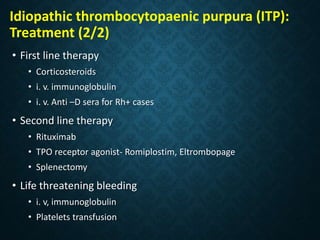
• First line therapy
• Corticosteroids
• i. v. immunoglobulin
• i. v. Anti –D sera for Rh+ cases
• Second line therapy
• Rituximab
• TPO receptor agonist- Romiplostim, Eltrombopage
• Splenectomy
• Life threatening bleeding
• i. v, immunoglobulin
• Platelets transfusion
Idiopathic thrombocytopaenic purpura (ITP):
Treatment (2/2)
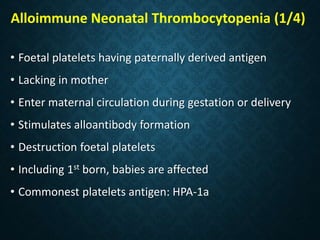
Alloimmune Neonatal Thrombocytopenia (1/4)
• Foetal platelets having paternally derived antigen
• Lacking in mother
• Enter maternal circulation during gestation or delivery
• Stimulates alloantibody formation
• Destruction foetal platelets
• Including 1st born, babies are affected
• Commonest platelets antigen: HPA-1a
Alloimmune Neonatal Thrombocytopaenia:
Differential diagnosis (2/4)
• Increased peripheral destruction of platelets
• Immune destruction by maternal antibodies
• Auto immune antibodies (Maternal ITP or SLE)
• Alloimmune neonatal thrombocytopaenia
• Non-immune mechanism
• Disseminated intravascular coagulation
• Intrauterine infections
• Giant haemangioma
Alloimmune Neonatal Thrombocytopaenia:
Differential diagnosis (3/4)
• Decreased production of platelets
• Thrombocytopaenia absent radii (TAR) syndrome
• Wiskott-Aldrich syndrome
• May-Hegglin anomaly
• Bernard- Soulier syndrome
• Fanconi anaemia
• Congenital malignancies
Alloimmune Neonatal Thrombocytopaenia
(4/4)
• Self limiting- resolve in three weeks
• Intra cranial haemorrhage: due to trauma during vaginal
delivery
• Severe cases: purpura and haemorrhage with in few
hours of delivery
• Severe symptomatic thrombocytopaenia
• Treated with maternal derived platelets transfusion
Post transfusion purpura (1/2)
• Rare life threatening disorder
• Sudden onset thrombocytopaenia
• Bleeding occurs after 7-10 days of blood transfusion
• Common in mutiparous women
• Donor platelets: have HPA-1a antigen
• Patient’s platelets: lack HPA-1a antigen
Post transfusion purpura (2/2)
• May be previously sensitised by HPA-1a positive foetal
platelets
• Treatment: i.v. gammaglobulin and plasmapheresis
Thrombotic microangiopatheis
• Characterised by
• Microvascular thrombosis
• Microangiopathc haemolytic anaemia (MAHA)
• Thrombocytopenia
• Classification
• Thrombotic thrombocytopaenic purpura (TTP)
• Haemolytic uraemic syndrome (HUS)
Thrombotic thrombocytopaenic purpura (1/5)
• Uncommon disorder
• Hyaline microthrombi formation
• At microcirculation of various organs
• Due to platelets aggregation
• Idiopathic variety
• Autoantibodies against ADAMTAS13
• Leads to deficiency of ADAMTAS13
• Accumulation of ultra-large vWF multimers
• Bind large numbers of platelets
ADAMTS13: A disintegrin and metalloprotease with thrombospondin 1 and 13
Thrombotic thrombocytopaenic purpura (2/5)
• Familial variety (Upshaw-Sohulman syndrome)
• ADAMTS13 deficiency: mutation in ADAMTS13 gene
• Affects young adults
• Common in female
• Manifestations
• Microangiopathic haemolytic anaemia
• Red cells passes through fibrin strands of microthrombi- haemolysis
• Clinically: pallor, icterus
• Peripheral blood smear: fragmented and nucleated RBC,reticulocytosis
• LDH and unconjugated bilirubin: increased in serum
ADAMTS13: A disintegrin and metalloprotease with thrombospondin 1 and 13, RBC: Red Blood Cells, LDH: Lactose dehydrogenased
Thrombotic thrombocytopaenic purpura (3/5)
• Manifestations (Contd.)
• Bleeding secondary to severe thrombocytopaenia
• Petechiae
• Ecchymosis
• Epistaxis
• Gastrointestinal or genitourinary bleeding
• Coagulation profile: normal in most cases (PT, APTT)
• Fluctuating neurologic dysfunction
• Altered consciousness level
• Seizures
• Visual field abnormality
• Hemiparesis
PT: Prothombin Time, APTT: Activated Partial Thromboplastin Time
Thrombotic thrombocytopaenic purpura (4/5)
• Manifestations (Contd.)
• Renal abnormalities
• Proteinuria
• Haematuria
• Azotaemia
• Fever
• Correct diagnosis is essential
• Platelets transfusion to correct thrombocytopaenia
• May aggravate predisposition to thrombosis
Thrombotic thrombocytopaenic purpura (5/5)
• Treatment
• Transfusion of fresh frozen plasma
• Plasmapheresis
• Antiplatelet drugs
• Corticosteroids
• Vincristine
Haemolytic Uraemic Syndrome (1/2)
• Characterised by
• Acute renal failure
• Thrombocytopenia
• Microangiopathic haemolytic anaemia (MAHA)
• Typical variety
• Children <5 yrs age
• Associated with Shiga toxin-producing Escherichia coli O157:H7
• Diarrhoeal illness followed by MAHA, thrombocytopaenia and
renal failure
• Atypical variety
• Diarrhoeal prodrome not occurs
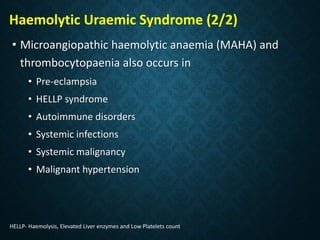
Haemolytic Uraemic Syndrome (2/2)
• Microangiopathic haemolytic anaemia (MAHA) and
thrombocytopaenia also occurs in
• Pre-eclampsia
• HELLP syndrome
• Autoimmune disorders
• Systemic infections
• Systemic malignancy
• Malignant hypertension
HELLP- Haemolysis, Elevated Liver enzymes and Low Platelets count
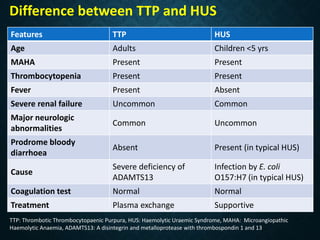
Difference between TTP and HUS
Features TTP HUS
Age Adults Children <5 yrs
MAHA Present Present
Thrombocytopenia Present Present
Fever Present Absent
Severe renal failure Uncommon Common
Major neurologic
abnormalities
Common Uncommon
Prodrome bloody
diarrhoea
Absent Present (in typical HUS)
Cause
Severe deficiency of
ADAMTS13
Infection by E. coli
O157:H7 (in typical HUS)
Coagulation test Normal Normal
Treatment Plasma exchange Supportive
TTP: Thrombotic Thrombocytopaenic Purpura, HUS: Haemolytic Uraemic Syndrome, MAHA: Microangiopathic
Haemolytic Anaemia, ADAMTS13: A disintegrin and metalloprotease with thrombospondin 1 and 13
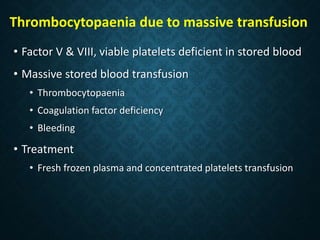
Thrombocytopaenia due to massive transfusion
• Factor V & VIII, viable platelets deficient in stored blood
• Massive stored blood transfusion
• Thrombocytopaenia
• Coagulation factor deficiency
• Bleeding
• Treatment
• Fresh frozen plasma and concentrated platelets transfusion
Thrombocytopaenia due to increased platelet
sequestration or pooling
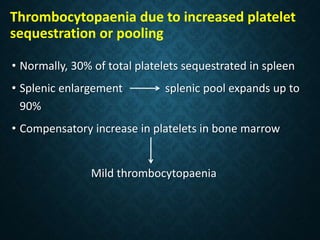
• Normally, 30% of total platelets sequestrated in spleen
• Splenic enlargement splenic pool expands up to
90%
• Compensatory increase in platelets in bone marrow
Mild thrombocytopaenia
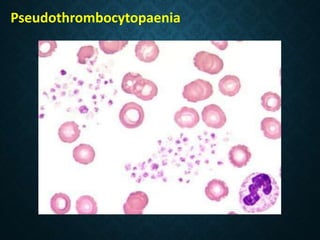
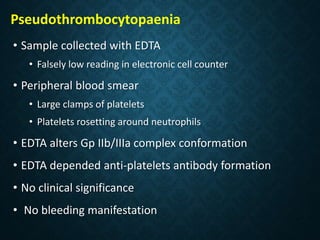
• Sample collected with EDTA
• Falsely low reading in electronic cell counter
• Peripheral blood smear
• Large clamps of platelets
• Platelets rosetting around neutrophils
• EDTA alters Gp IIb/IIIa complex conformation
• EDTA depended anti-platelets antibody formation
• No clinical significance
• No bleeding manifestation
Pseudothrombocytopaenia
References
1. Kawthalkar Shirish M, Essentials of Haematology,Second edition 2013
Thank you

Thrombocytopenia

  • 1.
    THROMBOCYTOPAENIA Modarator: Prof (Dr.) TusharKanti Das, HOD by Dr Sweta Biswas Das 2nd Year PGT
  • 2.
    Thrombocytopaenia • Subnormal amountof platelets in peripheral blood • Normal range: 1.5 lakhs to 4.5 lakhs per µl* • Abnormal: <50,000 per µl** • Count between 20,000 to 50,000 per µl# • Bleeding with trauma or surgery or mild spontaneous bleeding • Count <20,000 per µl# • Spontaneous and severe haemorrhage * "Platelet count: MedlinePlus Medical Encyclopedia". www.nlm.nih.gov. Retrieved 2015-05-01. ** "What Is Thrombocytopenia? - NHLBI, NIH". www.nhlbi.nih.gov. Retrieved 2015-05-01. # Kawthalkar Shirish M, Essentials of Haematology,Second edition 2013, pg: 402-403
  • 3.
  • 4.
    Thrombocytopaenia: Increase destructionof platelets • Immune • Idiopathic thrombocytopaenic purpura • Systemic lupus erythemaetosus • Drugs: Heparin, gold salts, penicillin, quinidine, quinine • Infections: HIV, malaria, dengue, HCV, Helicobacter pylori • Post transfusion purpura • Neonatal alloimmune purpura • Non-immune • Disseminated intravascular coagulation • Thrombotic thrombocytopaenic purpura/ Haemolytic Uremic syndrome • Giant haemangioma
  • 5.
    Thrombocytopaenia: Decrease productionof platelets • Hereditary • Fanconi’s anaemia • Wiskott-Aldrich syndrome • Acquired • Aplastic anaemia • Bone marrow infiltration (leukemia, myelodysplasia, myelofibrosis • Megaloblastic anaemia • Drugs (cytotoxic drugs, ethanol), radiation • Viral infections
  • 6.
    Thrombocytopaenia: Others • Dilutionalthrombocytopaenia • Massive blood transfusion • Increased sequestration • Hypersplenism
  • 7.
    Idiopathic thrombocytopaenic purpura(ITP) • Autoantibodies or immunocomplexes binds with platelets • Causes premature peripheral destruction • Two types • Acute ITP • Chronic ITP
  • 8.
    Idiopathic thrombocytopaenic purpura(ITP): Pathogenesis of Acute ITP Immune complex of viral antigen Host anti-viral antibodies Binds with Fc receptors of platelets Immune destruction of platelets by macrophage at spleen Thrombocytopaenia Anti-viral antibodies cross reacts with platelets antigen
  • 9.
    Idiopathic thrombocytopaenic purpura(ITP): Pathogenesis of Chronic ITP Thrombocytopaenia Antibodies Glycoprotein IIb/IIIa on platelet Megakaryocytes Decrease platelets formation Antibody-platelets complex Binds with Fc receptors of Macrophages Immune destruction of platelets by macrophage at spleen Hampers fibrinogen binding with platelets Causes platelets malfunction
  • 10.
    Idiopathic thrombocytopaenic purpura(ITP): Clinical features of acute and chronic ITP Parameter Acute ITP Chronic ITP Age Childhood Young adults Sex No sex preference Common in females H/o preceding viral infection or vaccination Common No Onset of bleeding Sudden Insidious Degree of thrombocytopenia Severe Moderate Duration of disease Self-limited (2-6 months) Many years Spontaneous remission Usual Rare
  • 11.
    • Anaemia: dueto bleeding • In Child: Lymphocytosis, Eosinophilia • Platelets: • Acute ITP < 20,000/cmm • Chronic ITP <50,000/cmm • Morphology: Megathrombocyte • Chronic ITP: Hyperactive giant platelets • mild bleeding manifestation • Number of Giant platelets • Proportional to Megakaryocytes in bone marrow Laboratory examination of ITP: Peripheral blood smear ITP: Idiopathic Thrombocytopaenic Purpura
  • 12.
    Laboratory examination ofITP: Bone Marrow examination • Megakaryocytes • Number- normal or increase • Morphology- • Hypogranular cytoplasm • Vacuolisation • Lack of platelets budding • Nuclear hypolobulation • Dense nuclear chromatin ITP: Idiopathic Thrombocytopaenic Purpura
  • 13.
    Laboratory examination ofITP: Others • Coagulation profile • Bleeding time- increased • Clot retraction- deficient • Platelets antibodies • Increased platelet-associated immunoglobulin • Not sufficient sensitive • Not sufficient specific ITP: Idiopathic Thrombocytopaenic Purpura
  • 14.
  • 15.
    Idiopathic thrombocytopaenic purpura(ITP): Differential diagnosis Isolated Thrombocytopaenia Thrombocytopaenia associated with other haematological disorders Secondary immune thrombocytopaenia (HIV, HCV, H. pylori, autoimmune disorders) Megaloblastic anaemia Drug induced thrombocytopaenia HELLP syndrome/ Pre-eclampsia Inherited thrombocytopaenia Hypersplenism Pseudothrombocytopenia Haematologic malignancies Aplastic anaemia Thrombotic thrombolytic purpura/ Haemolytic Uremic Syndrome Disseminated intravascular coagulation Evans syndrome Liver disease HELLP- Haemolysis, Elevated Liver enzymes and Low Platelets count
  • 16.
    Causes of inheritedthrombocytopaenia • Small platelets • Wiskott-Aldrich syndrome • Normal-sized platelets • Thrombocytopaenia absent radii syndrome • Congenital amegakaryocytic thrombocytopaenia • Giant platelets • MYH-9 syndrome • May-Hegglin anomaly • Fechtner syndrome • Epstein syndrome • Sebastian syndrome • Bernard-Soulier syndrome, Gray platelet syndrome, Montreal platelet syndrome
  • 17.
    Normal and giantplatelets Normal platelets Giant platelets
  • 18.
    Idiopathic thrombocytopaenic purpura(ITP): Diagnosis • Mucocutaneous type of bleeding • Acute ITP: abrupt onset • Chronic ITP: insidious onset • Physical examination: all other normal • Complete blood count: isolated thrombocytopaenia • Bone marrow: normal • Perform in unusual clinical feathers and course • Exclusion of other causes of thrombocytopaenia
  • 19.
    Idiopathic thrombocytopaenic purpura(ITP): Treatment (1/2) • Isolated thrombocytopaenia with no other blood smear abnormalities • No pervious or family history • No organomegaly • Normal bone marrow Immune - thrombocytopaenic purpura Mild to moderate thrombocytopaenia Follow up Severe thrombocytopaenia <30,000cmm Or Presence of bleeding Treatment
  • 20.
    • First linetherapy • Corticosteroids • i. v. immunoglobulin • i. v. Anti –D sera for Rh+ cases • Second line therapy • Rituximab • TPO receptor agonist- Romiplostim, Eltrombopage • Splenectomy • Life threatening bleeding • i. v, immunoglobulin • Platelets transfusion Idiopathic thrombocytopaenic purpura (ITP): Treatment (2/2)
  • 21.
    Alloimmune Neonatal Thrombocytopenia(1/4) • Foetal platelets having paternally derived antigen • Lacking in mother • Enter maternal circulation during gestation or delivery • Stimulates alloantibody formation • Destruction foetal platelets • Including 1st born, babies are affected • Commonest platelets antigen: HPA-1a
  • 22.
    Alloimmune Neonatal Thrombocytopaenia: Differentialdiagnosis (2/4) • Increased peripheral destruction of platelets • Immune destruction by maternal antibodies • Auto immune antibodies (Maternal ITP or SLE) • Alloimmune neonatal thrombocytopaenia • Non-immune mechanism • Disseminated intravascular coagulation • Intrauterine infections • Giant haemangioma
  • 23.
    Alloimmune Neonatal Thrombocytopaenia: Differentialdiagnosis (3/4) • Decreased production of platelets • Thrombocytopaenia absent radii (TAR) syndrome • Wiskott-Aldrich syndrome • May-Hegglin anomaly • Bernard- Soulier syndrome • Fanconi anaemia • Congenital malignancies
  • 24.
    Alloimmune Neonatal Thrombocytopaenia (4/4) •Self limiting- resolve in three weeks • Intra cranial haemorrhage: due to trauma during vaginal delivery • Severe cases: purpura and haemorrhage with in few hours of delivery • Severe symptomatic thrombocytopaenia • Treated with maternal derived platelets transfusion
  • 25.
    Post transfusion purpura(1/2) • Rare life threatening disorder • Sudden onset thrombocytopaenia • Bleeding occurs after 7-10 days of blood transfusion • Common in mutiparous women • Donor platelets: have HPA-1a antigen • Patient’s platelets: lack HPA-1a antigen
  • 26.
    Post transfusion purpura(2/2) • May be previously sensitised by HPA-1a positive foetal platelets • Treatment: i.v. gammaglobulin and plasmapheresis
  • 27.
    Thrombotic microangiopatheis • Characterisedby • Microvascular thrombosis • Microangiopathc haemolytic anaemia (MAHA) • Thrombocytopenia • Classification • Thrombotic thrombocytopaenic purpura (TTP) • Haemolytic uraemic syndrome (HUS)
  • 28.
    Thrombotic thrombocytopaenic purpura(1/5) • Uncommon disorder • Hyaline microthrombi formation • At microcirculation of various organs • Due to platelets aggregation • Idiopathic variety • Autoantibodies against ADAMTAS13 • Leads to deficiency of ADAMTAS13 • Accumulation of ultra-large vWF multimers • Bind large numbers of platelets ADAMTS13: A disintegrin and metalloprotease with thrombospondin 1 and 13
  • 29.
    Thrombotic thrombocytopaenic purpura(2/5) • Familial variety (Upshaw-Sohulman syndrome) • ADAMTS13 deficiency: mutation in ADAMTS13 gene • Affects young adults • Common in female • Manifestations • Microangiopathic haemolytic anaemia • Red cells passes through fibrin strands of microthrombi- haemolysis • Clinically: pallor, icterus • Peripheral blood smear: fragmented and nucleated RBC,reticulocytosis • LDH and unconjugated bilirubin: increased in serum ADAMTS13: A disintegrin and metalloprotease with thrombospondin 1 and 13, RBC: Red Blood Cells, LDH: Lactose dehydrogenased
  • 30.
    Thrombotic thrombocytopaenic purpura(3/5) • Manifestations (Contd.) • Bleeding secondary to severe thrombocytopaenia • Petechiae • Ecchymosis • Epistaxis • Gastrointestinal or genitourinary bleeding • Coagulation profile: normal in most cases (PT, APTT) • Fluctuating neurologic dysfunction • Altered consciousness level • Seizures • Visual field abnormality • Hemiparesis PT: Prothombin Time, APTT: Activated Partial Thromboplastin Time
  • 31.
    Thrombotic thrombocytopaenic purpura(4/5) • Manifestations (Contd.) • Renal abnormalities • Proteinuria • Haematuria • Azotaemia • Fever • Correct diagnosis is essential • Platelets transfusion to correct thrombocytopaenia • May aggravate predisposition to thrombosis
  • 32.
    Thrombotic thrombocytopaenic purpura(5/5) • Treatment • Transfusion of fresh frozen plasma • Plasmapheresis • Antiplatelet drugs • Corticosteroids • Vincristine
  • 33.
    Haemolytic Uraemic Syndrome(1/2) • Characterised by • Acute renal failure • Thrombocytopenia • Microangiopathic haemolytic anaemia (MAHA) • Typical variety • Children <5 yrs age • Associated with Shiga toxin-producing Escherichia coli O157:H7 • Diarrhoeal illness followed by MAHA, thrombocytopaenia and renal failure • Atypical variety • Diarrhoeal prodrome not occurs
  • 34.
    Haemolytic Uraemic Syndrome(2/2) • Microangiopathic haemolytic anaemia (MAHA) and thrombocytopaenia also occurs in • Pre-eclampsia • HELLP syndrome • Autoimmune disorders • Systemic infections • Systemic malignancy • Malignant hypertension HELLP- Haemolysis, Elevated Liver enzymes and Low Platelets count
  • 35.
    Difference between TTPand HUS Features TTP HUS Age Adults Children <5 yrs MAHA Present Present Thrombocytopenia Present Present Fever Present Absent Severe renal failure Uncommon Common Major neurologic abnormalities Common Uncommon Prodrome bloody diarrhoea Absent Present (in typical HUS) Cause Severe deficiency of ADAMTS13 Infection by E. coli O157:H7 (in typical HUS) Coagulation test Normal Normal Treatment Plasma exchange Supportive TTP: Thrombotic Thrombocytopaenic Purpura, HUS: Haemolytic Uraemic Syndrome, MAHA: Microangiopathic Haemolytic Anaemia, ADAMTS13: A disintegrin and metalloprotease with thrombospondin 1 and 13
  • 36.
    Thrombocytopaenia due tomassive transfusion • Factor V & VIII, viable platelets deficient in stored blood • Massive stored blood transfusion • Thrombocytopaenia • Coagulation factor deficiency • Bleeding • Treatment • Fresh frozen plasma and concentrated platelets transfusion
  • 37.
    Thrombocytopaenia due toincreased platelet sequestration or pooling • Normally, 30% of total platelets sequestrated in spleen • Splenic enlargement splenic pool expands up to 90% • Compensatory increase in platelets in bone marrow Mild thrombocytopaenia
  • 38.
    • Sample collectedwith EDTA • Falsely low reading in electronic cell counter • Peripheral blood smear • Large clamps of platelets • Platelets rosetting around neutrophils • EDTA alters Gp IIb/IIIa complex conformation • EDTA depended anti-platelets antibody formation • No clinical significance • No bleeding manifestation Pseudothrombocytopaenia
  • 39.
  • 40.
    References 1. Kawthalkar ShirishM, Essentials of Haematology,Second edition 2013
  • 41.