IRON DEFICIENCY ANEMIA Presenting by: Shoneza Kingston and Fizal Ali
Iron Deficiency Anemia "anemia" usually refers to a condition in which your blood has a lower than normal number of red blood cells. Iron is an essential mineral that is needed to form hemoglobin, an oxygen carrying protein inside red blood cells. Iron deficiency anemia is a condition in which the body lack enough red blood cell to transport oxygen-rich blood to body tissues
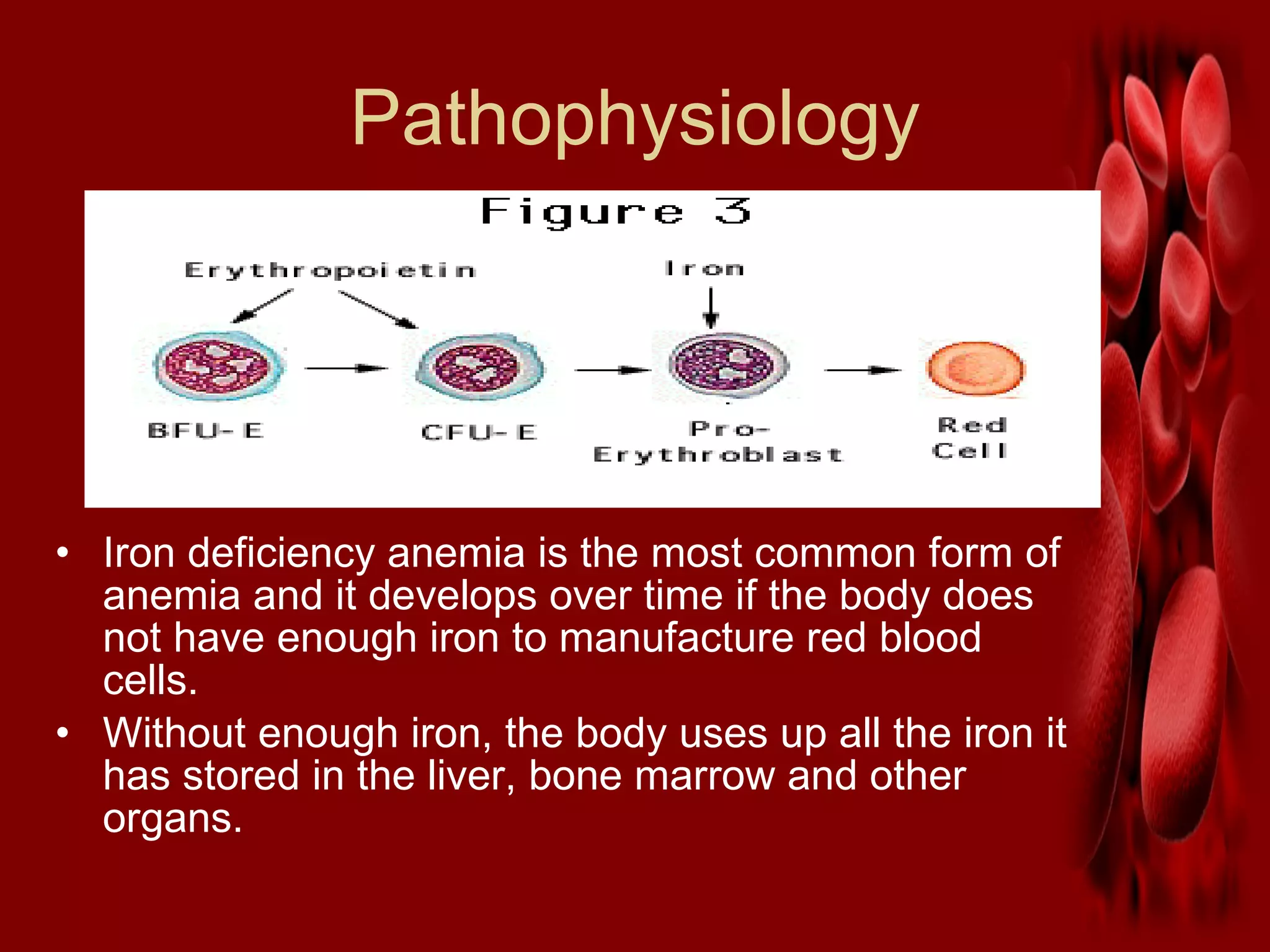
Pathophysiology Iron deficiency anemia is the most common form of anemia and it develops over time if the body does not have enough iron to manufacture red blood cells.  Without enough iron, the body uses up all the iron it has stored in the liver, bone marrow and other organs.
Once the stored iron is depleted, the body is able to make very few red blood cells.  If erythropoietin is present without sufficient iron, there is insufficient fuel for red blood cell production The red blood cells that the body is able to make are abnormal and do not have a normal hemoglobin-carrying capacity, as do normal red blood cells.
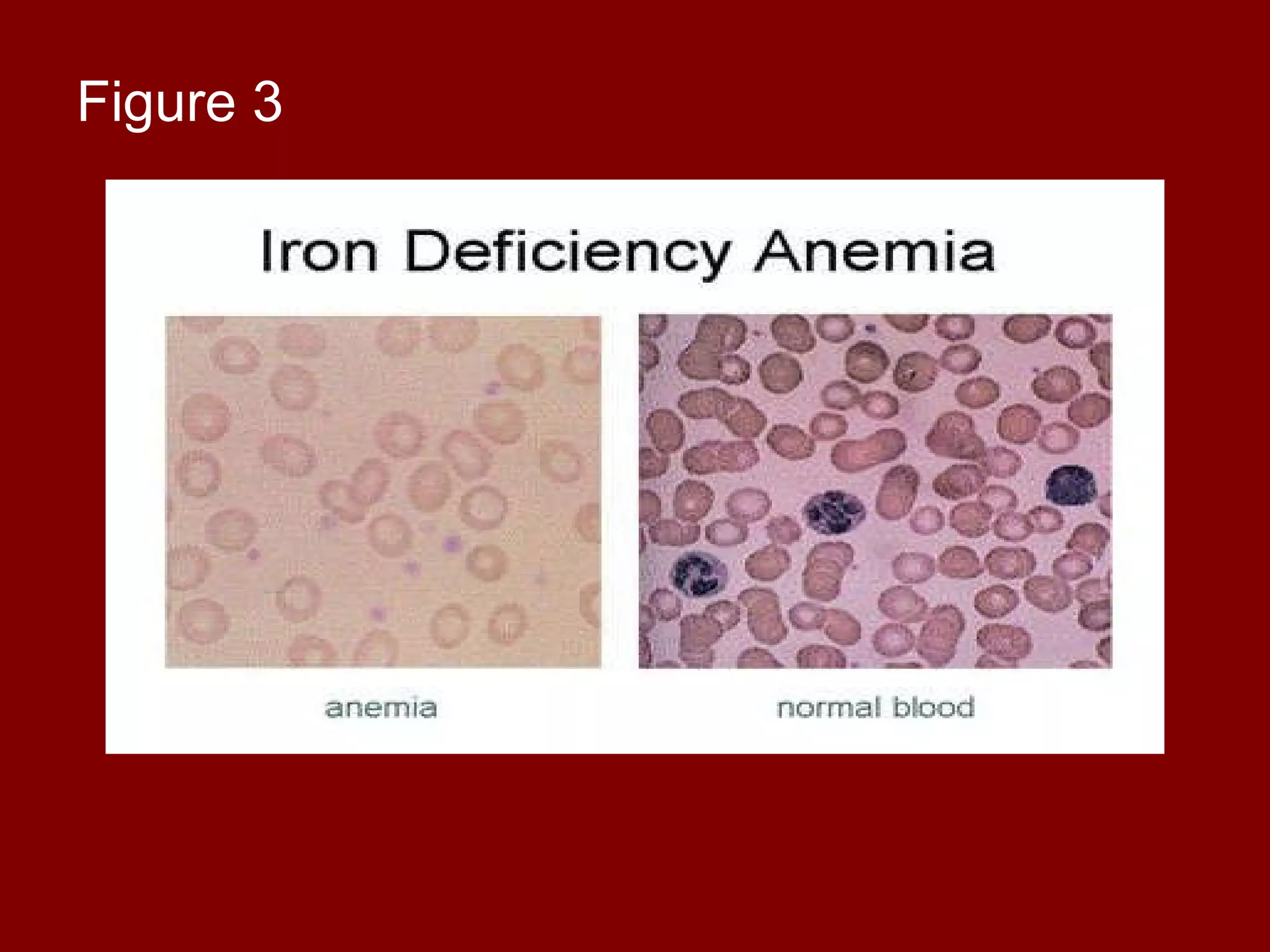
Figure 3
Etiology Iron-deficiency anemia is usually due to : blood loss poor diet an inability to absorb enough iron from food.
Blood Loss Blood lost causes iron depletion In women, long or heavy menstrual periods or bleeding fibroids in the uterus.  Childbirth Internal bleeding Poor Diet Low iron intake.  During some stages of life, such as pregnancy and childhood.
Inability To Absorb Enough Iron Even if you have enough iron in your diet, your body may not be able to absorb it. This can happen if you have intestinal surgery or a disease of the intestine. Prescription medicines that reduce acid in the stomach also can interfere with iron absorption.
Clinical Presentation Iron-deficiency anemia can cause: brittle nails cracks in the sides of the mouth
Extreme fatigue (tiredness) chest pain
Pale skin Dizziness or lightheadedness
Fast heart rate Headache
an enlarged spleen Cold hands and feet frequent infections. Irritability shortness of breath swelling or soreness of the tongue
An unusual craving for non-nutritive substances such as: Ice Dirt Paint or starch. This craving is called pica. Some people who have iron-deficiency anemia develop restless legs syndrome (RLS). RLS is a disorder that causes a strong urge to move the legs.
Some signs and symptoms of iron-deficiency anemia are related to the condition's causes. A sign of intestinal bleeding is bright red blood in the stools or black, tarry-looking stools. Very heavy menstrual bleeding, long periods, or other vaginal bleeding may suggest that a woman is at risk for iron-deficiency anemia.
Severe iron-deficiency anemia can lead to: problems with growth and development  in children angina (chest pain) leg pains (intermittent claudication)
TREATMENT IRON SUPPLEMENT
IMPORTANT POINTS ABOUT IRON SUPPLEMENT . Before using iron medication, check if you are allergic to any drugs or food dyes, or if you have: iron overload syndrome hemolytic anemia (a lack of red blood cells) porphyria (a genetic enzyme disorder that causes symptoms affecting the skin or nervous system) thalassemia (a genetic disorder of red blood cells) liver or kidney disease if you are an alcoholic; or if you receive regular blood transfusion.
IMPORTANT POINTS ABOUT IRON SUPPLEMENT . Most  iron medication are taken on an empty stomach, at least 1 hour before or 2 hours after meal.
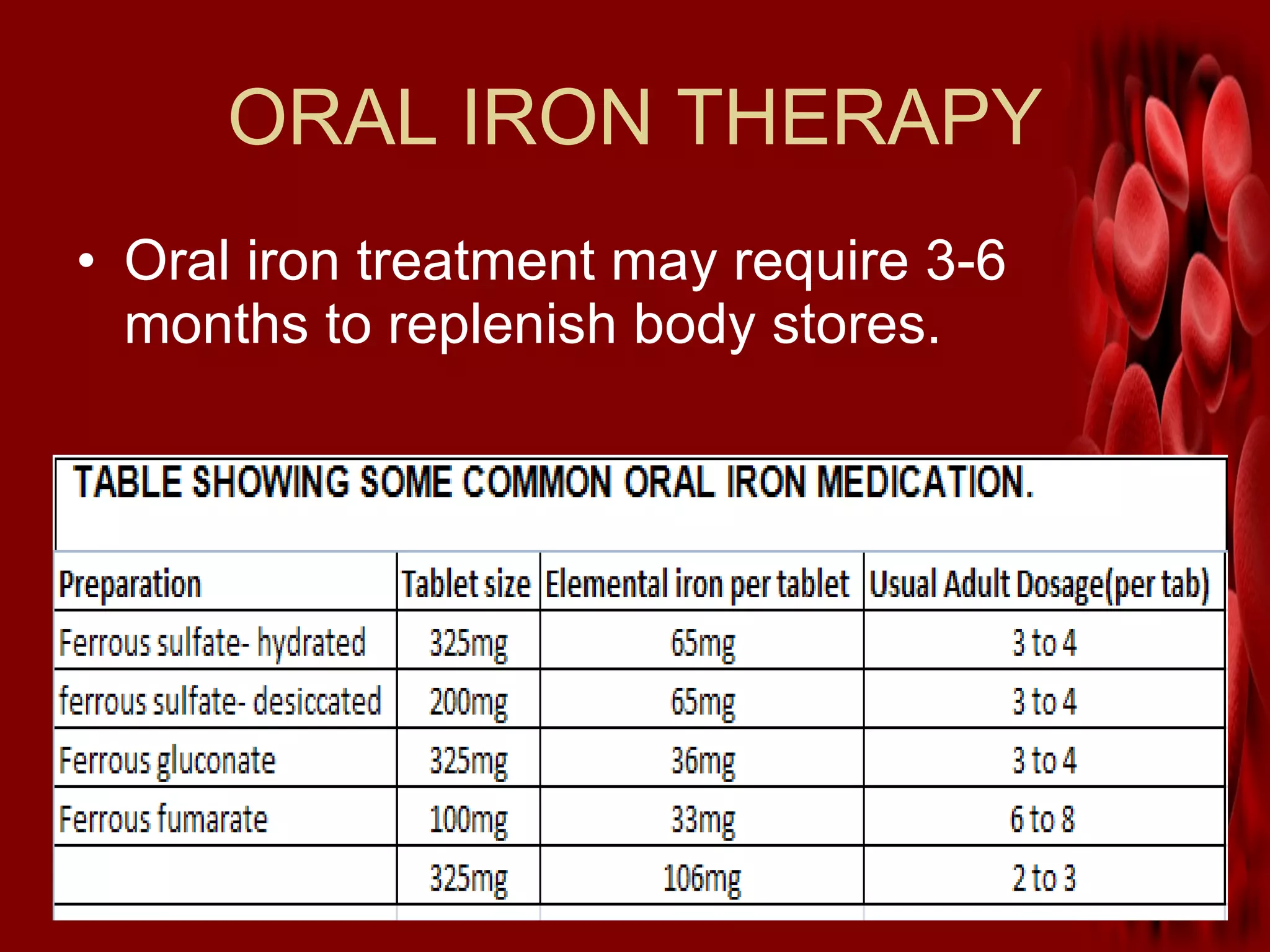
TREATMENT OF IRON DEFICIENCY ANEMIA. Iron deficiency anemia is treated with oral or parenteral iron preparation. Oral iron corrects the anemia just as rapidly and completely as parenteral iron in most cases if iron absorption from the GIT is normal. Different iron salt provide different amount of elemental iron. In iron deficient individual, about 50-80mg of iron can be incorporated in hemoglobin daily and about 25% of oral ferrous salt can be absorbed.
ORAL IRON THERAPY Oral iron treatment may require 3-6 months to replenish body stores.
Ferrous sulfate is the  DOC  for  iron deficiency anemia. Dosage:  325 mg tid, which provides 180 mg of iron daily of which 10mg is usually absorbed. Patients who cannot tolerate iron on an empty stomach should take it with food. Administration :  PO
GENERAL MECHANISM OF ACTION OF IRON SUPPLEMENT During the process of absorption, oxygen combines with iron and is transported into the plasma portion of blood by binding to transferrin. From there, iron and transferrin are used in the production of hemoglobin (the molecule that transports oxygen in the blood) and myoglobin( helps your muscle cells store oxygen.)
COMMON ADVERSE EFFECTS OF ORAL IRON THERAPY Nausea Epigastric discomfort Abdominal cramps Constipation and diarrhea. Black stool These effects are usually dose-related.
CONTRAINDICATIONS Avoid taking any other multivitamin or mineral product within 2 hours before or after taking your iron supplement.  Avoid antibiotic such as ciprofloxacin , demeclocycline , doxycycline , levofloxacin, lomefloxacin , minocycline , norfloxacin , ofloxacin , or tetracycline. Avoid antacids  within 2 hours before or after meals when taking your iron medication
If you have a bleeding disorder, you should avoid non-steroidal anti-inflammatory (NSAID) drugs, as well as aspirin, because these drugs may interfere with blood platelets, prolong bleeding, and irritate your stomach.
PARENTERAL  IRON THERAPY Iron Dextran-  is a stable complex of ferric hydroxide and low-molecular-weight dextran containing 50mg of elemental iron per milliliter of solution. It can be given deep IM injection or IV infusion. Adverse effect: light-headedness, fever, arthralgias, back pain, urticaria, bronchospasm and hypersensitivity reaction.
2 )- Iron sucrose complex & iron sodium gluconate complex. These are indicated for patient with hypersensitivity reactions to oral iron salts. They are only given by IV  route For patient who are treated chronically with iron, it is important to monitor the iron level to avoid serious toxicity associated with iron overload. Adverse effect same as iron dextran.
Non- pharmacological treatment Iron-rich diet Good sources of iron includes: meats - beef, pork, lamb, liver, and other organ meats poultry - chicken, duck, turkey, liver (especially dark meat) fish - shellfish, including clams, mussels, and oysters, sardines, anchovies leafy greens of the cabbage family, such as broccoli, kale, turnip greens, and collards legumes, such as lima beans and green peas; dry beans and peas, such as pinto beans, black-eyed peas, and canned baked beans
REFERENCES The HealthCentralNetwork, Inc.Copyright © 2001-2011. Treatment of Iron Deficiency,retrieved on 2011-10-05. Retrieved from  http://www.healthscout.com/ency/68/575/main.html#TreatmentofIronDeficiency A-Z Drug Facts for the Professional,Copyright © 2000-2011. Iron supplement, retrieved on 2011-10-03. Retrieved from ttp://www.drugs.com/ppa/ A-Z Drug Facts for the Professional,Copyright © 2000-2011. What should I avoid while taking iron supplement, retrieved on 2011-10-03. Retrieved from  http://www.drugs.com/ferrous_sulfate.html National Center for Biotechnology Information ,  U.S. National Library of Medicine  8600 Rockville Pike, Bethesda MD, 20894 USA Iron supplements: a common cause of drug interactions, retrieved on 2011-10-06. Retrieved from   http://www.ncbi.nlm.nih.gov/pmc/articles/PMC1368348/ Basic and clinical pharmacology 10 th  edition, Beram.G.  Katzung,MD,PhD. Professor Emertus, Department of cellular & Molecular Pharmacology, University of California San Francisco.

Iron deficiency anemia.

  • 1.
    IRON DEFICIENCY ANEMIAPresenting by: Shoneza Kingston and Fizal Ali
  • 2.
    Iron Deficiency Anemia"anemia" usually refers to a condition in which your blood has a lower than normal number of red blood cells. Iron is an essential mineral that is needed to form hemoglobin, an oxygen carrying protein inside red blood cells. Iron deficiency anemia is a condition in which the body lack enough red blood cell to transport oxygen-rich blood to body tissues
  • 3.
    Pathophysiology Iron deficiencyanemia is the most common form of anemia and it develops over time if the body does not have enough iron to manufacture red blood cells. Without enough iron, the body uses up all the iron it has stored in the liver, bone marrow and other organs.
  • 4.
    Once the storediron is depleted, the body is able to make very few red blood cells. If erythropoietin is present without sufficient iron, there is insufficient fuel for red blood cell production The red blood cells that the body is able to make are abnormal and do not have a normal hemoglobin-carrying capacity, as do normal red blood cells.
  • 5.
  • 6.
    Etiology Iron-deficiency anemiais usually due to : blood loss poor diet an inability to absorb enough iron from food.
  • 7.
    Blood Loss Bloodlost causes iron depletion In women, long or heavy menstrual periods or bleeding fibroids in the uterus. Childbirth Internal bleeding Poor Diet Low iron intake. During some stages of life, such as pregnancy and childhood.
  • 8.
    Inability To AbsorbEnough Iron Even if you have enough iron in your diet, your body may not be able to absorb it. This can happen if you have intestinal surgery or a disease of the intestine. Prescription medicines that reduce acid in the stomach also can interfere with iron absorption.
  • 9.
    Clinical Presentation Iron-deficiencyanemia can cause: brittle nails cracks in the sides of the mouth
  • 10.
  • 11.
    Pale skin Dizzinessor lightheadedness
  • 12.
  • 13.
    an enlarged spleenCold hands and feet frequent infections. Irritability shortness of breath swelling or soreness of the tongue
  • 14.
    An unusual cravingfor non-nutritive substances such as: Ice Dirt Paint or starch. This craving is called pica. Some people who have iron-deficiency anemia develop restless legs syndrome (RLS). RLS is a disorder that causes a strong urge to move the legs.
  • 15.
    Some signs andsymptoms of iron-deficiency anemia are related to the condition's causes. A sign of intestinal bleeding is bright red blood in the stools or black, tarry-looking stools. Very heavy menstrual bleeding, long periods, or other vaginal bleeding may suggest that a woman is at risk for iron-deficiency anemia.
  • 16.
    Severe iron-deficiency anemiacan lead to: problems with growth and development in children angina (chest pain) leg pains (intermittent claudication)
  • 17.
  • 18.
    IMPORTANT POINTS ABOUTIRON SUPPLEMENT . Before using iron medication, check if you are allergic to any drugs or food dyes, or if you have: iron overload syndrome hemolytic anemia (a lack of red blood cells) porphyria (a genetic enzyme disorder that causes symptoms affecting the skin or nervous system) thalassemia (a genetic disorder of red blood cells) liver or kidney disease if you are an alcoholic; or if you receive regular blood transfusion.
  • 19.
    IMPORTANT POINTS ABOUTIRON SUPPLEMENT . Most iron medication are taken on an empty stomach, at least 1 hour before or 2 hours after meal.
  • 20.
    TREATMENT OF IRONDEFICIENCY ANEMIA. Iron deficiency anemia is treated with oral or parenteral iron preparation. Oral iron corrects the anemia just as rapidly and completely as parenteral iron in most cases if iron absorption from the GIT is normal. Different iron salt provide different amount of elemental iron. In iron deficient individual, about 50-80mg of iron can be incorporated in hemoglobin daily and about 25% of oral ferrous salt can be absorbed.
  • 21.
    ORAL IRON THERAPYOral iron treatment may require 3-6 months to replenish body stores.
  • 22.
    Ferrous sulfate isthe DOC for iron deficiency anemia. Dosage: 325 mg tid, which provides 180 mg of iron daily of which 10mg is usually absorbed. Patients who cannot tolerate iron on an empty stomach should take it with food. Administration : PO
  • 23.
    GENERAL MECHANISM OFACTION OF IRON SUPPLEMENT During the process of absorption, oxygen combines with iron and is transported into the plasma portion of blood by binding to transferrin. From there, iron and transferrin are used in the production of hemoglobin (the molecule that transports oxygen in the blood) and myoglobin( helps your muscle cells store oxygen.)
  • 24.
    COMMON ADVERSE EFFECTSOF ORAL IRON THERAPY Nausea Epigastric discomfort Abdominal cramps Constipation and diarrhea. Black stool These effects are usually dose-related.
  • 25.
    CONTRAINDICATIONS Avoid takingany other multivitamin or mineral product within 2 hours before or after taking your iron supplement. Avoid antibiotic such as ciprofloxacin , demeclocycline , doxycycline , levofloxacin, lomefloxacin , minocycline , norfloxacin , ofloxacin , or tetracycline. Avoid antacids within 2 hours before or after meals when taking your iron medication
  • 26.
    If you havea bleeding disorder, you should avoid non-steroidal anti-inflammatory (NSAID) drugs, as well as aspirin, because these drugs may interfere with blood platelets, prolong bleeding, and irritate your stomach.
  • 27.
    PARENTERAL IRONTHERAPY Iron Dextran- is a stable complex of ferric hydroxide and low-molecular-weight dextran containing 50mg of elemental iron per milliliter of solution. It can be given deep IM injection or IV infusion. Adverse effect: light-headedness, fever, arthralgias, back pain, urticaria, bronchospasm and hypersensitivity reaction.
  • 28.
    2 )- Ironsucrose complex & iron sodium gluconate complex. These are indicated for patient with hypersensitivity reactions to oral iron salts. They are only given by IV route For patient who are treated chronically with iron, it is important to monitor the iron level to avoid serious toxicity associated with iron overload. Adverse effect same as iron dextran.
  • 29.
    Non- pharmacological treatmentIron-rich diet Good sources of iron includes: meats - beef, pork, lamb, liver, and other organ meats poultry - chicken, duck, turkey, liver (especially dark meat) fish - shellfish, including clams, mussels, and oysters, sardines, anchovies leafy greens of the cabbage family, such as broccoli, kale, turnip greens, and collards legumes, such as lima beans and green peas; dry beans and peas, such as pinto beans, black-eyed peas, and canned baked beans
  • 30.
    REFERENCES The HealthCentralNetwork,Inc.Copyright © 2001-2011. Treatment of Iron Deficiency,retrieved on 2011-10-05. Retrieved from http://www.healthscout.com/ency/68/575/main.html#TreatmentofIronDeficiency A-Z Drug Facts for the Professional,Copyright © 2000-2011. Iron supplement, retrieved on 2011-10-03. Retrieved from ttp://www.drugs.com/ppa/ A-Z Drug Facts for the Professional,Copyright © 2000-2011. What should I avoid while taking iron supplement, retrieved on 2011-10-03. Retrieved from http://www.drugs.com/ferrous_sulfate.html National Center for Biotechnology Information , U.S. National Library of Medicine 8600 Rockville Pike, Bethesda MD, 20894 USA Iron supplements: a common cause of drug interactions, retrieved on 2011-10-06. Retrieved from http://www.ncbi.nlm.nih.gov/pmc/articles/PMC1368348/ Basic and clinical pharmacology 10 th edition, Beram.G. Katzung,MD,PhD. Professor Emertus, Department of cellular & Molecular Pharmacology, University of California San Francisco.

Editor's Notes

  • #28 What is arthralgias?