 Plant Breeding: Theory and Practice: V.L. Chopra (2012)
 Breeding Field Crops: David Allen Sleper and John Milton Poehlman
 Plant Breeding: Principles and Methods- B.D.Singh
 Principles and Practice of Plant Breeding- J.R. Sharma
 Principles of Plant Breeding: R.W. Allard
 Plant Breeding: N.W. Simmonds
Reference Books
HARDY-WEINBERG LAWHARDY-WEINBERG LAW
Random Mating PopulationsRandom Mating Populations
Each individual of the population has equal opportunityEach individual of the population has equal opportunity
of mating with any other individual of that population such aof mating with any other individual of that population such a
population is called random mating populations, Mendelianpopulation is called random mating populations, Mendelian
populations or panmictic populations.populations or panmictic populations.
Gene PoolGene Pool
Gene pool may be defined as the sum total of all theGene pool may be defined as the sum total of all the
genes present in the populationgenes present in the population
PopulationPopulation
It consists of all such individuals that share the same gene pool, i.e., have an opportunity toIt consists of all such individuals that share the same gene pool, i.e., have an opportunity to
intermate with each other and contribute to next generation of the populationintermate with each other and contribute to next generation of the population
Population GeneticsPopulation Genetics
Population genetics is that branch of geneticsPopulation genetics is that branch of genetics
that is concerned with the evolutionary processes ofthat is concerned with the evolutionary processes of
natural selection, genetic drift, mutation, migration,natural selection, genetic drift, mutation, migration,
and random mating.and random mating.
Hardy-Weinberg LawHardy-Weinberg Law
• This law was independently developed by Hardy, inThis law was independently developed by Hardy, in
1908, in England and Weinberg, in 1909, in Germany1908, in England and Weinberg, in 1909, in Germany
• ““Gene and genotype frequency in a MendilianGene and genotype frequency in a Mendilian
population remain constant generation after generationpopulation remain constant generation after generation
if there is no selection, mutation, migration or randomif there is no selection, mutation, migration or random
drift”drift”
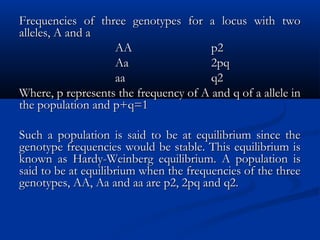
Frequencies of three genotypes for a locus with twoFrequencies of three genotypes for a locus with two
alleles, A and aalleles, A and a
AAAA p2p2
AaAa 2pq2pq
aaaa q2q2
Where, p represents the frequency of A and q of a allele inWhere, p represents the frequency of A and q of a allele in
the population and p+q=1the population and p+q=1
Such a population is said to be at equilibrium since theSuch a population is said to be at equilibrium since the
genotype frequencies would be stable. This equilibrium isgenotype frequencies would be stable. This equilibrium is
known as Hardy-Weinberg equilibrium. A population isknown as Hardy-Weinberg equilibrium. A population is
said to be at equilibrium when the frequencies of the threesaid to be at equilibrium when the frequencies of the three
genotypes, AA, Aa and aa are p2, 2pq and q2.genotypes, AA, Aa and aa are p2, 2pq and q2.
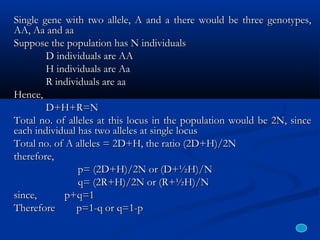
Single gene with two allele, A and a there would be three genotypes,Single gene with two allele, A and a there would be three genotypes,
AA, Aa and aaAA, Aa and aa
Suppose the population has N individualsSuppose the population has N individuals
D individuals are AAD individuals are AA
H individuals are AaH individuals are Aa
R individuals are aaR individuals are aa
Hence,Hence,
D+H+R=ND+H+R=N
Total no. of alleles at this locus in the population would be 2N, sinceTotal no. of alleles at this locus in the population would be 2N, since
each individual has two alleles at single locuseach individual has two alleles at single locus
Total no. of A alleles = 2D+H, the ratio (2D+H)/2NTotal no. of A alleles = 2D+H, the ratio (2D+H)/2N
therefore,therefore,
p= (2D+H)/2N or (D+½H)/Np= (2D+H)/2N or (D+½H)/N
q= (2R+H)/2N or (R+½H)/Nq= (2R+H)/2N or (R+½H)/N
since,since, p+q=1p+q=1
Therefore p=1-q or q=1-pTherefore p=1-q or q=1-p
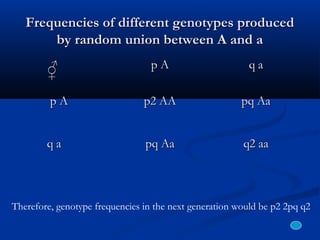
Frequencies of different genotypes producedFrequencies of different genotypes produced
by random union between A and aby random union between A and a
p Ap A q aq a
p Ap A p2 AAp2 AA pq Aapq Aa
q aq a pq Aapq Aa q2 aaq2 aa
♂♂♀♀
Therefore, genotype frequencies in the next generation would be p2 2pq q2
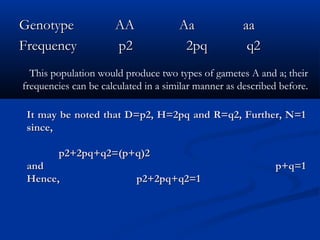
It may be noted that D=p2, H=2pq and R=q2, Further, N=1It may be noted that D=p2, H=2pq and R=q2, Further, N=1
since,since,
p2+2pq+q2=(p+q)2p2+2pq+q2=(p+q)2
andand p+q=1p+q=1
Hence, p2+2pq+q2=1Hence, p2+2pq+q2=1
GenotypeGenotype AAAA AaAa aaaa
FrequencyFrequency p2p2 2pq2pq q2q2
This population would produce two types of gametes A and a; their
frequencies can be calculated in a similar manner as described before.
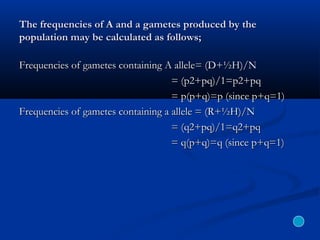
The frequencies of A and a gametes produced by theThe frequencies of A and a gametes produced by the
population may be calculated as follows;population may be calculated as follows;
Frequencies of gametes containing A allele= (D+½H)/NFrequencies of gametes containing A allele= (D+½H)/N
= (p2+pq)/1=p2+pq= (p2+pq)/1=p2+pq
= p(p+q)=p (since p+q=1)= p(p+q)=p (since p+q=1)
Frequencies of gametes containing a allele = (R+½H)/NFrequencies of gametes containing a allele = (R+½H)/N
= (q2+pq)/1=q2+pq= (q2+pq)/1=q2+pq
= q(p+q)=q (since p+q=1)= q(p+q)=q (since p+q=1)
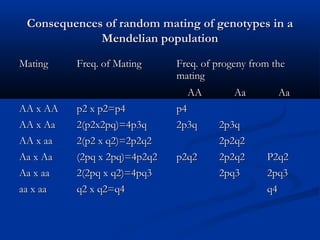
Consequences of random mating of genotypes in aConsequences of random mating of genotypes in a
Mendelian populationMendelian population
MatingMating Freq. of MatingFreq. of Mating Freq. of progeny from theFreq. of progeny from the
matingmating
AAAA AaAa AaAa
AA x AAAA x AA p2 x p2=p4p2 x p2=p4 p4p4
AA x AaAA x Aa 2(p2x2pq)=4p3q2(p2x2pq)=4p3q 2p3q2p3q 2p3q2p3q
AA x aaAA x aa 2(p2 x q2)=2p2q22(p2 x q2)=2p2q2 2p2q22p2q2
Aa x AaAa x Aa (2pq x 2pq)=4p2q2(2pq x 2pq)=4p2q2 p2q2p2q2 2p2q22p2q2 P2q2P2q2
Aa x aaAa x aa 2(2pq x q2)=4pq32(2pq x q2)=4pq3 2pq32pq3 2pq32pq3
aa x aaaa x aa q2 x q2=q4q2 x q2=q4 q4q4
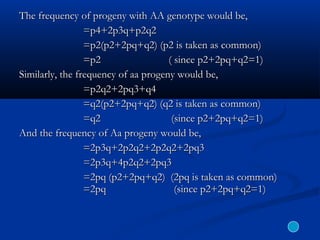
The frequency of progeny with AA genotype would be,The frequency of progeny with AA genotype would be,
=p4+2p3q+p2q2=p4+2p3q+p2q2
=p2(p2+2pq+q2) (p2 is taken as common)=p2(p2+2pq+q2) (p2 is taken as common)
=p2=p2 ( since p2+2pq+q2=1)( since p2+2pq+q2=1)
Similarly, the frequency of aa progeny would be,Similarly, the frequency of aa progeny would be,
=p2q2+2pq3+q4=p2q2+2pq3+q4
=q2(p2+2pq+q2) (q2 is taken as common)=q2(p2+2pq+q2) (q2 is taken as common)
=q2=q2 (since p2+2pq+q2=1)(since p2+2pq+q2=1)
And the frequency of Aa progeny would be,And the frequency of Aa progeny would be,
=2p3q+2p2q2+2p2q2+2pq3=2p3q+2p2q2+2p2q2+2pq3
=2p3q+4p2q2+2pq3=2p3q+4p2q2+2pq3
=2pq (p2+2pq+q2) (2pq is taken as common)=2pq (p2+2pq+q2) (2pq is taken as common)
=2pq=2pq (since p2+2pq+q2=1)(since p2+2pq+q2=1)

Hardy weinberg law

  • 1.
     Plant Breeding:Theory and Practice: V.L. Chopra (2012)  Breeding Field Crops: David Allen Sleper and John Milton Poehlman  Plant Breeding: Principles and Methods- B.D.Singh  Principles and Practice of Plant Breeding- J.R. Sharma  Principles of Plant Breeding: R.W. Allard  Plant Breeding: N.W. Simmonds Reference Books
  • 2.
  • 3.
    Random Mating PopulationsRandomMating Populations Each individual of the population has equal opportunityEach individual of the population has equal opportunity of mating with any other individual of that population such aof mating with any other individual of that population such a population is called random mating populations, Mendelianpopulation is called random mating populations, Mendelian populations or panmictic populations.populations or panmictic populations. Gene PoolGene Pool Gene pool may be defined as the sum total of all theGene pool may be defined as the sum total of all the genes present in the populationgenes present in the population PopulationPopulation It consists of all such individuals that share the same gene pool, i.e., have an opportunity toIt consists of all such individuals that share the same gene pool, i.e., have an opportunity to intermate with each other and contribute to next generation of the populationintermate with each other and contribute to next generation of the population
  • 4.
    Population GeneticsPopulation Genetics Populationgenetics is that branch of geneticsPopulation genetics is that branch of genetics that is concerned with the evolutionary processes ofthat is concerned with the evolutionary processes of natural selection, genetic drift, mutation, migration,natural selection, genetic drift, mutation, migration, and random mating.and random mating. Hardy-Weinberg LawHardy-Weinberg Law • This law was independently developed by Hardy, inThis law was independently developed by Hardy, in 1908, in England and Weinberg, in 1909, in Germany1908, in England and Weinberg, in 1909, in Germany • ““Gene and genotype frequency in a MendilianGene and genotype frequency in a Mendilian population remain constant generation after generationpopulation remain constant generation after generation if there is no selection, mutation, migration or randomif there is no selection, mutation, migration or random drift”drift”
  • 5.
    Frequencies of threegenotypes for a locus with twoFrequencies of three genotypes for a locus with two alleles, A and aalleles, A and a AAAA p2p2 AaAa 2pq2pq aaaa q2q2 Where, p represents the frequency of A and q of a allele inWhere, p represents the frequency of A and q of a allele in the population and p+q=1the population and p+q=1 Such a population is said to be at equilibrium since theSuch a population is said to be at equilibrium since the genotype frequencies would be stable. This equilibrium isgenotype frequencies would be stable. This equilibrium is known as Hardy-Weinberg equilibrium. A population isknown as Hardy-Weinberg equilibrium. A population is said to be at equilibrium when the frequencies of the threesaid to be at equilibrium when the frequencies of the three genotypes, AA, Aa and aa are p2, 2pq and q2.genotypes, AA, Aa and aa are p2, 2pq and q2.
  • 6.
    Single gene withtwo allele, A and a there would be three genotypes,Single gene with two allele, A and a there would be three genotypes, AA, Aa and aaAA, Aa and aa Suppose the population has N individualsSuppose the population has N individuals D individuals are AAD individuals are AA H individuals are AaH individuals are Aa R individuals are aaR individuals are aa Hence,Hence, D+H+R=ND+H+R=N Total no. of alleles at this locus in the population would be 2N, sinceTotal no. of alleles at this locus in the population would be 2N, since each individual has two alleles at single locuseach individual has two alleles at single locus Total no. of A alleles = 2D+H, the ratio (2D+H)/2NTotal no. of A alleles = 2D+H, the ratio (2D+H)/2N therefore,therefore, p= (2D+H)/2N or (D+½H)/Np= (2D+H)/2N or (D+½H)/N q= (2R+H)/2N or (R+½H)/Nq= (2R+H)/2N or (R+½H)/N since,since, p+q=1p+q=1 Therefore p=1-q or q=1-pTherefore p=1-q or q=1-p
  • 7.
    Frequencies of differentgenotypes producedFrequencies of different genotypes produced by random union between A and aby random union between A and a p Ap A q aq a p Ap A p2 AAp2 AA pq Aapq Aa q aq a pq Aapq Aa q2 aaq2 aa ♂♂♀♀ Therefore, genotype frequencies in the next generation would be p2 2pq q2
  • 8.
    It may benoted that D=p2, H=2pq and R=q2, Further, N=1It may be noted that D=p2, H=2pq and R=q2, Further, N=1 since,since, p2+2pq+q2=(p+q)2p2+2pq+q2=(p+q)2 andand p+q=1p+q=1 Hence, p2+2pq+q2=1Hence, p2+2pq+q2=1 GenotypeGenotype AAAA AaAa aaaa FrequencyFrequency p2p2 2pq2pq q2q2 This population would produce two types of gametes A and a; their frequencies can be calculated in a similar manner as described before.
  • 9.
    The frequencies ofA and a gametes produced by theThe frequencies of A and a gametes produced by the population may be calculated as follows;population may be calculated as follows; Frequencies of gametes containing A allele= (D+½H)/NFrequencies of gametes containing A allele= (D+½H)/N = (p2+pq)/1=p2+pq= (p2+pq)/1=p2+pq = p(p+q)=p (since p+q=1)= p(p+q)=p (since p+q=1) Frequencies of gametes containing a allele = (R+½H)/NFrequencies of gametes containing a allele = (R+½H)/N = (q2+pq)/1=q2+pq= (q2+pq)/1=q2+pq = q(p+q)=q (since p+q=1)= q(p+q)=q (since p+q=1)
  • 10.
    Consequences of randommating of genotypes in aConsequences of random mating of genotypes in a Mendelian populationMendelian population MatingMating Freq. of MatingFreq. of Mating Freq. of progeny from theFreq. of progeny from the matingmating AAAA AaAa AaAa AA x AAAA x AA p2 x p2=p4p2 x p2=p4 p4p4 AA x AaAA x Aa 2(p2x2pq)=4p3q2(p2x2pq)=4p3q 2p3q2p3q 2p3q2p3q AA x aaAA x aa 2(p2 x q2)=2p2q22(p2 x q2)=2p2q2 2p2q22p2q2 Aa x AaAa x Aa (2pq x 2pq)=4p2q2(2pq x 2pq)=4p2q2 p2q2p2q2 2p2q22p2q2 P2q2P2q2 Aa x aaAa x aa 2(2pq x q2)=4pq32(2pq x q2)=4pq3 2pq32pq3 2pq32pq3 aa x aaaa x aa q2 x q2=q4q2 x q2=q4 q4q4
  • 11.
    The frequency ofprogeny with AA genotype would be,The frequency of progeny with AA genotype would be, =p4+2p3q+p2q2=p4+2p3q+p2q2 =p2(p2+2pq+q2) (p2 is taken as common)=p2(p2+2pq+q2) (p2 is taken as common) =p2=p2 ( since p2+2pq+q2=1)( since p2+2pq+q2=1) Similarly, the frequency of aa progeny would be,Similarly, the frequency of aa progeny would be, =p2q2+2pq3+q4=p2q2+2pq3+q4 =q2(p2+2pq+q2) (q2 is taken as common)=q2(p2+2pq+q2) (q2 is taken as common) =q2=q2 (since p2+2pq+q2=1)(since p2+2pq+q2=1) And the frequency of Aa progeny would be,And the frequency of Aa progeny would be, =2p3q+2p2q2+2p2q2+2pq3=2p3q+2p2q2+2p2q2+2pq3 =2p3q+4p2q2+2pq3=2p3q+4p2q2+2pq3 =2pq (p2+2pq+q2) (2pq is taken as common)=2pq (p2+2pq+q2) (2pq is taken as common) =2pq=2pq (since p2+2pq+q2=1)(since p2+2pq+q2=1)