
POPULATION GENETICS
PREPARED BY: ARUSHI ARORA
A-2016-30-050
1
CONTENTS
TOPICS
• Population genetics
• Variation in population
• Hardy Weinberg law
• Gene pool concept
• Allele frequency
• Rare and common alleles
• References
SLIDE NUMBER
• 3-8
• 9-19
• 20-26
• 27-37
• 38-42
• 43
• 44
2
POPULATION
• A population is a summation of all the organisms of
the same group or species, which live in a particular
geographical area, and have the capability of
interbreeding.
3
POPULATION GENETICS
• Defined as study of the distribution and change
in frequency of alleles within populations and is
related to evolution.
• Population genetics is the study of the frequency and
interaction of alleles and genes in populations.
• In population genetics population is a set of
organisms in which any pair of members
can breed together.
• This means that they can regularly exchange gametes
to produce normally-fertile offspring, and such a
breeding group is also known therefore as
a gamodeme.
4
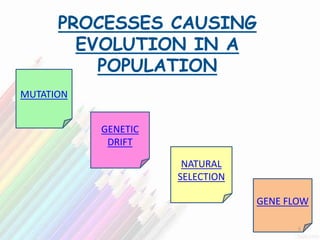
PROCESSES CAUSING
EVOLUTION IN A
POPULATION
NATURAL
SELECTION
GENE FLOW
MUTATION
GENETIC
DRIFT
5
 Population genetics is a vital ingredient in the
emergence of the modern evolutionary synthesis.
 Its primary founders were
• Sewall Wright(1945)
• J. B. S. Haldane(1924)
• Ronald Fisher,(1930) who also laid the foundations
for the related discipline of quantitative genetics.
6
• Population genetics began as a reconciliation
of Mendelian inheritance and biostatistics models
• In a series of papers starting in 1918 and culminating
in 1930 the book The Genetical Theory of Natural
Selection by Fisher.
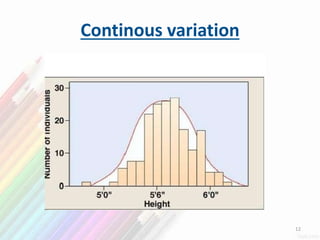
• He showed that the continuous variation measured by
the biometricians could be produced by the combined
action of many discrete genes, and that natural
selection could change allele frequencies in a
population, resulting in evolution.
7
• In a series of papers beginning in 1924, another
British geneticist, J.B.S. Haldane worked out the
mathematics of allele frequency change at a single
gene locus under a broad range of conditions.
• Haldane also applied statistical analysis to real-world
examples of natural selection, such as the Peppered
moth evolution and industrial melanism
8
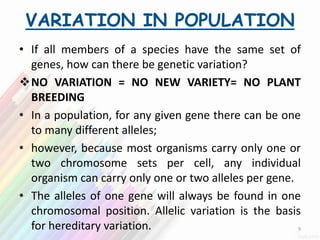
VARIATION IN POPULATION
• If all members of a species have the same set of
genes, how can there be genetic variation?
NO VARIATION = NO NEW VARIETY= NO PLANT
BREEDING
• In a population, for any given gene there can be one
to many different alleles;
• however, because most organisms carry only one or
two chromosome sets per cell, any individual
organism can carry only one or two alleles per gene.
• The alleles of one gene will always be found in one
chromosomal position. Allelic variation is the basis
for hereditary variation. 9
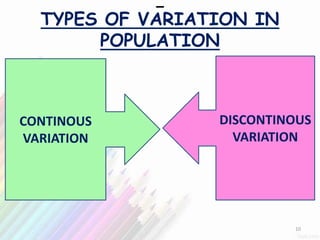
TYPES OF VARIATION IN
POPULATION
CONTINOUS
VARIATION
DISCONTINOUS
VARIATION
10
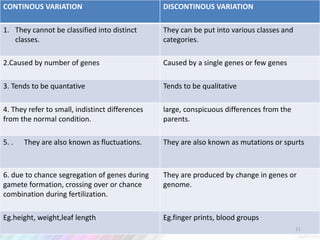
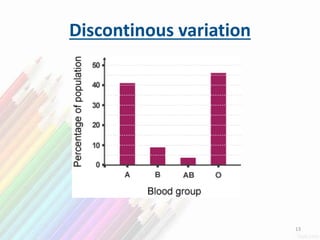
CONTINOUS VARIATION DISCONTINOUS VARIATION
1. They cannot be classified into distinct
classes.
They can be put into various classes and
categories.
2.Caused by number of genes Caused by a single genes or few genes
3. Tends to be quantative Tends to be qualitative
4. They refer to small, indistinct differences
from the normal condition.
large, conspicuous differences from the
parents.
5. . They are also known as fluctuations. They are also known as mutations or spurts
6. due to chance segregation of genes during
gamete formation, crossing over or chance
combination during fertilization.
They are produced by change in genes or
genome.
Eg.height, weight,leaf length Eg.finger prints, blood groups
11
Continous variation
12
Discontinous variation
13
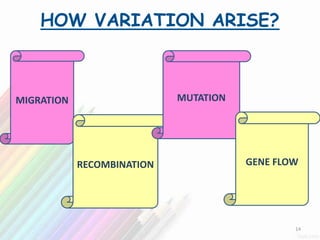
HOW VARIATION ARISE?
MIGRATION
RECOMBINATION
MUTATION
GENE FLOW
14
MIGRATION
• It is the movement of organisms from one location to
another.
• If the migrating individuals mate or cross with the
destination individuals, they can provide a sudden
influx of alleles
• This way migrating individuals contribute gametes
carrying alleles that can alter the existing proportion
of alleles in the destination population.
15
MUTATION
• They are the changes in DNA or nucleotide
sequences which happen a sudden.
• A single mutation has a large efeect in creation of
variation in a population
• It creates an entirely new character in a population
which may be capable of selection
16
RECOMBINATION
• It is the production of offspring with the
combinations of traits that differ from those found in
parents.
• Genetic recombination occurs during meiosis
• It is a major contributor in variation in a population
17
GENE FLOW
• Gene flow is the transfer of alleles or genes from one
population to another.
• These alleles bring about variation in population and
this is related to migration as brings new alleles to
the population.
• Generally horizonal gene transfers that is through
hybridization which is used by breeder.
18
GENE POOL CENTRES
• Gene pool centres refers to :
areas on the earth where important crop plants and
domestic animals originated.
They have an extraordinary range of the wild
counterparts of cultivated plant species and useful
tropical plants.
Gene pool centres also contain different sub tropical
and temperate region species
19
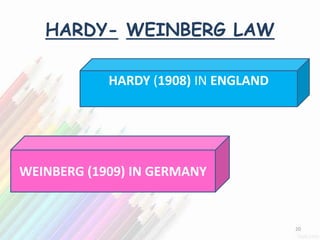
HARDY- WEINBERG LAW
HARDY (1908) IN ENGLAND
WEINBERG (1909) IN GERMANY
20
Hardy- Weinberg law states that gene and
genotype frequencies in a Mendelian
population remain constant generation after
generation if there is no selection, mutation,
migration or random drift.
21
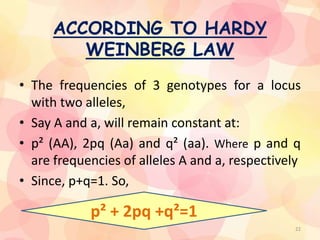
ACCORDING TO HARDY
WEINBERG LAW
• The frequencies of 3 genotypes for a locus
with two alleles,
• Say A and a, will remain constant at:
• p² (AA), 2pq (Aa) and q² (aa). Where p and q
are frequencies of alleles A and a, respectively
• Since, p+q=1. So,
p² + 2pq +q²=1
22
ASSUMPTIONS OF HARDY –
WEINBERG LAW
Large population
Random mating
No mutation
No migration
Natural selection
23
ASSUMPTIONS
 LARGE POPULATION: large size of population limits
errors and also Allele frequencies in a small population
are more likely to get affected by random drift as
compared to allele frequencies in a large population.
 RANDOM MATING. It refers to matings in a population
that occur in proportion to their genotypic frequencies.
If deviation from the expected value occurs, then no
random mating. So, the assumption will be eliminated.
 NO MUTATIONS. Mutations create and maintain
variations within a population and these introduce new
genes and alleles in a gene pool which violate the hardy
weinberg law.
24
 NO MIGRATION. Immigration results in addition
of new alleles into the existing gene pool which
results in large changes in allele frequencies.
Migration in population may cause unbalance in
the law.
 NO NATURAL SELECTION: Due to natural
selection, certain phenotypes are favored over
other. So, the allele frequencies will change and
the population will evolve which will disturb the
law.
25
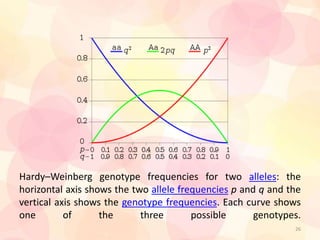
Hardy–Weinberg genotype frequencies for two alleles: the
horizontal axis shows the two allele frequencies p and q and the
vertical axis shows the genotype frequencies. Each curve shows
one of the three possible genotypes.
26
GENE POOL CONCEPT IN CROP
BREEDING
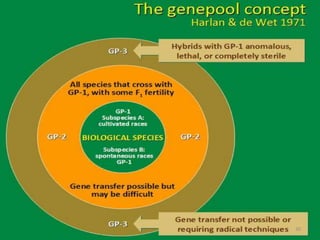
• Harlan and de Wet (1971) proposed classifying each
crop and its related species by gene pools rather
than by formal taxonomy.
27
GENE POOL
Set of all genes, or
genetic information,
in a single
population, usually of
a particular species
28
GENE POOL
Sum of a population’s
genetic material at a
given time.
29
30
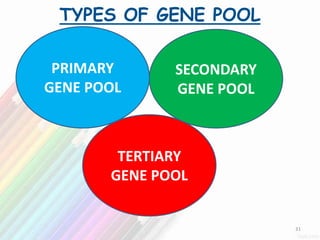
TYPES OF GENE POOL
TERTIARY
GENE POOL
PRIMARY
GENE POOL
SECONDARY
GENE POOL
31
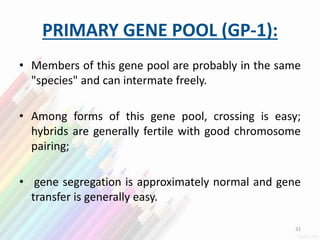
PRIMARY GENE POOL (GP-1):
• Members of this gene pool are probably in the same
"species" and can intermate freely.
• Among forms of this gene pool, crossing is easy;
hybrids are generally fertile with good chromosome
pairing;
• gene segregation is approximately normal and gene
transfer is generally easy.
32
Example of primary gene pool
• The primary gene pool of both cultivated and wild
varieties of sunflower(Helianthus annus) .
• A winter’s sunflower (H.winterii) a perennial grass in
south Siberia whose genes are easy to be bought in
cultivated ones.
• So both constitute members of gene pool 1.
33
SECONDARY GENE POOL (GP-2):
• Members of this pool are normally classified as
different species than the crop species under
consideration (the primary gene pool).
• These species are closely related and can cross and
produce at least some fertile hybrids. BUT…
 hybrids may be weak
 hybrids may be partially sterile
 chromosomes may pair poorly or not at all
 recovery of desired phenotypes may be difficult in
subsequent generations
 The gene pool is available to be utilized, if the plant breeder
or geneticist is willing to put out the effort required.
34
Example of secondary gene pool
• Aegilops tauschii AND Aegilopes speltoides,
two wild relatives in secondary gene pool of
bread wheat (Triticum aestivum)are diploid.
That means that they have paired
chromosomes whereas bread wheat is
hexaploid(six copies).
• So, some crosses if result from this would be
partially sterile or weak.
• THESE CONSTITUTE SECONDARY GENE POOL
35
TERTIARY GENE POOL (GP-3):
• Members of this gene pool are more distantly related
to the members of the primary gene pool. The
primary and tertiary gene pools can be intermated,
but gene transfer between them is impossible
without the use of "rather extreme or radical
measures" such as:
• embryo rescue (or embryo culture, a form of plant
organ culture)
• induced polyploidy (chromosome doubling)
• bridging crosses (e.g., with members of the
secondary gene pool). 36
Example of tertiary gene pool
• Triticum turgidum (AABB, 2n=28) and
• Aegilops speltoides(BB,2n=14)
produce amphdipoid hybrid (INTERGENERIC CROSS).
This can be made fertile using various techniques like
colchicine treatment.
EXAMPLE OF A SUCESSFUL CROSS BEING Triticale
DEVELOPED BY RIMPAU.
37
ALLELE FREQUENCY
• The allele frequency for an allele is the fraction of the
genes in the pool that is composed of that allele (for
example, what fraction of moth coloration genes are
the black allele).
• Evolution occurs when there are changes in the
frequencies of alleles within a population; for
example, the allele for black color in a population of
moths becoming more common
38
ALLELE FREQUENCY
• Allele frequency, or gene frequency, is the relative
frequency of an allele (variant of a gene) at a
particular locus in a population, expressed as a
fraction or percentage.
• It is the fraction of all chromosomes in the
population that carry that allele.
• Microevolution is the change in allele frequencies
that occurs over time within a population.
39
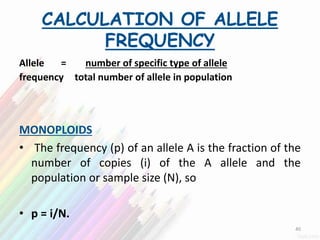
CALCULATION OF ALLELE
FREQUENCY
Allele = number of specific type of allele
frequency total number of allele in population
MONOPLOIDS
• The frequency (p) of an allele A is the fraction of the
number of copies (i) of the A allele and the
population or sample size (N), so
• p = i/N.
40
DIPLOIDS
• If f(AA),f(AB) AND F(BB) are the frequencies of the
three genotypes at a locus with two alleles,
• Then,
o p=f(AA)+1/2f(AB)=frequency of A
o q=f(BB)+1/2f(AB)=frequency of B
o Their sum must be equal to 1 as p+q=1
41
EXAMPLE
• Consider a locus that carries two alleles, A and B. In a
diploid population there are three possible genotypes,
two homozygous genotypes (AA and BB), and one
heterozygous genotype (AB). If we sample 10
individuals from the population, and we observe the
genotype frequencies.
1.freq(AA) = 6
2.freq(AB) = 3
3.freq(BB) = 1
• Then there are 6 × 2 + 3 = 15 observed copies of the A
allele and 1 × 2 + 3 = 5 of the B allele, out of 20 total
chromosome copies. The frequency p of the A allele is
p = 15/20 = 0.75, and the frequency q of the B allele is
q = 5/20 = 0.25.
42
RARE AND COMMON ALLELES
COMMON ALLELES
• The alleles in a population
with frequencies >1%
• These alleles are frequent
enough in a population
• They can be observed by
genotyping in standard
marker panels
RARE ALLELES
• They are polymorphic
alleles with <1% frequency
• They are seen in only
handful of individuals or are
private to a single individual
• They can be observed by
sequencing technologies.
43
REFRENCES
https://en.m.wikipedia.org/wiki/Gene_pool
http://www.fao.org/docrep/006/y4011e/y4011e0e.htm
http://www.yourarticlelibrary.com/biology/5-factors-
affecting-genetic-equilibrium-hardy-weinberg-equilibrium-
theory/27259/
https://en.m.wikipedia.org/wiki/Allele_frequency
http://www.ncbi.nlm.nih.gov/pmc/articles/PMC2914559/
https://en.m.wikipedia.org/wiki/Hardy%E2%80%93Weinbe
rg_principle
http://www.cwrdiversity.org/about/what-is-a-genepool/
http://study.com/academy/lesson/what-is-a-gene-pool-
definition-example-quiz.html
https://en.m.wikipedia.org/wiki/Population_genetics
http://evolution.berkeley.edu/evolibrary/article/evo_17
44
45

Arushi arora

  • 1.
    POPULATION GENETICS PREPARED BY:ARUSHI ARORA A-2016-30-050 1
  • 2.
    CONTENTS TOPICS • Population genetics •Variation in population • Hardy Weinberg law • Gene pool concept • Allele frequency • Rare and common alleles • References SLIDE NUMBER • 3-8 • 9-19 • 20-26 • 27-37 • 38-42 • 43 • 44 2
  • 3.
    POPULATION • A populationis a summation of all the organisms of the same group or species, which live in a particular geographical area, and have the capability of interbreeding. 3
  • 4.
    POPULATION GENETICS • Definedas study of the distribution and change in frequency of alleles within populations and is related to evolution. • Population genetics is the study of the frequency and interaction of alleles and genes in populations. • In population genetics population is a set of organisms in which any pair of members can breed together. • This means that they can regularly exchange gametes to produce normally-fertile offspring, and such a breeding group is also known therefore as a gamodeme. 4
  • 5.
    PROCESSES CAUSING EVOLUTION INA POPULATION NATURAL SELECTION GENE FLOW MUTATION GENETIC DRIFT 5
  • 6.
     Population geneticsis a vital ingredient in the emergence of the modern evolutionary synthesis.  Its primary founders were • Sewall Wright(1945) • J. B. S. Haldane(1924) • Ronald Fisher,(1930) who also laid the foundations for the related discipline of quantitative genetics. 6
  • 7.
    • Population geneticsbegan as a reconciliation of Mendelian inheritance and biostatistics models • In a series of papers starting in 1918 and culminating in 1930 the book The Genetical Theory of Natural Selection by Fisher. • He showed that the continuous variation measured by the biometricians could be produced by the combined action of many discrete genes, and that natural selection could change allele frequencies in a population, resulting in evolution. 7
  • 8.
    • In aseries of papers beginning in 1924, another British geneticist, J.B.S. Haldane worked out the mathematics of allele frequency change at a single gene locus under a broad range of conditions. • Haldane also applied statistical analysis to real-world examples of natural selection, such as the Peppered moth evolution and industrial melanism 8
  • 9.
    VARIATION IN POPULATION •If all members of a species have the same set of genes, how can there be genetic variation? NO VARIATION = NO NEW VARIETY= NO PLANT BREEDING • In a population, for any given gene there can be one to many different alleles; • however, because most organisms carry only one or two chromosome sets per cell, any individual organism can carry only one or two alleles per gene. • The alleles of one gene will always be found in one chromosomal position. Allelic variation is the basis for hereditary variation. 9
  • 10.
    TYPES OF VARIATIONIN POPULATION CONTINOUS VARIATION DISCONTINOUS VARIATION 10
  • 11.
    CONTINOUS VARIATION DISCONTINOUSVARIATION 1. They cannot be classified into distinct classes. They can be put into various classes and categories. 2.Caused by number of genes Caused by a single genes or few genes 3. Tends to be quantative Tends to be qualitative 4. They refer to small, indistinct differences from the normal condition. large, conspicuous differences from the parents. 5. . They are also known as fluctuations. They are also known as mutations or spurts 6. due to chance segregation of genes during gamete formation, crossing over or chance combination during fertilization. They are produced by change in genes or genome. Eg.height, weight,leaf length Eg.finger prints, blood groups 11
  • 12.
  • 13.
  • 14.
  • 15.
    MIGRATION • It isthe movement of organisms from one location to another. • If the migrating individuals mate or cross with the destination individuals, they can provide a sudden influx of alleles • This way migrating individuals contribute gametes carrying alleles that can alter the existing proportion of alleles in the destination population. 15
  • 16.
    MUTATION • They arethe changes in DNA or nucleotide sequences which happen a sudden. • A single mutation has a large efeect in creation of variation in a population • It creates an entirely new character in a population which may be capable of selection 16
  • 17.
    RECOMBINATION • It isthe production of offspring with the combinations of traits that differ from those found in parents. • Genetic recombination occurs during meiosis • It is a major contributor in variation in a population 17
  • 18.
    GENE FLOW • Geneflow is the transfer of alleles or genes from one population to another. • These alleles bring about variation in population and this is related to migration as brings new alleles to the population. • Generally horizonal gene transfers that is through hybridization which is used by breeder. 18
  • 19.
    GENE POOL CENTRES •Gene pool centres refers to : areas on the earth where important crop plants and domestic animals originated. They have an extraordinary range of the wild counterparts of cultivated plant species and useful tropical plants. Gene pool centres also contain different sub tropical and temperate region species 19
  • 20.
    HARDY- WEINBERG LAW HARDY(1908) IN ENGLAND WEINBERG (1909) IN GERMANY 20
  • 21.
    Hardy- Weinberg lawstates that gene and genotype frequencies in a Mendelian population remain constant generation after generation if there is no selection, mutation, migration or random drift. 21
  • 22.
    ACCORDING TO HARDY WEINBERGLAW • The frequencies of 3 genotypes for a locus with two alleles, • Say A and a, will remain constant at: • p² (AA), 2pq (Aa) and q² (aa). Where p and q are frequencies of alleles A and a, respectively • Since, p+q=1. So, p² + 2pq +q²=1 22
  • 23.
    ASSUMPTIONS OF HARDY– WEINBERG LAW Large population Random mating No mutation No migration Natural selection 23
  • 24.
    ASSUMPTIONS  LARGE POPULATION:large size of population limits errors and also Allele frequencies in a small population are more likely to get affected by random drift as compared to allele frequencies in a large population.  RANDOM MATING. It refers to matings in a population that occur in proportion to their genotypic frequencies. If deviation from the expected value occurs, then no random mating. So, the assumption will be eliminated.  NO MUTATIONS. Mutations create and maintain variations within a population and these introduce new genes and alleles in a gene pool which violate the hardy weinberg law. 24
  • 25.
     NO MIGRATION.Immigration results in addition of new alleles into the existing gene pool which results in large changes in allele frequencies. Migration in population may cause unbalance in the law.  NO NATURAL SELECTION: Due to natural selection, certain phenotypes are favored over other. So, the allele frequencies will change and the population will evolve which will disturb the law. 25
  • 26.
    Hardy–Weinberg genotype frequenciesfor two alleles: the horizontal axis shows the two allele frequencies p and q and the vertical axis shows the genotype frequencies. Each curve shows one of the three possible genotypes. 26
  • 27.
    GENE POOL CONCEPTIN CROP BREEDING • Harlan and de Wet (1971) proposed classifying each crop and its related species by gene pools rather than by formal taxonomy. 27
  • 28.
    GENE POOL Set ofall genes, or genetic information, in a single population, usually of a particular species 28
  • 29.
    GENE POOL Sum ofa population’s genetic material at a given time. 29
  • 30.
  • 31.
    TYPES OF GENEPOOL TERTIARY GENE POOL PRIMARY GENE POOL SECONDARY GENE POOL 31
  • 32.
    PRIMARY GENE POOL(GP-1): • Members of this gene pool are probably in the same "species" and can intermate freely. • Among forms of this gene pool, crossing is easy; hybrids are generally fertile with good chromosome pairing; • gene segregation is approximately normal and gene transfer is generally easy. 32
  • 33.
    Example of primarygene pool • The primary gene pool of both cultivated and wild varieties of sunflower(Helianthus annus) . • A winter’s sunflower (H.winterii) a perennial grass in south Siberia whose genes are easy to be bought in cultivated ones. • So both constitute members of gene pool 1. 33
  • 34.
    SECONDARY GENE POOL(GP-2): • Members of this pool are normally classified as different species than the crop species under consideration (the primary gene pool). • These species are closely related and can cross and produce at least some fertile hybrids. BUT…  hybrids may be weak  hybrids may be partially sterile  chromosomes may pair poorly or not at all  recovery of desired phenotypes may be difficult in subsequent generations  The gene pool is available to be utilized, if the plant breeder or geneticist is willing to put out the effort required. 34
  • 35.
    Example of secondarygene pool • Aegilops tauschii AND Aegilopes speltoides, two wild relatives in secondary gene pool of bread wheat (Triticum aestivum)are diploid. That means that they have paired chromosomes whereas bread wheat is hexaploid(six copies). • So, some crosses if result from this would be partially sterile or weak. • THESE CONSTITUTE SECONDARY GENE POOL 35
  • 36.
    TERTIARY GENE POOL(GP-3): • Members of this gene pool are more distantly related to the members of the primary gene pool. The primary and tertiary gene pools can be intermated, but gene transfer between them is impossible without the use of "rather extreme or radical measures" such as: • embryo rescue (or embryo culture, a form of plant organ culture) • induced polyploidy (chromosome doubling) • bridging crosses (e.g., with members of the secondary gene pool). 36
  • 37.
    Example of tertiarygene pool • Triticum turgidum (AABB, 2n=28) and • Aegilops speltoides(BB,2n=14) produce amphdipoid hybrid (INTERGENERIC CROSS). This can be made fertile using various techniques like colchicine treatment. EXAMPLE OF A SUCESSFUL CROSS BEING Triticale DEVELOPED BY RIMPAU. 37
  • 38.
    ALLELE FREQUENCY • Theallele frequency for an allele is the fraction of the genes in the pool that is composed of that allele (for example, what fraction of moth coloration genes are the black allele). • Evolution occurs when there are changes in the frequencies of alleles within a population; for example, the allele for black color in a population of moths becoming more common 38
  • 39.
    ALLELE FREQUENCY • Allelefrequency, or gene frequency, is the relative frequency of an allele (variant of a gene) at a particular locus in a population, expressed as a fraction or percentage. • It is the fraction of all chromosomes in the population that carry that allele. • Microevolution is the change in allele frequencies that occurs over time within a population. 39
  • 40.
    CALCULATION OF ALLELE FREQUENCY Allele= number of specific type of allele frequency total number of allele in population MONOPLOIDS • The frequency (p) of an allele A is the fraction of the number of copies (i) of the A allele and the population or sample size (N), so • p = i/N. 40
  • 41.
    DIPLOIDS • If f(AA),f(AB)AND F(BB) are the frequencies of the three genotypes at a locus with two alleles, • Then, o p=f(AA)+1/2f(AB)=frequency of A o q=f(BB)+1/2f(AB)=frequency of B o Their sum must be equal to 1 as p+q=1 41
  • 42.
    EXAMPLE • Consider alocus that carries two alleles, A and B. In a diploid population there are three possible genotypes, two homozygous genotypes (AA and BB), and one heterozygous genotype (AB). If we sample 10 individuals from the population, and we observe the genotype frequencies. 1.freq(AA) = 6 2.freq(AB) = 3 3.freq(BB) = 1 • Then there are 6 × 2 + 3 = 15 observed copies of the A allele and 1 × 2 + 3 = 5 of the B allele, out of 20 total chromosome copies. The frequency p of the A allele is p = 15/20 = 0.75, and the frequency q of the B allele is q = 5/20 = 0.25. 42
  • 43.
    RARE AND COMMONALLELES COMMON ALLELES • The alleles in a population with frequencies >1% • These alleles are frequent enough in a population • They can be observed by genotyping in standard marker panels RARE ALLELES • They are polymorphic alleles with <1% frequency • They are seen in only handful of individuals or are private to a single individual • They can be observed by sequencing technologies. 43
  • 44.
  • 45.